The Mystery of the 1411 Ceylon Mountain War: Why Did the Ming Dynasty Invade?
When people first hear the story of Zheng He, the image that often comes to mind is that of a peaceful trade envoy, carrying silk and porcelain as he traveled between nations. However, a bloody battle that erupted in Sri Lanka (then known as Ceylon) in 1411 shattered this one-dimensional portrayal.
This raises the core question long debated by historians and military enthusiasts: Why did the Ming Dynasty attack Ceylon?
The answer lies not in simple “aggressive expansion,” but in a meticulously planned “decapitation strike.” It was a precise act of self-defense against the treacherous actions of the local ruler—King Alakeshvara, a figure best described as a “pirate warlord.”
If you believe this is merely a legend from Eastern historical texts, the tactical analysis and multi-source historical comparison that follow will reveal how this battle became a turning point in 15th-century global geopolitics.
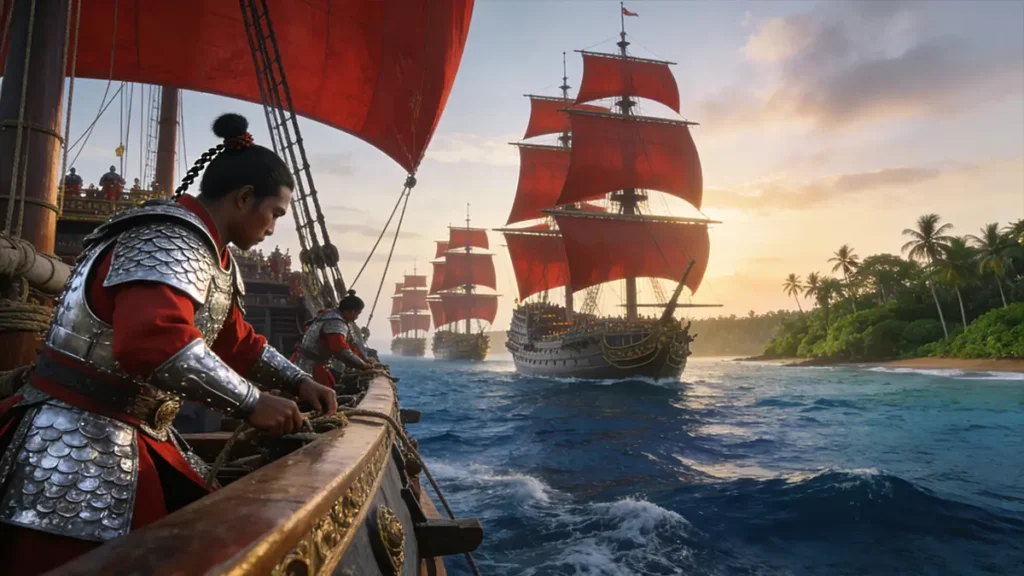
Stage Setting: Pax Minga Clashes with “Pirate Warlords”
To understand this conflict, we must first move beyond the concept of the “tribute system,” which may be unfamiliar to Western readers. Consider it instead as “Pax Minga” (Great Ming Peace)—an international order dominated by the Ming navy, designed to safeguard trade on the high seas.
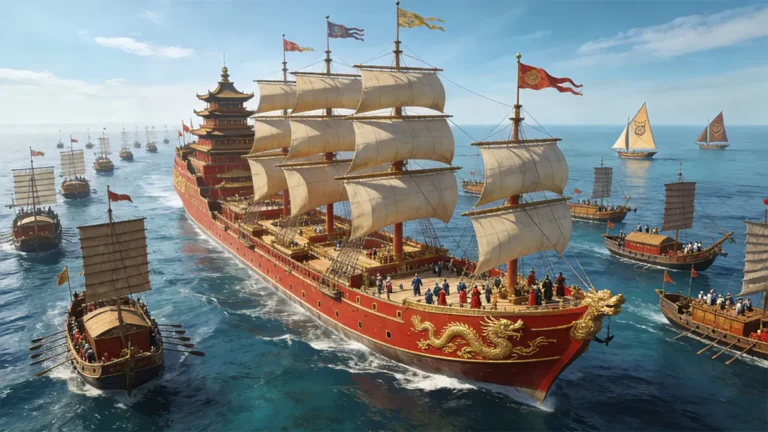
Under this order, Zheng He was not merely a diplomat but an Admiral with independent command authority. His fleet served as the “aircraft carrier strike group” of its era, tasked with clearing obstacles from maritime routes.
Yet, King Alakeshvara, ruler of the Kingdom of Kotte in Ceylon, had no intention of abiding by these rules.
- The Ming Perspective: According to the History of the Ming Dynasty, Alakeshvara “remained stubbornly defiant.” He not only refused to observe diplomatic protocols but also repeatedly extorted passing merchant ships and even attempted to plunder the treasure-laden Ming fleet.
- Local Legends: Sri Lanka’s chronicle, the Rajavaliya, though differing in details, acknowledges that the Kingdom of Kotte was highly militarized and hostile toward outsiders.
In the Western reader’s context, Alakeshvara’s role is starkly defined: he was a “pirate warlord” controlling a vital strategic chokepoint. He exploited his geographical advantage to turn international trade routes into his personal cash cow.
This tension was further complicated by religious factors. Ceylon housed the sacred Buddhist relic, the Buddha’s Tooth Relic. Rumors circulated that the Ming sought to seize this holy object. However, the Galle Trilingual Inscription, now housed in Sri Lanka’s National Museum, provides counterevidence. This stone tablet explicitly records Zheng He’s pre-war funding for temple repairs and offerings of spices.
Stone tablets do not lie: the Ming Dynasty extended an olive branch first. Having made this initial gesture of goodwill, what then provoked the subsequent military conflict?
The Deadly Trap: When Diplomatic Envoys Encountered a “Banquet of Betrayal”
The flashpoint of conflict stemmed from a grave diplomatic betrayal that flagrantly violated international norms.
In 1410, during Zheng He’s third maritime expedition, King Alakeshvara ostensibly invited the Admiral ashore for “friendly negotiations,” but in reality, he had laid a trap. According to detailed accounts in the Ming History: Annals of Ceylon, when Zheng He led a small escort deep inland, Alakeshvara suddenly turned hostile.
He dispatched a massive army—estimated by historical records at around 50,000 troops—to cut off the Ming fleet’s only route back to the coast.
This was a classic strategy of “encirclement” (known in Chinese as weng zhong zhuo bie, or “catching a turtle in a jar”). The Ceylonese plan was clear:
- Surround and annihilate Zheng He’s land detachment.
- Divide forces at sea to plunder the now-leaderless treasure ships.
For Western readers accustomed to chivalry or modern rules of warfare, this act of “luring envoys and stabbing them in the back” crossed a fundamental line. This was precisely the most direct reason why the Ming Dynasty attacked Ceylon: it was not a premeditated conquest, but forced self-defense against a threat to survival.
Facing an enemy five times his size and the constant risk of slaughter, Zheng He faced a life-or-death decision. Should he hold his ground and await reinforcements, or attempt a forced breakout?
Neither. He chose to strike at the heart of the enemy.
Tactical Review: The Miracle of 2,000 vs. 50,000
The ensuing battle stands as one of the most spectacular examples of “special operations” in the 15th century, its audacity capable of astonishing modern military strategists.
Zheng He keenly identified a fatal vulnerability on the battlefield: Alakeshvara had drained the defenses of the royal city of Kotte to encircle him. The nation’s elite forces were concentrated along the coastline, leaving the capital itself virtually defenseless.

This presented a once-in-a-lifetime opportunity—and a colossal gamble.
- Surprise Deployment: Zheng He assembled approximately 2,000 elite soldiers, abandoning heavy siege equipment in favor of light firearms, fire arrows, and dry rations.
- Jungle Infiltration: The force slipped through the tropical jungle under cover of night, bypassing the main Sri Lankan defenses like a dagger plunging straight into the enemy’s heart.
- Technological Superiority: When the Ming forces appeared before the royal city, they demonstrated overwhelming technical dominance. As noted by British sinologist Joseph Needham in Science and Civilisation in China, the Ming army’s firearms vastly surpassed the Ceylonese forces’ cold steel and elephant troops in both range and lethality. In the narrow streets, elephants could not unleash their crushing force; instead, they panicked and disrupted their own formations.
The Ming forces avoided prolonged engagements, fixated on a single objective: the royal palace.
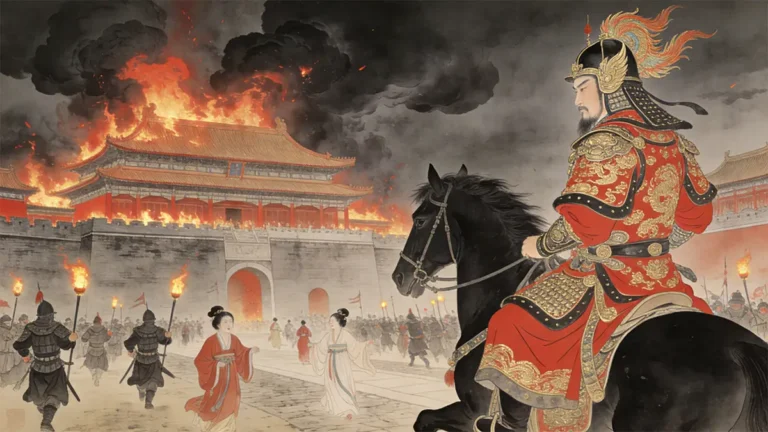
Under the cover of firepower, this two-thousand-strong unit swiftly breached the city gates and stormed the main hall. King Alakeshvara and his royal entourage were captured before they could mount any effective resistance.
News of the king’s capture caused the immediate collapse of the 50,000-strong army besieging Zheng He’s fleet. With their leader taken, continuing the fight held no meaning. What seemed an inevitable crushing defeat was thus reversed into a complete victory within a single day.
But this was only half the story. The true test lay in how to manage the aftermath of victory.
A Clash of Civilizations: Benevolence vs. Colonization
Had this been the script of European colonizers, what followed would typically be the slaughter of cities, plunder of resources, establishment of permanent fortresses, and forced imposition of religious beliefs.
But history took an unexpected turn here.
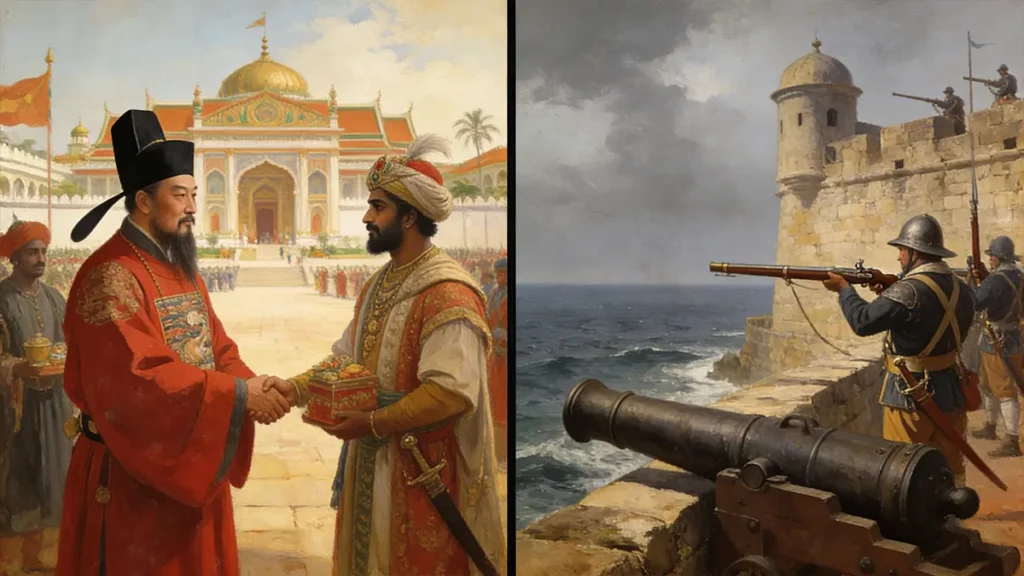
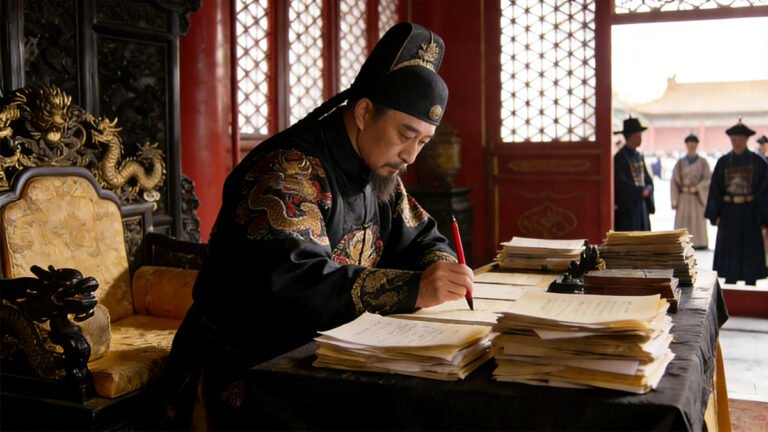
King Alakeshvara was escorted back to Nanjing, the capital of the Ming Dynasty. In the imperial court of the Forbidden City, facing the Yongle Emperor, this former “Pirate King” awaited his sentence. By the standards of the time, execution or life imprisonment would have been reasonable choices.
Yet the Yongle Emperor made a decision that stunned everyone.
The Veritable Records of the Ming Taizong state that the emperor deemed Alakeshvara ignorant and guilty of grave crimes, but not deserving of death, nor should his nation be annihilated. The Ming Dynasty did not occupy a single inch of Ceylon, did not demand exorbitant reparations, and did not even station a single soldier there.
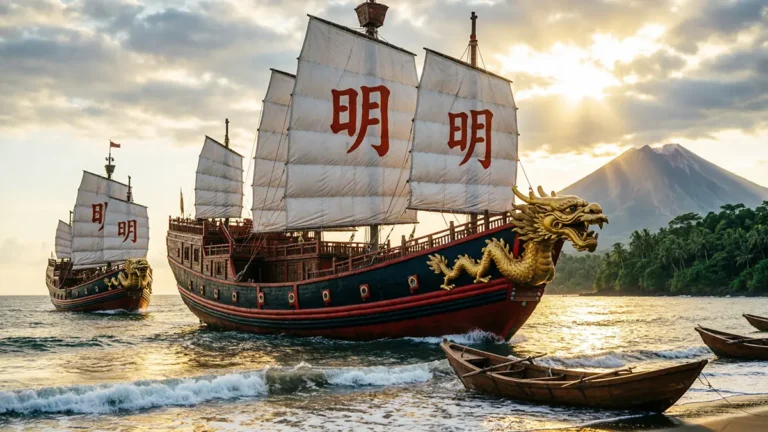
Ultimately, Alakeshvara was released (some historical records state he was deposed but spared his life). The Ming Dynasty assisted the Ceylonese royal family in installing a new, wise, and Ming-friendly monarch—Parakramabahu VI. Subsequently, Zheng He’s fleet packed up and set sail.
This approach of “no colonization, only order” was unique in the world history of that era. We can clearly see the fundamental difference between the Ming model and the later European model through the following comparison:
| Feature | The Ming Model (1411) | European Colonial Model (16th C.+) |
|---|---|---|
| Military Goal | Punitive & Restorative (Restore Order) | Conquest & Extraction (Seize Resources) |
| Post-War Action | Install Proxy & Withdraw | Build Permanent Forts & Garrison |
| Economic Logic | Tribute Trade (Mutual Benefit) | Monopoly & Exploitation |
| Religious Stance | Respect Local Faiths (e.g., Temple Donations) | Forced Conversion |
American sinologist Edward Dreyer, in his work Zheng He: China’s Maritime Expeditions, 1405-1433, commented that this behavior demonstrated the Ming Dynasty’s unique logic of “armed diplomacy”: military force was employed solely to establish rules, not for the sake of domination itself.
This distinction prompts a profound reflection: If the global order of the 15th century had been dominated by the Ming Dynasty, would the world have turned out very different?
The Eternal Enigma of Power and Restraint
Returning to our original question: Why did the Ming Dynasty attack Ceylon?
The answer now becomes exceptionally clear. This was not a war driven by territorial greed, nor a religious zealotry to seize the Sacred Tooth Relic. It was a precise law enforcement operation to safeguard the Maritime Silk Road and strike against a pirate regime.
Through a masterful “decapitation strike,” the Ming Dynasty sent a signal to all powers along the Indian Ocean: peaceful trade would be protected, but any attempt to disrupt the rules would come at a cost.
For today’s global audience, grasping this is crucial. It shatters the simplistic narrative of “inevitable expansionist authoritarianism in the East,” revealing instead an international practice rooted in the philosophy of “the Way of the King.” Zheng He’s fleet was indeed the “aircraft carrier strike group” of its era, possessing devastating power. Yet the manner in which they wielded that power was marked by surprising restraint and rationality.
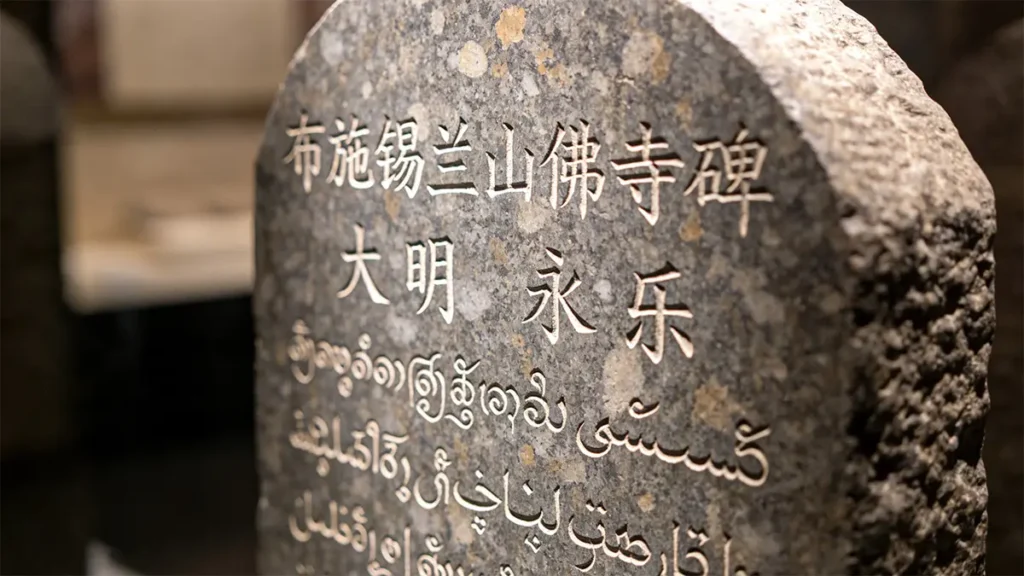
The next time you see that weathered “Stele Commemorating the Donation to the Buddhist Temple on Sri Lanka Mountain” in a museum, or trace Sri Lanka’s location on a map, perhaps you’ll recall that late night. The silhouettes of 2,000 soldiers traversing the jungle not only altered the fate of a kingdom but also left behind a historical enigma: how power and benevolence can coexist.