The Political Landscape of 15th Century Ming Dynasty: Power, Intrigue, and Transformation
Why is the 15th century key to understanding the rise and fall of the Ming Dynasty?
In 1402, Prince Zhu Di of Yan stormed Nanjing, where Emperor Jianwen allegedly immolated himself within the palace. This civil war, known as the Jingnan Campaign, not only altered the succession to the throne but also planted the political seeds that would shape the Ming Dynasty for over two centuries: imperial power must be absolute, yet it cannot function independently. Consequently, emperors continually created proxies—first the civil officials of the Cabinet, later the eunuch faction—and pitted them against each other to maintain their own transcendent status.
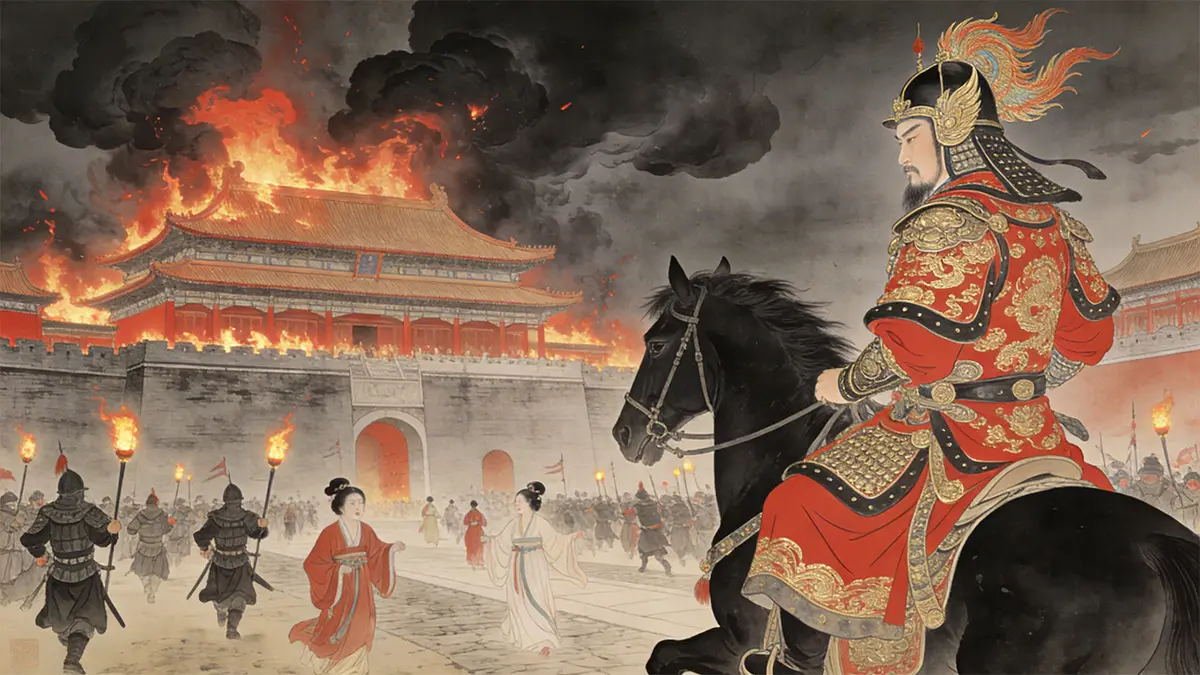
From 1402 to 1500, within a mere 98 years, the Ming Dynasty completed its strategic retreat from being the “Supreme Ruler of the Realm” to fortifying its “Nine Frontier Defenses.” The grand feats of Emperor Yongle’s five personal campaigns against the Mongols and Zheng He’s seven voyages to the Western Seas, alongside the devastating defeat of Emperor Yingzong captured by the Oirat at Tumu Fortress half a century later, appear as a rupture yet share the same origin.
Understanding this era hinges on three questions:
- First, how was power centralized?
- Second, how did palace intrigue become institutionalized?
- Third, how did the state shift from outward expansion to inward defense?
This article eschews enumerating “cultural achievements” to instead delve into the imperial core, examining the institutional choices, personnel struggles, and strategic pivots that determined the nation’s fate. We shall see: the relocation of the capital, maritime exploration, and the rise of eunuchs were not isolated events, but inevitable outcomes under a series of structural pressures.
In short, the 15th-century Ming political structure was a dynamically unstable triangle: the emperor at the apex, leaning left on civil officials (administering affairs through the Cabinet) and right on eunuchs (monitoring internal and external affairs via the Office of Ceremonial Affairs and the East Factory). The relationship among these three components fluctuated dramatically with the monarch’s ability, age, and external crises—the very root of political turbulence.
1: Centralization Projects of the Yongle Era (1402–1424)
1.1 The Legitimacy Crisis and Redefining Imperial Authority
The foremost challenge facing Zhu Di upon ascending the throne was not governance, but legitimacy. As a usurper, he could neither acknowledge the legitimacy of the Jianwen Emperor (which would make him a traitorous subject) nor completely erase his existence (which would strip the “Jingnan” campaign of its moral foundation).
This paradox spurred a systematic historical purge. According to Volume 13 of the Veritable Records of the Ming Taizong, Zhu Di immediately decreed upon ascending the throne: “Abolish the era name of Jianwen. All edicts and decrees issued during the Jianwen era shall be rescinded.” The purge of Jianwen’s former ministers was particularly brutal: Fang Xiaoru was executed along with ten clans (873 people put to death), Qi Tai and Huang Zicheng were subjected to lingchi (slow slicing), and Jing Qing’s “extending the net to the vine” implicated hundreds of families. These were not acts of vengeance but a deliberate project of legitimization—reconstructing history by erasing memory.
The Fairbank Center for Chinese Studies at Harvard University noted that the political atmosphere in the early Yongle era was “permeated with post-traumatic tension,” with the emperor exhibiting extreme sensitivity to any potential dissent (Fairbank & Goldman, China: A New History, 2nd ed., p. 162). This insecurity directly gave rise to two key institutional innovations.
1.2 Institutional Innovation: The Cabinet, the East Factory, and the Relocation of the Capital
The Cabinet: A Decision-Making Mechanism Without a Chancellor
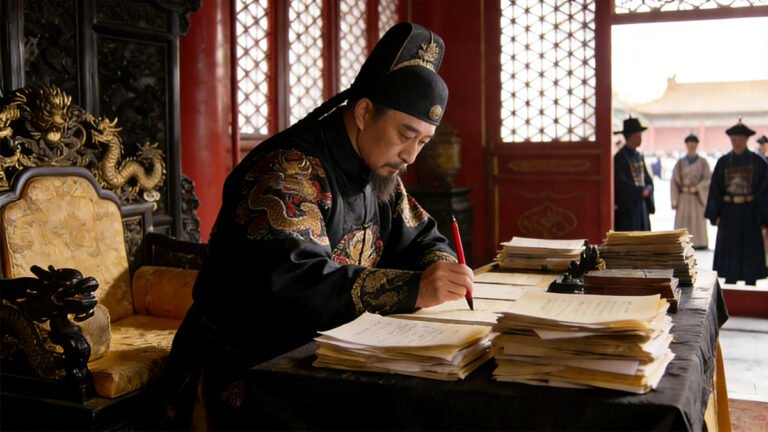
In 1380, Zhu Yuanzhang abolished the Secretariat, ending the millennia-old chancellor system. Yet the state still required governance. Emperor Yongle’s solution was to select low-ranking officials from the Hanlin Academy to serve in the Wenyuan Pavilion, assisting in reviewing memorials. These individuals held no formal titles, being referred to only as “Grand Scholar of a Certain Hall,” yet wielded substantial power due to their proximity to the emperor.
The History of Ming: Official Roles, Volume 1 records: “Upon ascending the throne, the Chengzu Emperor specially selected Xie Jin, Hu Guang, Yang Rong, and others to serve in the Wenyuan Pavilion, participating in state affairs… Yet these Grand Scholars held no rank higher than fifth grade and never exercised sole authority over the Six Ministries.” This design of “authority derived from lowly status” ensured imperial authority remained unchallenged.
By the time Emperor Yongle passed away in 1424, the Cabinet had developed the rudiments of the “drafting and approval” system—where officials drafted imperial responses on the emperor’s behalf, which were then confirmed by the Office of Ceremonial Affairs with the “red seal.” This process became the central battleground for the ensuing two centuries as civil officials and eunuchs vied for influence.
The East Factory: An Instrument of Imperial Surveillance
In 1420, the eighteenth year of the Yongle reign, the “Eastern Factory for Investigating Affairs” (East Factory) was established—initially in Nanjing, before relocating to Beijing following the formal move of the capital in 1421. Its first commander was the eunuch Chen Wu (later granted the name Wang Yan). This marked the first state-level secret service agency in Chinese history led by eunuchs.
The East Factory could arrest and interrogate officials and even commoners without going through the Ministry of Justice or the Censorate. The Wanli Dynasty’s “Great Ming Code” (Volume 165) records: “The East Factory investigated treason, seditious speech, and major crimes, sharing equal power with the Embroidered Uniform Guard.” However, while the Embroidered Uniform Guard belonged to the outer court system, the East Factory reported directly to the emperor. Its true function was not anti-corruption, but monitoring the loyalty of officials to the new regime.
Notably, the East Factory’s establishment in 1420 coincided with the eve of the capital’s relocation to Beijing in 1421. This was no coincidence—Zhu Di understood that moving the capital north to the Mongol frontier meant distancing himself from the southern gentry’s stronghold, necessitating a tighter control system.
Relocating the Capital to Beijing: A Military-First Strategy
In 1421, Emperor Yongle formally relocated the capital to Beijing, demoting Nanjing to a secondary capital. This move fundamentally reshaped China’s political geography.
The relocation entailed immense costs. Huang Renyu estimated that constructing the Forbidden City alone mobilized one million laborers and consumed over 6 million taels of silver—equivalent to one-third of the nation’s annual fiscal revenue at the time (Huang, Taxation and Governmental Finance in Sixteenth-Century Ming China, p. 35). Yet Zhu Di willingly bore this burden, guided by a clear strategic logic: Nanjing, isolated in the southeast, proved inadequate to counter the northern Yuan threat; only by having the “Son of Heaven guard the nation’s gates” could the steppes be intimidated.
The layout of today’s Beijing Forbidden City still reflects this intent: the Three Great Halls face south, backed by the artificially raised Jingshan Hill to guard against northern raids, extending southward to the Temple of Heaven—the entire capital functioning as a military fortress facing the steppes.
In summary, the Yongle era established a highly personalized autocracy: no chancellor, yet a cabinet drafted edicts; no independent judiciary, yet the East Factory administered extrajudicial punishment; ostensibly adhering to Confucian rituals, yet internally reliant on secret police rule. This “institutional contradiction” was precisely the source of political tension in the 15th century.
1.3 Zheng He’s Voyages to the Western Seas: A Legitimization Project, Not a Trade Expedition
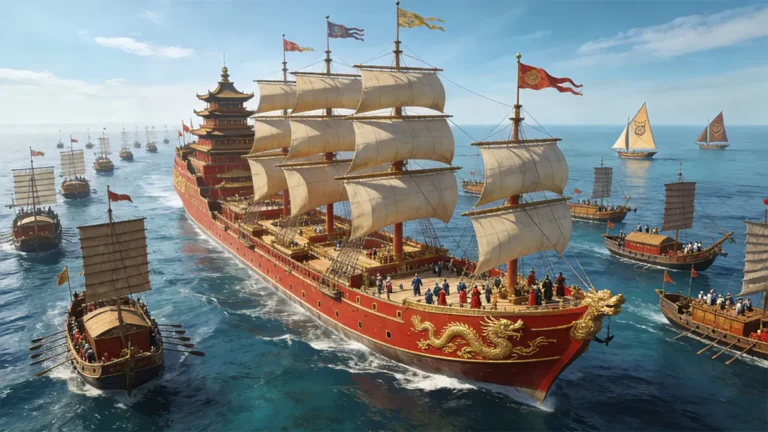
On July 11, 1405, Zheng He set sail from Taicang with 27,800 men aboard 62 treasure ships—the largest ocean-going fleet of the pre-industrial era (data sourced from Ma Huan’s “A Survey of the Ocean’s Shores” and the “Record of the Divine Responses of the Heavenly Princess” stele in Changle, Fujian).
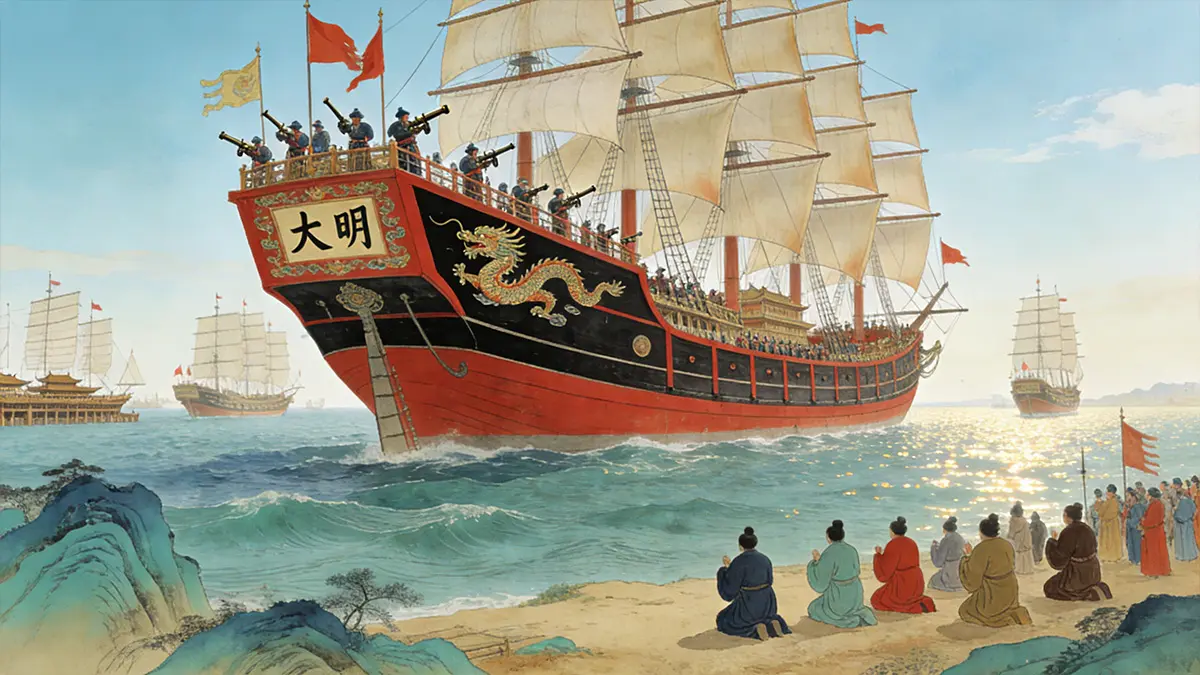
Traditional interpretations emphasize its “peaceful diplomacy” and “trade missions.” However, recent scholarship (e.g., Joseph Needham, Timothy Brook) argues that the primary purpose of these voyages was political legitimization. Emperor Yongle needed to demonstrate to both domestic and international audiences that he was not merely the ruler of China, but the “Supreme Ruler of the World.”
Three pieces of evidence support this:
- First, the fleet carried vast quantities of silk and porcelain as imperial gifts, not for commercial profit. Statistics from the Veritable Records of the Ming Dynasty indicate that foreign gifts during the Yongle era accounted for over 12% of total fiscal expenditures (Brook, The Troubled Empire, p. 89).
- Second, monuments proclaiming the “Emperor’s virtue and authority” were erected at every port of call. Examples include the Galle Stele in Sri Lanka (now housed in the National Museum of Colombo), which declared Ming authority in Chinese, Tamil, and Persian.
- Third, exotic animals like the “qilin” (i.e., giraffe) were brought back to create an auspicious spectacle of “all nations paying homage,” reinforcing the narrative of divine mandate.
Political Objectives of Zheng He’s Maritime Expeditions (Selected Voyages)
| Voyage | Time Period | Main Destinations | Political Events / Purposes | Symbolic Achievements |
|---|---|---|---|---|
| First | 1405–1407 | Java, Sumatra, Ceylon | Suppressed pirate Chen Zuyi; established authority in the South Seas | Seal of the Jiugang Pacification Commission |
| Third | 1409–1411 | Ceylon, Calicut (India) | Captured the Ceylonese king who refused tribute; escorted him to Beijing | Trilingual inscription of Buddhist temple donation in Ceylon |
| Sixth | 1421–1422 | Arabian Peninsula, East Africa | First voyage after capital relocation; showcased authority of the new capital | Presentation of a “qilin” (giraffe) at the Hall of Heavenly Devotion |
Sources: Ma Huan’s “Oceanic Voyages,” the Tianfei Stele in Changle, Fujian, and Levathes (1994).
However, this costly spectacle could not endure. After the seventh voyage concluded in 1433, the Ming Dynasty permanently halted its maritime expeditions. The reasons lay not in technical limitations or lack of will, but in the dual backlash of fiscal constraints and ideological shifts.
1.4 Fiscal Overdraft and Economic Foundations
The Golden Age of Yongle was built upon massive fiscal overdraft.
According to the Ming History: Economic Records, by the end of the Yongle era, the annual revenue of the Imperial Granaries reached approximately 3 million taels of silver, while a single northern military campaign cost 800,000 taels. More critically, the rigid system of in-kind taxation—where peasants paid taxes in rice and wheat and performed labor duties—prevented the government from flexibly allocating resources. When warfare, construction projects, and maritime expeditions advanced simultaneously, local authorities could only impose additional levies—known as the meltage surcharge (“huohao”) and “surplus contributions”—fueling widespread public resentment.
Huang Renyu incisively observed: “Yongle’s policies were heroic, but his fiscal system remained primitive. This mismatch doomed the enterprise to unsustainability.” (Taxation and Governmental Finance, p. 41)
By 1424, when Zhu Di died, the imperial treasury was nearly depleted. His successor, Emperor Hongxi, immediately issued an edict: “Cease the Western Ocean treasure ships, halt the northern campaigns, and reduce construction projects.” This was not a policy shift but a forced contraction following fiscal bankruptcy.
At this juncture, the Ming economy was characterized by: a barter-based fiscal system, labor conscription, and silver yet to achieve full monetization. This pre-modern fiscal framework proved incapable of sustaining global projection, ultimately compelling the state to retreat inward.
2: The Triangular Struggle Between Civil Officials, Eunuchs, and Imperial Authority (1425–1448)
2.1 The Ren-Xuan Era of Good Governance: The Civil Officials’ Fleeting Golden Age
Following the Yongle Emperor’s death, the Hongxi Emperor (1424–1425) and Xuande Emperor (1425–1435) ruled for only eleven years, yet their reigns became celebrated as the “Ren-Xuan Era of Good Governance.” Superficially attributed to “enlightened monarchs,” this era was in fact a rational compromise forced by fiscal collapse.
During Xuande’s reign, the Cabinet gained the “right to draft imperial edicts”—proposing responses to memorials from the Six Ministries before presenting them to the emperor for his personal approval. As recorded in Volume 45 of the Veritable Records of the Ming Xuanzong Emperor, in the fifth year of Xuande (1430), “Yang Shiqi and others of the Cabinet were ordered to draft responses to memorials, which the Emperor personally reviewed and approved,” marking the Cabinet’s formal entry into the core of power.
The “Three Yangs” (Yang Shiqi, Yang Rong, Yang Pu) used Neo-Confucianism as their banner, constructing a moral discourse system to constrain imperial authority. Harvard scholar Benjamin Elman observed: “By the 1430s, literati scholars began transforming Neo-Confucianism from a philosophical system into a tool for political practice.” (Elman, A Cultural History of Civil Examinations, p. 132)
The defining political feature of this era was a transient equilibrium: imperial authority was constrained by the moral discourse of the literati, while eunuchs had yet to interfere in governance.
2.2 Maritime Ban and National Strategic Retreat
In 1433, the same year Zheng He returned from his voyage, the imperial court issued an edict: “Dissolve the Maritime Trade Office and prohibit private maritime vessels.” The Ming Dynasty formally abandoned its maritime ambitions.
Three primary reasons underlay this decision:
- First, the fiscal burden proved unsustainable. Li Qingxin’s History of Overseas Trade in the Ming Dynasty estimates that each maritime expedition incurred net expenditures exceeding 500,000 taels of silver, while tribute gifts often surpassed the value of received tributes by tenfold.
- Second, opposition from the civil officialdom. Literati scholars viewed maritime voyages as “a drain on the national treasury,” fearing merchants would disrupt the established order of scholars and farmers.
- Third, a strategic shift northward. The rise of the Oirat Mongols strained northern defenses.
Thus, the Ming Dynasty retreated from its role as architect of a “world order” to a mere sentinel guarding the “Nine Frontier Garrisons.”
2.3 Emperor Yingzong’s Accession and Wang Zhen’s Autocratic Rule
In 1435, the nine-year-old Emperor Yingzong ascended the throne, and eunuch Wang Zhen of the Office of Ceremonial Affairs swiftly filled the power vacuum.
Wang Zhen’s rise relied on two factors:
- First, the young emperor’s dependence. Yingzong addressed him as “Master,” obeying his every command.
- Second, institutional loopholes. The Office of Ceremonial Affairs held the authority to “red-stamp” edicts, enabling it to amend or even veto drafts prepared by the Cabinet.
The History of Ming: Biographies of Eunuchs records: “Zhen’s power swayed both court and country; princes and nobles addressed him as ‘Father-in-Law.’” More critically, he controlled the Imperial Garrison (the three major military camps within the capital), merging military authority with the inner court.
Though the Six Ministries (Personnel, Revenue, Rites, Military, Justice, Works) nominally remained the administrative core, their ministers could not submit memorials without Wang Zhen’s prior approval. The formally intact civil service system had been hollowed out by eunuchs.
2.4 Fiscal Austerity and the Deterioration of State Capacity
Despite being hailed as a “golden age,” the Renxuan era saw no fiscal recovery. The Veritable Records of Emperor Yingzong of Ming documented that by the early Zhengtong reign (1436), grain reserves in the Imperial Granaries sufficed for only six months. The military farming system collapsed due to land consolidation, leaving border garrisons severely short of provisions.
This predicament laid the groundwork for Wang Zhen’s adventurism—he needed a decisive victory to legitimize his rule.
3: Cataclysm: The Tumu Incident and the Crisis of Legitimacy (1449–1457)
3.1 Frontier Crisis and Policy Failures
During the 1440s, the Mongol Oirat tribe unified the northern steppes under the leadership of Esen and launched frequent incursions southward. Yet the Ming intelligence apparatus severely malfunctioned—the Embroidered Uniform Guard and East Factory were preoccupied with internal strife, while frontier commanders falsified military reports.
In the spring of 1449, Esen invaded under the pretext of “reducing tribute horse prices.” Wang Zhen strongly advocated for the emperor to lead the campaign personally, seeking to replicate the glory of the Yongle Emperor’s northern expeditions and consolidate his own authority.
3.2 The Tumu Pass Incident
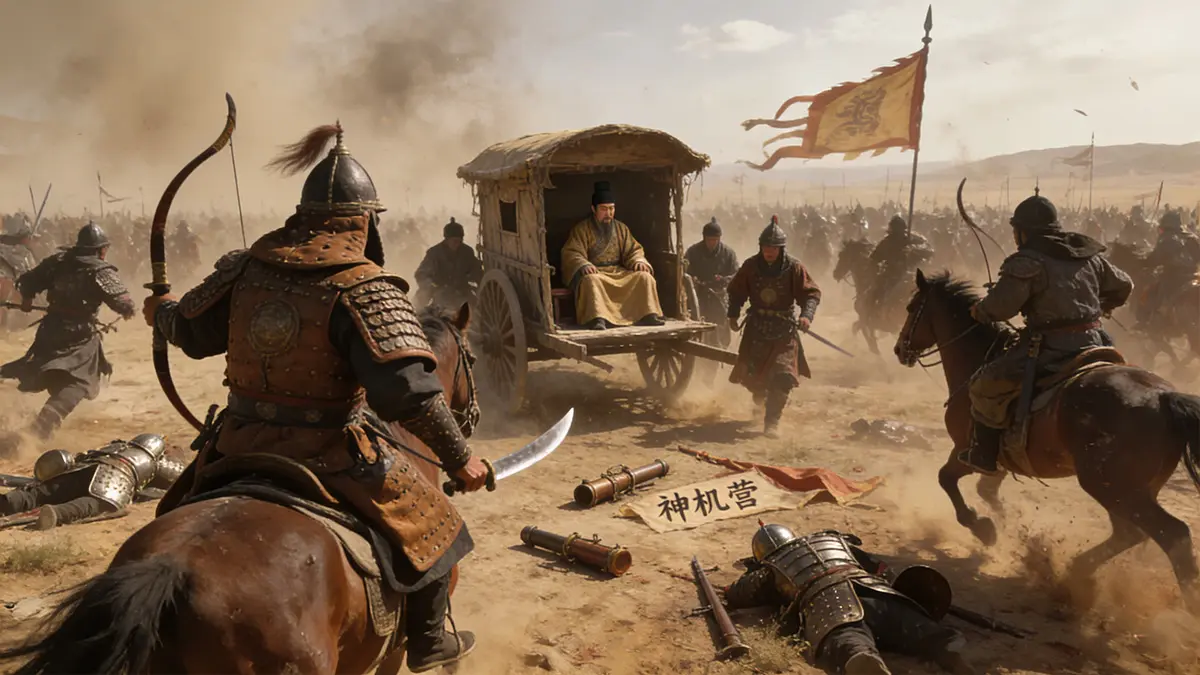
In July 1449, Emperor Yingzong led an army of approximately 200,000 troops into battle. Decision-making was entirely dominated by Wang Zhen, with the Cabinet and the Ministry of War excluded.
On August 15, the Ming forces were surrounded at Tumu Fortress (present-day Huailai, Hebei), cut off from water supplies, and suffered total annihilation. Emperor Yingzong was captured, and Wang Zhen was executed. The elite “Three Elite Divisions” of the imperial guard were virtually wiped out, dealing a devastating blow to the Ming dynasty’s military strength.
3.3 The Defense of Beijing and the Seizure of the Imperial Throne
Amidst the crisis, Yu Qian, Vice Minister of War, installed Emperor Yingzong’s younger brother Zhu Qiyu as Emperor Jingtai and organized the defense of Beijing. Yu bypassed the Office of Ceremonial Affairs to directly command the troops, effectively implementing emergency governance by the civil official faction during the imperial power vacuum.
In 1457, Emperor Yingzong—held under house arrest for seven years—launched the “Palace Coup” with support from Xu Youzhen, Shi Heng, and eunuch Cao Jixiang, successfully restoring his throne. Yu Qian was executed for “treasonous conspiracy.”
The Palace Coup fundamentally represented retaliation by the eunuch-military alliance against the civil official faction. Thereafter, eunuch interference in governance became normalized.
Notably, although the Ming dynasty fell in 1644, the three major flaws that emerged in the mid-15th century—eunuch interference in governance, fiscal rigidity, and strategic passivity—had already planted the seeds of its structural decline.
4: Transformation Complete: From Expansionist Empire to Defensive State (1460–1500)
4.1 The West Bureau and the Zenith of Secret Police Rule
In 1477, Emperor Xianzong established the West Bureau, headed by eunuch Wang Zhi. Its authority far surpassed that of the East Bureau, granting it the power to arbitrarily arrest officials of the fourth rank and below. The History of Ming records: “Wherever the West Bureau went, officials fled in panic.” Secret police politics reached its zenith.
4.2 The Hongzhi Revival: An Illusion of Institutional Stabilization?
In 1487, Emperor Xiaozong ascended the throne, abolished the West Bureau, dismissed Wang Zhi, and promoted capable ministers like Liu Jian and Xie Qian—an era known as the “Hongzhi Revival.”
Yet beneath this veneer of integrity, institutional rigidity had taken deep root: the Cabinet had become a mere procedural machine, the Six Ministries operated with inefficiency, and fiscal reforms had stalled.
4.3 The Political Legacy of the Late 15th Century
By 1500, the Ming Dynasty had undergone three major transformations:
- Power Structure: Imperial authority relied on eunuchs to counterbalance civil officials, creating a vicious cycle;
- National Strategy: The empire had completely abandoned maritime ventures, focusing solely on the Great Wall defense line;
- Fiscal System: The commodity economy rendered the tax-in-kind system unsustainable, creating a crisis-ridden foundation.
Though the Six Ministries retained their formal functions, since Wang Zhen’s rise, the Office of Ceremonial Affairs had interfered in decision-making through the “red-stamp approval” system, while the East and West Factories monitored officials’ words and deeds. The institutionally intact administrative system was, in reality, effectively neutered by the inner court.
References
Denis Twitchett & Frederick W. Mote (eds.), The Cambridge History of China, Vol. 8
Ray Huang, Taxation and Governmental Finance in Sixteenth-Century Ming China, SDX Joint Publishing Company, 2001
Timothy Brook, The Troubled Empire: China in the Yuan and Ming Dynasties, Harvard University Press, 2010
Veritable Records of the Ming Dynasty (Ming Shilu) and History of Ming (Ming Shi), punctuated and collated editions published by Zhonghua Book Company