Why is Zheng He worshipped in Thailand?
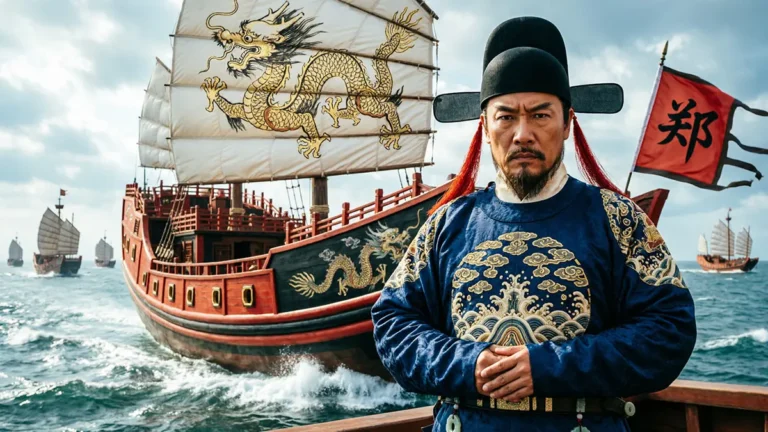
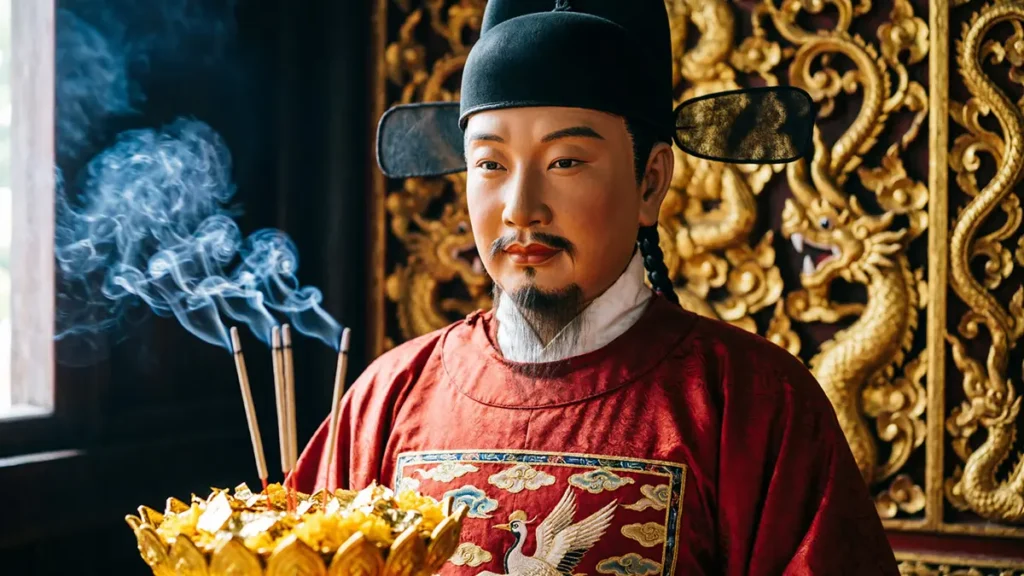
On the banks of a bustling canal in Bangkok’s Thonburi district stands an unassuming shrine. Though there are no grand temples here, incense burns continuously throughout the year. Devotees press their palms together in the traditional Thai “Wai” gesture, yet the prayers they recite are for safe voyages. The object of their worship is clad in the ceremonial robes of an ancient Chinese civil official and wears a black silk hat, yet the name inscribed on the altar is not that of a typical Chinese deity, but rather Chao Mae Thapthim (Ruby Goddess) in Thai.
What is intriguing is that this idol, revered by locals as a female guardian deity, is actually modeled after Zheng He—the famous Chinese Muslim eunuch and commander of the Ming Dynasty fleet—who lived 600 years ago. How did a male eunuch from the East evolve into a local goddess who protects all living beings in the Theravada Buddhist Kingdom of Siam? This is not merely a historical remnant, but a cultural fusion experiment spanning six centuries.
To unravel this mystery, we must first return to the era when giant ships cut through the waves and examine what exactly this fleet left behind on this land.
The Arrival of the Treasure Ships: When the Ming Dynasty Met Ayutthaya
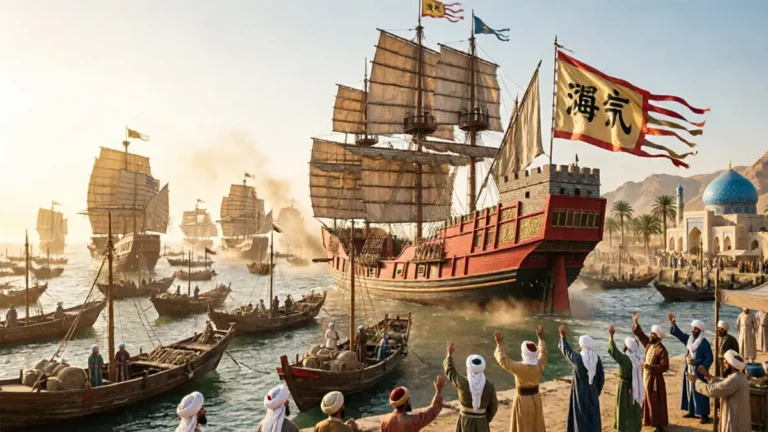
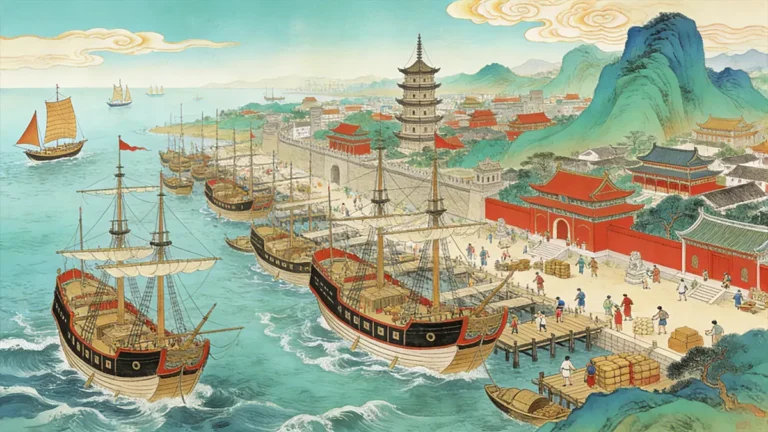
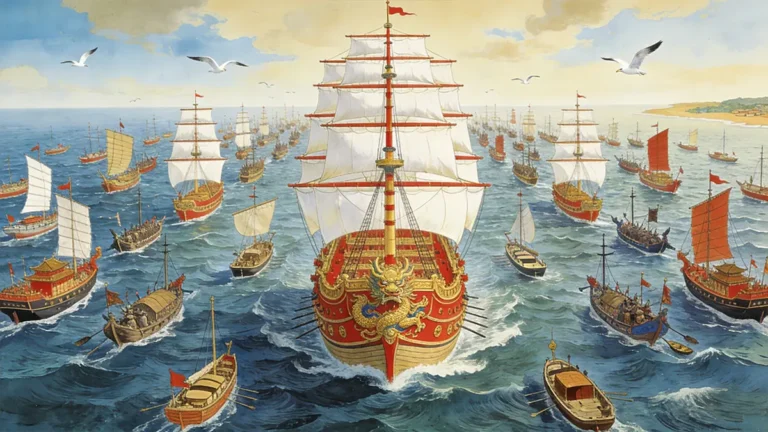
Historical archives provide us with a solid starting point. According to the Veritable Records of the Ming, Zheng He’s fleet visited the Kingdom of Siam (present-day Thailand) at least four times in the early 15th century, between 1405 and 1433.
These were not mere passing visits. Ayutthaya, the capital of Siam at the time, was one of the most prosperous trade hubs in Southeast Asia. Ma Huan, a Ming-era interpreter who accompanied the fleet, described the customs and culture of Siam in detail in his work The Overall Survey of the Ocean’s Shores (completed in 1451), specifically noting the locals’ welcoming attitude toward Chinese merchant ships. Ma Huan wrote that trade between the two sides was conducted fairly, “much to the delight of the locals,” and that no military conflicts occurred, unlike those in Sri Lanka or Sumatra.
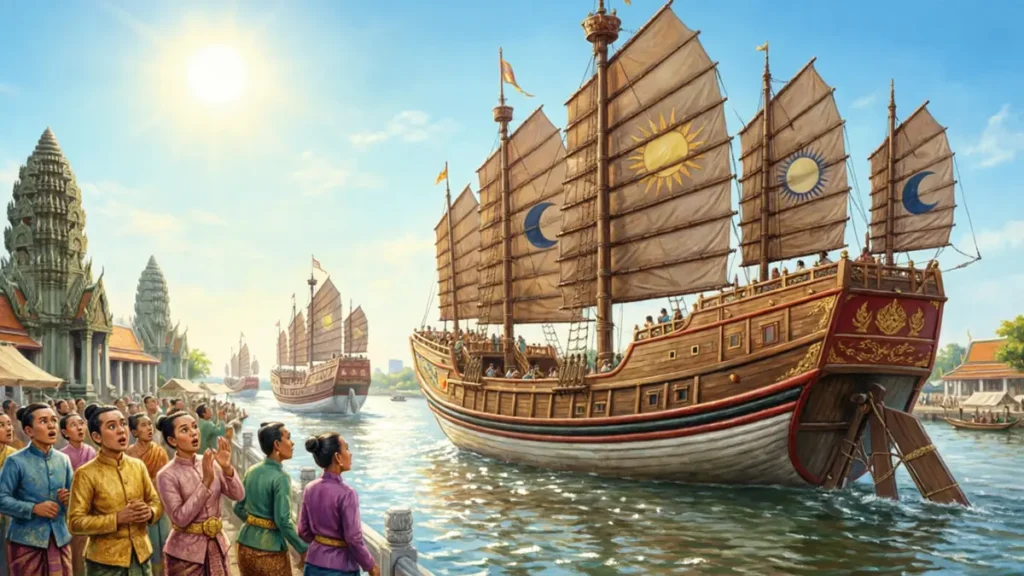
Western sinologists such as Joseph Needham also noted in Science and Civilisation in China that Zheng He’s fleet carried large quantities of porcelain and silk in exchange for Siamese sappanwood, pepper, and precious spices. This trade was not merely an exchange of goods but also a political signal: the Ming Dynasty sought stability within the tribute system, not colonial occupation. For the Ayutthaya Kingdom, which had long been threatened by the neighboring Khmer Empire, Zheng He’s massive fleet effectively served as a “ballast” for regional security.
This initial encounter, rooted in peace and prosperity, laid the foundation of trust for his later deification. But trust alone does not build altars. How, then, did a respected foreign envoy slowly ascend into the realm of the divine in the local imagination?
A Transformation of Identity: From Historical Figure to Guardian of the Waters
In the folk belief systems of Southeast Asia, death is not an end, but rather a new beginning. Those who possessed great power in life, met an untimely death, or made significant contributions to their communities are often venerated as “deities” (Chao Por/Chao Mae).
Here, Zheng He’s identity underwent a remarkable transformation. As a navigator, he naturally held dominion over “water.” For the residents of the Chao Phraya River Delta, the river was both a source of life and a place of danger. Storms, reefs, and pirates constantly threatened merchant ships. The unbeatable sailing record of Zheng He’s fleet gradually became mythologized through word of mouth. People began to believe that even after his death, this commander continued to rule the waters and could calm the storms.
It is worth noting that in Thailand, Zheng He’s image does not exist in isolation but overlaps with the faith in the Chinese sea goddess “Mazu.” Over the course of its long transmission, the general public often fails to distinguish the specific details of historical figures. The image of Mazu as a female sea goddess is deeply ingrained in the public consciousness, and Zheng He’s role as a protector of seafarers overlaps significantly with that of Mazu.
Thus, a unique cultural phenomenon emerged: in certain Thai-Chinese communities, while Zheng He’s role was preserved, his image gradually shifted toward that of a female deity or simply merged with local goddess legends. This is why the veneration of Zheng He in Thailand occasionally adopts the form of a goddess. It is not a misinterpretation of history, but rather a manifestation of folk religious pragmatism—devotees do not care whether he is male or female, only whether he is efficacious.
This fusion is particularly evident in specific deities, especially the mysterious “Ruby Goddess.”
This transformation of gender and identity is not a figment of the imagination; in a specific temple in Bangkok, we can find the most direct evidence.
The Mystery of the Ruby Goddess: Chao Mae Thapthim
In Bangkok folklore, Chao Mae Thapthim (Lady of the Ruby) is a highly influential deity. There are several accounts of her origins, and one widely circulated story links her directly to Zheng He.
According to oral history from the older generation of the local Chinese community, during his visit to Siam, Zheng He presented the local king with a precious ruby, or perhaps averted disaster through a miracle involving the ruby during a crisis. Over time, this memory became distorted: the person who gave the gem became the personification of the gem itself, or the deity guarding it.
At the San Chao Mae Thapthim shrine in Bangkok’s Thonburi district, although the principal deity is known as the “Ruby Goddess,” the accompanying statues often bear distinct features of Ming Dynasty officials. Even more intriguing is the theory put forward by some scholars that the term “Thapthim” (ruby) here may be a metaphor for the red porcelain or coral treasures brought by Zheng He’s fleet, items that were believed at the time to possess the power to ward off evil spirits.
In religious anthropology, this phenomenon is known as a “syncretic deity.” It is neither purely Buddhist nor purely Taoist, but rather a blend of Thai animism, Mahayana Buddhist bodhisattva devotion, and Chinese folk ancestor worship. Here, Zheng He is no longer merely the eunuch carrying out the emperor’s orders; he has become a symbol representing the mysterious power and protection from the East.
If you visit these temples in person, you will find the details of the rituals even more intriguing.
Stepping into these shrines, you will discover that the worship practices of the devotees perfectly illustrate what true “cultural fusion” really means.
At the Ceremony: When Thai Wai Meets Chinese Offerings
Observing the rituals for Zheng He in Thailand is like witnessing a silent cultural dialogue.
In the relevant temples in Bangkok or Ayutthaya, you rarely see purely Chinese-style kneeling worship. Instead, the vast majority of worshippers—including many of purely Thai descent—press their palms together, raise their hands above their heads, and perform the standard Thai wai. Yet the offerings on the altar are distinctly Chinese: whole roasted pigs, red rice wine, and even Chinese pastries.
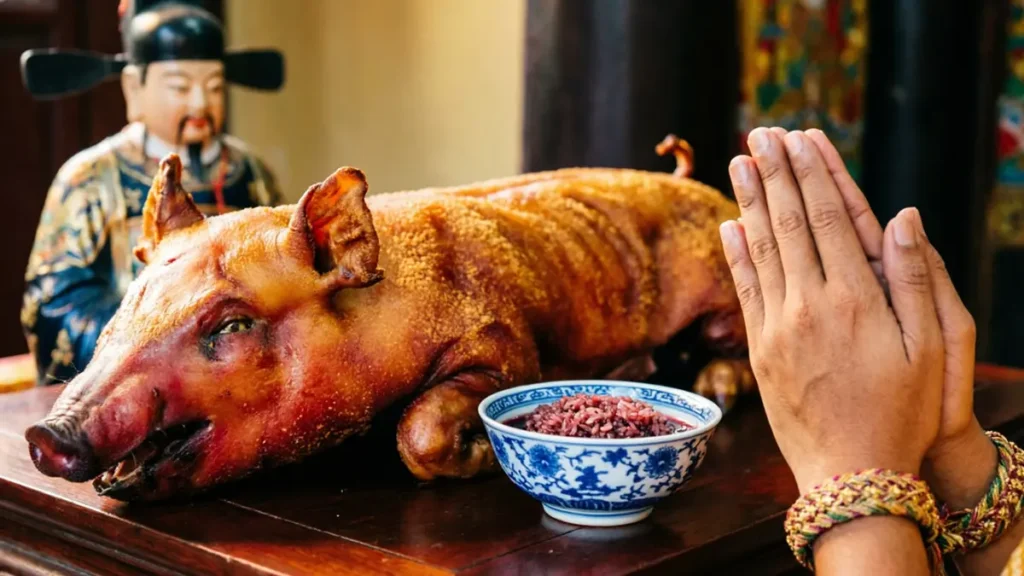
This combination of “Thai rituals with Chinese offerings” is highly symbolic. It signifies that Zheng He (or Chao Mae Thapthim) has transcended ethnic boundaries. He is no longer merely the patron saint of the Chinese community but has been incorporated into Thailand’s indigenous pantheon.
The details reveal the true essence. At the fortune-telling stations in some temples, you’ll find the fortune slips printed in both Thai and Chinese. The fortune-teller may explain the omens in Thai, but the allusions they cite come from Romance of the Three Kingdoms or the tales of Zheng He’s voyages to the West. Even more intriguing is that many visitors come to seek fortune for business prosperity or safe voyages at sea—a trans-temporal echo of the trade boom brought by Zheng He’s fleet 600 years ago.
According to informal records from Thailand’s Fine Arts Department, temples blending Chinese elements are densely concentrated along the Chao Phraya River, particularly in ancient port cities. They serve not only as places of worship but also as community hubs, preserving the shared memories of local Chinese and Thai residents.
This harmonious coexistence did not happen overnight; it is the result of centuries of intermarriage, trade, and cultural exchange.
Today, Zheng He’s legacy in Thailand serves as a quiet reminder: true civilizational exchange leaves behind not scars of conflict, but memories of shared reverence.
Historical Echoes in a Global Context
Taking a broader view, the veneration of Zheng He is by no means an isolated phenomenon. Traces of Zheng He and legends about him can be found in Malacca, Semarang in Indonesia, and even along the East African coast. However, in Thailand, this veneration exhibits the most distinctive local characteristics.
Western sources also provide indirect corroboration of this. In his travelogue, Simon de la Louvère, a 17th-century French diplomat on a mission to Siam, recorded with surprise that the Siamese held “the Chinese” in special esteem, a reverence partly rooted in memories of the might of ancient Chinese fleets. Although he did not directly mention the deification of Zheng He, he keenly captured the deep cultural trust underlying Sino-Thai relations.
Today, with the advancement of modern connectivity projects like the Belt and Road Initiative and the construction of the China-Thailand Railway, Zheng He’s story has taken on new relevance. He is no longer merely a historical symbol, but an early exemplar of connectivity and peaceful cooperation. For Western tourists and history enthusiasts, exploring the traces of Zheng He in Thailand is not only a journey of discovery but also an opportunity to understand the complex interactions within Asia.
If you’ve developed a keen interest in this history and wish to explore these hidden temples for yourself, the following information may be helpful.