The Four Yi Guan: The Ming Dynasty’s Official Bureau of Translators and Interpreters
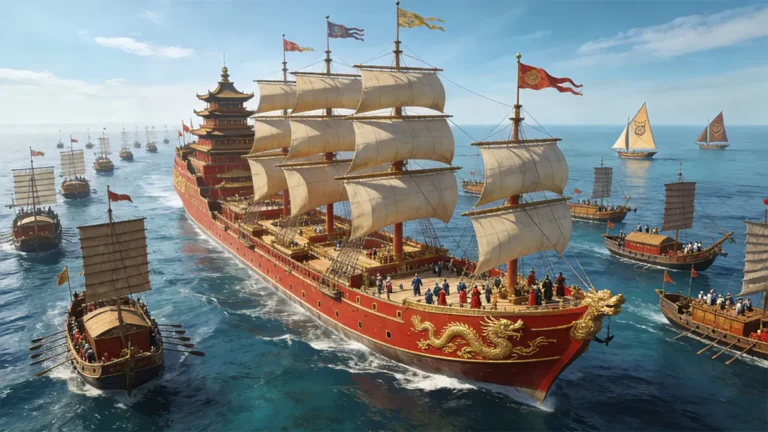
Imagine this: in 1405, a fleet of 62 massive ships anchored at Calicut on the west coast of India. An envoy dressed in Ming dynasty official robes stepped onto the shore. Facing local princes speaking Malayalam, he remained unflustered—for behind him stood a group of highly trained translators. These were not hastily recruited interpreters, but official translators from a special agency located near the Forbidden City in Beijing. This agency was the Siyi Guan, effectively the Ming dynasty’s Bureau of Translators.
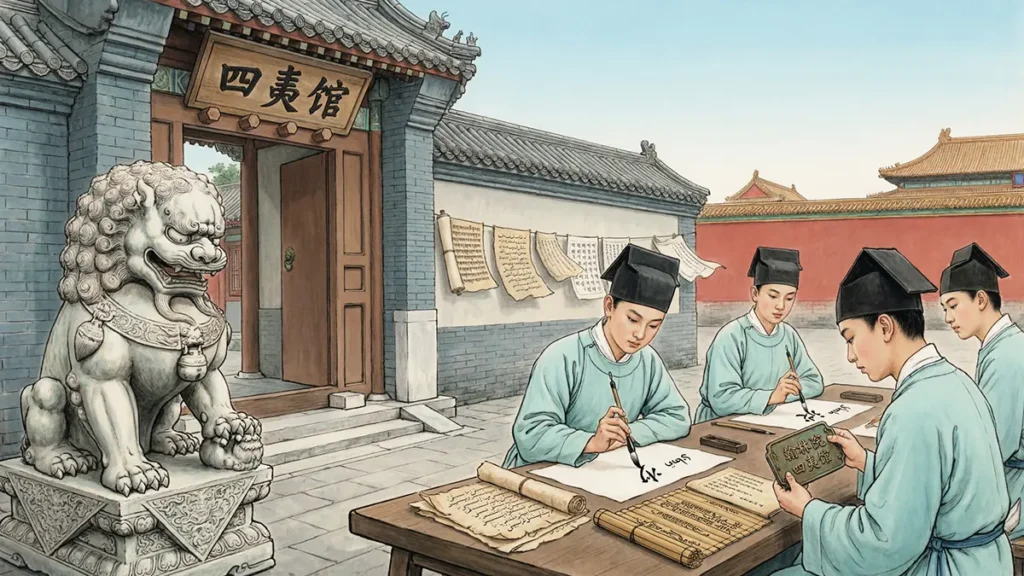
To understand how the Ming Dynasty managed a tribute network spanning East Asia, Southeast Asia, Central Asia, and even East Africa, it is not enough to simply look at Zheng He’s nautical charts. What truly kept this system running were language, documentation, and institutional frameworks—and this was precisely the core mission of the Siyi Guan. Next, we will unveil this little-known yet crucial “operating system” of the empire.
What Was the Siyi Guan? A Name Misunderstood
The Siyi Guan was established in the fifth year of the Yongle era (1407) by personal order of the Ming Emperor Chengzu, Zhu Di, and was directly administered by the Hanlin Academy. Its official functions are clearly recorded in the History of the Ming: Treatise on Official Duties: “The Siyi Guan: translation apprentices master foreign languages and scripts to manage tribute relations.” (History of Ming, Vol. 74)
The term “Yi” in its name often confuses modern Western readers. In fact, within the political context of 15th-century China, “Yi” was not a pejorative term but rather a geographical concept derived from the Book of Rites, referring broadly to non-Han peoples in the four directions surrounding the Central Plains—similar to the Latin term gentes externae (foreign peoples). As Timothy Brook, former director of the Joseph Needham Research Institute at the University of Cambridge, noted in The Troubled Empire: “The Ming dynasty’s ‘Tianxia’ order depended on the institutionalized recognition of difference, rather than cultural assimilation.” (Brook, The Troubled Empire: China in the Yuan and Ming Dynasties, Harvard University Press, 2010, p. 112)
Therefore, translating “Siyi Guan” as a “Bureau for Barbarians” is a serious misinterpretation. A more accurate understanding is “Bureau of Translators”—a central institution specifically responsible for handling multilateral diplomatic language affairs. This is the standard rendering used in authoritative academic works like The Cambridge History of China.
So, how exactly did this institution operate? Its day-to-day work was far more sophisticated than its name might suggest.
Eight Divisions, One Hundred Officials, One Thousand Volumes: The Operational Mechanism
The Siyi Guan was not a single department, but a complex comprising eight language-specific divisions. According to the Regulations of the Four Foreign Languages, revised during the Wanli era, these eight divisions were: the Mongolian Division, the Jurchen Division (Manchu-Tungusic), the Tibetan Division, the Persian Division, the Chagatai Turkic Division, the Dai Division, the Burmese Division, and the Thai Division. (See the facsimile edition of the Regulations of the Siyi Guan, held by the National Library of China)
Each division was staffed with several “translation apprentices”—official trainees. They were typically selected from students at the Imperial Academy or local Confucian schools, aged between 15 and 25, and had to pass rigorous tests of linguistic aptitude. Once selected, they underwent years of intensive, closed-door training: they were required not only to master spoken language but also to become proficient in the corresponding writing systems, and even to study local etiquette and customs.
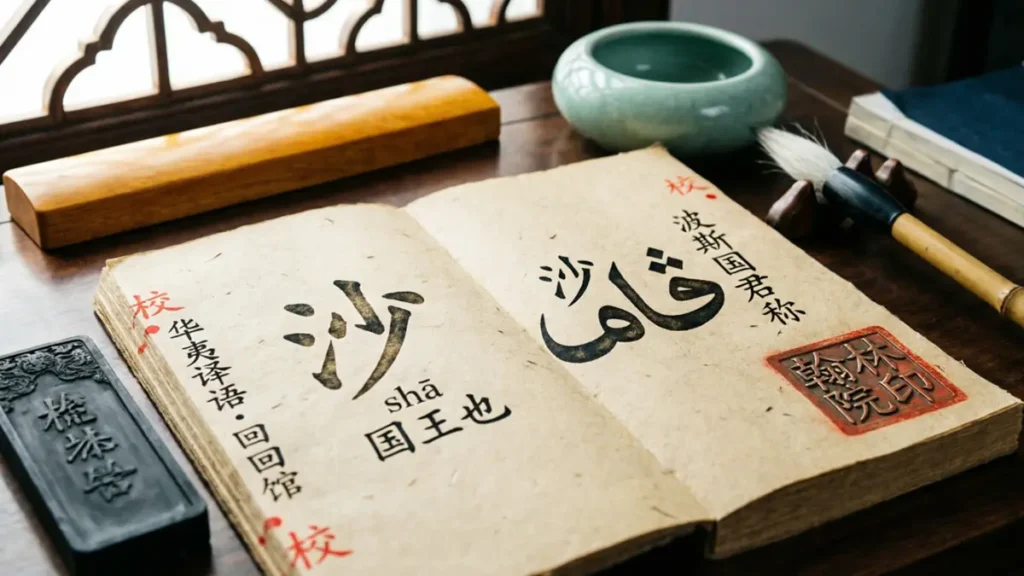
One of their core outputs was a series of dictionaries titled Hua-Yi Yiyu (Dictionary of Chinese and Foreign Terms). The earliest extant version is housed at the National Palace Museum in Taipei; one page displays the Chinese phonetic transcription “Sha” and its definition for the Persian word “Shah” (king). (Digital archive of Hua-Yi Yiyu from the National Palace Museum, Taipei) These manuals served not only as translation tools but also as tangible repositories of Ming-dynasty diplomatic knowledge.
More importantly, the Siyi Guan bore the heavy responsibility of two-way document translation. Incoming diplomatic documents (“laiwen”) submitted by foreign delegations had to be translated into Chinese by the corresponding division and submitted to the Ministry of Rites; the emperor’s edicts were then translated back into the original language by the same division, sealed with the imperial jade seal, and returned to the envoys. The entire process was subject to strict deadlines—typically no more than ten days—failure to meet which would result in punishment for the officials involved.
This highly institutionalized translation system ensured the accuracy and authority of information transmission as the Ming Dynasty handled affairs involving hundreds of tributary states. By contrast, European nations of the same period had not yet established permanent diplomatic translation institutions. It was not until the late 16th century that Spain established the “Casa de la Contratación” in Seville, which served a similar function, but its scale and systematic nature fell far short of the Siyi Guan.
However, the significance of the Bureau of Translators extended far beyond the technical level. It was, in fact, the nerve center of the Ming Dynasty’s “world order.”
The Invisible Pillars of Globalization 1.0
In the 15th century, the world was quietly becoming interconnected. While the Portuguese were still groping for a route around the Cape of Good Hope, the Ming Dynasty had already established official relations with more than 120 states through the tribute system (Source: The Chan’s Great Continent: China in Western Minds, Jonathan D. Spence, Yale University Press, 1998, p. 23).
The Siyi Guan served as the linguistic interface for this vast network. Without it, even if Zheng He’s fleet had reached East Africa, it would have been unable to conduct effective negotiations with the sultans of Malindi or Mombasa; without it, Tibetan lamas, Muslim merchants from Central Asia, and kings from Southeast Asia would have been unable to obtain legitimate diplomatic status at the Forbidden City.
Interpreters did more than convert words. In Calicut, Malacca, and Hormuz they were the ones who explained who Zheng He was—an imperial envoy entitled to ceremonial respect, an admiral with two hundred ships behind him, and, in the ports of the Indian Ocean, a fellow Muslim and a hajji. How each ruler read that identity determined how the fleet was received.
It is worth noting that the functions of the Bureau of Translators had long transcended mere language conversion. It also served as an intelligence-gathering station. During the translation process, apprentices would record the words, deeds, attire, and details of tribute offerings of the delegation members, compiling reports such as the “Records of the Customs of the Four Regions” for reference by the Ministry of War and the Ministry of Rites. Such institutionalized cross-cultural observation was extremely rare in the pre-modern world.
From a global historical perspective, the Siyi Guan represented a unique form of governance wisdom: achieving multi-ethnic co-governance through standardized translation. This stood in stark contrast to the language assimilation policies later implemented by European colonial empires. As Harvard historian Philip Kuhn observed: “The resilience of the Chinese Empire stemmed in part from its institutional capacity to accommodate difference.” (Kuhn, Origins of the Modern Chinese State, Stanford University Press, 2002)
So, what remains today of this institution that once underpinned the diplomatic order of half of Asia?
Legacy: From the Forbidden City to Modern Diplomacy
After the Qing Dynasty entered the Passes, the Siyi Guan was reorganized into the “Huitong Siyiguan” (Combined Bureau of Interpreters and Translators) in the first year of the Shunzhi reign (1644), continuing to perform similar functions until the establishment of the modern Ministry of Foreign Affairs (Zongli Yamen) in the late 19th century. Its institutional roots profoundly influenced China’s diplomatic language management system for centuries to come.
Today, when you see students studying Persian or Burmese at Beijing Foreign Studies University, in a sense, they are carrying on the spiritual legacy of the Siyi Guan. And in the globalized 21st century, the role of the Bureau of Translators has never been more crucial—whether it’s the simultaneous multilingual release of United Nations documents or the localization strategies of multinational corporations, all are driven by the enduring need for precise cross-linguistic communication.
The story of the Ming Bureau of Translators reminds us that true global influence stems not only from fleets or trade, but even more so from those who, though unsung, convey meaning with precision. Zheng He’s treasure ships will eventually decay, but the bridges built by language can span the ages.