When Bengal Sent a Qilin: Decoding the Mythical Gift from Saif al-Din Hamza Shah
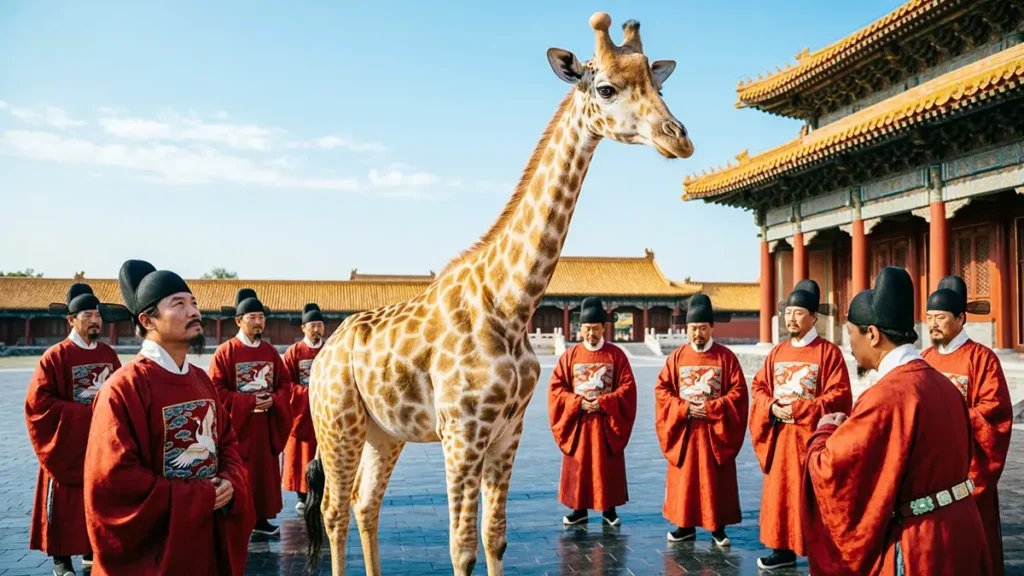
On September 20, 1414, the air seemed to stand still in front of the Hall of Supreme Harmony in the Forbidden City in Beijing. A diplomatic delegation from South Asia slowly entered the square, followed by a creature that left everyone present breathless: it had the body of a deer, the tail of an ox, the hooves of a horse, and a fleshy horn growing from its head. When officials from the Ministry of Rites tremblingly uttered the words “qilin,” the entire Ming Dynasty erupted in excitement. For the Yongle Emperor—the third ambitious ruler of the Ming Dynasty, who had just seized the throne through the “Jingnan Campaign” (a brutal civil war, 1399–1402)—this was not merely an auspicious sign, but irrefutable proof of his divine mandate. However, this creature, revered as a divine beast, was in fact a giraffe from East Africa. It was a meticulously planned diplomatic gamble by the Sultan of Bengal, Sayfuddin Hamza Shah. This gift exchange across the Indian Ocean unveiled a little-known chapter of strategic maneuvering within the global trade networks of the early 15th century.
Key Facts: A Brief Overview of the “Qilin Incident” of 1414
- Date: September 20, 1414 (recorded in the Ming Shilu).
- Gift: A giraffe (Giraffa camelopardalis), mistaken for the mythical qilin.
- Giver: Sayfuddin Hamza Shah, Sultan of the Bengal Sultanate (present-day Bangladesh/West Bengal, India).
- Recipient: Emperor Yongle (Zhu Di), who had just relocated the capital to Beijing.
- Outcome: Bengal secured extensive trade privileges, and the emperor’s legitimacy was temporarily consolidated.
- Key Takeaway: This is a classic case of information asymmetry, where relations between the Bengal Sultanate and the Ming Dynasty were strengthened through cultural translation rather than military force.
Before delving into this incredible journey, we must first understand: Why would a Muslim sultan be willing to participate in the enactment of a Confucian myth?
Why Did the Muslim Sultan Play the “Confucian Card”?
In the early 15th century, the Sultanate of Bengal was at the height of its economic power. Historian R.C. Majumdar notes in A History of Bengal that the region controlled more than 30 percent of the global textile market at the time. However, Sultan Saifuddin Hamza Shah faced constant threats from neighboring countries on the Indian subcontinent. Desperate for a powerful ally, he turned his gaze eastward.
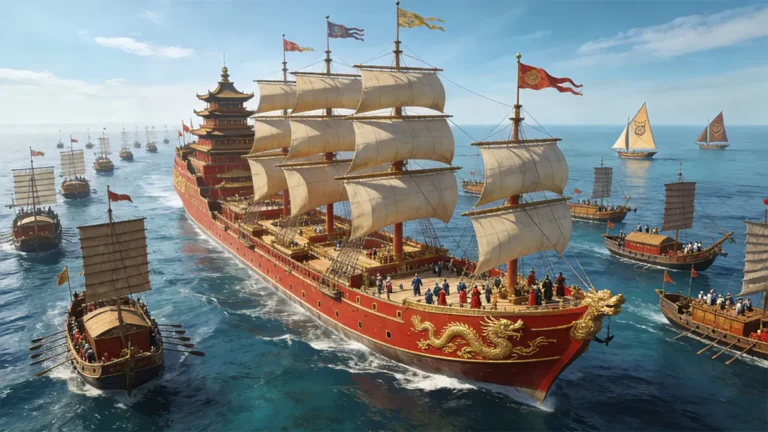
At that time, China, under the rule of the Yongle Emperor, was projecting its power across the globe. Between 1405 and 1433, the emperor launched seven large-scale maritime expeditions led by Zheng He. These voyages were not merely for exploration but served as political tools to enforce the “tributary system.” Under this system, foreign rulers acknowledged the emperor’s supremacy in exchange for protection and lucrative trade privileges.
Hamza Shah realized that sending ordinary commodities like cotton or sugar would not guarantee special treatment. He needed something that would directly appeal to the emperor’s psychological needs. Having seized the throne, the Yongle Emperor desperately sought divine validation. By presenting a “qilin,” the sultan was not merely sending an animal; he was handing the emperor a ready-made political victory.
This strategic alliance defined the unique nature of relations between the Bengal Sultanate and the Ming Dynasty, transforming a biological curiosity into a geopolitical asset. But acquiring the animal was only the first step; delivering it alive to Beijing was a logistical nightmare.
Logistical Feats: How Did They Transport a 1.2-Ton Giant in the 15th Century?
The journey began on the East African savanna, likely near what is now Kenya or Somalia. Adult giraffes can stand up to 5.5 meters tall and weigh approximately 1.2 tons. Moving such a massive creature required a supply chain comparable to a modern engineering feat.
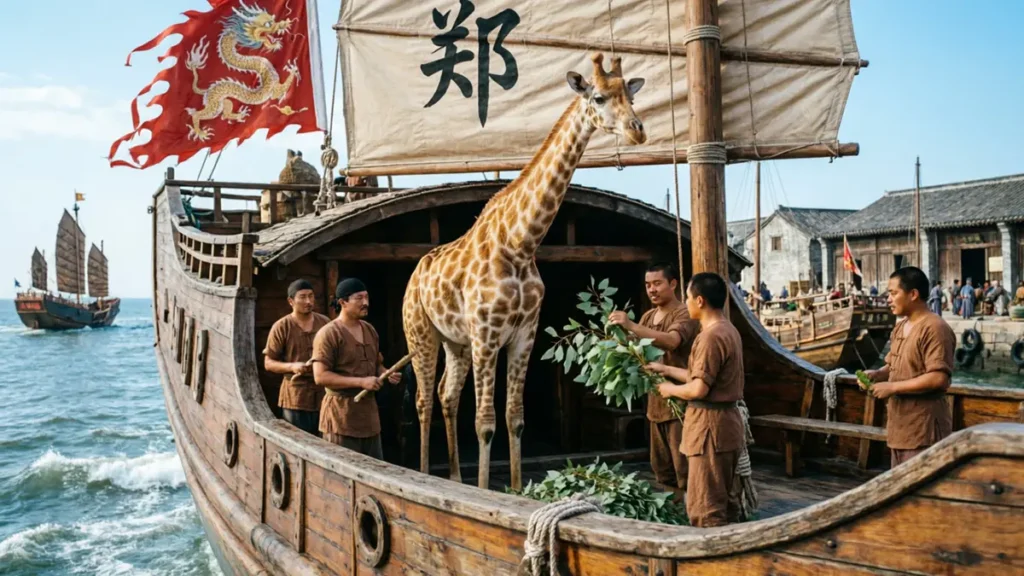
First, Arab merchants captured the young giraffe and transported it in a reinforced wooden crate to the port of Mombasa. From there, it boarded a large dhow and crossed the seas to reach Bengal. Upon arrival in Chittagong (the main port of the Sultanate of Bengal), the animal was “refitted” for the long journey to China.
A 15th-century manuscript in the collection of the National Museum in Dhaka describes the specially constructed vessel built for this leg of the journey. The ship was over 20 meters long, with a lowered deck and a roof reinforced with silk and straw to withstand storms. The crew included dedicated veterinarians and keepers to ensure the giraffe’s survival.
- Daily Consumption: The animal required 50 kilograms of specific acacia leaves and 20 liters of fresh water each day.
- Duration: The sea voyage from Bengal to Fujian, China, took approximately six months.
- Risk Factors: Historically, the mortality rate for large animals on such voyages exceeded 60%, making this a high-risk undertaking.
When the ship finally docked in Quanzhou, the giraffe was transferred to a royal barge for the final leg of its journey to Beijing. Its survival was a testament to Bengal’s maritime expertise, but the real challenge lay on land: how to convince the Chinese court that this African mammal was, in fact, a Chinese deity.
Cultural Translation: When Zoology Meets Political Propaganda
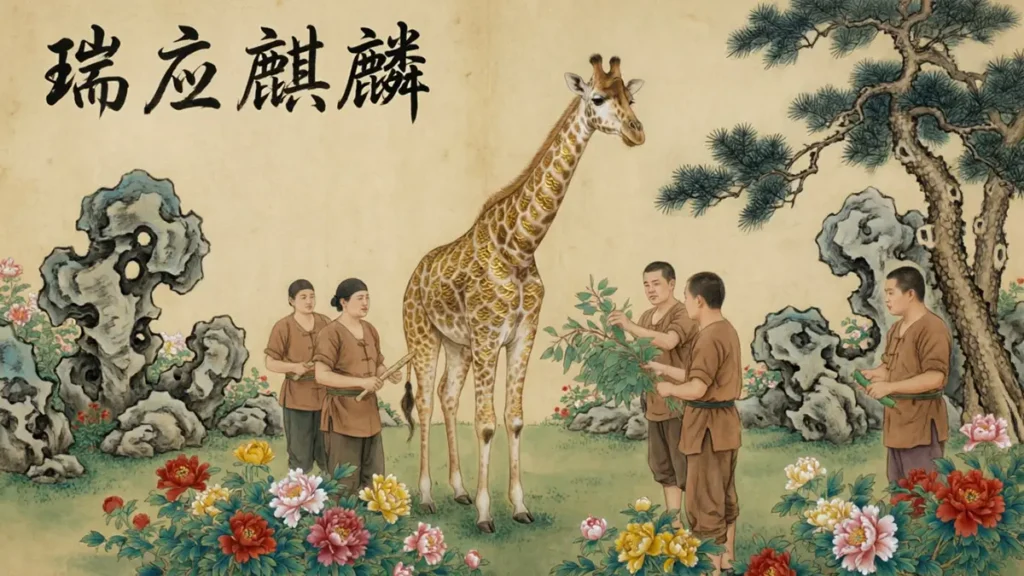
As soon as the giraffe arrived in Beijing, the process of “cultural translation” began immediately. Court painters were summoned to document the event, resulting in Shen Du’s famous painting The Auspicious Qilin. Now housed at the Philadelphia Museum of Art, this painting serves as primary evidence of that historic moment.
Note the artist’s dilemma: although the spots were rendered as scales to align with mythological conventions, the giraffe’s long neck and ossicones clearly betrayed its African origins. This is a masterpiece of political propaganda disguised as zoology.
Scholars such as Yang Rong and Hu Guang swiftly composed the Ode to the Auspicious Qilin. They deliberately ignored the giraffe’s biological reality. Instead, they mapped its features onto ancient Confucian texts: emphasizing the deer-like body, ox-like tail, and single horn, while its true African characteristics were downplayed or reinterpreted.
This was not a lie in the modern sense at the time, but a necessary fiction. Admitting it was merely a “giraffe” (or “Zulafa,” as Arab merchants called it) would have stripped the emperor of his divine mandate. Calling it a qilin, however, validated his rule. The court collectively agreed to suspend disbelief, prioritizing political stability over scientific accuracy.
While myths were being woven in the Golden Hall, merchants were calculating profits and losses in the marketplace. The “qilin” was expensive, but the return on investment was staggering.
The Economic Ledger of “Qilin” Investments
Western historians often mistakenly believe that the tribute system was merely a display of vanity. In reality, it functioned like a meticulously structured trade agreement. The Ming Dynasty adhered to a policy often summarized as “generous giving, modest receiving” (known as hou wang bo lai), meaning that the value of gifts bestowed upon foreigners far exceeded the value of the tribute items they brought.
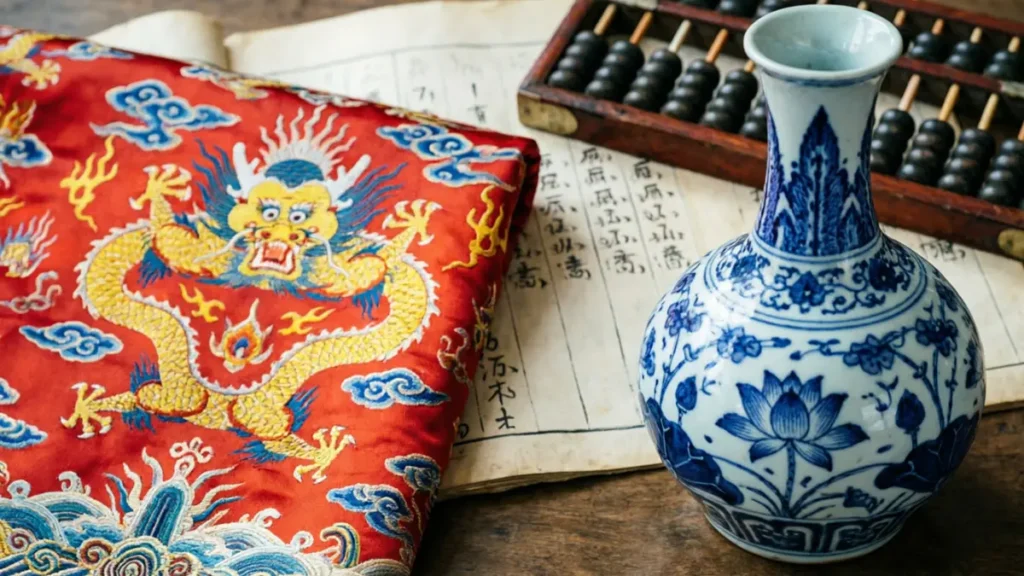
For the Bengali mission, the accounts looked roughly as follows:
The Economic Ledger of the “Qilin” Investment:
Costs:
- Acquiring and capturing giraffes in East Africa.
- Six months’ worth of specialized feed (50 kg per day) and fresh water.
- Marine insurance (against storms and disease).
- Salaries for veterinarians, keepers, and sailors.
Returns:
- Fine Silk: The “hard currency” of the Indian Ocean, which could be resold in Bengal and India for substantial profits.
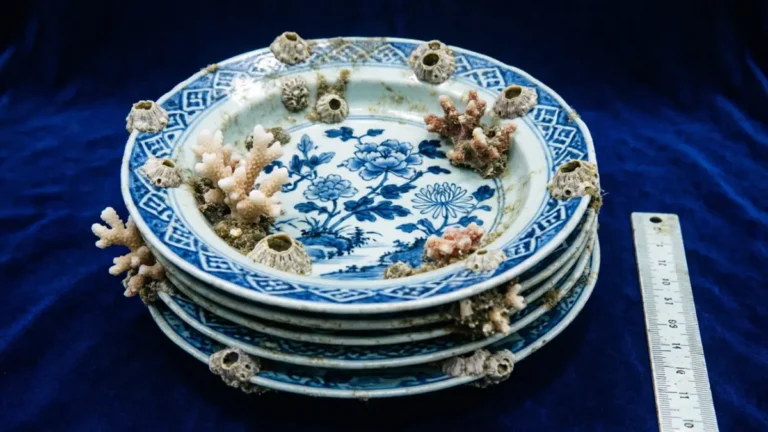
- Blue-and-White Porcelain: A luxury item highly sought after in Islamic markets, commanding extremely high prices.
- Direct Monetary Grants: Silver ingots and copper coins bestowed by the emperor.
- Duty-Free Trade Status: Official permission for Bengali ships to enter Chinese ports duty-free for several years.
Historian Louise Levathes notes in her book When China Ruled the Seas that Zheng He’s fleet was essentially a state-sponsored commercial enterprise. Sultan Hamza Shah fully understood this. By capitalizing on the emperor’s appetite for myth, he secured a monopoly on trade privileges that no other nation could rival. This economic pragmatism explains why relations between the Bengal Sultanate and the Ming Dynasty remained so robust for decades, surpassing many other diplomatic ties of the time.
However, myths have an expiration date, and the magic of the qilin eventually began to fade.
The End of a Myth and the Dawn of Globalization
By the mid-15th century, the illusion began to shatter. As more giraffes entered China via various trade routes—brought by envoys from Malindi and other East African nations—the novelty gradually wore off. Court records began to use the transliterated term “Zulafa” instead of the sacred “Qilin.” The animal was no longer a unique sign from heaven, but merely another exotic import.
At the same time, the political climate in Beijing shifted. Following the “Tumu Crisis” of 1449 (in which the emperor was captured by Mongol forces), the Ming court turned inward. Costly maritime expeditions were halted, and the tribute trade was viewed as a financial burden rather than a source of glory. The giraffe that had once shaken the court and the country died quietly in the imperial gardens, its legacy reduced to a few paintings and dry official records.
Nevertheless, the story of the 1414 qilin remains a powerful lens through which to view early globalization. Preceding Columbus by nearly 80 years, it reveals a world in which Africa, Asia, and the Middle East were already deeply interconnected. An African animal, captured by Arabs, gifted by a Bengali Muslim ruler, and interpreted by Chinese Confucian scholars—this single event encapsulates the complexity of premodern international relations.
Today, as we view Shen Du’s painting in Philadelphia, we see more than just a case of mistaken identity. We witness two great civilizations—Islamic Bengal and the Confucian Ming Dynasty—negotiating peace through the power of imagination. Saifuddin Hamza Shah may not have known he was creating a 600-year-old enigma, but his gift reminds us of an eternal truth: in cross-cultural diplomacy, a shared narrative is often more valuable than cold, hard facts.
Think about this:
If you were a modern leader trying to break into a new market, what kind of “mythical gift” would you offer? Would it be a groundbreaking technology, a rare cultural artifact, or something else entirely? Feel free to share your thoughts below.