The Naval Might of the Ming Dynasty: Cannons, Crossbows, and Beyond
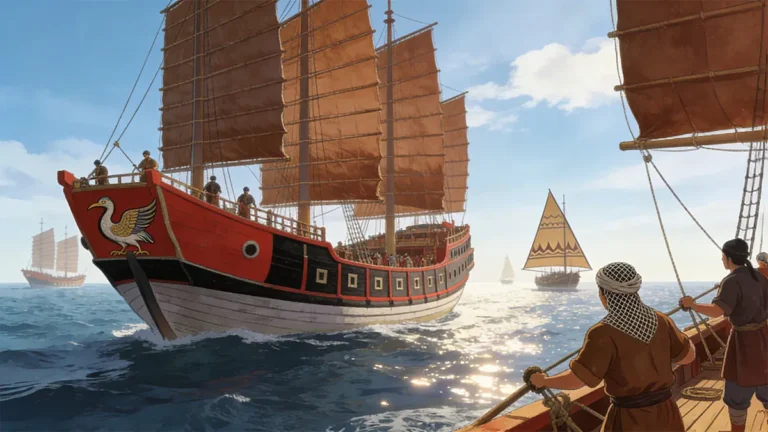
If the Indian Ocean of the 15th century had a “maritime police force,” its members wore neither the crimson of Portugal nor the turbans of the Ottomans—but the imperial uniforms of the Ming Dynasty, distinguished by the flying fish insignia reserved for elite naval personnel.
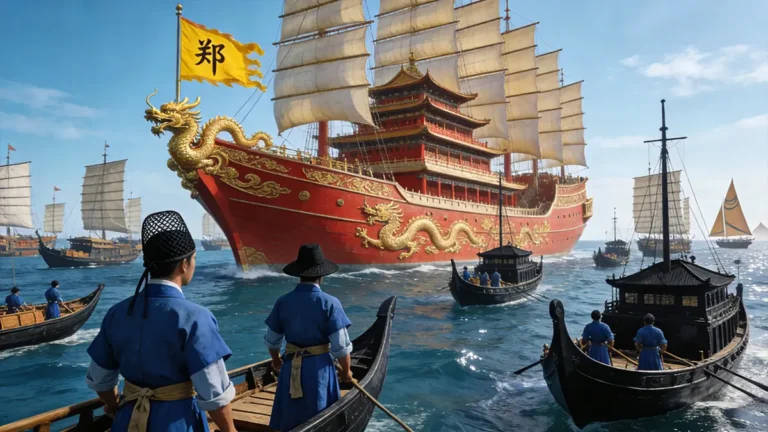
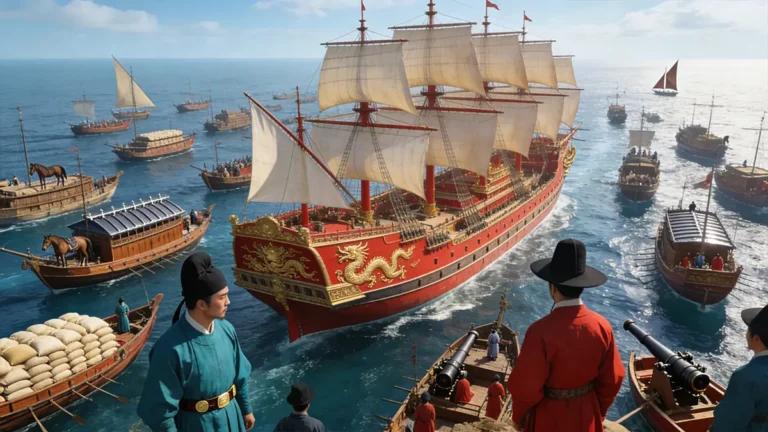
This was no exaggeration. From Hormuz to Malacca, merchants, envoys, and even pirates recognized the authority of Zheng He’s fleet. Between 1405 and 1433, this armada undertook seven grand voyages across the Western Pacific and Indian Ocean. Its scale, logistical precision, and technological sophistication far surpassed anything Europe would produce for another century. Yet unlike Columbus or Vasco da Gama, Zheng He’s mission was not conquest or commerce alone—it was to project a vision of order: a maritime world centered on the Ming court, upheld through a blend of overwhelming force and ritual diplomacy.
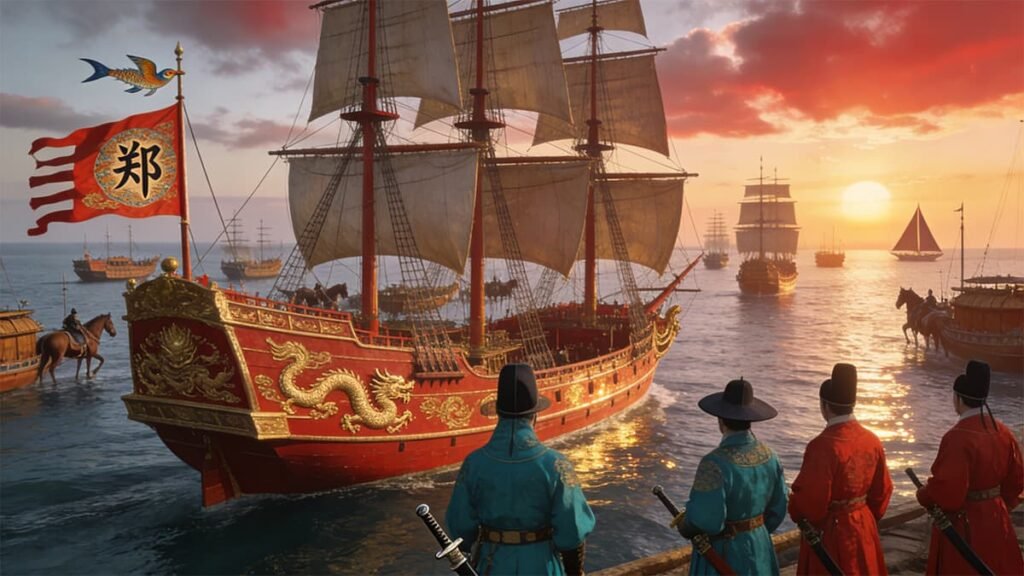
Today, many Western readers still assume China’s premodern navy was little more than “wooden boats with sails.” But archaeological finds and Ming military manuals tell a different story. The Ming Navy was not only the largest naval force of the 15th century—it was also the first to systematically integrate gunpowder weapons, melee arms, and advanced ship design into a cohesive fighting system. Its true innovation lay in combining destructive firepower with tactical discipline, achieving regional dominance without building a single colony.
To understand how, we begin with a weapon Portuguese sailors called the “fire-breathing dragon.”
It was neither myth nor legend, but a battlefield-tested device recorded in the Wubei Zhi (Treatise on Military Preparedness). The next section reveals how the Ming redefined naval combat through gunpowder.
From “Fire Dragons” to Folangji: A Silent Artillery Revolution
In 1521, off Tuen Mun near Guangdong, Portuguese ships clashed with Ming coastal forces. João de Barros, the royal chronicler of Portugal, wrote in his Décadas da Ásia that Chinese warships launched “rockets that rose into the sky and then burst forth dozens of flaming arrows—like a dragon breathing fire.” This matches the Huolongchushui (“Fire Dragon Emerging from Water”) described in the Wubei Zhi: the world’s earliest known shipborne multi-stage rocket.
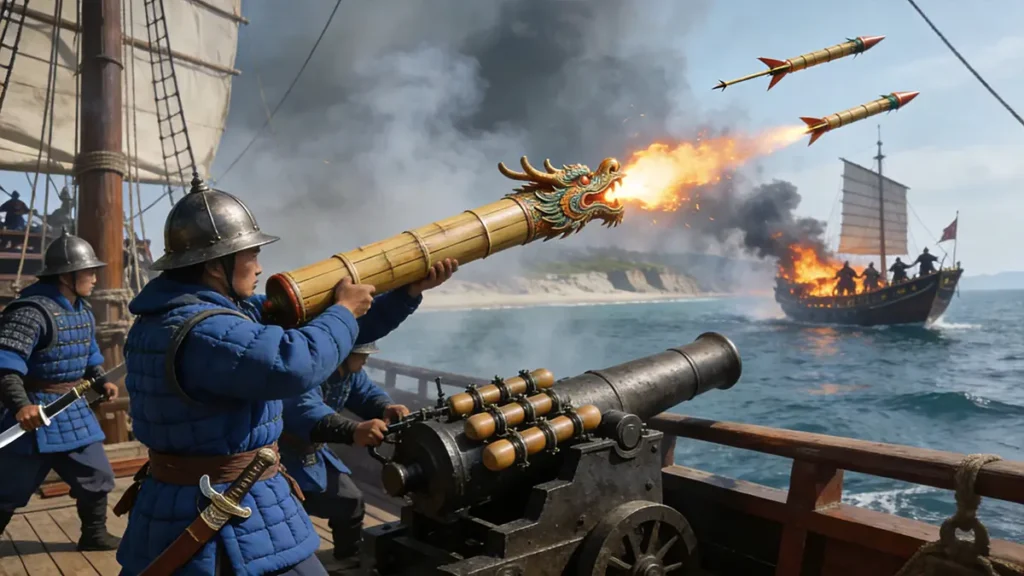
But this was only the opening act. The real transformation came with the Folangji cannon, a breech-loading artillery piece likely introduced via Ottoman or Portuguese traders in the 1520s. The Ming swiftly reverse-engineered and standardized it. By 1560, General Qi Jiguang—a hero of the anti-piracy campaigns—wrote in his Jixiao Xinshu (New Treatise on Military Efficiency): “Each war junk shall carry four Folangji cannons with nine pre-loaded breech chambers, enabling rapid, uninterrupted fire.”
Because the chambers were loaded in advance, crews could swap them in seconds—achieving a rate of 3–4 rounds per minute. This dwarfed the firing speed of contemporary European muzzle-loaders, which required lengthy reloading after each shot.
The data confirms it. Joint research by the Royal Armouries Museum and China’s National Museum shows that by the 1550s, Ming Folangji cannons had an effective range of about 500 meters. While shorter than the British Saker’s 800 meters, their speed made them devastating in the close-quarters chaos of naval boarding actions. Crucially, Ming foundries cast these guns in iron—not expensive bronze—enabling mass production. This was military industrialization before the term existed.
This capacity for rapid adaptation explains why the Ming Navy could still defeat Wokou pirates and repel early European incursions well into the late 16th century. Yet artillery alone didn’t win sea battles. On deck, an older technology remained indispensable.
Why did Ming sailors continue to rely on crossbows in the age of gunpowder? The answer lies in the brutal reality of hand-to-hand combat at sea.
Precision on the Decks: Why the Repeater Crossbow Endured
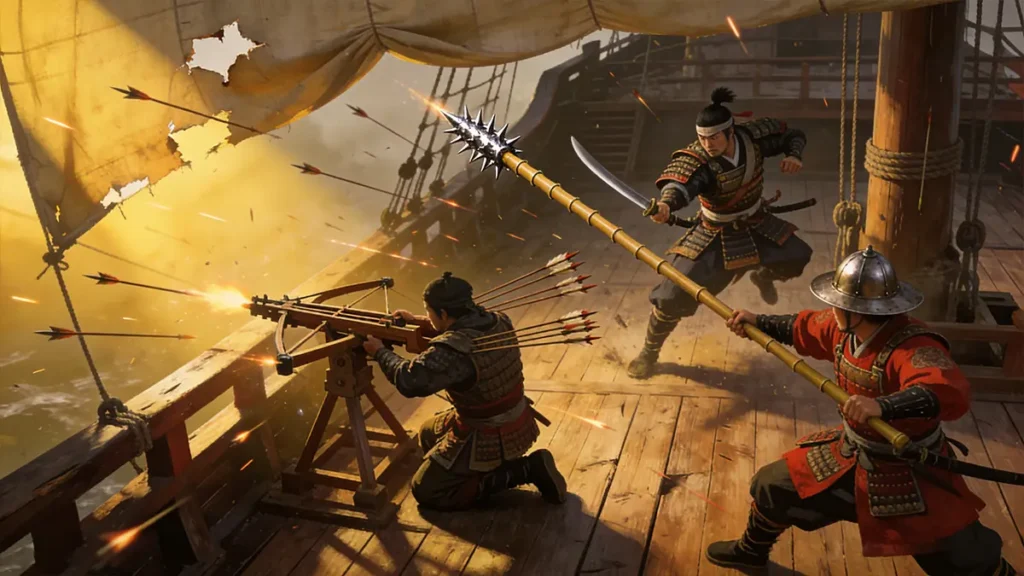
By the 16th century, matchlock muskets had largely replaced bows in Europe. But aboard Ming warships, the Zhuge repeater crossbow remained standard issue until the late 1500s. The reason was tactical necessity.
The deadliest phase of naval warfare wasn’t cannon duels—it was boarding. When enemy sailors leapt onto your deck, every second counted. A matchlock took 20–30 seconds to reload; a repeater crossbow could fire ten bolts in under 15 seconds, with minimal training. During his campaigns against Japanese raiders in Taizhou, Qi Jiguang explicitly ordered: “In close combat, crossbows come first; firearms second.”
Archaeology backs this up. In 2005, a Ming warship wreck from the Jiajing era (1522–1566) was recovered off Pingtan, Fujian. Alongside Folangji cannons, divers found dozens of bronze crossbow triggers and sliding rails—now displayed at the Quanzhou Maritime Museum. These weapons had an effective range of 80 meters and enough accuracy to hit a man on a heaving deck.
Even more ingenious were specialized melee weapons like the langxian—a five-meter bamboo pole tipped with iron spikes, designed to keep sword-wielding pirates at bay. Clumsy as it looked, it neutralized the famed agility of Japanese warriors. This “use length to control shortness” philosophy reflected the Ming navy’s deep understanding of close-combat dynamics.
Yet even the finest weapons need a platform. And the Ming warship itself was an engineering triumph.
Treasure Ships: Floating Fortresses, Not Myths
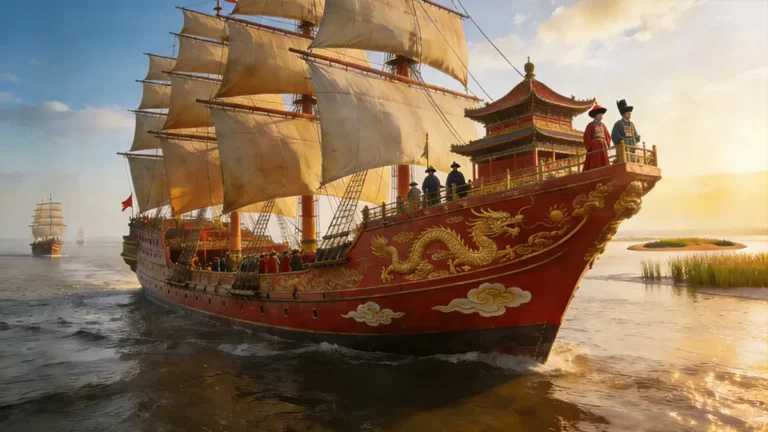
When people hear of Zheng He’s Fleet, they often imagine “400-foot giants.” The figure comes from the Ming Shi (History of Ming), which claims treasure ships were “44 zhang” long—roughly 137 meters. But modern scholars treat this as symbolic exaggeration.
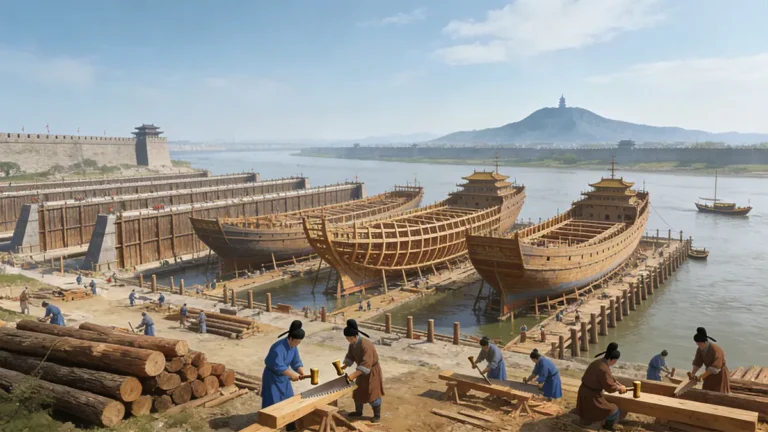
Excavations at the Longjiang Shipyard in Nanjing—the actual dockyard that built Zheng He’s vessels—uncovered rudderposts over 11 meters tall. Based on proportional analysis, historians now estimate the largest Treasure Ships were 60–70 meters (200–230 feet) long, with beams of about 14 meters. Still, that made them twice the size of Columbus’s Santa María, and the largest wooden ships afloat in the 15th century.
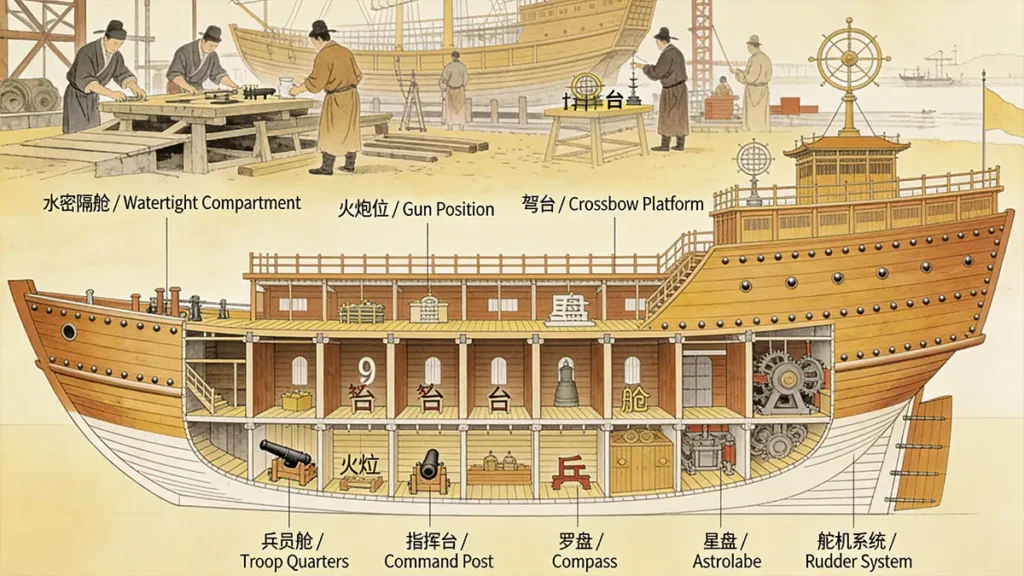
More importantly, they featured watertight compartments—the hull divided into 9–13 sealed sections. If one flooded, the ship stayed afloat. Marco Polo noted this technology in the 13th century (Travels, Ch. 152), but Europe wouldn’t adopt it widely until the 1700s.
Navigation was equally advanced. Zheng He’s navigators used magnetic compasses paired with star-altitude boards (derived from Arab kamals) to sail across open ocean. By 1433, they reached Malindi in East Africa—six decades before da Gama.
These were not just ships but self-sustaining fleets. Ma Huan, a Muslim interpreter on Zheng He’s voyages, recorded five vessel types: command ships (Treasure Ships), troop transports, grain carriers, water tankers, and dedicated warships. Together, they formed a mobile logistical network capable of operating for six months without port calls—a level of coordination unmatched in its time.
But true naval power extends beyond wood and iron. The next section explores how signals, strategy, and philosophy turned a fleet into an instrument of global order.
Beyond Weapons: Systems, Signals, and a Non-Colonial Maritime Order
In 1411, Zheng He’s fleet faced rebellion in Ceylon (modern Sri Lanka). Rather than storm the capital, Ming commanders executed a textbook pincer movement: the main fleet feigned attack from the front while light craft landed troops behind enemy lines. The king was captured within days.
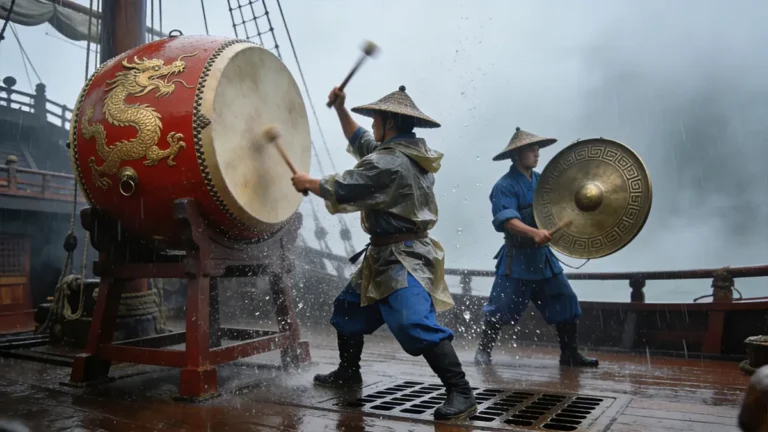
Success depended on flawless communication. By day, colored flags conveyed complex orders; by night, lantern patterns and gong rhythms coordinated maneuvers. Persian envoy Abd al-Razzaq, visiting Calicut in 1442, marveled: “The Chinese fleet moves as one hand—striking where it wills.”
Critically, the Ming Navy pursued a different vision of power. It sought no colonies, extracted no resources. Instead, it enforced a tribute system: through displays of might and generosity, it drew states into a China-centered trade network. At Malacca and Hormuz, the Ming established “official factories”—trading posts, not fortresses.
This “force in service of ritual” logic was unique in 15th-century naval warfare. It explains why Zheng He’s seven voyages conquered no territory. And it’s why, when court politics shifted inward after 1433, the fleet was dismantled—it was never meant to be permanent.
So why did history’s most powerful premodern navy vanish? The answer lies not in technology, but in choice.
The Paradox of Power: Rise, Retreat, and Legacy
After 1433, the Ming imposed strict haijin (maritime prohibition) laws: shipbuilding was banned, blueprints destroyed, and oceanic ambition condemned as wasteful. Officially, it was about cost—one Treasure Ship equaled a year’s tax revenue from Jiangnan (per Ming Shilu, vol. 128). But deeper forces were at play: Confucian scholar-officials distrusted eunuch-led expeditions and saw the sea as a source of disorder.
Ironically, when the state abandoned the ocean, private actors filled the void. In 1633, Zheng Zhilong—a former pirate turned admiral—defeated the Dutch East India Company at the Battle of Liaoluo Bay using a hybrid fleet armed with both Ming-made and European-style cannons. His red-barrel guns came from Macau, proving that naval armament knowledge never truly disappeared—only state support did.
Today, shipwrecks in the South China Sea continue to yield Folangji cannons and gunpowder jars—like the 2021 “Nanao I” wreck off Guangdong. These artifacts remind us: the Ming Dynasty didn’t fail at sea. It chose land.
And that choice echoes in how we define “naval might” today.
Rethinking Maritime Power
The Ming Navy may not have built an empire, but it proved something profound: in the early age of gunpowder, a non-Western civilization could create the world’s most advanced naval system. From Fire Dragons to Folangji cannons, from repeater crossbows to watertight hulls, it represented the pinnacle of 15th-century naval warfare.
More importantly, it offered an alternative model: fleets as instruments of order, not exploitation; strength as a means to peace, not plunder. In an era when maritime rivalry is rising once again, this forgotten chapter deserves a second look.
It began not with conquest, but with a fleet sailing the Indian Ocean—believing that the greatest victory was the one never fought.