1405–1433: The Complete Timeline of Zheng He’s 7 Voyages and the Ming Treasure Fleet
When Zheng He led 27,000 men across the Indian Ocean, Christopher Columbus’s first voyage was still 87 years away.While Columbus sought new lands, the Ming fleet left behind tangible evidence of their presence, such as the Ming Dynasty shipwrecks found along the trade routes of Southeast Asia.
What does this gap signify? Imagine this—while the Ming Dynasty’s treasure fleet was already establishing trade networks across the Indian Ocean, Europeans were still debating how to navigate around the African coastline.While these expeditions were unprecedented in scale, they didn’t start from scratch; they followed the ancient routes of the [Maritime Silk Road before Zheng He], which had been developed over centuries by Arab and Chinese merchants. This chapter of history rarely appears in Western textbooks…
This chapter of history rarely appears in Western textbooks. Yet Zheng He’s 7 Voyages Timeline chronicles the largest and most technologically advanced oceanic expeditions in human maritime history—nearly a century before Europe’s Age of Discovery.
This article takes you through this twenty-eight-year maritime journey. Each voyage’s specific dates, ports of call, and pivotal events are documented with precise data and source references.
Let’s start with a table. It offers a comprehensive overview.
Quick Timeline Overview
| Voyage | Period | Main Destinations | Key Events |
|---|---|---|---|
| 1st | 1405-1407 | Southeast Asia, India | Captured pirate Chen Zuyi |
| 2nd | 1407-1409 | Southeast Asia, India | Established trade stations |
| 3rd | 1409-1411 | Southeast Asia, India, Ceylon | Battle of Ceylon |
| 4th | 1413-1415 | Persian Gulf | First arrival in Middle East |
| 5th | 1417-1419 | East Africa | Brought back giraffes |
| 6th | 1421-1422 | East Africa, Red Sea | Escorted envoys home |
| 7th | 1431-1433 | Red Sea, East Africa | Zheng He’s death |
Data sources: History of Ming Dynasty: Biography of Zheng He, World History Encyclopedia
Seven voyages, twenty-eight years, over thirty countries. But who was this man? Why did a court eunuch—a figure who, in the Ming Dynasty, often functioned as a high-ranking imperial administrator—become the admiral of the world’s largest fleet?
Who Was Zheng He?
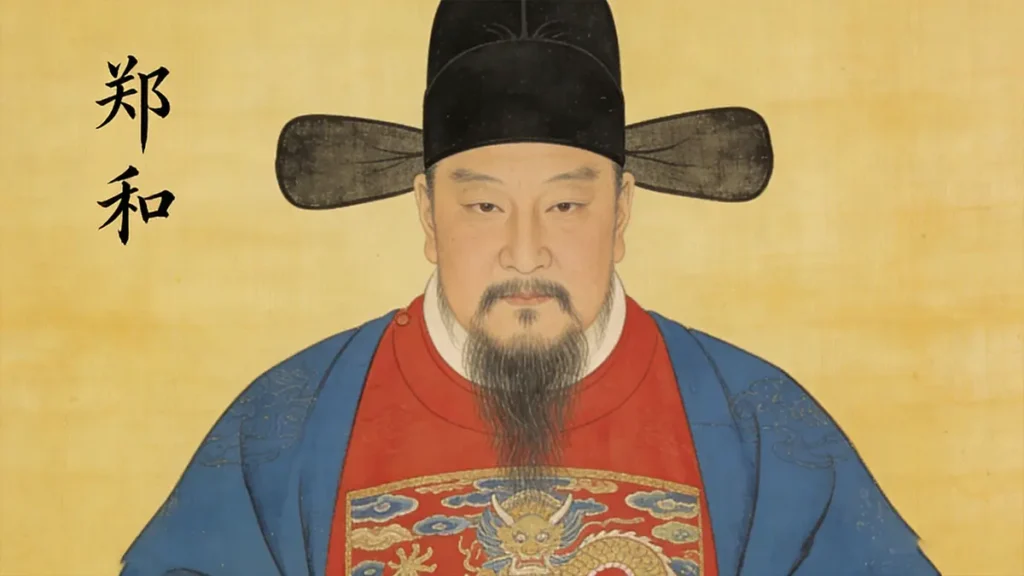
In 1371, in Yunnan, a Muslim family welcomed their son, naming him Ma He.
His father had made the pilgrimage to Mecca—a rare feat in 14th-century China, where most Muslims never completed the Hajj in their lifetimes. This detail proved crucial, explaining why Zheng He later conversed fluently with Arab merchants.
While his father completed the Hajj, historical debate continues regarding the Admiral himself: Did Zheng He go to Mecca during his own expeditions?
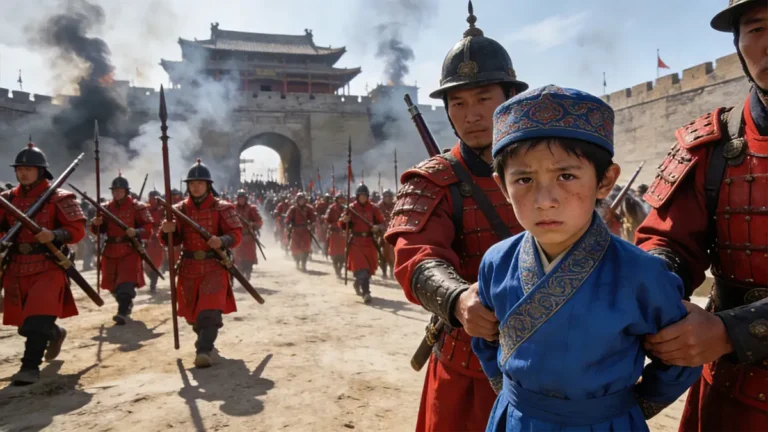
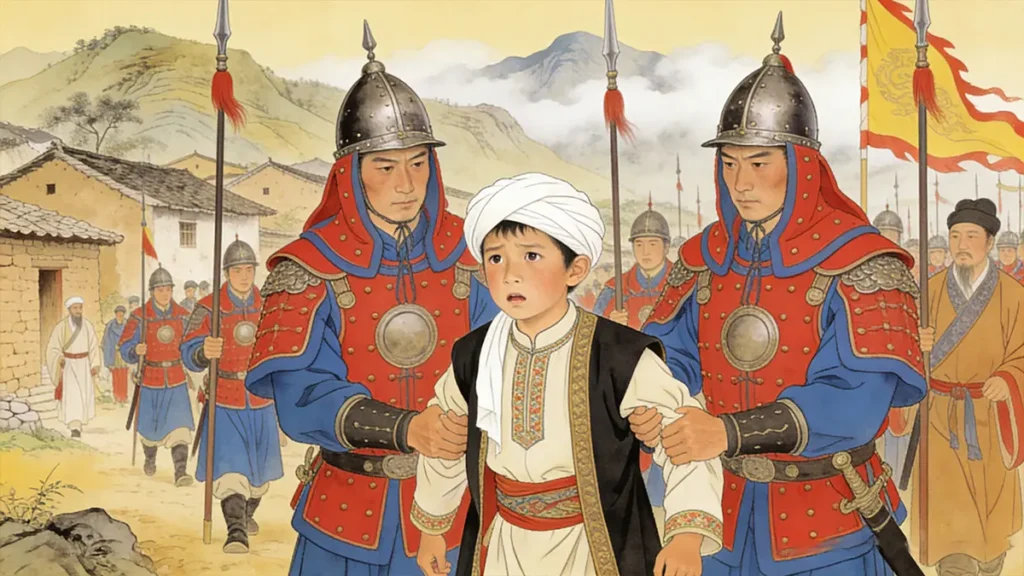
Fate shifted in 1381. Ming forces subdued Yunnan, and the ten-year-old Ma He was captured. He was subsequently castrated and sent to the palace of Prince Zhu Di, the Prince of Yan.
This decision transformed his life and altered the course of maritime history.
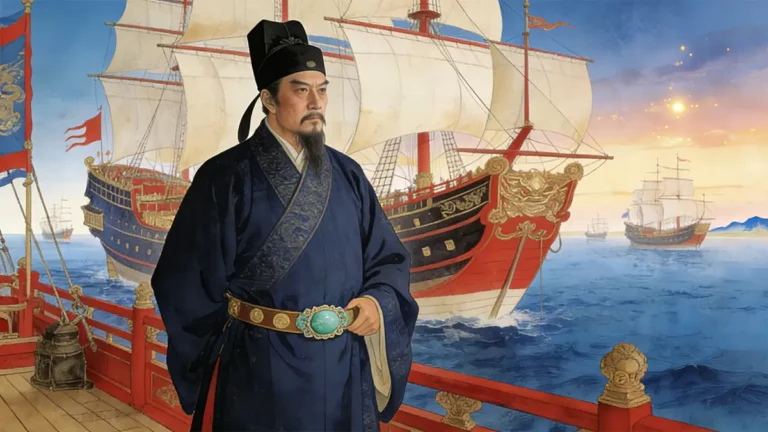
During the Jingnan Campaign, Ma He distinguished himself in battle. In 1403, when Zhu Di ascended the throne as the Yongle Emperor, he bestowed upon Ma the surname “Zheng.” Zheng He thus became one of the emperor’s most trusted officials.
British scholar Louise Levathes wrote in When China Ruled the Seas: “Zheng He possessed military prowess, diplomatic skill, and absolute loyalty to the emperor—key reasons for his selection as fleet commander.”
He spoke multiple languages: Arabic, Persian, and possibly Southeast Asian dialects. These skills proved vital for overseas diplomacy.
But language and competence were merely the foundation. What truly astonished observers was the sheer scale of the fleet he was about to command.
The Treasure Fleet
Imagine this scene: Over two hundred colossal vessels blanketing the sea, the shouts of twenty-seven thousand sailors echoing across the Persian Gulf.
This was not merely a fleet, but a floating maritime city.
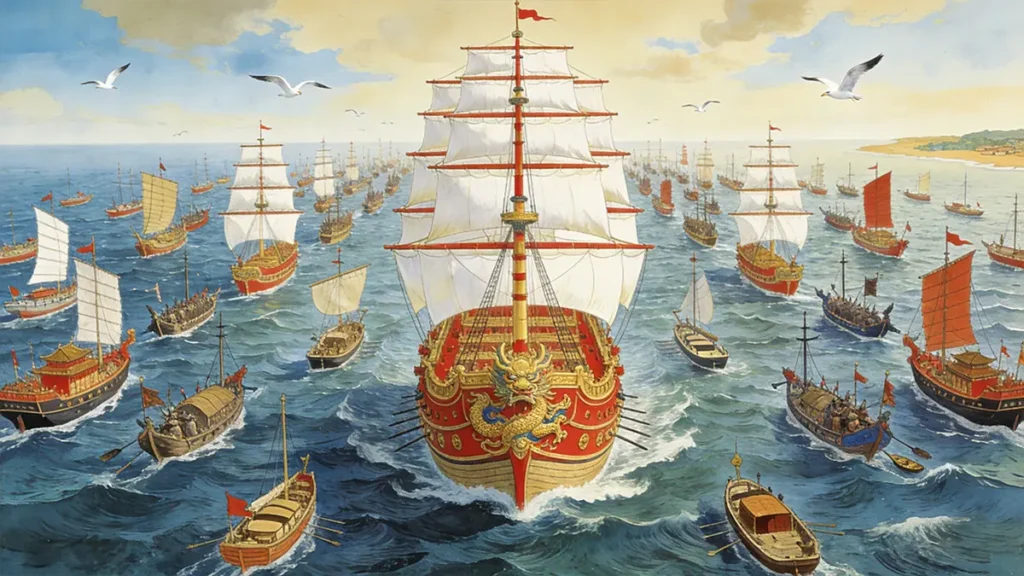
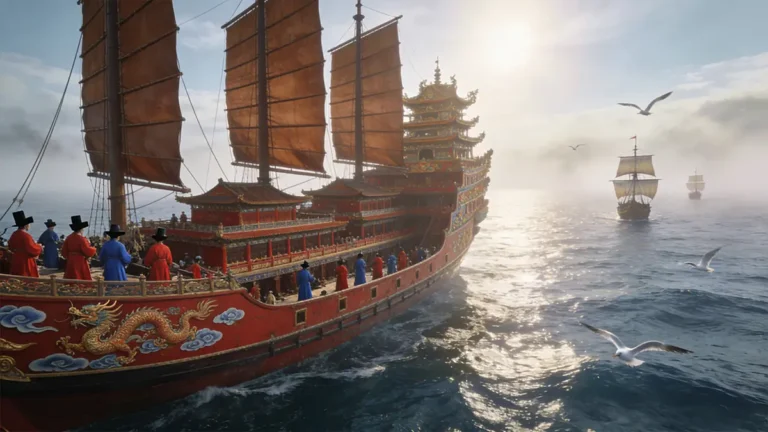
When Zheng He’s flagship (the Treasure Ship) anchored at Malacca, its deck spanned an area equivalent to two football fields. Compared to the Santa Maria, the ship Columbus relied on decades later, it resembled a fragile lifeboat.
The exact figures are as follows: The treasure ship measured approximately 148 meters (485 feet) in length and 60 meters (197 feet) in width. Columbus’s Santa Maria was about 30 meters (98 feet) long. A fivefold difference in length and a thirtyfold difference in displacement.
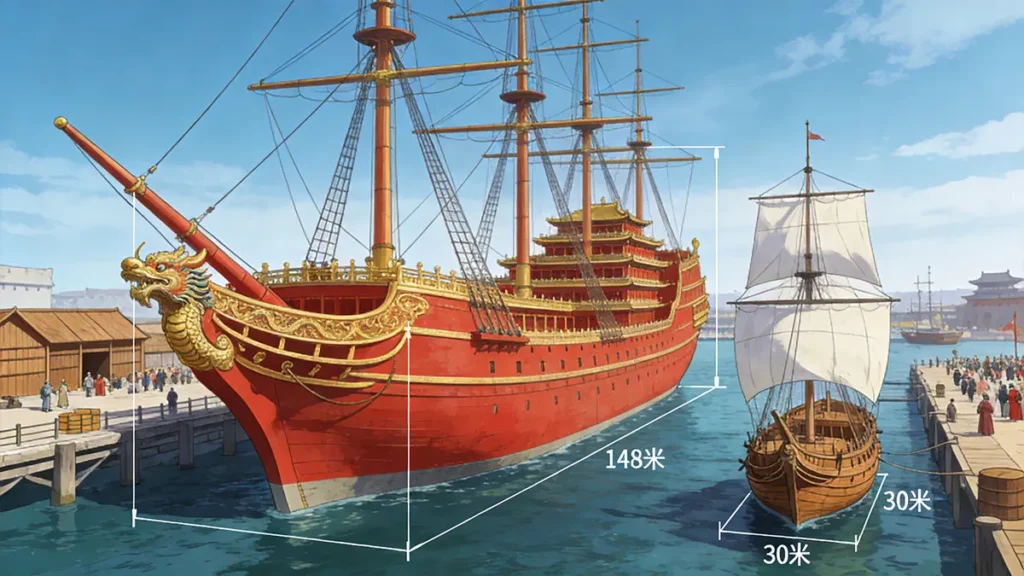
These data come from the archaeological report of the Nanjing Treasure Shipyard site. In 1957, archaeologists unearthed a complete rudder shaft measuring 11 meters (36 feet) long. Proportional calculations confirm the vessel’s dimensions align with records in the History of the Ming Dynasty.
The fleet comprised multiple ship types: treasure ships (flagships), warships, cargo vessels, horse carriers, and water supply ships. This division of labor mirrored the formation structure of modern navies.
Technical details are even more remarkable. Treasure ships employed watertight compartmentalization—dividing the hull into independent compartments so that flooding in one would not affect others. This technology was not adopted in Europe until the 18th century.
The ships featured medical facilities, kitchens, and stables, enabling crews to sustain long-term maritime operations. They were fully equipped with nautical charts, compasses, and astrolabes (instruments for measuring latitude).
Professor Edward L. Dreyer of Emory University remarked in Zheng He: China and the Oceans in the Early Ming Dynasty: “The organizational capability of this fleet was unmatched in the world during the fifteenth century.”
The fleet was ready. Now, let us follow them on their first voyage.
First Voyage (1405–1407)
July 1405, Longjiang Port, Nanjing.
The fleet set sail. This marked the beginning of Zheng He’s 7 Voyages Timeline and the start of the largest-scale oceanic expedition in human maritime history.
The route headed south. The first stop was Champa (present-day central-southern Vietnam). Then came Java and Sumatra.The route headed south. The first stop was Champa (present-day central-southern Vietnam). Then came Java and Sumatra. In Java, the fleet encountered its first major diplomatic crisis—a bloody misunderstanding linked to the Majapahit Civil War, which resulted in the tragic death of 170 Ming soldiers. Crossing the Strait of Malacca, the fleet entered the Indian Ocean. The final destination was Calicut (present-day Kozhikode, India).
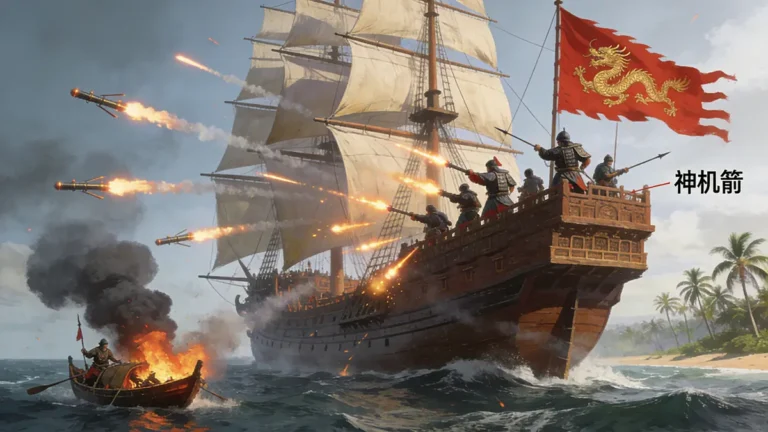
A pivotal event unfolded in the Strait of Malacca. Pirate leader Chen Zuyi had operated there for years, threatening trade routes. Though he had accepted amnesty from the Ming Dynasty, he continued raiding merchant ships.
Zheng He avoided a direct confrontation. He feigned retreat to lure Chen Zuyi into pursuit. Then, he turned his fleet around to counterattack, capturing the pirate fleet. Chen Zuyi was taken back to Nanjing and publicly executed.
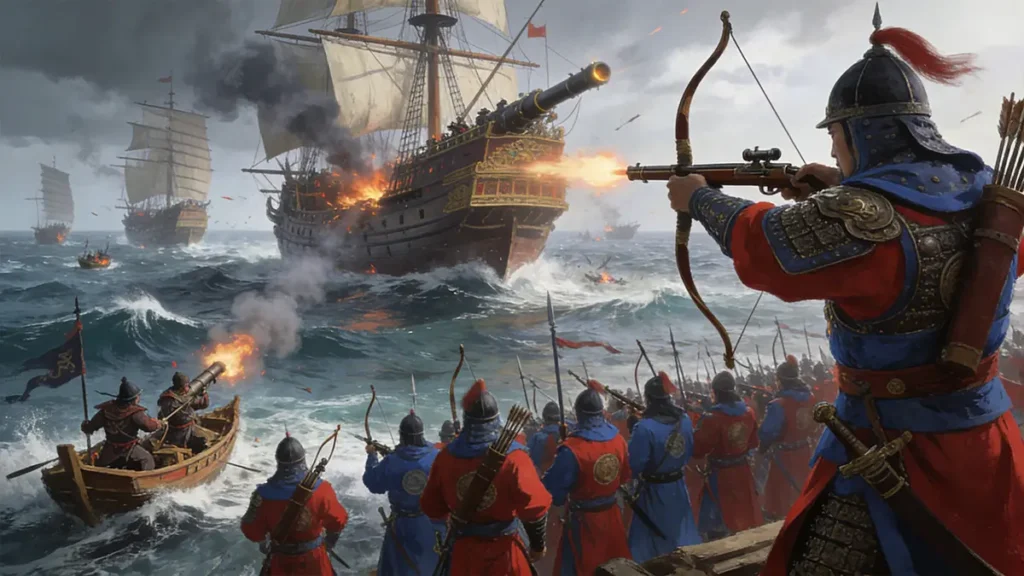
The significance of this battle extended far beyond a military victory. It sent a clear message to nations along the route: the Ming navy possessed both the capability to clear threats from shipping lanes and the willingness to safeguard trade security.
In October 1407, the fleet returned to Nanjing. Accompanying them were foreign envoys bearing gifts, prepared to present themselves before the Yongle Emperor.
The first voyage tested the fleet’s long-distance capabilities. A trade network began to take shape. Yet the true test lay ahead.
However, this maritime prosperity came at a cost. When the fleet once again entered the Indian Ocean, the real troubles had only just begun.
The Second Voyage (1407–1409)
The second voyage followed immediately after the first. It departed in 1407 and returned in 1409.
This expedition aimed to consolidate relationships. The fleet revisited nations reached during the first voyage. Trade agreements were deepened. More ports opened to Ming ships.
Siam (present-day Thailand) was a key focus. At the time, Siam was in conflict with Malacca. Zheng He mediated the dispute. Zheng He’s legacy in Thailand as Sam Pao Kong.This demonstrated the Ming Dynasty’s diplomatic role—not as a conqueror, but as an arbitrator.
Volume 8 of The Cambridge History of China notes: “The Ming tribute system (a diplomatic framework where foreign states acknowledged Ming supremacy in exchange for trade privileges) was not a colonial system. It emphasized ritual and trade, not territorial occupation.”
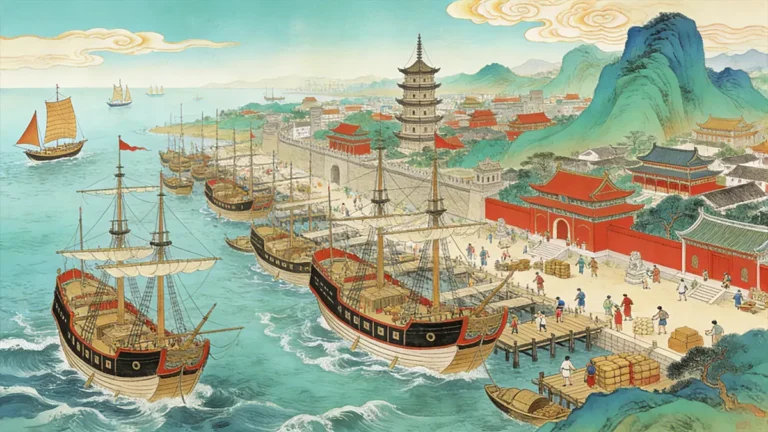
The fleets returned with greater quantities of spices and gems. Foreign envoys increased in number. The port of Nanjing grew increasingly bustling.
The second voyage proved that long-distance trade could be sustained. But tranquility was soon shattered.
The Third Voyage (1409–1411)
The fleet set sail in 1409. The route was similar to previous voyages, but trouble arose in Ceylon (present-day Sri Lanka).
King Alagakkonara of Ceylon harbored hostility toward the fleet. He may have feared the expansion of Ming influence or coveted the treasures carried aboard.
The king invited Zheng He ashore, then ambushed the fleet with his troops.
Zheng He demonstrated remarkable military intuition. Instead of fighting a desperate battle on the beach, he exploited the enemy’s all-out assault to lead 2,000 elite soldiers straight to the poorly defended royal palace.
While the military outcome was decisive, the geopolitical tensions leading to this clash were complex. Explore the deep-seated causes of the 1411 Ceylon Mountain War to understand why diplomacy failed.
The outcome was decisive.
The king was captured and taken to Nanjing. Emperor Yongle spared his life, releasing him and installing a pro-Ming monarch. This exemplified Ming policy—demonstrating strength without territorial occupation.
The Malacca base was established during this voyage, becoming a vital supply point for the fleet. For centuries thereafter, Malacca served as a pivotal hub for East-West trade.
The fleet returned in 1411, laden with gems, spices, ivory, and the King of Ceylon—who was later released.
The third voyage cemented Ming dominance in the Indian Ocean. Next, the fleet would venture further westward.
But what did westward mean? It meant entering the heartland of the Islamic world.
The Fourth Voyage (1413–1415)
This voyage broke new ground—the fleet entered the Persian Gulf for the first time.
Departing in 1413, the route traversed Southeast Asia and India before heading west. The destination was Hormuz (near the present-day Strait of Hormuz).
Hormuz was a major trading hub at the time, attracting Arab merchants. Zheng He’s fleet marked the first entry of the Chinese navy into the heartland of the Islamic world.
Ma Huan, author of The Overall Survey of the Ocean’s Shores (《瀛涯胜览》, Yingya Shenglan), served as an interpreter on the voyage. He documented local customs and landscapes. This book later became a crucial historical source for studying 15th-century Indian Ocean trade.
The fleet also visited Bengal, bringing back a giraffe. Unfamiliar with this creature, the Ming people dubbed it “qilin”—a mythical auspicious beast in Chinese tradition.
The giraffe was transported to Beijing, where court painters created the “Qilin Painting.” This artwork is now housed in the National Palace Museum in Taipei.
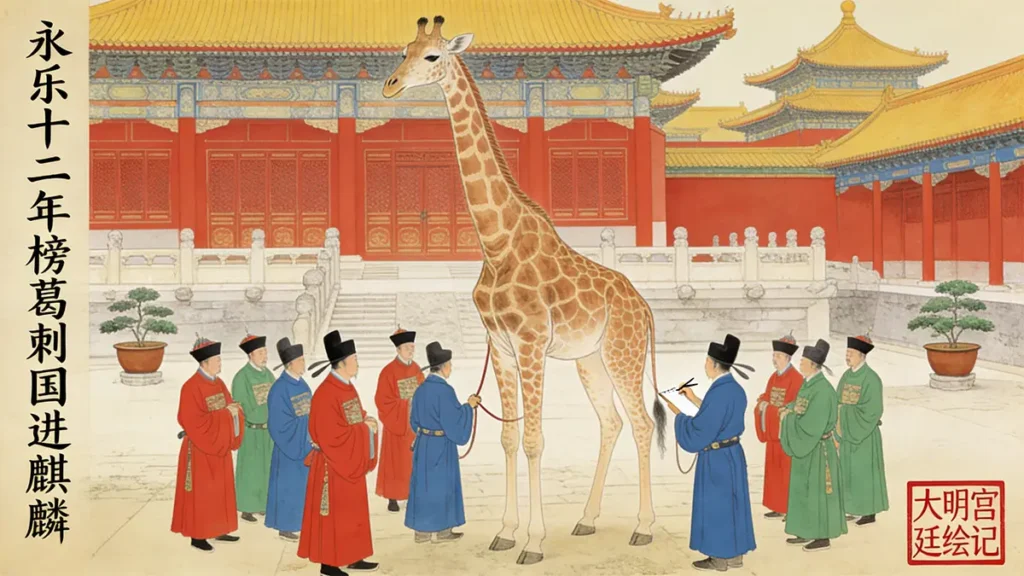
The fleet returned in 1415, bringing Persian carpets, glassware, and Arabian horses. Cultural exchange reached new heights.
The fourth voyage proved that Ming ships could reach the Middle East. But there were even more distant lands—the East African coast.
What awaited them on that continent?
Fifth Voyage (1417–1419)
In 1417, the fleet set sail once more, this time bound for East Africa.
The route followed a similar path to the fourth voyage, but after passing the Persian Gulf, it continued southward. The fleet reached Mogadishu (present-day Somalia) and Malindi (present-day Kenya).
This marked the first time a Chinese fleet reached the East African coast, predating Vasco da Gama’s arrival by eighty years.
Archaeological excavations at the Malindi site uncovered Chinese porcelain dating precisely to Zheng He’s voyage period. This provides tangible evidence confirming the fleet’s presence there.
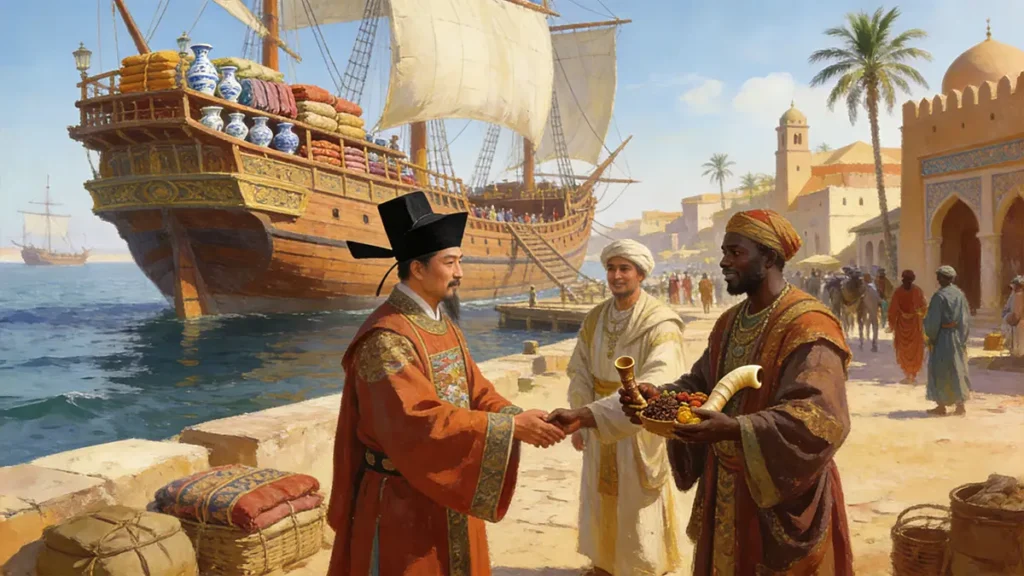
The fleet returned with more “qilin”—actually giraffes—alongside zebras, ivory, and rhinoceros horns. These exotic treasures caused a sensation in Beijing.
The Veritable Records of the Ming Dynasty recorded Emperor Yongle’s immense delight. He regarded this as proof that the Heavenly Court’s (the Ming imperial court) prestige and virtue had spread far and wide.
The fleet returned in 1419, having reached the farthest extent of its voyages. The Ming Dynasty’s maritime influence now spanned the entire Indian Ocean.
But the nature of the next voyage would be different.
The Sixth Voyage (1421–1422)
The primary mission of this voyage was to escort foreign envoys back to their homelands.
Departing in 1421, the fleet carried envoys from seventeen nations. After paying homage in Beijing, they needed to return home.
The fleet operated in separate groups: some escorted envoys to India, others to the Persian Gulf, and still others to East Africa. Such organizational complexity was unprecedented in the fifteenth century.
The fleet returned in 1422. However, maritime activities ceased after this voyage.
The reason was straightforward—the Yongle Emperor passed away in 1424. The new emperor showed little interest in ocean voyages, and the civil bureaucracy also deemed the naval expeditions too costly.
The History of Ming records: “Upon Emperor Ren’s accession, an edict was issued halting voyages to the Western Seas.”
The Age of Exploration seemed to be ending. Yet a decade later, one final voyage would take place.
It was Zheng He’s farewell journey.
Seventh Voyage (1431–1433)
After 1424, the fleet remained inactive for seven years. In 1431, Emperor Xuanzong of Ming decided to resume the maritime expeditions.
Zheng He was already sixty years old. He embarked on the voyage despite his illness. This marked the final leg of Zheng He’s 7 Voyages Timeline.
The fleet remained massive in scale. Over two hundred ships carried more than twenty thousand people. The route followed previous voyages but reached the Red Sea—approaching Mecca.
For Zheng He personally, this may have been a pilgrimage. Born into a Muslim family, his father had visited Mecca. Historical records, however, do not explicitly state whether he disembarked.
In 1433, during the fleet’s return journey, Zheng He passed away. The location remains disputed—possibly Calicut (India) or at sea.
A tomb for Zheng He exists on Niu Shou Mountain in Nanjing. Yet it is a symbolic burial mound (cenotaph). His true resting place may forever remain a mystery.
After the fleet’s return, the Ming Dynasty completely halted its ocean voyages. Maritime restrictions intensified. Records of these voyages were destroyed.
The twenty-eight-year era of exploration concluded. World history shifted course.
You might now ask: Why did Europeans later surpass China? Why did China cease its maritime endeavors?
A Comparison Between Zheng He and European Explorers
First, consider the timeline.
Zheng He’s first voyage commenced in 1405. Columbus set sail in 1492—an 87-year gap. Vasco da Gama reached India in 1497, arriving 92 years later.
The disparity in fleet size was even more pronounced. Zheng He commanded over 200 ships with 27,000 crew members. Columbus sailed with three ships and ninety men. Magellan set sail with five ships and two hundred seventy men.
Yet the outcomes were entirely different.
Europeans established colonies. China did not. Why?
The first reason lies in differing objectives. Ming dynasty voyages aimed to demonstrate imperial might and establish tribute relationships. Europeans sought trade routes and resources.
The second reason was economic structure. China was an agricultural empire, self-sufficient and requiring no overseas resources. European nations were smaller with limited resources, necessitating outward expansion.
The third reason was political systems. After Emperor Yongle’s death, the civil bureaucracy seized power. They deemed maritime expeditions wasteful, gradually tightening maritime restrictions.
British historian Gavin Menzies proposed in 1421: China’s Discovery of the World that Zheng He’s fleet may have reached the Americas. However, this theory has been rejected by mainstream historians due to a lack of credible evidence.
Timothy Brook, Professor of Chinese History at the University of Oxford, wrote: “Zheng He’s voyages were diplomatic and trade missions, not colonial expeditions. Judging them by European standards misrepresents their nature.”
This contrast raises a larger question: What is the legacy of Zheng He’s voyages?
Historical Impact and Legacy
The direct impact was evident. Over thirty nations established tribute relations with the Ming Dynasty. An Indian Ocean trade network took shape. Chinese began migrating to Southeast Asia.
The long-term legacy proved more profound.
Numerous Zheng He temples dot Southeast Asia—found in Malaysia, Indonesia, and Thailand. Locals revered him as “San Bao Gong,” a folk belief distinct from official religion.

Chinese communities took root in Southeast Asia. Many Chinese in Malaysia and Singapore today are descendants of those sailors and merchants.
Modern China also commemorates this history. In 2005, marking the 600th anniversary of Zheng He’s voyages, China established “Maritime Day,” observed annually on July 11th.
The Belt and Road Initiative draws inspiration from this history. The concept of the Maritime Silk Road directly originates from Zheng He’s sea routes.
What value does this history hold for Western readers?
First, it offers a perspective beyond Eurocentrism. Globalization did not begin with Europeans.
Second, it demonstrates an alternative model of international relations. The tribute system, unlike colonialism, emphasized ritual and reciprocity.
Third, it helps understand contemporary China. China’s maritime historical perspective differs from the Western one.
This history deserves wider recognition. But you may still have specific questions.
Frequently Asked Questions
References and Further Reading
Primary Sources
- The Biography of Zheng He in the History of the Ming Dynasty (《明史·郑和传》, Míng Shǐ·Zhèng Hé Zhuàn) – Qing dynasty official history
- Veritable Records of the Ming Dynasty (《明实录》, Míng Shílù) – Ming dynasty official archives
- A Glimpse of the Star-Ship (《星槎胜览》, Xīngchá Shènglǎn) – Written by Fei Xin (费信), 1436
- The Overall Survey of the Ocean’s Shores (《瀛涯胜览》, Yíngyá Shènglǎn) – Written by Ma Huan (马欢), 1451
Academic Works
- Levathes, Louise. When China Ruled the Seas. Oxford University Press, 1994.
- Dreyer, Edward L. Zheng He: China and the Oceans in the Early Ming Dynasty. Pearson, 2007.
- The Cambridge History of China, Volume 8. Cambridge University Press.
- Needham, Joseph. Science and Civilisation in China. Cambridge University Press.
Online Resources
- World History Encyclopedia – “Zheng He” entry
- Encyclopædia Britannica – “Zheng He” entry
- China Maritime Museum official website (中国航海博物馆)
- Nanjing Zheng He Museum official website (南京郑和博物馆)
Museums
- National Museum of China, Beijing (中国国家博物馆)
- Nanjing Zheng He Museum (南京郑和博物馆)
- China Maritime Museum, Shanghai (中国航海博物馆)
- British Museum, London (Zheng He-related collections)