The First Voyage of Zheng He: Subduing Chen Zuyi, the Pirate King of Palembang
The dull thud of wooden wheels rolling over Nanjing’s stone pavements shattered the dawn’s silence. In the autumn of 1407, a specially constructed prison cart creaked its way toward the execution ground. Confined within was no ordinary highwayman, but Chen Zuyi—the “Pirate King” who had terrorized the South Seas for over a decade, a nightmare to Arab and Indian merchants alike. His hands were bound by heavy iron chains. The head of the man who once commanded a hundred warships and led tens of thousands now hung low, awaiting the final judgment of the Yongle Emperor.
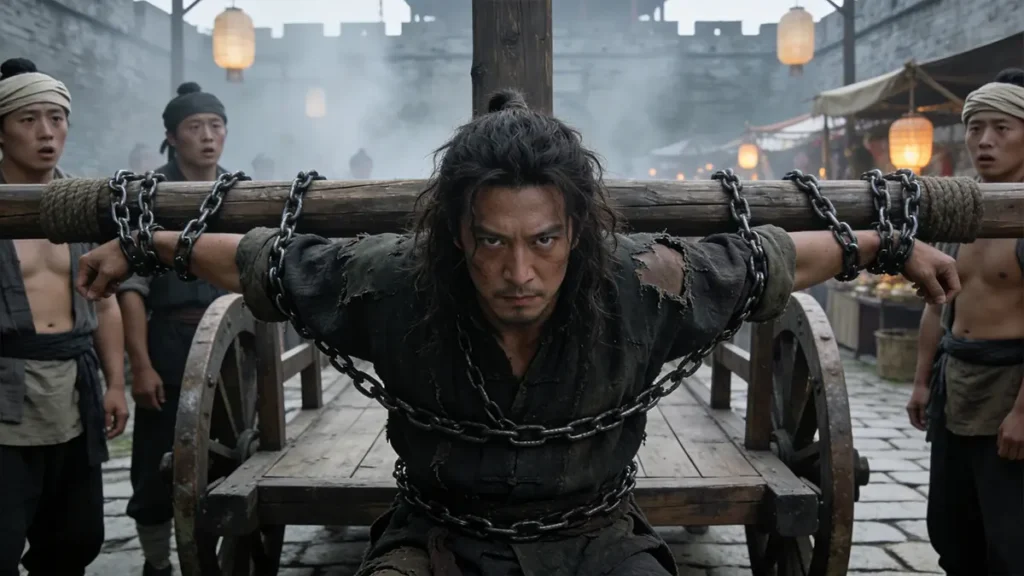
The onlookers likely knew not that this prisoner’s fate had been sealed thousands of miles away, in the mist-shrouded waters of the Strait of Malacca. Just months prior, he had plotted a fiery ambush capable of engulfing the entire Ming fleet. Yet history knows no “what ifs.” This lengthy escort journey from the South Seas to Beijing marked not only a pirate’s demise but also the most dramatic—and most underrated—military chapter of Zheng He’s first voyage.
To understand why Chen Zuyi met such an end, we must rewind to that morning thick with the briny tang of salt and the scent of impending bloodshed, back to the deceptively tranquil waters off Palembang.
The Gamble in the Fog
When Zheng He’s fleet arrived off the coast of Palembang, the atmosphere was eerily stifling. On the surface, the envoys sent by Chen Zuyi were obsequious, presenting a letter of surrender and tribute. According to the customary practices of the tribute system, this typically signaled peace. Yet Zheng He did not accept it immediately.
Inside his brightly lit tent, a secret envoy named Shi Jinqing had just delivered deadly intelligence: Chen Zuyi’s surrender was a ruse. The pirate king planned to exploit the narrow harbor channels, where the Ming fleet could not deploy its full formation. Using favorable winds, he would unleash fire ships while coordinating with over ten thousand warriors ambushing from shore to annihilate the invaders.
It was a classic trap. But in the details, Chen Zuyi had overlooked a crucial variable: the discipline and technological prowess of the Ming navy.
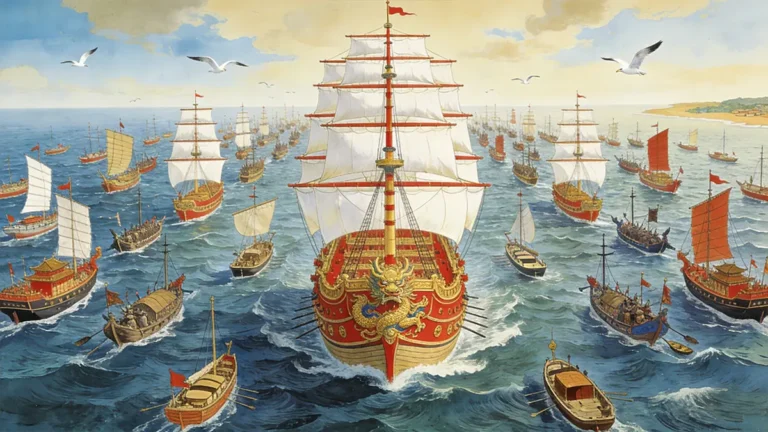
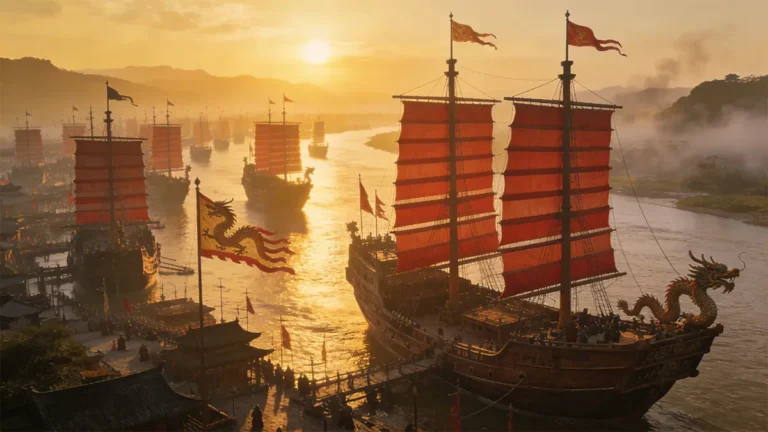
The Ming treasure ships of that era were not merely colossal floating fortresses; they were self-sustaining maritime cities. According to scattered historical records like Records of Western Nations, to combat scurvy during prolonged voyages, the fleet cultivated bean sprouts and vegetables in specially designed wooden boxes. This extreme control over logistics reflected the terrifying organizational discipline of the force. More significantly, they were armed with the world’s most advanced naval firearms: the “Divine Mechanism Arrows” (Shenji Jian) and early matchlock guns. When Chen Zuyi believed he was hunting a docile lamb, he was actually sticking his head into the jaws of a fully armed steel beast.
Zheng He made a bold decision: he would play along. The outcome of this psychological battle would be decided within hours.
Thunderous Strike: An Asymmetric Massacre
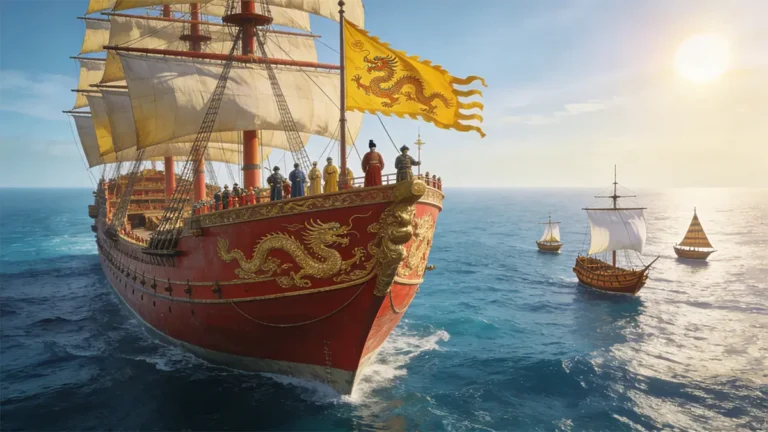
The moment battle erupted, the chaos Chen Zuyi anticipated failed to materialize. As the pirate fleet charged out of the harbor with the wind, attempting to close in and set Ming vessels ablaze, Zheng He’s flagship suddenly signaled. What had appeared to be a loose formation instantly reorganized. The massive treasure ships, leveraging their towering freeboard—reportedly several stories high—formed vertical walls impenetrable to pirate scaling attempts.
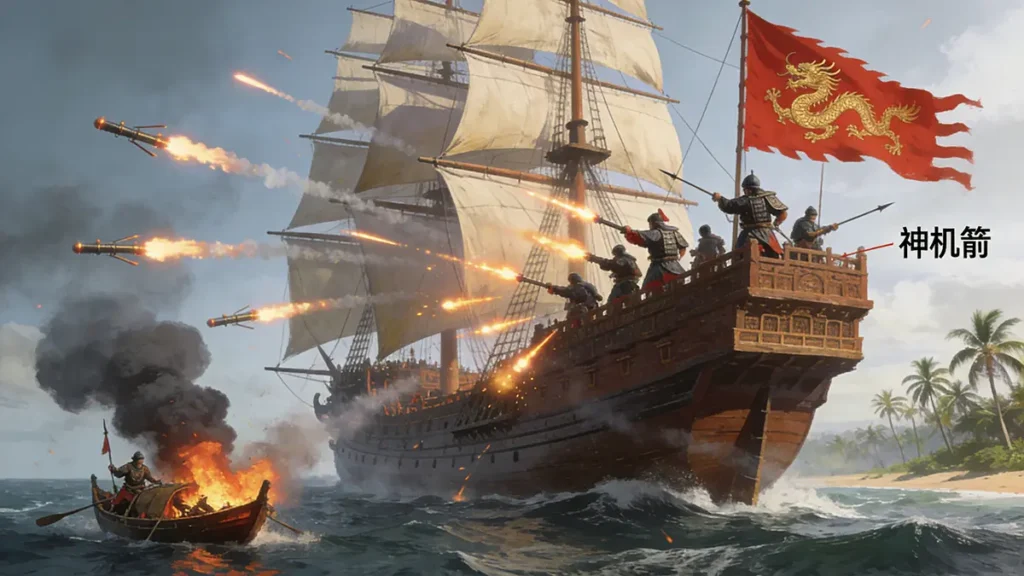
Immediately, the Ming forces demonstrated the true might of Ming Dynasty Naval Power. Instead of rushing to board, soldiers on deck unleashed a barrage of “Divine Mechanism Arrows.” These gunpowder-propelled rockets screeched through the air, landing within the pirates’ tightly packed formation and instantly igniting multiple wooden fast ships. Fueled by the wind, the flames spread rapidly, engulfing the pirates’ own fleet.
Details of this engagement, known as the Battle of Palembang 1407, are recorded with stark brevity: “Over five thousand enemy pirates were slain, ten pirate ships burned, and seven captured.” Behind these numbers lay a brutal reality: this was not a contest of equals, but a one-sided display of firepower. The pirates’ vaunted agility and ferocity proved child’s play against the Ming forces’ systematic artillery barrage and meticulously coordinated tactics. Chen Zuyi attempted a breakout, only to find his small raiding vessels shattered against the massive treasure ships. Ultimately, he was captured alive amid the chaos.
This engagement is now regarded by many military historians as the pinnacle paradigm of early anti-piracy operations in history: intelligence-driven, luring the enemy deep, technologically superior, and totally annihilating. It left the adversary no chance for recovery.
As the smoke cleared and debris floated on the sea, Zheng He’s mission was far from over. He needed to establish a new order within this power vacuum.
The Vacuum and Rebuilding of Order
After Chen Zuyi was taken away, Palembang fell into a delicate power vacuum. Following the logic of later European colonizers, this place should have been flagged, fortified, and taxed. Yet Zheng He made a decision that greatly surprised Western scholars.

He did not occupy the land. Instead, he supported Shi Jinqing, the local leader who had provided crucial intelligence, and established the “Old Port Pacification Commission” (Jiu-gang Xuanwei Si). This administrative innovation, steeped in Eastern wisdom, nominally placed the region under Ming suzerainty while granting local autonomy to maintain maritime security. British sinologist Joseph Needham observed that this embodied the Ming dynasty’s logic of “generous giving, modest taking”—establishing suzerainty to secure regional stability rather than pursuing direct economic exploitation.
The impact was immediate. With pirate forces eliminated, navigational risks in the Strait of Malacca plummeted. Data indicates that over the following decades, merchant vessels transiting this route to China surged, encompassing not only Chinese junks but also vast numbers of Arab dhows and Indian merchant ships. Maritime Silk Road history thus entered a brief yet glorious “Golden Age,” where trade prosperity even catalyzed the subsequent rise of the Malacca Sultanate.
Yet, as we revisit this history today, certain details remain shrouded in debate—a testament to the enduring fascination of historical inquiry.
Controversy and Echoes: Myth or Reality?
Academic debate over this battle—and indeed the entire feat of Zheng He’s voyages—has never ceased. The most contentious topic remains the actual dimensions of the treasure ships. The “forty-four zhang in length” (approximately 120 meters) mentioned in the History of Ming draws scoffs from many modern shipbuilding experts, who dismiss it as a physically impossible “myth” in the era of wooden construction. Yet archaeologists excavating the Longjiang Shipyard site in Nanjing uncovered massive rudder shafts, their dimensions suggesting the flagship indeed dwarfed contemporary European vessels.
The truth likely lies somewhere in between: regardless of whether the treasure ships truly measured a hundred meters, the relative technological superiority demonstrated by the Ming navy at the Battle of Palembang 1407 is indisputable. This superiority extended beyond sheer hull size to encompass the systematic application of firearms, logistical support, and tactical command.
This approach of “ending war through war” stood in stark contrast to Vasco da Gama’s methods when he arrived in the Indian Ocean half a century later. The Portuguese bombarded merchant ships to monopolize the spice trade and establish colonial footholds; Zheng He’s punitive expeditions, though equally ruthless in execution, were fundamentally driven by the logic of restoring security to public sea lanes. This distinction allows researchers of anti-piracy operations in history to discern different implications when revisiting this chapter.
Six hundred years later, the Strait of Malacca remains one of the world’s busiest energy corridors. The echoes of cannon fire have long faded, yet the contemplation of order, security, and hegemony persists.
Conclusion: An Unfinished Dialogue
The moment Chen Zuyi’s head fell, the most arduous phase of Zheng He’s first voyage came to an end. This campaign not only cleared the path to the Indian Ocean but also showcased a unique model of maritime governance to the world: Ming Dynasty Naval Power was not merely a tool for conquest, but a means of upholding a “world order.”
Today, as we confront renewed pirate threats and geopolitical undercurrents, looking back to 1407 Palembang may offer timeless insights. True strength lies not in how many foes you destroy, but in whether you can build rules that benefit all upon the ruins.
The dust of history has settled, but the story continues. If you’re interested in the navigational techniques of Zheng He’s fleet or the details of overseas trade during the Ming Dynasty, feel free to leave a comment below. We’ll explore more in our next episode.