Zheng He in Malacca: How the Ming Treasure Fleet Built a Global Trade Hub
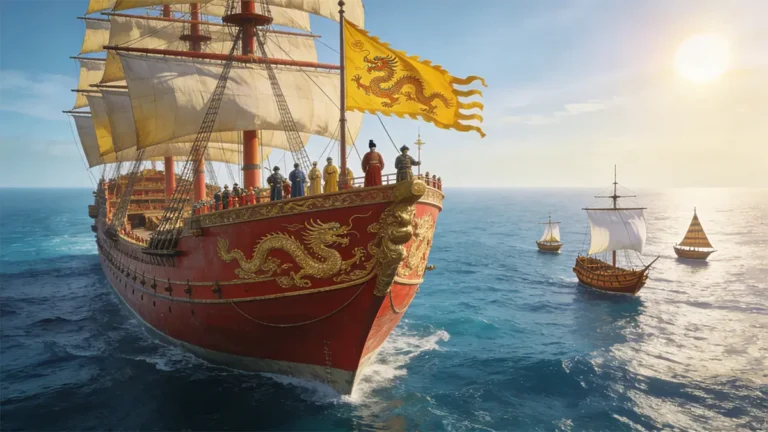
In 1405, a fleet appeared on the Indian Ocean that would have been unimaginable to any monarch in the known world. Its flagship, the “Treasure Ship,” measured over 120 meters (approximately 400 feet) in length, with an estimated displacement of around 3,100 tons. By comparison, when Christopher Columbus crossed the Atlantic 87 years later, his flagship, the Santa María, was a mere 20 meters long and displaced less than 100 tons. Zheng He’s treasure ships were dozens of times larger than Columbus’s flagship; the entire fleet carried a crew of 27,000, while Columbus set sail with just 90 men. This was not merely a voyage; it was the Apollo Moon Landing of the 15th century—a super-project driven by national will and overwhelming technological superiority.
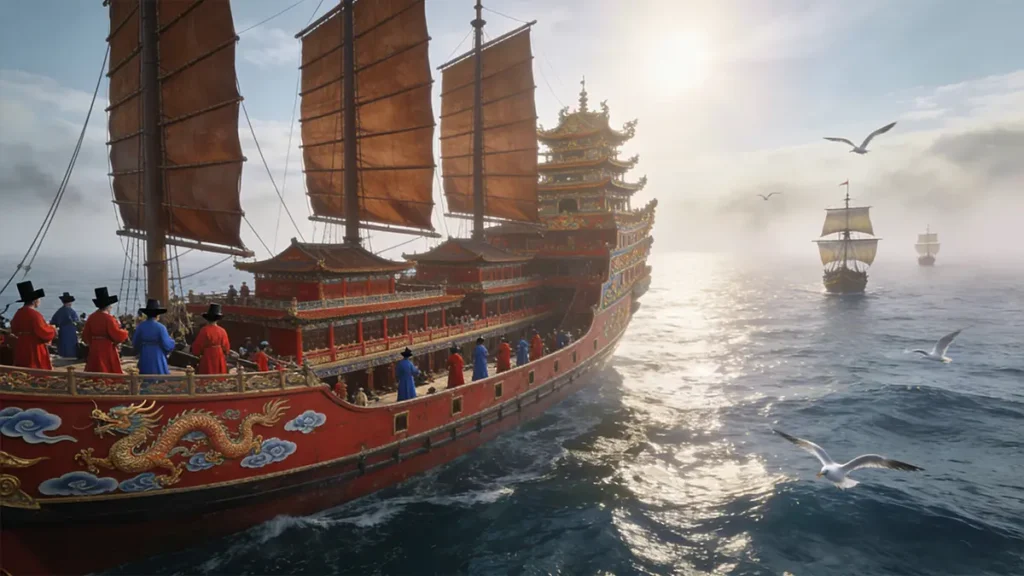
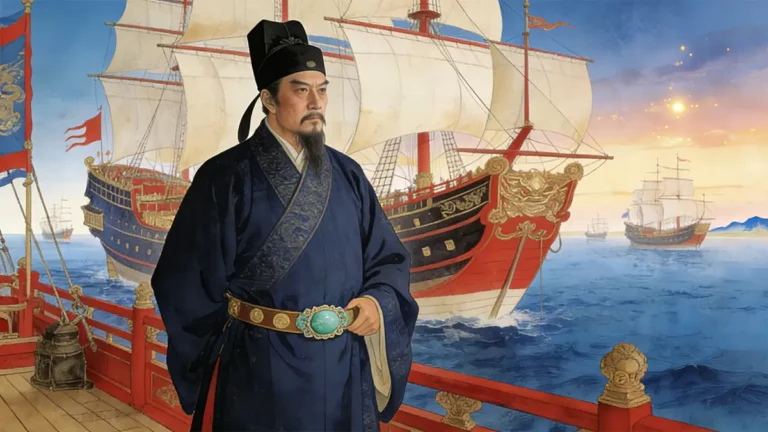
When this colossal maritime city-state entered the Strait of Malacca, the Malacca Sultanate was little more than a fishing village caught in a geopolitical squeeze, perpetually threatened by the military ambitions of the Ayutthaya Kingdom to the north (modern-day Thailand). Yet Zheng He’s seven voyages profoundly altered the port’s destiny. He did not simply “discover” it; through meticulous diplomacy, logistical infrastructure, and security guarantees, he propelled Malacca onto the center stage of global trade, transforming it into the first true global logistics hub connecting the Ming Empire, the Islamic world of the Indian Ocean, and the East African coast.
Engineering Marvels: Watertight Compartments and a Self-Sustaining Supply Chain
To understand how Zheng He reshaped Malacca, one must first unravel the engineering logic behind his fleet. According to the Ming History: Biography of Zheng He and archaeological data from the Nanjing Treasure Shipyard, these vessels employed the era’s world-leading watertight compartment technology. The hulls were divided into multiple independent sealed sections, ensuring the ship remained afloat even if several compartments were breached—a feature not widely adopted in European shipbuilding until the late 18th century. Furthermore, the fleet navigated using precise nautical charts (Zheng He’s Nautical Charts) and the “star-tracking” method, determining latitude by measuring stellar altitudes with minimal error.
This technological edge translated directly into a decisive logistical advantage. As historian Edward L. Dreyer notes in Zheng He: China and the Oceans in the Early Ming Dynasty, the fleet carried vast supplies of fresh water and dry provisions, but also maintained onboard vegetable gardens for fresh produce and even stables for transporting horses. In stark contrast, crews on contemporary European vessels often succumbed to scurvy and relied heavily on plundering or begging for supplies along their routes. Zheng He’s fleet functioned as a self-sustaining mobile base. This self-sufficiency allowed them to engage in equitable trade with ports, rather than establishing military strongholds to control water and food sources, as later colonial powers would do.

Strategic Site Selection and Institutional Innovation: The Birth of the “Guanchang”
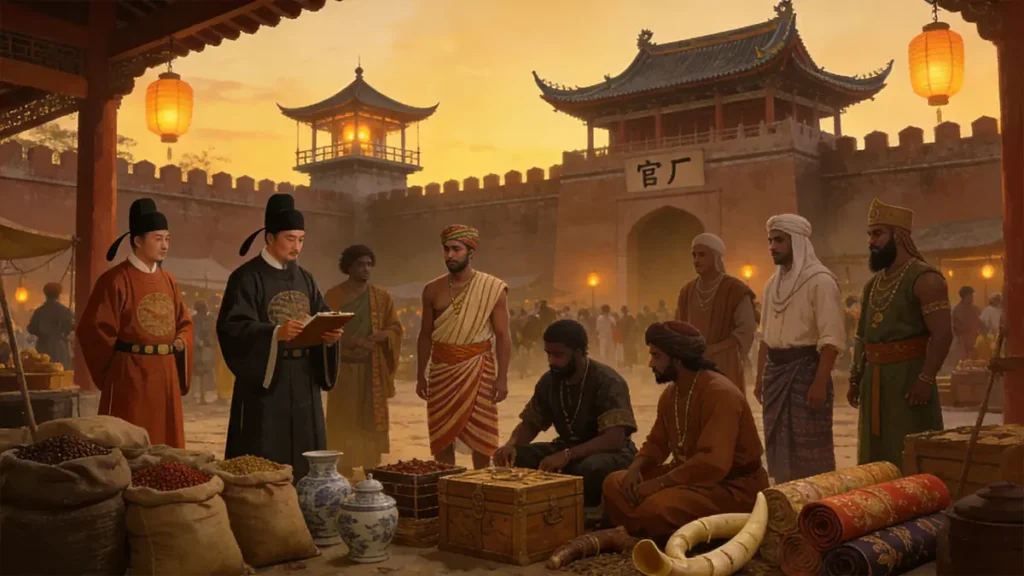
Zheng He leveraged Malacca’s unique geographic position at the convergence of the northeast and southwest monsoons to establish a specialized institution known as the “Guanchang” (Official Depot). According to Ma Huan’s Yingya Shenglan (The Overall Survey of the Ocean’s Shores, 1416), the Ming Dynasty constructed a walled complex of warehouses in Malacca, complete with fortified walls and watchtowers.
Imagine the humid air of Malacca, thick with the pungent scent of pepper and the rich, musky aroma of ambergris. Beneath the watchtowers within the compound, merchants from diverse nations haggled in a cacophony of languages. This was far more than a warehouse; it was an integrated facility combining customs, bonded storage, quality inspection, and diplomatic reception. Merchants could deposit goods in the official depots, where Ming officials would register them without immediate taxation. Transactions occurred only once buyers were found or the monsoon winds shifted. This system drastically reduced trade risks and capital tie-up costs.
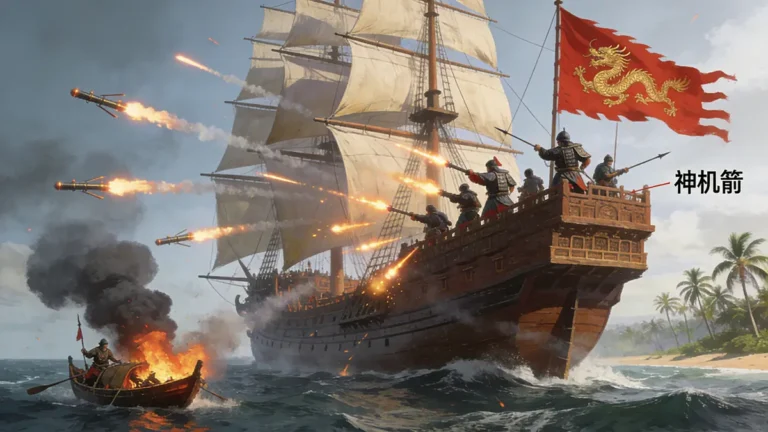
Crucially, Zheng He’s military campaigns eliminated Chen Zuyi, a notorious pirate who had long terrorized the strait. The Veritable Records of the Ming Dynasty recount that in 1407, Zheng He captured Chen Zuyi and escorted him back to Nanjing for execution. This sent an unequivocal signal to the entire Indian Ocean business community: the Strait of Malacca was now a “safe trade zone” under the protection of the Ming navy.
Another Form of Globalization: The “Eastern NASDAQ” Under the Tribute System
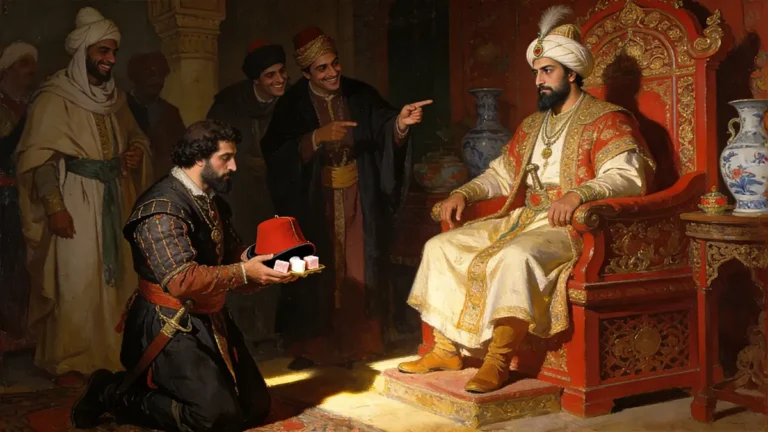
Western historical narratives often misinterpret the Tribute System as mere political submission. Economically, however, it functioned as a state-subsidized free trade agreement. The Ming Dynasty adhered to the principle of “giving generously and receiving sparingly,” meaning the gifts bestowed upon tribute envoys often exceeded the value of the goods they offered. For the Sultan of Malacca, receiving investiture from the Ming Emperor meant gaining a “green channel” into China’s vast market and a security guarantee against Siamese invasion.
Under this model, Malacca evolved into a colossal “Eastern NASDAQ.” Chinese porcelain, silk, and copper coins served as hard currency, exchanged for Southeast Asian spices (pepper, cloves), Indian cotton, Arabian gems, and African ivory. In his 1515 work Suma Oriental, the Portuguese explorer Tome Pires marveled: “Whoever controls Malacca holds Venice by the throat.” Although Pires wrote over half a century after Zheng He’s death, the prosperity he described was rooted in the trade networks Zheng He had established. Unlike the Portuguese who followed, Zheng He imposed no heavy tariffs and established no colonial rule; he secured trade privileges and regional stability simply by recognizing the legitimacy of local sultans.
A Cultural Melting Pot: The Origins of the Baba Nyonya and Religious Bridges
Zheng He’s fleet carried not only soldiers and sailors but also interpreters, merchants, artisans, and physicians. Many settled in Malacca, intermarrying with local Malay women. Their descendants gradually formed the distinctive Baba Nyonya (Peranakan) community, preserving Chinese ancestor worship and Confucian rituals while deeply localizing their language, attire, and cuisine. They stand as an exemplary case of early globalized immigrant integration.

Notably, Zheng He himself was Muslim (born into a Muslim family in Yunnan; his father had performed the Hajj to Mecca). This background granted him inherent credibility throughout the Islamic world. In Malacca, he not only facilitated the spread of Islam across Southeast Asia but also served as a religious bridge between Confucian China and the Indian Ocean’s Islamic sphere. Relics attributed to him, such as the Sam Po Kong Well, remain sites of shared reverence for local Chinese, Malay, and Indian communities to this day. This religious and cultural inclusivity allowed Malacca to maintain its vitality as a multicultural crossroads for centuries, even after the Ming Dynasty withdrew.
A Turning Point in History: The Great Retreat and the Power Vacuum
Whenever I read about that pivotal turn of events in 1433, I feel an indescribable sense of regret. It was not merely a shift in fiscal policy; it marked the moment the East effectively closed its doors to maritime civilization.
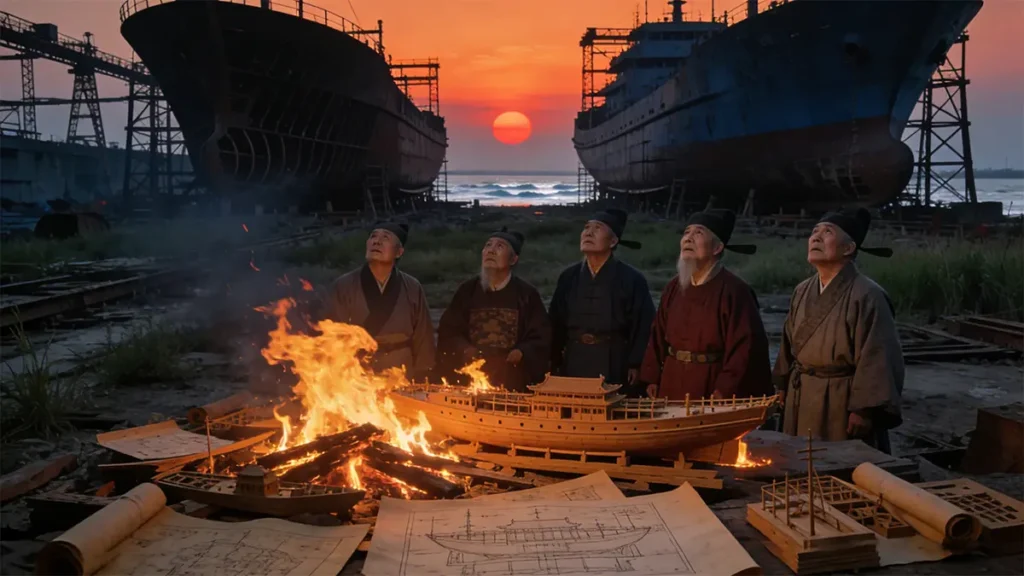
Shortly after Zheng He’s seventh expedition returned in 1433, the political winds within the Ming court shifted abruptly. Burdened by massive expenditures and pressure from the Mongol frontier in the north, the court adopted an inward-looking defensive posture, implementing a strict Maritime Ban (Haijin). Blueprints for constructing ocean-going treasure ships were destroyed, and state-organized long-distance trade was forcibly terminated. Historians call this “The Great Withdrawal.”
Viewed from a broader perspective, this was a moment that altered the course of world history. At the time, the Ming Dynasty accounted for approximately 30% of global GDP. Its sudden exit from the Indian Ocean trade network created a massive power vacuum. Within decades, Portuguese fleets led by Vasco da Gama and Afonso de Albuquerque exploited this opening. Unlike Zheng He, the Portuguese brought cannons, fortresses, and colonial domination, forcibly severing the existing tribute networks and transforming Malacca into a cog in a predatory colonial machine. Scholars like Jared Diamond often cite this case to explore why technologically advanced societies can falter in global competition. The Ming withdrawal marked the end of Asia-centered peaceful trade networks and the dawn of Western-dominated colonial globalization.
Modern Echoes: From Treasure Ships to Container Giants
Today, the Strait of Malacca remains one of the world’s busiest maritime corridors, carrying roughly one-third of global trade and nearly half of the world’s oil shipments. Modern container giants crisscross these waters, creating scenes strikingly similar to the treasure ship fleets of 600 years ago. In China’s current Belt and Road Initiative, Malacca remains a pivotal node—in many ways, a historical echo of the trade networks forged during Zheng He’s era.
What Zheng He bequeathed to Malacca was not a legacy of abandoned fortresses or conquered lands, but an early paradigm of interconnectedness, multicultural coexistence, and commercial governance. He demonstrated that without colonial domination or military plunder, a prosperous global trade hub could be built through technological empowerment, institutional innovation, and diplomatic mutual trust. Against today’s backdrop of geopolitical tensions and fragmented global trade, revisiting this history offers a path to thinking beyond zero-sum games.
From engineering marvels to institutional innovation and deep cultural integration, Zheng He’s story is far from over. If you are interested in specific details—such as the operational mechanisms of the “Guanchang” or the evolution of Baba-Nyonya culture—please refer to the FAQ section below.