The Majapahit Civil War: Why Zheng He Intervened in Old Java
Half a century before the Age of Exploration officially began, a super fleet of 27,000 officers and soldiers, armed with heavy artillery, suddenly appeared along the Southeast Asian coastline. This was not an advance colonial force of the Portuguese or Dutch, but the Ming Dynasty’s Treasure Fleet from the East, commanded by the Muslim eunuch Zheng He.
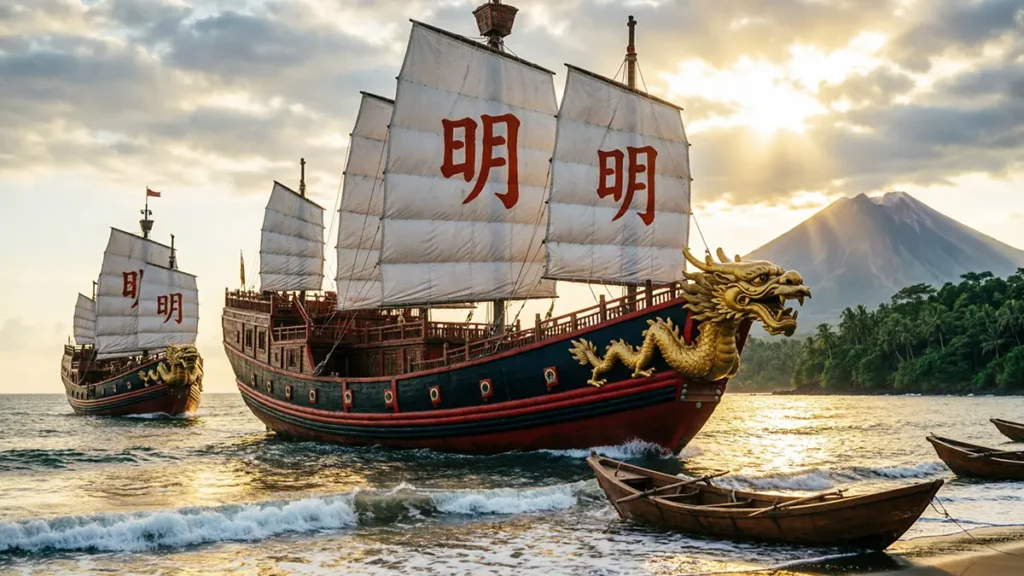
Their objective was not to seize territory, yet it proved far more formidable than conquest: they sought to forcibly restore order.
At that time, the Majapahit Empire—dubbed the “Venice of the East”—was engulfed in a bloody civil war known to history as the Paregreg War. This was not merely a struggle for the throne, but a devastating conflict comparable to England’s Wars of the Roses: King Wikramawardhana of the East and King Bhre Wirabhumi of the West tore the entire island of Java apart. It was at the height of this conflagration that Zheng He’s fleet arrived. It was at the height of this conflagration that Zheng He’s fleet arrived. To understand where this conflict fits within his broader expeditions, you can refer to the Zheng He 7 voyages timeline, which details each of his missions.The subsequent Zheng He Java intervention was not the “peace mediation” lightly described in traditional histories, but a ruthless, precise, and profoundly Machiavellian exercise of “gunboat diplomacy.”
This is not a story of “harmony,” but a case study in Realpolitik—a tale of power, miscalculation, and colossal reparations.
Western Reader’s Guide: Navigating the Key Players
When facing complex Javanese names, keep these three figures in mind:
- The Legitimate King (Wikramawardhana): Controlled the capital, represented orthodoxy, and emerged as the ultimate victor.
- The Rebel King (Bhre Wirabhumi): Controlled the eastern provinces; the challenger who paid a heavy price for accidentally killing Ming soldiers.
- The Arbiter (Zheng He / Cheng Ho): Admiral of the Ming fleet, a Muslim bearing Emperor Yongle’s “ultimatum.”
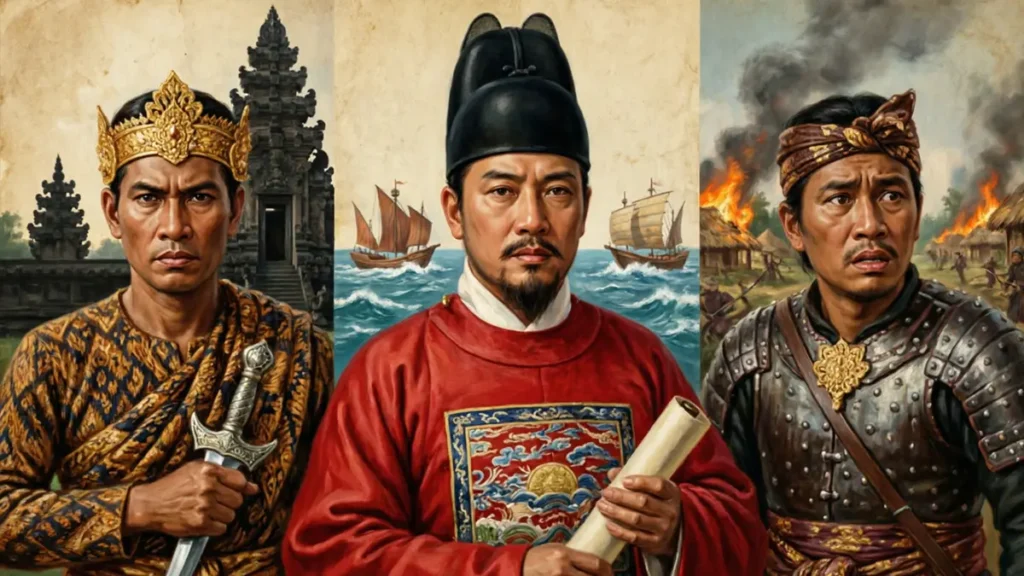
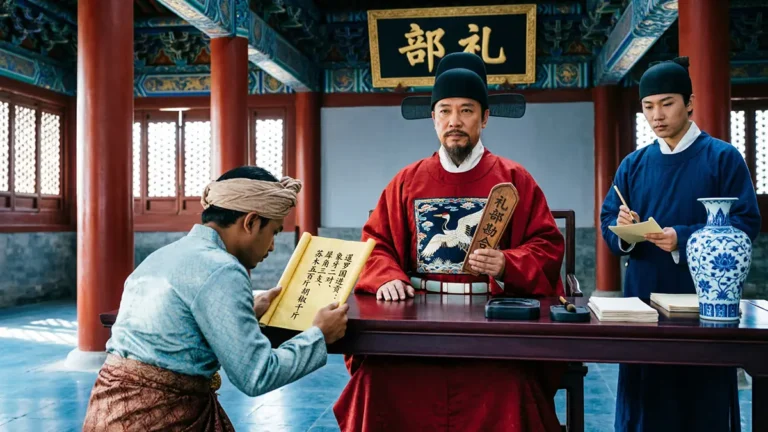
The story began with a fatal mistake. In 1405, part of Zheng He’s fleet landed on the northern coast of Java. At this time, the Majapahit Civil War had reached a fever pitch, and social order had completely collapsed. Amidst the chaos, forces loyal to King Bhre Wirabhumi mistook these strangers—dressed in foreign attire and heavily armed—for mercenaries or pirates hired by the Eastern King.
The outcome was shocking: 170 Ming officers and soldiers were killed.
This figure comes from Volume 59 of the Veritable Records of the Ming Taizong. For the Yongle Emperor, who had just ascended through a coup and urgently needed to establish his authority, this was not merely a loss of life but a direct challenge to the dignity of the “Celestial Empire.” Had this occurred in Europe, one might expect a bloody massacre in retaliation. But Zheng He’s choice revealed a higher dimension of strategic wisdom.
Instead of opening fire immediately, he opted for blockade and negotiation. What calculations lay behind this restraint?
Sixty Thousand Taels of Gold: An Economic “Nuclear Strike”
Zheng He’s response was not cannonballs, but an astronomical bill.
Faced with the looming barrels of the Treasure Fleet’s artillery, King Bhre Wirabhumi was forced to sue for peace. The indemnity he agreed to pay: 60,000 taels of gold.
To grasp the staggering magnitude of this figure, consider this analogy: it equaled several years’ worth of spice trade revenue for the Majapahit Kingdom. According to research by economic historian Peng Xinwei, this fortune could have funded a massive standing army or constructed an impregnable fortress. Yet for the Western King, mired in the Majapahit Civil War, this indemnity drained the lifeblood from his war machine.
Data Support: Confirmed via the History of Ming: Annals of Java and Wikipedia’s “Majapahit” entry as “60,000 taels of gold.”
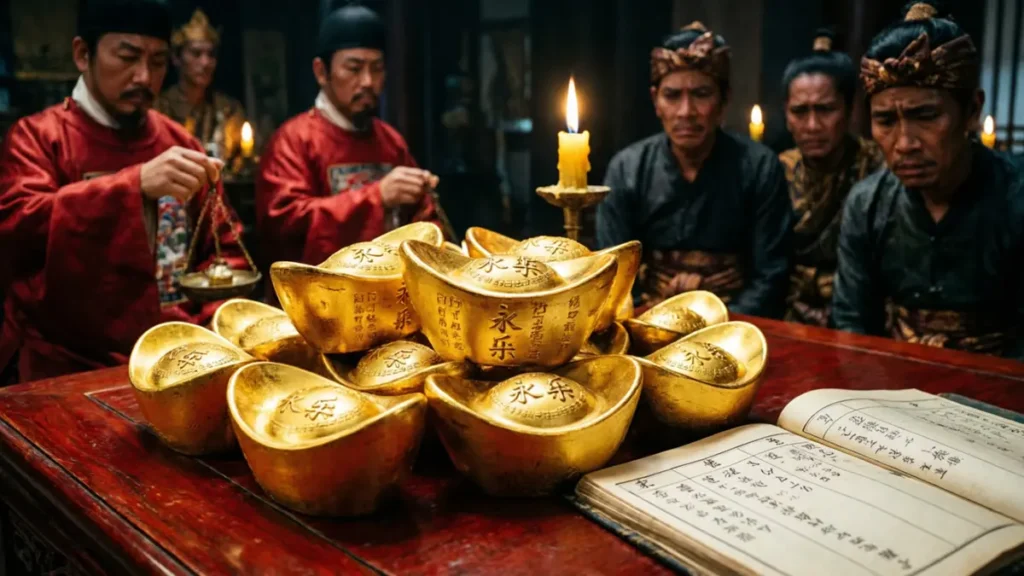
Strategic Consequences: The Western King could have used this money to purchase weapons and hire mercenaries against the Eastern King. Instead, these resources flowed entirely into the Ming treasury.
This encapsulates the core logic of the Zheng He Java intervention: it required no Ming soldiers to enter the jungle for hand-to-hand combat. Through a forceful “law enforcement operation,” Zheng He directly deprived the rebels of the capital needed to sustain their war effort. This exemplified a classic “asymmetric intervention”—I won’t fight your battles, but I will ensure your adversary cannot fight at all.
This strategy was ruthlessly cold-blooded yet exceptionally efficient. It revealed the Ming Dynasty’s unique philosophy in handling international crises: not pursuing territorial occupation, but demanding absolute order and obedience.
The Moral Gray Zone: A Muslim Eunuch’s Dilemma
Here lies an often-overlooked detail that deeply resonates with Western readers: Zheng He himself was a Muslim (Haji Ma), and the civil war he intervened in unfolded between two Hindu-Buddhist princes.
Imagine Zheng He’s psychological portrait standing on the deck. As a Muslim from Yunnan, he may have felt a natural affinity for the emerging Islamic forces on this land (such as the precursors to the Demak Sultanate). Yet his identity was first and foremost that of a servant to the Yongle Emperor, a guardian of the “Celestial Empire’s” order.
- The Moral Dilemma: When the Western King (a potential future Muslim ally, or at least an anti-Hindu orthodox force) faced collapse, did Zheng He ever hesitate?
- The Realistic Choice: Historical records show Zheng He displayed no hesitation whatsoever. He strictly enforced the imperial court’s orders and pressured the Western King.
This demonstrates that on the scales of Realpolitik, religious identity yielded to national interests. Zheng He’s actions proved that long before Machiavelli penned The Prince, Eastern statesmen had mastered this principle: foreign policy should not be shackled by moral or religious sentiment, but must serve the stability of geostrategic interests.
This amoral decision-making process represents precisely the “gray zone” that Western history enthusiasts find so compelling. It shatters the stereotype of Zheng He as merely a “peace envoy,” revealing instead the image of a complex, pragmatic, and even ruthless statesman.
Global Perspective: “Gunboat Diplomacy” Before the Age of Exploration
Elevating our view to the global stage, the events of 1405 hold landmark significance.
Typically, we regard “gunboat diplomacy” as the exclusive domain of the 19th-century British Royal Navy—using warships to coerce weaker nations into opening ports. Yet Zheng He’s actions in Java predated those of Lord Dalhousie by a full 400 years.
| Feature | 19th-Century European Model | 15th-Century Ming Dynasty Model |
|---|---|---|
| Method | Military threats & Invasion | Display of Military Force |
| Goal | Unequal treaties & Colonization | Symbolic Indemnities & Tribute |
| Outcome | Long-term Colonial Rule | Restoration of Order & Withdrawal |
The Cambridge History of China notes that Emperor Yongle’s diplomatic objective was to establish a “concentric circle” order based on ritual and trade, rather than direct administrative control. Zheng He’s intervention in Java perfectly embodied this goal: he did not need to establish a governorate there, but only to ensure local rulers understood that disrupting trade routes and killing envoys carried consequences they could not afford.
This intervention, though brief, was explosively potent. It successfully suppressed the intensity of the Majapahit Civil War within a short timeframe, forcing both sides back to the negotiating table (though the Eastern King ultimately eliminated the Western King through military means). More significantly, it sent a signal across the entire Indian Ocean world: Ming maritime power existed not merely on maps, but in every moment an anchor chain was cast.
The Price of Order and the Echoes of History
With the departure of Zheng He’s fleet, Java regained a superficial calm. King Wikramawardhana ultimately prevailed in the civil war, unifying the Majapahit Empire. Yet the long-term repercussions of this intervention proved profound.
The massive outflow of gold accelerated the decline of Majapahit’s centralized authority, empowering local nobility and indirectly creating a power vacuum that later facilitated the rise of Islamic sultanates along the coast. Today, when we stroll through the Sam Poo Kong Temple in Semarang, we often witness scenes of peaceful, incense-filled tranquility. Yet behind those ancient stone pillars lies a hidden, breathtaking power struggle.
For modern readers, this history offers a profound lesson: in international relations, peace is rarely begged for, but rather enforced through deterrence. Zheng He’s 1405 expedition was neither simple aggression nor naive mediation, but a meticulously calculated coercive peace.
When we revisit the intersection of the Majapahit Civil War and Zheng He’s expedition, perhaps we should temper our romanticized lens of the “great navigator” with a cooler eye toward the mechanisms of power. After all, in an era without the United Nations, order sometimes only truly descended when the shadow of immense force was cast upon the seas.
This, above all, is the most authentic legacy the Zheng He Java intervention bequeathed to the world.