The Structure of Zheng He’s Fleet: Treasure Ships, Horse Ships, and Supply Ships Explained
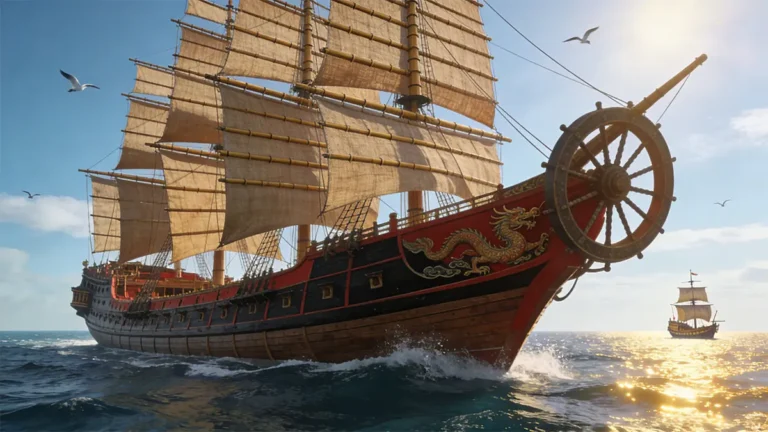
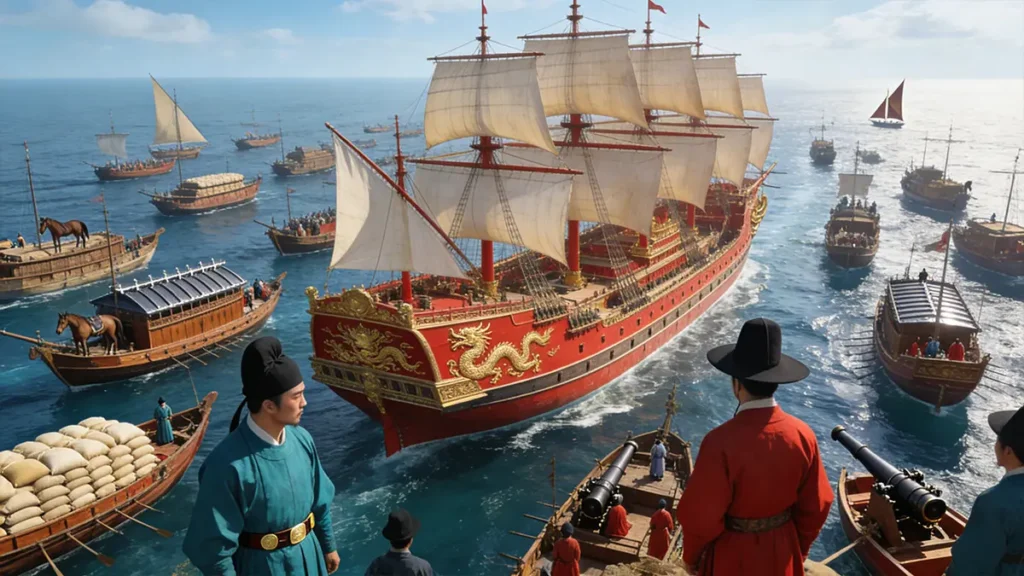
Many people mistakenly believe that Zheng He’s voyages to the Western Seas were solely for treasure hunting. Yet from an engineering perspective, they represented the most complex modular maritime system in the 15th century. Dubbed a “floating city at sea,” this fleet wasn’t composed of a single colossal vessel but a coordinated network of six specialized ship types with distinct functions—from the diplomatic flagship treasure ships to the world’s first supply vessels equipped with systematic freshwater management capabilities. This “aircraft carrier battle group”–style structure predated similar Western logistical concepts by a full three centuries.
The Scale: A Cross-Century Comparison That Defies Imagination
In 1405, when Zheng He set sail with 27,800 men, Europe’s largest maritime expedition was still merely a coastal reconnaissance mission involving dozens of people. To grasp the scale of this disparity, consider it alongside Columbus’s first voyage 87 years later:
| Dimension | Zheng He’s Fleet (1405) | Columbus’s Fleet (1492) |
|---|---|---|
| Crew Size | 27,800 people | ~90 people |
| Number of Ships | 317 vessels | 3 ships |
| Flagship Length | 137 meters (450 feet) | 19 meters (62 feet) |
| Voyage Range | China → East Africa (~14,000 km) | Spain → Caribbean (~6,000 km) |
This was not merely a matter of size—it was a generational leap at the systemic level. Zheng He wasn’t just sailing; he was operating a self-sustaining maritime society across two oceans.
Why Was Zheng He’s Fleet Structure Unprecedented?
The answer lies in the precision-engineered collaborative system formed by its six specialized vessel types. Each ship functioned as an organ within this floating metropolis.
Flagship Module: Treasure Ship — A Mobile Homeland
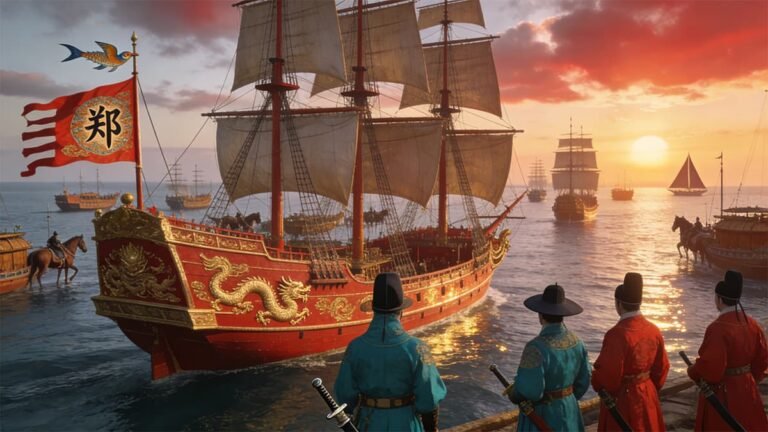
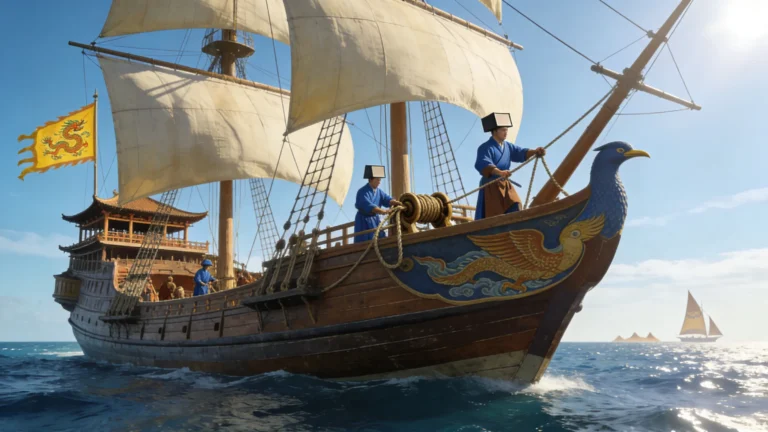
The treasure ship was the soul of the entire fleet. The largest measured approximately 137 meters (450 feet) in length and 56 meters (184 feet) in width—equivalent to 1.5 American football fields, and even larger than many modern destroyers.
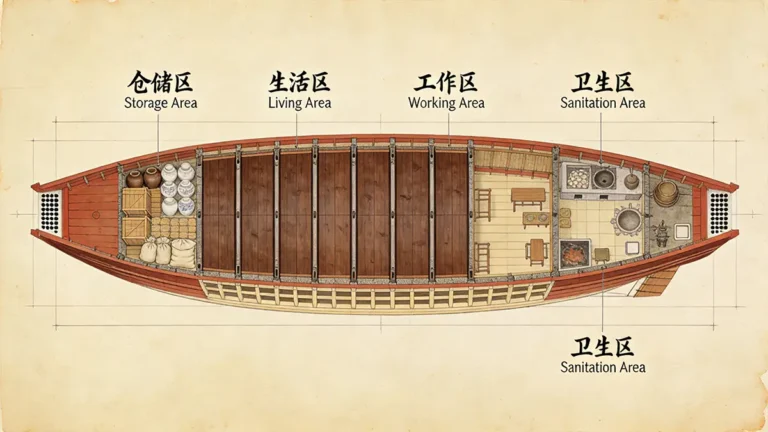
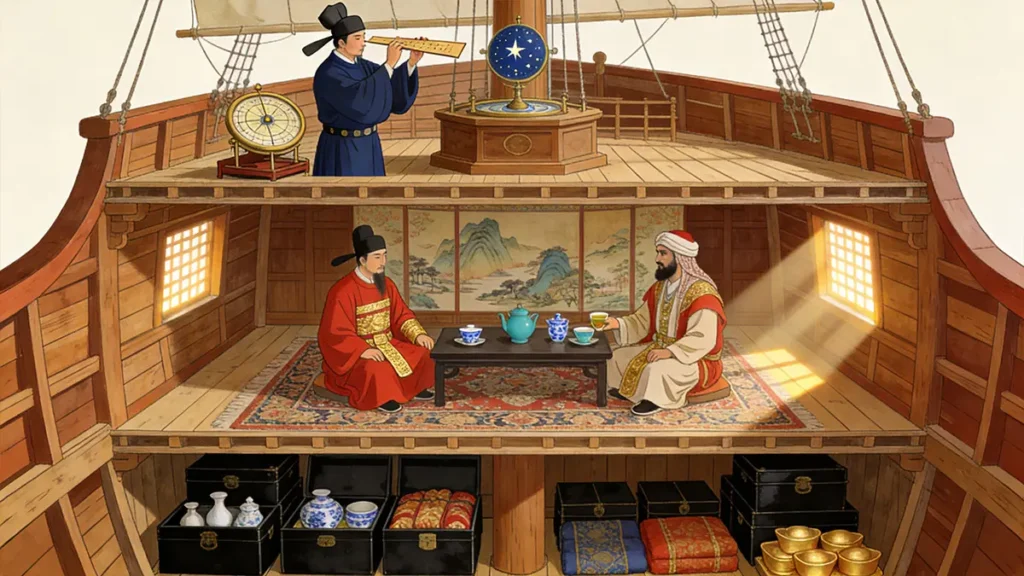
Its interior was not a hollow cargo hold but a three-tiered functional space:
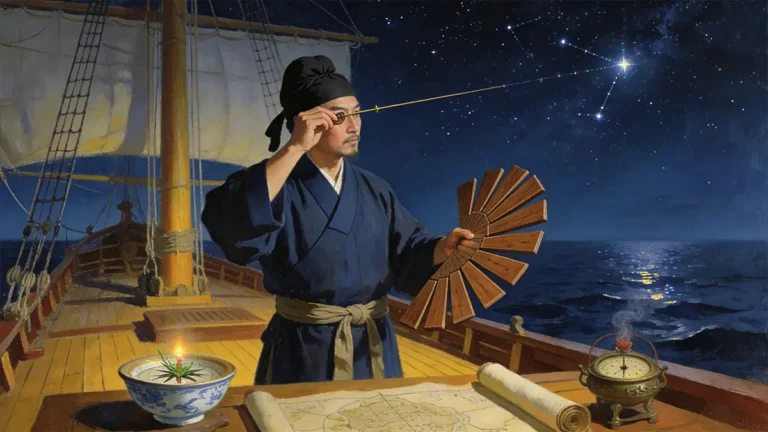
- Upper Deck: An astronomical observatory where navigators used “oceanic celestial navigation” to measure the altitude of Polaris and determine latitude;
- Middle Deck: Diplomatic reception halls and quarters for high-ranking officials, decorated with silk screens and Persian carpets;
- Lower Deck: Storage for state gifts—crates of porcelain, lacquerware, gold ingots, and brocade destined for foreign rulers.
The true engineering marvel lay in its watertight bulkheads: the hull was divided by transverse wooden partitions into dozens of independent compartments. If one section flooded, the others retained buoyancy. This technology would not appear in Europe until the 18th century.
Notably, the fleet’s commander, Zheng He, was a Hui Muslim from Yunnan, originally named Ma He. His religious identity became a crucial diplomatic asset. In ports across the Arabian Peninsula and East Africa, local Muslim communities welcomed the fleet more readily due to shared faith—a strategic advantage documented in UNESCO’s “Maritime Silk Road” archives.
Logistics Module: Horse Ships and Grain Ships — Heavy-Duty Floating Warehouses
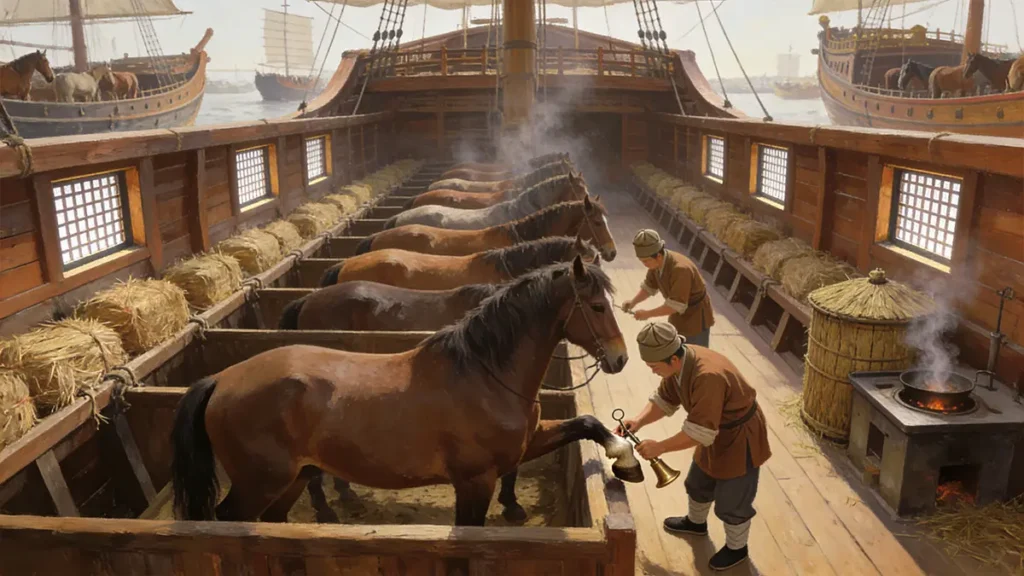
Horse ships carried far more than equines. They transported tribute animals—including giraffes from East Africa in 1415, which Ming officials hailed as the mythical qilin (auspicious unicorn).
Their design reflected deep engineering insight:
- Anti-slip grooves on deck planks prevented horses from falling during storms;
- High-side ventilation windows actively expelled ammonia from stables, protecting crew health;
- Hay storage was isolated at the stern, away from kitchen fire hazards;
- According to the Zheng He Genealogy, two dedicated veterinarians accompanied each voyage to care for livestock (National Maritime Museum, Greenwich).
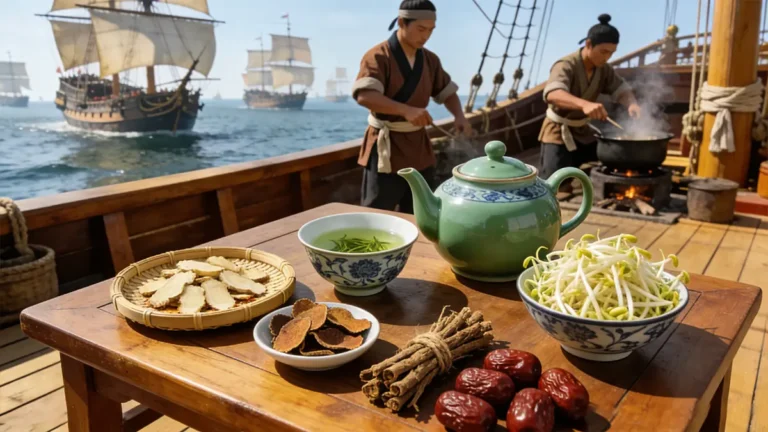
Grain ships carried months’ worth of provisions: rice, pickled vegetables, and douchi (fermented black beans)—a “pre-modern superfood” rich in probiotics and B vitamins, essential for gut health on long voyages.
Life Support Module: Water Tankers — 15th-Century Freshwater Factories
Water tankers were the fleet’s lifeline. Over 30,000 large ceramic jars—each holding about 200 liters—provided a total freshwater capacity of 6 million liters (1.6 million gallons). Rainwater channels on deck funneled precipitation into central reservoirs.
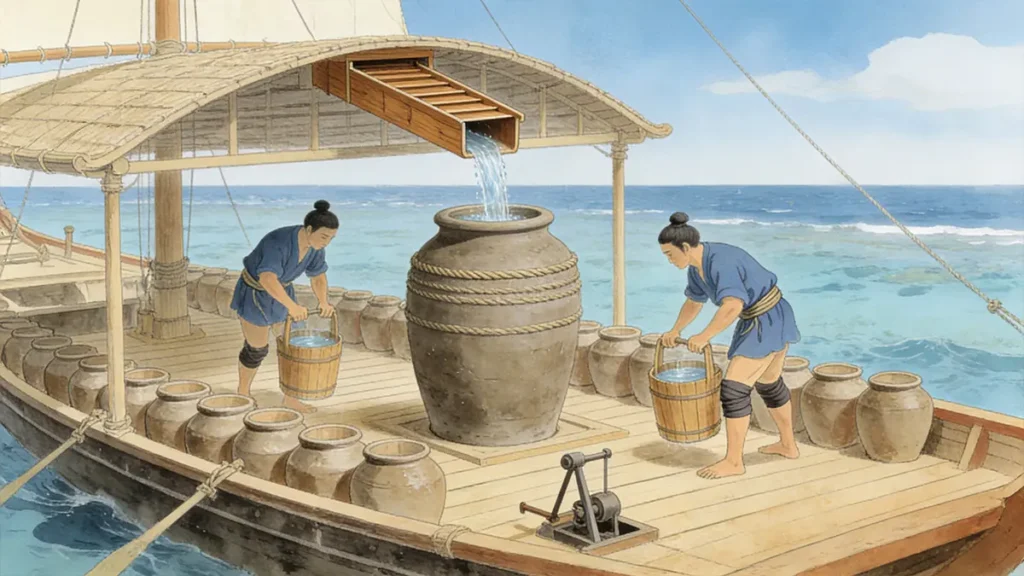
More importantly, the fleet relied on a pre-established network of resupply ports: Champa (Vietnam), Malacca (Malaysia), Calicut (India), and Hormuz (Iran). Every 30–40 days, ships docked to replenish water and fresh food.
Thanks to their compact size and agility, water tankers also served multiple auxiliary roles: firefighting, casualty evacuation, and emergency logistics—showcasing the Ming navy’s principle of resource multiplexing.
Defense & Transport Module: Troop Carriers and Warships
Troop carriers could accommodate over 300 personnel—soldiers, envoys, craftsmen, and interpreters—and typically encircled the treasure ships as a protective inner ring.
Warships, measuring 30–50 meters (100–160 feet), bristled with early firearms, rockets, catapults, and crossbows. Deployed on the fleet’s outer perimeter, they focused on pirate deterrence, not conquest.
The entire defense doctrine emphasized asymmetric deterrence: display strength to avoid conflict. As the Yingya Shenglan records: “Upon encountering pirates, cannons were fired as warning—subduing without battle.”
The Science Behind the Floating City: How Did They Survive at Sea?
Mobile Farming: Sprouts and the Prevention of Scurvy
Crews grew soybean sprouts onboard. By soaking beans and placing them in shaded deck corners, they harvested vitamin C–rich sprouts in just 3–5 days. This practice likely prevented scurvy—300 years before Captain Cook promoted sauerkraut in the British Navy (Schottenhammer, 2020).
Navigation Without GPS: Monsoons and Stars
The fleet sailed in perfect sync with nature:
- Winter: Southward on the northeast monsoon;
- Summer: Northward on the southwest monsoon.
Navigators used water compasses (magnetic needles floating in bowls—more stable than European dry compasses) and celestial navigation via star altitudes. Without longitude? No problem—they relied on fixed inter-port routes and accumulated experience.
Communication Without Radio: Flags, Lanterns, and Gongs
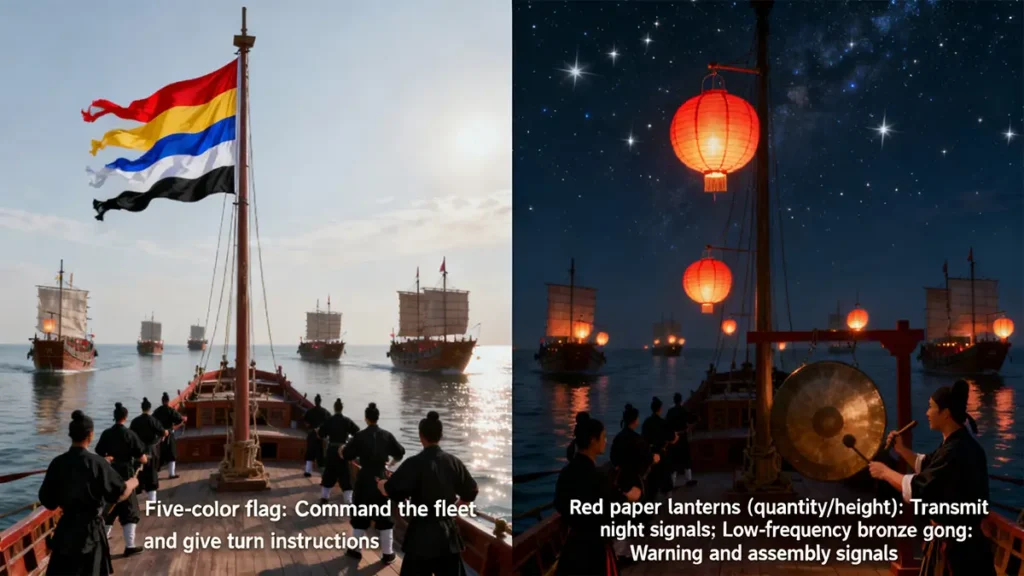
Coordination among 300+ ships relied on a sophisticated signaling system:
- Day: Five-color flags—Red = Stop, Yellow = Assemble, Blue = Turn;
- Night: Lantern codes—number, height, and flash frequency conveyed commands;
- Emergencies: Low-frequency gong beats cut through wind and waves; signal cannons synchronized fleet-wide maneuvers.
This allowed the armada to move as one organism.
A Multilingual Mini–United Nations
The fleet was a cross-cultural microcosm:
- Arabic-speaking interpreters (tongshi) facilitated diplomacy in Islamic lands;
- Persian merchants advised on trade protocols in Hormuz;
- Malay pilots guided ships through the treacherous Strait of Malacca.
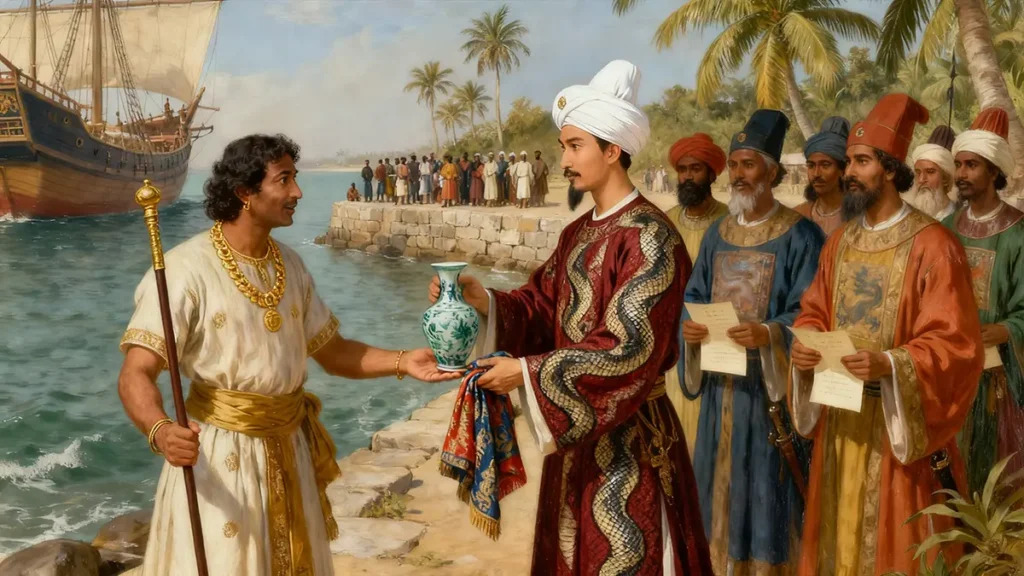
At key ports like Calicut and Hormuz, local guides boarded to liaise with authorities—ensuring peaceful entry into unfamiliar territories.
The Legacy: Why Didn’t This System Become Permanent?
After seven voyages (1405–1433), the Ming Dynasty abruptly turned inward. In 1433, Emperor Xuande ordered all oceanic expeditions halted and treasure ship blueprints destroyed. The Veritable Records of the Ming state plainly: “Destroy the designs to eliminate future troubles.”
This reveals a fundamental divergence:
- Ming China: Treated seafaring as a one-time political spectacle to bolster imperial legitimacy;
- Portugal: From 1415, Prince Henry institutionalized navigation through schools, maps, and shipbuilding—creating a self-replicating knowledge system.
China’s maritime expertise fractured; Europe surged ahead.
Yet Zheng He’s legacy endured. When Vasco da Gama reached East Africa in the early 1500s, locals still told tales of “great ships from the East” (Diffie & Winius, 1977). On Kenya’s Lamu Archipelago, oral histories speak of “Chinese sailor descendants”—a cultural memory that, while lacking definitive DNA proof, testifies to real contact.
Conclusion: The Ocean as Bridge, Not Conduit of Conquest
Zheng He’s fleet stands as a civilization peak never fully inherited. These Ming treasure ships were more than enormous wooden vessels; they formed the centerpiece of a sophisticated maritime system that combined diplomacy, logistics, navigation, and defense. It fought disease with bean sprouts, mastered monsoons, commanded fleets with colored flags, and earned respect through generosity—not force.
Its true legacy isn’t “why China didn’t colonize,” but that it proved another path was possible: the ocean as a bridge between civilizations, not a highway for plunder.
In today’s era of reimagining global cooperation, this 15th-century floating city still radiates the quiet brilliance of inclusion, engineering, and peace.
Frequently Asked Questions (FAQ)
Authoritative Sources for Further Reading
- History of the Ming Dynasty, Vol. 304: Biography of Zheng He | Chinese Text Project
- J.V.G. Mills, Yingya Shenglan (Cambridge University Press, 1970)
- Joseph Needham, Science and Civilisation in China, Vol. 4: Physics and Physical Technology
- British Library – “Zheng He’s Voyages” Online Exhibition
- UNESCO – “The Maritime Silk Road”
- National Maritime Museum, Greenwich – Chinese Shipbuilding Collection