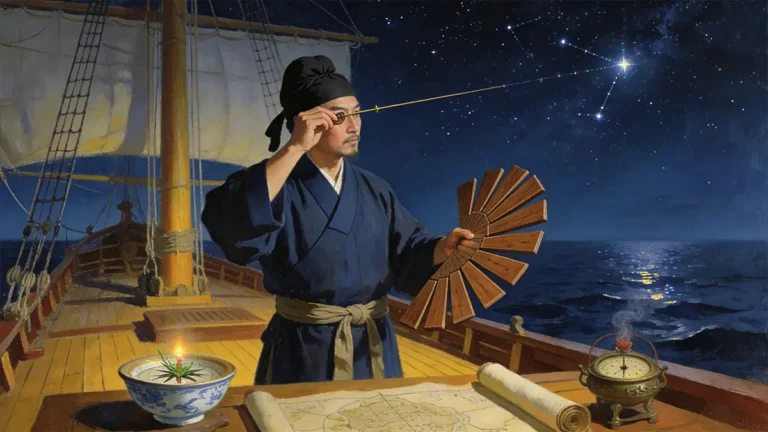
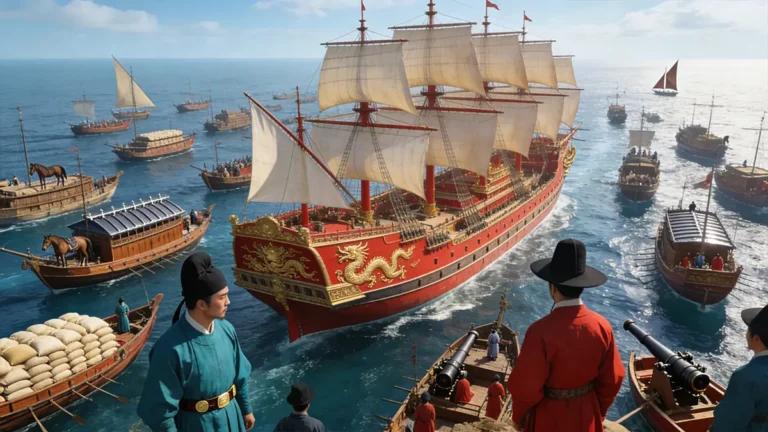
How Did Ming Dynasty Ships Communicate at Sea? Flags, Lanterns & War Drums Explained
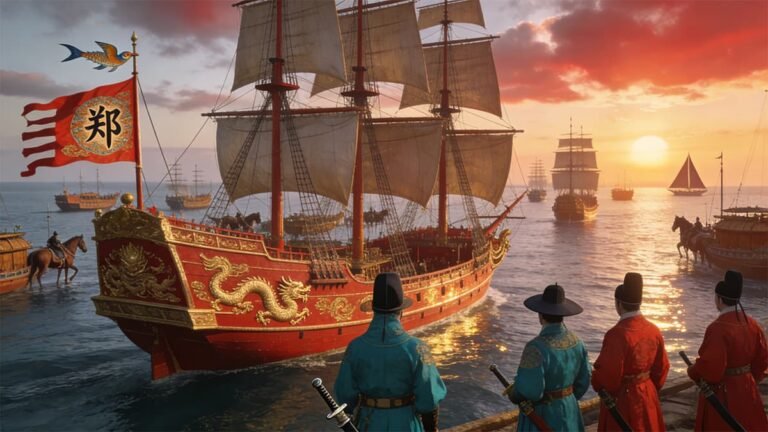
In the winter of 1431, just before Zheng He embarked on his seventh expedition to the Western Seas, a fleet detachment encountered sudden dense fog off the coast of Champa, Vietnam. Visibility plummeted to less than 100 meters, instantly severing communication between the flagship and the rear squadron. According to the Ming Dynasty text Yingya Shenglan (The Overall Survey of the Ocean’s Shores), had it not been for the timely sounding of three gong strikes—which prompted all ships to gather by sound—the entire fleet might have collided with hidden reefs.
This was no isolated incident. Portuguese apothecary and diplomat Tomé Pires wrote in his 1515 work Suma Oriental:
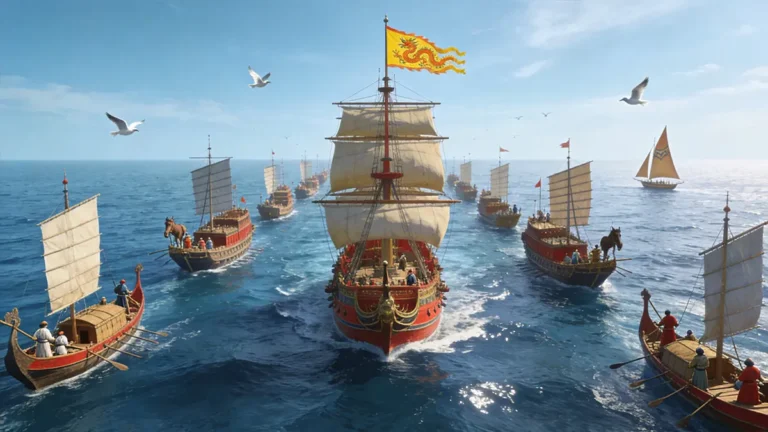
“The multitude of Chinese ships moved as one body, astonishing Europeans. They had no horns, no confusing flag signals—only lamps lit and drums beaten, and ten thousand vessels followed.”
How did the Ming navy achieve this level of coordination four centuries before the invention of radio? The answer lies not in myth, but in a precise, multi-layered signaling system built on color, light, and rhythm. This protocol allowed tens of thousands of sailors across hundreds of ships to “see” commands by day, “read” them in darkness, and “hear” them through storms—enabling silent, real-time coordination across the Indian Ocean.
Let’s begin where daylight made communication clearest: with the flags that turned philosophy into naval command.
Daytime: Five-Colored Command Flags — A Language Rooted in Cosmic Order
On clear seas, visual signaling was fastest and most reliable. The Ming navy didn’t rely on improvised gestures or random cloth—they used a rigorously codified system grounded in China’s ancient Five Elements (Wu Xing) cosmology.
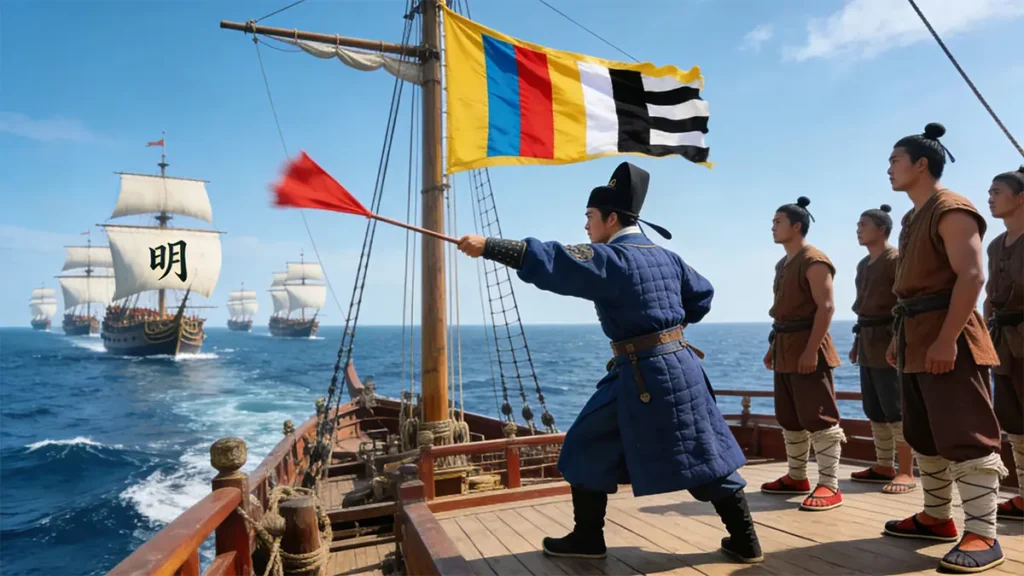
According to the Ming military compendium Wubei Zhi (Treatise on Military Preparedness, compiled in 1621 but reflecting 14th-century practice), the fleet employed five primary signal flags, each tied to a direction and elemental force:
- Blue (Qing): East, Wood
- Red: South, Fire
- Yellow: Center, Earth
- White: West, Metal
- Black: North, Water
Raising a red flag, for instance, could mean “sail south” or “prepare for engagement.” The yellow flag was reserved exclusively for the flagship—it signaled direct orders from the commander-in-chief.
But meaning wasn’t just in color—it was in motion. As recorded in the Ming Shi · Bingzhi IV (History of Ming: Military Treatise IV):
“By day, signals are given with flags. A swift raise signifies advance; a slow lowering signifies retreat.”
More nuanced commands used directional gestures: three leftward waves ordered the entire port wing to turn; a sharp upward thrust meant emergency assembly.
Critically, the system was bidirectional. After the flagship issued a signal, every subordinate vessel had to raise a small “response flag” (yingqi) in acknowledgment—functionally identical to a modern “ACK packet” in digital communication. No reply? The flagship knew the message hadn’t gotten through.
This discipline enabled Zheng He’s fleet to maintain tight formations across open ocean—a feat unmatched in Europe at the time, where ships still relied on shouting or single-color banners.
So what happened when night fell, and visibility vanished?
Nightfall: Lanterns as Digital Code—Not Just Light, But Language
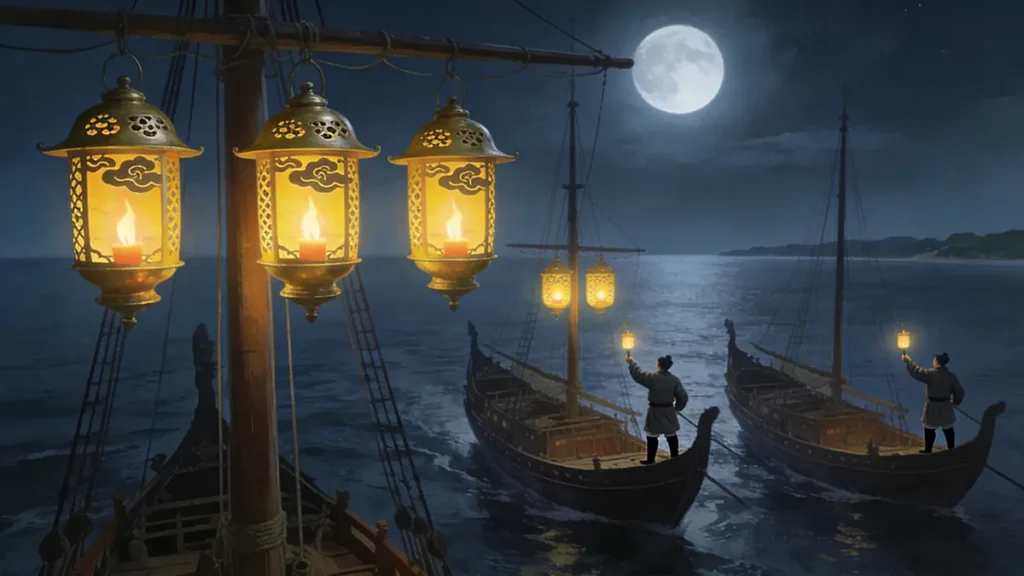
After sunset, flags became useless. But the Ming navy seamlessly switched to a light-based protocol using specially designed copper lanterns.
These weren’t ordinary lamps. Fueled by refined whale oil or pine resin, they burned steadily with minimal smoke—even in Force 8 gales—and cast a bright, steady glow visible over long distances.
More importantly, the number, height, and arrangement of lanterns formed a nighttime coding system. Historian Joseph Needham documented this in Science and Civilisation in China (Vol. 4, Part 3):
- 1 lantern: Stand by at anchor
- 2 lanterns: Proceed forward
- 3 lanterns: Emergency assembly—all ships converge on the flagship
Height indicated authority: three lanterns hoisted atop the flagship’s mainmast signaled full-fleet mobilization. Smaller vessels displayed only a single lantern on their foremast, confirming readiness without overruling command.
To ensure signals reached the rear of long convoys, the fleet used a relay system: once a ship observed the flagship’s signal, it immediately replicated the lantern pattern, passing the message down the line. In a 20-ship column, a command could propagate from front to back in under two minutes.
This sophistication wouldn’t appear in Europe until the 18th century, when the British Royal Navy developed its own night signaling lamps. By then, the Ming system had already guided fleets across half the globe.
But even lanterns failed in thick fog. That’s when sound took over.
Thick Fog and Storms: War Drums and Gongs — Acoustic Commands That Cut Through Chaos
When visibility dropped below 50 meters—as in monsoon rains or sea fog—visual signals disappeared entirely. The Ming fleet then activated its third layer: auditory signaling.
Only two instruments were used: oxhide war drums and bronze gongs. Their use followed strict rhythmic codes, not improvisation.
As the Wubei Zhi states plainly:
“Rapid drumbeats signal advance; slow beats signal retreat; gong sounds signal halt.”
Specific patterns included:
- Drums at 2–3 beats per second: Full-speed advance or rapid disengagement
- Slow, even drumming: Orderly withdrawal or formation adjustment
- Single gong strike: Immediate stop—all movement ceases
- Drums + gongs together: Highest alert—battle stations
Why these instruments? Modern acoustic analysis (e.g., a 2018 study in the Journal of Maritime Archaeology) confirms that low-frequency drum tones (80–200 Hz) travel farthest in humid air—over 1 kilometer—while high-frequency gong notes (1–2 kHz) cut through the roar of waves. Together, they created a full-spectrum “maritime broadcast.”
Each treasure ship carried dedicated signalmen: one for flags, one for lanterns, one for drums. All underwent rigorous training to avoid misreading rhythms in chaos.
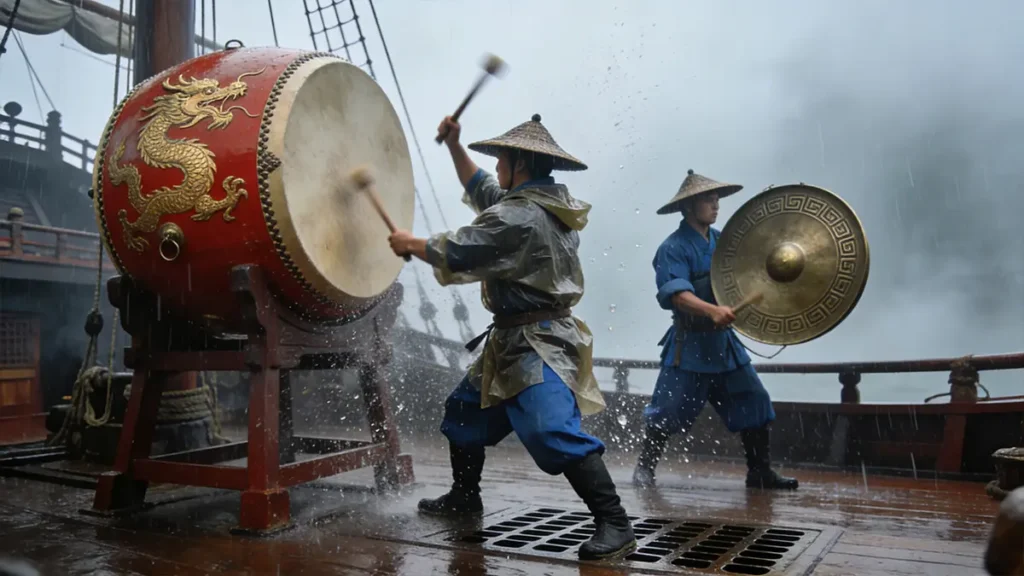
This system let Zheng He’s fleet navigate stormy waters off Sumatra with cohesion. Meanwhile, Vasco da Gama’s contemporaries often anchored helplessly in similar conditions.
Yet even this had limits. For true emergencies—pirate attacks, groundings—there was one last resort.
Emergency Signals: Smoke and Torches—But Pigeons Were Not “Sea Couriers”
In life-or-death crises, speed mattered most. The Ming navy used smoke and fire as distress signals.
- White smoke (wet straw + sulfur): “Our ship is damaged—send aid”
- Black smoke (animal fat added): “Enemy sighted—prepare for combat”
- Red torches at night: Visible for miles; signaled immediate danger
Ma Huan, a Muslim interpreter on Zheng He’s voyages, recorded in Yingya Shenglan (1416) how, during an attack near Ceylon (Sri Lanka):
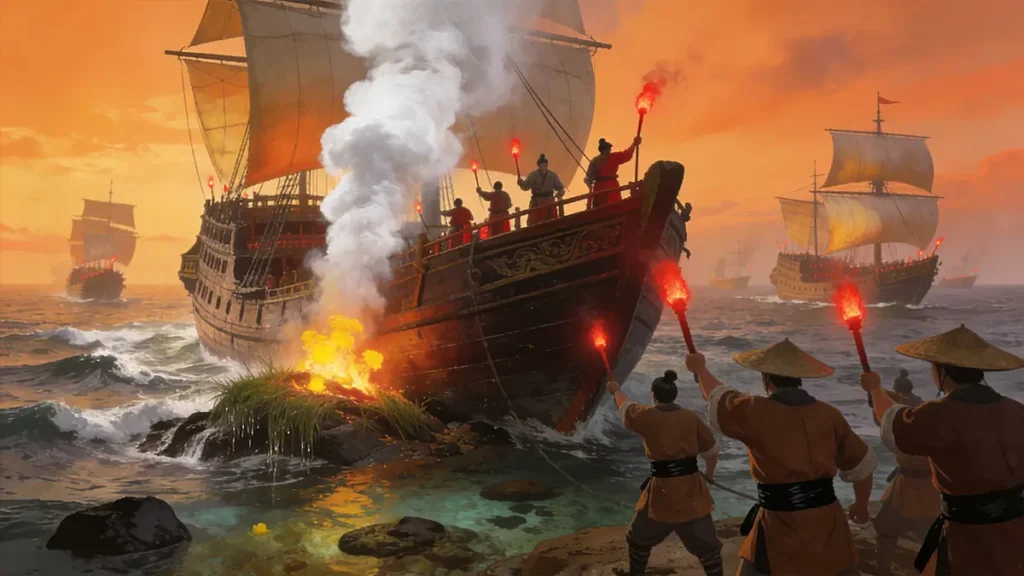
“They raised a red flame as a signal, and all ships gathered around like a fortress.”
As for carrier pigeons—often romanticized in popular accounts—their role was far more limited. Pigeons require land-based lofts and visual landmarks to navigate. Over open ocean, they were useless.
In reality, Zheng He’s fleet used pigeons only between fixed ports. At trading posts in Calicut (India) and Malacca, messengers released birds carrying scrolls to Nanjing—a form of strategic shore-to-shore intelligence, not real-time fleet coordination.
Still, this layered redundancy—flags, lights, sound, fire—ensured that none of Zheng He’s seven voyages failed due to communication breakdown.
But how did this system compare globally? And did it leave a legacy beyond China?
A Global Perspective: A World-Class System, Confirmed by Foreign Observers
From a global maritime standpoint, the Ming signaling system was extraordinary for its time.
Portuguese historian Gaspar Correia noted in Lendas da Índia (Legends of India, c. 1550s) that when the Portuguese arrived in Malacca in 1509, they found local authorities using a “three-light system” to manage nighttime ship traffic—“a method apparently derived from the great Eastern fleets.” This was almost certainly a legacy of Zheng He’s visits decades earlier.
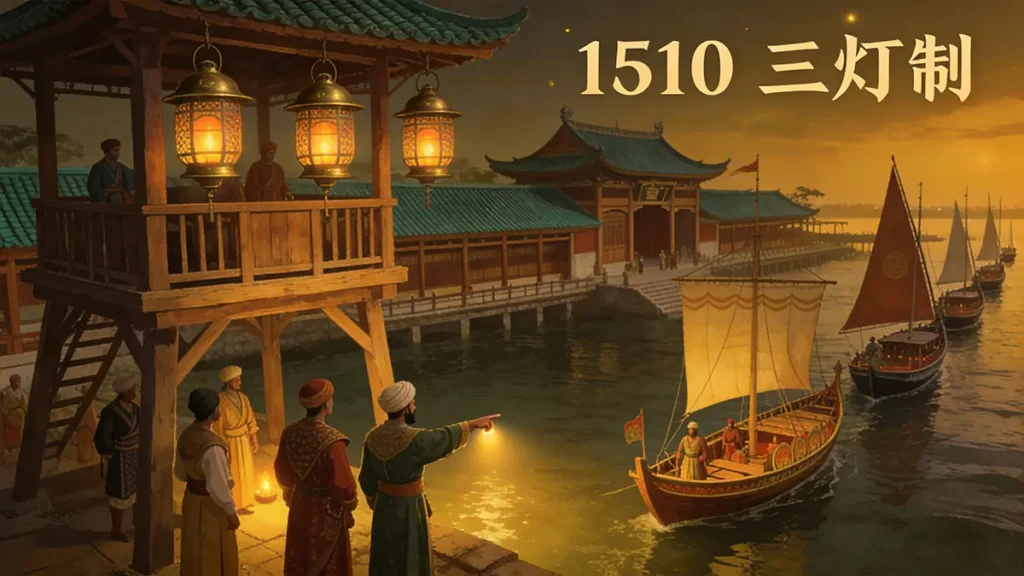
Similarly, later versions of the Javanese epic Nagarakretagama mention that the Majapahit Kingdom established “signal keepers” in the mid-15th century whose procedures closely mirrored those in the Wubei Zhi.
Most impressively, the system reflected institutional sophistication: standardized equipment, uniform training, and feedback loops—hallmarks of modern command-and-control, rare in the pre-industrial world.
Europe wouldn’t develop a comparable coded flag system until 1799, when Home Popham introduced his signal code for the British Navy. The Ming had operationalized theirs by 1405.
This isn’t nationalist exaggeration—it’s cross-verified by global sources. As British scholar Karl A. Wittfogel observed:
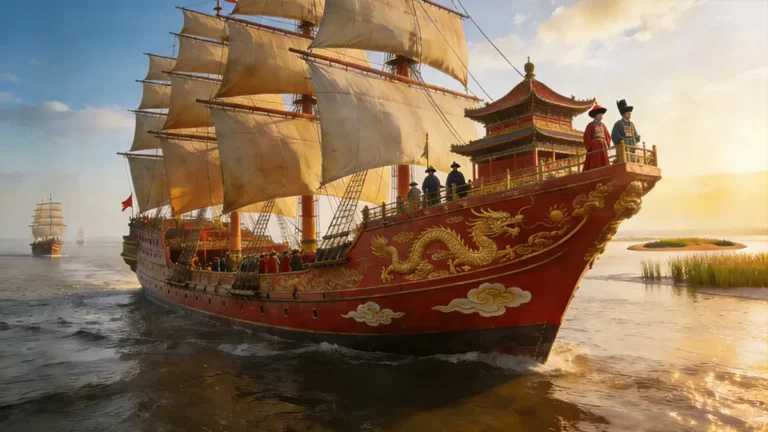
“The command efficiency of the Ming navy represents the closest approximation to ‘systems engineering’ in the history of pre-industrial maritime affairs.”This incredible coordination was the backbone of Zheng He’s treasure ships, allowing them to dominate the seas for decades.
Conclusion: The Silent Fleet — Humanity’s First Maritime “Local Area Network”
Zheng He’s treasure ships crossed oceans without engines, radios, or satellites—yet moved as one organism. Their secret wasn’t magic, but a triad of technologies:
- Flags spoke the language of daylight
- Lanterns encoded the night
- Drums and gongs beat the rhythm of survival in storms
Together, they formed the world’s first real-time, large-scale collaborative network at sea—600 years before the internet.
Today, as engineers design V2X (vehicle-to-everything) systems for drone swarms and autonomous convoys, they’re echoing principles Ming sailors mastered with silk, copper, and oxhide.
If you could step aboard one of those treasure ships, which role would you choose: flag bearer, lantern keeper, or drummer? And which season would test your skills most—the typhoons of the South China Sea, or the impenetrable fogs off the Arabian coast? Share your thoughts in the comments below.
Authoritative Sources:
- Ma Huan, Yingya Shenglan (1416). English translation: The Overall Survey of the Ocean’s Shores, trans. J.V.G. Mills, Hakluyt Society, 1970.
- Ming Shi · Bingzhi IV (History of Ming: Military Treatise IV). Zhonghua Book Company edition. Available via Chinese Text Project.
- Mao Yuanyi, Wubei Zhi (Treatise on Military Preparedness), Vol. 186. Digitized by Harvard-Yenching Library. Access via HathiTrust.
- Pires, Tomé. Suma Oriental (c. 1515). Translated by Armando Cortesão, Asian Educational Services, 1990.
- Needham, Joseph. Science and Civilisation in China, Vol. 4, Part 3: Civil Engineering and Nautics. Cambridge University Press, 1971.
- “Acoustic Properties of Historical Naval Signals,” Journal of Maritime Archaeology, Vol. 13, 2018.