How Zheng He’s Voyages Transformed Southeast Asian Cuisine
Whether you’re enjoying a bowl of laksa at a hawker center in Singapore or taking a bite of Nyonya cake on a street corner in Malacca, the spicy, coconutty, and slightly tangy flavors dance on your tongue. This distinctive taste is no accident; its origins can be traced back to the Indian Ocean monsoons of the early 15th century. Between 1405 and 1433, the Ming fleet undertook seven voyages. Sailors, merchants, and accompanying artisans stopped at ports across Southeast Asia to restock supplies, and some eventually chose to settle there. Historical records and linguistic studies indicate that these early immigrants intermarried with the indigenous peoples of the Malay Archipelago, gradually forming the Peranakan community. The fusion of culinary cultures did not happen overnight, but the maritime network certainly provided the initial impetus for this centuries-long evolution of taste. To understand Zheng He’s impact on Southeast Asian cuisine, we must first return to that era of trade dominated by sails and spices, and examine how the food found in ship’s holds evolved into the staples of today’s dining tables.
I. 1405–1433: Fleet Logistics and Port Supply Stations
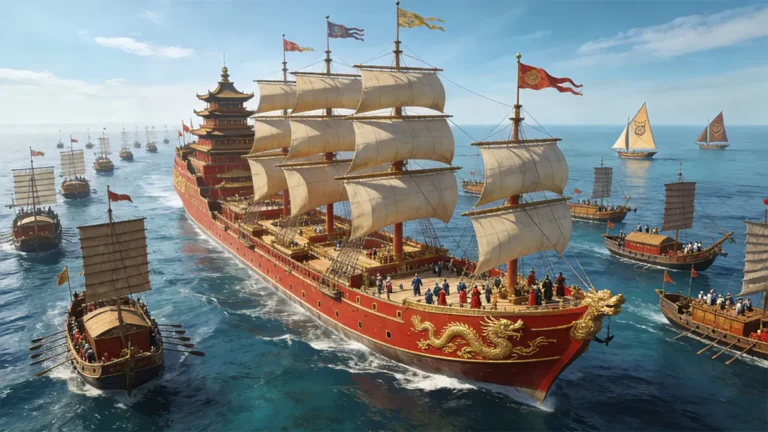
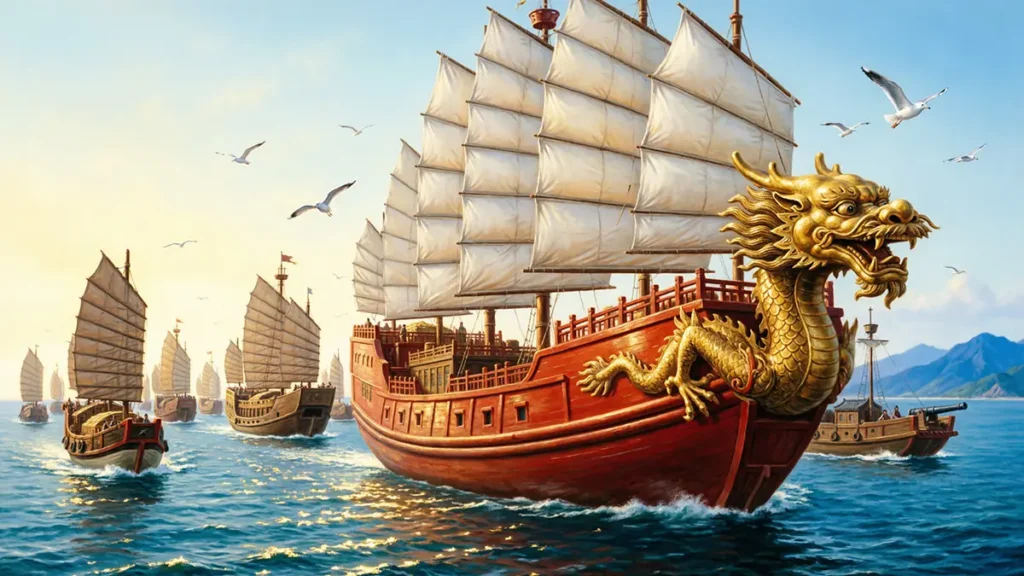
According to cross-referenced evidence from the Veritable Records of the Ming Taizong and British scholar Edward L. Dreyer’s Zheng He: China and the Oceans in the Early Ming Dynasty, the size of each expeditionary fleet typically exceeded 200 vessels, with an accompanying crew of approximately 27,000 [Source: Edward L. Dreyer, Zheng He: China and the Oceans in the Early Ming Dynasty, 2006]. Maintaining the daily provisions for such a massive fleet relied on a highly standardized food storage system. The holds were loaded with large quantities of salted meats, dried vegetables, tea, and fermented bean paste; these long-lasting provisions provided essential calories during ocean voyages and served as a form of currency for exchanging fresh ingredients when the fleet docked.
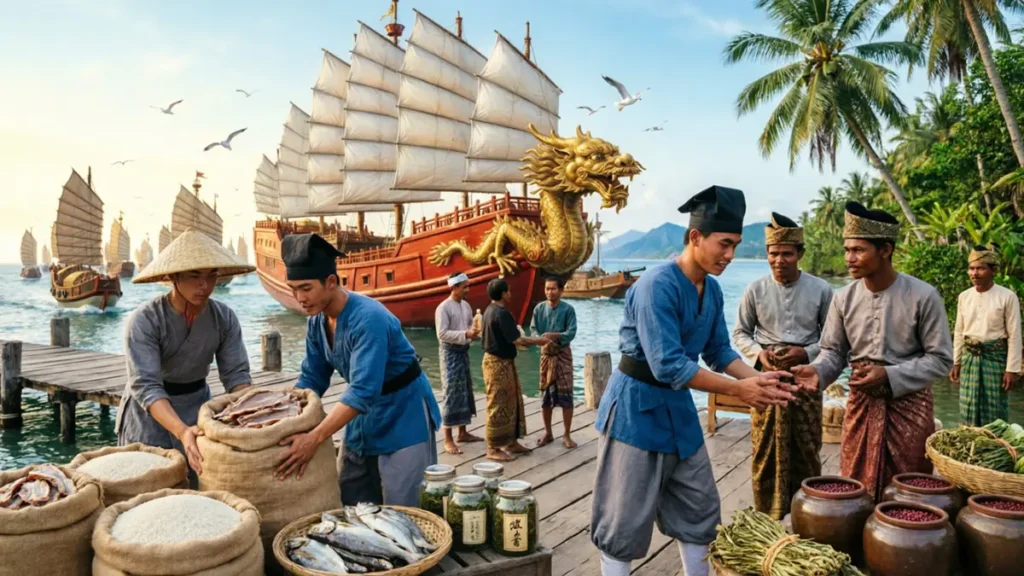
Zheng He’s route was what made this settlement possible in the first place: Malacca, the northern coast of Java, and Palembang on Sumatra were not random anchorages but fixed nodes on the fleet’s regular itinerary, revisited voyage after voyage. It was at these stopovers that the fleet established temporary supply points, and where some sailors and artisans chose to remain due to injury or illness, monsoon delays, or commercial opportunities. Historian Anthony Reid notes in Southeast Asia in the Age of Commerce that by the fifteenth century, Malacca had already become a multilingual, multi-faith trading hub, and the emergence of Chinese settlements filled a gap in coastal handicrafts and regional distribution [Source: Anthony Reid, Southeast Asia in the Age of Commerce, Vol. 1, Yale University Press, 1988]. The arrival of the fleet was not intended as a cultural export, but the movement of people inevitably led to the diffusion of lifestyles. When the first group of Ming settlers began building cooking stoves in the tropical rainforest, the first practical problem they faced was how to recreate the flavors of home in an environment lacking traditional ingredients.
The logistical challenges of these voyages set the stage, but the true culinary transformation began only after the sails were furled and settlers stayed behind._
II. Settlement and Intermarriage: The Birth Code of the Peranakan Kitchen
This adaptation quickly evolved into systematic culinary experimentation. Chinese men who remained in the Nanyang (the historical term for Southeast Asia) often formed families with local women, making the household kitchen the first physical space where two culinary traditions converged. Chinese cooking emphasizes precise heat control and fermentation, while Malay culinary traditions rely heavily on fresh herbs, coconut milk, and stone-ground pastes. When the iron wok met the local mortar, and when soy sauce seeped into curry leaves, a new flavor logic began to take shape.
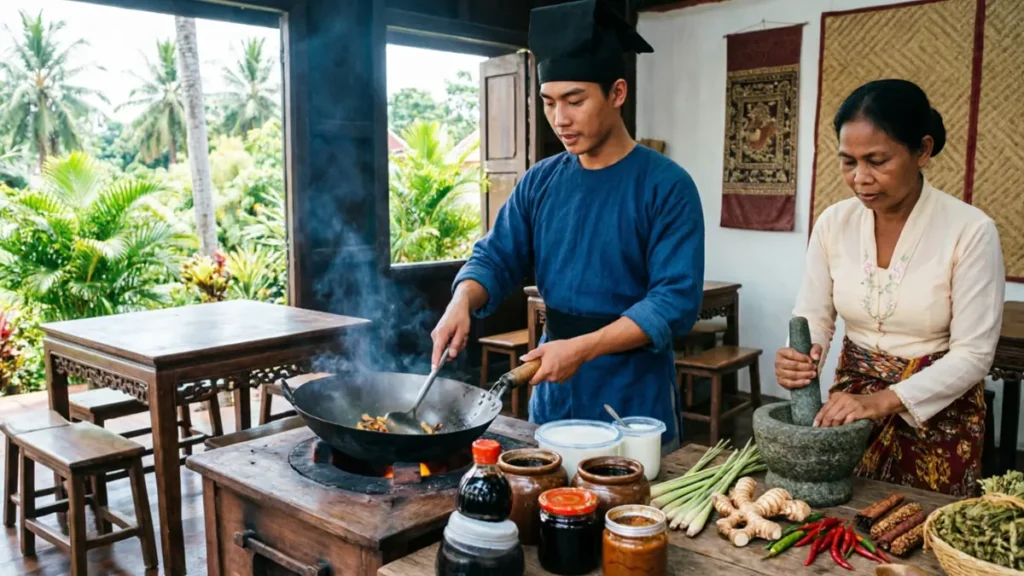
Academics typically refer to this fusion cuisine as Peranakan or Nyonya cuisine. Field research from the Asia Research Institute at the National University of Singapore notes that Nyonya food is not simply “Chinese cuisine adapted to the tropics,” but rather a distinct flavor system: sambal as a base, tamarind to balance richness, and lemongrass with galangal substituting for certain Central Plains spices [Source: NUS Asia Research Institute, Peranakan Culinary Traditions Study, 2019]. This combination did not exist in any single culture prior to the 15th century. The Zheng He voyages brought not only population movement, but a stable channel for technical exchange. Settlers gradually mastered local spice profiles, while indigenous communities began adopting Chinese stir-frying and fermentation techniques. Once this cross-cultural collaboration settled into daily routines, it naturally required concrete dishes to give it form.
III. Culinary Evidence: Five Dishes Reshaped by Maritime History
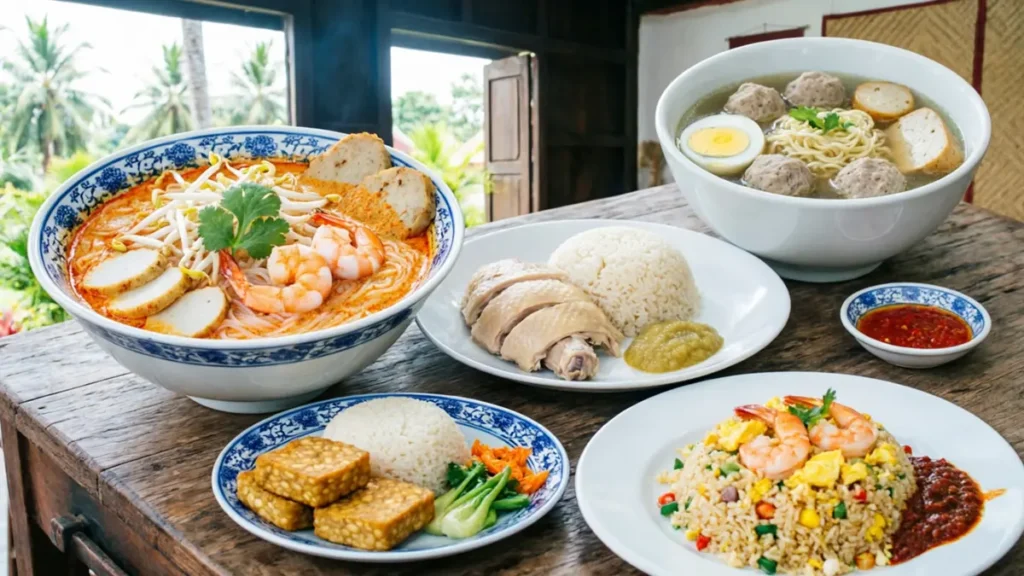
The most direct way to trace this history is to examine several dishes that remain central to Southeast Asian dining tables today. While there are various theories regarding the origins of laksa, culinary anthropologists generally agree that its early form is linked to the rich broth-making techniques brought by Fujianese immigrants. Early broths were simmered from shrimp shells and fish bones; settlers later added coconut milk and sambal paste, giving rise to the two major branches commonly found today: curry laksa and asam laksa.
Indonesian Bakso meatballs underwent a longer process of localization. While meatball production in southern China relied on starch and finely minced meat, after the dish was introduced to Java, local chefs substituted part of the flour with cassava starch and incorporated Indonesia’s unique method of simmering in clear broth, giving the meatballs a more springy texture. As for Hainanese chicken rice, its transmission path is relatively clear. The method of preparing poached chicken, which entered the Malay Peninsula with Hainanese laborers in the late 19th century, actually continued the Ming Dynasty sailors’ preference for “authentic” poultry cooking. The techniques of low-temperature slow cooking and chilling were well-suited to the tropical climate’s demand for light cuisine.
Tofu was introduced even earlier, but the maritime network of the Zheng He era accelerated the spread of soy products throughout the archipelago. Although Indonesia’s tempeh is a local fermented innovation, its production philosophy shares the same microbial control logic as traditional Chinese douchi and fermented tofu. The evolution of these dishes is not an isolated phenomenon; together, they point to a broader pattern of resource substitution.
These ingredient swaps did not happen in a vacuum. They were part of a larger economic and agricultural exchange that flowed both ways across the South China Sea.
IV. Two-Way Exchange: A Taste of Globalization 1.0
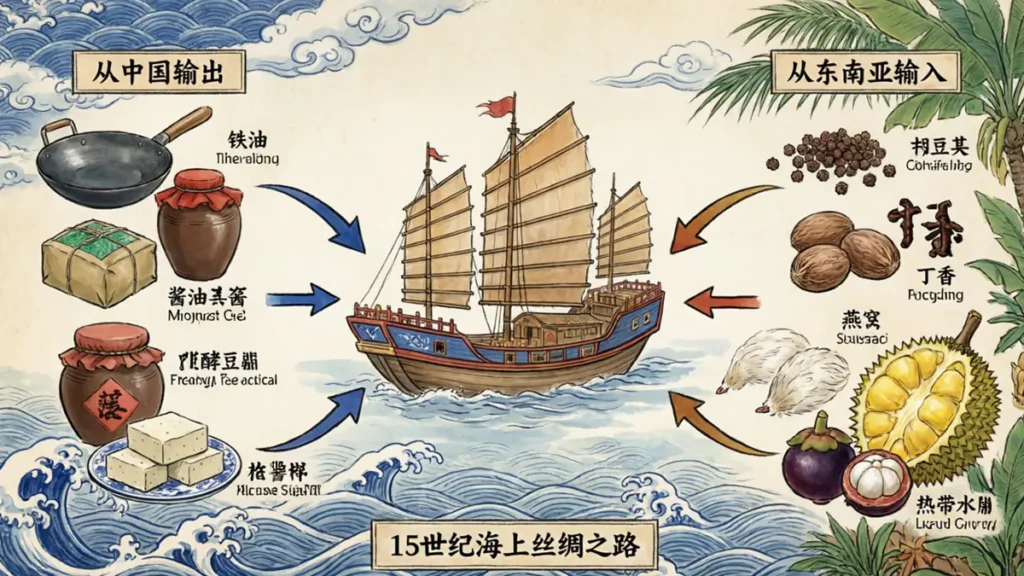
The culinary shift was fundamentally reciprocal. The fleets carried not only cooking utensils and basic ingredients from China, but also tea trade networks and soy sauce brewing techniques. At the same time, tropical produce from Southeast Asia entered East Asian markets via the same maritime routes. In his Suma Oriental, completed in 1515, the Portuguese apothecary Tomé Pires provided a detailed account of the scale of the spice trade at the port of Malacca [Source: Armando Cortesão (Trans.), The Suma Oriental of Tomé Pires, Hakluyt Society, 1944]. By this period, pepper, nutmeg, cloves, and bird’s nest were no longer mere luxuries but had gradually become part of the daily diet along China’s southeastern coast.
Local gazetteers from the mid-to-late Ming Dynasty indicate a significant increase in the variety of spices used in cooking in the Fujian and Guangdong regions, a development directly linked to the regular maritime trade that began during the Zheng He era. This systematic flow of goods was a hallmark of how the Ming Dynasty Tributary System provided the formal structure for regional economic integration.The flow of food has never followed a single direction. It resembles a centuries-long exchange of resources: fermentation techniques and ironworking from the Central Plains were traded for aromatic plants and aquatic proteins from the tropics. Once this exchange pattern became established in port cities and immigrant communities, it detached from its original maritime context and instead became the foundational code of regional culinary structures. Modern diners seeking to fully experience this history need only walk down a few specific streets.
V. From History to the Present: How to Savor Six Centuries of Fusion
Jalan Hang Jebat (formerly Jonker Street) in Malacca and George Town in Penang preserve the most intact Nyonya culinary ecosystems. In these neighborhoods, designated as UNESCO World Heritage Sites, traditional charcoal-fired slow-cooking and handcrafted paste-pounding techniques continue to this day [Source: UNESCO World Heritage Centre, Melaka and George Town, Historic Cities of the Straits of Malacca, 2008]. Jakarta’s Glodok Chinatown and Bangkok’s Yaowarat Road, meanwhile, showcase a different evolutionary trajectory: the deep integration of Chinese wok-stirring techniques with Thai and Indonesian spices.
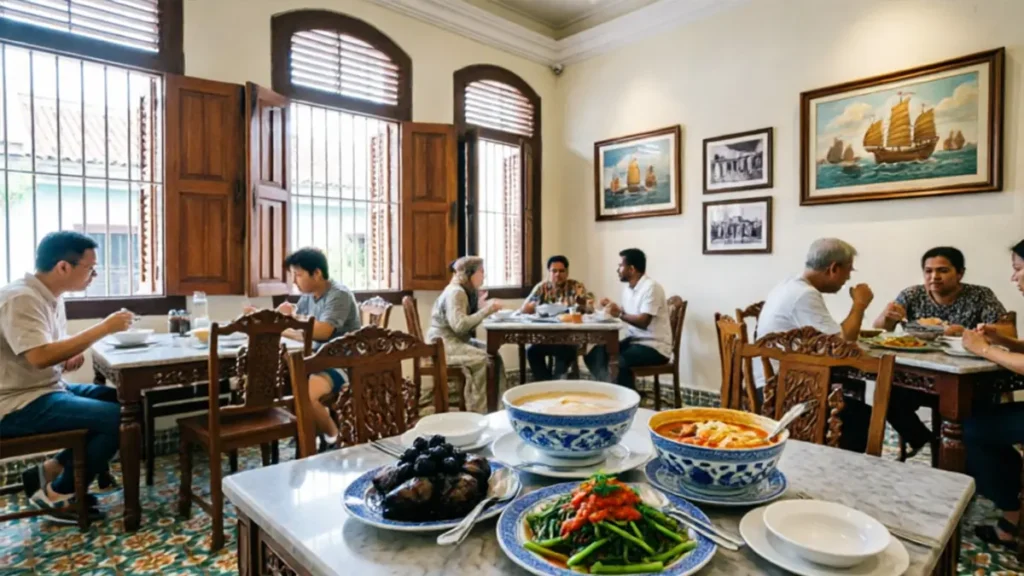
To identify dishes with historical continuity in restaurants, look for Kangkung Belacan (water spinach stir-fried with belacan, a pungent fermented shrimp paste), Ayam Buah Keluak (chicken stewed with black nuts), and Nyonya Laksa. The layered flavors of these dishes directly reflect the accumulation of culinary techniques since the 15th century. For readers wishing to try their hand at home, a simplified version of Nyonya Fried Rice is a good place to start. The basic method involves stir-frying day-old rice with belacan, coconut milk, and kaffir lime leaves, then adding eggs and dried shrimp to finish. Substitute ingredients are widely available at most international supermarkets. For a deeper exploration, consider reading Anthony Reid’s Southeast Asia in the Age of Commerce or exploring academic and documentary series on Asian food history produced by major broadcasters. The traces left by food often endure longer than written words.
Conclusion: The Routes May Fade, but the Conversations at the Table Continue
Zheng He’s fleet has long since sunk to the ocean floor, yet people at both ends of the route continue to share the same set of culinary memories. From 15th-century supply stations to 21st-century street food stalls, the evolution of cuisine chronicles the entire process of population movement, technological exchange, and community rebuilding. Zheng He’s impact on Southeast Asian cuisine lies not in the invention of any single dish, but in the fact that he provided the initial setting for cross-cultural collaboration. When iron woks, soy sauce, and coconut milk meet on the same stove, fusion becomes inevitable. The next time you sit down at a table in Southeast Asia, perhaps you can pay attention to the migration routes hidden behind the spices. Which dish you’ve tasted has made you feel the weight of history the most?