Dismantling the Dual Power: How the Hongwu Emperor Redefined Chinese Bureaucracy in 1380
In the first month of 1380, Hu Weiyong, the Left Chancellor of the Ming dynasty, was accused of treason and executed within days. The punishment did not end with Hu. Almost immediately, the Hongwu emperor abolished the Secretariat, eliminated the office of chancellor, and ordered the Six Ministries to report directly to the throne. What began as a political purge thus became a constitutional turning point in the history of Ming government.
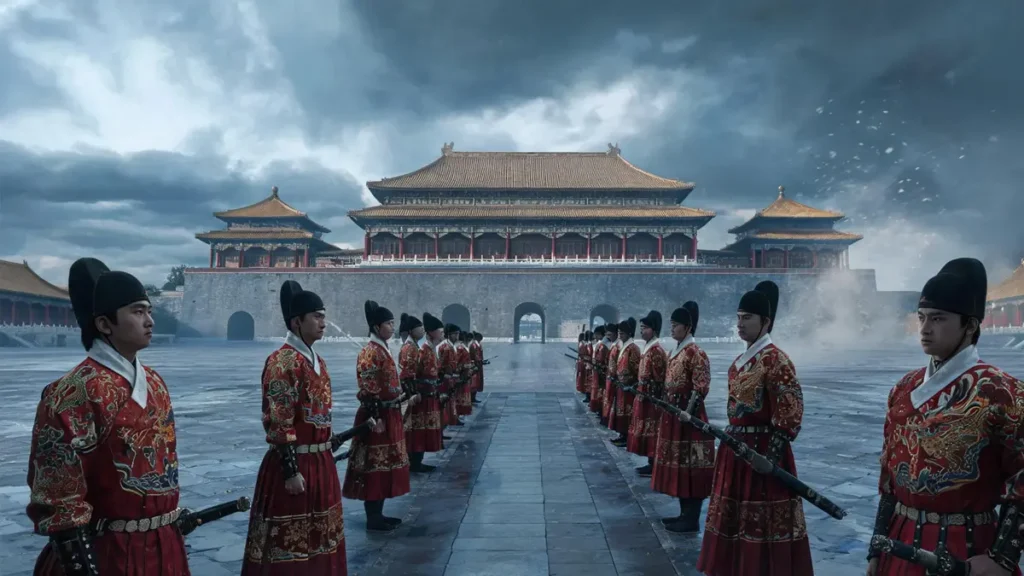
A post that had stood, in one form or another, since the early imperial period was now formally removed from the architecture of government.
This was never merely about purging a powerful minister. It was a decisive attempt to end the long-standing tension between imperial and ministerial authority—a tension that had structured Chinese central government for centuries. But what followed the abolition proved more complicated than the act itself.
The Problem of Hu Weiyong
The History of the Ming charges Hu Weiyong with plotting rebellion. Even in Ming times, the charge invited skepticism.
During the Wanli reign, the scholar Wang Shizhen noted in his Yanshan tang bieji that much of the case rested on allegations that were vivid in detail but thin on corroboration. The well-known story about a sweet spring bubbling up in Hu’s courtyard—a portent he supposedly used to lure the emperor into an ambush—reads less like a failed conspiracy and more like a narrative assembled after the fact.
Whether Hu actually planned rebellion is difficult to establish. What is clearer is that, by the late 1370s, the Secretariat under his control had become a center of power that Zhu Yuanzhang could no longer tolerate.
Two patterns are well attested. First, Hu controlled the flow of information. Memorials from officials across the empire passed through the Secretariat before reaching the throne, and Hu decided what the emperor saw. According to the Hongwu shilu, or Veritable Records of the Hongwu reign, "when memorials from various offices arrived, Weiyong would examine them first; those unfavorable to himself were simply withheld and never reported." In plain terms, Hu saw the paperwork before the emperor did, and anything dangerous to him could simply stop there. Second, Hu exercised extensive influence over appointments. Senior positions in the Six Ministries and the provinces were difficult to secure without his approval.
This would have touched one of Zhu Yuanzhang’s deepest political anxieties. He had witnessed the collapse of the Yuan dynasty firsthand—a court paralyzed by powerful ministers, an emperor reduced to irrelevance, edicts that never left the capital. For him, ministerial overreach was not an abstract problem of administrative design. It was a threat to dynastic survival.This conviction was forged in the fires of his own tumultuous rise from peasant to founder of the Ming Dynasty.
On this point, the historian Wu Han argued in his biography of Zhu Yuanzhang that the emperor’s hatred of the chancellorship grew directly from his fear of repeating the late Yuan pattern of a sidelined sovereign and an unchecked ministry. Zhao Dingxin has offered a different emphasis: the abolition can also be understood as a radical institutional response to the breakdown of Yuan governance—an attempt to remove all intermediary layers between the ruler and the state. The reform strengthened imperial authority in the short term. Whether it strengthened the state in the long term is a harder question.
The Burden of Direct Rule
The new design was straightforward on paper. The Secretariat was gone. The Six Ministries—Personnel, Revenue, Rites, War, Justice, and Works—now reported directly to the emperor. The intermediary office had been removed. Information would flow without obstruction.
The practical difficulty appeared almost immediately.
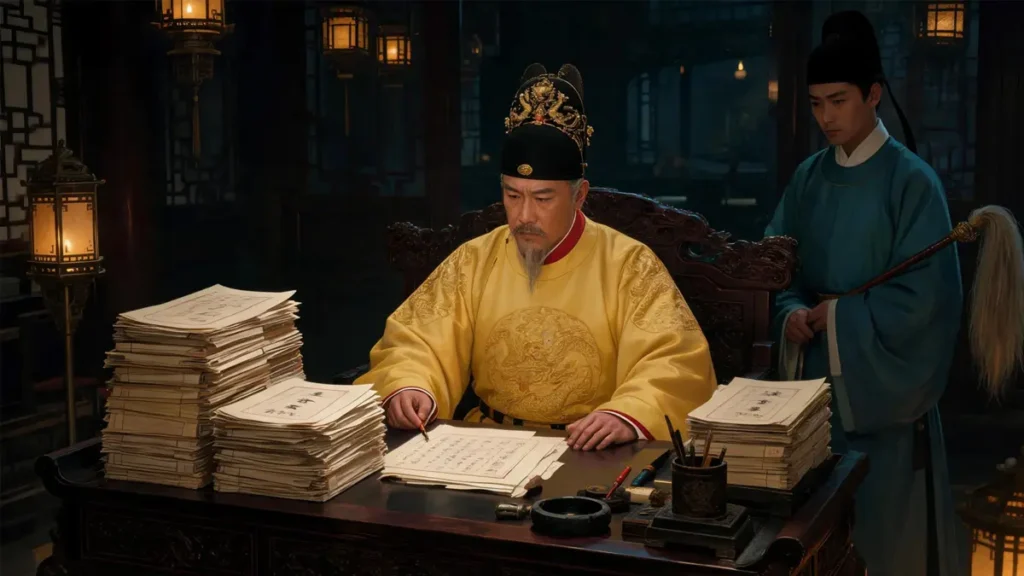
A frequently cited figure holds that Zhu Yuanzhang once processed over 3,600 memorials in eight days. The number comes from the Hongwu shilu, drawn from outer-court submissions recorded in the ninth month of the seventeenth year of the Hongwu reign. That averages to roughly 450 items per day. Even without eating or sleeping, this meant reading, considering, and responding to nearly twenty items an hour.
Zhu himself complained about the workload. In the Da Gao, his collection of admonitory proclamations, he wrote: "Whenever I sit in repose, I think upon the affairs of the realm and find not a single day of peace. The business of governance is a tangled thicket of ten thousand threads. How can one man manage it all alone?" The tone is unmistakably that of a ruler discovering the limits of direct control.
What happened next reveals the tension at the heart of the reform. In the same year he abolished the chancellorship, Zhu created the "Four Auxiliary Officials," seasonal appointees meant to assist with administrative work. The experiment collapsed quickly—the men selected were judged "mediocre in talent and learning." By the fifteenth year of Hongwu, he had established the first Grand Secretaries, scholars who attended the emperor and offered counsel.
The pattern is hard to miss. Zhu abolished the legally recognized chancellor, only to create a succession of assistants whose defining feature was that they could not formally become chancellors.
Under the Yongle emperor, this logic hardened into a durable arrangement. The Grand Secretaries acquired the power to draft rescripts—piaoyi—slips of paper attached to memorials with a recommended course of action. But a draft rescript was a suggestion, not a decision. The final endorsement, written in red ink, remained with the emperor. And to ensure that the Grand Secretaries did not simply become chancellors by another name, Yongle also routed some of that red-ink authority through the eunuchs of the Directorate of Ceremonial, inserting them between the emperor and his scholar-advisers.
The same preference for personal servants over official offices produced the most spectacular appointment of the age. A quarter-century after the chancellorship was abolished, the Yongle emperor handed two hundred ships and some 27,000 men to Admiral Zheng He—a palace eunuch who had served him personally since the 1390s. The fleet answered to no ministry, and its commander took orders from the emperor alone.
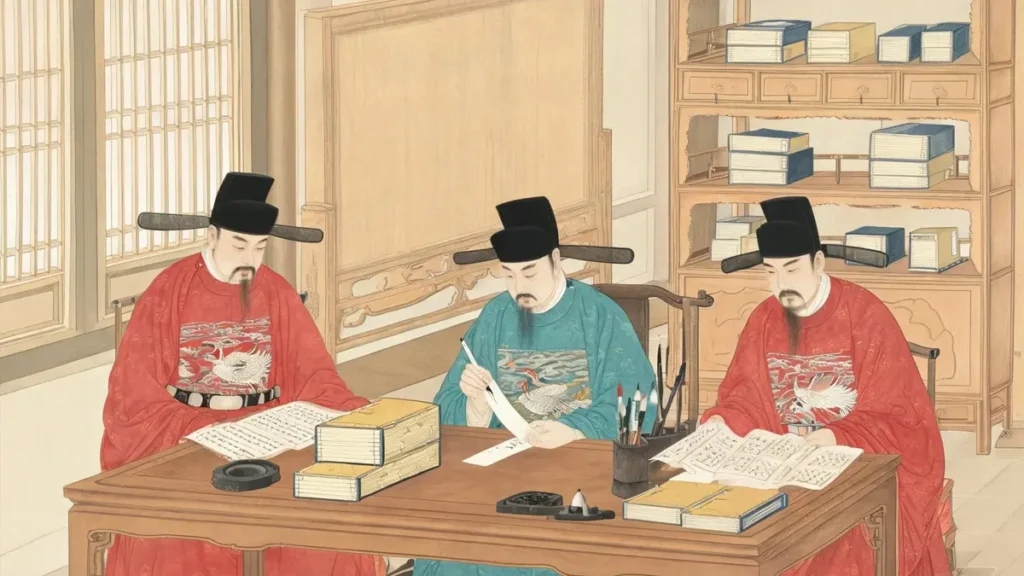
Huang Zongxi, writing in the seventeenth century in his Mingyi daifang lu, or Waiting for the Dawn, delivered a sharp verdict on this structure. the abolition of the chancellorship, he argued, did not eliminate ministerial power. It displaced it into the hands of eunuchs. The Grand Secretaries could draft recommendations, but they had no executive authority. The eunuchs of the Directorate of Ceremonial controlled the final endorsement, but they bore no administrative responsibility. Power and accountability had been separated.
This was not a theoretical observation. During the Wanli reign, the Senior Grand Secretary Shen Shixing faced waves of impeachment and submitted his resignation three times, while the head eunuch of the Directorate of Ceremonial maintained firm control over the channels through which documents moved. The emperor did not attend court for decades. The machinery of state continued to function—not because the constitutional design was sound, but because the Grand Secretaries and the eunuchs had developed an informal layer of decision-making that operated alongside the official structure. No one defended it in principle. No one could govern without it in practice.
The functions of power had not disappeared. Someone still had to screen documents, coordinate ministries, and translate imperial will into administrative action. What changed was the location of those functions. They moved away from a legally defined office and into a set of informal relationships among the emperor, the Grand Secretariat, and the Directorate of Ceremonial.
The Problem of the Sources
Any account of the Hu Weiyong case has to begin with a problem of evidence. The most important official source, the Hongwu shilu, was not a neutral record preserved intact from Zhu Yuanzhang’s reign. It was compiled and revised under later political conditions, most importantly under the Yongle emperor, whose own legitimacy depended on presenting himself as the proper heir to the founder’s intentions.
The Hongwu shilu was compiled three times—first under the Jianwen emperor, then twice under Yongle, who was dissatisfied with the earlier versions. Details of the Hu Weiyong case were almost certainly reshaped in the process to fit a simpler narrative of a sagely founder executing a treacherous minister.
Fortunately, the Ming archive is broader than the official veritable records. The Ming jingshi wenbian, a large collection of Ming statecraft writings and memorials, preserves thousands of documents from across the dynasty, and many of them reveal how the Six Ministries functioned after the abolition. The Da Gao, for all its bluster and intimidation, captures Zhu Yuanzhang’s genuine frustration with the administrative burdens he had created for himself. The Da Ming huidian, the collected statutes of the Ming compiled during the Wanli reign, provides a static picture of institutional design—formal duties, procedures, chains of command. Read against the event-driven accounts in the Hongwu shilu, these statutes reveal which rules were observed and which were circumvented from the start.
Gu Yanwu, the early Qing scholar, offered one of the most incisive contemporary critiques in his Rizhi lu, or Record of Daily Knowledge: "Since the thirteenth year of Hongwu, when the Chancellor was abolished and authority returned to the Six Ministries—yet the affairs of the Six Ministries are all affairs of the court; they are not affairs the Six Ministries may decide on their own." The ministries appeared to have gained authority. In practice, they now had to appeal upward for every significant decision.
Taken together, these sources—official and private, prescriptive and descriptive, early and late—do not yield a single tidy narrative. They reveal an institutional experiment whose consequences were still unfolding two centuries after the event.
Conclusion
The abolition of the chancellorship is difficult to treat as either a simple act of paranoia or a clean institutional reform. It solved a problem Zhu Yuanzhang could see very clearly: the danger of a ministerial office powerful enough to screen information and control appointments. But it also created problems he was less willing to acknowledge. The court still needed coordination, filtering, and delegated judgment. It simply no longer had a legitimate office designed to provide them.
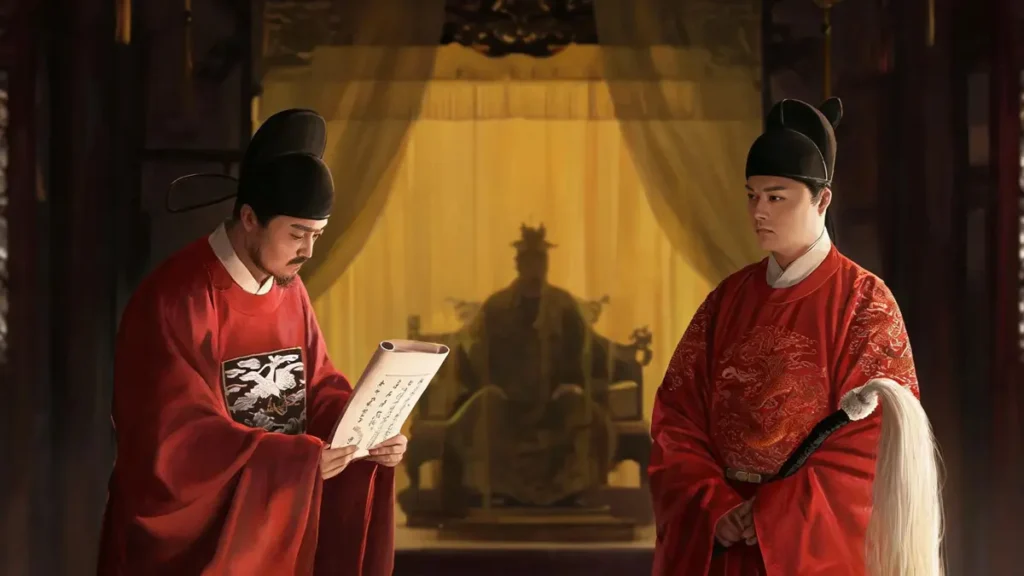
For the rest of the dynasty, Ming government lived with a contradiction Zhu Yuanzhang had created but never resolved. It needed something like a chancellor, yet could not admit that need. What emerged in the end was not a restored institution, but a nameless substitute—indispensable in practice, illegitimate in theory.
Sources and Further Reading
- Hongwu shilu (Veritable Records of the Hongwu reign), with attention to Yongle-era revisions
- Zhu Yuanzhang, Da Gao (The Great Warnings)
- Ming shi (History of the Ming), "Treatise on Official Posts"
- Ming jingshi wenbian (Ming Administrative Compendium of Statecraft)
- Da Ming huidian (Collected Statutes of the Great Ming)
- Huang Zongxi, Mingyi daifang lu (Waiting for the Dawn), "On Establishing a Chancellor"
- Wang Shizhen, Yanshan tang bieji (Miscellaneous Notes from the Yanshan Studio)
- Gu Yanwu, Rizhi lu (Record of Daily Knowledge)
- Wu Han, Zhu Yuanzhang zhuan (Biography of Zhu Yuanzhang)
- Qian Mu, Zhongguo lidai zhengzhi deshi (The Political Gains and Losses of Chinese Dynasties)
- Zhao Dingxin, The Confucian-Legalist State: A New Theory of Chinese History
- Works by Frederick W. Mote, Charles O. Hucker, and other Western Sinologists on Ming institutional history