Zhu Yuanzhang (Hongwu Emperor): Founder of the Ming Dynasty
In 1344, in a small village along China’s Huai River, a gaunt, 16-year-old boy wailed over the bodies of his parents. His name was Zhu Chongba. Within two weeks, a plague — swift and merciless, like a reaper calling roll — had taken his father, his mother, and his eldest brother. The once-large household was reduced to just him and his surviving brother. They were so destitute they couldn’t even afford a burial plot. A neighbor, taking pity, gave them a scrap of wasteland to wrap their dead in torn straw mats and lay them in the earth. The sky was a grey-yellow haze. Locusts blotted out the sun, devouring the last of the crops. Zhu knelt in the dirt, clawing at the ground with his bare hands, nails packed with mud and blood.

No one — and I mean no one, least of all him — would have guessed that this starving, orphaned teenager would, thirty years later, become the absolute master of the largest empire on the planet, ruling over a population of more than 100 million. History would come to know him by a different name: Zhu Yuanzhang, founder of the Ming Dynasty.
This sounds like myth. But it actually happened. To wrap your head around just how staggering this leap is, picture a rough European parallel: imagine a serf who lost everything in the Black Death of the 14th century, fled into a monastery just to beg for bread, and then somehow ended up overthrowing a king and building an entirely new system of rule that would make an entire continent tremble. This wasn’t just a “rags to riches” story. It was a fall from the lowest dust of society, straight up to the solar center of power. The man who would become the Hongwu Emperor—was he a savior-hero pulling his people out of the abyss? Or a paranoid monster consumed by the very power he seized? The truth is messier and far more interesting than you might expect.
Let’s go back to the beginning. A genuine hell-mode start.
Zhu Yuanzhang’s Early Life: A Hellish Beginning Amidst the Plague
Timelines can feel abstract, so let’s put Zhu’s early life on a global map. Between the 1330s and 1350s, while the Black Death was violently reshaping European society, the Mongol-led Yuan Dynasty in the East was staggering under its own twin blows of natural and man-made disaster. According to the History of Yuan, the year 1344 unleashed a chain-reaction catastrophe in Zhu’s home region: first a prolonged drought, then a locust swarm that blotted the sky, and finally a lethal epidemic. Scholars still debate the exact disease, but the devastation is clear — families were wiped off the map in days. One powerful data point comes from The Cambridge History of China, which estimates that China’s population plummeted from roughly 90 million at the peak of Mongol rule to perhaps under 60 million by the early Ming. That’s roughly one in every three people, gone.
That first wound of Zhu’s life was ripped open right across this era’s fault line. He fled to Huangjue Temple, becoming a novice monk—not because of any sudden spiritual awakening, but purely in order to stay alive. Local inscriptions and gazetteers tell us that temples of the time functioned more like refugee camps, overflowing with displaced peasants. Zhu’s daily job was sweeping, burning incense, and ringing the bell—all for a single bowl of watery gruel. But this “job” lasted just fifty-some days. The temple’s grain ran out, and the abbot sent the monks away to wander and beg. Dressed in a monk’s robe, begging for scraps—that was his life now.
Those fifty days as a novice—sweeping, hauling water, begging for gruel—are covered in our account of his Buddhist monk years.
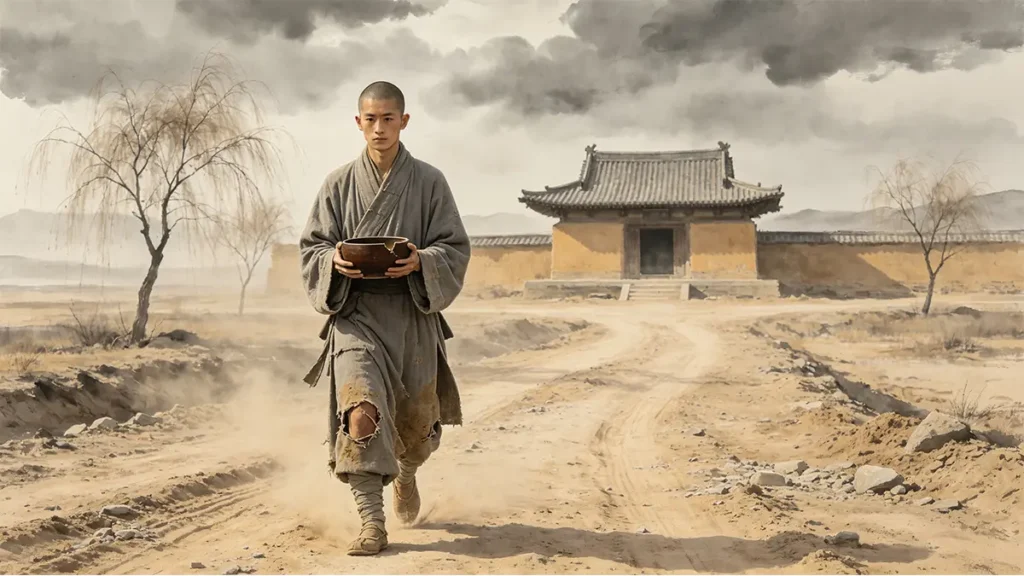
These years of homeless, bottom-feeding survival would wire his political DNA for life. We’ll see how soon enough.
Son of Chaos: How the Hongwu Emperor Rose From Beggar to Warlord
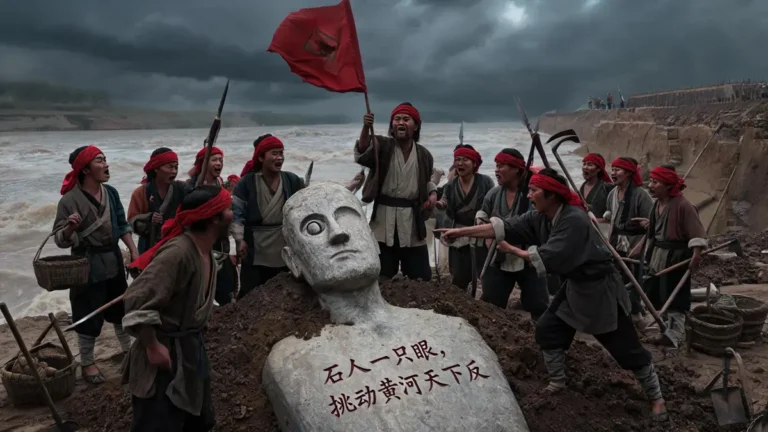
If there’d been a news scroll back then, the headline might have read: “Starving, Itinerant Monk Finds New Job at Rebel Camp.” In 1352, when he was 25, Zhu got a letter from a childhood friend inviting him to join the Red Turban rebels in Haozhou. That letter nearly killed him. Someone tipped the authorities off that he was in contact with insurgents, forcing him to flee into the night. Joining Guo Zixing’s unit was less about revolutionary idealism and more the last, desperate gamble of an unemployed drifter grabbing the only rope thrown his way.
Turns out, this dirt-poor peasant was a natural-born soldier. The Veritable Records of the Ming Taizu flatters him with phrases like “heroic in bearing and vast in ambition” — certainly some post-victory image-burnishing is at play — but his performance in the field was no fabrication. Unlike other rebel chiefs who were mostly into looting and burning, Zhu kept his men disciplined, showing a startling capacity for calm calculation and organization. He shot up from foot soldier to squad commander to centurion. His raw charisma drew the attention of Guo Zixing, who made the decision that would alter the course of Chinese history: he married his adopted daughter, Lady Ma, to Zhu. The future Empress Ma would become the one emotional anchor the Hongwu Emperor truly trusted his entire life.
What transformed Zhu from a regional warlord into a dynastic contender was a strategy boiled down to nine Chinese characters, offered by an old scholar named Zhu Sheng: “Gao zhu qiang, guang ji liang, huan cheng wang.” “Build high your walls, stockpile grain, and delay calling yourself king.” This was the shrewdest political startup plan of the medieval age. Translation: secure your base, build an economic engine, and — crucially — while all the other warlords were busy crowning themselves emperors and painting targets on their backs, keep a low profile. Trade ego for time, and time for space. The genius of this playbook would be vindicated in the cataclysmic showdown to come.
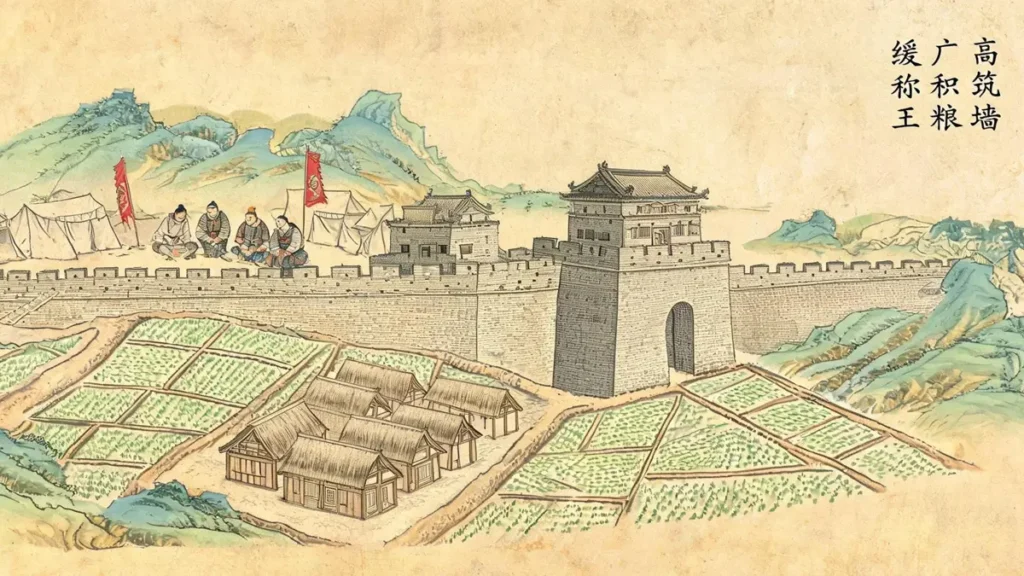
This was the beginning of an improbable and meticulously planned ascent. His climb from rebel camp to dynastic contender is mapped step by step in our guide to how Zhu Yuanzhang rose to power.
The Battle of Lake Poyang: A Medieval Fleet Battle of Fire and Blood
Now cut to 1363, Lake Poyang in Jiangxi Province. This wasn’t just two warlords going at each other. This was a medieval “Battle of Trafalgar” that would decide the fate of China. To get a sense of the scale of this thing, look at the numbers:
| Category | Zhu Yuanzhang’s Forces | Chen Youliang’s Forces |
|---|---|---|
| Date | August 30 – October 4, 1363 | |
| Location | Lake Poyang, Jiangxi Province | |
| Troop Strength | Approx. 200,000 | Approx. 600,000 |
| Fleet Composition | Small, nimble fire-ships | Massive three-story tower ships, chained together |
| Commander | Zhu Yuanzhang | Chen Youliang |
| Tactical Pivot | Fire attack on a northeast wind, torching the chained fleet | Chained ships lost all maneuverability |
| Outcome | Decisive victory against overwhelming odds | Chen Youliang killed by a stray arrow while breaking out; his fleet annihilated |
The two belligerents: Zhu Yuanzhang and his arch-nemesis, Chen Youliang. By the account of the Mingshi Jishi Benmo, Chen’s fleet was the medieval equivalent of inland aircraft carriers — his tower ships rose several stories high, lashed together with iron chains, some of them even large enough for horses to gallop across their decks. Against this, Zhu had only 200,000 men and a patchwork of much smaller, nimbler boats.
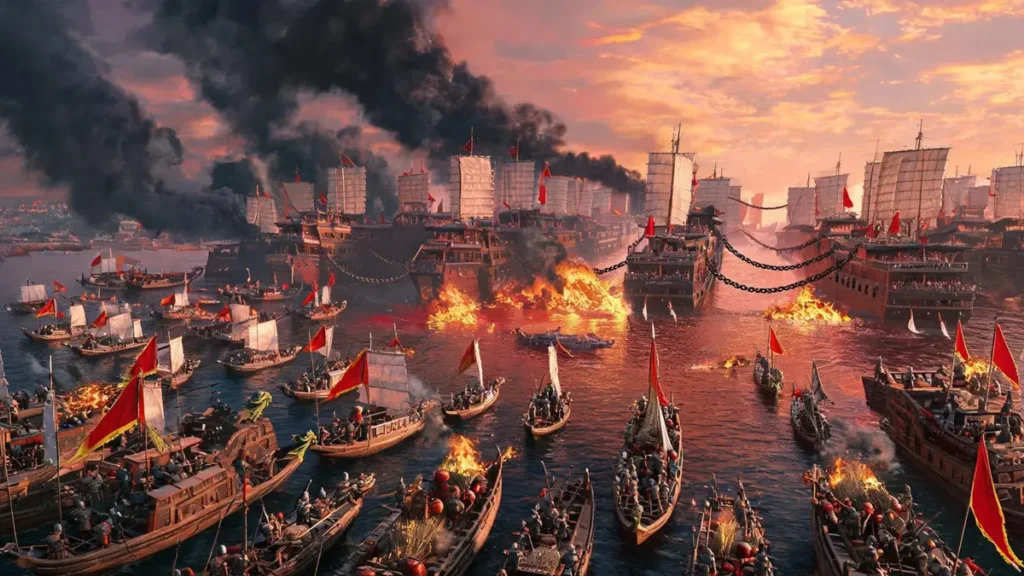
The details of this battle are pure Shakespearean theater. At first, Chen’s towering ships were like floating fortresses. Zhu’s fleet couldn’t get close without being smashed to splinters. A frontal assault was suicide. So what was the play? Fire. He borrowed a trick from the Battle of Red Cliffs eight centuries earlier — but with a devilish attention to detail. He assembled a suicide squadron of small boats, packed them with gunpowder and reeds, and, on an afternoon when a northeast wind began to blow, sent them hurtling like a pack of starving piranhas into the mass of chained giants. The historical record says: “Wind whipped the flames white-hot, smoke and fire blotted the sky, and the lake’s water turned crimson.” In that moment, battle became one-sided slaughter. Chen Youliang himself, trying to break out, was struck in the eye by a stray arrow and died. An era ended right there.
How he cut himself loose from his rebel roots and built imperial legitimacy deserves its own account — that’s the story of the Red Turban Rebellion and the birth of the Ming.
This victory meant everything. It eliminated the only rival strong enough to block Zhu’s southern unification and cleared the last roadblock on his path to the throne.The Battle of Lake Poyang was not just a victory; it was the crucible in which the Ming Dynasty was forged.
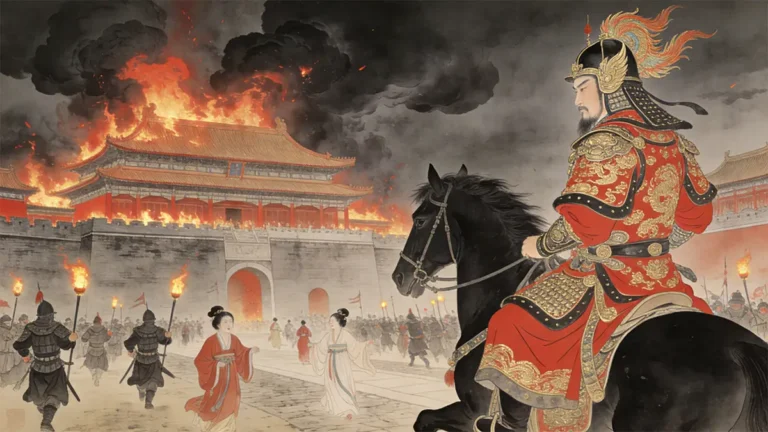
So it was, on January 23, 1368, that Zhu Yuanzhang ascended the throne in Nanjing. He named his dynasty “Ming” — meaning “brightness” — and took the era name “Hongwu,” or “Vast Martial Power.” The beggar was now the Hongwu Emperor. He dispatched a northern expeditionary army that ended Mongol rule over China. But if the story ended there, it would be just another grand heroic epic. The part that has transfixed — and horrified — historians is what came next: the transformation of a famine survivor and rebel leader into an emperor consumed by suspicion. For a closer look at Zhu Yuanzhang’s diligence, harsh punishments, and governing personality, see our analysis of Zhu Yuanzhang’s personality. The story of how the Hongwu Emperor turned against the very generals who had helped him build the Ming Dynasty—and why—is the darkest chapter of his reign. We trace it in full in Zhu Yuanzhang’s cruelty and paranoia, from the first executions to the last. The most devastating single case was the Lan Yu Rebellion Case, in which roughly 15,000 people were put to death.
Why Did Zhu Yuanzhang Kill His Generals? The Great Ming Purges
The Hongwu Emperor was, by any measure, one of the hardest-working monarchs in history. But he increasingly resembled an unstable, obsessive-compulsive imperial CEO, burning with anxiety and paranoia. His greatest fear — the one that really broke him — was the succession. When his meticulously groomed heir, Crown Prince Zhu Biao, died suddenly in 1392, that fear consumed whatever mercy was left.
He concluded that the biggest threat to the empire wasn’t external invasion. It was the very group of “founding heroes” who had helped him conquer it. To guarantee his young grandson could survive on the throne, he initiated a ruthless, methodical purge. The sheer bloodshed is best told with numbers:
Two Major Purges of the Early Ming
| Case | Date | Central Figure | Estimated Executed (Linked by Association) | Political Consequence |
|---|---|---|---|---|
| Hu Weiyong Affair | 1380 (extending into the 1390s) | Chancellor Hu Weiyong | Over 30,000 | The Chancellorship was abolished. The emperor assumed direct control of all six ministries. |
| Lan Yu Affair | 1393 | General Lan Yu | Approx. 15,000 | The founding military aristocracy was annihilated. All military authority now flowed solely to the imperial house. |
The first flashpoint was the “Hu Weiyong Affair” of 1380. Hu was the Chancellor — the number two man in the empire, second only to the emperor himself. The Hongwu Emperor accused him of plotting treason. According to the late Ming historian Wu Han’s research, the case grew like an ever-expanding prosecution snowball. What started with a few individuals eventually saw, through a web of guilt-by-association, over 30,000 people executed. And then he did something even more monumental: he used the case to abolish the Chancellorship itself. A position that had anchored Chinese governance for over a thousand years was simply erased. He left behind a chilling imperial rule: any future official who suggested restoring the post would be executed on the spot. All power, like blood through capillaries, now flowed directly to the emperor alone.
If the Hu case was institutional absolutism, the “Lan Yu Affair” of 1393 was physical annihilation on a staggering scale. Lan Yu was the great general who had crushed the Mongol forces, a military god among the founding fathers. He was accused of plotting rebellion and sentenced to be “flayed and stuffed with straw.” And that is meant literally. According to the Ming-era notebook Shuyuan Zaji, his skin was stripped from his body, stuffed full of straw, and then paraded around the country as a “touring exhibition” to warn every other general what awaited them. Around fifteen thousand more people were executed in the fallout. A curtain of pure terror descended across the entire bureaucracy.You can read a blow-by-blow account of how the founding generals were eliminated in our article on the Ming Dynasty founding generals.
To enforce this reign of high-tension control, he also created one of the most legendary secret police organizations in history: the Jinyiwei, the “Embroidered Uniform Guard.” These palace guards, known for their golden flying-fish insignia and curved swords, operated entirely outside the normal judicial system. They answered to the emperor and only the emperor. They could spy, arrest, interrogate — anyone they deemed suspect. It was like inserting a probe directly into the brain of the bureaucracy, constantly monitoring everyone’s loyalty signals. The corrupting nature of absolute power has rarely found a more vivid case study than the aging Hongwu Emperor.
Now let’s look at the strange, contradictory DNA this butcher-and-father figure bequeathed to China.
Zhu Yuanzhang’s Portrait Mystery: One Face, Two Opposing Images
If you image-search the Hongwu Emperor, the first thing that’ll baffle you is his portraits. One school is the official court painting: dignified, imposing, almost kindly. The other is the bizarre folk version: a face splattered with dark moles, a jutting chin, like some ogre that crawled out of a Grimm’s fairy tale. Scholars still argue about which is “real,” but the most widely accepted theory is that the hideous portrait was a form of political propaganda — a deliberately constructed “chosen monster” image, breaking from all normal aesthetics to project mystical authority and menace. This visual contradiction is the key to understanding his whole legacy.
His treatment of the common people stood in jaw-dropping contrast to his slaughter of the elite. He may be the most viciously anti-corruption ruler in Chinese history. His law stated that any official caught embezzling more than 60 liang of silver (roughly equivalent to tens of thousands of dollars today) would also suffer that grotesque penalty: flayed, stuffed with straw, and the resulting human scarecrow placed conspicuously beside the incoming official’s desk as a permanent, skin-crawling warning. At the very same time, he was slashing agricultural taxes, encouraging massive land reclamation, and nursing the war-torn economy back to health. According to the eminent economic historian Liang Fangzhong, during the Hongwu reign, the total acreage of cultivated land across the empire shot up more than fourfold, reaching over 8.5 million qing. To the peasant class, this same tyrant was their greatest shield.
And yet, his vision was trapped by its own era. The empire he built was inward-looking, designed for absolute stasis. He imposed the “Sea Ban” — forbidding private maritime trade, slamming the door on the outside world. He placed a heavy ideological and economic boot on the merchant class, trying to freeze society into a neat grid of atomized peasant households. The source code of this dynasty — hyper-centralization, deliberate isolation, and a robust secret-police apparatus — not only defined the 276-year trajectory of the Ming, but also seeded the deep conservatism and rigid brittleness of the Qing Dynasty that followed.
A Ghost Beyond Definition
Zhu Yuanzhang, the Hongwu Emperor, escapes any neat museum label. He was a brutal slaver and the liberator of millions of peasants from an old, decayed world. He was a pathological architect of order, and the son of chaos who destroyed the age he was born into.
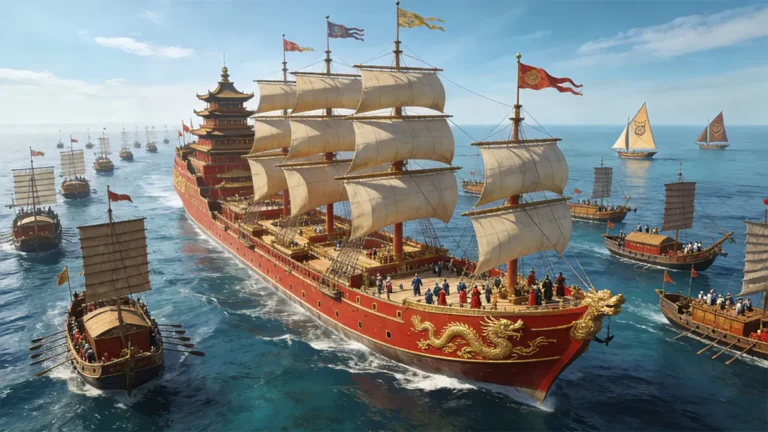
Let’s ask a counterfactual question. Without this beggar-monk from Huangjue Temple, what would East Asia have looked like after the 14th century? Perhaps China, like Europe after the Mongols receded, would have fractured into a longer, messier era of competing states and warlords. The leviathan of centralized, gargantuan population that amazed Marco Polo and, later, the Jesuit missionaries, might never have come into existence at all.And without that leviathan, there would have been no Admiral Zheng He—no state with the reach, the shipyards, and the tax base to send two hundred ships and twenty-seven thousand men beyond Malacca into the Indian Ocean a single generation later.
Consider this: visit his resting place, the Ming Xiaoling Mausoleum in Nanjing. There stands a giant stone tablet inscribed with four characters: “Zhi Long Tang Song” (“Governing growth surpassing that of the Tang and Song”). It means his accomplishments surpassed those of the great Tang and Song emperors. And who left that glowing review? The Kangxi Emperor, a conquering Manchu ruler, over a century later. The fact that an outsider emperor from a foreign dynasty would choose to publicly praise the native emperor who expelled his ancestors’ ilk — that right there is the perfect footnote to the Hongwu Emperor’s complicated gravitational pull. The scar this “Beggar Emperor” left on history remains deeply etched into anyone who truly looks at it.