Started with a Bowl: How Zhu Yuanzhang Used the Red Turban Rebellion to Found the Ming Dynasty
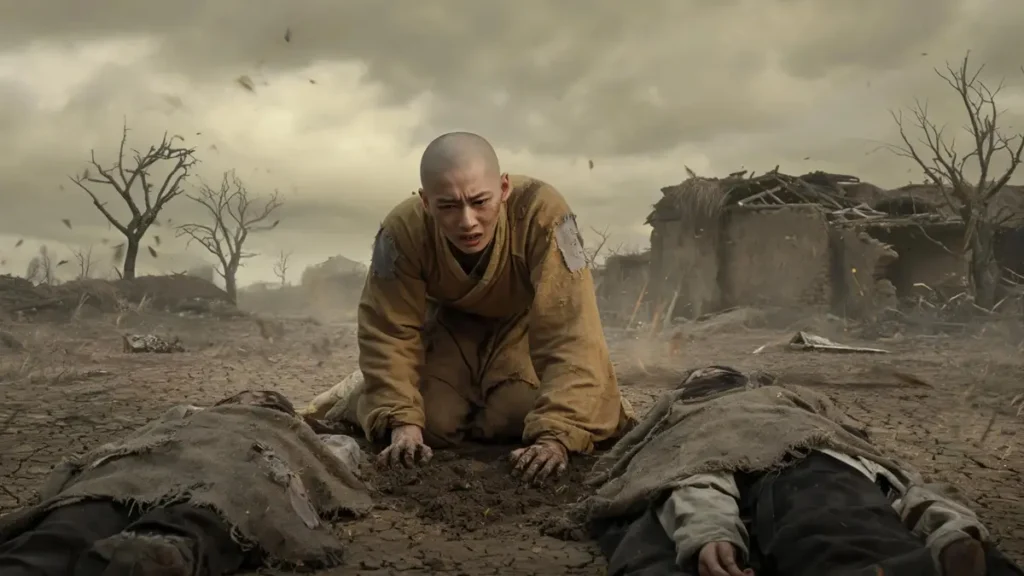
In 1344, a young man without even a proper name—Zhu Chongba, meaning "Double Eight," a number—knelt before the bodies of his parents. He couldn’t afford coffins. Twenty-four years later, he was the Hongwu Emperor, ruler of a quarter of the world’s population. The improbable springboard for this staggering ascent was a peasant uprising steeped in apocalyptic religious fervor: the Red Turban Rebellion. Zhu Yuanzhang did not start this rebellion. But he exploited it with a cold, calculating brilliance that few in history have matched. He climbed the Red Turban ladder, and at the crucial moment, he kicked it away, performing a ruthless political surgery that transformed him from a "bandit sorcerer" into the Son of Heaven.
Why Would a Buddhist Monk Join an Apocalyptic Cult?
First, rewind to the twilight of the Yuan Dynasty.
The Mongol rulers had divided their subjects into four castes, with the Southern Chinese at the very bottom. But it wasn’t the legal discrimination that pushed the empire over the edge—it was the weather. The Yellow River breached its banks repeatedly. Famine and plague swept across the Central Plains. According to the History of Yuan, the floods of 1344 alone inundated thousands of square miles, creating millions of starving refugees. To ordinary people, these were not natural disasters. This was heaven’s judgment.
The White Lotus Society seized this mood.
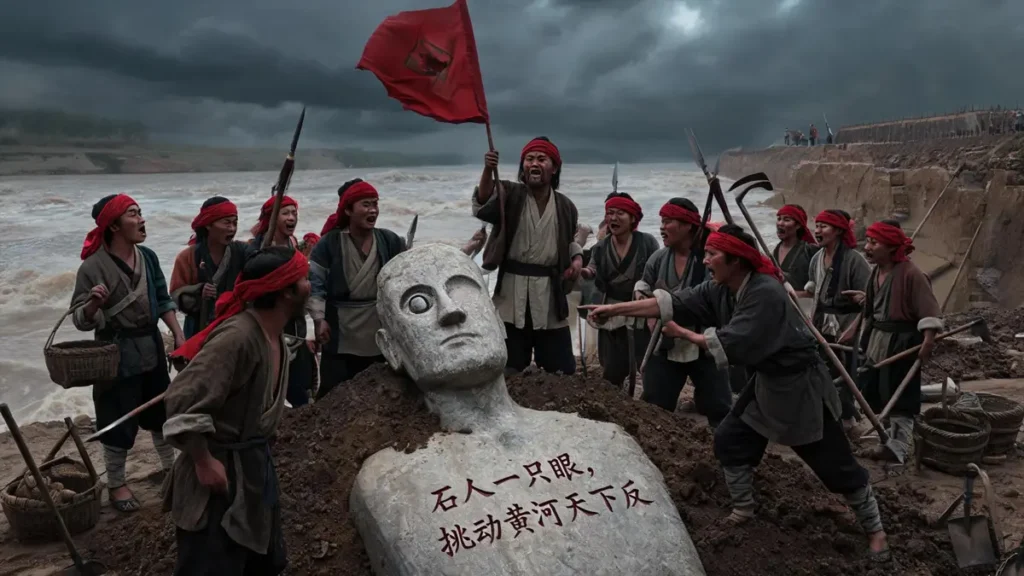
This folk religion, dripping with millenarian prophecy, preached that "Maitreya will descend, and the King of Light shall appear." The world was ending. A savior was coming. Follow him and enter a new age. For a Western reader, the parallel to the Christian millenarian movements of the Middle Ages is uncanny: the world is corrupt beyond repair, the Last Judgment looms, and the faithful must take up arms to pave the way. In 1351, Han Shantong and Liu Futong buried a one-eyed stone statue at a Yellow River work site, carved with the words: "Do not say the stone man has but one eye; with a single blink, it will turn the Yellow River world upside down." The Red Turban Rebellion had begun. The name came from their iconic red headscarves—red, in esoteric Buddhism, symbolizing the light of Maitreya.
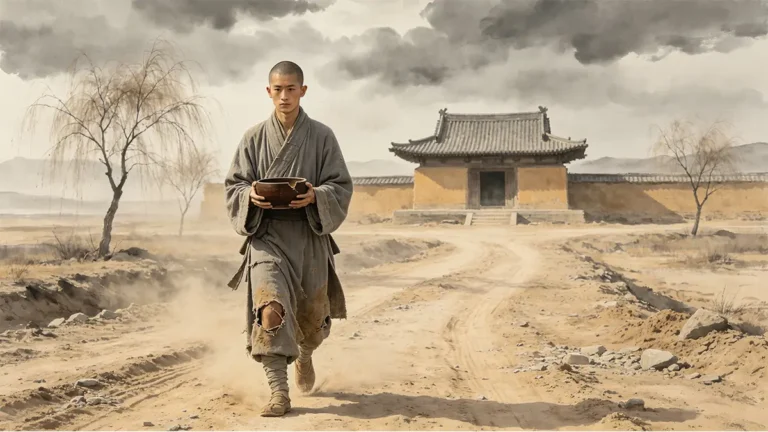
Zhu Yuanzhang was still a monk at Huangjue Temple. The temple had run out of food, so he was sent out to beg. He saw people starve to death. He saw vast tracts of abandoned farmland. He saw how the Red Turbans made desperate peasants believe that the end was near, but that light was just over the horizon. In 1352, Yuan troops torched Huangjue Temple. In that chaotic time when even the clay gods were smashed and dragged away, Zhu threw his tattered monk’s robe onto the ground and walked to Haozhou to join Guo Zixing’s Red Turban army.
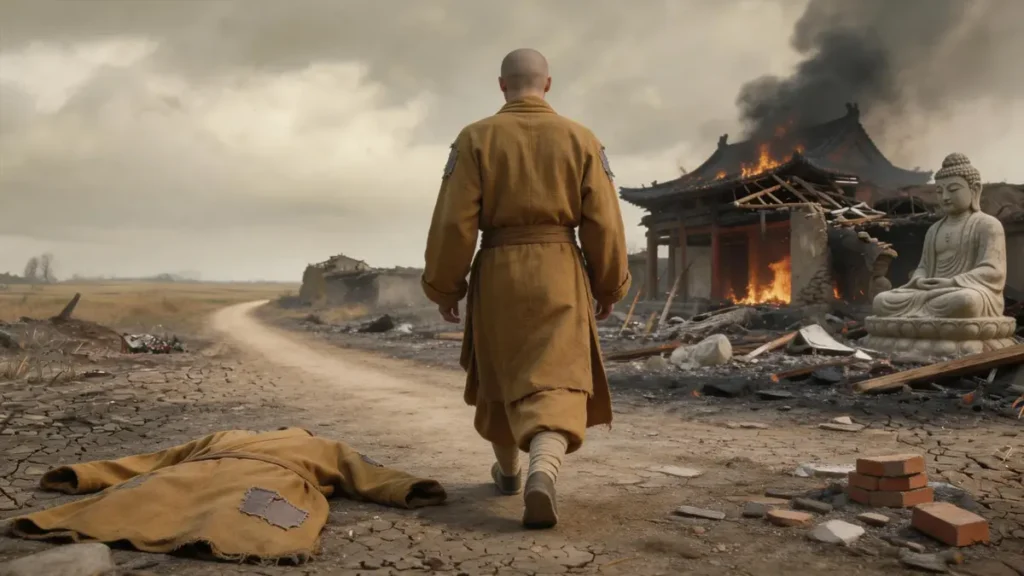
This was no decision born of faith. In his own later recollections, Zhu never disguised the passivity of his choice: no food, nowhere to go, and the Red Turbans were the only option that kept you from starving. But once inside, this man began to display a terrifying instinct for survival and power.
How Do You Build an Empire’s Foundation Inside a Chaotic Militia?
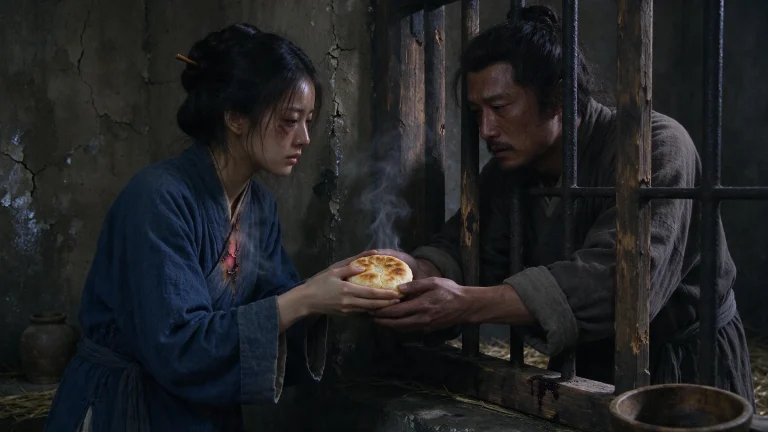
Guo Zixing noticed the ex-monk initially for one simple reason: he wasn’t afraid to die. He charged into battle first but held back when it was time to divide the loot. In an army where everyone grabbed for money and grain, this behavior was deeply strange. Guo decided the man was useful. He promoted him to a personal guard and married him to his adopted daughter, Lady Ma—the future Empress Ma, famed for her wisdom and virtue.
But Zhu Yuanzhang’s true genius lay in what he grasped early on: Guo Zixing’s Red Turbans were, at their core, a loose armed gang held together by religious slogans and plunder. You couldn’t conquer an empire with that.
He began to do several things deliberately.
He recruited scholars. Zhu himself was illiterate, but he understood something more clearly than any other rebel leader of his time: military force wins battles, but civil administration wins dynasties. Every time he captured a town, he sought out the local Confucian scholars. Li Shanchang, Liu Bowen, Song Lian—these men he gathered around himself. Liu Bowen was later mythologized as a kind of Merlin figure, but his actual role was to give Zhu a coherent political strategy: stop acting like a Red Turban general and start acting like the master of the world.
He imposed discipline. The Red Turbans typically sacked everything in their path, but Zhu issued a death order to his troops: no looting, no indiscriminate killing. This wasn’t kindness. It was the cold recognition of a brutal truth: to hold power, the common people had to believe your army was better than the Mongol one. This "we don’t steal your grain, we just take your territory" army became his most powerful weapon for swallowing up rival warlords.
Then he did the most strategically brilliant thing of all—he seized Nanjing. In 1356, Zhu crossed the Yangtze and took the city of Jiqing, renaming it Yingtian. This move was pivotal. Nanjing sat astride the lower Yangtze, controlling the wealth of Jiangnan. From here, he could either strike north to the Central Plains or hold the southeast as a self-contained kingdom. More importantly, by leaving the Red Turban heartland of Huaixi, he was no longer "Guo Zixing’s subordinate." He was an independent warlord.
When Guo Zixing died, Zhu smoothly absorbed his former master’s forces. Nominally, he still acknowledged the Red Turbans’ shared leader, Han Lin’er, the so-called "Little King of Light." In practice, he had already built his own regime. This burgeoning power would soon be tested in the greatest military showdown of the era: the Battle of Lake Poyang.This veneer of loyalty was not going to last.
The Largest Naval Battle of the Middle Ages Decided China’s Fate
As Zhu Yuanzhang rose, two other powers dominated the south: Chen Youliang and Zhang Shicheng.
The situation in the 1360s resembled a Chinese version of a three-kingdom standoff. Chen Youliang held the Huguang and Jiangxi regions and commanded the largest army. Zhang Shicheng controlled the wealthy Jiangsu-Zhejiang region and had the deepest pockets. Zhu was caught in the middle, threatened on both sides. To the west, Chen wanted to sweep down the Yangtze. To the east, Zhang was restless.
Common sense dictated taking out the softer target, Zhang Shicheng. But Liu Bowen proposed a more radical plan: strike the strongest, Chen Youliang, first. His reasoning was cold and precise—Zhang was a man content to defend his territory, lacking the ambition to attack while Zhu was busy. Chen was consumed by ambition. If Chen was not destroyed, Zhu would never have a secure rear.
In 1363, the two fleets met at Lake Poyang for a showdown.
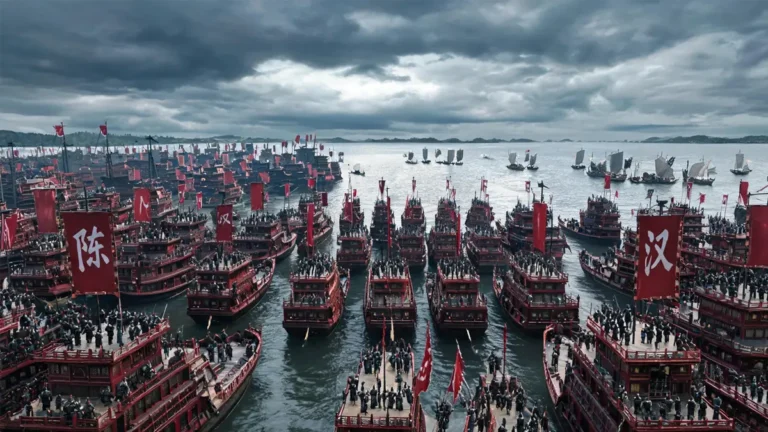
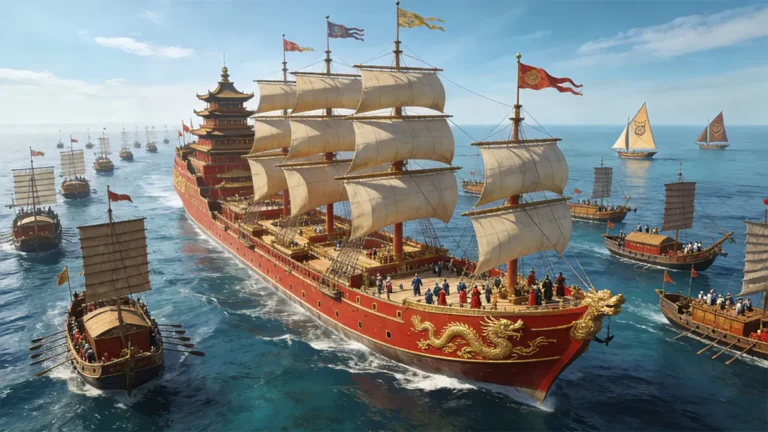
The scale, even in the context of the 14th-century world, was staggering. Chen Youliang supposedly mustered a force of six hundred thousand men, deploying colossal "tower ships"—multi-story warships, some over thirty feet high, chained together into floating fortresses. The formation bore a certain resemblance to the arrayed fleets of the Ottoman and Holy League forces at Lepanto in 1571, except larger and much earlier in time. Zhu Yuanzhang’s fleet was smaller and more agile. He opted for fire. In late August, a northeast wind picked up. Zhu sent small boats packed with gunpowder and combustibles drifting toward Chen’s chained-together fleet. The fire spread. Chen’s "waterborne Great Wall" disintegrated in a single day. Chen Youliang himself was struck by an arrow and died.
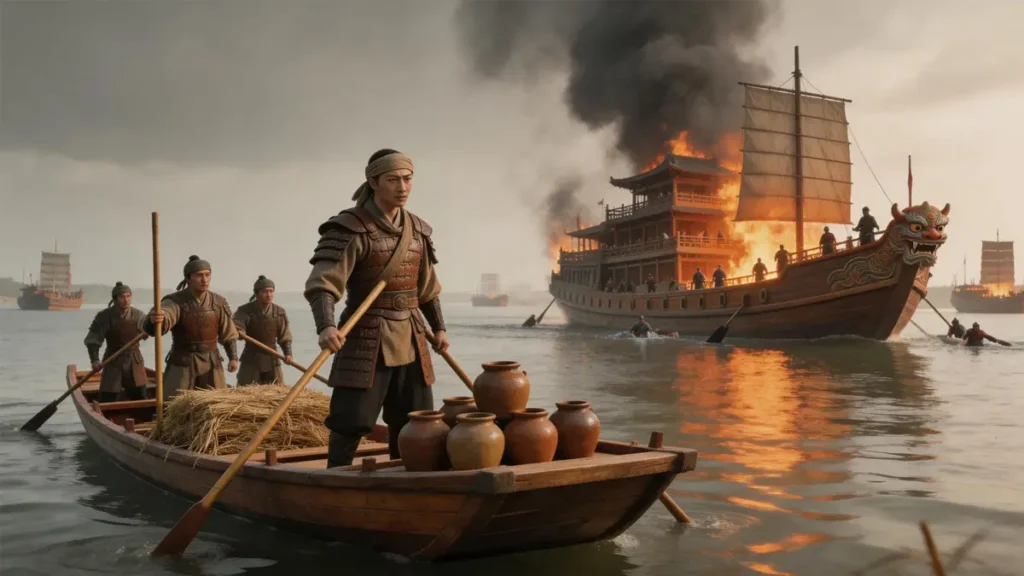
Lake Poyang was not just a military victory. It shattered the balance of power in the south. With Chen’s territory and surviving forces absorbed, no one could challenge Zhu alone. The battle also made one thing unmistakably clear: Zhu Yuanzhang was no longer an appendage of the Red Turban system. He was the true player on the board.
"The Sinking at Guabu": A Silent Coup
In 1366, Zhu Yuanzhang sent men to escort Han Lin’er from Chuzhou to Nanjing. The boat sank, inexplicably, at the Guabu crossing. Han Lin’er drowned.
The official story was an "accidental capsizing." But the world does not produce coincidences of this magnitude. Zhu needed Han Lin’er dead. As long as Han Lin’er breathed, he remained the "Little King of Light" of the Red Turbans, the "puppet propped up by the White Lotus"—a political toxin for a man about to found a new dynasty.
This is the coldest part of Zhu Yuanzhang’s relationship with the Red Turban Rebellion. He had taken his seed capital from the uprising: his core officers, his army, his territorial base. But he also understood that the White Lotus taint behind the Red Turbans meant "bandit sorcerers" in the eyes of the Confucian gentry. To win over the landlord class and the scholars, a complete political decoupling was non-negotiable.
And so, "the sinking at Guabu."
And so, the famous declaration in his northern expedition’s war manifesto: "Expel the barbarians and restore China." The phrasing was masterful. It reframed a religiously-charged peasant revolt as an orthodox narrative of Chinese national liberation from alien rule. Zhu Yuanzhang was no longer a Red Turban remnant. He was the restorer of Chinese civilization. Northern gentry defected to the Ming army in droves. Mongol rule in the north collapsed rapidly.
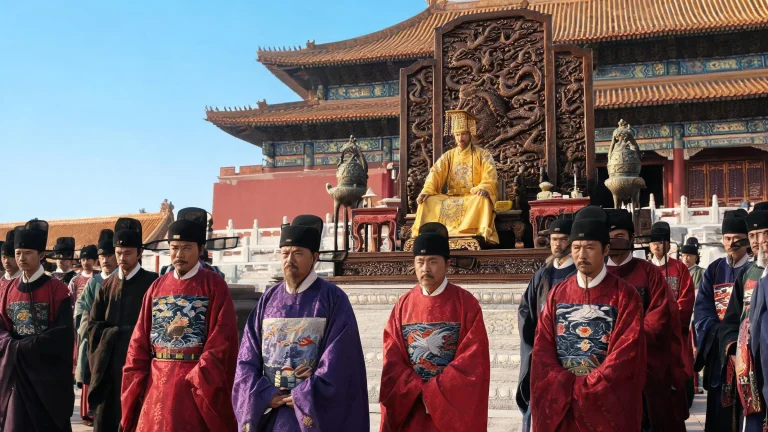
In 1367, Xu Da and Chang Yuchun led the northern campaign. In the first lunar month of 1368, Zhu Yuanzhang declared himself emperor in Nanjing, adopting the dynastic title "Ming"—meaning "Brilliant." The choice of this name was itself an exquisitely balanced political calculation: the character "Ming" invoked the Red Turbans’ prophecy of the "King of Light," soothing those grassroots followers who had fought for that very illumination; simultaneously, "Da Ming" was a classical Confucian image from the I Ching, signifying "the great brightness of the cosmos," which lent the new dynasty solemnity and legitimacy. Within a year, the last Yuan emperor fled north, and Mongol rule over China proper was finished.
The table below captures the three critical phases of Zhu Yuanzhang’s identity transformation, and the political machinery behind each:
| Period | Identity | Relationship to the Red Turbans | Key Maneuver |
|---|---|---|---|
| 1352–1356 | Guo Zixing’s subordinate | Inside the Red Turban system | Marrying Lady Ma, building the Huaixi core |
| 1356–1366 | Independent warlord | Nominal allegiance to Han Lin’er | Taking Nanjing, destroying Chen Youliang |
| 1366–1368 | Ming Emperor | Complete severance | The Guabu sinking, issuing the northern expedition manifesto |
This table makes one thing plain: Zhu Yuanzhang was never a man who passively waited for his moment. At every stage, he knew exactly how long the Red Turban card could be played and precisely when to discard it.
The Red Turbans’ Legacy—and His Fear
After his coronation, Zhu Yuanzhang’s attitude toward the Red Turbans and the White Lotus reversed 180 degrees. During the Hongwu reign, the White Lotus was ruthlessly suppressed. Anyone "spreading heretical delusions" faced execution. He personally decreed: "Those who falsely claim Maitreya’s descent, the White Lotus Society, the Manichaean cult—all are heretical ways that deceive the masses, and all are forbidden."
It seemed like ingratitude of the highest order. It was, in fact, brutally clear-eyed thinking. He understood the explosive power of desperation at the bottom of society intimately—he had ridden that very force to the throne. What he feared more than anything was that one day, another desperate Zhu Chongba would tie on a red headscarf and try it all again.
So he did several things that would reshape China profoundly: he abolished the office of prime minister, concentrating power solely in the emperor; he established the Embroidered Uniform Guard, a secret police to monitor the bureaucracy and the populace; he vigorously promoted Confucian education and the civil service examination system, locking social norms tightly to state ideology. To understand how this visceral terror translated into Zhu Yuanzhang’s broader institutional purges and anti-corruption policies, explore his complete emperor biography.This was a man who had clawed his way up from the very bottom, acting on a visceral terror of bottom-up rage.
Understanding the relationship between Zhu Yuanzhang and the Red Turban Rebellion is not just about understanding one man’s origin story. It illuminates a recurring political pattern in imperial China: how apocalyptic moods at a dynasty’s end are ignited by folk religion, how an elite from the margins uses the uprising to complete a vertical leap in class, and how, after the new dynasty is founded, it walks a tightrope between answering grassroots grievances and suppressing social turmoil.
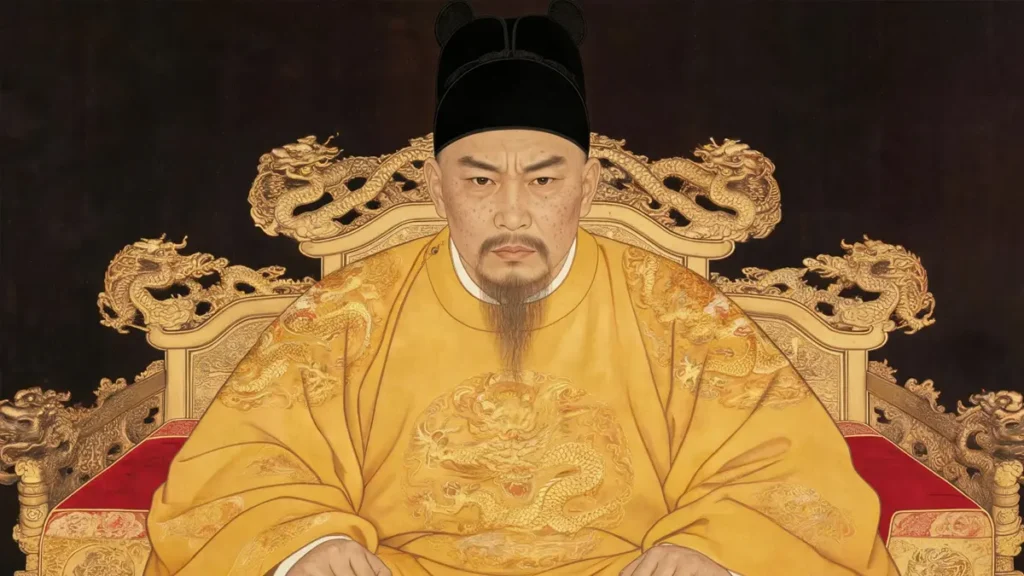
Zhu Yuanzhang climbed onto the dragon throne. But he spent his entire life in fear of another version of himself. That fear, more than his grand title of Hongwu, explains the political DNA of the Ming Dynasty for the next two and a half centuries.
Key References
- History of Ming (Ming Shi), Annals of Taizu; Treatise on Food and Goods
- Veritable Records of the Ming, Taizu section
- Wu Han, Biography of Zhu Yuanzhang
- Frederick W. Mote, Imperial China: 900–1800
- Timothy Brook, The Troubled Empire: China in the Yuan and Ming Dynasties
- On the White Lotus and late Yuan uprisings, see Daniel L. Overmyer, Folk Buddhist Religion, and related scholarship
- Troop figures for the Battle of Lake Poyang are drawn from the History of Ming biography of Chen Youliang; modern scholars dispute the exact numbers, but the broad consensus on the battle’s scale is consistent