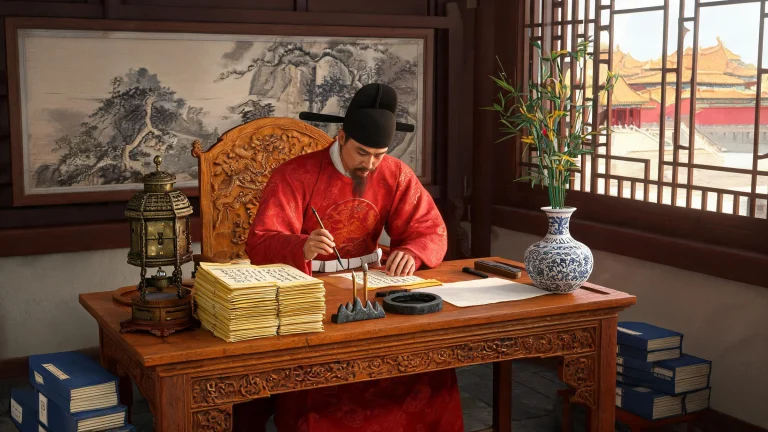
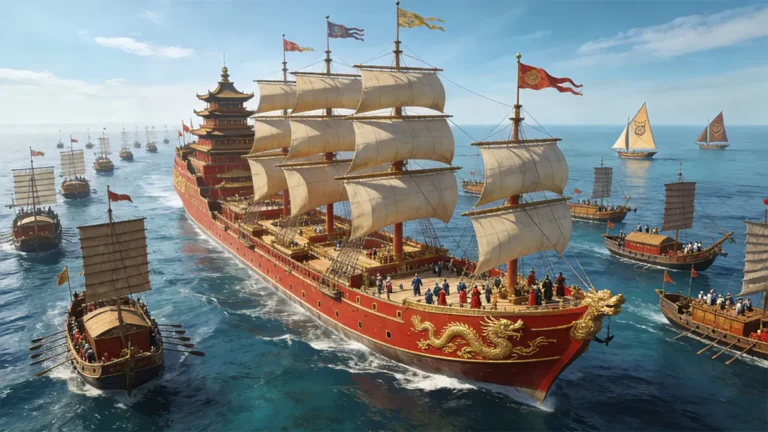
The Beggar King: The Untold Story of Zhu Yuanzhang’s Early Life
In 1344, a seventeen-year-old boy stood alone on the flood-ravaged plains of central China. His entire family had just starved to death. He had no land, no food, and not even a patch of earth to bury his parents. His name was Zhu Chongba—a name that was really just a number, the kind given to peasants too insignificant to deserve a real one.
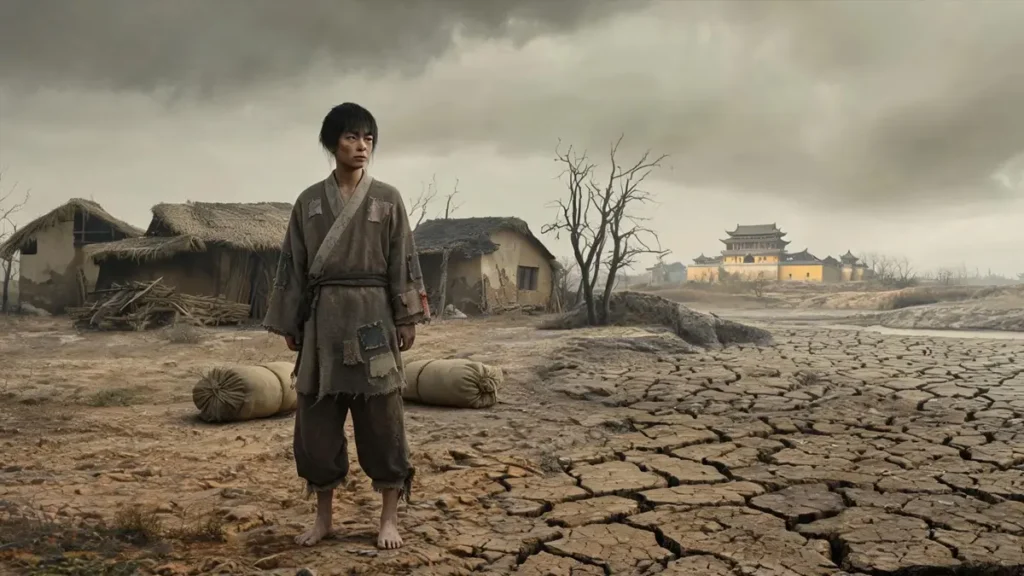
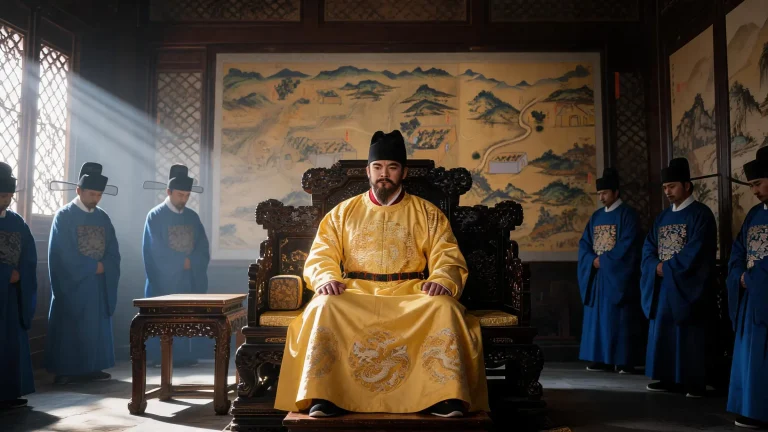
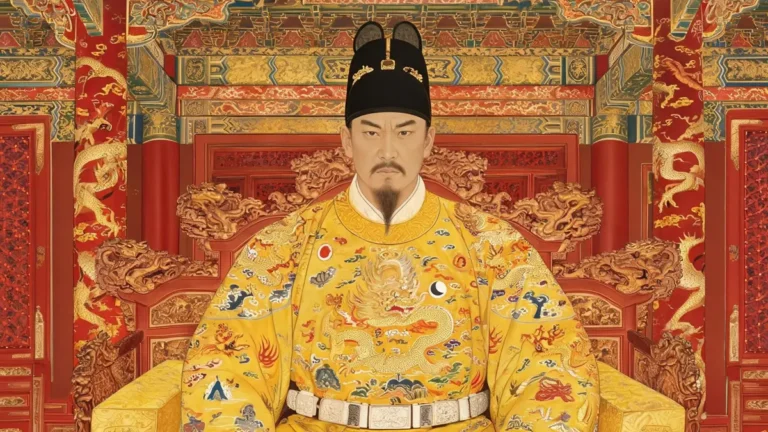
Twenty-four years later, in 1368, that same boy ascended the throne as emperor of China. He called his dynasty Ming, meaning "bright."
This is not legend. This is the most vertiginous social climb in recorded political history. Imagine a medieval European serf becoming Holy Roman Emperor—that comparison still undersells it. Zhu Yuanzhang survived famine, plague, years of homeless wandering, and a brutal civil war, not through luck, but through a survival instinct forged in the worst that the fourteenth century could throw at a human being.
This is the story of the Zhu Yuanzhang early life—those nearly impossible years that made the man, and in making the man, made an empire.
How Could a Man Without a Name Become an Emperor?
European missionaries asked the same question.
Juan González de Mendoza, in his History of the Great and Mighty Kingdom of China, wrote with barely concealed bewilderment about a Ming founder "of such humble origins that his family name was scarcely known"—a man who nonetheless built an empire larger than any European kingdom. Decades later, Matteo Ricci, the Jesuit who penetrated the Ming court, noticed that officials spoke of their dynasty’s founder with a mixture of reverence and wariness. Reverence for the legend. Wariness of the institutional shadow he left behind.
If we fixate only on the rags-to-riches drama, we miss what actually matters.
Every choice Zhu made in his early years wired itself directly into how he later ruled. His methods of punishing corrupt officials—flaying them alive, displaying their stuffed skins as warnings. His almost pathological obsession with agriculture. His bone-deep distrust of the bureaucracy. These were not policy preferences he developed after taking the throne. They were reflexes, burned into his nervous system during eight years of hell between 1344 and 1352.
And those years unfolded against the backdrop of a fourteenth-century global crisis. The Mongol Yuan dynasty collapsed in almost perfect synchrony with the Black Death ravaging Europe, the unraveling of the Mongol world-system, and climate-driven crop failures across Eurasia. Zhu Yuanzhang did not rise in a stable world. He rose in the wreckage of one.
What Actually Happened on the Huai River Plains in 1344?
The Late Yuan: An East Asian Apocalypse
Before we can understand Zhu, we need to see the ground he stood on.
By the mid-fourteenth century, the Mongol Yuan dynasty was a rotting carcass. Paper currency had inflated into worthlessness. The Yellow River breached its banks with devastating regularity. Local officials squeezed the peasantry for every last grain, while a cooling climate slashed harvests year after year. The entire North China plain was turning into a refugee factory.
The year 1344 on the Huai River plains was East Asia’s Florence on the eve of the Black Death—except death came not through the bacterium Yersinia pestis, but through famine, flood, and despair. The efficiency was comparable.
According to the History of the Yuan, the Yellow River floods of 1344 alone inundated vast stretches of Henan, Shandong, and Anhui provinces. Relief funds dispatched by the imperial court were skimmed at every level of the bureaucracy. By the time anything reached actual victims, the amount was negligible. Meanwhile, underground religious sects—the White Lotus Society, the Maitreya cults—were spreading through the countryside like wildfire, offering not just spiritual comfort but organizational networks for rebellion.
Zhu Yuanzhang entered this world at its very bottom.
He was born in 1328, in Zhongli, Haozhou—modern-day Fengyang in Anhui province—to a family of impoverished tenant farmers. The Mongols had classified the population into four legal categories: Mongols at the top, then Semu people (Central Asians and other allies of the Mongols), then Han Chinese of the north, and finally Southern Chinese at the very bottom. The Zhu family belonged to that lowest category. But in truth, they did not even have a secure place in the hierarchy. They owned no land. No property. Not even a proper name.
His father was called Zhu Wusi. He was called Zhu Chongba.
This was not a name. It was a registration number. Under the Yuan household registration system, commoners without official rank were labeled with their father’s numerical designation. Chongba roughly translates to "Double Eight" or "the eighth one again"—the kind of label you give to inventory, not to a human being.
A man who would one day rule over a hundred million subjects began life as a digit.
There is a dark absurdity here that fiction could not get away with.
A Single Disaster Took Everything He Had
1344 was the first breaking point.
That spring, the Huai River valley was hit by drought, then locusts, then pestilence—three calamities stacked on top of each other in a single season. Nature’s efficiency in clearing human populations can be chilling.
According to the Veritable Records of the Ming Taizu, the epidemic claimed Zhu’s father Zhu Wusi, his mother Lady Chen, and his eldest brother Zhu Chongwu within a single month. The exact dates of their deaths were never recorded. Zhu himself, after he became emperor, tried to reconstruct the timeline and could only offer vague approximations.
This detail says everything. The deaths of the poor were not worth recording in time.
What followed is even harder to read.
After their parents died, the two surviving brothers—seventeen-year-old Zhu and one remaining sibling—could not find a single plot of land on which to bury their family. They went to the local landlord, a man named Liu De, and begged for a small patch of earth. Liu De refused them to their faces. It was only a neighbor, a man named Liu Jizu, who could not bear the sight any longer and offered a scrap of wasteland so the brothers could wrap the bodies in rags and hastily bury them.
The History of the Ming records this in brutally restrained language: "A villager, Liu Jizu, gave them land, and only then could they bury the dead."
Eight Chinese characters. The utter helplessness of a teenager standing beside his parents’ corpses, with no recourse whatsoever, compressed into eight characters.
Years later, after he took the throne, Zhu Yuanzhang posthumously ennobled Liu Jizu as the Marquis of Righteous Benevolence, with hereditary privileges. As for Liu De, the landlord who refused them a grave—according to some accounts, Zhu found him too, but did not execute him. The records say only that he "spoke with him and released him."
No one knows what Zhu said. But a man whose entire family starved to death, whose parents did not even have a coffin, seated thirty years later on the Dragon Throne, looking down at the landlord who denied him a grave—and he just says a few words and lets him go. That kind of restraint is more terrifying than a killing.
This was not magnanimity. This was a man who understood that the landlord was a product of the old order. The person he wanted to destroy was not one individual. It was the system that allowed peasants to die without even a place to be buried.
How Did Three Years of Begging Become an Emperor’s Training Ground?
The Monastery That Sheltered Him for Only Fifty Days
After his parents died, there was no family left. No food either.
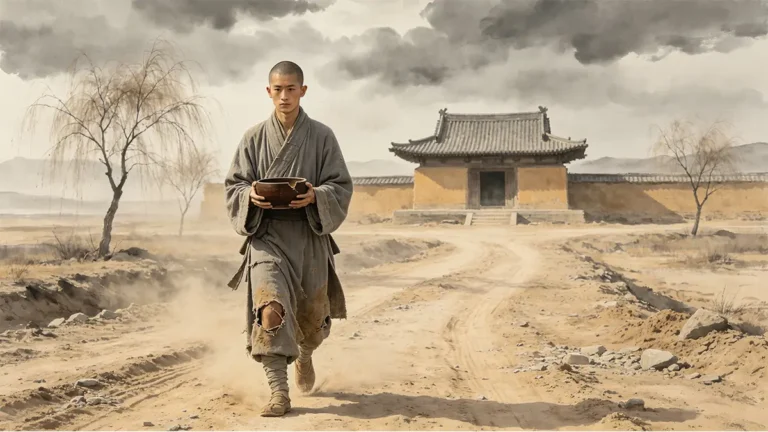
To stay alive, Zhu accepted a suggestion from neighboring villagers and took monastic vows at a nearby Buddhist temple called Huangjue Monastery. Do not mistake this for religious awakening. This was pure survival strategy. Monks, at least, got fed.
Huangjue Monastery sheltered him for less than two months.His time at Huangjue and his subsequent life as a wandering monk were pivotal, leading many to question whether he was really a Buddhist monk or merely a survivor.
By the autumn of 1344, the temple’s grain reserves were exhausted. The abbot disbanded the monks, ordering each to beg for his own food. At seventeen, Zhu was forced out of the monastery and into a wandering life that would last more than three years.
Matteo Ricci, in his journals, would later note the Chinese Buddhist practice of itinerant monks—men who were supposedly engaged in spiritual pilgrimage, but were in reality often simply homeless wanderers in religious disguise. Ricci probably never realized that the founder of the dynasty in which he was living had once been exactly such a wanderer.
These three years are usually glossed over in historical summaries. In my view, that is a mistake. These were precisely the years that turned Zhu Chongba into the man who could become Zhu Yuanzhang, rather than just another anonymous corpse by the roadside.
His Feet Moved, But His Eyes and Ears Did the Real Work
From late 1344 through early 1348, Zhu wandered across a vast area of Huaixi and eastern Henan—roughly what is today northern Anhui, southern Henan, and western Jiangsu. The exact route is lost to history.
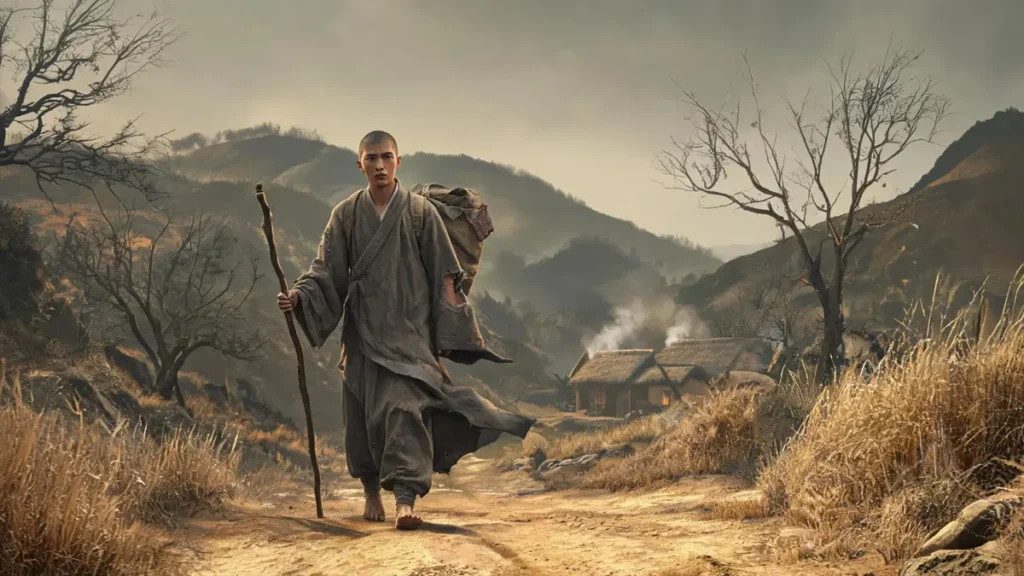
This was not spiritual cultivation. This was forced, extreme fieldwork.
What he saw on the road was not the literary cliché of "the suffering of the common people." What he saw was the complete rot of the Yuan state’s local administration. Grain confiscated by officials. Peasants beaten in the streets by tax collectors. White Lotus gatherings held in secret at night. He watched an empire dying from its capillaries inward.
No scripture teaches these things.
Later in life, Zhu displayed an uncanny sensitivity to terrain when commanding armies, an almost supernatural ability to detect deception in local administration, and a razor-sharp instinct for who could be trusted and who could not. The source of all these abilities lies in those three years of wandering.
He learned how to hide his true intentions in front of strangers. He learned when to leave, immediately, without looking back. He learned exactly how long a single meal could sustain him. He learned to tell the difference between people who were genuinely kind and those who were simply exploiting his monk’s robe.
Medieval Europe had plenty of wandering friars. After the Black Death, the roads were full of them. But most of those men simply walked until they died. Zhu walked his way to an empire.
What made the difference?
He maintained an observer’s vigilance without ever sinking into becoming a pure survival machine. This requires a rare kind of mental toughness—to keep your brain running, to keep remembering everything you see, to keep silently building a model of how the world works, when you cannot even be sure of your next meal.
That psychological constitution is rarer than any military skill.
A Point Often Overlooked: Could He Even Read?
Scholars debate this. I think the answer is yes—and he learned fast.
The traditional narrative insists Zhu was born utterly illiterate. But during his time at Huangjue Monastery, he would have had at least minimal exposure to Buddhist texts—a novice who swept floors and fetched water could not avoid written characters entirely. During his three years on the road, he wandered through regions that were hotbeds of White Lotus activity, places saturated with vernacular scriptures, ritual chants, and prophetic verses, all semi-literate, mixing spoken language with classical phrases. If you hear enough of it, you start to recognize the characters.
What is certain is that after Zhu returned to Huangjue Monastery in 1348, he began consciously learning to read and write. By the time he joined the army in 1352, he could independently handle military dispatches, orders, and correspondence. That speed of progress suggests a man of considerable intelligence.
Besides, in the chaos of the late Yuan, an illiterate man could never be more than someone else’s weapon. Zhu wanted to be the one holding the blade. Learning to read was not an inspirational life choice. It was a survival imperative.
How Did One Letter Destroy His Last Safe Option?
1351: The Entire Huai River Valley Caught Fire
After returning to Huangjue Monastery, Zhu spent three relatively quiet years. He did menial work. He learned to read. It seemed he might live out his days in the dim light of the Buddha hall.
The outside world had other plans.
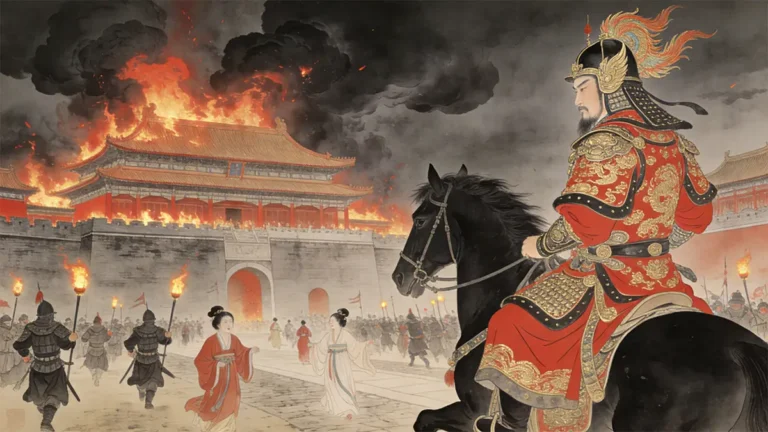
In 1351, the White Lotus leader Liu Futong launched an uprising in Yingzhou, proclaiming that Han Shantong was a descendant of the Song imperial line and raising the banner of "Oppose the Yuan, Restore the Song." The rebels wrapped red cloth around their heads as identification—this was the Red Turban Rebellion, which would eventually sweep across half of China.
The Yuan government’s response was, to put it mildly, catastrophic. Imperial forces not only failed to suppress the rebels, they routinely slaughtered civilians and presented the heads as rebel trophies to claim rewards. This pushed neutral peasants into the rebel camp, family by family.
Red Turban activity spread to the Haozhou area, where Huangjue Monastery stood. The temple now faced threats from every direction—Yuan officials saw it as a rebel sympathizer, while rebels viewed it as a Yuan collaborator.
Zhu was caught in the middle. And then the letter arrived.
Tang He’s Message and the Divination That Changed Everything
Early 1352. The sender was Tang He, a childhood friend from Fengyang.
Tang He had already joined the Red Turban army under a warlord named Guo Zixing. His letter urged Zhu to come and join him. The Veritable Records describes it simply: "he sent a letter to recruit him." The wording must have been urgent.
Here was the problem. If this letter was discovered, Zhu would be executed. No questions asked.
The Yuan government did not distinguish between actual rebels and those merely in contact with rebels. For anyone linked to the rebellion, the penalty was death. Zhu’s monk’s robe offered no protection—if anything, it made him more suspicious. An outsider monk in a temple, with no local roots, was the most obvious kind of suspect.
Zhu hesitated so badly that he walked into the main hall of the temple and cast divination lots before the Buddha statue.
Picture this. A future emperor, kneeling in a crumbling temple, trembling hands throwing divination tools, before a clay statue of the Buddha, while outside the gates, Yuan soldiers or rebel forces could burst in at any moment.
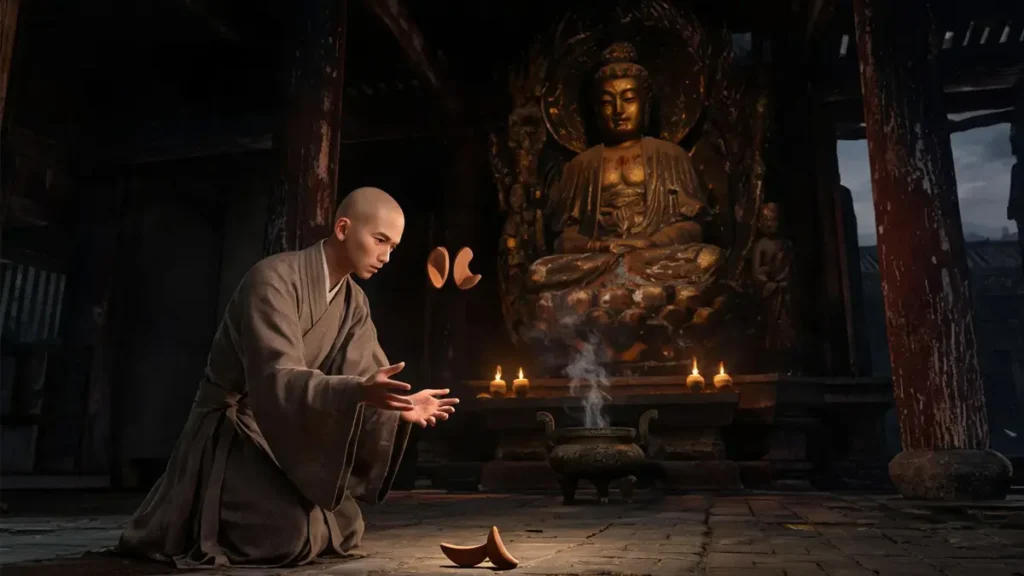
Whether or not you believe in fate, you have to admit: this is one of the wildest coin-flips history ever tossed.
The Veritable Records records the sequence: he first asked whether he should stay at the temple—the lot was inauspicious. He then asked whether he should flee—still inauspicious. Finally, he asked whether he should join the rebels—the lot was auspicious.
The divination pointed to an answer he had probably already sensed. There was no way back.
He left Huangjue Monastery and headed for Haozhou city. Zhu was twenty-four years old. It had been exactly eight years since his family starved to death.
From a Number to a Jade Blade: A Masterclass in Identity Engineering
What Guo Zixing Saw Was More Than a "Strange-Looking Man"
When Zhu reached Haozhou, he immediately ran into trouble: the city guards assumed he was a Yuan spy and tied him up.
The Veritable Records gives us a cinematic moment: Guo Zixing rode past, saw this bound monk, noted his "extraordinary and imposing appearance," and ordered him untied and enrolled as a personal guard.
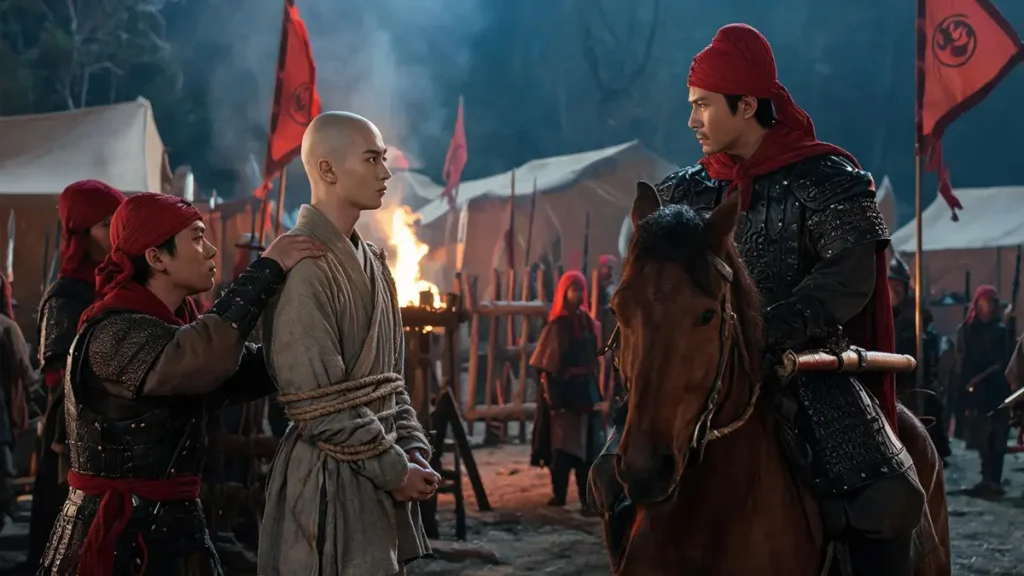
Those words—"extraordinary and imposing appearance"—have been debated ever since. Some say Zhu’s face was genuinely unusual; the surviving portraits, with that elongated chin and protruding jaw, are certainly hard to describe as conventionally handsome, but they are unforgettable. Others suspect this was later court historians applying the standard rhetoric for founding emperors, who are always supposed to look distinctive.
I lean toward a simpler explanation: Guo Zixing spotted a rare set of qualities.
A man who had survived three years on the road. A man who had taught himself to read in a monastery. A man who did not panic when bound and facing death. In a landscape swarming with desperate peasants and petty warlords, such a person was extraordinarily scarce. Guo’s Red Turban army was large and loud, but its core cadre consisted mostly of rough military men. What Guo lacked was someone with both brains and fearlessness.
Zhu was assigned to Guo’s personal guard and quickly proved exceptional.
It was not just courage in battle. More importantly, he understood discipline. After every engagement, he handed over all spoils to Guo without holding anything back. After every mission, he voluntarily reported the full details without claiming credit. In an army with notoriously lax discipline, this behavior was practically extraterrestrial.
Guo began entrusting him with important assignments. Before long, Zhu was promoted to a junior officer rank. Then Guo married his adopted daughter, a young woman surnamed Ma, to him.
The Political Engineering of a Name
The name "Zhu Yuanzhang" emerged during this period.
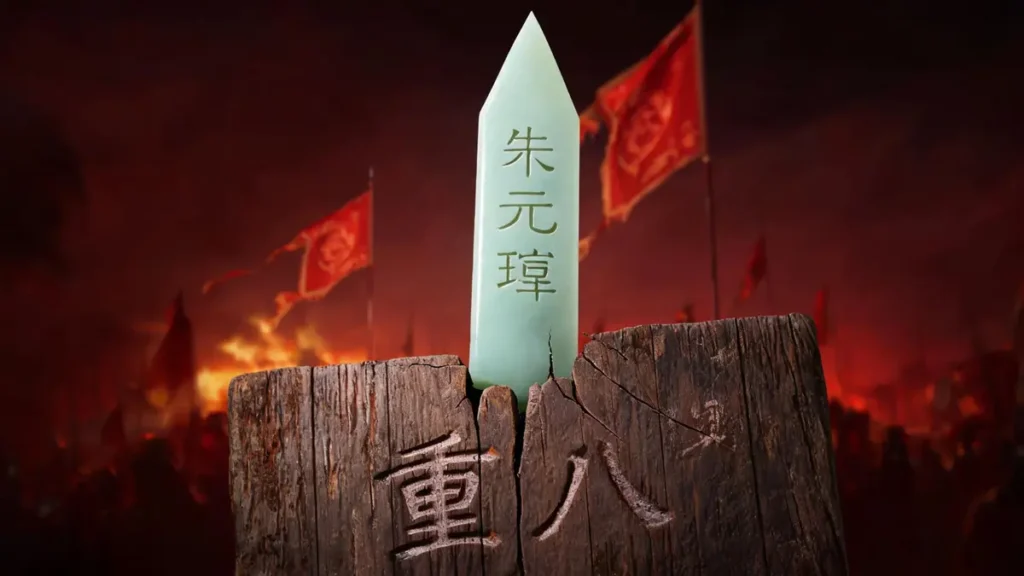
His original name was Zhu Chongba. When he first joined the Red Turbans, he renamed himself Zhu Xingzong—"Xingzong" meaning "to revive the family line," a typical aspiration for a man rising from the bottom.
But then he changed it to Zhu Yuanzhang.
The character Yuan refers to the Yuan dynasty. The character Zhang designates a pointed jade implement, used in ancient times as both a ritual object and a symbolic weapon. Taken together, the name means: "The Sharp Jade Blade That Will Destroy the Yuan."
This was not a casual choice of name. This was a political declaration of war.
In that era, names carried ideological weight. Han Shantong claimed descent from the Song imperial line. Han Lin’er styled himself the "Little Ming King." Liu Futong rallied followers under the banner of restoring the Song. Everyone used names or titles to announce their political goals. Zhu Yuanzhang’s name declared his target: the entire Yuan dynasty.
The shift from Zhu Chongba to Zhu Yuanzhang was not a peasant upgrading to a nicer name. It was a man switching his operating system from "survive" to "conquer."
At the same time, marriage sealed his social ascent.
Ma’s father had died early, and Guo Zixing had raised her as his own daughter. A warlord’s adopted daughter in the late Yuan was not as valuable as an aristocratic lady in more stable times, but this step was still decisive. Zhu was no longer a solitary outsider monk. He was Guo Zixing’s son-in-law. He belonged to the inner circle of the rebel leadership.
In less than a year, he had gone from a suspicious monk nearly executed on sight, to a man with political standing, military rank, and family connections in Haozhou city.
The operational efficiency of this rise is, in any era’s power game, something close to textbook.
How Did Early Suffering Etch Itself Into the Ming Dynasty?
Everything above tells what happened. What follows is the part that should truly make the hair on your neck stand up: those early traumas later became state policy.
| Early Life Experience | Corresponding Policy or Behavior | Deep Psychological Driver | Institutional Consequence |
|---|---|---|---|
| Family starved to death; no land for burial | Brutal punishment of corrupt officials (flaying, stuffing skins) | Deep distrust of local enforcers | Waves of mass executions during the Hongwu reign |
| Three years of homeless begging | Prioritizing agriculture, suppressing commerce, strict population controls | Instinctive suspicion of merchants and itinerants | Strengthened household registration and travel permit systems |
| Rose through a peasant rebellion | Continued to call himself "a commoner from Huaixi" even as emperor | Used origin narrative to build legitimacy | Deliberately restrained the nobility while favoring peasants |
| Witnessed Yuan officials extorting famine victims | Low tax rates, frequent land tax remissions | "Hunger memory" driving economic policy | Chronic fiscal strain on the Ming state |
This table crystallizes a simple fact that is surprisingly easy to overlook: every single trauma of the Zhu Yuanzhang early life became a system. Not a metaphorical influence—actual statutes carved into the Ming legal code and the emperor’s own edicts.
His Hatred of Corrupt Officials Was Not Political Theater
Later historians often interpret Zhu Yuanzhang’s anti-corruption campaigns as pretexts for political purges. This reading is not entirely wrong—in his later years, he certainly used anti-corruption charges to eliminate officials he considered unreliable or potentially threatening.
But if you trace it back to what he saw in 1344—officials intercepting famine relief funds, causing the deaths of tens of thousands of peasants, including his own parents—the initial motive cannot be reduced to power politics.
The Great Warnings, a collection of legal pronouncements personally compiled by Zhu Yuanzhang, catalogs a gruesome array of punishments: flaying, amputation of hands, severing of feet, death by slow slicing. Reading these texts, you can feel that he was not just threatening. He genuinely wanted every official to understand that the price of corruption was worse than starving to death.
Underneath this policy lies the most primal, irrational rage of a hungry child against adults who "took the money and did nothing."
Similarly, his pathological emphasis on agriculture came from the same place. Zhu decreed that merchants could not wear silk and that the sons of merchants could not sit for the imperial examinations. From the standpoint of economic rationality, these policies were self-crippling. But from the perspective of a man who had watched the collapse of food distribution kill his entire family, his logic was internally consistent: farming mattered more than commerce. Stability mattered more than mobility.
You can call this shortsighted. But he was not an economist. He was a survivor. And survivor logic is sometimes brutally simple.
His Paranoia Was Not a Character Flaw—It Was a Survival Strategy
Psychology enthusiasts in the West love to analyze Zhu Yuanzhang’s paranoia. There is good reason for this.
Between 1344 and 1352, here is what he experienced: his parents killed by famine, himself expelled from the monastery, rejected and driven away countless times during his years of wandering, nearly executed on sight when he tried to join Guo Zixing. And in not one of these events did any institutional protector appear. No lord gave him shelter. No church offered him relief. No law protected his life.
He survived entirely on his own.
A man who emerges from this environment—expecting him to trust others is simply unreasonable.
This is why the great purges of the late Hongwu reign—the Hu Weiyong case, the Lan Yu case—cannot be fully explained through normal political logic. Zhu Yuanzhang was not afraid of any specific individual rebelling. He was afraid the entire system would devour his descendants the moment he was gone. He killed not his enemies, but every person he could imagine becoming an enemy.
This was the worst legacy of his early years, and the most chilling part of the whole story. But it was also what made Ming imperial power, in his hands, reach an intensity that left even the European missionaries who later arrived in China utterly stunned.
Who Would Zhu Yuanzhang Have Been Without the Famine of 1344?
This question has no answer. But it is worth asking.
If the Yuan relief system had functioned. If the Yellow River had not burst its banks in 1344. If Zhu Wusi had not starved to death—Zhu Chongba would most likely have spent his life farming a patch of soil in Fengyang, just like his father, dying in obscurity, leaving no mark on any historical record.
He would not appear in the History of the Ming. He would not be a name in Matteo Ricci’s journals. He would not be the founder of the Eastern empire that stunned European readers of Mendoza.
But turn the question around. That famine killed several million people just like him.
How many potential Zhu Yuanzhangs died in those millions? The question is its own answer.
Zhu liked to call himself "a commoner from Huaixi" even after he became emperor. It sounded like humility. It was actually top-tier power rhetoric. He was telling everyone: the emperor you now obey was once exactly as lowly as you, so you have no standing to complain.
But the phrase has another layer, one he might never have admitted to himself. Only a system that crushed people as thoroughly as the Yuan did could produce a man who needed to overthrow it just to prove he existed.
The Zhu Yuanzhang early life is not one man’s legend. It is a cross-section of a collapsing world.
When Matteo Ricci and his fellow Jesuits encountered the Ming dynasty in the late sixteenth century—an empire whose bureaucratic sophistication left Europeans dizzy, whose centralized power baffled the missionaries—the operating code of that empire was written in those eight years: the famine-stricken spring of 1344, the desperate divination of 1351, the impossible transformation from monk to general in 1352.
The boy named Zhu Chongba died long ago.
What survived was a man who knew hunger, betrayal, and fear from the inside. In 1368, he rebuilt order. But he used a method that only he could wield—not mercy, not forgiveness, not institutional innovation. Memory.
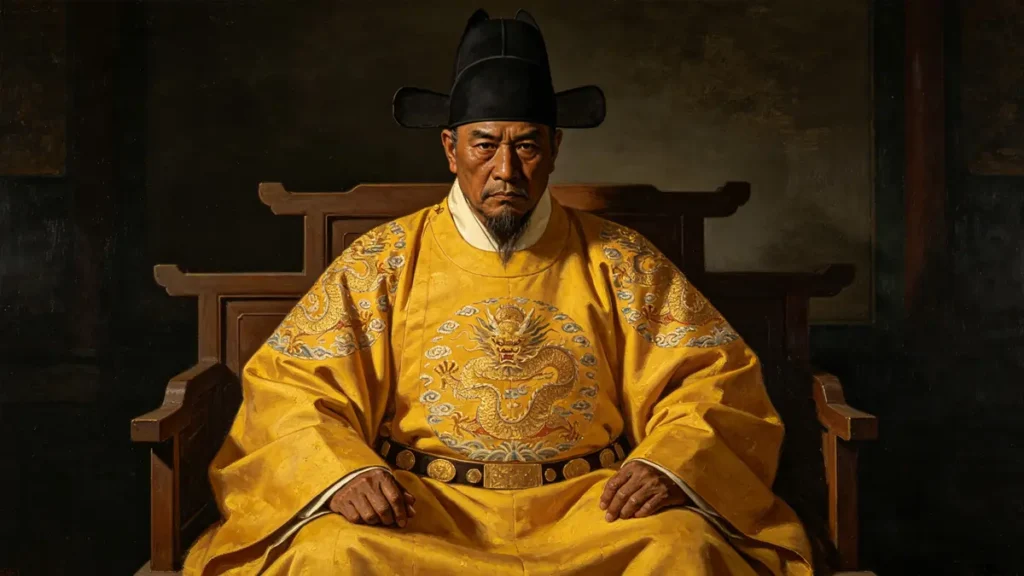
He never forgot what it felt like to have no land to bury his parents. And so his Ming Empire would never permit anyone to say, "There was nothing I could do."
Even if the cost of that refusal was tens of thousands of severed heads.
History is brutal in this way: a man twisted by suffering, and then using that twisted force to reshape an entire world. Should we mourn the starving boy on the roadside—Zhu Chongba, who lost everything? Or should we fear the cold-eyed Hongwu Emperor on the Dragon Throne?
Perhaps those two men were never truly separate.