Zhu Yuanzhang’s Rise to Power: A Complete Summary
Zhu Yuanzhang rose to power by combining military leadership, political patience, and administrative skill. He began as a poor orphan and Buddhist novice, joined the Red Turban Rebellion in 1352, captured Jiqing—modern-day Nanjing—in 1356, and built a powerful base in the lower Yangtze. He then defeated Chen Youliang and Zhang Shicheng, launched a northern expedition against the Yuan dynasty, and founded the Ming dynasty in 1368.
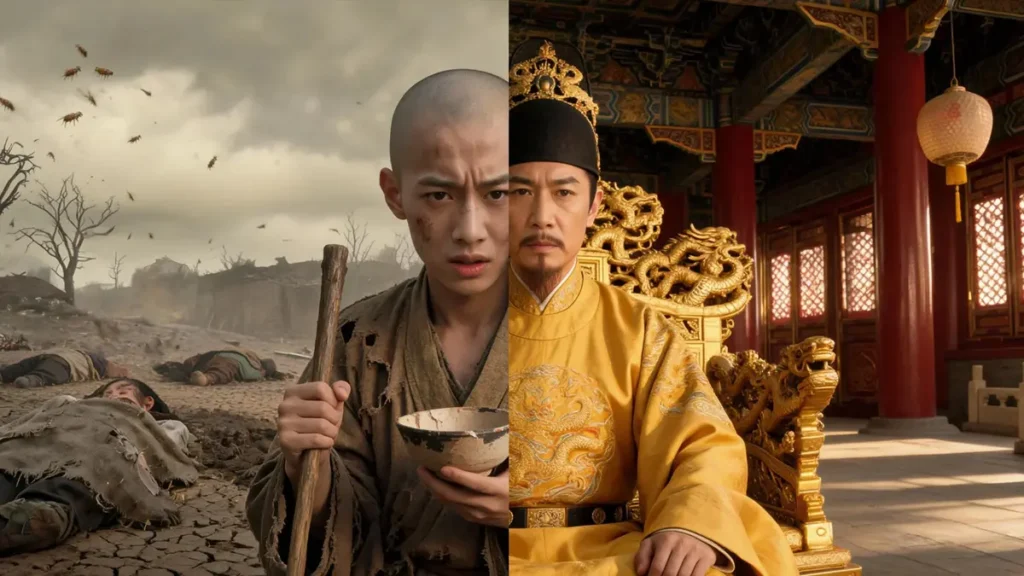
A sixteen-year-old orphan, having buried his parents and brother with his own hands during a plague and famine, enters a Buddhist monastery in desperation — only to leave soon after, wandering and begging for three years. Twenty-four years later, this same man sits on the Dragon Throne in Nanjing, ruling the largest and wealthiest empire on Earth. Zhu Yuanzhang’s rise to power was not some simplistic rags-to-riches fairy tale. It was a cold, almost terrifyingly calculated strategic operation: he read the collapse code of Yuan-dynasty society with unnerving precision, then used Confucian order, military discipline, and geopolitical patience to turn himself into the only reliable answer in an age of chaos.
This summary traces his path to the throne. For a richer, more textured narrative of his entire life, from orphan to emperor, explore the main feature.
From Famine and Beggary to the Red Turban Rebellion
Let’s go straight to the summer of 1344.
Locusts and plague had swept through the Huai River basin for months. Zhu Yuanzhang’s family of eight lost four members in just two weeks. No coffins. No burial ground. A neighbor eventually offered a scrap of land to lay them to rest. The Veritable Records of the Hongwu Emperor does not gloss over this episode — it frames it as the origin point of the entire imperial narrative. This starting point was so devastatingly bleak that years later, as emperor, Zhu would still write in his edicts: "In my humble youth, the living suffered for food and clothing, and the dead had no proper grave."
You won’t find comparable language in the coronation declarations of contemporary European monarchs. Henry V never told you he starved as a child. Charles VII never wove famine into his royal proclamations. But Zhu Yuanzhang did.
Because the persona he was building was never that of a divinely anointed monarch. He was presenting himself as a man who crawled out of hell to rebuild order itself.
This brings us to the first critical node in Zhu Yuanzhang’s rise to power: he understood, earlier and more clearly than every other rebel leader, that the Yuan dynasty’s problem wasn’t "Mongol rule" — it was total institutional collapse.
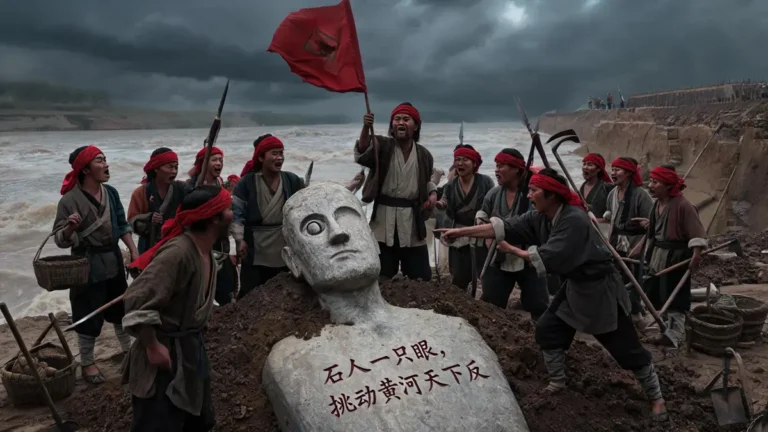
Flood refugees from the Yellow River plain. Salt-smuggling gangs turned armed militias. White Lotus millenarian cults. Local warlords carving out fiefdoms. A Mongol military apparatus rotting from corruption. These ingredients didn’t just create a demand for dynastic change. They generated an apocalyptic mood that spread across North China and the Yangtze Delta. The Red Turban Rebellion drew its mobilizing power from potent religious eschatology — Han Shantong declared "Maitreya descends, the Ming King is born" — a message that resonated with desperate peasants as powerfully as European millenarian movements or Dominican apocalyptic preaching resonated with plague-stricken populations in the fourteenth century.
Joining Guo Zixing’s Red Turban Forces in 1352
When Zhu Yuanzhang joined Guo Zixing’s Red Turban forces in 1352, he displayed no particular religious fervor. He was a pragmatist. He fought bravely, yes, but the more telling detail was how he handled the spoils of war: "Whatever property was captured, he distributed it entirely among his soldiers, taking nothing for himself." This wasn’t moral virtue. This was cold calculation. In a world falling apart, a commander who didn’t hoard plunder was rarer — and more valuable to follow — than a commander who simply fought well.
This combination of battlefield courage and practical leadership helped Zhu build a loyal following within the Red Turban movement. He was not merely participating in the rebellion; he was gradually developing the military and political network that would support his own independent power base.
Capturing Jiqing: How Nanjing Became Zhu Yuanzhang’s Power Base
What truly accelerated Zhu Yuanzhang’s rise to power was the capture of Jiqing — modern-day Nanjing — in 1356.
Before Nanjing, Zhu’s force was essentially a mobile raiding army. After taking Nanjing, he started doing something most Red Turban leaders had no interest in: governing. He established military agricultural colonies, repaired irrigation systems, and recruited displaced farmers to return to abandoned fields.The History of Ming: Treatise on Food and Money records a telling detail: even at the height of military campaigns, he dispatched men to dredge clogged river channels, because grain rotting in transit was more dangerous than any enemy army.
Build High Walls, Store Abundant Grain, and Delay Claiming the Throne
This is the real meaning behind Zhu Sheng’s famous nine-character strategy: "Build high walls, store abundant grain, and delay claiming the throne." Many read this as a passive, defensive posture. It was anything but. "Delay claiming the throne" does not mean "never claim it." It means: don’t claim it yet. At the time, Liu Futong was propping up Han Lin’er as the Longfeng Emperor. Chen Youliang murdered Xu Shouhui and declared himself emperor. Zhang Shicheng had already styled himself King of Wu years earlier. Zhu Yuanzhang? He didn’t take the title King of Wu until 1364, and even then, he continued using the Longfeng reign name until his northern expedition in 1367. This political posture paid enormous dividends: he avoided becoming the Yuan court’s primary target, and he avoided creating unnecessary enemies within the Red Turban coalition.
The strategy allowed Zhu to strengthen his territory before openly competing for supreme power. He could let rival leaders expose their weaknesses while he accumulated grain, soldiers, officials, and political legitimacy.
Look at this through a global lens, and there’s a subtle resonance with contemporary European statecraft. Zhu’s "delay claiming the throne" was, at its core, strategic risk hedging — preserving maximum flexibility while rivals rushed forward to absorb the blow. It echoes, in spirit if not in form, the cautious, consolidation-first approach of Henry VII after the Wars of the Roses: stabilize your base, let your enemies make mistakes, then strike.
The Battle of Lake Poyang and the Defeat of Chen Youliang
But Zhu Yuanzhang’s rise to power still lacked one definitive, brutal trial by combat.
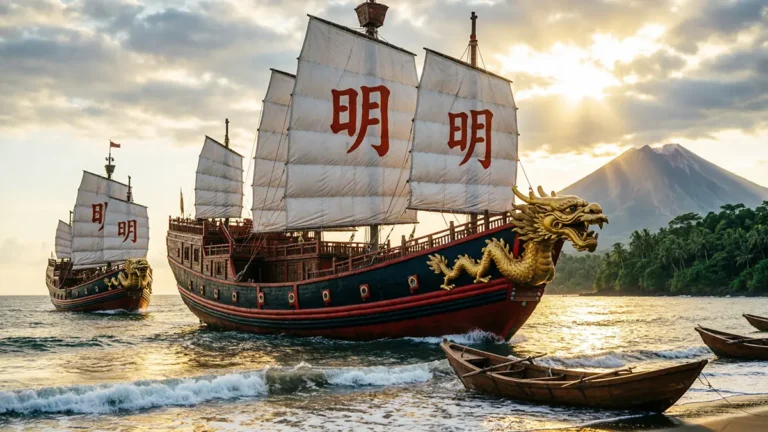
The Battle of Lake Poyang in 1363 was the largest naval engagement of medieval Chinese history — and the duel that would decide the fate of the south. Chen Youliang’s fleet boasted massive three-deck ironclad warships, towering over the water. Later accounts reportedly gave his forces a figure as high as 600,000, although medieval military numbers are difficult to verify and were often exaggerated. Zhu’s ships were smaller. His numbers were thinner. But he held two decisive advantages: wind direction and iron discipline.

I won’t belabor the tactical details. Just this: the battle raged for thirty-six days. Chen Youliang took an arrow to the skull and died. Zhu captured hundreds of warships and tens of thousands of prisoners. And then he did something that set him apart from both Chen Youliang and Zhang Shicheng — he did not execute the surrendered troops. Chen was paranoid and brutal; his subordinates were perpetually on the verge of defection. Zhang was indecisive and lax; his soldiers grew soft. Zhu’s military discipline was cold to the point of ruthlessness, but his system of reward and punishment was transparently clear. After the battle, surrendered soldiers could be integrated into his forces. Surrendered officers could keep their ranks. Land could be redistributed to displaced farmers.
In the language of institutional analysis, this is what we call a "winner’s credible commitment to order." In Zhu’s own words: "He who does not delight in killing shall unify all under heaven."
Why Zhu Yuanzhang Succeeded Where Other Warlords Failed
The table below offers a clearer comparative view of how Zhu Yuanzhang and his chief rivals approached the war for China:
| Comparison Dimension | Zhu Yuanzhang | Chen Youliang | Zhang Shicheng |
|---|---|---|---|
| Political Message | Expel the barbarians, restore Chinese rule | Replace the Yuan, found a new dynasty | Protect the territory, maintain regional peace |
| Military Strategy | Steady advance, south first, then north | Concentrate forces, seek decisive battle | Passive defense, lacked offensive ambition |
| Talent Policy | Recruited Confucian scholars, institutionalized absorption | Relied on old subordinates, mistrusted commanders | Patronized many scholars, lacked a core team |
| Popular Support | Strict military discipline, tax reduction, land reclamation | Allowed looting, lost civilian support | Heavy taxation, limited regional appeal |
| Timing of Coronation | 1364, delayed claiming kingship | 1360, murdered former master, declared emperor | 1354, proclaimed himself king far too early |
This table points to a truth that is simple but frequently overlooked: among the warlords of the late Yuan, Zhu Yuanzhang was neither the best-resourced nor the highest-born. But he made the fewest mistakes. At every juncture, he chose the most pragmatic option. This is not a moral judgment. It is a cost-benefit analysis.
Zhu’s advantage was not simply that he fought better battles. He also connected military expansion to food production, local administration, recruitment, and political timing. His rivals competed as powerful regional leaders, but Zhu increasingly behaved like the founder of a new state.
Defeating Zhang Shicheng and Unifying Southern China
After defeating Chen Youliang, Zhu Yuanzhang turned his attention to Zhang Shicheng, who controlled wealthy territories in the lower Yangtze region. Zhang’s regime possessed important agricultural, commercial, and transportation resources, making him the final major obstacle to Zhu’s control of southern China.
Zhu’s forces gradually isolated Zhang’s territories and attacked his remaining strongholds. The fall of Pingjiang in 1367 brought Zhang Shicheng’s independent power to an end and gave Zhu control over much of southern China.
The Northern Expedition and the Fall of the Yuan Dynasty
In 1367, Zhu dispatched Xu Da and Chang Yuchun at the head of 250,000 troops on a northern expedition. This was exceedingly rare in Chinese history — a south-to-north unification campaign. The Southern Song had failed at it. The Southern Dynasties had failed. The Eastern Jin had failed. But the internal collapse of the Yuan court did the heavy lifting. Mongol noble infighting. The Emperor Huizong’s vacillation. Regional warlords sitting on their hands, waiting to see who would win. The northern expedition became a rout.
How Zhu Yuanzhang Founded the Ming Dynasty
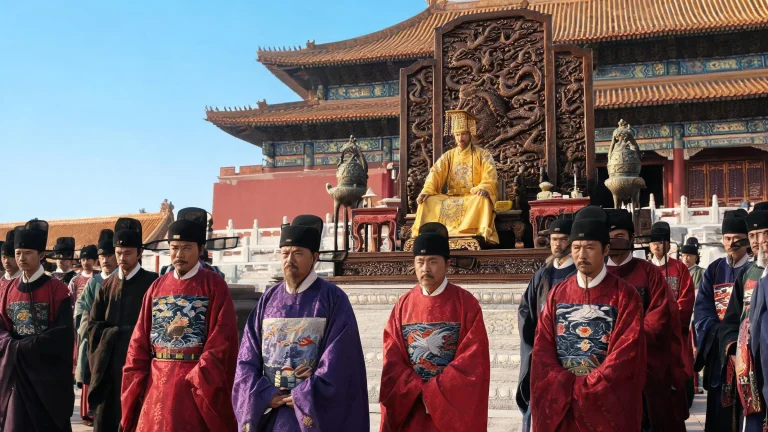
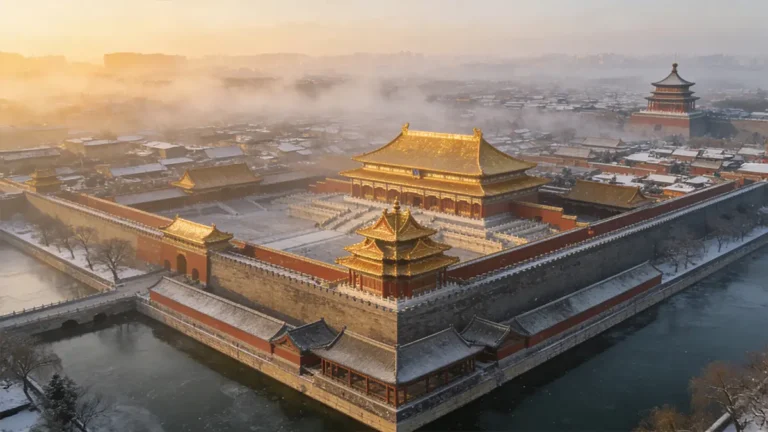
In early 1368, Zhu Yuanzhang ascended the throne in Nanjing, proclaiming the Ming dynasty, era name Hongwu — "Vast Martial Prowess." By August, Ming forces had taken Dadu — modern Beijing. The Yuan emperor fled north.
The legend of Zhu Yuanzhang’s rise to power ends here. But the truly interesting questions only begin.
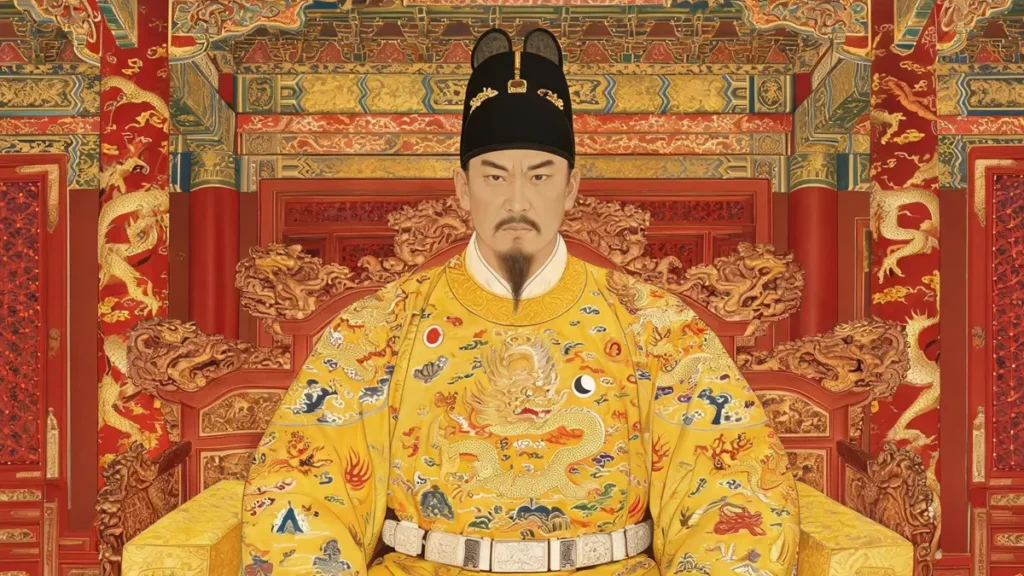
He was a beggar. This fact became an inescapable shadow over the political culture of the Ming dynasty. He detested corruption with an almost pathological intensity. Anti-corruption enforcement under the Hongwu reign was without parallel in Chinese history: officials caught embezzling sixty taels of silver could be flayed alive, their skins stuffed with straw and displayed as warnings. He viewed the bureaucratic class with deep-seated suspicion. He abolished the office of the Chancellor, concentrating imperial power directly onto the Six Ministries. He established the Embroidered Uniform Guard, using a secret police apparatus to surveil his own officials. His ruling style carried the indelible imprint of a survivor from the bottom: trust no one, depend on no intermediary institutions, personally handle everything — to the point of reviewing hundreds of memorials a day.
This trajectory ran directly counter to contemporary European political evolution. During the fourteenth and fifteenth centuries, the English and French monarchies were moving, haltingly, toward consultative parliaments and negotiated aristocracy. Ming China, in Zhu Yuanzhang’s hands, veered toward extreme centralization. One way to understand this divergence: a regime born from total societal collapse harbors a near-instinctive terror of losing control.
When Matteo Ricci later described the Ming administrative system in his journals, he oscillated between admiration for its efficiency and bewilderment at the tense, mistrustful relationship between the emperor and his bureaucracy. He saw the concentration of power but could not fully grasp the trauma that fueled it. Zhu Yuanzhang ran the empire like a vast agricultural estate that had to be micromanaged, every official a potential thief, every policy a makeshift dike repair. This logic extended from Nanjing to Yunnan, from the Hongwu era all the way to the Chongzhen emperor’s final days.
So the true legacy of Zhu Yuanzhang’s rise to power was not simply a new dynasty. It was a genetic code of deep institutional distrust toward the entire bureaucratic apparatus. All the systemic afflictions that would later plague the Ming — the tug-of-war between the Grand Secretariat and the eunuch establishment, the mass remonstrations of censorial officials, the chronic fiscal collapse — can trace their seeds back to the founding logic of the Hongwu reign.
A man who crawled out of hell ended up locking his entire empire inside his fears.
That is, perhaps, the deepest and most haunting echo of Zhu Yuanzhang’s rise to power.
Primary References
- Veritable Records of the Ming Emperor Taizu
- History of Ming: Annals of Taizu; History of Ming: Treatise on Food and Money
- Zhu Sheng’s nine-character strategy: "Build high walls, store abundant grain, delay claiming the throne"
- Matteo Ricci, De Christiana expeditione apud Sinas (Journals of Matteo Ricci)
- Scholarship on the late Yuan Red Turban Rebellion and White Lotus millenarianism
- Military history research on the Battle of Lake Poyang (1363)