Ming Dynasty Founding Generals: Who Zhu Yuanzhang Killed
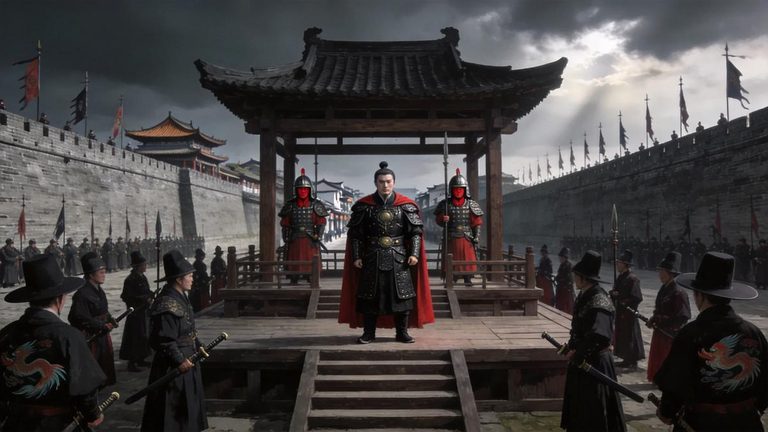
In the eleventh month of 1370, in Nanjing, the army that had driven the Mongols out of the north came home. Zhu Yuanzhang had already reported the completion of the campaign at the suburban altars. On this day he enfeoffed the Ming dynasty founding generals in a single ceremony. Li Shanchang became Duke of Han, Xu Da Duke of Wei, Li Wenzhong Duke of Cao, Feng Sheng Duke of Song, Deng Yu Duke of Wei, and Chang Mao, son of the late Chang Yuchun, Duke of Zheng. Twenty-eight more men became marquises, Tang He among them. In the same month Wang Guangyang was made Count of Zhongqin and Liu Ji Count of Chengyi. Three days later the emperor held a sacrifice for the soldiers who had died in the northern campaign.
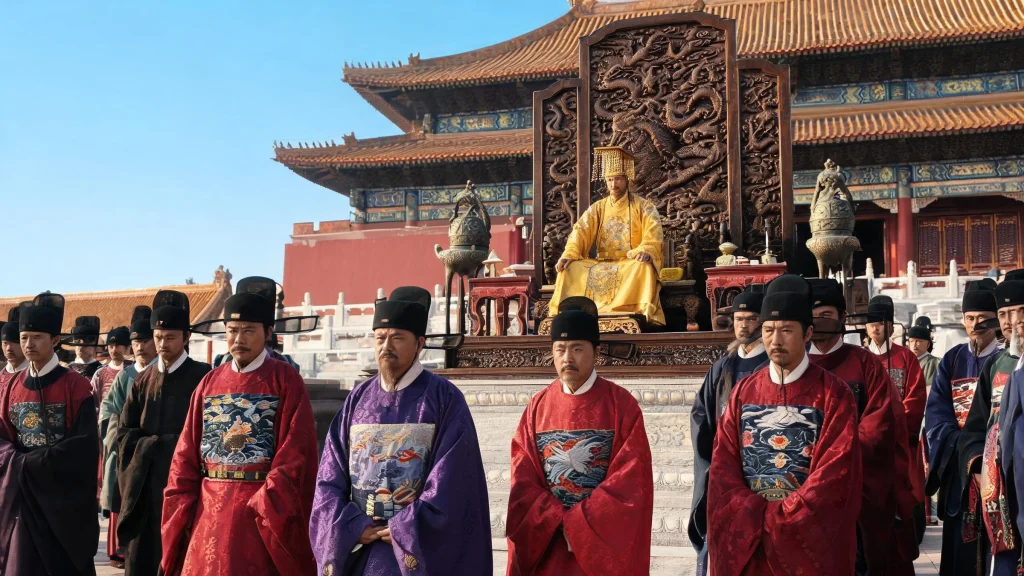
Two of those dukedoms sound identical in English. The Wei of Xu Da is the name of an ancient state. The Wei of Deng Yu means guard.
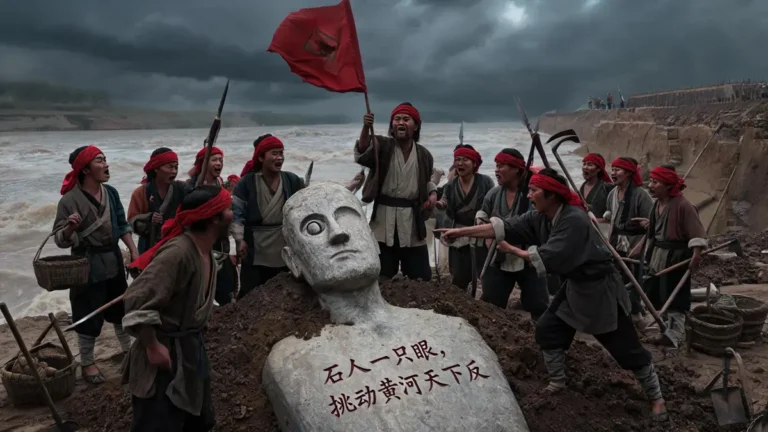
The men on the roll were his neighbors and his kin. Xu Da and Tang He came from the same village in Zhongli. Li Wenzhong was his elder sister’s son. Chang Yuchun, Feng Sheng and Deng Yu had been fighting for him since the 1350s. Twenty-six years earlier, in a village on the Huai River, his parents and an elder brother had died within the same year and the family was too poor to bury them. He entered a Buddhist monastery, and when the monastery closed its granary he spent three years begging his way through the region. The list of 1370 was the furthest he would ever be from those years. Some of it was settled on the spot. Every duke and marquis received an iron warrant, which stated how many times he could escape execution and stated that rebellion was not among the crimes excused. Li Shanchang’s was the most generous: two deaths excused for himself, one for his son.
A year and a half later, in the sixth month of 1372, he had an iron tablet written and published, setting out item by item what the households of dukes and marquises were not permitted to do. They were not to put soldiers to private use. They were not to seize hills, lakes, tea plantations or mines from the state or from ordinary people. The stewards who ran their estates were not to bully villagers.
From 1380 the roll began losing names, one at a time. By the last years of the reign only two holders of those titles were still alive. "Of the dukes and marquises," the History of the Ming says, "almost all were gone." The survivors it names are Geng Bingwen and the Marquis of Wuding, Guo Ying. Another chapter of the same history puts the same fact twice over: the old generals who founded the dynasty followed one another to the end. Men of strength and courage, it says, were mown down until few were left.
First Wang Guangyang, then Li Shanchang
By 1380 the left and right grand chancellors of the Central Secretariat were an office that no longer existed. The summary at the close of Li Shanchang’s biography does the arithmetic. When the Ming was founded, a Central Secretariat was created with left and right grand chancellors, and the men who actually served in that capacity were three: Li Shanchang, Wang Guangyang and Hu Weiyong. "For the whole of the Ming," the summary adds, "only Shanchang and Guangyang were ever called grand chancellor." In two hundred and seventy years of the dynasty, three men held the post. All three died by the emperor’s order.
Wang Guangyang went first. In the ninth month of 1379 a mission arrived from Champa and the Central Secretariat did not report it. Zhu Yuanzhang was furious and questioned the secretariat. Hu Weiyong and Wang Guangyang knocked their heads on the floor, asked for punishment, and passed the blame to the Ministry of Rites, which passed it straight back. In the twelfth month Wang Guangyang was on his way into exile in the far south when the emperor’s order caught up with him at Taiping. The History of the Ming records the outcome in one line: the edict was delivered, and he was killed.
In the first month of 1380 the vice censor-in-chief Tu Jie laid an accusation. The left grand chancellor Hu Weiyong, he said, was plotting rebellion. The court then debated what to do about Tu Jie himself and decided that he had been part of the plot, had turned informer only when it was failing, and could not be spared. Hu Weiyong, the censor-in-chief Chen Ning and Tu Jie were executed on the same day. Five days later Zhu Yuanzhang abolished the Central Secretariat, did away with the office of grand chancellor, and split the Chief Military Commission into five commissions, for the center, left, right, front and rear. A chancellorship that had existed for more than a thousand years ended in that month, and so did the single military commission. From then on the Six Ministries reported to the emperor directly.
Li Shanchang stood first on the roll of 1370, and the patent of nobility compared him to Xiao He, the Han minister who kept an army fed. He had an iron warrant of his own. He died in 1390, aged seventy-seven. The steps are spread through his biography. In 1385 his younger brother Li Cunyi and a nephew were accused of ties to Hu Weiyong. The emperor spared their lives. Li Shanchang did not go to court to thank him, and the emperor, in the historian’s phrase, bore it in mind. Five years later he wanted to build a house and borrowed three hundred garrison soldiers from Tang He, Duke of Xin. Tang He reported it up in secret. He then asked a favor for a relative named Ding Bin, and the interrogation of Ding Bin reopened the old case. Two household slaves, one of them a servant in the house of Lu Zhongheng, laid information against him. The last formality was a movement of the stars: the reading of the omen said the disaster should fall on a great minister. Li Shanchang was ordered to die. Seventy-odd members of his household, his wife, daughters, brothers and nephews among them, were killed with him.
The following year a bureau director in the Ministry of Works, Wang Guoyong, sent up a memorial arguing that Li Shanchang had been wronged. The History of the Ming disposes of the whole episode in one line: the emperor read it, and did not punish him after all.
The killing did not stop at chancellors. Song Lian had taught the crown prince. In 1380 his eldest grandson Song Shen was named as a follower of Hu Weiyong, and Song Lian was sent away to Maozhou in the west. He died on the road at Kui, aged seventy-two. A man in his seventies was carried a long way from home, and the charge belonged to his grandson.
The boil on Xu Da’s back, and the medicine Liu Ji drank
Xu Da died in the second month of 1385, aged fifty-four. The History of the Ming sets out the sequence plainly. In 1384 Venus intruded into the constellation of the general, and the emperor was troubled. Xu Da was in Beiping with a boil on his back. He improved, and the emperor sent his eldest son Xu Huizu north with a letter of comfort, then recalled Xu Da to the capital. In the second month of the next year he grew worse and died. The emperor suspended court and wept at the funeral. He made Xu Da posthumously Prince of Zhongshan and raised three generations of his ancestors to princely rank. His tablet went into the imperial ancestral temple, and his portrait into the temple of meritorious officials, both in the first position.
While he lived, the two men kept testing each other. The emperor remarked that his elder brother Xu had won great merit and had no house worthy of it, and offered him the residence he had used as Prince of Wu. Xu Da firmly declined. One day the emperor drank with him there, got him drunk, covered him with a blanket and had him carried into the main bedchamber. Xu Da woke, hurried down the steps and prostrated himself calling for death. The emperor had been watching in secret, and was delighted. He then had a mansion built in front of the old one and named the ward Great Merit.
After Xu Da’s death a second version of it appeared. Xu Zhenqing, writing in the middle of the Ming, says that when Xu Da was recovering from the boil, the emperor suddenly sent him a meal; Xu Da wept as he ate it in front of the messenger and died soon afterwards. That book does not say what the food was. A collection by Wang Wenlu fills in a steamed goose. Liang Yi’s record says it was horse meat. By the eighteenth century, when Zhao Yi wrote his notes on the dynastic histories, the story had settled into the shape most readers still know. Zhao Yi’s verdict on it was four characters: baseless rumor.
In the same note Zhao Yi cites two memorials from the Hongwu years as evidence. The plainer one, by the supervising secretary Chen Wenhui, says that Liu Ji and Xu Da were distrusted and Li Shanchang and Zhou Dexing slandered, and asks how far apart that is from the fate of Xiao He and Han Xin. It survives in the biography of Li Shilu, which means a version of it was handed to the emperor at the time. Zhao Yi concludes from it that the distrust was real. The two biographies in the History of the Ming, he says, show nothing but imperial favor, because the compilers left small frictions out. He then adds his own reading: few of the meritorious ministers of that time came through intact. That Xu Da and Liu Ji died in their own beds was already an exception.
Liu Ji died in 1375, aged sixty-five, convinced to the end that he had been trapped. When Hu Weiyong was made grand chancellor he said that if his own warnings turned out to be wrong, that would be a blessing for the common people, and then fell ill with grief and anger. The History of the Ming then writes that while Liu Ji lay ill in the capital, Hu Weiyong sent a doctor, and after Liu Ji drank the medicine something gathered in his belly like a stone the size of a fist. Later, it continues, the vice censor-in-chief Tu Jie accused Hu Weiyong of treason and said as well that he had poisoned Liu Ji to death. The sentence ends with a Chinese particle that marks hearsay. The poisoning entered the official record through the testimony of an informer, and the informer was executed the same day.
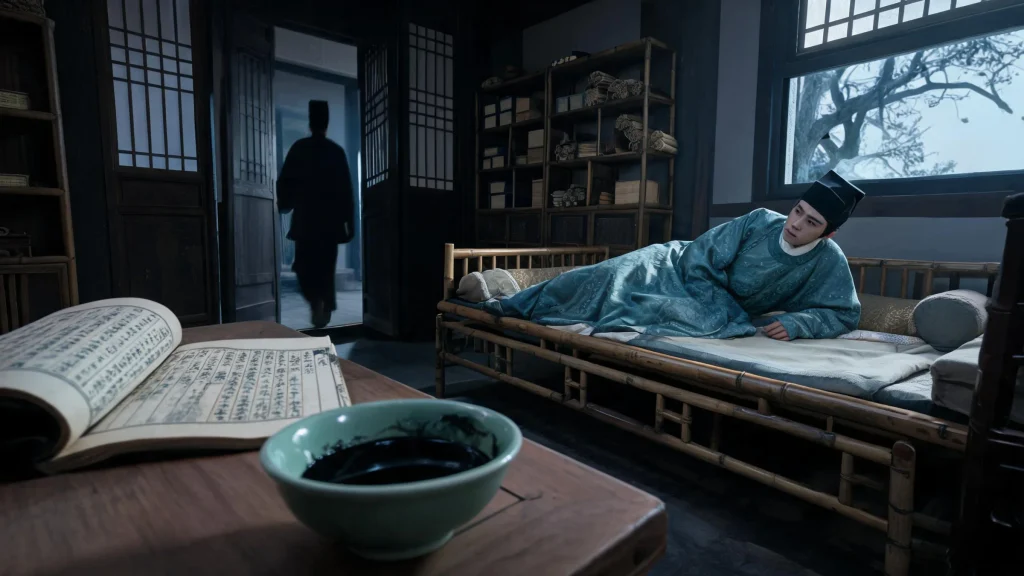
One case in that generation is stranger still. Li Wenzhong was Zhu Yuanzhang’s nephew, the son of his elder sister, and was later adopted as a son. In the winter of 1383 he fell ill; the emperor came to see him and put the Marquis of Huai’an, Hua Zhong, in charge of his treatment. He died in the third month of the next year, aged forty-six. The emperor suspected poison. He stripped Hua Zhong of his title, sent his family to a frontier guard at Jianchang, and had the doctors who handled the case executed together with their wives and children. On this occasion the emperor was not silencing anyone. He wanted someone to answer for a death. Li Wenzhong had done one thing that displeased him: he had urged Zhu Yuanzhang to kill less.
February 1393: one duke, thirteen marquises, two counts
Among the Ming dynasty founding generals, Lan Yu was the last who could take an army into the field on his own. In the fourth month of 1388 he led a hundred and fifty thousand men out of Daning and destroyed the camp of Toghus Temür, heir of the Yuan, at Buir Lake, on what is now the border between China and Mongolia. He took the prince’s second son, several hundred consorts, princesses and nobles, seventy-seven thousand men and women, and more than a hundred and fifty thousand horses, camels, cattle and sheep. Zhu Yuanzhang compared him to Wei Qing and Li Jing, generals of the Han and the Tang, and made him Duke of Liang. He was also the younger brother of Chang Yuchun’s wife. The first crown princess, Lady Chang, was Chang Yuchun’s daughter.
Afterwards Lan Yu supplied the pretext himself. The History of the Ming calls him tall, red-faced, full of courage and strategy, with real talent as a commander. It also records his household slaves and adopted sons, his seizure of farmland at Dongchang, and the censor he drove off when the man came to look into it. Riding back from a campaign one night, he found the gate at Xifeng Pass slow to open and had his soldiers break it down. The emperor had meant to make him Duke of Liang; because of these things he changed a single character, so that the title read Liang the cold rather than Liang the beam, and he had the offense carved onto the iron warrant. Later Lan Yu was appointed junior tutor to the crown prince and complained that he was not thought fit to be grand tutor.
In the fourth month of 1392 the crown prince Zhu Biao died. In the ninth month the emperor made Zhu Biao’s son by his second wife, Lady Lü, imperial grandson-heir. The new heir had no marriage tie to Lan Yu. Whether the two events are connected, no document from the period says anything that would prove it. All I can do is put them in the order they happened.
In the eleventh month Lan Yu captured Yuelu Timur, father and son, at Jianchang, and was called back to the capital. Early in the second month of 1393 Zhu Yuanzhang recalled the Duke of Song, Feng Sheng, the Duke of Ying, Fu Youde, Chang Sheng and the Marquis of Dingyuan, Wang Bi, to Nanjing. Eight days later the court accepted a report from Jiang Huan, commander of the Embroidered Uniform Guard, the imperial secret police. Lan Yu was executed that day. With him died the Marquis of Heqing, Zhang Yi, the Marquis of Puding, Chen Huan, the Marquis of Jingchuan, Cao Zhen, the Marquis of Zhulu, Zhu Shou, the Count of Dongguan, He Rong, and the minister of personnel, Zhan Hui. The prison testimony said he intended to move while the emperor was outside the city for the ceremonial ploughing. Two days later the Register of Treacherous Officials was published across the empire. The day after that, the emperor went out and plowed the ceremonial field.
By the ninth month the official figure was published: fifteen thousand people killed together with their families, and a statement that followers of Hu and followers of Lan would from then on be pardoned and not pursued. The register listed one duke, thirteen marquises and two counts. This purge went further than the Hu Weiyong case of 1380. It reached Mongols who had surrendered only six years earlier. Naghachu, a descendant of Muqali, Genghis Khan’s great commander, had brought more than two hundred thousand of his people over to the Ming in 1387 and had died on the road south to Yunnan. His son Chaghan was made Marquis of Shenyang, and in 1393 he died as a follower of Lan Yu.
Within a month of the executions the army changed hands. In the third month of 1393, Feng Sheng and Fu Youde were ordered to hold the frontier in Shanxi and Beiping, and every guard officer under them was placed under the command of the princes of Jin and Yan. Four days later an edict said that the two princes needed to report only major military matters. For the previous thirteen years the arrangement had been split three ways: the five commissions kept the rolls and the training, the Ministry of War issued deployment orders, and a separate general was appointed for each campaign. Nobody held all three. Lan Yu was the most successful of those temporary commanders, and less than a month after his death frontier officers were taking orders from imperial princes.
The list did not stop there. In the eleventh month of 1394 Fu Youde was executed for an offense the record does not name, in the twelfth month Wang Bi, and in the second month of 1395 Feng Sheng, whose sons were not allowed to inherit. At the end of that passage, the biography of Lan Yu writes one line: the old generals who founded the dynasty followed one another to the end.
A tidier explanation for all of it came later. Zhu Yuanzhang is said to have thrown a thorny branch on the ground and told the crown prince to pick it up. Zhu Biao hesitated. The emperor said: you will not take it because of the thorns; if I strip them off for you first, is that not better? The story does not appear in the crown prince’s biography in the History of the Ming. It comes from private writings of the middle and late Ming, which is to say, from the anecdotal tradition.
The History of the Ming does contain a passage about a thorny branch, and it means the opposite. In the winter of 1367, before he took the throne, Zhu Yuanzhang had his son taken to see a farm household and look over the food and the tools, and then pointed at a thorn branch by the road. The ancients used this for flogging, he said, because it disperses the wind and wounds without killing. Their hearts were kind; remember it. He was talking about a punishment tool, and about mercy. In 1377 he also ordered that government business be submitted to the crown prince for a decision first and reported to him afterwards.
Tang He handed back his army and went home to Fengyang
Tang He was three years older than Zhu Yuanzhang and came from the same village in Zhongli. When Guo Zixing first raised troops, Tang He brought a dozen men to join him. In those years most of the commanders were of comparable standing to Zhu Yuanzhang and none of them would serve under him; Tang He alone kept to his orders with great care. He also talked too much when he drank. While he held Changzhou he asked for instructions and got no answer, and said in his cups that holding that city was like sitting on a roof ridge: look left and you are on the left, look right and you are on the right. The remark was recorded. When he was later made Duke of Xin, the emperor went through the Changzhou business again and had it carved onto his warrant.
The History of the Ming gives the background to what came next. The emperor was growing older, the empire was quiet, the Duke of Wei and the Duke of Cao had both died before him, and he did not want the generals to hold troops indefinitely, but he had no pretext to move against them. Tang He, at a quiet moment, spoke up himself. His teeth were long, he said, and he could no longer stand being driven; he asked to go home to his village, to wait there for his bones. The emperor was delighted. He gave him money to build a house in the central capital at Fengyang, and had houses built for the other dukes and marquises as well.
Handing back the army did not make him idle. The emperor told him that though he was old he should make one more journey, and Tang He surveyed the coast of Zhejiang, laid out garrison posts, and built fifty-nine walled towns, Ninghai and Linshan among them. He conscripted thirty-five thousand men for the work, and the coast suffered for it. When people complained, his answer was that a man planning far ahead does not pity complaints nearby, and a man given a great task does not fuss over trifles; whoever complained again would taste his sword. When the towns were done he took one man from every coastal household with four or more adult males and got fifty-eight thousand seven hundred soldiers. In the eleventh month of 1387 he returned to the capital and reported the fifty-nine towns. In the sixth month of the following year he took his family home to Fengyang, and after that he came to court once a year.
Asking to leave was not safe in itself. Around 1381 the chief minister of the Court of Judicial Review, Li Shilu, laid down his tablet in the emperor’s presence and asked to be allowed to go home, because Zhu Yuanzhang had taken up Buddhism and Li Shilu objected to it. The emperor had the guards beat him to death on the steps.
In the first month of 1390, at the New Year audience, Tang He lost his voice. The emperor went to see him that same day and soon sent him back to Fengyang. In 1394, when he was too ill to rise, the emperor wanted to see him and had him brought into the inner hall in a sedan chair. He stroked him with his own hand and talked about the village and the hard years of the war. Tang He could no longer answer and only knocked his head on the floor. The emperor wept, and gave him gold and silk for his funeral. In the eighth month of 1395 Tang He died, aged seventy, and was made posthumously Prince of Dong’ou.
The History of the Ming sums up his life in one sentence: at that time dukes, marquises and old generals were caught up in the treason cases one after another, and few escaped. Tang He alone lived out his years and finished with his honors intact. The biography then records what his last years looked like. He heard discussions at court and never repeated a word of them. He had more than a hundred concubines and dismissed them all with money when he fell ill. Most of what the emperor gave him he shared out in his home district. His coastal towns were still standing two hundred years later. When Japanese pirates raided the southeast in the sixteenth century, the people of Zhejiang sheltered behind those walls, and a regional censor asked the court for a temple in his memory.
1389: Mu Ying breaks the elephant phalanx at Dingbian
Mu Ying took the other road. He lost his father young, fled the fighting with his mother, and lost her too. Zhu Yuanzhang and Empress Ma took him in and raised him as a son, and for a time he carried the imperial surname. Zhu Yuanzhang adopted more than twenty boys from other families as he rose and sent them out to hold the towns he took; the one who won most in the southwest was Mu Ying.
In 1381 he went to Yunnan as junior right vice general under Fu Youde, with Lan Yu beside him. At the Baishi River near Qujing he came up to the bank under cover of fog. When the fog lifted, the Yuan troops saw how close he was. He sent a picked force across downstream, around behind the enemy line, hung false banners in the valleys, and had every man blow a brass horn. The Yuan formation came apart. He drove his army across, took the commander Dalima alive, and the prince of Liang fled and died. The next year Fu Youde and Lan Yu went back north, and Mu Ying was left to hold Yunnan.
What he did there is in his biography. He chose prefects and magistrates, promoted farming and mulberry growing, and judged officials every year on whether the garrison fields had gained or lost, until more than a million mu were under cultivation. He widened the narrow Lake Dian and the flooding stopped. He opened salt wells to draw merchants and evened out labor service against household numbers. He read constantly, and when he had time he had scholars in to lecture on the classics and the histories.
In 1389 Si Lunfa of Luchuan raided Dingbian with a force said to number three hundred thousand, armored elephants in front, each carrying a bamboo tube of javelins on its back. Mu Ying took thirty thousand horsemen, drew up artillery and heavy crossbows in three lines, and gave the order: forward or nothing. When the left wing gave ground he saw it from high ground, took out his sword, and told an attendant to bring him the commander’s head. The commander saw a man riding down with a sword, charged the enemy line in earnest, and the rest of the army followed, killing more than forty thousand and taking thirty-seven elephants alive. That winter Mu Ying came to court. The emperor feasted him in the Fengtian Hall, and when he took his leave for Yunnan he stroked him and said that the man who let him sleep without worrying about the south was Ying.
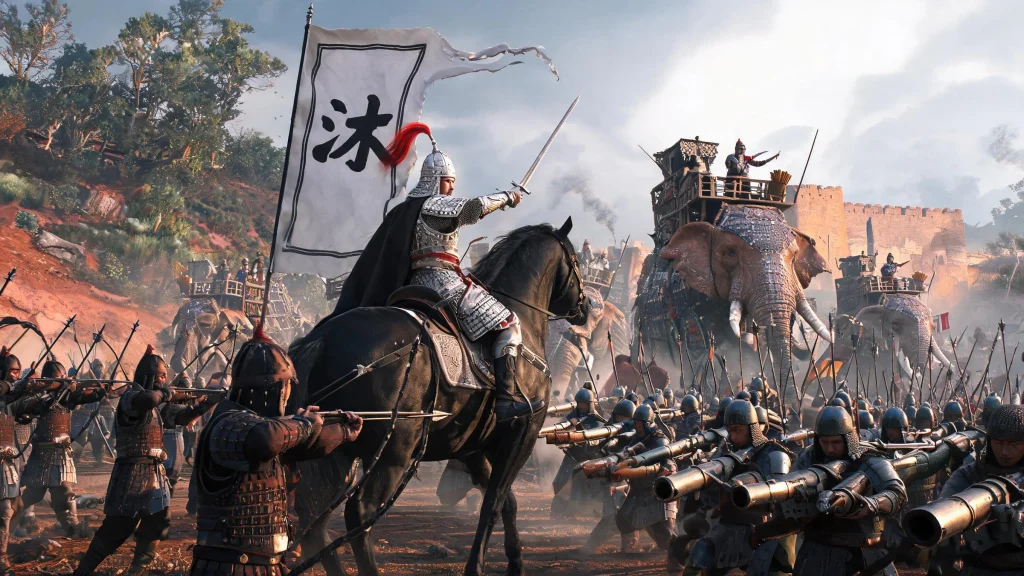
In the sixth month of 1392 the news of the crown prince’s death reached Yunnan and Mu Ying wept bitterly. Years earlier, when Empress Ma died, he had wept until he vomited blood. This time he fell ill and died in his post, aged forty-eight, and was made posthumously Prince of Qianning. Eight months later the Lan Yu case began.
Mu Ying’s sons Chun, Sheng and Ang all held Yunnan. From 1383, when Mu Ying was left to hold the province, to 1661, when the last of the line, Mu Tianbo, was surrounded and killed by Burmese soldiers near Ava, the family held Yunnan for two hundred and seventy-eight years. Twelve generations of the name are recorded in that single juan. The verdict at the end of the chapter says their reputation lasted as long as the dynasty.
May 1398: the Ming dynasty founding generals are gone, and Kaiping passes to the Prince of Yan
In the fifth month of 1398 Zhu Yuanzhang fell ill. On the fifth day of his illness he handed the defense of Kaiping, north of the Great Wall, to two commanders. The chief commissioner Yang Wen was assigned to the Prince of Yan, Zhu Di, and the Marquis of Wuding, Guo Ying, to the Prince of Liao, Zhu Zhi. Both were placed under the Prince of Yan’s orders. In the intercalary fifth month he died in the western palace.
The heir was his grandson Zhu Yunwen. The History of the Ming records one detail of the transition. Zhu Yuanzhang had once let the crown prince decide the memorials. The crown prince was merciful and reduced punishments. Now the job passed to the grandson, who was equally inclined to be lenient. He asked his grandfather for permission to go through the ritual classics and the law codes of earlier dynasties, and to revise the seventy-three clauses of the Hongwu code that were too harsh. In the second month of 1399 he raised his father Zhu Biao to imperial rank and issued an edict barring the princes from any further command over civil and military officials. In the seventh month the Prince of Yan rose in rebellion.
The commander the court produced was the Marquis of Changxing, Geng Bingwen. Of the dukes and marquises of the founding generation only he and Guo Ying were left, and he was sixty-five. He took his army to Zhending with a nominal three hundred thousand men, of whom a hundred and thirty thousand arrived. In the eighth month he fought the Yan army along the Hutuo River, was beaten, and withdrew into the city. The court replaced him with Li Jinglong, Duke of Cao, the eldest son of Li Wenzhong and the husband of a princess. The History of the Ming says of Li Jinglong that he was a rich man’s son who did not understand war and whose only talent was self-importance, so that the veteran commanders under him were sullen and would not fight for him. When the Prince of Yan heard of the appointment he told his officers that Li Jiujiang was a boy in silk and easy to deal with. Li Jinglong led five hundred thousand men and then six hundred thousand, was beaten at Zhengcunba, was beaten again at the Baigou River, and after that battle, in which tens of thousands of government soldiers died, the southern armies never recovered.
On the battlefields of the Hongwu years the names had been Xu Da, Lan Yu, Feng Sheng, Fu Youde and Wang Bi. On the battlefield of 1399 they were Geng Bingwen and Li Jinglong.
The end came at the Jinchuan Gate. On the day the Yan army crossed the river, the chief commissioner of the left, Xu Zengshou, was preparing to open the city from inside and was put to death. The Prince of Gu, Zhu Hui, and Li Jinglong opened the Jinchuan Gate, the Yan army entered, and the palace caught fire. Xu Zengshou was Xu Da’s fourth son. The Jianwen emperor had once asked him whether the Prince of Yan would rebel, and he had answered that he would not. Once the war began he sent report after report on the state of the capital to the Yan camp. Before the city fell the emperor put the question to him directly, got no answer, and cut him down with his own sword in the palace corridor. His elder brother Xu Huizu went the other way. In 1399 Xu Huizu was sent to relieve Shandong, beat the Yan army at Qimei Mountain, and frightened it badly; then he was recalled by an edict, after which the commanders at the front were isolated and lost one battle after another. When the Prince of Yan entered the capital, Xu Huizu stayed in his father’s shrine and refused to welcome him. He was stripped of his title and confined to his house, and died in 1407. In the Wanli period the court recorded the loyal ministers of the Jianwen reign and gave him the first place among those honored in Nanjing. Xu Da’s eldest daughter was the empress of the Yongle emperor.
At the end of Xu Da’s biography the History of the Ming notes that among all the founders, only Xu Da’s descendants held two dukedoms. One came from the son who fought to the death for the Jianwen emperor, and the other from the son who died serving Zhu Di.
Seven years after Zhu Yuanzhang’s death, Timur was at Samarkand preparing a campaign against China. He fell ill at Otrar on the Syr Darya and died on the road. That army never reached the Ming frontier.
What the killing bought can be stated plainly. It bought the absence of the thing that had wrecked earlier dynasties. In more than two hundred years of the Ming, no general with an army took the throne, and no minister with troops gathered enough power to challenge it. The arrangements Zhu Yuanzhang built up from 1380 were aimed at the generals and the great ministers, and they held. The cost is written on the order of battle for 1399. When the court had to fight a civil war, the Ming dynasty founding generals were gone, and the men it could send were a sixty-five-year-old marquis and a rich man’s son who did not understand war.
Questions readers ask
Sources and further reading
The History of the Ming (Mingshi), juan 2, 3 and 4, Basic Annals of Taizu and of the Jianwen emperor. https://zh.wikisource.org/zh-hans/%E6%98%8E%E5%8F%B2/%E5%8D%B72 The History of the Ming, juan 115, biography of Zhu Biao, the crown prince. https://zh.wikisource.org/zh-hans/%E6%98%8E%E5%8F%B2/%E5%8D%B7115 The History of the Ming, juan 125, biography of Xu Da. https://zh.wikisource.org/zh-hans/%E6%98%8E%E5%8F%B2/%E5%8D%B7125 The History of the Ming, juan 126, biographies of Li Wenzhong, Deng Yu, Tang He and Mu Ying. https://zh.wikisource.org/zh-hans/%E6%98%8E%E5%8F%B2/%E5%8D%B7126 The History of the Ming, juan 127, biographies of Li Shanchang and Wang Guangyang. https://zh.wikisource.org/zh-hans/%E6%98%8E%E5%8F%B2/%E5%8D%B7127 The History of the Ming, juan 128, biographies of Liu Ji and Song Lian. https://zh.wikisource.org/zh-hans/%E6%98%8E%E5%8F%B2/%E5%8D%B7128 The History of the Ming, juan 130, biographies of Geng Bingwen and Guo Ying. https://zh.wikisource.org/zh-hans/%E6%98%8E%E5%8F%B2/%E5%8D%B7130 The History of the Ming, juan 132, biography of Lan Yu. https://zh.wikisource.org/zh-hans/%E6%98%8E%E5%8F%B2/%E5%8D%B7132 The History of the Ming, juan 139, biographies of Ye Boju, Zheng Shili, Li Shilu and Chen Wenhui. https://zh.wikisource.org/zh-hans/%E6%98%8E%E5%8F%B2/%E5%8D%B7139 The History of the Ming, juan 308, biography of Hu Weiyong. https://zh.wikisource.org/zh-hans/%E6%98%8E%E5%8F%B2/%E5%8D%B7308 Zhao Yi, Notes on the Twenty-Two Histories, juan 31, on the restraint of the Ming history’s biographies, quoted with commentary in the Guangming Daily journal Browsing Books, 2007. https://www.gmw.cn/02blqs/2007-08/07/content_695007.htm The iron tablet of 1372 and its nine clauses. https://www.guoxuedashi.com/lishi/10453r/ Encyclopaedia Britannica, Timur, including the campaign toward China that ended at Otrar in 1405. https://www.britannica.com/biography/Timur Encyclopaedia Britannica, Hongwu, on the founding emperor’s reign. https://www.britannica.com/biography/Hongwu Wikipedia, Mu Tianbo, the last duke of Qian, killed in Burma in 1661. https://zh.wikipedia.org/wiki/%E6%B2%90%E5%A4%A9%E6%B3%A2 Wikipedia, Xu Da and Tang He, for the broader military careers. https://en.wikipedia.org/wiki/Xu_Da https://en.wikipedia.org/wiki/Tang_He