Inside the Single Whip Reform: Taxes, Land & Silver
The accounting lists from the Hongzhi reign of the Ming dynasty record twenty-four items under the summer tax alone. Rice and wheat of two grades. Silk floss, silk yarn, silk yarn commuted into cloth. Cotton commuted into cloth, ramie, hemp, safflower. Paper money, rent notes, tax notes. This is the bookkeeping the single whip reform replaced.
Twenty-four lines, and each one a separate thing a county owed the throne.
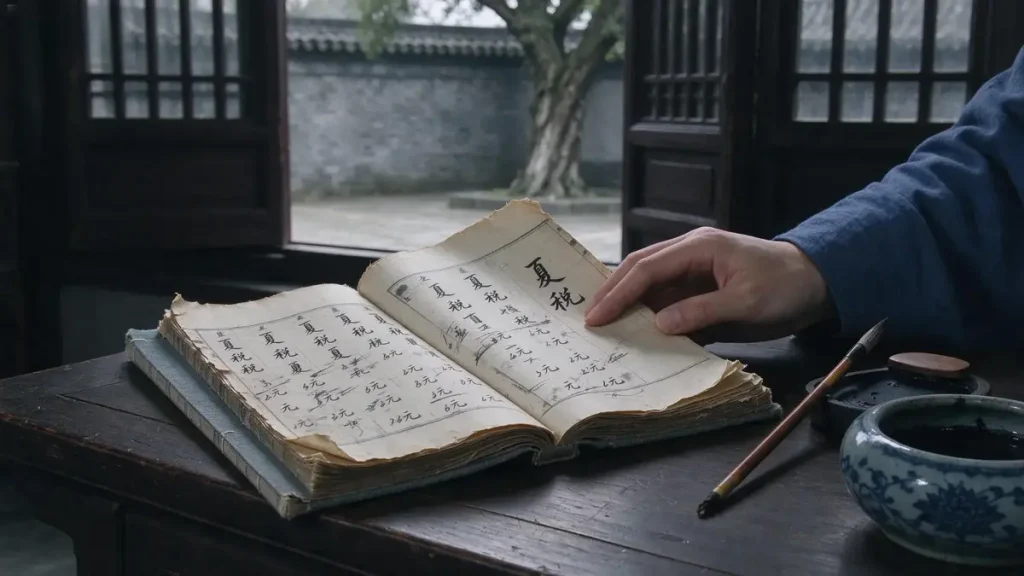
The autumn grain column carried seventeen more. Rice, of course, but also rent notes, rental fees, mountain rent, ox-rent grain, a levy on date trees, a levy on fish ponds, cotton lint by the acre, and an entry the clerks wrote as silk yarn commuted into rice. Forty-one lines across the two columns, before a single day of labor was counted.
Labor came on top of that. Households were grouped a hundred and ten to a ward and ten to a squad, and the squads took turns. When a squad’s turn came, its men went, and they carried their own food. Beyond the rotation sat the work a county needed done whether or not anyone’s turn had come: dredging a channel, hauling grain, guarding a granary, staffing a post station. That was assessed on adult males. Whatever the throne wanted at short notice was simply demanded as it arose. Over all of it sat tribute, meaning whatever the district produced that the capital wanted, sent up in kind. Grain was counted in piculs, cloth in bolts, paper money in strings, labor in men and days, tribute in pieces. A county had to line up five kinds of unit in one book, and the way it lined them up was conversion. Grain into cloth, cloth into paper money, paper money into silver. The rate was proposed by the district and approved by the Ministry of Revenue. The same picul of rice might go at three mace of silver in one county and four in the next.
"Accounts already settled might run ten years past their deadline," the History of the Ming says of the 1560s and 1570s. "Some counties entered grain as collected before it had been collected, in one case a hundred thousand piculs." Arrears in a single county ran to several hundred thousand.
That was the system in the year before Wanli 9.
Zhejiang had already tried it in 1566
The single whip did not come out of Beijing on one day in 1581.
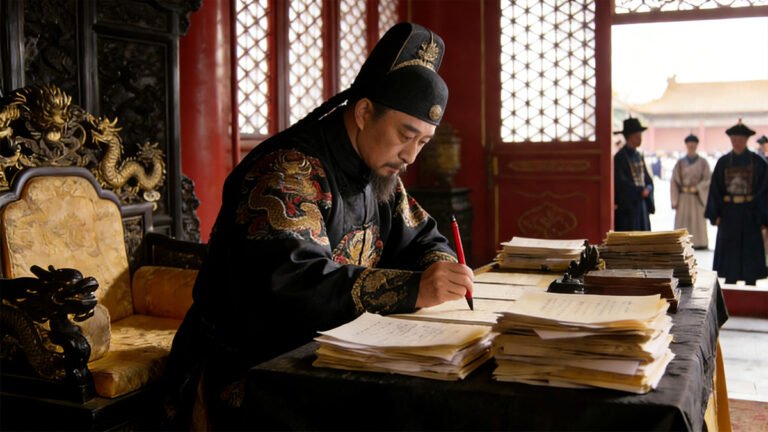
In the Xuande reign, Zhou Chen governed the lower Yangzi as grand coordinator, with Kuang Zhong as prefect of Suzhou. The two of them proposed that state-owned fields be taxed at the same rate as private ones, because the gap between the two schedules was ruinous. The Ministry of Revenue turned them down. In 1547 Zhao Ying, prefect of Jiaxing, tried again with a flat rate of three dou of rice per mu, and several counties in the region simply began doing it. Then in 1566 Pang Shangpeng, a regional inspector in Zhejiang, pushed it to the scale of a province. A county’s labor obligations would be performed by men the government paid. To raise the money he graded households into upper, middle and lower and apportioned the cost into each household’s tax bill. Hai Rui was doing something similar in South Zhili in the same years.
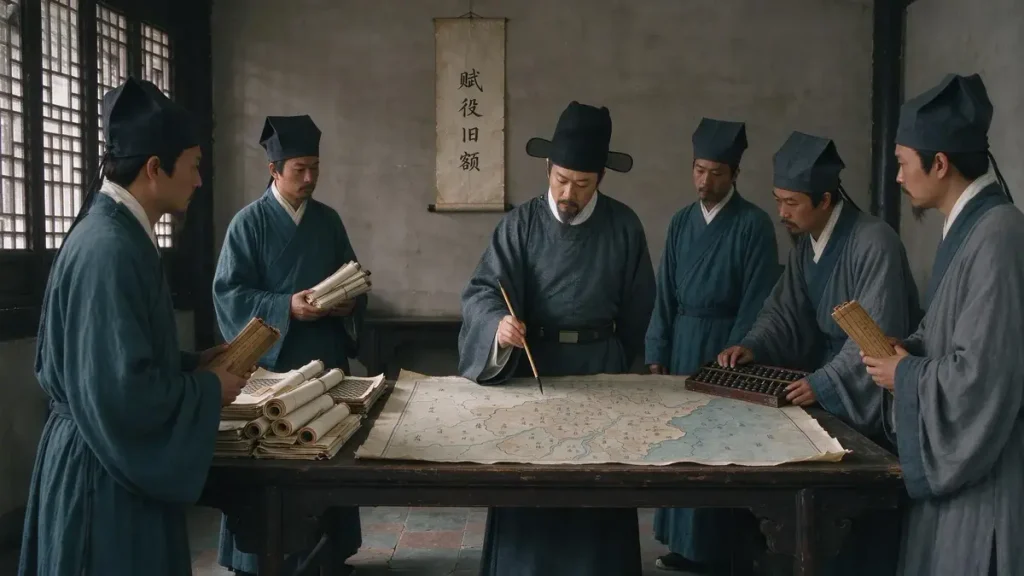
The name came earlier than the law. Clerks had been writing "one compilation" for the arrangement since the Jiajing reign, because the point was to compile the separate items into one reckoning. Later the second character was written as the word for whip, and sometimes as the word for edge. In 1572 Wang Zongmu, director-general of grain transport, applied the Jiangnan service method to his jurisdiction, and the memorials out of his office called it the single whip. The author of a local gazetteer objected that the whip character was inelegant and ought to be revised. In the registers the term was shortened again, to "the one-line method." Liang Fangzhong once sorted the variants out of the Ming sources: whip, compilation, edge, the whip method, the line method, all naming the same thing. Why the whip character is the one that stuck, the record does not say.
The dynastic history disposes of the whole sequence in four characters: it was tried several times, and stopped several times.
In 1572 Zhang Juzheng became senior grand secretary. Huguang ran a pilot in 1576. Fujian began surveying its fields in 1578, and the survey regulations drawn from the Fujian experience went out to the empire in the eleventh month of 1580. In 1581 the single whip reform went empire-wide. Empire-wide is the Qing compilers’ word. Districts adopted it at different times over the following years, and the History of the Ming does not say which.
A note worth one tael, then three thousandths of one
A Treasure Note Directorate was set up in 1375, and the Great Ming Treasure Note appeared the next year. The terms were explicit. One string of notes was worth a thousand cash, one tael of silver, one picul of rice. The same edict forbade the people to trade in gold or silver on pain of punishment. Bringing gold and silver to the office in exchange for notes was permitted. The paper had no reserve behind it and could not be redeemed. What held it at a tael was the ban, and the number of sheets the government chose to print.
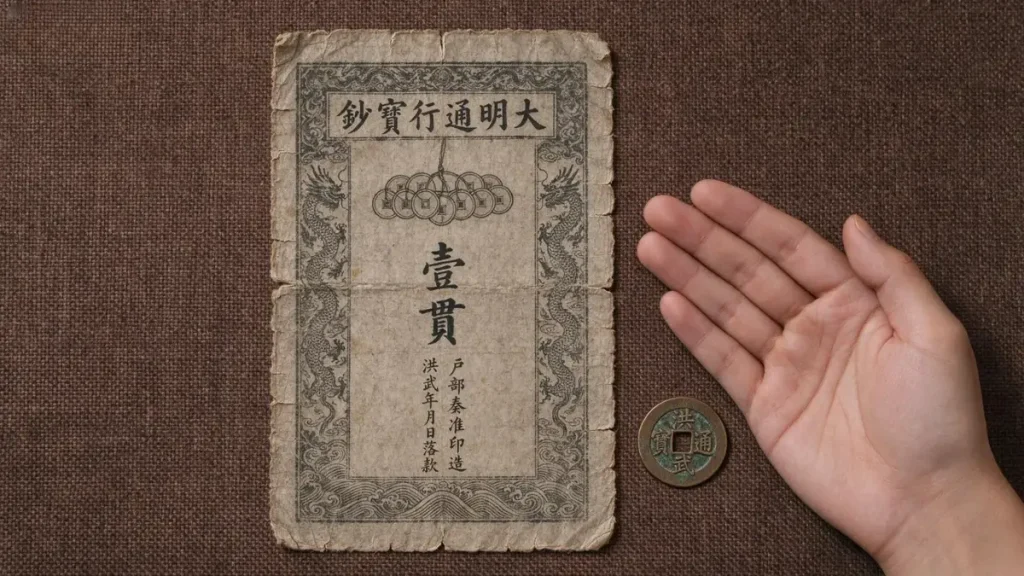
By the early 1390s, in Zhejiang, Jiangxi, Fujian and Guangdong, people were already valuing cash above notes. Some were settling a string of notes at a hundred and sixty cash. In the Xuande reign a picul of rice cost fifty strings. The founders had set it at one. Under Chenghua the History of the Ming records that a string of notes would not buy a single cash, while the state went on assessing tax at two and a half mace of silver to the string. What was nominally collected in paper was collected in silver. The history’s verdict on the arrangement runs to four characters: the people were greatly impoverished.
In 1525 the tax office was ordered to take a string of notes at three thousandths of a tael, and seven cash at one hundredth of a tael.
From one tael in 1375 to three thousandths in 1525 is a factor of roughly three hundred. By then the government had stopped pretending the paper was worth anything. The Yingzong emperor had authorized the commutation of grain and wheat into silver back in 1436, and lifted the ban on silver. "Court and countryside alike used silver," the History of the Ming says, "and copper only for small sums. Paper was kept for paying officials, who could not pass it on." So the single whip did not introduce silver. Silver had circulated for a century and a half, and the state had been collecting it for about as long. What the single whip did was write the practice into the statute of the realm and extend it to every household that owed grain.
What the single whip reform merged
The History of the Ming gives the whole measure in one passage in its treatise on fiscal administration.
"It consolidates the taxes and services of a whole prefecture or county. It measures the land and counts the adult males, and grain and poll obligation alike are delivered to the government. For the labor owed in any given year, the government hires the men itself. Labor dues are converted at the cost of feeding and paying a hired man, adjusted up or down. Silver dues carry an allowance for the cost of delivery. Every fixed quota, every assigned quota, every demand of the capital treasuries, every retention and supply charge, and every item of local tribute is merged into one. The whole is assessed on the acre and collected in silver, and the officials handle it. That is why it is called the single whip. As legislation, it was simple enough."
The hiring is the part that changed daily life. Before, the county named a man and he went, with his own food, to dredge the channel or haul the grain or mind the post station. After, the county raised money and hired somebody, and the cost was built into the assessment in advance, along with the wastage allowance on the silver. The assessment fell on land and on adult males together, in proportions that varied by district. Some places set six parts on males to four on land, some the reverse, some half and half. Full commutation, with the poll element absorbed entirely into the acre, came only with the Qing reforms of the 1720s. To say the single whip abolished the head tax claims more than the record supports.
What it did abolish was a layer of middlemen. Collection and delivery had been handled by ward headmen and grain captains, respectable locals who took the grain from their neighbors and got it to the granary. The reform moved collection and delivery to the county magistrate’s own staff. The men in between had been a source of surcharges, and they were also a source of local standing, which is why they did not entirely disappear.
| Before the reform | After | |
|---|---|---|
| What the tax was assessed on | Land by the acre, service by household and by adult male, in three separate registers | Land and adult males combined, assessed on the acre |
| What was handed over | Grain, cloth, paper money, labor, each in its own form | Silver only, with labor hired by the government |
| Who collected it | Ward headmen collected, grain captains delivered | County officials collected and delivered |
| How many items | Summer tax, autumn grain, ward service, equalized service, miscellaneous levies, tribute, all separate | One item, fixed at the county level |
| Where it went | Grain to the granary, cloth to the depot, men to the worksite | Silver to the government |
The county’s total was fixed. Whatever the old quota had been, the merged item could not exceed it. The rule was meant to block new surcharges. In 1618 it did not hold. For the man who owed the tax, one task remained. He had to sell grain and turn it into silver. How the silver was then divided inside the yamen was no longer his concern.
Silver cost twice as much in China as in Spain
In the sixteenth century the Ming dynasty produced little silver of its own. Yunnan had mines and modest output, and the rest came in from outside. After the single whip, several million farming households needed a fixed quantity of silver every year.
Supply did not rise. Demand did, sharply.
The gold-silver ratio is the clearest measure. In the early sixteenth century an ounce of gold bought six ounces of silver in China and twelve in Europe, ten in Persia and eight in India. By the end of the century Canton quoted five and a half to seven, while Spain quoted twelve and a half to fourteen. An ounce of silver therefore bought roughly twice as much gold in China as it did in Spain. A merchant who had spent twenty-five years in the Asian trade from Madrid worked the sums in 1609. Gold in Canton went at seven times its weight in silver at the outside. In Spain it went at twelve. Ship silver east, buy gold, sell the gold, and the gain came to seventy-five or eighty percent.
So silver moved east. There were two routes. One ran from the Americas to Seville, then around the Cape of Good Hope by way of Goa to Macao. The other crossed the Pacific from Acapulco to Manila. Most of the metal took the second.
Manila: one cargo, seven and a half tons of silver
In the sixth month of 1573, two Spanish galleons left Manila for Acapulco. They carried 712 bolts of silk damask, 11,300 bolts of cotton, and 22,300 pieces of porcelain, worth 300,000 pesos, or about seven and a half tons of silver. The voyage returned a profit of six times its outlay.
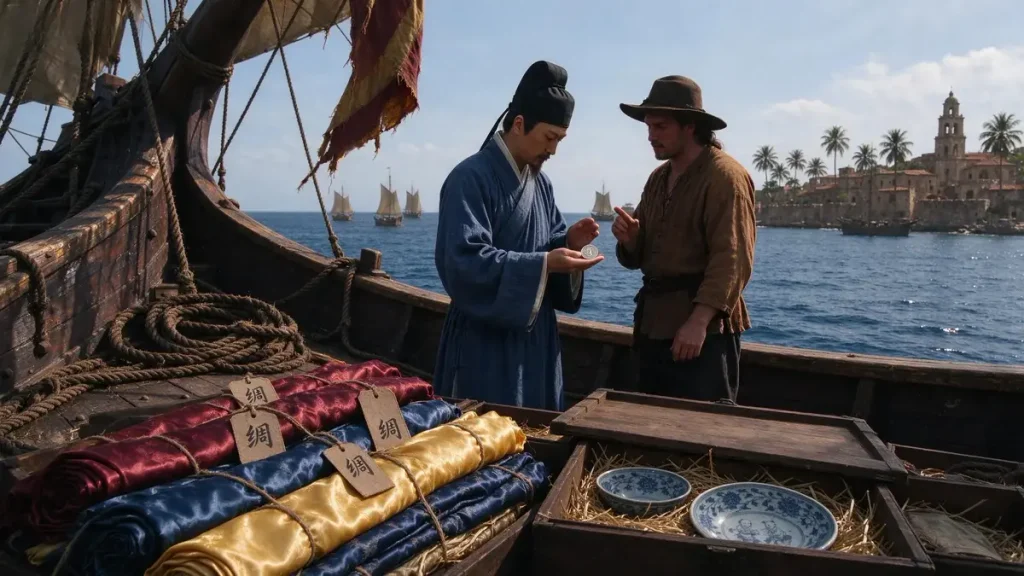
Chinese merchants had brought the cargo down from Yuegang in Zhangzhou. The port had been opened in 1567, and Fujianese ships went to Manila every year after that. Zhang Xie, in a survey of the eastern and western oceans, described Luzon with a trader’s bluntness: "The place produces nothing. The Spaniards trade silver for goods, so a ship comes home with nothing but silver, and hardly any cargo at all." Out went silk and porcelain. Back came coin.
The silver started at Potosí. Spain found the mountain in 1545 in what is now Bolivia, and for the next century it supplied the bulk of Spanish American output. Bars went by mule train to Lima, then by ship up the coast. Some reached Acapulco and went aboard the Manila galleon. Some crossed the Atlantic from Panama to Seville. How much arrived is a matter of dispute. George Bryan Souza counts 154 million pesos, or 4,620 tons, landed at Manila between 1590 and 1644. Chuan Han-sheng puts the annual figure between one and four million pesos, with two or three million as the normal year. A third estimate works from the number of sailings, about 132 galleons between 1565 and 1644, and at 1.1 million pesos of cargo apiece arrives at 145 million pesos, or some 105 million taels of silver. The orders of magnitude agree. The fine figures do not.
Madrid tried to stop the flow. A decree of 1593 capped tonnage and cargo value and made the route a crown monopoly. The archbishop of Manila described the result in a letter of 1598: a million pesos came over from New Spain every year, all of it against his majesty’s orders, into the hands of Chinese heathens. Japan sold silver too. From the 1560s the Iwami Ginzan and other mines were worked on a large scale, and for a time Japan was among the world’s leading producers. The metal left through Nagasaki against Chinese raw silk and cotton cloth.
The mines of the Americas, the silk and porcelain of China, and the consumption of Europe were joined by that route. The Ming state did little in the arrangement beyond taxing the merchants who sailed from Yuegang, and it taxed them in silver. It could not touch the output of Potosí. It had no say in when the king of Spain issued a decree.
Ten years of grain in the Grand Granary
Zhang Juzheng began a land survey in Fujian in 1578. The regulations went empire-wide in the eleventh month of 1580. By the end of that year the registered tax-bearing acreage came to 7,013,976 qing, some 2.33 million qing above the figure for 1571. The survey met resistance wherever great houses held concealed land. The throne’s instruction was not gentle: anyone who obstructed the surveyors, whether imperial clansman, official or soldier, was to be reported and punished under the law. The result is recorded in Zhang’s biography. "The grain in the Grand Granary was enough for ten years." The Court of the Imperial Stud held four million taels of silver as well.
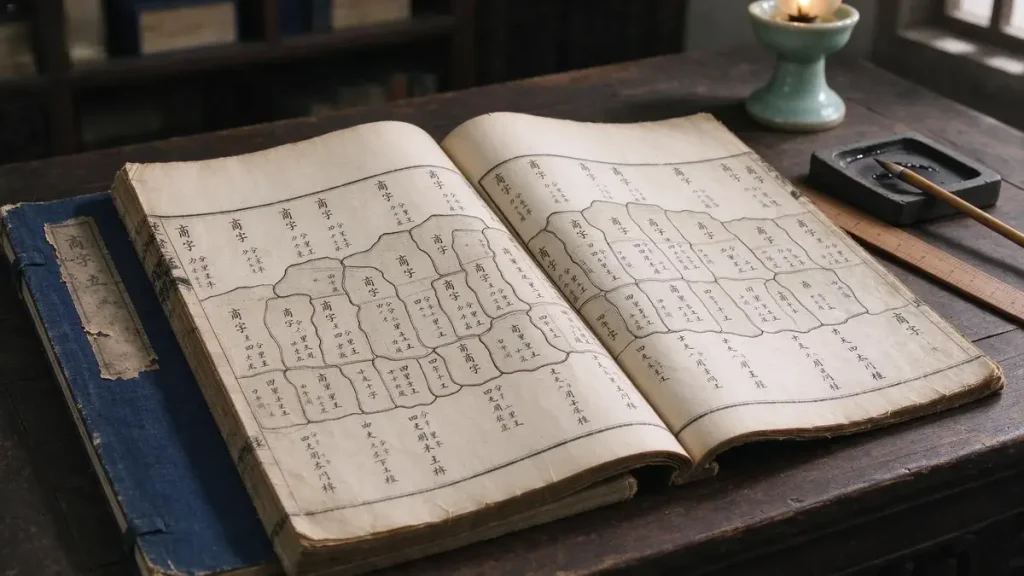
For a farming household the immediate consequence of the single whip was one trip to market a year. Tax in grain meant handing over part of the harvest. Tax in silver meant selling part of the harvest first. In a good year grain was cheap, and a family sold more of it to raise the same assessment. In a bad year the price was better and there was less to sell. Both ends of that trade worked against the seller. Market towns grew through the Wanli reign in the Jiangnan counties around Suzhou and Songjiang, with separate markets for cotton cloth, raw silk and rice. Part of the reason was that the assessment had become silver.
Zhang died in the sixth month of 1582, little more than a year after the single whip went empire-wide. In the fourth month of 1584 his household was confiscated. The History of the Ming records that the prefect and magistrate of Jingzhou registered the residents and sealed the gates before the commissioners arrived, and that when the gates were opened more than ten people had starved. The search turned up ten thousand taels in gold and a hundred thousand in silver. His eldest son, an official in the Ministry of Rites, was put to torture, confessed under it to having lodged 300,000 taels with named friends, and hanged himself soon after. The verdict the throne approved said he should have been disinterred and beheaded, and was spared that.
The single whip was not repealed. By the confiscation it had been running across the empire for three years.
After ten years the rules fell into disorder
The History of the Ming follows its account of the reform with one sentence on what became of it.
"Ward headmen and grain captains were abolished in name and remained in fact, and when a service fell due the farming population was conscripted for it again. Ten years or so after the whip method came in, its regulations fell into disorder, and it could not be followed in full."
Surcharges grew back outside the fixed quota. The reform had capped a county’s total, but an emergency levy was not bound by the cap, and each new item was apportioned over the same acres.
In 1630 Fan Jingwen, governor of Henan, put the case against it. "Since the change to the whip method, the service of a district has been spread over the grain of that district, and one would expect some relief. Yet the people still run about every year and spend all they have in top-ups, because the whip method is in force and the great households have still not been touched." The gentry’s exemptions had never been repealed, and their share of the service came back down onto the small holders.
Then there was the metal itself. Tax silver arrived as fragments of varying fineness. It had to be melted into official ingots before it could be sent up, and melting loses weight. The shortfall was recovered by a surcharge, and no standard governed how large it should be. Grain prices did the rest. The assessment was a fixed weight of silver. The harvest was not fixed. A good year meant cheap grain and more of it sold to raise the same sum. A bad year meant expensive grain and an empty storehouse.
Under Chongzhen, the silver stopped coming
In 1618, with the war in Liaodong going badly, the Liaodong surcharge came to three million taels at a stroke. The imperial treasury was full and the Wanli emperor would not release it. The minister of revenue, Li Ruhua, revived the precedent of the campaigns against the Japanese in Korea and against the Bozhou rebellion, and added three and a half thousandths of a tael to every mu. That came to just over two million taels across the empire. The next year added the same again. The year after that added two thousandths more. Nine thousandths in all, 5.2 million taels, and from then on a permanent line in the budget.
The silver stopped arriving in the same years.
In 1629 the Chinese ships calling at Manila fell from more than forty a year to six. In 1634 Spain issued an emergency decree restricting the trade. In 1639 Manila saw a massacre of Chinese residents, and in the same year Japan ended Portuguese trade at Nagasaki. In 1640 Japan cut off Macao. In 1641 Malacca fell to the Dutch, closing the last leg between Goa and the China coast.
Two main channels, gone within a few years of each other.
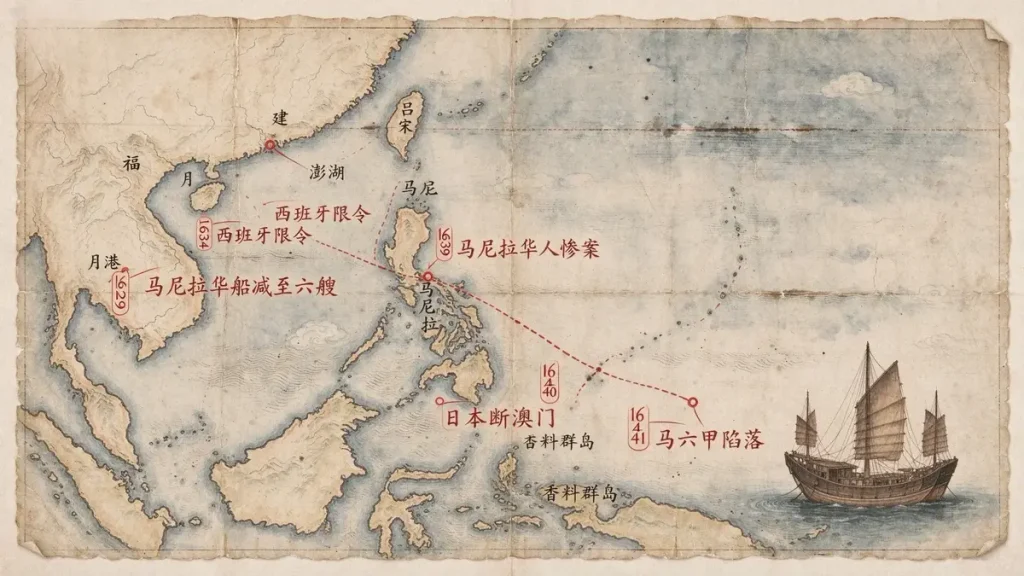
Silver grew scarce, and its price rose against everything else. The assessment did not move. The silver a family could raise did. Hoarding made it worse, and Peng Xinwei estimated that 250 million taels lay buried in private cellars by the end of the dynasty.
In the twelfth month of 1628 the History of the Ming records that the famine victims of Shaanxi were suffering under the surcharges, and that armed bands rose in force and plundered their way through Fuzhou and Yan’an.
Blaming the fall of the Ming on silver alone, however, outruns the evidence.
Ni Laien and Xia Weizhong have argued against the strong version of that case. They point out that American silver reaching Seville was falling at a time when the flow from Mexico to Manila was rising. They note that more silver came from Japan than from Manila. The shortage in China, they argue, became severe only in the 1670s, twenty years into the Qing sea ban, by which time the Ming had been gone for three decades. They add that the Grand Granary still held silver on the eve of the fall, and that private hoards ran to tens of millions of taels.
In the third month of 1644 Li Zicheng reached Beijing. On the nineteenth day the Chongzhen emperor hanged himself on the hill behind the palace. The History of the Ming gives the burial one line: on the appointed day the rebels moved the coffins of the emperor and empress to Changping, and the people of Changping opened the tomb of Consort Tian and buried them in it.
Sources and further reading
Primary sources
History of the Ming, juan 78, treatise on fiscal administration II: the Hongzhi accounting lists of 24 summer-tax and 17 autumn-grain items; the definition of the single whip; the four characters on its repeated trial and reversal in the Jiajing reign; the remark that after ten years its regulations fell into disorder; Fan Jingwen’s 1630 memorial; and the Liaodong surcharge figures of 1618 to 1620.
History of the Ming, juan 81, treatise on money and grain V: the 1375 Treasure Note and its official rates; the 160-cash string; rice at fifty strings a picul under Xuande; the note worthless against a single cash under Chenghua while assessed at two and a half mace; and the three-thousandths rate of 1525.
History of the Ming, juan 213, biography of Zhang Juzheng: the ten years of grain in the Grand Granary, the four million taels at the Court of the Imperial Stud, the performance deadlines, the confiscation and its dead, and the verdict that he should have been disinterred and beheaded.
History of the Ming, juan 23 and 24, annals of Chongzhen: the rising in Shaanxi in the twelfth month of 1628 and the burial entry of 1644.
Zhang Xie, Dongxi Yangkao (A Survey of the Eastern and Western Oceans), juan 5, on Luzon: the passage on Spaniards trading silver for goods and ships returning with nothing else.
Official and reference works
Encyclopaedia Britannica, China, economic policy and developments: the consolidated-assessment scheme called a single whip, promulgated in 1581, and the assessment that it was at best a bookkeeping change and never universally applied. That judgement is the strongest sceptical reading in print and should be set against the surplus figures in juan 213.
Wikipedia, Single whip law: used to confirm the standard English name and the 1580 date given in some secondary accounts, against the 1581 date in the History of the Ming and Britannica.
Wikipedia, Zhang Juzheng: the nine years of grain, the four million taels at the Court of the Imperial Stud, and the cadastral work of 1581 and 1582, used for cross-checking only.
Palace Museum, Beijing: collection holdings including a fish-scale register of the Wanli survey, used for the physical form of the survey records.
Liang Fangzhong, "Shi yi tiao bian fa" (An Explanation of the Single Whip Method), collected in the Liang Fangzhong papers: the philology of the name, the variants in Ming registers, and the objection recorded in the Dixiang jilue.
Chuan Han-sheng, on the annual flow of American silver to Manila; George Bryan Souza, on the total landed between 1590 and 1644; Peng Xinwei, A Monetary History of China, on late Ming hoarding. All three are cited here at second hand and their figures should be checked against the originals before publication.