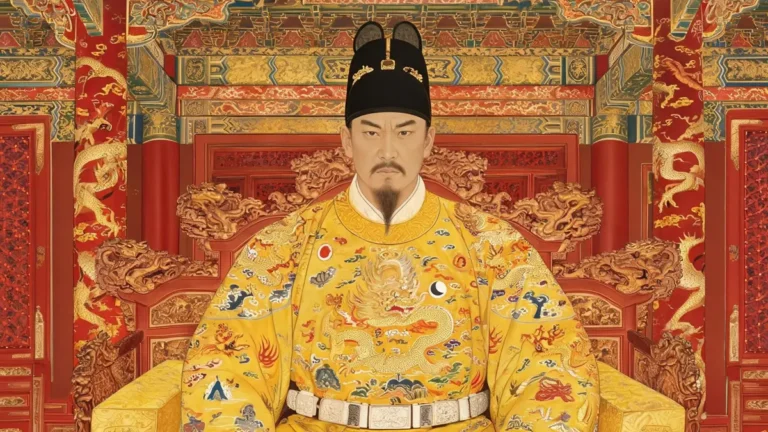
The Wanli Emperor (Zhu Yijun): 30 Years of Strike & Ming Decline
In the fifth month of 1615 a man named Zhang Cha walked in through the Donghua Gate with a stick of jujube wood. He crossed the palace grounds and reached the gate of the Ciqing Palace, where Zhu Changluo, the eldest son of the Wanli Emperor and the heir apparent, lived. He struck the eunuch on guard, Li Jian, and injured him.
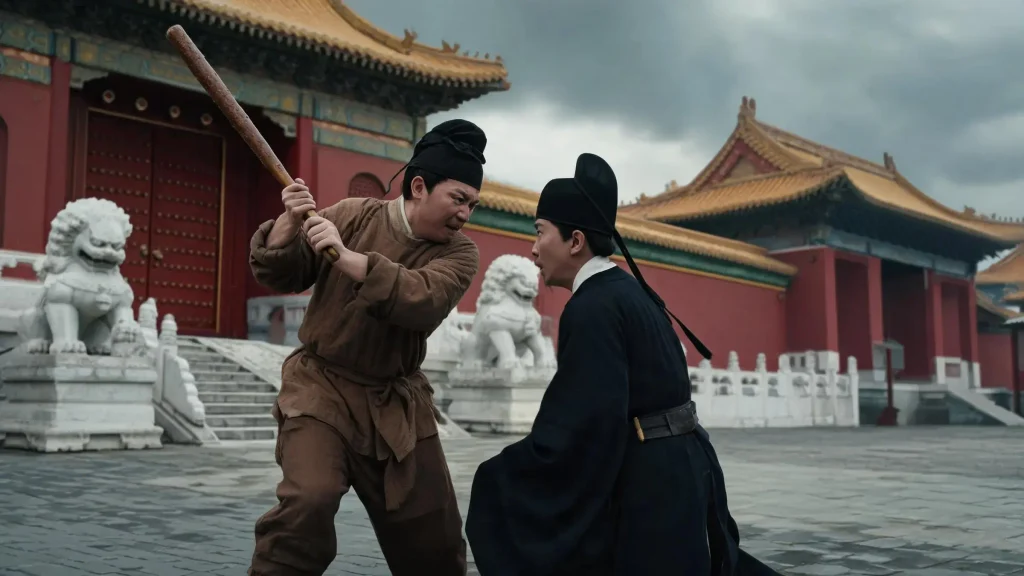
The case could not be contained. The Ministry of Justice questioned him, decided he was mad, and closed the file. A prison official named Wang Zhicai did not believe it. He reopened the interrogation, and Zhang Cha gave up two names: Pang Bao and Liu Cheng, both eunuchs in the household of Consort Zheng. A stick attack had become a conspiracy that pointed at the Wanli Emperor’s favourite consort.
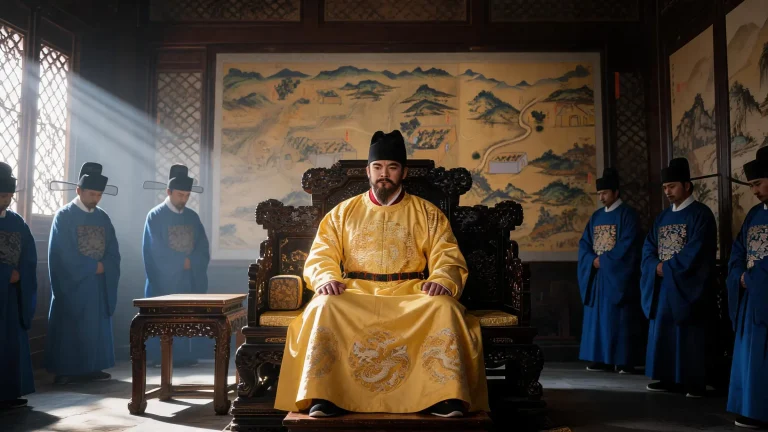
In the same month the Wanli Emperor met his ministers at the Cining Palace, in the mourning hall of his late mother, the Empress Dowager Li. He had the heir apparent speak in front of them, the heir apparent asked that the affair not be allowed to spread, and in the end only Zhang Cha was executed. Pang Bao and Liu Cheng were beaten to death inside the palace. That is the outcome recorded in the History of the Ming, in the annals and in the biography of Consort Zheng.
The record does not say when the Wanli Emperor’s ministers had last seen him before that day. In the fourth month of 1612 the censors of Nanjing put the matter in a memorial. The benches of the censorate and the ministries stand empty, business is left undone, and the sovereign has sat deep in the palace for more than twenty years without once meeting a minister. The empire, they wrote, will sink. The answer to that memorial was two words: no reply. Seven years later, in the ninth month of 1619, the officials threw themselves down at the palace gate and asked the emperor to hold court and take up business. The answer was the same two words.
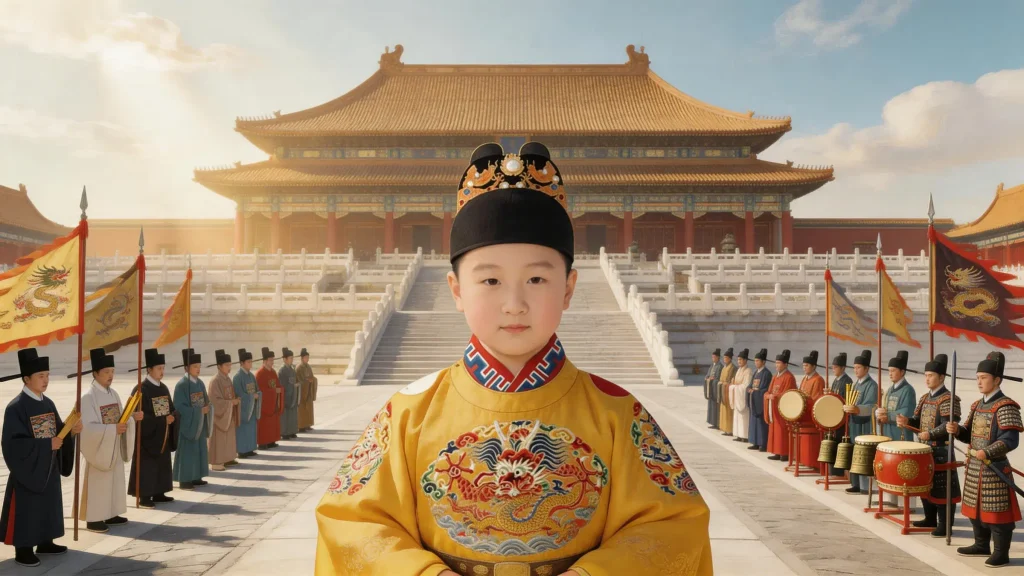
The Wanli Emperor did not begin this way. In the fifth month of 1572 his father, the Longqing Emperor, died, and in the sixth month the boy took the throne at the age of ten. For the first ten years the finances of the dynasty were as comfortable as they were at any point in the Ming. Zhang Juzheng was in the Grand Secretariat checking names against realities and clearing arrears, the Single Whip Law was extended to the whole empire, and the accounts of every frontier garrison were audited year by year. Forty-eight years later, the appraisal appended to his own annals said that by common account the Ming died under the Shenzong Emperor. The same annals record that all three great campaigns of the Wanli Emperor’s reign were fought to a finish. Both statements sit in the same book, and together they are the honest picture of the Wanli years.
What the Wanli Emperor stopped was showing up. Memorials still came to his desk, and he endorsed few and kept many. When an office fell vacant, he did not fill it. When ministers asked him to settle the succession, he did not answer. There was a clear political logic in this. He wanted the son of Consort Zheng as his heir. The civil service blocked him with ritual precedent and the ancestral rules, and he had no instrument that could simply overrule them, so he used absence, silence and vacant posts as his instruments. The deadlock lasted until he died. Neither side won, and the bill was paid in finance, frontier defence and local government.
Zhang Juzheng and the education of a ten-year-old emperor
In the sixth month of 1572 the ten-year-old Zhu Yijun took the throne. Two men stood over him: Zhang Juzheng, senior grand secretary, and Feng Bao, a eunuch of the Directorate of Ceremonial who also ran the Eastern Depot. His mother, the Empress Dowager Li, was still alive, and she could manage both of them and him.
The intensity of the Wanli Emperor’s education shows in Zhang Juzheng’s methods. He first did the work himself, compiling more than a hundred episodes of good and bad government, illustrating them, and explaining them in plain language so the boy would understand. Then he had the Hanlin officials sort the imperial instructions and the veritable records of every emperor since the founder into forty headings. The headings included the hardship of founding the dynasty, diligent government, study, reverence for heaven, following the ancestors, protecting the people, instructing the heir and keeping the imperial clan in order. They also included employing worthy ministers, removing the wicked, accepting remonstrance, keeping the law, long tenure in office, valuing prefects, controlling close attendants, caution in punishment, restraint in military affairs and managing the frontier peoples. He asked that they be expounded outside the regular colloquium on the classics. The History’s comment on the forty headings is four characters: the language was mostly pointed and urgent.
The Wanli Emperor was handled more directly in other settings. In the eleventh month of 1580 Feng Bao reported to the empress dowager that the Wanli Emperor had been out at night with young eunuchs. She summoned him and reprimanded him, and he knelt for a long time to receive it. Feng Bao then had Zhang Juzheng draft an edict in which the emperor reproached himself, and had it circulated to the grand secretaries. The wording was harsher than it needed to be. The Wanli Emperor was eighteen that year. He read it, felt the shame of it, and issued it anyway because his mother stood behind it. Feng Bao’s biography also keeps one everyday detail. When the emperor was playing with the young eunuchs and saw Feng Bao come in, he straightened his clothes and sat up, saying, here comes the big companion.
Zhang Juzheng’s other face is in the same biography. He held the law hard, audited the post stations, cut redundant offices, and cleaned up the schools, and he dismissed a great many people in the process. Senior officials and ordinary clerks could no longer ride the post horses, and travelled like merchants. In the single year 1582, provincial redundant posts were cut, labour service rolls were audited, and waste in every office was trimmed. Those tightened accounts are what later writers call the prosperity of the early Wanli years.
Zhang Juzheng died in the sixth month of 1582.
The reckoning came quickly. In the twelfth month of the same year, Feng Bao was demoted to a minor post and his property was confiscated. In the third month of 1583 Zhang Juzheng’s ranks were stripped. Memorials against him kept coming after that. The Wanli Emperor ordered his titles removed and the sealed edicts and the patents for four generations of his family taken back. The charges were published with a note that he deserved to have his coffin opened and his corpse mutilated, but would be spared. When the family property in Jingzhou was seized, the local officials registered the household in advance and sealed the gates. Members of the family hid in empty rooms, and more than ten of them starved before the doors were opened. The confiscation produced ten thousand taels of gold and more than a hundred thousand of silver. His eldest son, Zhang Jingxiu, a secretary in the Ministry of Rites, could not bear the torture, confessed falsely to having hidden three hundred thousand taels with friends, and hanged himself.
One sentence in the same biography is the thread of the whole business. In the early years of the reign the Wanli Emperor was pressed by his mother, and whatever she asked for he approved. The History’s wording is that out of necessity he approved everything, while in his heart he resented Bao and Juzheng. The character used for that resentment is a rare one, and it is where the record stops. What a boy who was managed by two grown men between the ages of ten and eighteen actually held in his mind is not in the sources.
The Single Whip Law, and silver from the other side of the Pacific
The longest-lived of the measures Zhang Juzheng left the Wanli Emperor was the tax system. The fiscal treatise of the History gives the Single Whip Law in full. All the taxes and labour services of a county were gathered together, land was measured and adults were counted, and grain and labour alike were paid over to the government. The labour owed for a year was hired by the government, with heavy labour converted into a food and wage figure and light labour converted into a payment with handling costs added. The regular quotas, the special levies, the annual needs of the capital granaries, the sums retained locally, the supplies for official entertaining and the local tribute in kind were all combined into one item, assessed on the acre and paid in silver. The compilers’ verdict is that the method was simple and convenient. It had been tried and suspended several times, and the Wanli Emperor put it in force everywhere in 1581.
For the Wanli Emperor’s treasury, the gain was plain. What a county owed became one figure in silver, hundreds of local levies were folded into it, and the clerks had far less room to work the margin. The other side was just as plain. From that point the Ming state, and the Wanli Emperor’s court with it, ran on silver.
Where the silver came from is the most important external fact of the Wanli Emperor’s reign. China’s own mines were poor, and the early Ming had banned the use of gold and silver in trade when it pushed its paper money, so the main source of the metal lay outside the country.
One line ran from Japan. Its silver output rose steeply in the late sixteenth century, and the metal flowed into China and Korea in large quantities. The other line was longer. In 1545 the Spanish found the silver mountain at Potosi in Upper Peru, and from 1565 they ran the Manila galleons between Manila and Acapulco, paying American silver for Chinese raw silk, silk cloth and porcelain. Later estimates often put it this way: between 1500 and 1800 Bolivia and Mexico produced roughly eighty per cent of the world’s silver, and about thirty per cent of it went to China. The methods behind those figures differ widely, and what is solid is the direction of the flow. The silver that reached China in the Wanli years came mainly along the Japanese and the American routes.
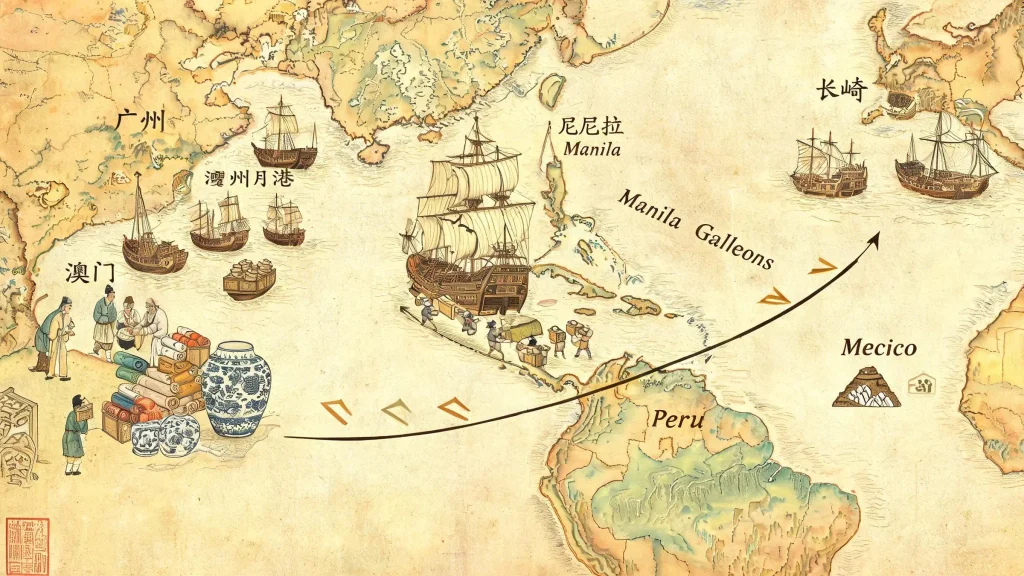
Over the following decades the law deformed in practice across the Wanli Emperor’s empire. In the Tianqi period the censor Li Yingsheng listed ten ways it harmed people. In 1630 the Henan governor Fan Jingwen put it more bluntly. The whip had moved a county’s labour duties onto the county’s tax grain, which should have given the countryside some relief, but the countryside still ran year after year and bankrupted itself in contributions. The whip was in force, he wrote, and the great households were never abolished. He meant the grain captains and the village headmen, posts abolished on paper and still there in fact, still carrying and shifting the load.
After Zhang Juzheng died, the next senior grand secretary, Shen Shixing, scrapped the performance audit he had run and simplified everything. With the auditing machine stopped, the clean accounts stopped too.
The heir the emperor wanted, and the protocol the Ministry of Rites withheld
The Wanli Emperor’s eldest son, Zhu Changluo, was born in the eighth month of 1582. His mother, Wang, was a palace woman of the Cining Palace. The business began by accident. The Wanli Emperor visited the Cining Palace and slept with her privately, and the rule was that a palace woman who received the emperor’s favour was given presents. The eunuchs of the records office wrote down the date and the gifts as proof of it. The emperor did not want it known at the time, and nobody around him dared mention it. Then at a meal with the Empress Dowager Li, his mother raised the subject, and he denied it. She had the palace diary brought in and showed it to him. She said that she was old and had no grandson yet, and that if this was a boy it was a blessing for the dynasty. A mother was honoured through her son, she said, so why should there be ranks between them?
Wang was made consort in the fourth month of 1582 and gave birth to the eldest son in the eighth month. In the first month of 1586 Consort Zheng gave birth to the third son, Zhu Changxun, and was raised to the highest consort rank, while Wang was not raised at all. In 1601 the Wanli Emperor finally invested the eldest son as heir apparent, and Wang still got nothing. She reached the highest consort rank only in 1606. The History records her deathbed plainly. In 1611 she was gravely ill, the heir had to ask permission before he could visit her, the gate was still locked and had to be forced, and she was blind by then. She felt for her son’s clothes and wept, and said that he had grown so big, and that she had nothing left to regret.
The suspicion at the Wanli Emperor’s court had started in the year Consort Zheng bore her son. The History’s biography of the consort states it in one line: the outer court suspected her of a plan to seat her own son. The sentence that follows carries more weight. Officials competed in memorials about the succession, thousands of them, all pointing at the inner palace and attacking the ministers in office, and the emperor ignored the lot. From that, the feud of factions began.
The Wanli Emperor had a whole set of methods for delay. In 1589 he offered a date, on condition that the officials shut up. He disliked shrill noise, he said, and the memorials he had withheld were withheld because they tried to set him against his son. If the officials did not pester him again the following year, the investiture would take place the year after. Otherwise it would wait until the heir apparent was fifteen. In the eleventh month of the same year, on the Empress Dowager Li’s birthday, the Wanli Emperor received Wang Xijue alone in the warm pavilion. Wang pressed him to settle the succession, and he answered with a question: what if the empress has a son? Wang replied that the argument would do ten years earlier, when the boy was three, but that the eldest son was thirteen now and there was nothing left to wait for.
In 1600 Wang Dewan, chief supervising secretary of the Office of Scrutiny for Revenue, memorialized about the empress and about the mother of the heir. The emperor was furious, had him thrown into the imperial prison and questioned, then flogged a hundred strokes at court and struck off the rolls. The Wanli Emperor also sent word to the ministers: are you for the eldest son, or are you for Wang Dewan? If you are for the eldest son, stop pestering me. If you insist on Wang Dewan, then the investiture is postponed another year. The date of the succession was being used as a penalty.
In the first month of 1593 the matter reached its highest point. The Wanli Emperor showed Wang Xijue a handwritten order: he wanted to wait for a son by the empress, and in the meantime to enfeoff the eldest son and his two brothers as princes together. The court erupted. Officials went in groups to Wang Xijue’s house to argue with him. Wang asked for a formal debate and was refused, and asked for an audience without getting an answer. In that same year Gu Xiancheng memorialized, and stated the family law as directly as it could be stated. In this dynasty’s rule for establishing an heir, the eastern palace does not wait for a son of the empress, and the eldest son is never enfeoffed alongside his brothers. The plan was dropped.
Why the Wanli Emperor could not simply write the order himself comes down to procedure. An investiture required the Ministry of Rites to draw up the protocol, a formal debate, and publication; only through that sequence did the imperial will become a ceremony. The one thing he could do on his own was delay, pushing the date back, holding the memorials, returning the drafts.
Primogeniture was also the hardest rule in the Wanli Emperor’s own family law. The Yongle Emperor had taken the throne by civil war. Within the month of his accession he had cut the Jianwen line out of the clan order, moved his elder brother’s tablet back to the tomb park, and demoted three of his brother’s sons to princes. That same emperor spent the rest of his life upholding the primogeniture rule. By the Wanli reign the rule had a century and a half of practice behind it, and touching it meant touching the ancestral law.
On the eighteenth day of the ninth month of 1601, at the second watch of the night, the edict finally came. The Wanli Emperor regretted it at once and ordered a new date. Shen Yiguan sealed the edict and sent it back, saying that he would not dare obey it even if he died for it, and the emperor gave way. On the fifteenth day of the tenth month the investiture was performed. In the same year the Wanli Emperor used money as a weapon: he ordered the Ministry of Revenue to hand over twenty-four million taels for the ceremonies of investiture and enfeoffment, to pin the officials down.
Memorials left unanswered, offices left empty
The practice of holding memorials back became normal in the Wanli Emperor’s middle years, during Shen Shixing’s term as senior grand secretary. In the twelfth month of 1589 Luo Yuren, a case reviewer in the Court of Judicial Review, submitted four warnings on drink, on lust, on avarice and on temper. The Wanli Emperor wanted to punish him severely, and Shen Shixing persuaded him not to circulate the document, and nudged Luo into resigning. Shen’s biography then records, in seven characters, that from this point memorials began to be held back in the palace. A memorial went in and was not endorsed, not rejected and not sent back. It stayed in the emperor’s hands.
What stopped with them was the whole machinery of appointments. In the tenth month of 1587 Shen Shixing asked for the withheld memorials to be released. In the twelfth month of 1600 Zhao Zhigao and other grand secretaries asked the same. In the seventh month of 1601 Sun Piyang, minister of personnel, asked for the memorials on filling posts. In the third month of 1603 the Ministry of Personnel reported vacant prefectures. In the second month of 1604 the grand secretaries asked to fill the provincial and circuit posts and to send out inspecting censors. Each time the answer was no reply.
In the fourth month of 1612 the censors of Nanjing wrote the consequence into a memorial. The benches stand empty, they wrote, business is left undone, and the sovereign has sat deep in the palace for more than twenty years without once meeting a minister. No reply.
In the last years one man was left running the Grand Secretariat. Fang Congzhe alone held the government, and his biography preserves the emperor’s own logic. The Wanli Emperor disliked remonstrance officials. Men selected for posts had waited two or three years for their orders, and by then were waiting eight. Fang asked for the answers dozens of times and never got them. The emperor considered that with the empire at peace the offices need not all be filled, and meant to cut them down. When the war in Liaodong began, the Wanli Emperor would not admit the earlier mistake, and carried on as before. That the offices need not all be filled is the line the History leaves in his mouth.
The Wanli Emperor opened a second channel for money beside the regular one. In the seventh month of 1596 he sent eunuchs to open mines in the capital region, and before long Henan, Shandong, Shanxi, Zhejiang and Shaanxi were all ordered to dig, with the ministers remonstrating again and again and being ignored. The eunuch biographies explain where the idea came from. Ningxia had cost more than two million taels in 1592; the war in Korea, eight years from beginning to end, cost more than seven million; Bozhou cost two or three million in 1597. Three campaigns back to back had emptied the treasury. Fires destroyed the Qianqing and Kunning palaces in 1596, and the three great halls in 1597. There was no money for rebuilding, the accountants were at their wits’ end, and the mining tax began on a great scale. The eunuchs went out to the provinces. Gao Huai went to Liaodong, Chen Feng to Huguang, Yang Rong to Yunnan, Gao Cai to Fujian, Chen Zeng to Shandong, Pan Xiang to Jiangxi and Wang Hu to Zhending. Sun Long, the eunuch over the Suzhou and Hangzhou silk workshops, was also given the commercial tax. The summary line in the same chapter is that less than a tenth of the money reached the public treasury while the empire was left desolate and its people in torment.
The riots against the Wanli Emperor’s tax collectors followed in order. In the fourth month of 1599 Linqing rose, burned the tax office of the eunuch Ma Tang and killed thirty-four of his retinue, in the same month that the emperor was at the Meridian Gate receiving Japanese captives taken in Korea. In the twelfth month of 1599 Wuchang and Hanyang rose and wounded Chen Feng. In the third month of 1601 Wuchang rose again, killed six of Chen Feng’s men and burned the governor’s office; in the fifth month of the same year Suzhou killed several of Sun Long’s men. In the third month of 1602 Tengyue killed a tax official. In 1606 the people of Yunnan burned Yang Rong’s house and killed him along with two hundred of his followers.
One scene from the second month of 1602 is hard to get around. The Wanli Emperor was gravely ill and summoned Shen Yiguan to the Qixiang Palace. He ordered the mining tax stopped, the silk workshops stopped, prisoners released, and every official punished for speaking restored to office, then lay down, and everyone in the room wept. The next day he was better and cancelled the order. Shen’s biography supplies the detail. About twenty eunuchs came to the Grand Secretariat to take the order back, saying that the mining tax could not be abolished and that the rest was for the grand secretaries to decide. Shen refused to hand it over, and the eunuchs knocked their heads on the floor until they nearly bled. Tian Yi, the eunuch of the Directorate of Ceremonial, argued against the reversal, and the Wanli Emperor was angry enough to want to kill him with his own hand. The mining tax lasted until the Wanli Emperor died. The testamentary edict abolished all excise taxes and the new silk workshops.
Ningxia, Korea and Bozhou: three campaigns the Wanli Emperor signed off on
Under the Wanli Emperor the Ming fought three large wars, later grouped together as the three great campaigns. Two sets of figures survive. Wang Dewan’s memorial gives Ningxia at 1.8 million taels, Korea at 7.8 million and Bozhou at 2 million. The same memorial adds another account: the annual subsidy to the frontier was 430,000 taels under the Hongzhi and Zhengde emperors, 2.7 million under the Jiajing Emperor, and 3.8 million by his own day.
The war in Korea lasted seven years. In the fifth month of 1592 Japanese troops took the Korean capital, King Seonjo fled to Uiju on the Yalu and asked for help, and the court’s decision came down to one line: Korea is the fence of the realm, and must be contested. In the seventh month of 1592 the vanguard under Zu Chengxun was beaten back from Pyongyang; in the tenth month Li Rusong was pulled out of the Ningxia campaign and made commander against the Japanese. For seven years after that the dynasty moved garrisons from Liaodong, Xuanfu, Datong and Shanxi across the Yalu, and Ulsan, Sacheon and Noryang are all in the biographies. What ended the war was not a victory. Toyotomi Hideyoshi died in the eighth month of 1598, and the History’s closing line is that the trouble stopped only when the kampaku died.
The bill changed hands the moment the war ended. In the intercalary month of 1599 the court announced the peace and remitted the surcharge that had been levied for the Korean campaign. In the same month the emperor ordered twenty-four million taels out of the state treasury for the marriages of his sons, and the Ministry of Revenue reported that the treasury was empty. Seven years in Korea had cost 7.8 million taels; a few marriages were priced at three times that.
The Wanli Emperor’s own part in the wars was personnel and endorsement. He approved the transfer of Li Rusong, he approved the sending of Chen Lin and Liu Ting to Korea in 1598, and after Fushun fell in 1618 he appointed Yang Hao to command in Liaodong and gave him the imperial sword. The last plan was pushed through by his own ministers. Fang Congzhe, the minister of war Huang Jiashan, and the supervising secretary Zhao Xingbang argued that the army had been out too long and the money was running out. They sent a red flag to Yang Hao’s headquarters day after day to hurry him into the attack. Frontier appeals mostly went unanswered. From the biography of Li Weihan: the Son of Heaven again left the myriad affairs unmanaged, and the frontier officials cried out and were heard as if they were not there, until the Liaodong business was ruined.
In the fourth month of 1618, the forty-sixth year of the Wanli Emperor’s reign, the Later Jin took Fushun, and the thousand-commander Wang Mingyin died there; in the seventh month the Qinghe fort fell. The History says our Great Qing troops at this point, which is how the Qing compilers wrote; the name of the regime at the time was the Later Jin, and it changed only in 1636. In the second month of 1619 Yang Hao swore in his army at Liaoyang and marched out on the twenty-first, in four columns. Ma Lin went from Kaiyuan to the north, Du Song from Fushun to the west, Li Rubai through the Yahuguan pass toward Qinghe, and Liu Ting from Kuandian. They were to meet at Erdaoguan on the second day of the third month. The army was numbered at 470,000 men. It snowed, and the date leaked. Du Song, racing for the credit, crossed the Hun River ahead of time, walked into the ambush at Erdaoguan and lost his whole force. Ma Lin camped and was broken by the Later Jin coming down off the high ground, and ran. Liu Ting, three hundred li in, was taken in by Later Jin troops wearing Ming armour under Ming banners, and died fighting when his camp broke up. Only Li Rubai’s column came back whole.
The figures in Yang Hao’s biography are cold. More than three hundred and ten officers and officials were killed, along with more than forty-five thousand eight hundred soldiers. The horses, camels, armour and weapons lost were beyond counting. When the report of the defeat came in, the capital was shaken. Three months later Kaiyuan fell and Ma Lin was killed. In the ninth month the officials threw themselves down at the palace gate again and asked the Wanli Emperor to hold court, and there was no reply. In the twelfth month the court added another surcharge to the land tax.
The hole in Liaodong was not dug in that one year. In 1606 Li Chengliang argued that the six Kuandian forts were too isolated to hold, and moved the whole population back inside the frontier. The people would not go, so the army drove them, and the dead lay in heaps. For the record he claimed credit for recovering runaways. Song Yihan said that abandoning the land was no policy, Xiong Tingbi’s inspection agreed with him, and Song memorialized again and again. The emperor remembered Li Chengliang’s old service, and left all of it unanswered in the palace. In the fifth month of 1583 the History records the first act of the Later Jin state: our Great Qing Taizu, the High Emperor, raised troops against Nikan Wailan and took the city of Tulun. Two months earlier, Zhang Juzheng had been stripped of his ranks.
Wucai porcelain, a striking clock, and The Peony Pavilion
In the same years the kilns at Jingdezhen burned at their hottest. The wucai porcelain of the Wanli Emperor’s reign put underglaze blue together with overglaze red, green, yellow and aubergine, and the contrast between the colours is strong. Shapes ran large: garlic-head bottles, gu-shaped stands, meiping jars, great jars, with the reign mark of the Wanli years written on the base. These pieces sold extremely well in Japan and in Europe. Japanese collectors prized wucai for centuries, and European buyers liked the strong colour, which sat well in their interiors. One documented episode is the seizure at sea in 1602 of a Portuguese carrack by the Dutch East India Company, with a cargo of Wanli blue and white. That cargo was auctioned in Amsterdam in 1604, and the name kraak porcelain travelled across Europe with it. Long appetite abroad, together with a later Chinese preference for Song wares, early Ming blue and white and Qing imperial porcelain, meant that the best wucai left the country.
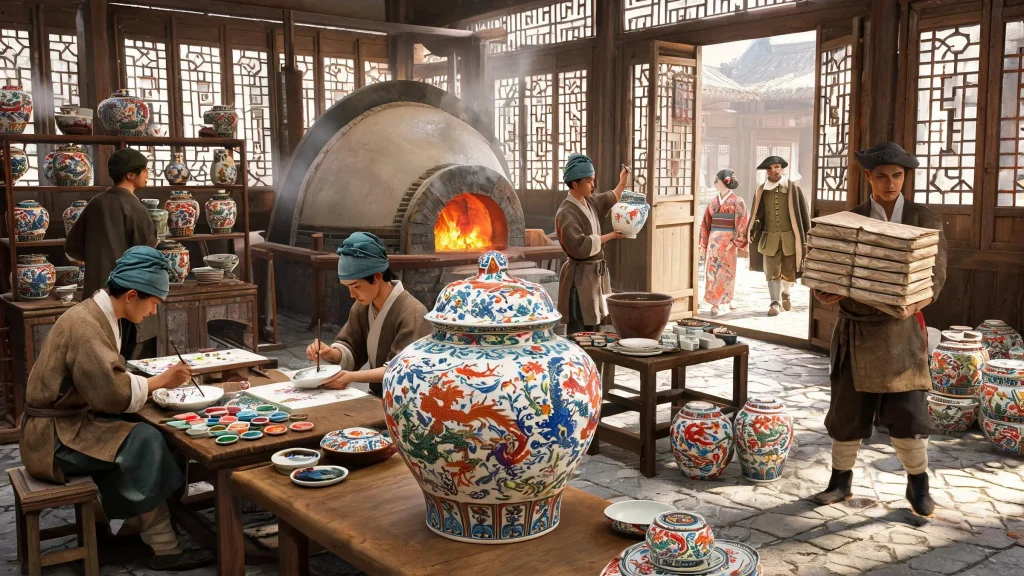
The same town had other business. The eunuch chapter of the History records that Pan Xiang, the mining eunuch in Jiangxi, provoked a riot at Jingdezhen in which the workshops were burned. The peak years for porcelain exports were also the years of the hardest conflict between tax eunuchs and kiln workers.
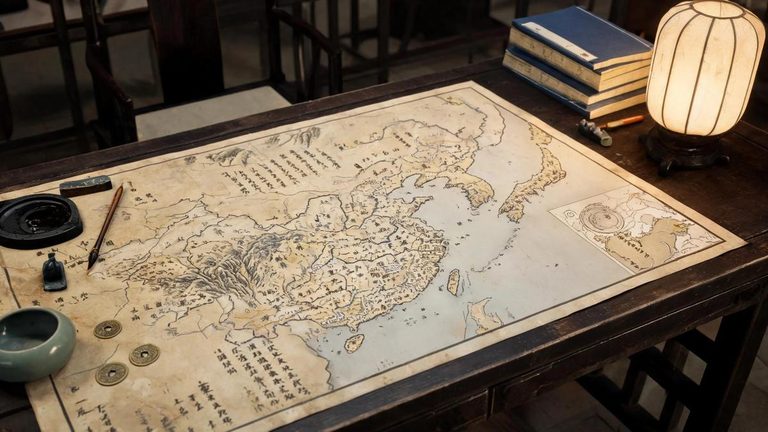
In 1600 the annals for the year close with one line: Matteo Ricci of the Great Western Ocean presented local products. Ricci reached Beijing on January 24, 1601, with a striking clock and a world map among his gifts. By his own account the Wanli Emperor kept the clock in the palace, had four eunuchs taught to wind and maintain it, and never met the man himself. In 1602 Ricci and Li Zhizao printed the Kunyu Wanguo Quantu in Beijing, a world map that placed China a little east of centre and marked the Americas, Africa and Europe on it. Ricci died in Beijing on May 11, 1610. By custom a missionary who died in China was sent back to Macao for burial, and Ye Xianggao and other grand secretaries pressed the case until the emperor granted a plot at Zhalan, outside the Fucheng Gate. He was the first foreigner allowed to be buried in Beijing.
The market towns and printing houses of Jiangnan grew up in the same decades. In 1598 Tang Xianzu, at home in Linchuan, finished The Peony Pavilion, a play about a girl who dies for love and comes back because of it; some scholars date it to 1597. Theatre troupes, print shops, wine houses and silk firms sat inside one network, and silver moved through it. In the sixth month of 1587 the Wanli Emperor’s court left four characters in the record, prohibiting lavishness among the officials. Decree after decree against extravagance is itself a record of fashion.
After Dingling: the Wanli Emperor’s curved spine, and a verdict in the dynastic history
Work began on the Dingling tomb in the eleventh month of 1584. The Wanli Emperor was twenty-one, and the tomb was his own project. In a little over a year eleven sites were surveyed, he went twice in person with ministers and geomancers to Tianshou Mountain, and the site was settled below Dayu Mountain only after both empress dowagers had looked at it. The Duke of Dingguo, Xu Wenbi, and the grand secretary Shen Shixing led the work, with the ministers of war and of works supervising it, and twenty or thirty thousand workmen and soldiers on site every day. The surface buildings were finished in the sixth month of 1590, six years after the start, on about a hundred and eighty thousand square metres, for eight million taels of silver. The Wanli Emperor inspected the works six times, and on the Frost Descent day of 1588, after the ancestral rites, he went down into the finished underground palace and drank there. Eight million taels, set beside the 7.8 million that seven years in Korea had cost, needs no comment.
Dingling is the only Ming imperial tomb ever opened, and what opened it was a document filed in 1955. Wu Han, then deputy mayor of Beijing, proposed excavating Changling, the tomb of the Yongle Emperor, and Guo Moruo, Shen Yanbing, Deng Tuo and Fan Wenlan signed the request with him. Zheng Zhenduo, who headed the cultural relics bureau, and Xia Nai, deputy director of the Institute of Archaeology, both thought the conditions were not ready and opposed touching it. Changling gave no leads, trial digs elsewhere made no sense, and the choice fell on Dingling. Excavation began in May 1956, the stone wall sealing the underground palace was found in May 1957, the stone door was opened that September, and clearing finished at the end of July 1958. On September 6, 1958, the Xinhua News Agency announced to the world that Dingling had been opened. The underground palace, built of three halls with side chambers left and right, covers 1,195 square metres. It yielded more than three thousand objects, among them a crown woven from gold wire in the shape of a winged cap, twenty-four centimetres high and weighing 826 grams, phoenix crowns for the empresses Xiaoduan and Xiaojing, and bolts of silk.
Later examination of the Wanli Emperor’s remains left a few numbers about the man himself. A reconstruction concluded that his upper back was curved and that he stood 1.64 metres tall, and that his teeth were barely worn, which points to a refined diet and to severe gum disease. A blood type is also often mentioned, one that was unusual for northern China at the time. These are findings reported and repeated after the 1958 excavation rather than raw data published in an excavation report, and they should be labelled as such. The Wanli Emperor did use his body as a reason for not holding court. In the tenth month of 1586 Lu Hongchun, a secretary in the Ministry of Rites, memorialized asking him to take his illness seriously, and was flogged at court and struck off the rolls, which shows that by then the court did not believe the reason. Three centuries later the men who opened the coffin found a curved spine. Nothing connects the two directly. They point the same way.
The appraisal appended to the annals of the Shenzong Emperor was written by Qing historians. It runs like this. The Wanli Emperor took the throne as a child, Zhang Juzheng held the government, names were checked against realities, and the dynasty’s strength came close to prosperity. Then he drifted and sat deep in the palace, the framework of government decayed, and ruler and minister were cut off from one another. Men who loved power and profit raced after advantage and became the enemies of men of reputation, and factions stood against each other. Under the Tianqi and Chongzhen emperors the wicked party spread further, so that by common account the Ming died under the Shenzong Emperor, which is not hard to credit. The most important sentence in that passage is the earliest one: the dynasty came close to prosperity. The compilers admit that he once had a working state. The rest of the passage is their verdict on the thirty years that followed.
Faction fighting, in the later histories, starts with the Wanli Emperor. The biography of Wei Zhongxian opens by saying that because the Shenzong Emperor sat on the throne for a long time and was idle in government, many memorials went unread. Officials gradually formed into factions, each taking shrill talk for virtue, and the succession dispute pointed straight at the inner palace. When a grand secretary was attacked by a remonstrance official, he pleaded illness and left. At the end of Gu Xiancheng’s biography comes the roll call. Those who saved Li Sancai, those who fought the capital evaluation of 1611, those who defended the succession and those who exposed examination fraud were all labelled Donglin. So were those who asked for an inquiry into Xiong Tingbi, those who argued about the club case, those who argued about the red pill and the removal from the palace, and last those who crossed Wei Zhongxian. The result, the History says, was that factions were formed, the small men in the end blazed up, and the harm fell on the state until the Ming was gone.
The financial end of the Wanli Emperor’s reign is in the fiscal treatise. In 1618 the Liaodong surcharge jumped by three million taels. The Wanli Emperor’s private treasury was full at the time, and he grudged every tael out of it. Li Ruhua, the minister of revenue, cited the Korean and Bozhou precedents and added three and a half fen per acre, more than two million taels across the empire. The next year came another three and a half fen, and the year after that two fen more at the request of the war and works ministries. Nine fen in all, 5.2 million taels added, and it became the standing quota. The money was called the Liaodong levy. The same levy had been imposed twenty years earlier for Korea, and remitted in 1599.
The Wanli Emperor died in the seventh month of 1620, aged fifty-eight, and was buried at Dingling. The testamentary edict abolished all excise taxes and the new silk workshops; the heir apparent released a million taels of treasury silver for the frontier, ended the mining tax everywhere, and restored the officials who had been punished for speaking. A month later that heir was dead too. From the death of the Wanli Emperor to the Chongzhen Emperor’s suicide on Coal Hill, twenty-four years passed.
Questions readers ask
Sources and further reading
- History of the Ming (Mingshi), chapters 20 and 21, annals of the Shenzong and Guangzong emperors. The 1612 memorial on empty benches, the mining tax, the three campaigns, the 1615 audience, the 1619 prostrations and the 1620 testamentary edict: https://zh.wikisource.org/zh-hans/明史/卷20 and https://zh.wikisource.org/zh-hans/明史/卷21
- History of the Ming, chapter 78, fiscal treatise. The text of the Single Whip Law, its adoption in 1581, the Liaodong surcharge and its nine fen, and the emperor’s reluctance to spend his private treasury: https://zh.wikisource.org/zh-hans/明史/卷78
- History of the Ming, chapter 114, biographies of the empresses. Consort Wang and the birth of the heir, her blindness and deathbed, and Consort Zheng: https://zh.wikisource.org/zh-hans/明史/卷114
- History of the Ming, chapter 120, princes. Prince Fu, Zhu Changxun, his marriage costs and his estate: https://zh.wikisource.org/zh-hans/明史/卷120
- History of the Ming, chapter 213, biographies of Xu Jie, Gao Gong and Zhang Juzheng. The forty headings of instruction, the edict of self-reproach, the confiscation of the Zhang household and the resentful character in the record: https://zh.wikisource.org/zh-hans/明史/卷213
- History of the Ming, chapter 218, biographies of Shen Shixing, Wang Xijue, Shen Yiguan and Fang Congzhe. The start of withholding memorials, the enfeoffment plan of 1593, the investiture of 1601, the 1602 reversal on the mining tax, and the vacant offices: https://zh.wikisource.org/zh-hans/明史/卷218
- History of the Ming, chapter 231, biography of Gu Xiancheng. The objection to enfeoffing the three princes together, the Donglin academy, and the list of everyone later labelled Donglin: https://zh.wikisource.org/zh-hans/明史/卷231
- History of the Ming, chapter 235, biography of Wang Dewan. The cost of the three campaigns, the frontier subsidy figures, and the hundred strokes: https://zh.wikisource.org/zh-hans/明史/卷235
- History of the Ming, chapter 238, biographies of Li Chengliang and Li Rusong. The abandonment of the six Kuandian forts and the memorials left unanswered: https://zh.wikisource.org/zh-hans/明史/卷238
- History of the Ming, chapter 259, biographies of Yang Hao and Li Weihan. The orders for Sarhu, the four columns, the casualty figures and the frontier appeals that were not heard: https://zh.wikisource.org/zh-hans/明史/卷259
- History of the Ming, chapter 305, biographies of the eunuchs, second series. Feng Bao and the young emperor, the mining tax, the tax eunuchs in the provinces, the riots and the murder of Yang Rong: https://zh.wikisource.org/zh-hans/明史/卷305
- History of the Ming, chapter 320, Korea. The decision to fight for Korea and the line that the trouble stopped when the kampaku died: https://zh.wikisource.org/zh-hans/明史/卷320
- Palace Museum, entry on the Dingling tomb. The construction dates, the cost of eight million taels, the size of the site, the emperor’s six inspections and the more than three thousand objects recovered: https://www.dpm.org.cn/court/system/236405.html
- Palace Museum, entry on the club case. The attack of 1615 and the fifteen-year dispute over the succession: https://www.dpm.org.cn/court/event/156233.html
- Guangming Daily, account of the Dingling excavation, including the 1958 Xinhua announcement and the observation that the emperor’s upper body was curved: https://www.gmw.cn/01gmrb/1999-01/18/GB/17941%5EGM10-107.HTM
- Beijing Daily, on the excavation and the later World Heritage listing, for the sequence of the dig and the damage to excavated silk: https://xinwen.bjd.com.cn/content/s6865c7a8e4b0bd64e2e06a4e.html
- CNR, on the gold crown from Dingling, for its height, weight and the technique of gold-wire weaving: https://www.cnr.cn/bj/misd/mingwenhua/dmww/20240621/t20240621_526757562.shtml
- People’s Daily, on the monetisation of silver in the Ming, for the Manila route and the turn to silver in state finance: http://paper.people.com.cn/rmzk/html/2020-09/02/content_2006951.htm
- China News Service, on the dating of The Peony Pavilion to 1598: https://www.chinanews.com.cn/cul/2014/02-28/5895120.shtml
- Xicheng district government, on the Zhalan cemetery, for the burial of Matteo Ricci outside the Fucheng Gate and the grant of land: https://www.bjxch.gov.cn/xcfw/whfw/xxxq/pnidpv736405.html
- Encyclopaedia Britannica, entries on Matteo Ricci and on the Wanli Emperor, for the reign dates and the Jesuit mission: https://www.britannica.com/biography/Matteo-Ricci
- Wikipedia, entries on the Manila galleons, the silver trade, Dingling and Luo Yuren. Used as a finding aid only; the figures taken from it are cross-checked against the sources above.