Zhu Yuanzhang’s Personality: Diligence, Harsh Punishment, and His Final Verdict
In the intercalary ninth month of 1376, after an unusual movement in the heavens, Zhu Yuanzhang issued an edict inviting frank advice. Zhu Yuanzhang’s personality traits show up more clearly in what came back than in anything he wrote about himself. Ye Boju, a scholar from Ninghai who had been given the post of instructor at Pingyao, ninth rank, answered the edict with three complaints. The princes of the imperial family had been enfeoffed too lavishly, punishments were too frequent, and the emperor was trying to set the empire in order too fast.
Ye Boju began with the first. The principalities of his sons, Qin, Jin, Yan, Qi, Liang, Chu, Wu and Shu, each held dozens of walled towns in a row. Their walls and palaces stood not far below the capital’s in scale, and each was furnished with guards and soldiers. Ye Boju cited the revolt of the seven states under Emperor Jing of the Han and the wars of the eight princes of the Jin, which in his account opened the way for the troubles of Liu and Shi. Enfeoffment beyond the proper limits, he wrote, breeds disaster at once. He asked that the princely establishments be pressed down, their guards cut, and their territory limited.
The History of the Ming records what Zhu Yuanzhang said when he had finished reading: "This boy would drive a wedge between my own flesh and blood. Bring him here at once. I will shoot him myself."
Ye Boju was brought to Nanjing under escort. The grand chancellor submitted the matter at a moment when the emperor was in good humor, so nobody shot him, and he was sent to the prison of the Ministry of Justice instead. He died there.
The edict had been Zhu Yuanzhang’s own. At the close of Ye Boju’s biography the historians added a qualification: when the memorial arrived the princes held their titles but had not yet been given territory, and matters were not as Ye described them. The Prince of Yan grew strong only in the last years of the reign, and the rebellion that won him the throne came later. Contemporaries, the History notes, came to treat Ye Boju as a man of foresight.
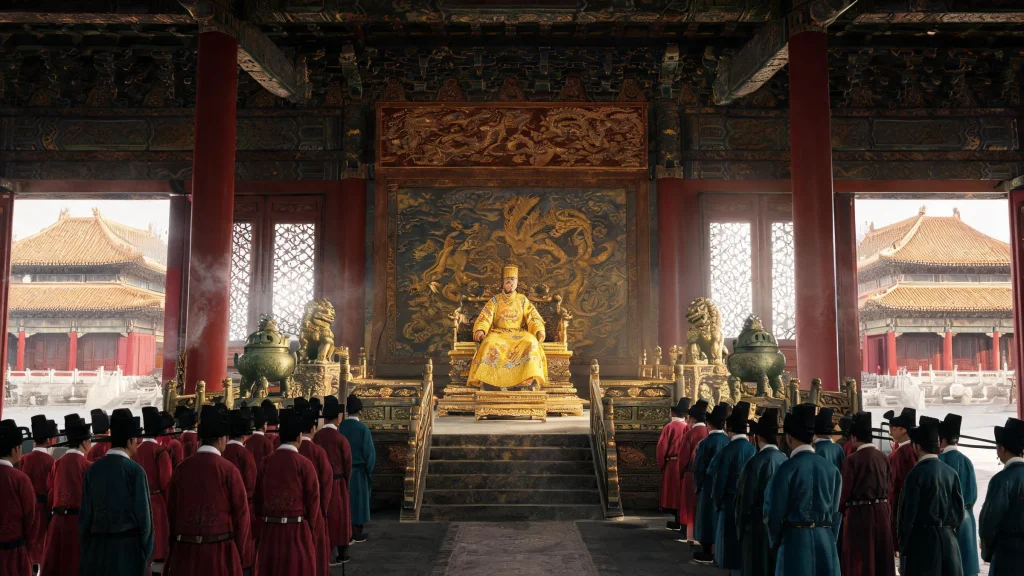
In 1376 Zhu Yuanzhang also remitted the land tax of the five prefectures Huai’an, Yangzhou, Anqing, Huizhou and Chizhou, together with Shanxi, Shaanxi, Henan, Fujian, Jiangxi, Zhejiang, Beiping and Huguang. The edict gives his reason. The palace works for the princes of Qin and Jin had laid a heavy burden on the people, building in the capital had gone on and on, and with stores now sufficient the tax should be forgiven. That winter he moved landless households from Shanxi and Zhending to Fengyang to open new fields. At the end of the year he sent the general Mu Ying to Shaanxi to ask after the condition of the people.
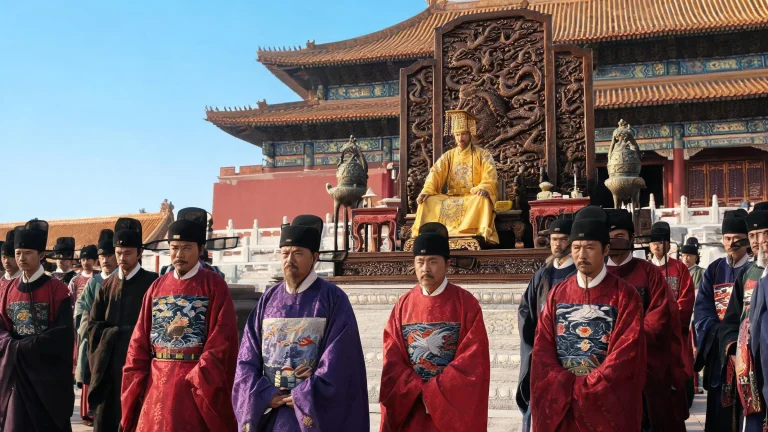
Before the throne
The Basic Annals in the History of the Ming open with the circumstances of Zhu Yuanzhang’s birth. His mother dreamed that a god gave her a pill to swallow, and the room smelled of it when she woke. Red light filled the house, and neighbors who saw it from a distance ran over thinking the place was on fire; there was no fire. The same pages describe him as a grown man: imposing, resolute, impossible to read.
In 1344 drought, locusts and epidemic struck the Huai River valley in that order. Zhu Yuanzhang was seventeen. His father, his mother and his elder brother died one after another, and the family was too poor to bury them. A neighbor named Liu Jizu gave up a piece of ground so that they could be buried at all. The orphan entered the Huangjue Temple as a monk. The temple could not feed its people for much longer than a month. He left to beg, set out for Hefei, fell ill on the road, and spent three years moving through the prefectures of Guang, Gu, Ru and Ying before returning. The same year’s entry in the Basic Annals records something with no connection to him. The Yuan general Cheli Buhua, unwilling to attack the rebels, seized ordinary people every day and reported them as prisoners taken in battle.
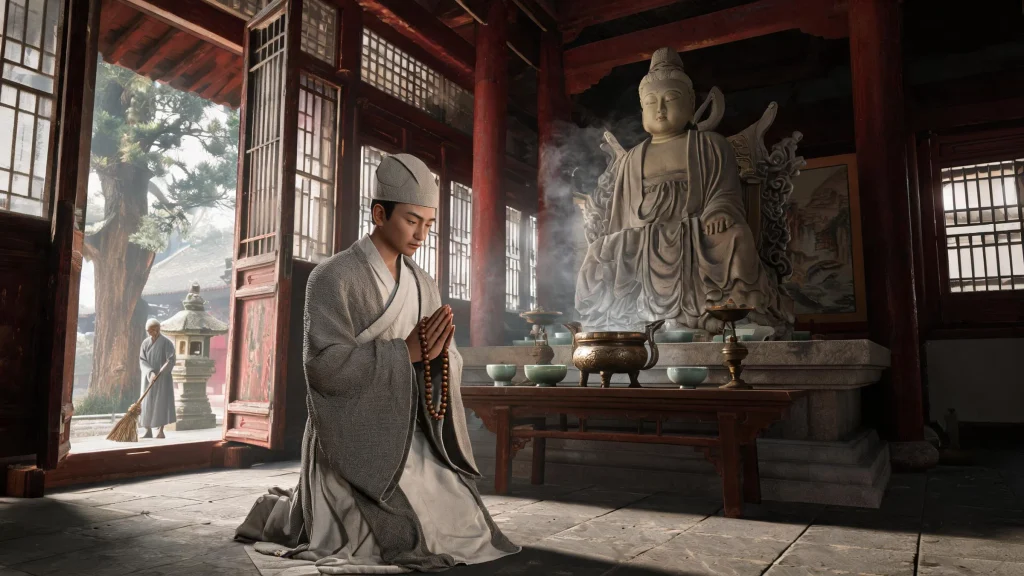
Zhu Yuanzhang mentioned these years in inscriptions and edicts several times. What he said was that he could not bury his parents, that he had been a monk, that he had begged for food. He never wrote a line about what the experience left inside him. Later tellings run straight from the plague to the harsh punishments of the Hongwu reign, and that step was added afterwards. His own verdict on himself, written at the end of his life, was that he had risen from humble circumstances and lacked the broad learning of the ancients.
In 1352, at twenty-five, he cast divination sticks to decide whether to flee the fighting or stay. Both answers were unlucky. He asked whether he should undertake something great, threw again, received a favorable answer, and in the third month entered Haozhou to meet the rebel leader Guo Zixing. Guo kept him as a bodyguard, found that he won every engagement he fought, and married him to the daughter of the Ma family he had raised, the future Empress Ma. The next year he raised seven hundred men in his home district and was given a command. The troops of Peng Da and Zhao Junyong were out of control, and Guo Zixing was too weak to master them. He handed his soldiers to another commander and rode south to Dingyuan with only Xu Da, Tang He and Fei Ju. He brought three thousand militia over from the Lüpai stockade, raided the Yuan general Zhang Zhiyuan by night at Hengjian Mountain, and took twenty thousand of his men. In 1355 Guo Zixing put him in command of the whole army. Zhu Yuanzhang hid the commission and entered the hall last, taking the seat on the left. When the business of the day was put in front of him he disposed of it so quickly that the other commanders sat speechless. Only then did he produce the commission and invoke military law against those who had missed the deadline for the city wall. After his troops took the city, he had the women they had seized sent home.
The paperwork of government
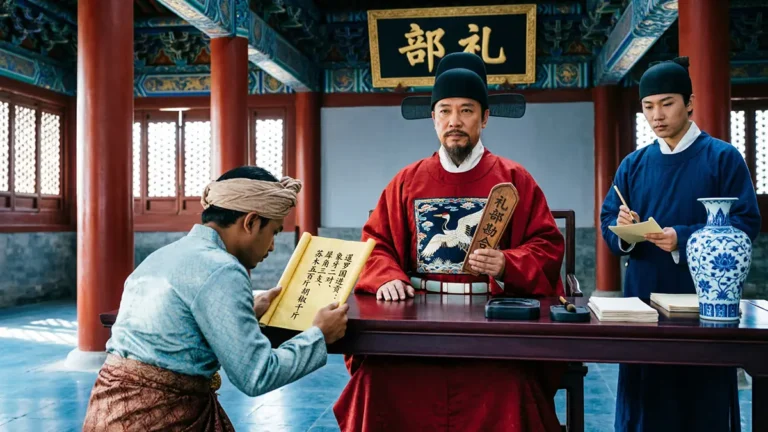
Chapter 165 of the Veritable Records of Taizu preserves an accounting from the ninth month of 1384. The supervising secretary Zhang Wenfu had counted the paperwork for him: in eight days, the offices of the court and the provinces sent in 1,660 memorials covering 3,391 separate matters. That comes to a little over 200 documents and more than 400 items a day. Zhu Yuanzhang’s own comment on the figure was a question: "How is one man to deal with that much business and get to all of it?"
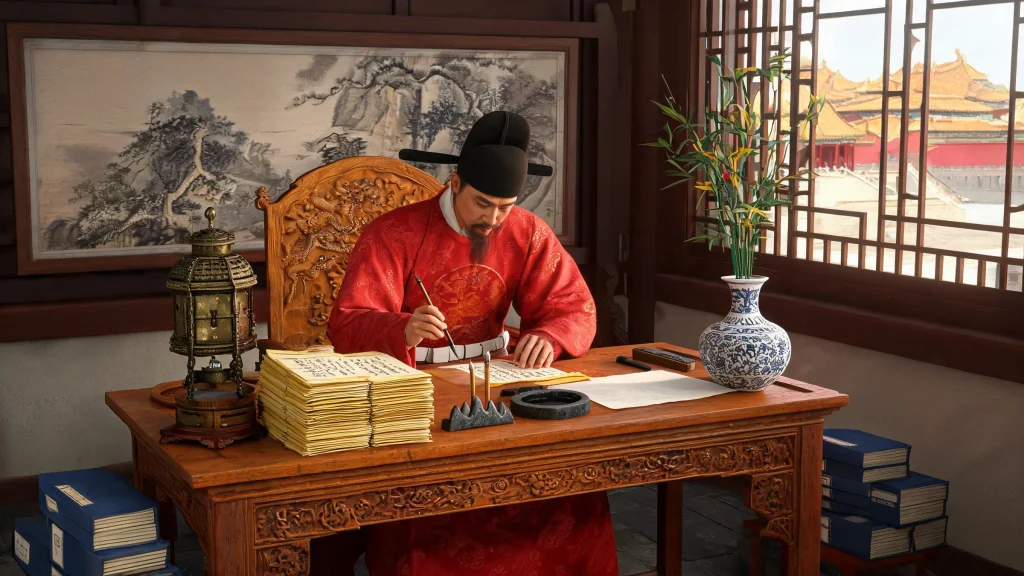
The count shows what the abolition of the chancellorship did not do. It removed an office without putting an institution in its place. The power to approve memorials now rested on Zhu Yuanzhang personally. In the eleventh month of 1382 he appointed grand secretaries of the halls and palaces, whose function was to advise and nothing more. By the Yongle and Xuande reigns the men who read the paperwork before the emperor saw it were grand secretaries of the Grand Secretariat together with eunuchs of the Directorate of Ceremonial. The arrangement had taken a shape he had not designed.
Zhu Yuanzhang kept to that routine to the end. In the first month of 1397 he was still setting up a horse administration for Shanxi, Beiping, Shaanxi, Gansu and Liaodong. In the first month of 1398, months before his death, he sent officials into Shandong and Henan to press on with farming. The deathbed edict he left behind says of him that he was diligent without rest.
In 1376, Ru Taisu, a secretary in the Ministry of Justice, submitted a memorial on current affairs that ran past ten thousand words. Zhu Yuanzhang had it read aloud to him. Partway through came the sentence that able men had barely survived these last years, one or two in a hundred, and that the men now appointed were pedantic scholars and routine clerks. Other passages were as offensive. He summoned Ru Taisu, questioned him to his face, and had him beaten at court that day.
That night Zhu Yuanzhang had the memorial read on in the palace and picked out four proposals worth acting on. He said, according to the History of the Ming: "It is hard to be a ruler and not easy to be a minister. What I want from frank advice is that it come to grips with the facts. Too many words obscure the hearing. What Ru Taisu had to say could have been put in five hundred words." He ordered the Central Secretariat to fix a format for memorials, so that men reporting on policy would leave out the verbiage. The usable parts of Ru Taisu’s memorial went to the offices concerned, and he wrote the preface to the edict himself for circulation. The memorial that earned a beating in the morning had four of its proposals adopted by nightfall. The History of the Ming gives Ru Taisu’s end in one line: in the end he died by the law.
Corruption and the law
The Treatise on Punishments in the History of the Ming describes how Zhu Yuanzhang went after corrupt officials from the first year of the dynasty. The names of officials who broke the law were posted at the Proclamation Pavilion for everyone to see. The Ministry of Justice was told that an official who broke the law might keep his post after forfeiting salary. The condition was that his fault be written on a placard at his own door, so that he would mend his ways. If he did not, the law took its course.
A conversation from the same chapter shows how he talked about severity. The vice censor-in-chief Chen Ning argued that heavy laws keep men from crime and that close inspection leaves no room for concealment. Zhu Yuanzhang disagreed. He cited the ancient practice of painting garments and distinguishing dress, which he said had been enough to keep the people from offending. Qin had the punishments of splitting the skull and pulling out the ribs, and the execution of whole clans, and still its prisons filled and the empire turned against it. He added that he had never heard of the methods of Shang Yang and Han Fei producing the rule of Yao and Shun. To the minister of justice Liu Weiqian he put it another way: "Benevolence and righteousness are the fat and the grain that feed the people. Punishments are the medicine that cures wrongdoing. To give up benevolence and rely on punishments alone is to feed a man on medicine."
In the third month of 1385 Zhu Yuanzhang had the vice minister of revenue Guo Huan executed for embezzling state grain. The Treatise on Punishments records the scale without softening it. Every official from the vice ministers of the Six Ministries downward was put to death. The stolen value was reckoned at seven million, officials in the provinces were drawn in, and tens of thousands died in the case. Tracing where the money had been left for safekeeping ruined middling households across the empire.
In the tenth month of that year Zhu Yuanzhang promulgated the Great Warnings, three successive editions compiled between 1385 and 1387 from cases the emperor judged himself, together with the lectures he gave on them. The three editions record no fewer than a thousand sentences of slow slicing, exposure of the severed head, and extermination of the offender’s kin, and ten thousand and more of the lesser executions. Even the third and mildest edition lists 364 palace graduates and Imperial College students with one to four offenses on their records. Their situation is given in five words: fortunate not to die, they kept their posts and handled business while carrying a death sentence.
The Great Warnings were not only addressed to officials. Xia Boqi and his nephew, scholars of Guixi, cut off their own fingers rather than take office, and Yao Run and Wang Mo of Suzhou failed to answer summons. Zhu Yuanzhang had all of them killed and their property confiscated. The body of law that made this a crime in its own right, the Treatise says, was the clause covering "a scholar within the four seas who will not serve his ruler."
Wang Pu, a censor in the Hongwu reign, left a different kind of scene. He had been demoted more than once for what he said. Sentenced to death at last, he was taken to the market, brought back again, and asked whether he would reform. Wang Pu answered that if he had done nothing wrong, there was no reason to kill him, and if he had, there was no reason to let him live. He asked for a quick death. Passing the History Office he called out to the scholar Liu Sanwu to record the date on which the emperor killed a censor who had committed no crime, and he was killed. Zhu Yuanzhang, compiling the Great Warnings, called the remark slander and listed his name in the book anyway.
The charge most often repeated about Zhu Yuanzhang is also the one the law does not support. The story is that officials who took more than sixty taels of silver were beheaded and then flayed. Their skins, stuffed with straw, were hung beside the magistrate’s seat, and a flaying shed was built beside every yamen. The Treatise on Punishments knows nothing of it. What it records for the Hongwu reign is the Proclamation Pavilion, the placards at officials’ doors, and the three editions of the Great Warnings. Its only mention of flaying belongs to the year 1510, more than a century later, when six rebel leaders were flayed after execution and Emperor Wuzong had their skins made into saddles and stirrups. The sixty-tael rule reached its familiar wording in Zhao Yi’s Notes on the Twenty-Two Histories, written in the eighteenth century, and mid- and late-Ming notebooks carry versions of the same story. Punishments in the last years of the Yuan were harsh enough that later writers had material to work with. No Hongwu statute contains the clause, and the ritual attached to the founder’s name appears to have been assembled after his death.
Registers, taxes and dress
In 1381 an order from Zhu Yuanzhang laid down what each kind of household was allowed to put on its back. Farming households might wear silk, gauze and cotton. Merchant households were limited to coarse silk and cloth, and a farming household with even one man in trade lost the right to silk and gauze for the whole family. The same year, the court ordered every prefecture and county to compile the yellow registers of taxes and labor service, recording households, adults and land level by level.
One such compilation, made in 1391, left figures behind: 10,684,435 households and 56,774,561 adults. The registers were not a census for its own sake, since each household owed the grain and the labor that the numbers in the book assigned to it. Classification came first and counting came second. Zhu Yuanzhang’s personality traits show in that sequence, and in the method that went with it: he met uncertainty with a written rule and resistance with an execution.
Zhu Yuanzhang’s treatment of farmers did not stop at registration. In 1378, after floods in Suzhou, Songjiang, Jiaxing and Huzhou, he gave every household a picul of rice and remitted more than 650,000 in arrears. In the third month of 1380 he cut the heavy tax quotas of those same four prefectures by twenty percent, and in the fifth month he remitted the land tax across the empire. In the fourth month of 1393, when Xiaogan went hungry, grain was lent from the state granaries. An order followed that in years of famine grain be lent first and reported afterwards, making it law. In the first month of 1394 he opened granaries to lend grain to the poor. The appraisal at the end of the Basic Annals credits him with worrying more about the people as he aged. It also credits him with spending the equivalent of a full year’s revenue on canals, ponds and irrigation works, to help farming and guard against drought and flood.
In 1368 Zhu Yuanzhang had set up a drum of appeal outside the Meridian Gate, with a censor on duty beside it every day. Only grave injustices and secret matters justified striking it, and a single strike brought the case before the throne. By the last years of the reign people were traveling past their local courts straight to the capital. Investigations found the complaints unfounded more often than not, so he forbade the practice. Community elders were to hear disputes within each locale together with the village clerks, and only serious cases were to reach the officials. The prohibition did not stop the appeals, which multiplied instead, and in the end he turned to heavy penalties and sent those who bypassed the courts into exile on the frontier.
Mencius and the monks
The biography of Qian Tang in the History of the Ming records an argument with a dead man. Zhu Yuanzhang read the Mencius and came to the passage in which a ruler who treats his ministers as dirt and weeds can expect them to treat him as an enemy. He said that no subject had any business saying such a thing, and proposed removing Mencius from the sacrifices in the Confucian temple. An edict issued in advance warned that anyone who remonstrated would be charged with great disrespect. Qian Tang submitted a memorial saying that he would die for Mencius and count it an honor, and the court expected him to be killed. Zhu Yuanzhang, seeing that he was sincere, did not punish him, and Mencius kept his place in the temple. In the end, all the same, he had scholars produce an Abridged Mencius.
Zhu Yuanzhang had been a monk himself, and as emperor he became a patron of the religion he had once practiced. According to the History of the Ming he summoned monks of repute from the southeast and held assemblies at Mount Jiang. Monks who pleased him in discussion received gold-embroidered robes and were brought into the palace to talk. Men such as Wu Yin and Hua Keqin were raised to high office and used as his eyes and ears outside the court, and their followers grew arrogant and slandered officials. At the monks’ request a Buddhist registry was created out of the earlier Office of Buddhist Affairs, with ranks of its own, and Daoism received the same treatment. Tens of thousands were ordained as monks and priests.
Li Shilu, chief minister of the Court of Judicial Review, objected. A scholar of the Zhu Xi tradition, he argued in a memorial that the emperor was founding a dynasty, and that everything the emperor did now became law for his descendants. How could he set aside the learning of the sages and promote heterodoxy? Li Shilu sent up dozens of memorials and got no answer. He then laid his tablet of office on the ground in the emperor’s presence and asked leave to go home and die. Chen Wenhui, a supervising secretary who had spoken out in the same cause, drowned himself in the Jinshui Bridge. Of Li Shilu the History of the Ming has a single line: "The emperor was furious, ordered the guards to seize and beat him, and he died at the foot of the steps."
A few years later the History adds a postscript to the affair: the emperor gradually learned that the monks had done a great deal that was unlawful, and ordered the Buddhist and Daoist establishments cleaned up. In the eighth month of 1382 he restored the imperial examinations, to be held once every three years.
The examinations of 1397
In the sixth month of 1372 Zhu Yuanzhang had an iron tablet drawn up and issued to the noble houses. It forbade the private use of garrison soldiers and the seizure of hills, lakes, tea gardens or mulberry grounds belonging to the state or to commoners. No bailiff was to use his household’s power to bully the people. Nine clauses in all.
The biography of Tang He in the History of the Ming states the emperor’s thinking about military command without dressing it up. Zhu Yuanzhang was growing old, the realm was quiet, and the Dukes of Wei and Cao were both dead. He did not want the generals to hold troops indefinitely, but an occasion for saying so had not arisen. Tang He saw it coming and raised the subject himself. His teeth were too old for further service, he told the emperor, and he asked to go home, where he would prepare a place for his coffin. Zhu Yuanzhang was delighted, granted him money for a house at the central capital, and built houses for the other nobles as well.
The offices were reorganized before the men who held them were. In the sixth month of 1376 Zhu Yuanzhang converted the provincial secretariats into provincial administration commissions. In the sixth month of 1377 an edict allowed subjects to send sealed memorials straight to the emperor, and the Office of Transmission followed in the seventh month. In the third month of 1378 memorials were ordered to go forward without being reported to the Central Secretariat first. By the first month of 1380 the path that paperwork took had been bypassing the grand chancellor for two and a half years.
That month, the left grand chancellor Hu Weiyong was executed for treason together with the censor-in-chief Chen Ning and the vice censor-in-chief Tu Jie. Five days later Zhu Yuanzhang sacrificed at the southern altar as usual. On the same day he abolished the Central Secretariat and the office of grand chancellor, and reset the ranks of the Six Ministries. The Chief Military Commission was divided into five, for the center, left, right, front and rear. An office that had stood for more than a thousand years left the machinery of government, and military command was split five ways. In the second month he called for men of upright and talented character and issued tallies to verify the empire’s grain and cash accounts, and in the fifth month he abolished the Censorate.
In 1382 the Embroidered Uniform Guard, the imperial secret police, replaced the Palace Insignia Office and ranked from the third grade. It kept a records office for paperwork and a judicial office for cases involving its own men. In 1384 its commander was raised to the third grade. In 1387 the men who ran the Guard were found to have abused prisoners. Zhu Yuanzhang had its instruments of torture burned and released the men it held to the Ministry of Justice. Every prison inside and outside the court was ordered to answer to the three judicial offices, and the Guard’s own prison was abolished.
The crown prince died in the fourth month of 1392. In the eighth month Zhu Yuanzhang had the Marquis Zhou Dexing executed. Feng Sheng and Fu Youde went into Shanxi with sixteen new garrisons of conscripted farmers, to settle and farm the frontier at Datong and Dongsheng. The noble houses, given fixed salaries in grain, handed their granted lands back to the state. In the ninth month Zhu Yunwen was made imperial grandson-heir.
In the second month of 1393 the Embroidered Uniform Guard commander Jiang Huan accused the Duke of Liang, Lan Yu, of treason. By the ninth month the announced figure was 15,000 executed with their families, and the Record of Treasonous Officials named one duke, thirteen marquises and two counts. By the end of the reign, the History says, of all the dukes and marquises of the founding only Geng Bingwen and Guo Ying were left.
Two months after the executions began, famine struck Xiaogan. Grain was lent from the granaries under an order that such loans be made first and reported afterwards. Within the same month a drought prompted Zhu Yuanzhang to call on officials to speak frankly about misgovernment and to review the prison rolls.
In the spring of 1397 the examination list came out. Song Cong of Taihe stood first, and no northerner appeared anywhere on it. Candidates who had failed said that the examiners were southerners protecting their own. Zhu Yuanzhang ordered a re-reading of the papers under the lecturer Zhang Xin, and the result displeased him. Someone then said that Zhang Xin’s men had shown him poor papers on purpose at the prompting of Liu Sanwu and his colleagues, which made him angrier still. Bai Xindao and others were sentenced to death, and the elderly Liu Sanwu was sent into exile on the frontier, with Song Cong. Zhu Yuanzhang then set the question himself, examined the candidates in person, and promoted sixty-one men, all of them northerners. Contemporaries called that year the north-south list, and also the spring and summer lists.
The Basic Annals keep only two lines on the matter. In the third month the graduates headed by Chen An were given their degrees, and in the sixth month a second list, examined by the Ministry of Rites and headed by Han Kezhong, received theirs. Three months separate the two lists, and they are the whole official record of an affair that cost a chief examiner his life. Whether the examiners favored southerners cannot be settled from what survives, which preserves only a report that someone said so. What Zhu Yuanzhang did about it can be described exactly: no second look at the old papers, a fresh examination, and a list reversed by region. Later reigns turned that reversal into a fixed quota of places for northern and southern candidates, which the Ming kept to the end.
Zhu Yuanzhang fell ill in the fifth month of 1398. Five days later Zhu Yuanzhang handed the defense of Kaiping, north of the Great Wall, to the commander Yang Wen and the Marquis Guo Ying, both of them under the orders of the Prince of Yan. In the intercalary fifth month he died in the western palace at seventy-one.
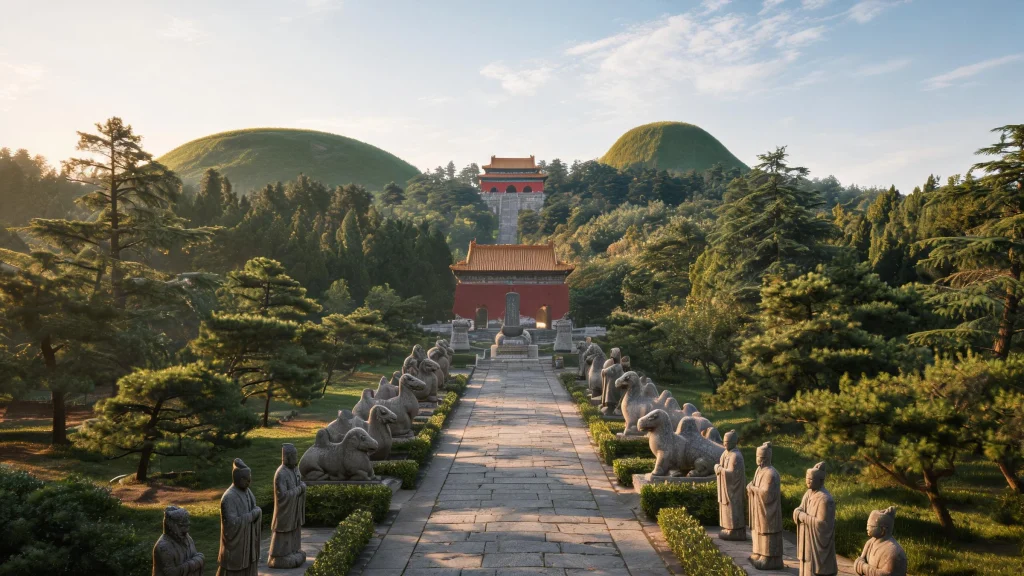
The deathbed edict is his own text, and it comes closer than anything else in the record to a first-hand account of Zhu Yuanzhang’s personality traits. "For thirty-one years I have held the mandate of Heaven, anxious and fearful, diligent without rest, intending only to benefit the people. Born of humble stock, without the broad knowledge of the ancients, I have loved good and hated evil, and fallen far short." What follows concerns his funeral. No gold or jade was to go among the offerings, and the hills and streams around the Xiaoling tomb were to be left as they were. Officials and people were to mourn for three days and then return to ordinary dress, and marriages were not to be obstructed. The princes were to remain in their principalities rather than come to the capital. The four characters he kept for himself were loved good and hated evil, and even then he added that he had fallen short of the ancients.
The appraisal attached to the Basic Annals says that Zhu Yuanzhang rose from common cloth and brought the seas under one rule, which had not happened since the Western Han. Because he was correcting the slackness of Yuan government, the appraisal adds, his rule was severe. The same passage credits him with putting down disorder and giving the empire a civil order, and with doing both himself.