Zhang Juzheng: How Ming Reform Ruined His Family After Death
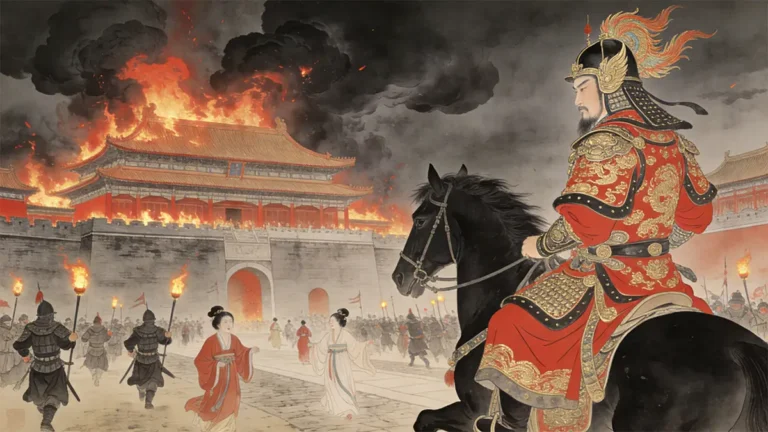
In the fourth month of 1584 a party of men surrounded Zhang Juzheng’s house in Jiangling, down the Yangzi in Huguang. The official in charge was a vice minister named Qiu Shun. With him came Zhang Cheng, a eunuch of the Directorate of Ceremonial, an officer of the Embroidered Uniform Guard, the imperial secret police, and a supervising secretary. Before they reached the gate, the prefect and the magistrate had already registered every person inside and sealed the doors. Some of the family had climbed over the wall into empty rooms. The rest were shut in. When the doors were opened again, a dozen of them had starved.
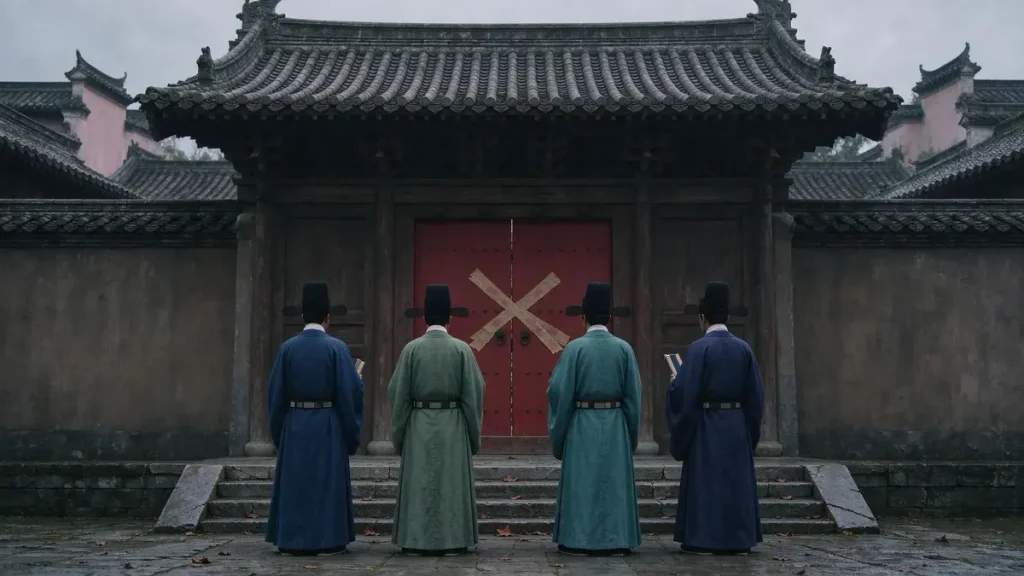
Zhang Juzheng had been dead two years.
He died on the twentieth day of the sixth month of 1582. The emperor closed the court and granted nine altars of sacrifice. He added the title Supreme Pillar of State and the posthumous name Wenzhong, and sent officials of the fourth rank, an officer of the Guard and a eunuch of the Directorate to bring the coffin home. No subject of the Ming got a better funeral.
Then the dates come quickly. In the twelfth month of 1582 Feng Bao, the eunuch who had run the Directorate of Ceremonial for a decade, was sent to Nanjing and his property was seized. In the third month of 1583 Zhang Juzheng’s ranks and titles were taken back. In the fourth month of 1584 the house in Jiangling was confiscated. In the eighth month the list of his crimes was posted across the empire and his survivors were sent to the frontier garrisons. One clause of that edict said he should have been disinterred and his corpse beheaded, and that the sentence was being waived.
The year Gu Lin gave away his rhino-horn belt
Zhang Juzheng was born in 1525. His father, Zhang Wenming, was a student in the prefectural school, which in the Ming meant a lifetime of examinations with no office at the end of it. At fifteen the son became a student himself. Gu Lin, then grand coordinator of Huguang, read a paper of his and said the boy was “a vessel for the state.” When he passed the provincial examination a little later, Gu Lin unfastened his own belt of rhinoceros horn and put it in his hands. “One day you will wear jade at the waist,” he said. “Rhino horn is too mean for you.”

A metropolitan degree was close to a prerequisite for the Grand Secretariat. He took the degree in 1547, at twenty-three, was chosen as a Hanlin bachelor and made a compiler. As a bachelor, the History of the Ming says, he “spent his days inquiring into the precedents of the state,” which was not how the comfortable ones spent the three years. For the next fifteen years he moved between the Hanlin Academy, the Directorate of Education and the household of the prince of Yu, in small offices at short distances. The prince of Yu became the Longqing emperor. While Zhang taught in that household, even its eunuchs “had nothing bad to say of him.”
The office he ended up running had no legal claim to the power he would hold. In the first month of 1380 Zhu Yuanzhang had his left grand chancellor Hu Weiyong killed and, five days later, abolished the Central Secretariat and the chancellorship. The Six Ministries answered to the emperor and to nobody else. The men later picked to sit in the Wenyuan Chamber and read memorials for the emperor were given the title grand secretary, fifth rank, three grades below a minister of the Six Ministries. The treatise on officials explains the name: they took their meals inside the palace and worked directly under the imperial halls, and the title was drawn up to avoid the name of chancellor. Rank was low. The work was not. Memorials came in at the Office of Transmission, went up to the emperor, and came back down to the Secretariat. There a grand secretary pasted his opinion to the front of the sheet on a slip of paper. That was piaoni, the draft rescript. If the emperor approved, a eunuch of the brush in the Directorate of Ceremonial copied the decision in red. That was pihong. Whatever the Secretariat drafted still needed a hand in the palace to pass it on.
Zhang Juzheng spent more than twenty years getting into that room. Under Yan Song he did not join the men who kept away from Xu Jie, and Yan Song thought well of him anyway. He and Gao Gong worked together at the Directorate of Education and promised each other they would end up running the government. In 1567 Zhang Juzheng entered the Grand Secretariat. The biography notes the speed of it: barely a year had passed since he held a fifth-rank Hanlin post.
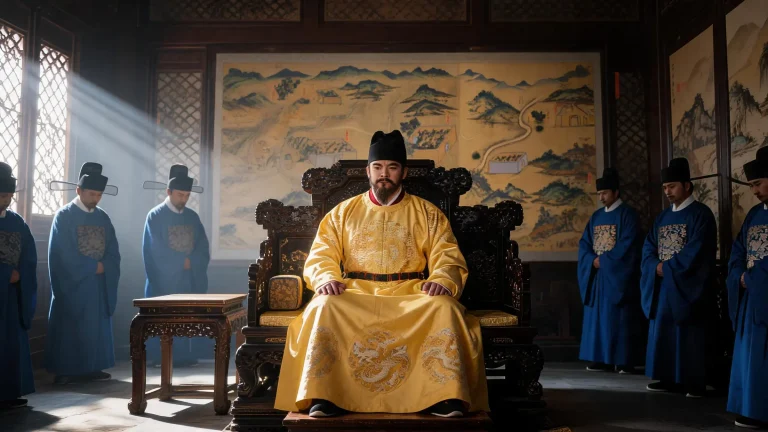
The turn came in 1572. The Longqing emperor died in the fifth month, and a ten-year-old boy, Zhu Yijun, took the throne. Gao Gong, now senior grand secretary, moved to take the red brush away from the Directorate of Ceremonial and bring it back inside the Secretariat. Feng Bao, who held the Directorate and the Eastern Depot, moved to keep his place. Gao Gong told Zhang Juzheng what he intended. Zhang Juzheng agreed, then told Feng Bao. In the sixth month an edict from the two dowager empresses and the boy emperor listed Gao Gong’s crimes and put him on the road out of Beijing. Zhang Juzheng took his seat.

Feng Bao has come down in the histories as a villain, and the chapter on eunuchs in the History of the Ming gives him two faces. He held the Directorate and the Eastern Depot, and “if a reward or a punishment did not come from Bao’s mouth, no one dared carry it out.” On the day the boy emperor took the throne, he “stood beside the throne and did not step down,” and the court was appalled. He also had a line he would not cross. When Zhang Juzheng sent lotus and a pair of white swallows into the palace as curiosities, Feng Bao sent word back: “The sovereign is young. Do not open his taste for strange things.” He kept his own family in order, and the capital gave him some credit for it. The power of the red brush had gathered inside the palace since the first Ming emperor, and it took both halves to make an edict: a draft from the Secretariat, a line of red from the palace. The history’s verdict on the partnership is blunt. Zhang Juzheng had ability, “and the reason he was trusted with the direction of the state was that Bao stood at his elbow.”
In 1573, three ledgers reached the Grand Secretariat
The government Zhang Juzheng took over moved slowly by design. Memorials that the ministries forwarded for a grand coordinator to investigate “sat unanswered,” in the words of the History of the Ming. The problem was not a handful of lazy officials. The paperwork had no exit at the far end, so cases stopped in the middle and nobody had to answer for them. In 1568 he had sent up a memorial on six matters, asking for fewer opinions, firmer discipline, faster execution of edicts, real verification of results, protection for the common people and better frontier defense. Nobody acted on it. By 1573 he had the seat.
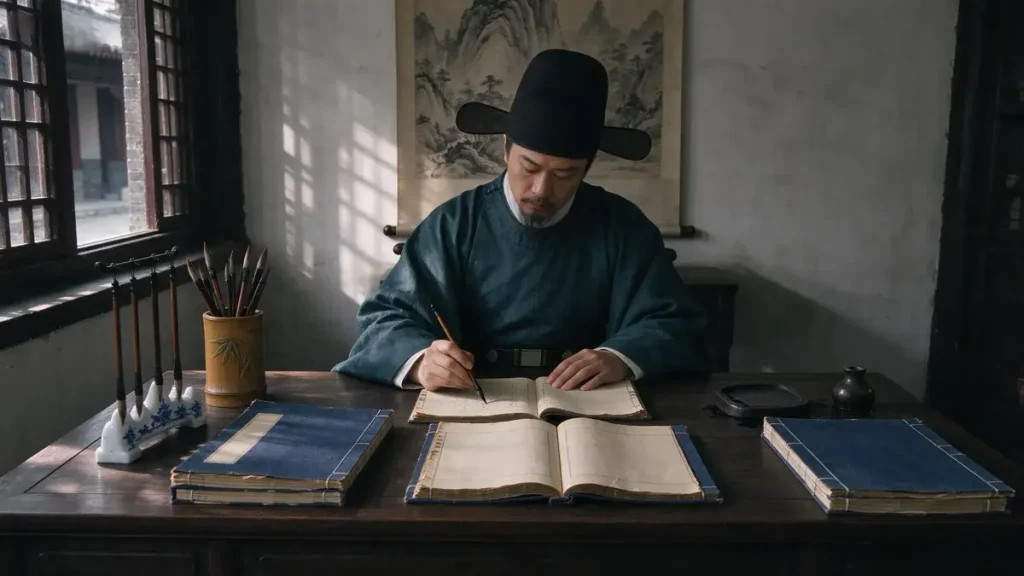
The performance review, kaocheng, worked like this. Every memorial got a deadline, set by the distance the answer had to travel and the urgency of the matter, and every deadline went into a ledger. The ledger was copied three times. One copy stayed with the office that owed the work, one went to the Six Offices of Scrutiny to be canceled when the work was done, and one went to the Grand Secretariat. The Secretariat checked monthly and totaled the year at the end of it. A missed deadline was a punishable offense. The pressure ran down the chain: if a grand coordinator dragged, his ministry answered for it; if the ministry dragged, the Six Offices answered; if the Six Offices dragged, the Secretariat answered.
“Deadlines were fixed by the size and urgency of the matter, and missing one was a crime,” the History of the Ming says. “From then on nobody dared cover up a failure, and the conduct of government turned severe.” The same passage adds that an order issued in the morning was carried out by evening, though the place lay ten thousand li away. Two figures in the same biography belong to the grain fleet and the horse markets rather than to the review: the Grand Granary held enough grain for ten years. The Court of the Imperial Stud had piled up more than four million taels.
One case shows how the deadlines reached the provinces. Mu Chaobi, duke of Qian, broke the law repeatedly in Yunnan. The court wanted him arrested and had spent years debating whether arresting him would set the southwest alight. Zhang Juzheng promoted the duke’s son, then sent a courier to tie the father up. Mu Chaobi did not move. Brought to Beijing, he was spared execution and shut away in Nanjing.
The cost was specific too. Yu Maoxue, a supervising secretary, asked for gentler government and was dismissed. Fu Yingzhen, a censor, said the same and was sent to prison, flogged and exiled. Liu Tai, a regional inspector in Liaodong, filed a false victory report; Zhang Juzheng applied the old rules, and Liu Tai answered with a memorial accusing him of arbitrary rule. He was flogged a hundred strokes, exiled, and died where he was sent. The post stations were cleaned up, and officials could no longer ride them free, “no different from merchants and travelers.” Quotas at the prefectural and county schools were cut, and in the large counties “the number of students was too small and advancement became hard.” The biography sums it up: “Many resented him for it.”
The single whip reform: dozens of levies folded into one payment
Ming taxation ran on two separate systems. Land tax came in summer and autumn installments, paid in grain or cloth or, when commuted, in paper money. Labor service was assessed on adult males and on household grade. It came in three kinds, the ward rotation, the equal service and miscellaneous corvée, some rendered in work and some paid in silver. Tribute sat on top of both. The registers that tracked people were the Yellow Registers, rebuilt every ten years. The registers that tracked land were the fish-scale maps, drawn field by field. By the middle of the dynasty both were rotten. Great households had their land “lodged” under the names of families holding an exemption, or “scattered” onto poor households, and a man who ran still left his tax behind him.
The single whip was not Zhang Juzheng’s invention. Districts in Jiangxi and South Zhili had been trying versions of it since the Jiajing reign, each one different, “tried several times and stopped several times,” as the treatise on fiscal administration puts it. What he did was take a method that had grown up in the provinces and drive it across the empire with the weight of the central government. In 1581, the ninth year of Wanli, it “was carried out in full.”
The treatise defines it this way. Under the single whip a county totaled its land tax and its labor service together and apportioned the total over acres and over adult males. The labor a county owed for the year was hired and paid for by the government. The rate came from the going wage for a laborer and from the fee a taxpayer would have paid to commute his own service. Everything else went into the same sum: the regular quota, the extra requisitions, the capital treasury’s annual needs, what the county kept, what it spent on hospitality, and the local products sent up as tribute. All of it became one item, assessed per acre and paid in silver. “The method was simple and easy to apply,” the compilers wrote.
For a small farmer the change meant no more weeks away from his fields on another man’s errand, and no more layer on layer of ward-level surcharges. He paid one sum in silver and was done. Arrears in a single county ran to hundreds of thousands of taels, the treatise says. And yet “once the whip method was in force there were no other exactions, and the people’s strength was not badly drained.”

None of it worked without knowing where the land was. The single whip put the charge on the acre, and the acreage on the books had fallen by half since the first Ming count. In 1578 the throne took Zhang Juzheng’s proposal and ordered a survey of all cultivated land within three years. The surveyors reduced each parcel to a rectangle and rounded off the irregular edges. The survey counted 7,013,976 qing, a qing being a hundred mu, some three million qing more than the Hongzhi registers had shown.
The other side of the survey sits in the same treatise. Zhang Juzheng, it says, prized exact accounting and treated excess acreage as a merit. Officials competed to shorten the measuring cord so the fields would come out larger, or squeezed land already under cultivation into the quota for newly opened acres. Four jurisdictions, North Zhili, Huguang, Datong and Xuanfu, raised their assessments on the strength of the surplus.
Folding the levies into the land did not touch who owned the land. Once the charge sat on the acre, a great household still had room to push its share onto someone with less pull. There was also the metal itself. The tax had to be paid in silver, and silver came from foreign trade and from domestic mines. How far the fall in imports after the 1620s contributed to the fiscal collapse is still argued over. The empire’s revenue now rested on a metal it did not produce. In 1630 Fan Jingwen, governor of Henan, put the case in one line: “The whip method is in force, and the great households have still not been touched.”
A ten-year-old emperor called him teacher
Zhang Juzheng’s authority stood on three things: the empress dowager’s backing, Feng Bao’s red brush, and the emperor’s age.
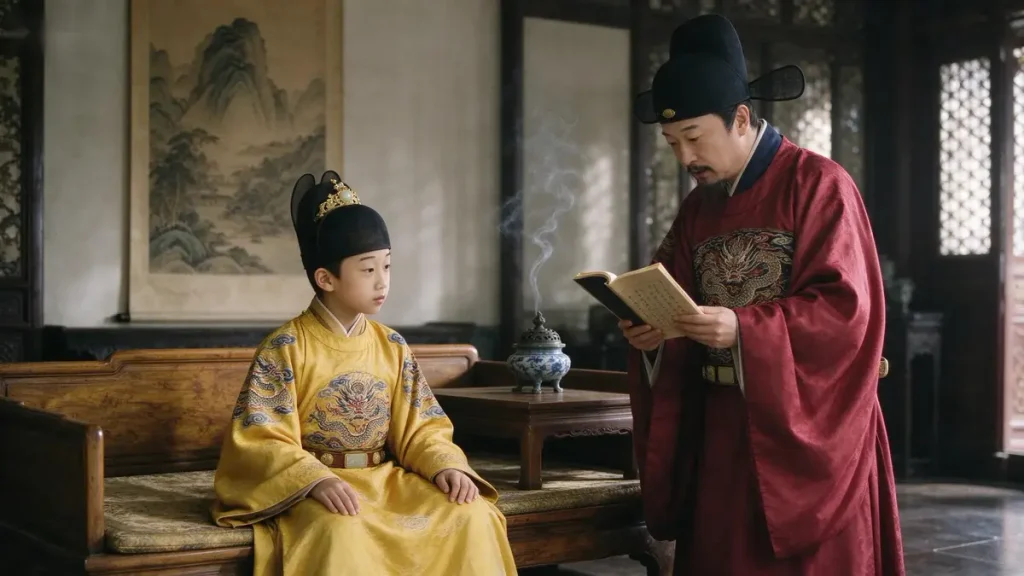
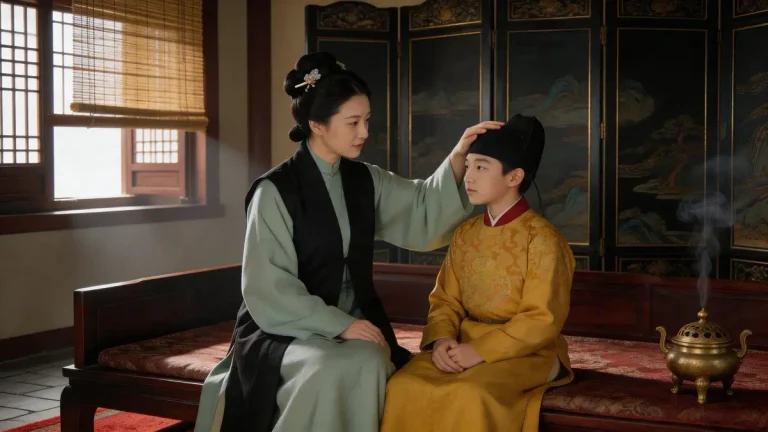
The education was built for an heir, not for a boy. He compiled an illustrated mirror of good and bad rulers, a hundred-odd cases from earlier dynasties. Each had a picture and a plain-language explanation that a ten-year-old could follow. He had the court scholars sort the founding emperor’s instructions into forty categories, from the hardship of the founding years to the restraint of amusements and the discipline of rewards. He managed the household too. When the silk workshops at Suzhou and Songjiang were to be kept running, he argued the emperor down in person and got the order cut by more than half. He stopped work on a hall. He blocked additions to the palace women and increases in their allowances.
The History of the Ming records that the empress dowager Li kept her son on a short rein, scolded him for every fault, and had one phrase she used: “What if Mr. Zhang hears of this?” The next sentence in the biography is the hinge of the reign. The emperor “stood in great fear of Zhang Juzheng. As he grew older, he came to loathe him.”
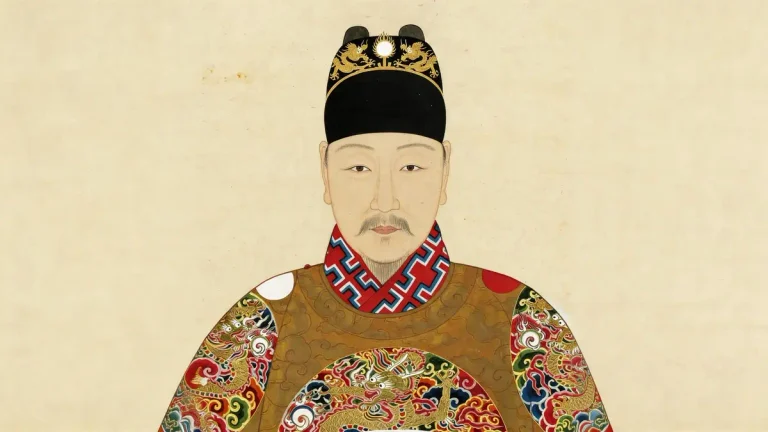
In the eleventh month of 1580 something happened that shows all three supports at once. The emperor, then eighteen, was drinking and playing at night in the Qianqing Palace with two of his personal eunuchs, Sun Hai and Ke Yong. They wore short jackets and narrow sleeves, and carried swords as they rode. Feng Bao reported it to the empress dowager. She summoned her son and dressed him down; he knelt on the floor and took it. Feng Bao then had Zhang Juzheng draft an edict in which the emperor condemned himself, and had it shown to the grand secretaries. The wording cut deep. The emperor read it and was ashamed, and because his mother required it, he issued it.
The year he refused to mourn
In the autumn of 1577 Zhang Wenming died in Jiangling. Under the rules, his son owed twenty-seven months of mourning leave before he could hold office again. Zhang Juzheng chose to be retained. The proposal came from Li Youzi, a vice minister of revenue, and Feng Bao insisted on it as well. Zhang Han, the minister of personnel, would not go along and was driven out.
The objection came from the men closest to him. Wang Xijue, Zhang Wei, Zhao Zhigao, Wu Zhongxing, Zhao Yongxian and Shen Maoxue, all Hanlin men, said it could not be done. Wu Zhongxing, Zhao Yongxian, Ai Mu, Shen Sixiao and Zou Yuanbiao sent up memorials against it and were flogged at court and exiled. That winter a comet rose in the southeast and stretched across the sky. “Feeling ran high, every finger pointed at Zhang Juzheng, and libels against him were hung on the main streets,” the History of the Ming says. The emperor ordered that anyone who raised the matter again would be executed, and the talk stopped.

The next year was the height of it. In the third month Zhang Juzheng went home to bury his father, and the emperor told the second grand secretary, Lü Diaoyang, and the rest: “On great matters do not decide alone. Send a courier to Jiangling and take Mr. Zhang’s instructions.” At Xiangyang the prince of Xiang came out of the city to meet him and gave a banquet. Custom required a duke or a marquis to address a prince as a subject; this meal was eaten as host and guest. At Nanyang the prince of Tang did the same.
The biography’s judgment on what the decision did to him is not gentle. “After the mourning affair Zhang Juzheng grew more willful. His dismissals and promotions followed his likes and dislikes, and the men around him took bribes.” The specifics are there as well. Three of his sons passed the metropolitan examination in succession, one at the top of the list and one second. A household steward named You Qi bought himself an office and exchanged visits and marriages with hereditary nobles. “For this the world hated him more.”
In the twelfth month of 1582, Feng Bao fell first
Zhang Juzheng died in the sixth month of 1582. He had been ill four months, while the whole bureaucracy set up Daoist altars and prayed for him, and the great officials of Nanjing, Shaanxi, Shanxi, Huguang and Henan did the same. The emperor sent routine business to Zhang Siwei and the others, and “great matters to his house for him to settle.” He was too tired to read a document through and would not let the second grand secretary touch it.
Feng Bao went down six months later. Zhang Jing and Zhang Cheng, eunuchs from the emperor’s old household, reported that Feng Bao and Zhang Juzheng had worked hand in glove. Feng Bao’s house, they said, held more than a subject should. Li Zhi, a censor, followed with a memorial. In the twelfth month Feng Bao was reduced to a minor posting, sent to Nanjing and stripped of everything: a million taels of gold and silver, and jewels to match. The emperor’s explanation to his mother was not statesmanlike. “The old slave was led astray by Zhang Juzheng.” He added that for years shameless officials had been selling the best of everything to the Zhang and Feng houses, and that prices had risen.
The History of the Ming puts it in one line: the emperor suspected Zhang Juzheng of hoarding, and he coveted it.
Then came the procedure. In the third month of 1583 the titles went. Yang Keli, a censor, revived an old charge that Zhang Juzheng had built the case that ruined Zhu Xianjie, the deposed prince of Liao. His consort sent up a memorial saying that “his gold and jewels, counted in the tens of thousands, all went to Zhang Juzheng.” In the fourth month of 1584 Qiu Shun and Zhang Cheng reached Jiangling. The prefect registered the household and sealed the doors, and when they were opened a dozen people had starved. The confiscation produced ten thousand taels of gold and a little over a hundred thousand of silver. The eldest son, Zhang Jingxiu, could not bear the interrogation, confessed to having lodged three hundred thousand taels with Zeng Shengwu, Wang Zhuan and others, and hanged himself. The throne left the family one empty house and ten qing of land to feed his mother. In the eighth month the crimes were posted and the survivors were sent to the frontier.
The numbers do not fit the charge. Feng Bao’s house yielded a million taels. Zhang Juzheng’s yielded a hundred and ten thousand. The three hundred thousand that Zhang Jingxiu confessed to was never found. The History of the Ming is explicit about the emperor’s motive, and greed is what it names. A household inventory cannot carry that suspicion, and it cannot carry the consort’s claim of tens of thousands in jewels. Both readings sit in the record, and no document gets at what the emperor was thinking in those months.
What made the purge thorough was the accumulation behind it. The review had pressed on every office in the bureaucracy. The survey had raised assessments in four regions. The school quotas had cut the number of degree holders the gentry could produce. Three sons in a row on the examination list handed the critics of the examiners a case. And the authority he had used for ten years rested on the fact that the emperor had been a child.
In 1618, with the war in Liaodong going badly, the surcharge for that front came to three million taels at a stroke. It settled into the budget at nine thousandths of a tael per mu, 5.2 million a year. That was thirty-six years after Zhang Juzheng died.
No one defended him for the rest of the Wanli reign. Under the Tianqi emperor the court began to cite him again, and his offices were restored with a funeral. In 1630 the two hereditary privileges and the patent came back. In 1640 his great-grandson Zhang Tongchang petitioned for the restoration of his grandfather’s rank. Li Rixuan, minister of rites, wrote the opinion: “The late grand secretary received the charge of the dying emperor and served the emperor’s ancestor for ten years, taking the labor and the resentment… His service was to the altars of the state. With time the judgment has settled, and men miss him more.” The emperor approved it.
Zhang Tongchang died in Guilin in the winter of 1650, executed with Qu Shisi.
Ray Huang’s 1587, A Year of No Significance came out from Yale in 1981 and took that year as its cross-section. Zhang Juzheng was five years dead. Shen Shixing held the Grand Secretariat, and Hai Rui and Qi Jiguang died within months of each other. The book is about the gap between fiscal practice, personnel rules, moral language and the work of administration. Most of that gap was already in place during the ten years Zhang ran the government.
Popular retellings prefer the tutor and the boy emperor. How the ledgers worked, and how the single whip turned a county’s obligations into one line of silver, get less room.
The verdict the Qing compilers wrote at the end of his biography runs: he understood the changes of the time and took hold of affairs without flinching. In the first years of Wanli he raised a state that had been sliding and shored up what had fallen, and he was by any measure a man of practical ability. The same verdict adds that his grip on authority came close to overawing the throne, and that disaster broke out after his death.
Sources and further reading
Primary sources
History of the Ming, juan 213, biography of Zhang Juzheng: the rhino-horn belt, the speed of his rise from a fifth-rank Hanlin post, the deadlines and the two verdicts on them, ten years of grain in the Grand Granary and four million taels at the Court of the Imperial Stud, the Mu Chaobi arrest, the mourning affair and the libels in the streets, the funeral instructions to Lü Diaoyang, the princes of Xiang and Tang, the three sons and the steward You Qi, the confiscation and its dead, Zhang Jingxiu’s confession, the sentence of disinterment, the restorations under Tianqi and Chongzhen, and the final verdict.
History of the Ming, juan 305, eunuchs II, biography of Feng Bao: the seizure of the Directorate and the Eastern Depot, the white lotus and the white swallows, the emperor’s “old slave” remark, the million taels, and the sentence that Zhang Juzheng governed with Bao at his elbow.
History of the Ming, juan 78, treatise on fiscal administration II: the definition of the single whip, the repeated trials and reversals before 1581, the remark that arrears in one county ran to hundreds of thousands of taels, the 1618 Liaodong surcharge and the 5.2 million taels it became, and Fan Jingwen’s memorial of 1630.
History of the Ming, juan 77, treatise on fiscal administration I: the 1578 order to survey all cultivated land within three years, the 7,013,976 qing counted, and the passage on shortened measuring cords and inflated quotas.
History of the Ming, juan 20, annals of Shenzong I: the dated entries for the death in the sixth month of 1582, the confiscation of Feng Bao in the twelfth month, the stripping of titles in the third month of 1583, the confiscation of the house in the fourth month of 1584, and the posting of the crimes in the eighth month.
History of the Ming, juan 72, treatise on officials I: the fifth rank of the grand secretaries, the note that the title avoided the name of chancellor, and the line that Xia Yan and Yan Song stood out as genuine chancellors.
History of the Ming, juan 74, treatise on officials III: the Directorate of Ceremonial’s duty to copy the imperial decision from the Secretariat’s draft, the clause rendered here as the eunuch of the brush.
Reference and further reading
Wikipedia, Zhang Juzheng: used to cross-check the sequence of offices and the 1572 date, not as an authority on the reforms.
Wikipedia, Single whip law: the standard English name of the reform and the variant dates given in secondary accounts, against the 1581 date in the treatise.
Wikipedia, Grand Secretariat: the English names for the offices and the rank structure, checked against juan 72.
Ray Huang, 1587, A Year of No Significance: The Ming Dynasty in Decline (Yale University Press, 1981): the cross-sectional view of the Wanli court and the argument about fiscal and moral administration that the last section of this article follows.
Encyclopaedia Britannica, China, economic policy and developments: the consolidated-assessment description of the single whip, useful as a check on the reform’s limits.
Liang Fangzhong, “Shi yi tiao bian fa” (An Explanation of the Single Whip Method), on the name and the regional precedents; cited at second hand and worth checking against the original before publication.