Zhu Jianshen (Emperor Xianzong): The Chenghua Reign
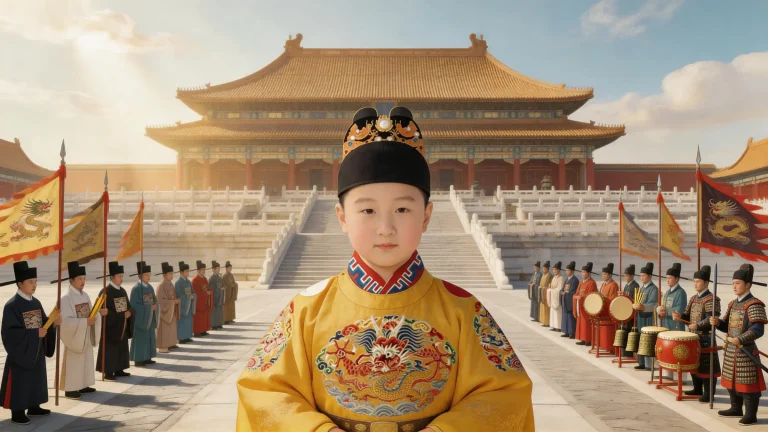
In the fifth month of 1452 the palace did five things in one morning. It stripped the crown prince of his title and made him Prince of Yi. It gave the succession to the reigning emperor’s son. It deposed the empress, raised the boy’s mother in her place, and declared an amnesty across the empire. The boy was four years old. Nobody told him how long he would be gone.
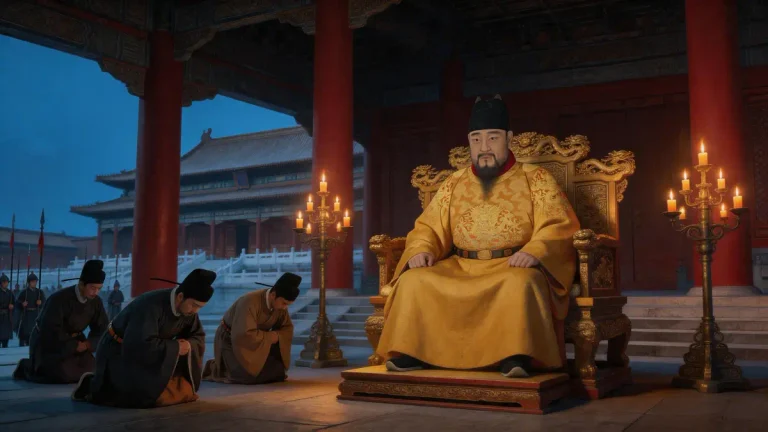
His father was in the Southern Palace. Three years earlier, in the eighth month of 1449, Emperor Yingzong had led the capital army out through Juyong Pass on a campaign against the Oirat Mongols. Six weeks later he was Esen’s prisoner. The Ming History says the dead numbered in the hundreds of thousands, a figure no one should trust, but the best troops of the capital really were lost there. Empress Dowager Sun ordered the emperor’s half-brother, the Prince of Cheng, to take charge of the government, and then named Yingzong’s eldest son crown prince. The child had been born in the eleventh month of 1447. He was not yet two. Making an infant crown prince had little to do with the infant. Esen held a hostage, and the court needed an answer. The emperor’s son is here. The throne is not empty.
A month later the Prince of Cheng took the throne as the Jingtai Emperor and demoted his brother to retired emperor. In the eighth month of 1450 Yingzong came back from the steppe and moved into the Southern Palace. Two brothers in one city, one on the dragon throne and one behind a locked door.
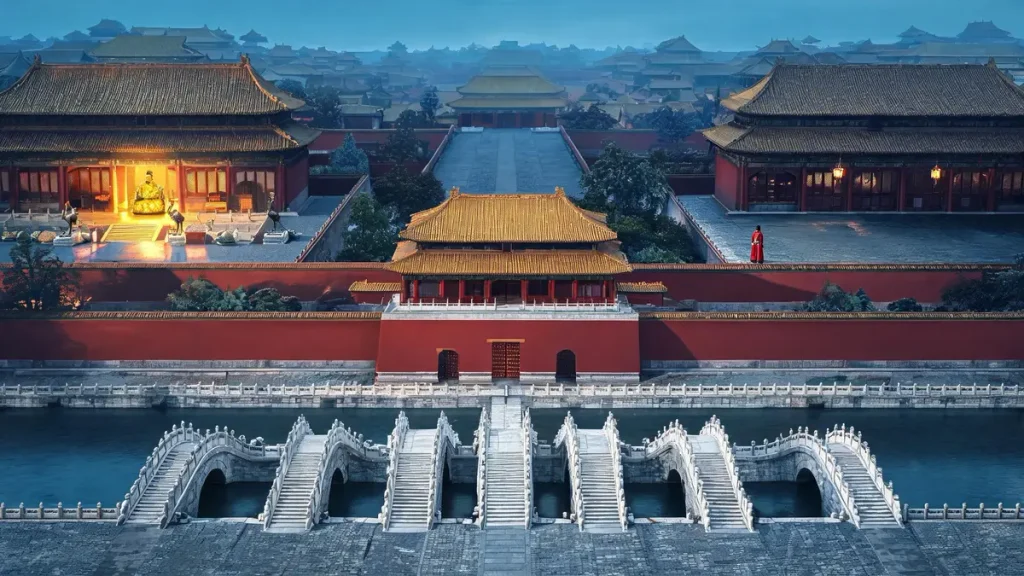
He had a son of his own. The five acts of that morning were for him. His empress, Wang, objected to the change of heir and was deposed the same day; the nephew became Prince of Yi; Zhu Jianji became crown prince. Jianji died a year and a half later, in the eleventh month of 1453. The Jingtai Emperor had no other son. Officials who petitioned to bring the Prince of Yi back were put in prison. He preferred an empty succession to that child’s return.
Those years the boy spent in the Prince of Yi’s residence. The Ming History records almost nothing about his daily life there, only that he later stuttered. A deposed prince growing up between an uncle’s suspicion and a father’s confinement: what those years left behind, the official record does not say.
In the first month of 1457 Shi Heng and Xu Youzhen broke open the wall of the Southern Palace and put Yingzong back on the throne. Two months later the boy was restored as crown prince and renamed. He had been Zhu Jianjun; from then on he was Zhu Jianshen. By then Yu Qian had been dead since the first month and his uncle since the second. The restoration came in the third.
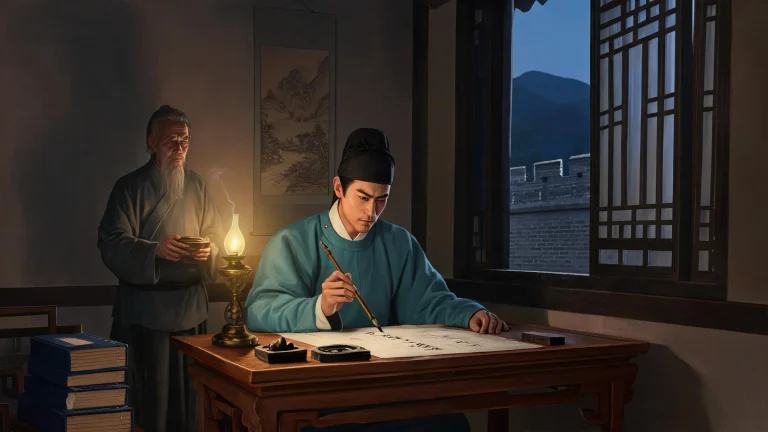
Yingzong died in the first month of 1464. His son took the throne at sixteen and changed the era name to Chenghua the following year.Zhu Jianshen was the eighth ruler in the sequence of Ming dynasty emperors, reigning from 1464 to 1487.
Consort Wan, seventeen years older than the Chenghua Emperor
Wan was from Zhucheng. She entered the palace at four, served Empress Dowager Sun, and was sent to the Eastern Palace when she was grown, to look after the child. The Ming History gives six characters for the arrangement: she served the emperor in the Eastern Palace. Whether she moved with him to the Prince of Yi’s residence after the deposition, the book does not say. Every later telling of the story sends her with him.
In the seventh month of 1464 the Chenghua Emperor was sixteen and she was thirty-five. He wanted to make her empress. Empress Dowager Zhou refused. A woman seventeen years older than the emperor, a former palace servant, was not going to be accepted by the court either. So Wu was chosen, daughter of the vice commissioner-in-chief Wu Jun, and installed that same month. A month later Wu was deposed.
The edict said she was frivolous in her conduct, careless in matters of ritual, unequal to her position. It also said the match had been settled on Lady Wang and that the eunuch Niu Yu had tampered with the selection in front of the empress dowager. Niu Yu was sent to grow vegetables at the Xiaoling tomb, and Wu Jun went to prison and then to the frontier. The edict never mentions Wan. The Ming History gives the reason. Once she was empress, Wu caught Wan in some fault and had her flogged. The emperor was furious.
In the tenth month Wang became empress and Wan became an imperial consort. Empress Wang stayed out of palace business from then on; the Ming History says she treated the whole situation as nothing.
Empress Dowager Zhou asked her son a question. What is so beautiful about her, that you favor her above everyone else? He answered that only when she stroked him did he feel settled, and that it had nothing to do with how she looked.
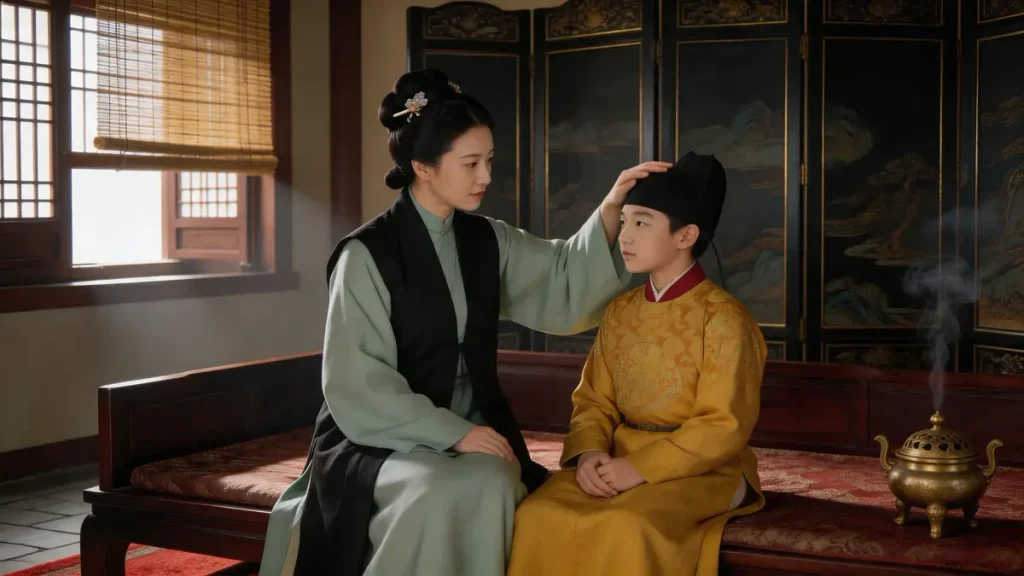
The line is not in the Ming History. It comes from the Zuiweilu of Zha Jizuo, written in the early Qing, more than a century after the fact. The same book says Wan was masculine in face and voice, like a man. Put the two together and the answer stops being about beauty.
The Ming History adds one detail of its own. When the emperor went out, Wan rode ahead of him in military dress. In the first month of 1466 she bore his first son. He was delighted, sent eunuchs to sacrifice at mountains and rivers across the country, and made her imperial consort. The child died before his first birthday. She never conceived again.
The six-year-old boy in the Western Inner Palace
The Hongzhi Emperor’s mother was named Ji. She came from He County in Guangxi, the daughter of a native chieftain. When government troops campaigned against the local peoples in the early 1460s she was taken and brought into the palace, where she was made a female scribe and, because she could read, put in charge of the inner treasury.
One day the emperor came to the treasury, asked her something, and liked the answer. He slept with her. She became pregnant. Consort Wan found out and sent a maid to deal with it. The maid came back and reported that it was not pregnancy but a growth in the belly. Ji was moved out to the Hall of Peaceful Joy.
In the seventh month of 1470 the child was born. Wan told the gate eunuch Zhang Min to take the baby and drown it. Zhang Min said: the emperor has no son. How can we throw this one away. He hid the infant in another room and fed him rice paste and honey. Wan’s people searched every day and found nothing. The boy reached five or six and his hair had never been cut. The deposed Empress Wu lived in the Western Inner Palace, close to the hall. She knew about him and came over to feed him. The emperor knew nothing.
In the summer of 1475 he called Zhang Min to comb his hair, looked in the mirror, and sighed that he was getting old with no son. Zhang Min knelt and said he deserved death, and that the emperor already had a son. The emperor stared at him and asked where. Zhang Min said that if he told, he would die, and that the emperor must protect the boy. Huai En, the eunuch at the head of the Directorate of Ceremonial, knocked his forehead on the floor. He said Zhang Min was telling the truth: the prince had been raised in the Western Inner Palace for six years and nobody had dared report it.
That day the emperor went to the Western Inner Palace and sent for the child. When the messenger arrived, Ji held her son and wept. She said: if you go, I will not live. When you see the man in the yellow robe with a beard, that is your father.
The boy came in a small red robe on a small palanquin. His hair dragged on the ground. He ran and threw himself into the emperor’s lap. The emperor set him on his knee and looked at him for a long time, and wept, and said: this is my son. He looks like me.
The next day the officials came to congratulate him and an edict went out to the empire. Ji was moved to the Palace of Eternal Longevity and called for a few times. Consort Wan wept day and night, saying that the little wretches had lied to her. In the sixth month of that year Ji died suddenly. Some said Wan had her killed. Some said she hanged herself. The Ming History sets the two accounts side by side and does not choose between them. Zhang Min was frightened, and swallowed gold.
In the eleventh month Zhu Youtang was made crown prince. Empress Dowager Zhou asked for the boy and told the emperor to give him to her. One day Consort Wan invited the crown prince to eat. The empress dowager told him to go but to eat nothing. He arrived and was offered food; he said he was already full. She offered soup; he said he was afraid it was poisoned. Wan flew into a rage and said that a child this small already did such things, and what would he do to her when he grew up. She made herself ill with fury. Before this, Consort Bai had borne a son, Zhu Youji, made crown prince in the eleventh month of 1471 and dead the following first month. He was given the posthumous name Crown Prince Daogong. The Ming History counts that death against Wan as well.
In 1485 the circle around the eunuch Liang Fang, afraid that the crown prince would settle accounts once he came of age, got Wan to press for a change of heir in favor of the Prince of Xing. Then Mount Tai began to shake. The diviners said the omen pointed at the Eastern Palace. The emperor was afraid, and the matter dropped.
In 1477 Beijing gained a new office
In 1476 something the sources call a black spectral presence appeared in the palace. A man named Li Zilong used Taoist talismans to get himself smuggled into the inner palace by the eunuch Wei She, was caught, and was executed. The Chenghua Emperor was disturbed. He wanted very much to know what was happening outside his walls.
Wang Zhi was a Yao from the Dateng Gorge in Guangxi, taken in a campaign, castrated, and sent into the palace. He had started at Zhaode Palace serving Consort Wan and had risen to the Directorate of the Imperial Horses. The Ming History calls him quick and clever. The emperor had him put on ordinary clothes and take one or two guards out into the city to listen. Nobody knew.
In the first month of 1477 the Western Depot opened with Wang Zhi in charge and its officers and runners assigned to gather intelligence. Its first good case was the eunuch supervisor at Nanjing, Qin Lipeng, who came to court with a hundred boats of contraband salt behind his tribute. When a county sheriff questioned him, Qin had the man’s teeth knocked out and shot another man dead. Wang Zhi investigated, reported it, and Qin was arrested and sentenced to death, though he was later spared. The Chenghua Emperor concluded that Wang Zhi could root out wrongdoing.
Wang Zhi made Wei Ying, a hundred-man commander in the Embroidered Uniform Guard, his confidant, and began a run of large cases. Yang Ye, commander of the Jianning guard and great-grandson of the grand preceptor Yang Rong, was accused by an enemy, fled to the capital, and hid with his brother-in-law Dong Yu. Dong Yu asked Wei Ying to intercede. Wei Ying agreed, then went straight to Wang Zhi. Wang Zhi had both men arrested and questioned under the sanpa, a torture that pulled the joints apart an inch at a time until the prisoner passed out and was revived. Yang Ye broke and said he had left gold with his uncle, a secretary in the Ministry of War. Wang Zhi arrested the uncle without asking the emperor and had his wife and children beaten with him. At the end of it Yang Ye was dead in prison, his father was sentenced to death, and the uncle and several others were demoted. Two bureau directors, a messenger of the court, and a provincial assistant commissioner were all taken for no reason at all.
The Ming History says that in those years runners were everywhere, from princely establishments and frontier garrisons to the canal, and that a quarrel between neighbors or a stolen chicken could be prosecuted as a serious crime. In the fifth month Grand Secretary Shang Lu, with Wan An, Liu Xu and Liu Ji, sent up a memorial listing Wang Zhi’s crimes one by one. The Chenghua Emperor was furious. He sent the eunuchs Huai En, Qin Ji and Huang Gao to the Grand Secretariat with a black face to ask whose idea the memorial had been.
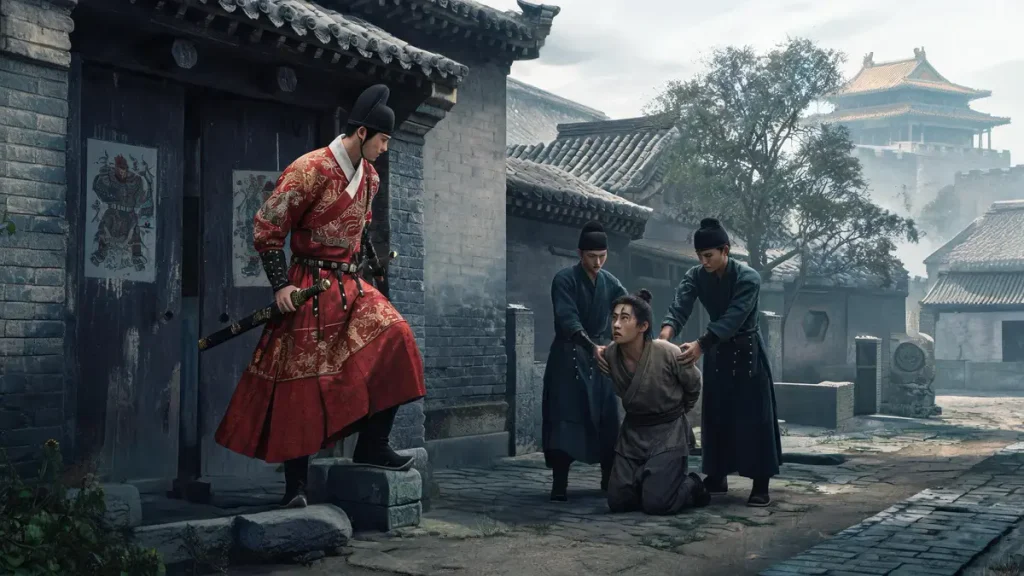
Shang Lu went through the offenses item by item and said that his colleagues were of one mind, that they were removing a danger to the state, and that there was no first or last among them. Liu Xu wept. Huai En reported it as it stood, and the emperor sent word of his concern. The next day the minister of war, Xiang Zhong, and others submitted a memorial of their own. The emperor could not refuse. He abolished the Western Depot, had Huai En read Wang Zhi a list of his crimes, pardoned him, and sent him back to the Directorate of the Imperial Horses. The city was delighted.
In the sixth month the Western Depot reopened. The censor Dai Jin, nine years in the same rank without promotion, had guessed the emperor’s mind and sent up a memorial praising Wang Zhi’s achievements. The depot reopened with a thousand-man commander, Wu Shou, as its judge. Xiang Zhong was impeached by the Eastern Depot and reduced to commoner status. The left censor-in-chief Li Bin was dismissed. Shang Lu retired. Within a short time dozens of senior officials, two ministers and two vice ministers among them, were pushed out.
In 1479 Wang Zhi toured the frontier with flying cavalry that covered hundreds of li a day. Censors and secretaries met him on the road and bowed. Prefects and magistrates were flogged. At Liaodong the grand coordinator Chen Yue came out of the city and crawled, with provisions laid on for a hundred li. Ma Wensheng, vice minister of war, was in Liaodong at the time, did not bow, and had made light of Chen Yue; he was framed and sent into exile. Fifty-six officials who protested were flogged at the palace gate.
There was a young eunuch at court called Achou who did comic turns. One day he played a drunk cursing in the street. Someone said the emperor was coming, and he cursed on. Someone said Director Wang was coming, and he ran, saying that these days people only knew Director Wang. Then he dressed as Wang Zhi and walked up to the emperor holding two battle-axes. Asked what they were for, he said he commanded troops and these two axes were all he needed. Which axes, he was asked. Wang Yue and Chen Yue.
The emperor laughed, and began to understand. Later the Eastern Depot’s eunuch Shang Ming caught some thieves and was richly rewarded. Wang Zhi resented it and complained that Shang Ming had not reported to him first. Shang Ming, frightened, quietly collected evidence that Wang Zhi had been repeating things said inside the palace, and submitted it together with Wang Yue’s illegal dealings. Only then did the emperor begin to distance himself.
In the third month of 1482 the Western Depot was abolished and never restored. In the sixth month of 1483 Wang Zhi was transferred to the Nanjing Directorate of the Imperial Horses. In the eighth month he was reduced to a menial, and his associates, Wang Yue, Dai Jin and Wu Shou among them, were demoted. Wang Zhi died in his bed.
Long Live the Grand Secretary
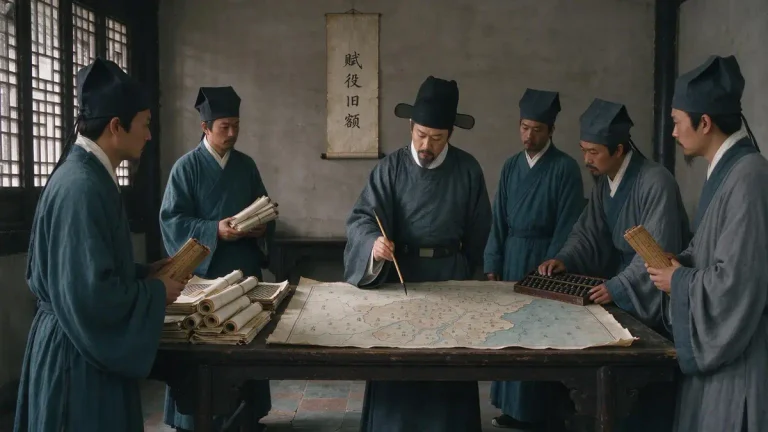
In the winter of 1471 a comet appeared in the asterism Tiantian and crossed Taiwei. Officials said the sovereign and his ministers had grown too distant and that the emperor should meet his grand secretaries regularly. Peng Shi and Shang Lu pressed the point. The eunuchs of the Directorate of Ceremonial fixed a day and told them that it was a first meeting, that feelings were not yet warm, that they should not say much and should wait for another time.
On the way in, they were told again. Peng Shi said the omens were frightening. The emperor said he knew, and that they should all do their best. Peng Shi said that a censor had asked the day before to cut the salaries of capital officials, that the military men would resent it, and that it would be better to leave things as they were. The emperor agreed.
Wan An then knelt, knocked his head on the floor, and shouted long live the emperor. Peng Shi and Shang Lu had no choice but to knock their heads and withdraw. The eunuchs teased the officials afterward. You complain that he never receives you. Now you have been received, and all you know how to do is shout long live. It became a joke, and Wan An was nicknamed the Long Live Grand Secretary.
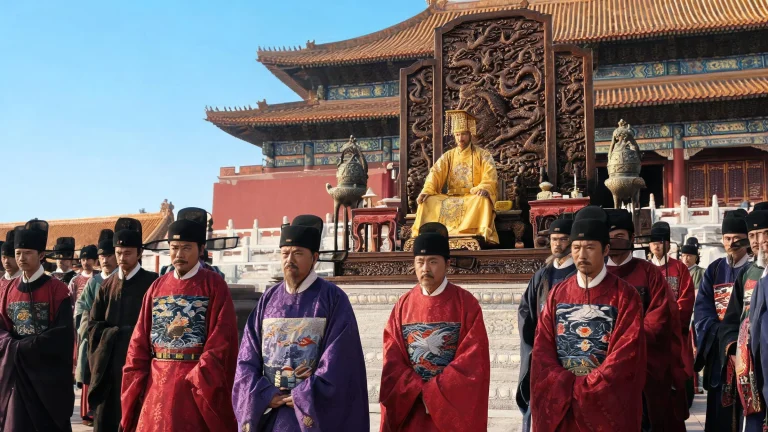
The Ming History adds a sentence of its own. From then on the emperor never received his great ministers in audience again. Later, when Yin Zhi joined the Grand Secretariat and wanted to see the emperor about business, Wan An stopped him. He said that when Peng Shi asked for an audience, one remark went wrong and they all knocked their heads and shouted long live, and they had been a joke ever since. These days, he said, we write everything out, the eunuchs pick what to pass on, and there is nothing he does not approve. It is better than talking to him face to face. That remark explains how the Chenghua court actually worked. Memorials came in, the Grand Secretariat drafted the reply, the Directorate of Ceremonial wrote the emperor’s endorsement in red, and the emperor read in between. He never had to appear.
There was a more direct reason the Chenghua Emperor did not appear. Lu Rong, an official of his own generation, wrote in the Shuyuan Zaji that at every audience, when the ministries reported business and something was to be approved, the emperor answered with one word: yes.
By 1480 the Chenghua Emperor could not manage even that. The record says his tongue was rough. Shi Chun, the chief minister of the Court of State Ceremonial, worked out the difficulty and suggested to the attendants that the word was hard to say and could be changed to two words: as usual. The emperor tried it, found it easier, was pleased, and asked who had thought of it. Shi Chun became vice minister of rites, then minister, then junior guardian of the heir apparent. Someone made a couplet about it: two words got him a ministry, so what use are ten thousand words.
Shen Defu’s Wanli Yehuo Bian is more direct. The Chenghua Emperor’s voice had a slight stammer, but when he proclaimed edicts from the throne he read like a string of pearls. Words prepared in advance came out clean. Answers improvised on the spot did not. Zha Jizuo records that when Empress Wang went to see him, the eunuchs stopped her at the door with the explanation that the emperor could not bear strangers and that she should not come often. She was not offended.
He did not see people. The business still had to be done. In the second month of 1464, his second month on the throne, the Ming History records it in six characters: for the first time, office was granted by inner note. No Ministry of Personnel, no evaluation. The emperor wrote a slip and somebody had a job. They came to be called chuanfeng officials, appointed by rescript. By the end of the reign Liang Fang had put through several thousand of them, and the Ming History says a commoner in white robes could end up at the head of the Court of Imperial Sacrifices. In the second month of 1485, 560 of them were dismissed in a single order. The Grand Secretariat was Wan An, Liu Xu and Liu Ji. A saying went around the capital: three grand secretaries pasted from paper, six ministers moulded from clay.
Wan An was from Meizhou, tall, with strong features, generous on the surface and deep underneath. He had worked the Consort Wan connection, sending a eunuch to pay his respects and describing himself as a junior member of her family. Wan, who had always been ashamed of her lack of pedigree, was delighted, and had her brother, the guard commander Wan Tong, visit the Wan household. Wan An spent twenty years in the government, and at every examination he had his own students appointed as examiners; his sons, grandsons, nephews and sons-in-law mostly passed.
In 1484 Lin Jun, a vice director in the Ministry of Justice, memorialized against Liang Fang and the monk Jixiao, and was imprisoned. The emperor wanted him dead. Huai En fought it. The emperor lost his temper and threw an inkstone at him, saying that Huai En was helping the man insult him. Huai En took off his cap and wept on the floor. The emperor shouted him out. Huai En went home and stayed in bed, and the case stalled, and Lin Jun lived. Later, after a comet, the rescript officials were dismissed. The eunuch Wang Min asked to keep the ones attached to the imperial stables, and the emperor agreed. Wang Min went to see Huai En, who cursed him: the comet is because of people like us ruining the government. We were about to put it right, and you have broken it again. Heaven should strike you. Wang Min was so ashamed that he died soon after.
One day the Chenghua Emperor looked into the inner treasury and found that the seven vaults of gold accumulated by earlier reigns were empty. He told Liang Fang and Wei Xing that it was the two of them who had drained it. Liang Fang said the Palace of Manifest Response and the other shrines had been built to pray for the emperor’s ten thousand years. The emperor was displeased and said that he would not touch them, but that the men who came after him would settle accounts.
In the eighth month of 1466 he offered a sacrifice to Yu Qian and restored the office of Yu Qian’s son Yu Mian. In the twelfth month of 1475 he restored the Jingtai Emperor’s imperial title, in an edict that said: my uncle the Prince of Cheng ascended the throne, quelled a crisis, preserved the state, and secured the ancestral altars.
The migrants of the Jing-Xiang highlands had been in revolt for years. In 1471 they were pacified, and more than 1.4 million of them returned to their land. In the twelfth month of 1476 Yunyang Prefecture was created, with a regional military commission and guard stations, and the migrants were entered in the registers. In the Ordos, Wang Yue raided the Hongyanchi camp in 1473 and the Mongol groups gradually withdrew from the loop; in 1474 Yu Zijun built a wall from Zicheng Fort to Huamachi. The remissions of grain tax fill the annals, several entries in almost every year.
The Ming History, summing up the reign, used eight characters: the rule of Ren and Xuan was seen again.
The purple Jingdezhen could not reproduce
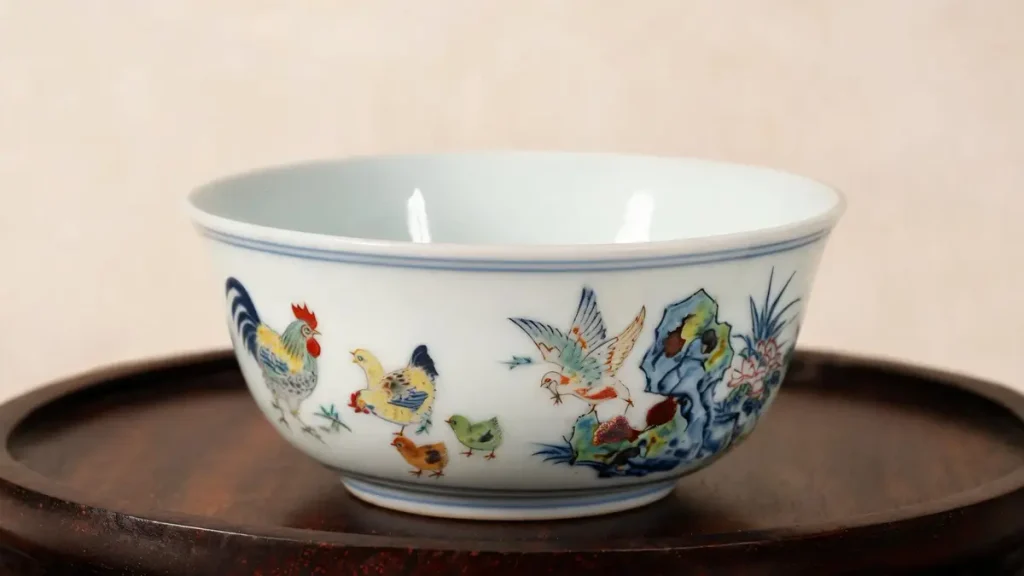
On April 8, 2014, at Sotheby’s in Hong Kong, a Chenghua doucai chicken cup 8.2 centimeters across sold for 281.24 million Hong Kong dollars, about 36 million US dollars. The buyer was Liu Yiqian of Shanghai, and the cup went to the Long Museum. He later drank tea out of it there. The photograph went around and people had opinions.
Fewer than twenty of these cups survive. Four are in private hands. The rest are in the National Palace Museum in Taipei, the British Museum, and collections like them. The cups were made at the imperial kilns at Jingdezhen during the Chenghua reign, and the kilns did not count cost. A batch of the same design was fired, then sorted piece by piece. Anything with the smallest flaw was smashed and buried on the spot. The best went to the palace. Excavations at the kiln site since the 1980s have turned up great quantities of shattered Chenghua shards, and half-finished pieces that had been painted in underglaze blue and never filled with color.
Doucai stacks two firings on top of each other. The potter paints the outline in cobalt on the unfired body, glazes it, and fires it above 1,200 degrees to make underglaze blue. Out of the kiln, the spaces inside the outlines are filled with red, yellow, green and purple, and the piece goes back into a kiln at about 800 degrees. If there is to be red, the iron-red enamel goes on last and is fired by itself. Every trip through a kiln costs another share of the batch.
Chenghua doucai has a purple the potters called chazi, the color of raw iron, bright and dry, which no later kiln could reproduce. Kangxi, Yongzheng and Qianlong all had the chicken cup copied. The best of the copies are off by that one color.
The painting is two groups of hens and chicks, separated by orchids and peonies. In one, a rooster stands in front with his head up, a hen pecks at the ground behind him, and chicks crowd around. In the other, a hen spreads her wings as if she were fighting something, and the chicks watch. The cup is under four centimeters high, with a slightly flared rim, and the body is thin enough to pass light.
The imperial ware of the Yongle and Xuande reigns was a different manner altogether: large blue-and-white jars and dishes, scrolling lotus and dragons in waves, objects made to fill a hall. Chenghua went the other way, smaller and finer, which is why collectors say the Chenghua reign made no large vessels. The same kilns, two generations apart, produced things that do not resemble each other.
Zhu Yan’s eighteenth-century treatise on ceramics, the Tao Shuo, quotes the Veritable Records of Shenzong: at the Wanli court, a pair of Chenghua chicken cups on the emperor’s table was worth a hundred thousand cash. That was less than a century after Chenghua.
The painting is a hen with her chicks, feeding. He was not yet two when his father was taken at Tumu, four when he left the Eastern Palace, nine when he came back. Whether there is any connection between those facts and this cup is a question the sources do not answer.
The first month of 1487
In the first month of 1487 Consort Wan died suddenly. The Chenghua Emperor suspended court for seven days, gave her the posthumous title of imperial noble consort, and buried her in the Tianshou Mountains. The Ming History does not record anything he said.
In the eighth month the Chenghua Emperor fell ill. The crown prince took over business in the Wenhua Hall, and a few days later the emperor died, in his forty-first year. He was buried at Mao in the ninth month. He had reigned twenty-three years.
The Ming History’s verdict begins with what he did well. He restored the Jingtai Emperor’s title, redressed Yu Qian’s wrong, held back Li Chun and recalled Shang Lu, and had the breadth of a real sovereign. It ends with the Western Depot. A ruler this decisive, the historians wrote, was still blinded by the people around him and took a long time to see it, and the harm done by women and eunuchs is a fearful thing.
When the Hongzhi Emperor came to the throne, the censor Cao Lin asked that Consort Wan’s posthumous title be stripped. A county official named Xu Xu asked that the doctors who had attended Consort Ji be arrested, and the Wan family questioned about how she died. The new emperor declined, on the ground that it would go against his father’s wishes. In the vault at Mao lie Wang, Ji and Shao, three empresses. Consort Wan is buried on Su Hill, outside it.
The place is still called Wanniangfen, the grave of Mother Wan.
Questions readers ask
Sources and further reading
The Ming History (Mingshi), annals of the Chenghua Emperor, juan 13 and 14: https://zh.wikisource.org/wiki/明史/卷13
The Ming History, biographies of the empresses, juan 113, including Consort Wan and Consort Ji: https://zh.wikisource.org/wiki/明史/卷113
The Ming History, biographies of the eunuchs, juan 304, for Wang Zhi and Huai En: https://zh.wikisource.org/wiki/明史/卷304
The Ming History, biography of Wan An and the grand secretaries of the reign, juan 168: https://zh.wikisource.org/wiki/明史/卷168
Sotheby’s Hong Kong, the April 2014 sale of the Meiyintang chicken cup: https://www.sothebys.com/
The Palace Museum, Beijing, on Chenghua doucai and the imperial kiln site at Jingdezhen: https://www.dpm.org.cn/