Zhu Youtang (Hongzhi Emperor): The Life of Ming Xiaozong
In the Wanli reign Shen Defu counted the consorts at the Ming tombs in the Tianshou Hills. Changling had sixteen, Xianling seven, Jingling eight, Yuling eighteen, Maoling fourteen, Kangling two, Yongling thirty consorts and twenty-six concubines. The Hongzhi Emperor’s tomb he covered in four characters: twin peaks of the precious mountain. At the sacrifices, no consort stood beside him.
Tai is where Zhu Youtang lies, with Empress Zhang and nobody else.
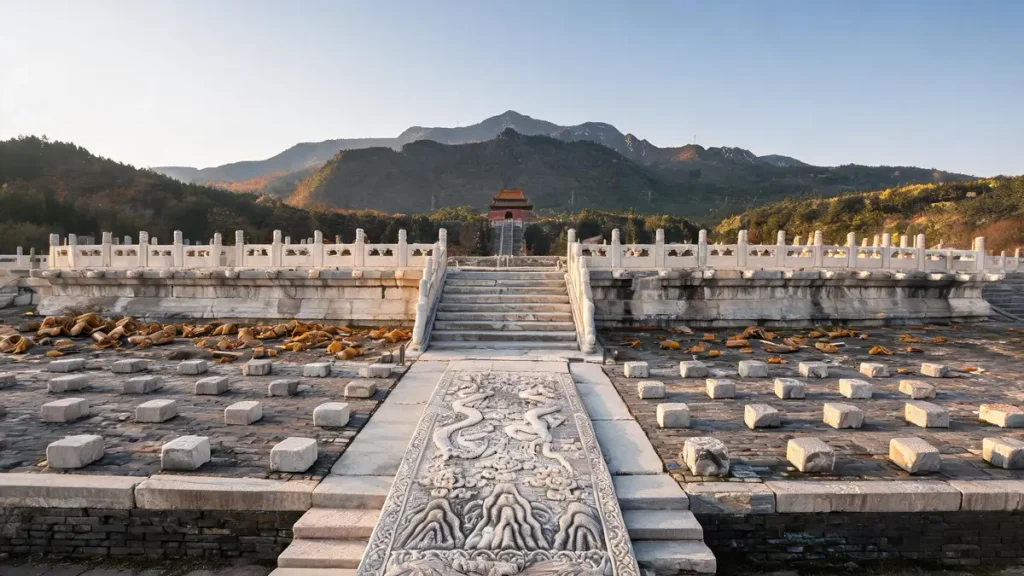
Shen Defu was writing about a hundred years after the fact, and his verdict on the arrangement was that the like of it had never existed. Sixteen Ming emperors, and every one of them trails a list of names through the biographies of the empresses. This reign is the exception. For the full succession and reign dates, see our guide to all 16 Ming dynasty emperors in order. The editors of the Ming History state their own rule: any woman who held the proper title gets an entry, and consorts with anything recorded about them are appended. Under Hongzhi there is one proper title, Empress Zhang, and nothing appended at all.
Power was not the reason. The Hongzhi reign was one of the calm stretches of the middle Ming. The Grand Secretariat functioned, the Six Ministries did their work, no eunuch held the government, and no minister at court could overrule the throne. Whatever he wanted, he could almost certainly have taken. He did not take a harem.
The story begins in the Western Palace in 1470.
Until he was six, nobody dared cut his hair
Zhu Youtang was born there in the seventh month of 1470. His father was the Chenghua Emperor, Zhu Jianshen. His mother was named Ji, from He County in Guangxi, the daughter of a native chieftain. When government troops campaigned against the local peoples in the Chenghua years she was taken and brought into the palace as a scribe. She could read, so they put her in charge of the inner treasury. The Ming History says Consort Wan in those years was "favored alone and jealous, and every pregnancy in the palace was dosed until it ended". Consort Bai bore a son, the crown prince known posthumously as Daogong, and he did not survive either.
When Ji conceived, Wan sent a maid to deal with it. The maid came back and reported that it was not a pregnancy but a hard lump in the belly. Ji was sent down to the Hall of Peaceful Joy, and there the child was born. Wan told the gate eunuch Zhang Min to take him away and drown him.
Zhang Min said one sentence: "The emperor has no son. How can we throw this one away?"
He hid the infant in another room and fed him on powdered rice and honey. Wan sent people to search every day and they found nothing. The boy got to five or six without anyone daring to cut his hair. The deposed Empress Wu was living in the Western Inner Palace, close to the Hall of Peaceful Joy. She knew what was going on and came over to feed him. The Ming History adds one short clause of its own: the emperor did not know.
Later tellings have him raised on scraps from a hundred kitchens. The official record leaves two names, a gate eunuch and a deposed empress.
The biography of Consort Wan has one more line. At birth the top of the child’s head, an inch across, had no hair, and some said a drug had done it. The line sits in her biography, not his mother’s, and the man who wrote it does not decide.
In the summer of 1475 the emperor had Zhang Min comb his hair. Looking into the mirror he said: I am getting old and I have no son.
Zhang Min knelt on the floor. I deserve death, he said. Your Majesty has a son.
The emperor stared at him and asked where. Zhang Min said: when I say it I die, and Your Majesty must stand behind the boy. Huai En, of the Directorate of Ceremonial, knocked his head on the floor and confirmed it. The prince was being kept in the Western Inner Palace, he was six, and nobody had dared report it.
That day the emperor went to the Western Inner Palace himself and sent for the boy. When the messenger arrived, Ji held her son and wept. Go, she said, and I will not live. When you see the man in the yellow robe with a beard, that is your father. The child was dressed in a small red robe and carried over in a small sedan chair. His hair dragged on the ground. He ran and threw himself into the emperor’s lap. The emperor set him on his knee and looked at him for a long time, and wept with joy and grief. This is my son, he said. He looks like me.
Next day the ministers came to congratulate him and the news went out in an edict to the empire. Ji was moved to the Palace of Eternal Longevity and called for a few times. Wan wept day and night and said these little men have cheated me. In the sixth month of that year Ji died suddenly. Some said Wan had her killed, some said she hanged herself. The Ming History sets the two accounts side by side and does not choose. Zhang Min was frightened and swallowed gold.
In the eleventh month the boy was made crown prince. The annals record one small thing from that year: the emperor ordered the Ministry of Rites to give him a name. He was six, and only then did he have one. Empress Dowager Zhou took him to Renshou Palace and told the emperor: give the boy to me.
One day Wan invited the crown prince to eat. Zhou told him to go and eat nothing. He arrived, Wan offered food, and he said he was already full. She offered soup, and he said he was afraid it was poisoned. Wan was furious. A child of a few years, she said, and already like this. In a few years he will eat me alive. The anger made her ill.
After he took the throne, the Hongzhi Emperor gave his mother the posthumous title Empress Xiaomu and sent the eunuch Cai Yong to find her family. Cai found two brothers, Ji Fugui and Ji Zuwang, and they were given Guard posts, houses, gold, silk, estates and servants. Later it came out that the two were surnamed Li and had invented the connection, and they were sent into exile on the coast. He kept looking, and never found anyone.
In 1490 the Minister of Rites, Geng Yu, memorialized. Guangxi had been through fire, famine and flight after the great campaigns, the years were long and the trail cold. He asked that the parents be granted posthumous titles, and that a shrine be built at Guilin, following the precedent set for Empress Ma. The answer he gave contained one line: he had thought the family might still be traced somehow, and he "would rather be cheated a hundred times than find the one that was true".
Yin Zhi, a grand secretary, wrote the dirge for her: the gate of the Han emperor’s mother, the grief of Renzong of Song. Both allusions are to emperors and their mothers. The emperor used to recite the lines to himself, and wept.
In the second month of 1488, someone proposed consorts for the Hongzhi Emperor
The Chenghua Emperor died in the eighth month of 1487. His son, the Hongzhi Emperor, took the throne in the ninth month at seventeen, and in the tenth he made Zhang empress. She was from Xingji, and her father Zhang Luan had entered the National Academy as a tribute student. She had been chosen as crown princess earlier that same year. In the second month of 1488 Guo Yong, a left vice-director of the Directorate of the Imperial Horses, proposed that girls be selected in advance, so that when the mourning period ended the emperor could take two of them as consorts.
Xie Qian, a Hanlin reader serving on the crown prince’s staff, stopped it with a memorial: "The six palaces are a system that ought to be provided. But the three years of mourning, how can they be set aside in a moment? The tomb is not finished, the mourning hut is still new. How can this be raised now?" The point was that choosing consorts was correct in itself, but the late emperor’s tomb was unfinished and the mourning hut still fresh. The matter was dropped.
In 1489 Han Ding, right supervising secretary for rites, raised it again, more directly. In antiquity the son of heaven married twelve women, to broaden the succession and secure the root; to abandon that and trust instead in crooked teachings, building altars and praying for blessing, was that not confusion? The emperor answered him with a gracious edict. A month later Han Ding tried again, and the emperor said: "The argument about establishing the great root is reasonable, but it is not something to be done at once."
In 1490 the Prince of Jing memorialized asking the emperor to select girls from good families broadly, to widen the succession. The emperor declined. In 1491 Ding Yan, a National Academy student waiting for a post at the Ministry of Personnel, sent up another memorial, again about consorts for the inner palace.
All of this is in Shen Defu’s book, and he offered an explanation: "The emperor agreed that Han Ding was right, but he never once extended his favor elsewhere, because the empress had him under control." Another account comes from Jiao Fang, chief compiler of the Veritable Records of Hongzhi, who said Xie Qian’s objection had been a way of courting the empress. Wang Shizhen demolished the line: "At the time the emperor’s sage age was just nineteen. How could the empress have had a monopoly of his nights?"
Three accounts, side by side. Xie Qian objected on grounds of mourning. Jiao Fang says he was courting the empress. Wang Shizhen says the emperor was nineteen and there was no monopoly to speak of. Which is right, the material does not settle. One thing is clear: for the next eighteen years, nobody selected a consort for this emperor.
In the tenth month of 1491 the empress bore a first son, Zhu Houzhao, and the birth was proclaimed to the empire. In the third month of 1492 he was made crown prince. She bore one more son, made Prince of Wei, who died in early childhood, and there were no others. Shen Defu is plain about it: "After the empress bore the late Prince of Wei, Xiaozong had no other son."
An emperor with one son was a dangerous thing in the politics of the time. In the last years of the reign rumour ran in the capital that the crown prince was not the empress’s own. A supernumerary soldier named Zheng Wang, from Wucheng, had a daughter who went into the household of a Gao who served as a commissioner of transmission, and from there into the palace. Zheng Wang got to know the eunuch Liu Shan and put it about that his daughter, now called Zheng Jinlian, was in Empress Dowager Zhou’s palace and was in fact the crown prince’s mother. The emperor was furious. Liu Shan was killed, Zheng Wang sentenced to death, and later pardoned.
The empress had a mouth ulcer
Lu Ji, a Ming official, recorded one scene in his miscellany. Empress Zhang had an ulcer in her mouth. The Imperial Medical Academy sent medicine and no palace servant dared carry it in. The academy’s director, Liu Wentai, was in favor with the emperor at the time; a secret order came for him to send in a woman physician. The emperor climbed onto the couch himself to apply the medicine, and held the rinsing water for her. The servants helped the empress sit up, staring at him. After a while he stepped back down. He was about to cough, and did not want to disturb her.
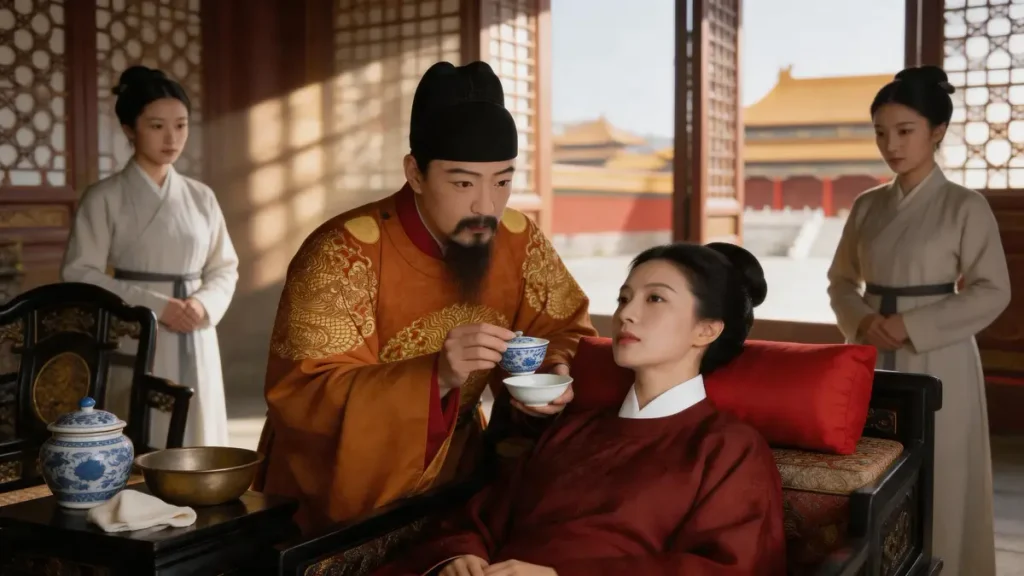
Zhang He’s book, the Zhouzai, records the rule instead. By the old regulation, emperor and empress did not spend the night together; she was summoned when wanted, and afterwards eunuchs walked her back with torches before and behind, which was called keeping off the cold. Only Xiaozong, who favored Empress Zhang above everyone, stayed the night, like an ordinary married couple. Mao Qiling, writing in the early Qing, put it in a sentence: he loved her, they rose and slept together in the palace, he favored no one else, and they lived like a country husband and wife.
Zhang Luan was made Count of Shouning, soon raised to marquis, and after his death created Duke of Changguo. Zhang Heling inherited the marquisate and Zhang Yanling was made Count of Jianchang. The emperor had an ancestral shrine built for the family at Xingji, splendid work that took several years. The Ming History says the two brothers "were both registered as residents of the palace, let their household trade for profit, drew repeated complaints from officials inside and outside the court, and the emperor did not ask, for the empress’s sake".
In the first years of the reign a man from Yuhang named He Ding was a palace attendant. He memorialized asking for the abolition of the rescript-appointed officials and made enemies among his own colleagues. One day there was a banquet in the inner court and the Zhang brothers were there. The emperor got up to relieve himself, and Zhang Heling, drunk, put the imperial crown on his own head. He Ding saw it and was furious. Some days later Zhang Heling was peering into the imperial bedchamber, and He Ding seized a ceremonial mace and went for him. He memorialized: "These two Zhangs are gravely disrespectful. They have no sense of a subject’s duty."
The empress worked the emperor into a rage, and He Ding went to the Embroidered Uniform Guard prison. They asked who had put him up to it. He said: someone. Who, they asked. He said: Confucius and Mencius. The supervising secretary Pang Pan, the censor Wu Shan, the minister Zhou Jing, the bureau secretary Li Kun and the examination graduate Wu Zongzhou all pleaded for him, and the emperor, for the empress’s sake, would not hear any of it. In the end the empress had the eunuch Li Guang beat him to death with rods.
The emperor thought of him afterwards, granted a sacrifice, and had the text cut into a stele.
In the middle of the reign a eunuch named Li Guang became a favorite. He worked on the emperor with Taoist talismans and prayers and forged rescripts to appoint officials directly, the old Chenghua pattern, and men came from everywhere with bribes. He seized farmland around the capital, monopolized the salt profits in the tens of thousands, built a great house and ran the water of Jade Spring around it. In 1498 he persuaded the emperor to build the Yuxiu Pavilion on Longevity Hill. The pavilion was finished, a young princess died, and shortly afterwards the Palace of Clear Tranquillity burned down. The diviners said the pavilion had violated the year’s prohibitions. The grand empress dowager said in anger: Li Guang today, Li Guang tomorrow, and now look what has come of it. Li Guang was afraid and killed himself.
The emperor suspected he had hidden books and sent men to search the house. They brought back a ledger of bribes with the names of many civil and military officials on it, and entries for "yellow rice" and "white rice", hundreds of bushels of each. The emperor was astonished. How much can Li Guang eat, he said, that he takes in rice like this. The attendants said: it is a cover word; yellow is gold, white is silver. The emperor was furious and ordered the judicial offices to investigate. The men who had dealt with Li Guang went to the Marquis of Shouning to ask for help, and the matter was dropped.
In the third month of 1504 the grand empress dowager died. That same month the Hongzhi Emperor fixed the rule that each chamber of the imperial ancestral temple would hold one emperor and one empress.
No consorts. A mother posthumously honored, her family hunted for years, past the point where the fraud was exposed. One emperor and one empress in every chamber of the ancestral temple. A eunuch beaten to death over the empress’s brothers. Whether these things are connected, the Ming History does not say in a single line.
Everyone above the fourth rank, written on a wall in the Wenhua Hall
He took the throne in the ninth month of 1487 and went to work. That month he dismissed the vice minister Li Zisheng, the eunuch Liang Fang, the imperial relative Wan Xi and their followers. In the tenth he purged the officials appointed by direct rescript, more than a thousand of them. The right commissioner of transmission Ren Jie and the vice minister Kuai Gang were among those sent to frontier posts or into dismissal. He abolished the titles of Dharma King, Buddha’s Son, State Preceptor and Perfected Man, and dismissed Wan An. All of it inside two months, and most of what had piled up at the end of the Chenghua reign was gone.
In the third month of 1488 the Hongzhi Emperor did something small. He had the names of the civil and military ministers and of every official of the fourth rank and above, in the capital and outside it, written out and pasted on the wall of the Wenhua Hall. In the same month he opened the classics colloquium and ordered daily lectures. The colloquium was the great session held in that hall on the second, twelfth and twenty-second of each month. The daily lecture was the small class held every day. That year the Joseon envoys who had come to Beijing went home and reported to their king. The new emperor, they said, appointed men on principle alone. He did not care for precious objects and never once skipped court in snow or wind. Everything about the last reign had been turned around.
In the second month of 1495 Li Dongyang and Xie Qian entered the Grand Secretariat, joining Liu Jian, who had come in at the end of the Chenghua reign. The three worked together until 1505. Xu Pu and Qiu Jun were in the Secretariat in those years too, and Qiu Jun died in office that same month. Wang Shu held the Ministry of Personnel and Ma Wensheng the Ministry of War, and Liu Daxia later took the War Ministry. The Ming History says that for a time the upright filled the offices. There was a saying in the capital: twelve ministries in two capitals, and one Wang Shu.
In the third month of 1497 the emperor called Liu Jian, Li Dongyang and Xie Qian to the Wenhua Hall to discuss government, and after that it became routine. In the fifth month of 1500 he called the three to the Platform to settle commanders for the capital army. In the sixth month of 1504 he called Liu Jian and Li Dongyang to the heated chamber to discuss the frontier. In the ninth month of that year he told the three that frontier claims of merit were verified by censors who took a year over them. Limits would now be set by distance, and latecomers punished. He told his lecturers to speak plainly and hold nothing back.
In the second month of 1491 he instructed the judicial offices. Better to be careful at the beginning, he wrote, than lenient at the end, and he wanted judges humane in mind and fair in law. In 1496 the Prince of Min complained about the magistrate of Wugang, Liu Xun, and the emperor had Liu Xun arrested. The supervising secretary Pang Pan and the censor Liu Shen objected, were put in the Guard prison, and were released soon after. It was one of the few hard things he did in eighteen years. In 1500 he issued regulations on judicial hearings. In the twelfth month of 1502 the Collected Statutes of the Great Ming were finished.
The breach at Zhangqiu
In the fifth month of 1489 the Yellow River broke at Kaifeng, ran into the Qin River, and fifty thousand men were put to work. In the spring of 1493 it broke at Zhangqiu, and Wang Shu and others recommended Liu Daxia, who was made a vice censor-in-chief and sent out.
Liu opened the Jialu River from Huanglinggang, cleared the Sunjiadu and Sifuying channels upstream to split the current, and then built a long dike from Zuocheng through Dongming and Changyuan to Xuzhou, three hundred and sixty li. The river was brought under control and Zhangqiu was renamed Anping. In the fifth month of 1494 the eunuch Li Xing and Chen Rui, Count of Pingjiang, worked alongside him. In the twelfth month the Zhangqiu works were finished, and in the second month of 1495 the Huanglinggang mouth was closed.
In the second month of 1490 the Ministry of Revenue asked for tax relief in the southern metropolitan region and Huguang. "In a bad year the principle is to take from the top and give to the bottom," the emperor said. "If you insist on the full amount, what becomes of the people?" He granted all of it. In the third month of the same year he ordered reserve granaries in every prefecture and county, stocked according to the number of li, with punishment for those short of quota. They took grain in good years and gave it out in bad ones, scattered across the counties. The year before, he had taken back land granted to deceased eunuchs and given it to the people who farmed it. In the intercalary month of 1490 he forbade members of the imperial clan and the nobility from petitioning for land or accepting it from those who offered it up. In the eighth month of 1491, after floods in Suzhou, Songjiang and Zhejiang, he stopped that year’s silk weaving. In the eighth month of 1492 he ended the extra weaving quotas in the same region and recalled the supervising eunuch. In the third month of 1502 he removed the eunuch supervising porcelain production at Raozhou.
In 1504 the Hongzhi Emperor called Liu Daxia to a private audience. You said before that the people were exhausted and the treasury empty, he said. Taxation has been fixed since the founding. How did it come to this? Because it is not in fact fixed, Liu said. Guangxi sends a wood called duo every year, Guangdong sends aromatics, the cost runs into tens of thousands, and that is only what we know of. The emperor asked about the soldiers. As poor as the people, Liu said. They have monthly grain in camp and campaign rations in the field, the emperor said. How are they poor? Their officers hold back more than half, said Liu. How could they not be?
The emperor sighed. "I have reigned a long time, and I did not know the soldiers and people of this empire were in this state. What kind of ruler am I?"
He issued a strict order against it.
He shut down the kilns at Jingdezhen
In the eleventh month of 1490 one line of an edict read: stop the works, and end the eunuch supervision of porcelain firing. In the third month of 1502 the eunuch supervising production at Raozhou was removed again.
The imperial factory at Jingdezhen stopped and started through those years. The Palace Museum, in the catalogue of an exhibition pairing Hongzhi and Zhengde wares, notes that the factory was shut down several times in this reign, which is why pieces bearing a Hongzhi mark are uncommon. The range of wares shrank as well: about sixteen types under Hongzhi against twenty-nine under Chenghua. Between those stops and starts, the reign produced the best yellow glaze of the Ming.
Low-fired yellow glaze takes iron oxide for color and lead oxide as a flux. The body is fired first, to biscuit or to plain white porcelain, then the glaze is applied and the piece goes back into a kiln at 850 to 900 degrees. Because the glaze was poured on rather than dipped, the potters called it poured yellow. Because the color was tender, later writers called it jiao yellow, and when it came out like chicken fat, chicken-fat yellow. One dish in the Palace Museum is 4.4 centimeters high and 21.5 across, glazed inside and out, even and bright, with white glaze inside the foot ring and a six-character Hongzhi mark in underglaze blue, two columns inside a double circle. The sides are shallow and the base sags slightly, which is why the shape is nicknamed the nest dish. There is also a jar with ox-head handles and gilt bands, 32 centimeters high, wide-mouthed and short-necked, with nine gilt lines down the body and an unglazed base carrying no mark. Yellow wares of the Ming are mostly dishes and bowls. Jars are rare, and this one belongs to Hongzhi alone.
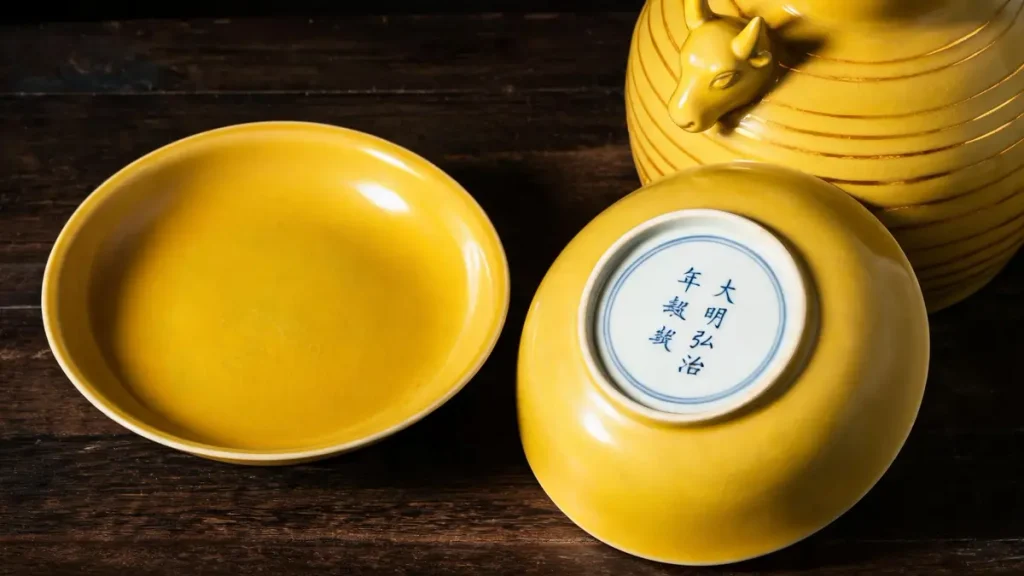
The museum’s own note says the Hongzhi yellow is glossy, correct in color, and the highest level ever reached; it adds that across its holdings the color is almost without variation. Piece after piece nearly the same, which is harder than painting a complicated design on one bowl. Chenghua doucai went through the kiln twice, once for the blue outline and once for the enamels, and every pass cost a share of the batch. Jiajing and Wanli blue-and-white grew fuller and busier. The Hongzhi dish carries nothing at all except a layer of glaze.
The edict of the eleventh month of 1490 was aimed at this kiln. It stopped, and started again, and stopped. Not many Hongzhi yellow pieces survive, but the several dozen in the Palace Museum storerooms are almost the same color.
In the second month of 1505 the Hongzhi Emperor stood at the Gate of Heavenly Mandate and spoke to the ministries of Revenue, War and Works. The population was growing, he said, while registered households and military rolls shrank every year. That came of officials failing to care for people and letting things drift, and they were to report what was wrong.
A month later came the palace examination.
The examiners had Wei Xiao first. His answer contained this sentence: I have heard that in a single day Your Majesty spends more time in the Palace of Earthly Tranquillity than in the Palace of Heavenly Purity. It could not be read out in front of the court. Wei Xiao was moved down to ninth in the second class and Gu Dingchen took first place.
Two months later the emperor fell ill.
In the fourth month he was fasting and praying for rain and caught a chill. The eunuch Zhang Yu of the Directorate of Palace Arrangements, Liu Wentai of the Imperial Medical Academy and several physicians sent in medicine. Ma Wensheng later demanded an inquiry. The finding was that they had prescribed without examining the emperor at all, and that the drugs did not match the illness. He did not recover.
In the fifth month he sank. He called Liu Jian, Li Dongyang and Xie Qian and gave them the final charge. The next day the Hongzhi Emperor died in the Palace of Heavenly Purity. He was thirty-four. The Ming History counts him as thirty-six.
Eighteen years earlier Liu Wentai had been impeached for prescribing wrongly to the Chenghua Emperor, and Hongzhi, newly on the throne, had only demoted him. This time he was spared death and sent to the frontier.
Later generations called the eighteen years the Hongzhi restoration. The Ming History’s verdict opens: of the sixteen Ming emperors, apart from Taizu and Chengzu, only Renzong, Xuanzong and Xiaozong are worth the name. It calls him frugal and restrained, diligent and concerned for the people, and ends by asking who else could have understood the way of holding on to what had been gained.
Zhu Houzhao took the throne, changed the era name to Zhengde, and was not yet fourteen. Sixteen years later he died in the Leopard Quarter with no son. The Prince of Xingxian’s boy was brought up from Huguang to be the Jiajing Emperor, and there followed years of the Great Ritual Controversy, in which he wanted imperial titles for his own father and the court refused.
After the funeral Ma Wensheng carried out the testamentary edict and dismissed 763 officials appointed by rescript. The next year a eunuch of the Directorate of Imperial Accoutrements asked for seven of them back, and Ma refused. The Ming History says that by then the conduct of government had already passed to the eunuchs.
It was Empress Zhang who, after the Zhengde Emperor died, worked with the Grand Secretary Yang Tinghe inside the palace to bring in the Jiajing Emperor. She lived until 1541. He began by calling her Holy Mother and later downgraded her to aunt, treating her worse every year.
Neither of her brothers came to a good end. Zhang Yanling was accused of treason and sentenced to death. The empress dowager put on a worn short jacket, sat on straw, and pleaded for him, and the Jiajing Emperor would not listen. Zhang Heling died first, in prison. In the eighth month of 1541 she died and was buried with her husband at Tai. After her death he had Zhang Yanling killed.
Questions readers ask
Sources and further reading
The Ming History (Mingshi), annals of the Hongzhi Emperor, juan 15: https://zh.wikisource.org/wiki/明史/卷15
The Ming History, biographies of the empresses, juan 113, for Consort Ji and Consort Wan: https://zh.wikisource.org/wiki/明史/卷113
The Ming History, biographies of the empresses, juan 114, for Empress Zhang and the fate of her brothers: https://zh.wikisource.org/wiki/明史/卷114
The Ming History, biographies of Wang Shu, Ma Wensheng and Liu Daxia, juan 182, for the Zhangqiu works and the 1504 audience: https://zh.wikisource.org/wiki/明史/卷182
The Ming History, biographies of the eunuchs, juan 304, for He Ding and Li Guang: https://zh.wikisource.org/wiki/明史/卷304
Shen Defu, Wanli Yehuo Bian, juan 3, on the petitions for consorts, the tombs at Tianshou Shan, and the Zheng Wang affair: https://zh.wikisource.org/wiki/萬曆野獲編/卷03
Lu Ji, Jianjia Tang Notes (Jianjia Tang Zazhu Zhaichao), on the empress’s illness.
Zhang He, Zhouzai, on the rule against overnight visits.
Mao Qiling, Supplementary Records of the Ming Palace (Shengchao Tongshi Shiyi Ji).
Shuo Ting, a Ming collection of court anecdotes, for Wei Xiao’s examination answer.
The Veritable Records of the Joseon Dynasty, report of the 1488 mission to Beijing: https://sillok.history.go.kr/
The Palace Museum, Beijing, Hongzhi yellow-glazed dish: https://ggzl.dpm.org.cn/pages/exhibit_works/details?id=10831
The Palace Museum, yellow-glazed jar with ox-head handles: https://www.dpm.org.cn/collection/ceramic/226732.html