Ming Dynasty Emperors: All 16 Rulers of the Ming Dynasty, In Order
What Were the Ming Dynasty Emperors?
The Ming dynasty emperors were the sixteen men who sat on the same throne between 1368 and 1644. The first was Zhu Yuanzhang, who took it in the southern suburbs of Nanjing on the fourth day of the first month of 1368. The last was Zhu Youjian, who hanged himself on Coal Hill in Beijing on the nineteenth day of the third month of 1644. Between those two mornings lie 276 years, and not one break in the family line.
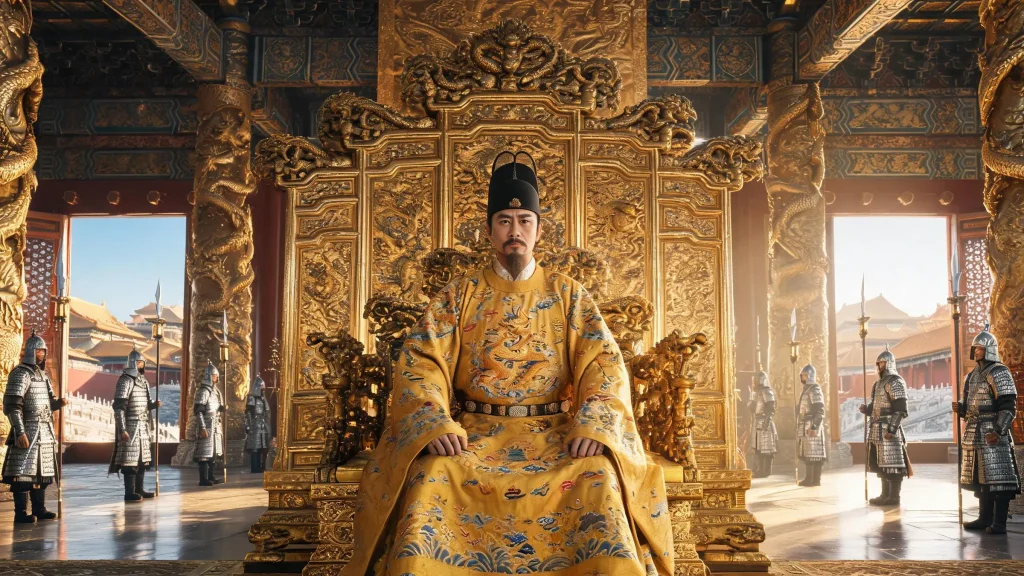
Ask for the Ming dynasty emperors in Chinese and you get three names per man, and all three are in the table below. The temple name is the title a man received in the ancestral temple after death. The era name is the one he used to count years while he lived. The personal name is the one he was born with. Ming practice settled on one era name per emperor, which is why later generations usually refer to these rulers by era name. Saying Hongwu or saying Wanli points at a person, not a year. A Ming dynasty emperor’s name on a museum label may be any one of the three, and which one the label picks depends on the museum.
Every one of the Ming dynasty emperors is in the table below, in order, with the temple name, the era name and the personal name side by side. Only one of the sixteen broke the one-era-name rule, the Yingzong Emperor, who used both Zhengtong and Tianshun.
| # | Temple name | Era name | Personal name | Reign | One line |
|---|---|---|---|---|---|
| 1 | Taizu | Hongwu | Zhu Yuanzhang | 1368-1398 | Commoner founder; abolished the chancellorship and put the Six Ministries under the emperor |
| 2 | Gongmin | Jianwen | Zhu Yunwen | 1398-1402 | Cut the princes down and provoked his uncle; vanished when Nanjing fell |
| 3 | Chengzu | Yongle | Zhu Di | 1402-1424 | Moved the capital to Beijing, sent Zheng He out, commissioned the Yongle Encyclopedia |
| 4 | Renzong | Hongxi | Zhu Gaochi | 1424-1425 | Nine months on the throne; his accession edict halted the treasure fleets |
| 5 | Xuanzong | Xuande | Zhu Zhanji | 1425-1435 | Officials in office, granaries full; a passion for cricket fighting |
| 6 | Yingzong | Zhengtong, Tianshun | Zhu Qizhen | 1435-1449, 1457-1464 | Captured at Tumu; restored seven years later; abolished the burial of consorts |
| 7 | Daizong | Jingtai | Zhu Qiyu | 1449-1457 | Held Beijing; deposed as a prince and buried west of the city |
| 8 | Xianzong | Chenghua | Zhu Jianshen | 1464-1487 | The Western Depot; Consort Wan; years without an heir |
| 9 | Xiaozong | Hongzhi | Zhu Youtang | 1487-1505 | One empress and no consorts; the Hongzhi restoration |
| 10 | Wuzong | Zhengde | Zhu Houzhao | 1505-1521 | The Leopard Quarter; made himself a general-in-chief; died without a son |
| 11 | Shizong | Jiajing | Zhu Houcong | 1521-1567 | The Great Rites Controversy; alchemy at the Western Park |
| 12 | Muzong | Longqing | Zhu Zaiji | 1567-1572 | Opened the port at Yuegang; peace and horse markets with Altan Khan |
| 13 | Shenzong | Wanli | Zhu Yijun | 1572-1620 | Zhang Juzheng’s reforms; most memorials left unread |
| 14 | Guangzong | Taichang | Zhu Changluo | 1620 | One month on the throne; the red pill |
| 15 | Xizong | Tianqi | Zhu Youxiao | 1620-1627 | Axe, saw and lacquer work; Wei Zhongxian ran the state |
| 16 | Sizong | Chongzhen | Zhu Youjian | 1627-1644 | Executed Yuan Chonghuan; hanged himself on Coal Hill |
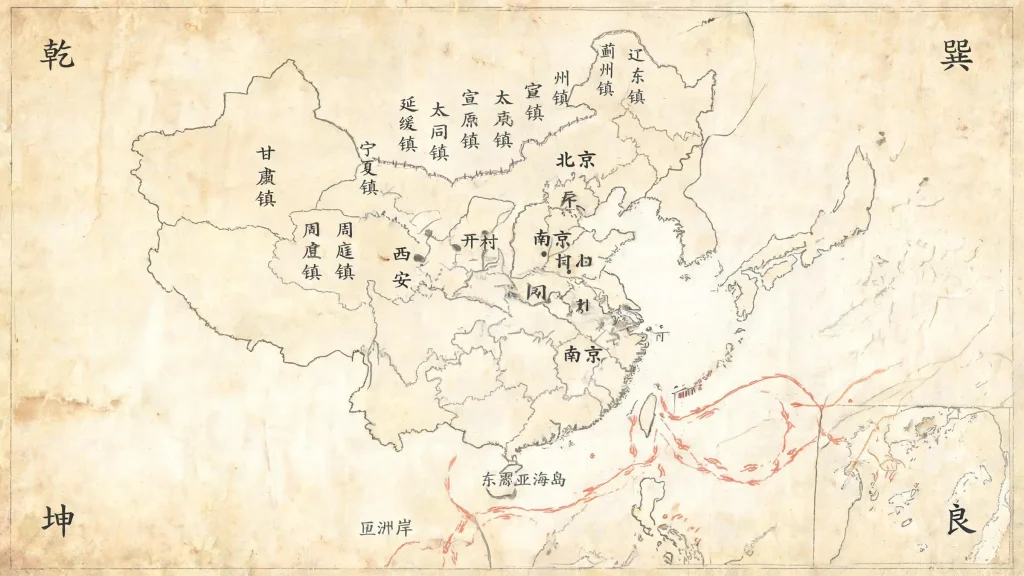
The Ming dynasty had 16 emperors, ruling from 1368 to 1644. This is the shortest list of Ming dynasty emperors in order anywhere on the page. Counted by reign, the table holds three more men than the tombs below Tianshou Mountain in Changping, north of Beijing. Zhu Yuanzhang lies at Xiaoling in Nanjing. Zhu Yunwen disappeared and has no tomb at all. Zhu Qiyu was stripped of imperial rank and buried as a prince west of the city. Thirteen emperors lie at the Ming Tombs, not sixteen.
The dates in the table are Western ones, and Ming years began on the first day of the first lunar month, so the two calendars do not line up year for year. Anyone building a Ming dynasty emperors timeline against European dates has to carry that few weeks of drift across the whole span.
How Many Emperors Did the Ming Dynasty Have?
Sixteen. The question of how many Ming dynasty emperors there were has a short answer and two long complications.
The era names do not match the headcount. The sixteen Ming dynasty emperors used seventeen era names, and the extra one belongs to the Yingzong Emperor. He counted fourteen years as Zhengtong. Then he was taken prisoner by the Oirats while his half-brother held the throne for more than seven years, and after his return he counted eight more years as Tianshun.
Then there is the Southern Ming. After Beijing fell in 1644, members of the Zhu family set up several governments in the south. The prince of Fu, Zhu Yousong, took the throne at Nanjing and changed the era name to Hongguang. The prince of Tang, Zhu Yujian, did the same at Fuzhou as Longwu. The prince of Gui, Zhu Youlang, did it at Zhaoqing as Yongli, and the Yongli Emperor was killed at Kunming in 1662. These rulers are not counted among the Ming dynasty emperors.
The reason is not that they were not of the Zhu family. It is a question of how the history was written. The History of the Ming, compiled under the Qing, ends its basic annals with the Zhuanglie Emperor, and no Southern Ming ruler has annals there. The figure of sixteen comes from that compilation. The two accounts are kept separately, and they do not contradict each other.
The Two Capitals: Nanjing and Beijing
The largest single change of the early Ming was the move of the capital from Nanjing to Beijing. It took from the first year of Hongwu to the sixth year of Zhengtong to finish. That is seventy-three years and five emperors, and the Ming dynasty emperors ruled out of Nanjing for most of it.
In the eighth month of 1368 the court handed out two names at once. Yingtian became Nanjing, and Kaifeng became Beijing. That Beijing was Kaifeng, and it has nothing to do with the city that carries the name today. In the ninth month of 1369 Zhu Yuanzhang made his home district of Linhao the Central Capital, that is, Fengyang, and built palaces and altars there. In 1375 he went to look at the works, came back, and ordered them stopped. For the rest of the Hongwu reign the capital stayed at Yingtian, the city we call Nanjing.
In the first month of 1403 Zhu Di renamed Beiping as Beijing. In 1417 he put the marquis of Taining, Chen Gui, in charge of construction. In the eleventh month of 1420 he proclaimed the move to the empire, and in the twelfth month the temples and palaces of the new capital were finished. On the first day of the first month of 1421 he held the New Year audience in the throne hall and feasted his ministers. In the fourth month of that year lightning set the three great halls on fire. The Eastern Depot was also established in 1420, with eunuchs ordered to gather intelligence.
The move happened, but the status did not follow it. In the third month of 1425 Zhu Gaochi ordered every office in Beijing to style itself a temporary seat again, and prepared to take the capital back to Nanjing. He died that May and never went. For the next twenty years Beijing carried that label. Only in the eleventh month of 1441, with the palaces and the three great halls rebuilt, did the court proclaim that Beijing was the capital and that no office was to call itself a temporary seat any longer.
The Forbidden City is the palace city built in those years. It stands at the center of Beijing, with Wansui Hill, today’s Jingshan, to the north and Chengtian Gate, the front gate of the imperial city, to the south. Nanjing was not abandoned either. The court kept a full set of Six Ministries and a Censorate there, and Nanjing served as a second capital.
The Hongwu Emperor (Zhu Yuanzhang), 1368-1398
Era name Hongwu, temple name Taizu, personal name Zhu Yuanzhang. He was the first of the Ming dynasty emperors, thirty-one years on the throne, twenty-five when he took up arms and forty when he took the throne.
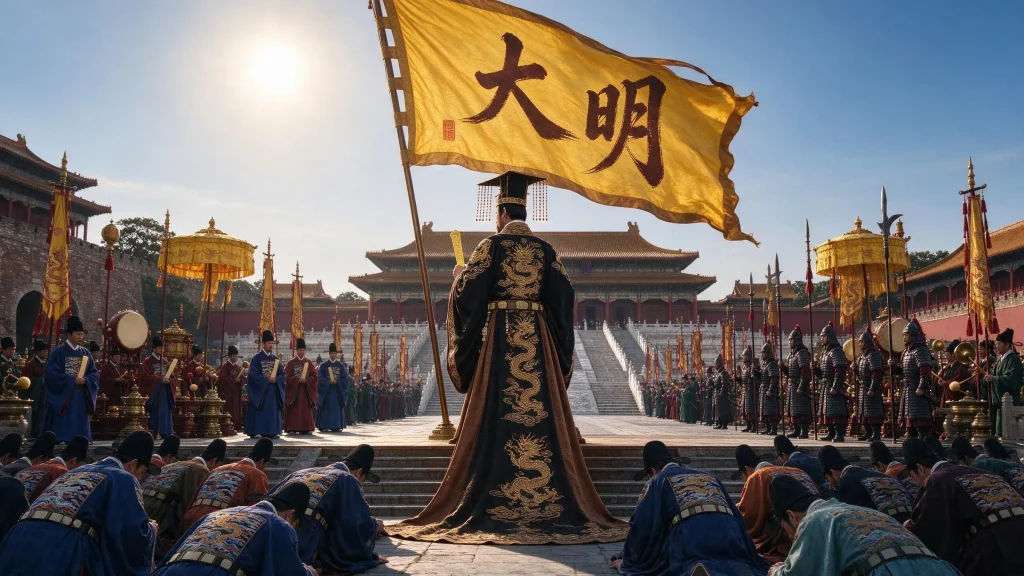
He was born in Zhongli in Haozhou, into a tenant farming household. The epidemic of 1344 carried off his parents and his eldest brother, and the family was too poor to bury them, so a neighbor gave them a piece of ground. He spent the next few years doing chores at the Huangjue Temple. Then he left it and begged his way from Hefei through Guangzhou, Gushi and Yingzhou, a round trip of three years. In the leap third month of 1352 he joined the rebel Guo Zixing at Haozhou as a bodyguard, and sixteen years later he took the throne in the southern suburbs of Nanjing.
Three things he did decided what the Ming would look like afterward. In the first month of 1380 the left grand chancellor Hu Weiyong was executed for treason, and five days later the court abolished the Central Secretariat and the office of grand chancellor and reordered the ranks of the Six Ministries. The chancellery that had run Chinese government from the Qin and Han down to the Yuan was gone, and each of the six ministers reported to the emperor directly. No later Ming dynasty emperors gave any of that authority back. Four years later a supervising secretary named Zhang Wenfu did the arithmetic for him. In eight days, 1,660 memorials arrived covering 3,391 separate matters, and Zhu Yuanzhang admitted in his own words that one man could not get to every part of it. In 1381 he ordered the yellow registers compiled, sorting households into units of ten and a hundred and rebuilt every ten years. By 1394 they reported 10,684,435 households and 56,774,561 adult males. He governed officials with heavy punishments: the Lan Yu case of 1393 ended with 15,000 people executed along with their clans. In the fourth month of that same year the annals record a drought, and an emperor who ordered his ministers to speak plainly about the faults of his government and ordered the prisons cleared.
In the leap fifth month of 1398 he died at the Western Palace, aged seventy-one, leaving an edict that told the princes to stay in their principalities and not come to the capital. For the full record of this man, start with Zhu Yuanzhang, the Hongwu Emperor.
The Jianwen Emperor (Zhu Yunwen), 1398-1402
Era name Jianwen, personal name Zhu Yunwen. He was the second of the Ming dynasty emperors, a grandson of the founder, four years on the throne. The History of the Ming gives his temple name as Gongmin; Huizong was added later by the Southern Ming.
He was twenty-one when he took the throne, and inside ten months he destroyed five princes. In the seventh month of 1399 the prince of Yan, Zhu Di, rose at Beiping. As his authority he cited a line from the Imperial Ancestral Instructions: when there is no upright minister at court and evil men are within, the princes shall drill their troops and await orders. In the sixth month of 1402 his army reached the Jinchuan Gate at Nanjing. The prince of Gu and Li Jinglong opened it, and the capital fell. The History records only that fire broke out in the palace and the emperor could not be found. He is the only one of the Ming dynasty emperors with no tomb at all.
The Yongle Emperor (Zhu Di), 1402-1424
Era name Yongle, temple name Taizong at first and Chengzu from the ninth month of 1538, personal name Zhu Di. He was the third of the Ming dynasty emperors, twenty-two years on the throne, the fourth son of Zhu Yuanzhang and prince of Yan from 1370.
He rose against his nephew under the name Jingnan, the quelling of the crisis, and entered Nanjing in the sixth month of 1402. Nine days after taking the throne he had Zhu Biao’s tablet removed from the ancestral temple and his rank cut back to crown prince. In the seventh month of the same year he dated the year as the thirty-fifth year of Hongwu, and the Jianwen era name was deleted from the record.
Three things he did in those years were never done again in the dynasty. The first was the capital: in the eleventh month of 1420 he proclaimed the move to Beijing, in the first month of 1421 he held the New Year audience in the new throne hall, and in the fourth month the three great halls burned. The second was the sea: in the sixth month of 1405 Zheng He sailed on the first of seven voyages to the Western Ocean, and over twenty-eight years the fleets reached the East African coast south of the equator. The third was a book. In the seventh month of 1403 he ordered Xie Jin and others to compile a reference work arranged by rhyme, and in the winter of 1408 it was finished as the Yongle Encyclopedia. It ran to 22,877 chapters bound into 11,095 volumes, roughly 370 million characters, drawn from between seven and eight thousand books. Only one copy was ever made. The Eastern Depot was also set up in 1420, with eunuchs ordered to gather intelligence.
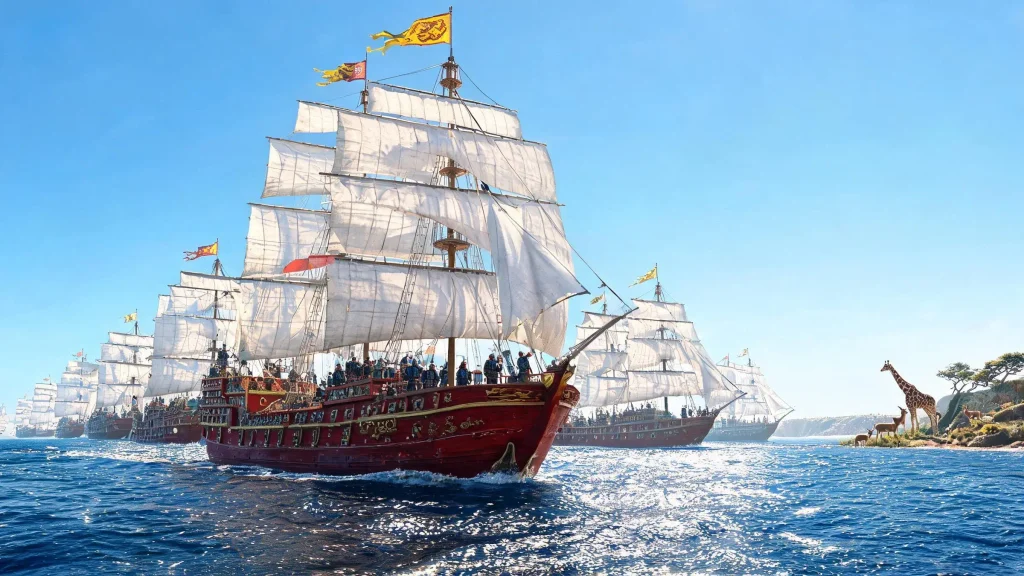
He led five campaigns into the steppe and died in 1424 on the way back from the last of them. The History’s appraisal gives him both halves: a territory wider than the Han or the Tang, and a seizure of the throne that ran against the grain of things. The Ming dynasty emperors who came after him lived in the city he built and worked through the office he improvised. For the voyages in full, start with the Yongle Emperor and Zheng He’s voyages.
The Hongxi Emperor (Zhu Gaochi), 1424-1425
Era name Hongxi, temple name Renzong, personal name Zhu Gaochi. He was the fourth of the Ming dynasty emperors, nine months on the throne, the eldest son of the Yongle Emperor and the man who held Beiping while his father marched south.
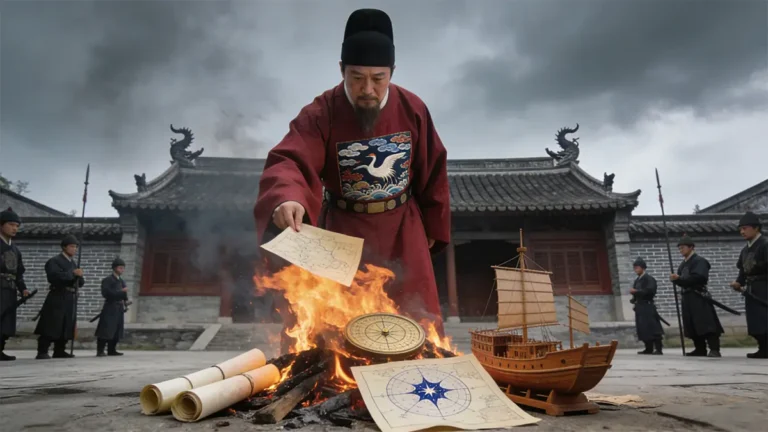
His accession edict stopped four things: the treasure fleets to the Western Ocean, the horse markets to the west, and the procurement offices in Yunnan and Jiaozhi. The voyages ended there. In the third month of 1425 he ordered every office in Beijing to style itself a temporary seat again and prepared to take the capital back to Nanjing. In the fifth month he died at the Qin’an Hall, aged forty-eight, without going. He is the only one of the Ming dynasty emperors who tried to move the capital back.
The Xuande Emperor (Zhu Zhanji), 1425-1435
Era name Xuande, temple name Xuanzong, personal name Zhu Zhanji. He was the fifth of the Ming dynasty emperors, ten years on the throne, the eldest son of the Hongxi Emperor.
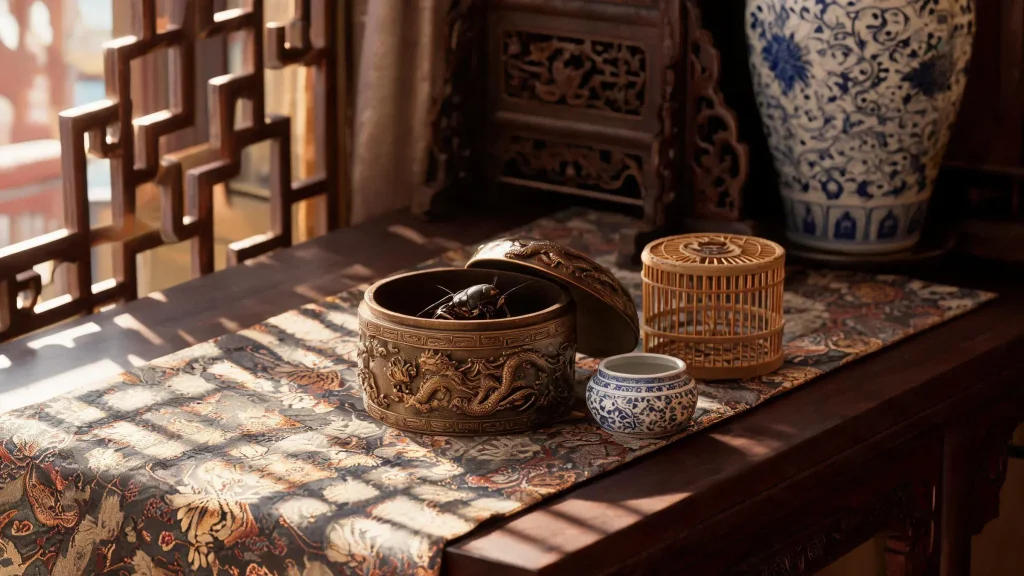
His reign left an unusually clean record, and the History’s appraisal says officials were competent, government was even-handed, the framework of law was kept up, the granaries were full and the countryside was content. The History of the Ming rated few of the Ming dynasty emperors as generously. Another record is less tidy. Shen Defu, writing in the Wanli period, noted that the Xuande Emperor was the best cricket fighter of the dynasty. He once sent a secret order to the prefect of Suzhou for a thousand crickets, and a street rhyme of the day ran: the crickets chirp and chirp, the Xuande Emperor wants them.
Two objects survive from the same decade. One is Zheng He’s last voyage, which sailed in 1430 and came back in 1433; Zheng He died at Calicut on the way home, and after that no Ming fleet went out of the Yangtze again. The other is the Xuande censer. The bronze censers sold today as Xuande work trace back to a book compiled late in the dynasty, which says that in 1428 the palace cast ritual vessels from imported copper. The reliability of that book is disputed, and almost all surviving so-called Xuande censers are later copies. Zhu Zhanji died at the Qianqing Palace in the first month of 1435, aged thirty-eight.
The Yingzong Emperor (Zhu Qizhen), 1435-1449 and 1457-1464
Era names Zhengtong and Tianshun, temple name Yingzong, personal name Zhu Qizhen. He was the sixth of the Ming dynasty emperors, twenty-four years in two stretches, and the only one of the sixteen who used two era names.
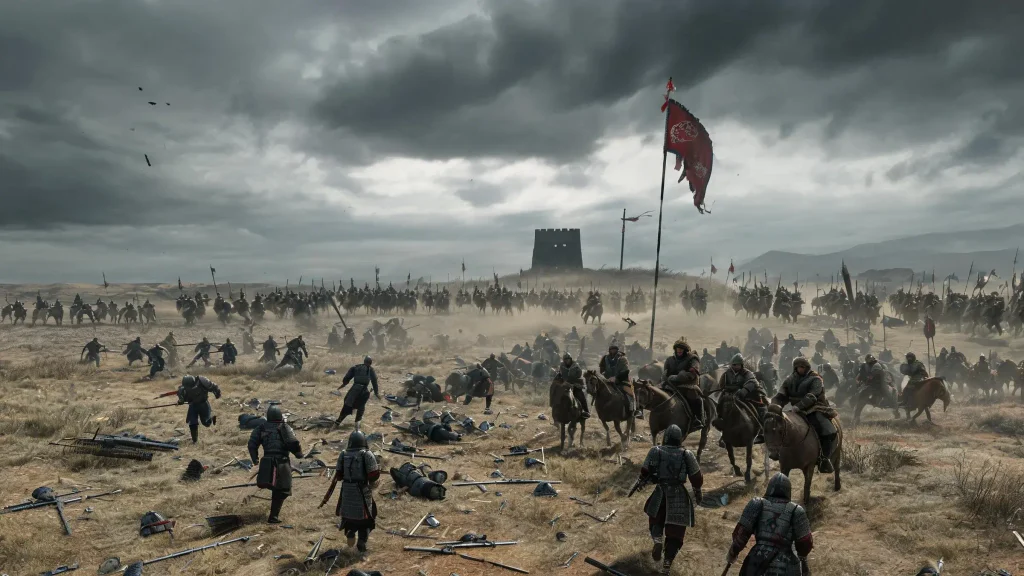
He took the throne at nine, and through the Zhengtong years the eunuch Wang Zhen, director of ceremonial, held the inner court. In the seventh month of 1449 Esen of the Oirats raided Datong and the court ordered an imperial expedition. Wang Zhi, the minister of personnel, led the assembled ministers in objecting and was ignored. In the eighth month the army was destroyed at Tumu. The History records that the dead numbered in the hundreds of thousands, that the duke of Yingguo and two ministers died there, and that Zhu Qizhen was taken prisoner, which the annals render as "the emperor went north". He was the only one of the Ming dynasty emperors taken prisoner in the field. Seven years later he came back, and more than seven years after that he was restored. In the first month of 1464, gravely ill, he left one line in his final edict: the burial of palace women with a dead emperor was abolished.
The Jingtai Emperor (Zhu Qiyu), 1449-1457
Era name Jingtai, personal name Zhu Qiyu. He was the seventh of the Ming dynasty emperors, more than seven years on the throne, a younger son of the Xuande Emperor. The History calls him the Jingtai Emperor; Daizong was a Southern Ming addition.
When news of Tumu reached Beijing the ministers gathered and wept, the expositor Xu Cheng proposed moving the capital south, and the vice minister of war Yu Qian refused. The empress dowager put Zhu Qiyu in charge, and in the ninth month of 1449 he took the throne and conferred on his captured brother the title of retired emperor. Beijing held. In the first month of 1457, with Zhu Qiyu ill, Shi Heng and Xu Youzhen brought the retired emperor out and restored him. In the second month Zhu Qiyu was reduced to the prince of Cheng. He died that same month at the age of thirty. His posthumous name meant cruel, his newly built tomb was demolished, and he was buried as a prince at the Jin Hill west of Beijing. He is one of the three Ming dynasty emperors who never reached the Ming Tombs.
The Chenghua Emperor (Zhu Jianshen), 1464-1487
Era name Chenghua, temple name Xianzong, personal name Zhu Jianshen. He was the eighth of the Ming dynasty emperors, twenty-three years on the throne. He was made crown prince before his second birthday, stripped of the title at five by his uncle the Jingtai Emperor, and restored in 1457.
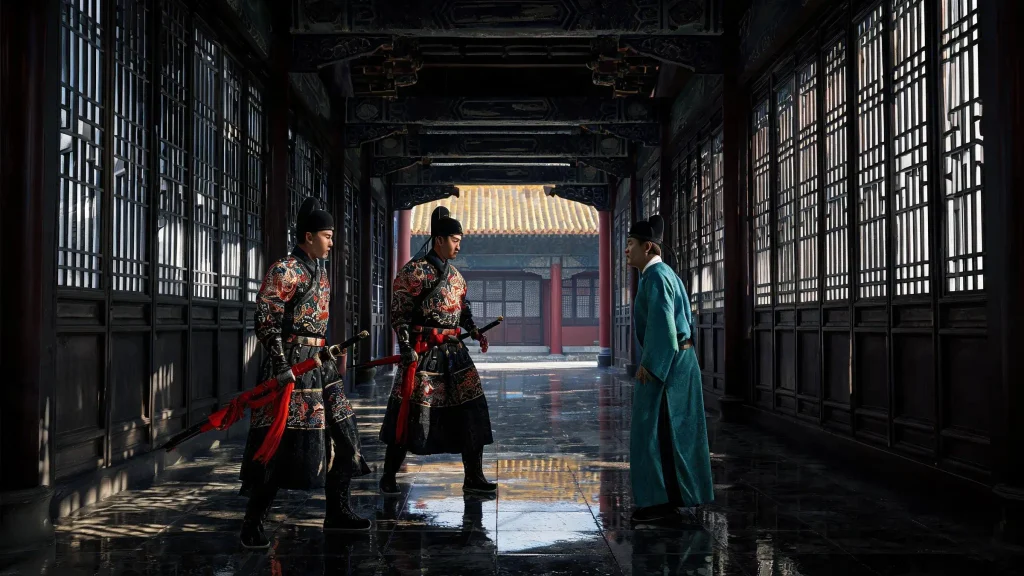
He took the throne at sixteen, and Consort Wan, who dominated his inner palace, was thirty-five, seventeen years older. For the Ming dynasty emperors the inner palace was a political institution, and this reign shows why. Two things define it. The first is the succession. Consort Wan bore a son in 1466, the child died before his first birthday, and the emperor had no heir for years afterward. In 1475 a boy who had been kept hidden inside the palace until he was five or six, his hair never cut, was acknowledged as the emperor’s son, and he grew up to be the Hongzhi Emperor. The second is the secret police. In the first month of 1477 the court established the Western Depot under the eunuch Wang Zhi. In the fifth month the grand secretary Shang Lu and the minister Xiang Zhong asked for it to be abolished, and the emperor agreed. In the sixth month Xiang Zhong was reduced to a commoner and the Western Depot was restored. Set up, closed and reopened inside one year.
The Hongzhi Emperor (Zhu Youtang), 1487-1505
Era name Hongzhi, temple name Xiaozong, personal name Zhu Youtang. He was the ninth of the Ming dynasty emperors, eighteen years on the throne, and the one among the sixteen with the strangest road to it. He was hidden inside the palace until he was six, and his father did not know he existed.
He took the throne at eighteen and named no secondary consorts. There was one empress, the Empress Zhang, and no one else. Later accounts compress this into a claim that he was the only monogamous emperor in Chinese history, which asks more of the sources than they will carry. The chapter on empresses in the History records one empress and no consorts, but monogamous is a modern word. Taxes and punishments were light in his eighteen years, and later writers called the period the Hongzhi restoration. In the fifth month of 1505 he died at the Qianqing Palace, aged thirty-six.
The men who wrote the History’s appraisal used him to rank the whole dynasty. Of the sixteen Ming dynasty emperors, apart from Taizu and Chengzu, only the Hongxi, Xuande and Hongzhi emperors deserve the name.
The Zhengde Emperor (Zhu Houzhao), 1505-1521
Era name Zhengde, temple name Wuzong, personal name Zhu Houzhao. He was the tenth of the Ming dynasty emperors, sixteen years on the throne, fifteen when he took it, the only son of the Hongzhi Emperor.
He disliked the Forbidden City. In the eighth month of 1507 he built the Leopard Quarter and lived there afterward. In the ninth month of 1517 he went to Yanghe and gave himself a title on the spot, commissioner-in-chief for military affairs and general-in-chief, and the title grew longer. A Ministry of Personnel document issued in his name reads: the commissioner-in-chief for military affairs and general-in-chief Zhu Shou, commanding the six armies in person, is specially created duke of Zhenguo, with an annual stipend of five thousand piculs. In the third month of 1521 he died at the Leopard Quarter, aged thirty-one, with no son, saying at the end that everything which had gone wrong was his own fault.
The History’s appraisal is blunt: he signed himself official titles, and the distinction between hat and shoe was gone. With no heir, the line of the Ming dynasty emperors left the direct descent of the Hongzhi Emperor and moved to the house of Xing.
The Jiajing Emperor (Zhu Houcong), 1521-1567
Era name Jiajing, temple name Shizong, personal name Zhu Houcong. He was the eleventh of the Ming dynasty emperors, forty-five years on the throne, the second-longest reign in the dynasty and the only one of the sixteen who came in from a princely house.
The Zhengde Emperor left no heir, and the court brought the prince of Xing up from Anlu in Hubei. Outside the city he refused the ceremony the Ministry of Rites had prepared for him, saying that the late emperor’s edict had made him heir to the throne and not a son. That was the first of his collisions with the grand secretary Yang Tinghe and the opening of the Great Rites Controversy, which was about whether he could give his own father the posthumous rank of emperor. After more than three years, in the ninth month of 1538, the matter was settled: the court moved Zhu Di up from Taizong to Chengzu and made the emperor’s father Ruizong, whose tablet went into the ancestral temple above the Zhengde Emperor’s.
In the tenth month of 1542 the annals carry one short line: palace women plotted treason and were executed, and Consort Duan and Consort Ning were cut apart in the marketplace. After that he moved to the Western Park and rarely held court for more than twenty years, though he controlled appointments through secret edicts. Abroad, the pressure came from two directions, Japanese pirates in the south and Mongols in the north. In the eighth month of 1550 Altan Khan broke through Gubeikou, raided Tongzhou and reached the walls of Beijing, and afterward the minister of war and a grand coordinator were executed in the marketplace. Zhu Houcong died at the Qianqing Palace in the twelfth month of 1566, aged sixty.
The Longqing Emperor (Zhu Zaiji), 1567-1572
Era name Longqing, temple name Muzong, personal name Zhu Zaiji. He was the twelfth of the Ming dynasty emperors, six years on the throne, the third son of the Jiajing Emperor.
His accession edict announced that all earlier orders which had proved inconvenient would be revised. Officials punished for speech were recalled, the alchemists were handed to the judiciary, Daoist rites and extraordinary procurement were stopped, and the bureau secretary Hai Rui came out of prison. Two things he did carried a long way for the Ming dynasty emperors who followed. One was at sea. In 1567 the grand coordinator of Fujian, Tu Zemin, asked that maritime trade be licensed, turning smugglers into registered merchants, limited to the Eastern and Western Oceans and barred from Japan. The emperor approved it and opened one port, Yuegang in Zhangzhou prefecture, with a county seat at Haicheng and a revenue office to issue sea permits and collect the permit tax. It was the first official loosening of the Ming sea ban. The other was on land. In the tenth month of 1570 Altan Khan’s grandson came over to the Ming, and in 1571 the court made Altan Khan the Shunyi King. Horse markets were established at three frontier towns, and a frontier that had fought for forty years went quiet.
The Wanli Emperor (Zhu Yijun), 1572-1620
Era name Wanli, temple name Shenzong, personal name Zhu Yijun. He was the thirteenth of the Ming dynasty emperors, forty-eight years on the throne, ten when he took it, the longest reign in the dynasty.
For the first ten years the government was in the hands of the grand secretary Zhang Juzheng. His audit checked performance against stated duties, and the Single Whip reform consolidated the labor and tax obligations into a single payment in silver; by 1581 it was in force across the empire. Zhang Juzheng died in the sixth month of 1582, and by a little over a year later he had been stripped of his ranks and his household seized. The great question of the reign was the succession. The eldest son, Zhu Changluo, was born to a palace woman of the Wang family, and the emperor favored Zhu Changxun, born to Consort Zheng, so the question of the heir hung open for more than a decade. Zhu Changluo was made crown prince only in the tenth month of 1601. By then the Ming dynasty emperors had stopped appearing in person before their ministers for years at a stretch, and the memorials piled up on the emperor’s desk, neither approved, nor rejected, nor sent back.
In the same years the dynasty fought three large wars, later grouped together as the three great campaigns of Wanli: against Pubei’s rebellion in Ningxia, against the Japanese in Korea, and against Yang Yinglong in Bozhou. Zhu Yijun died in the seventh month of 1620, aged fifty-eight. The men who wrote his appraisal hung the dynasty’s fate on his forty-eight years: commentators, they wrote, say the Ming died under the Shenzong Emperor.
The Taichang Emperor (Zhu Changluo), 1620
Era name Taichang, temple name Guangzong, personal name Zhu Changluo. He was the fourteenth of the Ming dynasty emperors, one month on the throne, the eldest son of the Wanli Emperor, and thirty-nine years waiting for it.
He was the shortest-reigning of the Ming dynasty emperors. He took the throne on the first day of the eighth month of 1620, fell ill later that month, grew worse, and on that day the assistant at the Court of State Ceremonial, Li Kezhuo, presented him with a red pill. On the first day of the ninth month he died at the Qianqing Palace. The History gives him one line: one month on the throne, aged thirty-nine. Because the reign was so short, the court renamed the months of 1620 after the eighth month as the Taichang year. Three incidents around his death were later grouped as the Three Cases, and they became the fuel of factional war for the next twenty years.
The Tianqi Emperor (Zhu Youxiao), 1620-1627
Era name Tianqi, temple name Xizong, personal name Zhu Youxiao. He was the fifteenth of the Ming dynasty emperors, seven years on the throne, fifteen when he took it, the eldest son of the Taichang Emperor.
By these years the Ming dynasty emperors had let the court turn into a place of factional war, and real power went to two people: the eunuch Wei Zhongxian and the emperor’s wet nurse, Madam Ke. Wei Zhongxian was from Suning and had been a gambler in his youth. He castrated himself after a losing streak and entered the palace under the name Li Jinzhong. He was illiterate. In 1624 the vice censor-in-chief Yang Lian memorialized against him, listing twenty-four crimes; the emperor did not understand what he was reading and issued an order reprimanding Yang Lian instead. In 1625 six men, Yang Lian and Zuo Guangdou among them, were taken into the Zhenfusi prison and beaten to death there. The most direct sentence in the History about the emperor himself comes from the biography of Wei Zhongxian. He was, it says, clever with his hands and loved nothing better than axe, saw and lacquer work, never tiring of it over the years. When he was measuring and cutting, Wei Zhongxian and his people would come to report business, until the emperor said he understood it all and they could handle it. Zhu Youxiao died at the Qianqing Palace in the eighth month of 1627, aged twenty-three.
The Chongzhen Emperor (Zhu Youjian), 1627-1644
Era name Chongzhen, personal name Zhu Youjian. He was the last of the Ming dynasty emperors, seventeen years on the throne, seventeen when he took it. His temple name was changed more than once under the Southern Ming, and the History calls him the Zhuanglie Emperor.
Three months after taking the throne he sent Wei Zhongxian to Fengyang and then ordered him arrested. Wei Zhongxian hanged himself on the road, and Madam Ke was beaten to death in the laundry office. In the first month of 1629 the emperor issued the register of the treason case in six grades and cleared Wei Zhongxian’s faction out of the court. Liaodong and the northwest could not be cleared. In the twelfth month of 1628 he put Yuan Chonghuan in the Embroidered Uniform Guard prison, and in the eighth month of 1630 he had him killed. After 1638 Lu Xiangsheng died in battle at Julu and Sun Chengzong died when Gaoyang fell. In 1640 the annals use five characters: people ate each other.
In the third month of 1644 Li Zicheng crossed Juyong Pass and took Changping. His army appeared before Beijing, the outer city fell in the evening, and the inner city fell at dawn. The emperor died on Coal Hill, and the eunuch Wang Chengen died with him. He wrote on the front of his robe that he had offended Heaven, that it was his ministers who had ruined him, and that the rebels might divide his body but must not harm a single one of the people. Nine days later Li Zicheng’s men took the coffins to Changping, and the people of Changping opened Consort Tian’s tomb and buried him in it.
How Did the Ming Dynasty Fall?
Zhu Youjian could not carry it alone. The Ming dynasty emperors of the 1630s levied taxes they could not collect and raised armies they could not pay, and disaster, finance, frontier war and rebellion all got worse at once, each one stretching the others out.
The weather went first. Northern China had more than a decade of drought and locusts, and in 1640 the annals record that people ate each other. That is not a figure of speech; it is the standard entry an annalist wrote for famine. When harvests failed, tax revenue failed with them. But the war in Liaodong had to be paid for, and the troops sent against the rebels had to be paid too, so the court added three surcharges, and the surcharges themselves pushed more farmers into the rebel armies. Silver was the third problem. Ming finances were settled in silver after the Wanli years, and when silver imports wobbled in the early seventeenth century the accounts went bare.
On the frontier, the Later Jin under Hong Taiji became strong enough to ride into China in formation, and after 1629 they went around the Shanhaiguan defenses more than once. Among the rebels, Li Zicheng and Zhang Xianzhong rose and fell repeatedly. Only in 1640, when Li Zicheng came out of Huguang into Henan and the starving joined him, did his army reach a size that mattered. His march on Beijing in the third month of 1644 was the last step, not the cause.
The History’s own explanation puts the blame back on the Wanli years, saying the dynasty died under the Shenzong Emperor. That is the judgment of the men who compiled the book rather than a record from the time, and it can sit alongside the climate, the finances and the fighting rather than closing them off.
The Ming Emperors at a Glance
From Zhu Yuanzhang’s accession at Nanjing in 1368 to Zhu Youjian’s suicide on Coal Hill in 1644, the Ming dynasty emperors used 276 years and seventeen era names. The table above is the shortest version of that list.
Two names carry most of the weight, and they are the most famous Ming dynasty emperors for opposite reasons. Zhu Yuanzhang built the machinery of the state; Zhu Di moved it to Beijing and sent it to sea. If you want to start with the first, go to Zhu Yuanzhang, the Hongwu Emperor. If you want the second, go to the Yongle Emperor and Zheng He’s voyages.
Sources and further reading
- The History of the Ming (明史), the dynasty’s official history, compiled under the Qing and finished in 1739. This page follows the basic annals: chapters 2 and 3 for Taizu, 4 for the Gongmin Emperor, 5 to 7 for Chengzu, 8 for Renzong, 9 for Xuanzong, 10 and 12 for Yingzong, 11 for the Jingtai Emperor, 13 and 14 for Xianzong, 15 for Xiaozong, 16 for Wuzong, 17 and 18 for Shizong, 19 for Muzong, 20 and 21 for Shenzong and Guangzong, 22 for Xizong and 23 and 24 for the Zhuanglie Emperor. The biographies behind the individual sections are chapter 113 on empresses, 147 on the Wenyuan Chamber staff, and 304 and 305 on eunuchs. Full text: https://zh.wikisource.org/zh-hans/%E6%98%8E%E5%8F%B2
- Palace Museum, Beijing, on the Ming Tombs, for the thirteen tombs and the three emperors who are not there: https://www.dpm.org.cn/court/system/236402.html
- UNESCO World Heritage Centre, Imperial Tombs of the Ming and Qing Dynasties, for the 2003 listing: https://whc.unesco.org/en/list/1004
- Xinhua, 4 July 2003, on the twenty-seventh session of the World Heritage Committee: https://news.sina.com.cn/w/2003-07-04/0042315325s.shtml
- People’s Daily Overseas Edition, 21 December 2012, Chen Hongyan on the Yongle Encyclopedia, for the 22,877 chapters, 11,095 volumes and 370 million characters: http://paper.people.com.cn/rmrbhwb/html/2012-12/21/content_1163600.htm
- National Central Library, Taipei, catalogue entry on a surviving volume of the Yongle Encyclopedia: https://rbook.ncl.edu.tw/NCLSearch/Selection/Details/24
- Fujian provincial government, on the Yongle Encyclopedia, drawing on the Yongle and Jiajing court records: https://qb.fujian.gov.cn/qwjy/202107/t20210706_5641392.htm
- Peking University, study of Ming overseas trade policy, for the 1567 opening of Yuegang and the permit tax: https://ccj.pku.edu.cn/Article/DownLoad?&id=332362800&type=ArticleFile
- Encyclopaedia Britannica, Hongwu: https://www.britannica.com/biography/Hongwu
- Wikipedia, List of emperors of the Ming dynasty, used as a cross-check on reign dates, era names and temple names: https://en.wikipedia.org/wiki/List_of_emperors_of_the_Ming_dynasty
- Wikipedia, Ming dynasty, for the institutional vocabulary used in this translation: https://en.wikipedia.org/wiki/Ming_dynasty
- Wikipedia, Ming tombs, for the tomb names and the emperors they belong to: https://en.wikipedia.org/wiki/Ming_tombs