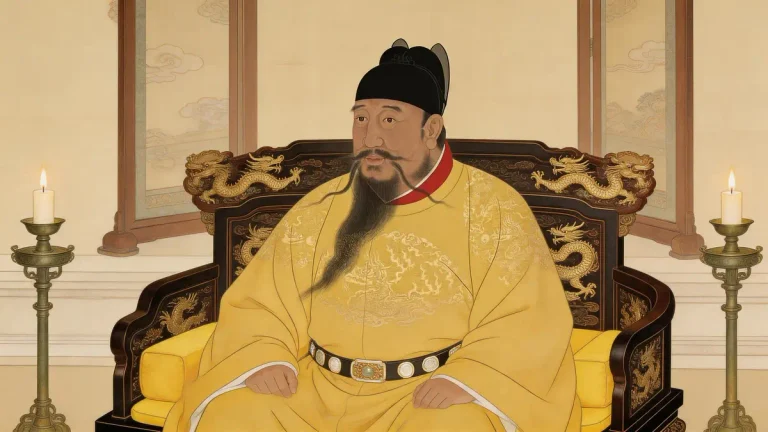
Emperor Zhengde (Wuzong): Zhu Houzhao’s Secret Life
In the ninth month of 1518 the Zhengde Emperor sent an edict back to Beijing from the Piantou Pass on the northern frontier.
Zhu Shou, governor of military affairs, general of awesome might and commander-in-chief, leading the six armies in person and clearing the frontier, is hereby created Duke of Zhenguo, with an annual stipend of five thousand bushels of grain. Let the Ministry of Personnel act on this edict.
The Ministry of Personnel acted on it.
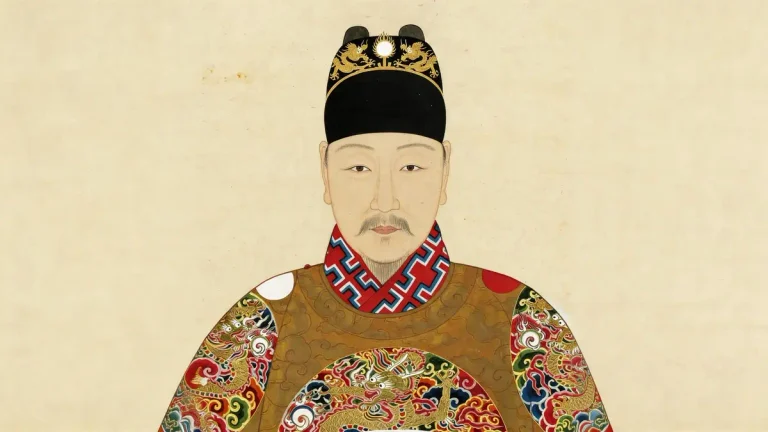
Zhu Shou was the emperor. He had invented the name, granted himself the title, and then put the paperwork through the ordinary channels so that a salary would be paid every year. No such rank as Duke of Zhenguo existed in the Ming nobility. He created it.
It was not the first. At Yanghe in the ninth month of 1517 he had proclaimed himself governor of military affairs, general of awesome might and commander-in-chief. The dukedom came a year later. The grand preceptorship followed in the second month of 1519. By the time he marched south against the Prince of Ning, his full style ran: Zhu Shou, grand preceptor, Duke of Zhenguo, general of awesome might, commander-in-chief, governor of military affairs, of the Rear Military Commission. Six titles in one breath.
After his death the Ministry of Rites gave him the temple name Wuzong and the posthumous name Yi. Neither character is a slight. Wu is the one for a ruler who puts down disorder. Yi is the one for a man who decides hard and then does it.
The Ming History’s verdict reads differently: "given to pleasure and idle wandering, familiar with little men, until he wrote out his own titles, and the distinction between hat and shoe was gone."
That last clause is aimed at the edict above. Hat on the head, shoe on the foot. The men who wrote the history did not think the two could be swapped.
Zhengde was the tenth of the Ming dynasty emperors, ruling from 1505 to 1521. For the complete list of rulers and their reigns, see our guide to the Ming dynasty emperors.
One leopard, two hundred and forty men
In the eighth month of 1507 the Zhengde Emperor moved out of the Palace of Heavenly Purity. The annals give four characters: the Leopard Quarter was built.
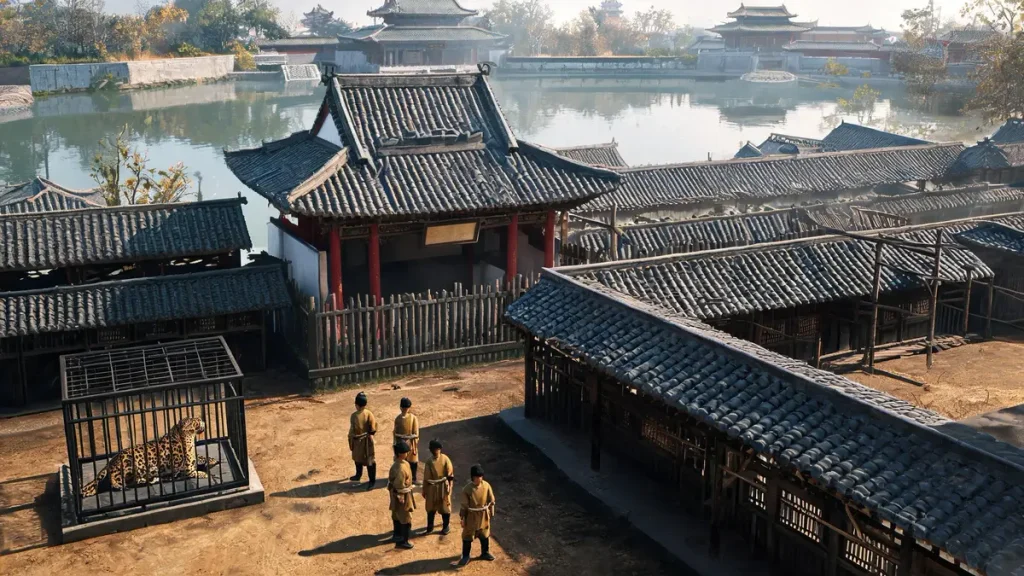
He did not invent it. The Ming court had kept leopards since the Xuande reign, and there were men enrolled as Leopard Quarter Braves, part keepers and part handlers for the nobles who came to watch animals fight. More than one place in Beijing carried the name. His stood on the southwest bank of the Taiye Lake inside the Western Garden, close to the Western Flowery Gate, where an older Tiger City already stood; the Leopard Quarter and a row of animal houses went up at its northwest corner.
The project kept accounts. By the tenth month of 1512 the Ministry of Revenue reported that the work had run five years, that it had cost more than 240,000 taels of silver, and that two hundred rooms had been added. The two hundred rooms had an official name, the Leopard Quarter offices.
An office is where paperwork is done.
Li Xun, a Ming historian whose study of the compound was published by the Palace Museum, counts four parts: the offices, the animal house, a drill ground and a Buddhist chapel. Rooms to work in, cages for the animals, ground to drill on, a place for services. His conclusion is that it was an office in fact and not simply a lodge for excursions, which is why it was called an office and not a lodge.
The leopards themselves are on the books. Zhu Guozhen, writing in the Wanli reign, copied out a schedule of the Western Garden’s provisions. Fifty-three dogs at the Western Flowery Gate and two hundred and twelve at the Imperial Horse Directorate ate fifty-four catties of pork a day between them, skin and bone included. Three tigers got eighteen catties of mutton, three foxes six, and the one marked leopard three.
Then a separate entry: "The Leopard Quarter in the Western Garden keeps one marked leopard, employs two hundred and forty braves, and draws more than 2,800 bushels of grain a year, with ten qing of land and 700 taels of rent."
One leopard. Two hundred and forty men. Twenty-eight hundred bushels.
Beyond the offices there was open ground for drill. He trained a force there that did not belong to the capital garrison. In the ninth month of 1512 he granted the imperial surname to a hundred and twenty-seven men at once and took them as adopted sons. That winter troops from the four frontier commands of Xuanfu, Datong, Liaodong and Yulin were kept in the capital and called the Four Outer Households. In the first month of 1513 he set up the East and West Commands and gave them to Jiang Bin and Xu Tai. The soldiers ran through the city. Drill was held inside the palace, the emperor turned out in uniform to watch, and rode out beside Jiang Bin with the armor of the two men overlapping, so that bystanders could not tell which was which.
The men who came in were not all entertainers. Qian Ning ran the Embroidered Uniform Guard and its prison, and among those he brought in were the musician Zang Xian, a Muslim called Yu Yong, and monks from Tibet. In the sixth month of 1510 the emperor named himself Dharma King of Great Celebration and had the seal cast and presented to him. The Folangji, as the Ming called the Portuguese, sent an embassy up from Guangzhou at the end of the reign, and one of its interpreters, a man called Huozhe Yas’an, attached himself to the emperor through Jiang Bin. The Ming History records the result: the emperor used to learn his speech for amusement.
He picked up a few words of Portuguese and used them as a joke. Yas’an, with that behind him, grew arrogant. He followed the court from Nanjing to Beijing, lodged in the residence for foreign envoys, and refused to kneel to the bureau secretary in charge, Liang Zhuo. Liang had him beaten. Jiang Bin cursed Liang out: "He has sported with the Son of Heaven. Would he kneel to a little official like you?" When the emperor died Yas’an went to prison, said he was Chinese by birth and had been used by the foreigners, and was executed.
Liu Jin, in the years of his ascendancy, timed his reports for the moments when the emperor was deep in some game. The emperor, annoyed, waved him off: "What do I keep you for? Must you come and muddle me?" After that Liu Jin decided things himself and stopped reporting.
When Liu Jin fell, Qian Ning took his place in the queue. Officials waited in the audience hall until the afternoon without learning whether the emperor was up; they sent men to look, and when Qian Ning appeared they knew the emperor was going out. After Qian Ning came Jiang Bin, and the Ming History says that in those years nothing inside or outside the court, great or small, was reported until it had been reported to Bin, and that some things were held back two or three years.
In the tenth month of 1506, eight men wept all night in front of the Zhengde Emperor
The Hongzhi Emperor died in the fifth month of 1505. On the eighteenth day of that month Zhu Houzhao took the throne at thirteen. The Ming History opens his annals with a line about the boy himself: quick by nature, fond of riding and archery. What his father left him was Liu Jian, Xie Qian and Li Dongyang in the Grand Secretariat, and Han Wen at the Ministry of Revenue.
Around him were other men. Liu Jin, Ma Yongcheng, Gao Feng, Luo Xiang, Wei Bin, Qiu Ju, Gu Dayong and Zhang Yong, eight servants from the Eastern Palace, were known as the Eight Tigers. Liu Jin ran the Palace Bells Office, brought in hawks, dogs, singers, dancers and wrestlers every day, and led the boy out of the palace in plain clothes.
In the tenth month of 1506 Han Wen led the court in a memorial asking for the eight to be executed. Liu Jian and Xie Qian backed him. The emperor, unable to refuse outright, sent the eunuchs Chen Kuan, Li Rong and Wang Yue of the Directorate of Ceremonial to the Grand Secretariat to discuss posting the eight to Nanjing. The envoys went back and forth three times and Liu Jian would not agree.
Jiao Fang, the minister of personnel, rode through the night to tell Liu Jin.
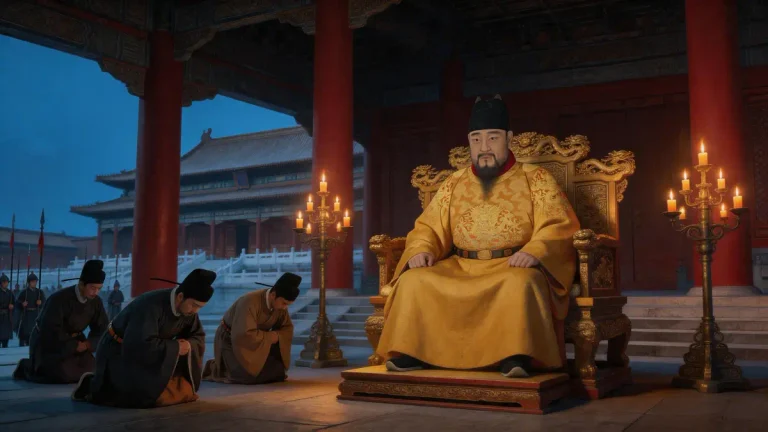
That night the eight knelt in front of the emperor and wept. The emperor wavered. Liu Jin said: "The one who means us harm is Wang Yue. Yue has bound himself to the grand secretaries to control Your Majesty’s comings and goings, so their first move is to take out what they fear. And hawks and dogs, what harm do they do to government? If the Directorate of Ceremonial had the right man in it, would the officials of the left rank dare talk like this?"
The emperor flew into a rage. He made Liu Jin head of the Directorate of Ceremonial that day, and gave the Eastern Depot to Ma Yongcheng and the Western Depot to Gu Dayong. Wang Yue and the others were sent to Nanjing to serve in the menial corps. Men went after them, killed Wang Yue on the road and broke Xu Zhi’s arm. Next morning the officials came to kneel at the gate in protest and found the ground moved under them. Liu Jian and Xie Qian resigned that day.
Left rank means the civil service. Under the Ming, memorials came to the Grand Secretariat to be drafted, then went to the Directorate of Ceremonial for the vermilion endorsement. Hold the second gate and nothing the Grand Secretariat drafts ever leaves the palace.
For nearly four years after that the Ming History is very clear about what Liu Jin’s power looked like. Dukes, marquises and imperial relatives did not dare treat him as an equal, and knelt when they visited him privately. Memorials came to him first as a red slip, the red copy, and only then went up as the white copy. Petitions called him Eunuch Liu and did not use his name. He posted his men as garrison supervisors in the frontier commands, then sent them to remeasure the military colonies, squeezing until the border troops burned an office building down. Retired ministers, Yong Tai, Ma Wensheng, Liu Daxia, Han Wen and Xu Jin among them, and the censor-in-chief Yang Yizhong, dozens of men, were fined grain to be delivered to the frontier until their households were ruined. When the Censorate sent up a document with his name written wrong, the censor-in-chief Tu Yong took his subordinates and knelt in apology before the matter closed. In the sixth month of 1508 someone left an anonymous letter on the imperial road abusing him. He had the whole court kneel outside the Gate of Heavenly Mandate, and at dusk sent every official below the fifth rank to prison. It was the hottest part of the summer. Three of them, the secretary He Yi, the prefectural judge Zhou Chen and the examination graduate Lu Shen, died of heat stroke.
In the fourth month of 1510 Zhu Zhifan, the Prince of Anhua, rose in Ningxia, and his manifesto listed Liu Jin’s crimes. The court sent Yang Yizhong and Zhang Yong against him. Within the month the general Qiu Yue had seized the prince.
Zhang Yong came back to present the prisoners, due on the fifteenth of the eighth month. Liu Jin tried to have the date put back. Zhang Yong, afraid of a trap, came in early. The presentation was made, the emperor had wine brought to thank him, and Liu Jin was at the table. Late that night, when Liu Jin had withdrawn, Zhang Yong produced the Prince of Anhua’s manifesto and laid out seventeen counts against him. The emperor, who had been drinking, looked down and said: "Jin has failed me."
They arrested him that night and searched his houses. They found a counterfeit seal, five hundred palace passes, armor, bows and crossbows, and the folding fan he carried every day, with two daggers hidden in the ribs of it.
Only then did the emperor rage: "The slave really did mean to rebel."
He was cut to pieces in the market and his head hung up, and the record of the case was printed and posted through the empire.
The man who moved against him was the eunuch Zhang Yong. The man who planned it was the censor-in-chief Yang Yizhong. The three grand secretaries do not appear in the account. Summing up the reign, the Ming History gives him the credit: he removed the traitor Liu Jin with his own hand.
Zhang Qin hid the keys to the Juyong Pass
In the seventh month of 1517, on Jiang Bin’s advice, the emperor decided to go out through the Juyong Pass to Xuanfu. Zhang Qin, the censor inspecting the passes, memorialized against it and got no answer. He tried again, listing three reasons the imperial carriage could not go. The country was unsettled and the cost of provisioning enormous. The road was dangerous and the two dowager empresses would worry. The Mongols were strong and not to be closed with. Nothing came back.
On the first day of the eighth month the emperor went out in plain clothes to Changping, and word came that he meant to pass through the gate at once. Zhang Qin ordered the commander Sun Xi to shut it, had the key brought to him and hid it. Liu Song, the eunuch stationed at the pass, wanted to go to Changping to pay his respects. Zhang Qin stopped him and said this:
"The emperor is going out through this gate. This is where you and I find out whether we live or die. If the gate stays shut he cannot go, and disobeying the Son of Heaven is a death sentence. If the gate opens he goes, and what happens to the empire after that nobody knows. If this turns out to be a second Tumu, the disaster of 1449, you and I die anyway. Better to die for not opening it. That death at least is not wasted."
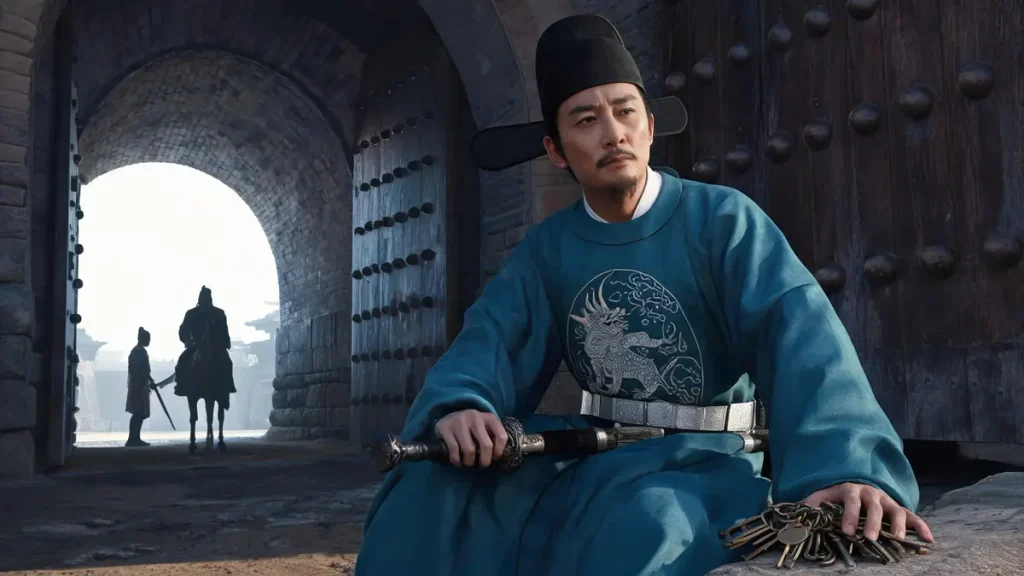
The emperor summoned Sun Xi. Sun Xi said: "The censor is here. I dare not leave without orders." So the emperor summoned Liu Song instead. Zhang Qin put the imperial tally and the seal on his back, laid his hand on his sword, and sat down in the gateway. "Any man who says open this gate," he said, "loses his head."
A messenger came again and Zhang Qin drove him off with the sword. The man went back and told the emperor the censor had nearly killed him. The emperor was furious and turned to Zhu Ning: "Go and arrest that censor and put him to death." That was when Liang Chu and Jiang Mian caught up with him at Shahe and asked him to turn back for the capital, and Zhang Qin’s memorial arrived, and the officials added their objections. The emperor gave way and went back to Changping.
Twenty days later Zhang Qin went off to inspect the Baiyang Pass. The emperor changed clothes, left by the Desheng Gate, slept that night in a farmhouse at Yangfang, and rode hard for the gate, asking along the way where the censor was. Zhang Qin chased him and was too late. The emperor left Gu Dayong to hold the pass and forbade any capital official to go out.
Zhang Qin looked west and wept. The story went round Beijing as the censor’s three memorials and the shut gate.
The next year, coming back from Xuanfu, the emperor reached the pass and laughed. "The censor stopped me before," he said. "I am back now." He did not punish him.
Zhang Qin wanted the seals of the two dowager empresses before he would open. He had no troops. What he had was a seal, a sword and a sentence about a death that would not be wasted. It held for twenty days.
Yingzhou: sixteen heads, fifty thousand rewards
In the tenth month of 1517 the Little Prince, the Ming name for Dayan Khan, raided Yanghe and plundered Yingzhou. The emperor came up from Yanghe, took command of the armies himself, and fought for five days. Then the Mongols withdrew.
The Veritable Records give the count: "In this action sixteen heads were taken, and of our army fifty-two were killed and five hundred and sixty-three seriously wounded." The entry ends with four more characters. The imperial carriage was nearly cut off.
The biography of Jiang Bin in the Ming History has it this way: "At Yingzhou the enemy withdrew. Sixteen heads were taken, several hundred of the army were killed, and the victory was reported to the capital."
Back in Beijing in the first month of 1518, the Zhengde Emperor told the grand secretaries that he had cut down an enemy himself in the line. Yang Tinghe and the others knocked their heads on the floor: "Your Majesty’s sage prowess leaves your servants and people nothing to do but rejoice."
In the seventh month of that year the rewards for Yingzhou were assessed. The annals say that more than fifty thousand men were given hereditary rank, promotion and reward. The biography of Jiang Bin says that nine thousand five hundred and fifty officials inside and outside the court were promoted and rewarded. The two figures differ by a factor of five and describe one event. On the larger count, sixteen heads bought fifty thousand rewards. On the smaller, six hundred men per head. Two months later Jiang Bin was made Count of Pinglu and Xu Tai Count of Anbian, both titles resting on that one action.
He did not stay in Beijing after Yingzhou. He was home less than a month before going back to Xuanfu. In the third month he was at Changping, in the fourth he visited the six imperial tombs and went on to Miyun. In the fifth he was at the Xifeng Pass, in the seventh he went back to Xuanfu, in the eighth he was at Datong, and in the ninth he reached the Piantou Pass, where he issued the edict making himself Duke of Zhenguo. In the tenth he crossed the Yellow River to Yulin, and in the eleventh he was at Suide, staying in the house of the commander Dai Qin. In the twelfth he crossed back, went to Shizhou and then to Taiyuan, where he conscripted musicians on a large scale and carried off the wife of a household musician named Yang Teng. Jiang Bin and the other favorites addressed her as Mother and called her Lady Liu. He got back to Xuanfu from Taiyuan in the first month of 1519, and to Beijing in the second.
The Ming History’s account of the Mongols gives the result of the battle: "After this they raided the frontier every year, but never in force again."
The Mongol side reads differently. The chronicle Altan Tobchi has Dayan Khan warned of the Ming advance, leaving a small force to watch the road and riding away with his wife, and never attacking the Ming again; he turned instead on the Mongjin. He died that same year, at forty-eight.
On one side sixteen heads. On the other, a khan who left first. Neither account supports a decisive battle, and the line about raiders who never came in force again is a Ming line.
Counting forward from Hongwu and Yongle, one Ming emperor spent five days on a battlefield. The Xuande Emperor went out against the Prince of Han at Le’an in 1426 and the prince surrendered without a fight. The Zhengtong Emperor went out in 1449 and was surrounded at Tumu without a fight. This one fought for five days, both sides took losses, and his own carriage was nearly cut off.
A hundred and seven men knelt outside the Meridian Gate
In the second month of 1519 the Zhengde Emperor made himself grand preceptor. The same day he informed the Ministry of Rites: "Zhu Shou, grand preceptor, Duke of Zhenguo, general of awesome might, commander-in-chief, governor of military affairs, will tour the two metropolitan provinces and Shandong, sacrificing and praying for blessing. Let the ceremonies be prepared and reported." The court understood what this was. He was going south.
Huang Gong, a bureau director in the Ministry of War, and five others memorialized against it and went to the Embroidered Uniform Guard prison. Shu Fen, a Hanlin compiler, and a hundred and six others knelt outside the Meridian Gate for five days. Zhang Ying, a deputy commander of the Jinwu Guard, cut his own throat as a protest; the guards stopped him and he lived, and later they beat him to death.
On the fifth day of the third month Shu Fen and the others, a hundred and seven in all, were flogged at the palace gate. The Ming History notes that the sky went dark with wind-blown dust. In the fourth month thirty-nine more were flogged, Huang Gong among them, and eleven men died of it.
On the fourteenth day of the sixth month Zhu Chenhao, the Prince of Ning, rebelled. Sun Sui, the vice censor-in-chief governing Jiangxi, and Xu Kui, the defense commissioner of Nanchang, refused to join him and were tied up and beheaded. Word reached Beijing. The emperor had his crimes proclaimed, reduced him to commoner status, and decided to go south himself.
In the seventh month Wang Shouren, the governor of southern Jiangxi, raised troops at Ji’an and took Nanchang first. Chenhao was besieging Anqing without success, turned back, met the government army at the Huangjia ferry, and was drawn in by a feigned retreat from Wu Wending, the prefect of Ji’an, while a second force came in behind him. He fell back on Qiaoshe. The next day the government troops burned his fleet, and Chenhao, his heir, Li Shishi and Liu Yangzheng were all taken. Forty-three days from the rising to the end. His consort Lou had argued against it. When it was over he said: "Zhou of Shang was ruined for listening to a woman. I am ruined for not listening to one, and it is too late to regret it."
In the eighth month the imperial carriage left the capital. At Zhuozhou Wang Shouren’s dispatch arrived. He suppressed it. It was not to be made public.
Later Zhang Yong intercepted Wang Shouren at Hangzhou with the emperor’s intention. Chenhao was to be let back into Poyang Lake so that the emperor could fight him when he arrived. Wang Shouren refused. Jiangxi, he said, had been devastated; if the imperial army came through again the disorder would be past calculating. Zhang Yong was persuaded and took charge of the prisoners.
In the twelfth month the emperor reached Yangzhou. That same month he reached Nanjing and stayed until the intercalary eighth month of the following year. The Ming History records a rescheduling of the suburban sacrifice in the first month. In the sixth he climbed Niushou Mountain, where the camps panicked in the night and word went round that Jiang Bin meant to seize power, and it took a long time to settle. In the eighth he remitted Jiangxi’s taxes, and in the intercalary eighth he received the Jiangxi prisoners. He also visited the house of the grand secretary Yang Yizhong at Zhenjiang, and went to the funeral of the grand secretary Jin Gui. Jiang Bin wanted to take him to Suzhou, then down into Zhejiang, then on to Hunan and Hubei. The officials argued hard against it, Jiang Bin’s own friends argued against it, and it stopped.
Yangzhou is where the biography of Jiang Bin is blunt. He turned private houses into a headquarters and combed the city for virgins and widows. And at the end of its entry for 1519 the Ming History has five characters:
"In Huai and Yang there was famine, and people ate one another."
In the fourth month of the following year, from Nanjing, he ordered relief for the prefectures of Huai and Yang.
The cast net in the Jishui Pond
In the eleventh month of 1519 he was fishing at Qingjiangpu. In the ninth month of 1520, on the way back north, he cast a net again in the Jishui Pond, the boat went over, they got him out, and the annals say only that he was not well after it.
In the tenth month he reached Tongzhou. In the eleventh he dealt with the men who had been in touch with Chenhao, and had the minister of personnel Lu Wan brought from Nanjing to the imperial camp. In the twelfth Chenhao was executed. He came back to the capital, reported the victory at the suburban altars, and on the seventeenth day went out to sacrifice to Heaven and Earth, where the illness came on during the first offering and he could not finish the rite.
In the first month of 1521 the suburban sacrifice was put off again. On the thirteenth day of the third month he was failing. He said to the Directorate of Ceremonial: "My illness will not be cured. Report my wishes to the empress dowager. The affairs of the empire are heavy; settle them with the grand secretaries. Everything that went wrong was my doing, and none of it was anything you could have prevented."
In the first month of 1514 the Palace of Heavenly Purity had burned. Yang Tinghe asked him to leave the throne hall, issue an edict of self-blame and invite plain speaking, and he ignored it. In the twelfth month of that year he rebuilt the palace and added a million taels to the tax quota of the empire. What he said on his deathbed is one of the few admissions in anything he left behind.
Two days later he died in the Leopard Quarter. He was twenty-nine. The Ming History counts him as thirty-one. In the fifth month the posthumous name and temple name were conferred, and he was buried at Kangling.
He had no son. The empress, of the Xia family, bore none, and he had never named an heir.
The day he died Gu Dayong and Zhang Yong went to the Grand Secretariat. Yang Tinghe produced the Imperial Ancestral Instructions: "Brother succeeds brother. Who is going to dispute that? The Prince of Xingxian’s eldest son is a grandson of the Chenghua Emperor, a nephew of the Hongzhi Emperor, and a cousin of the late emperor. In order of descent he is the one." Liang Chu, Jiang Mian and Mao Ji agreed. The eunuchs went in to the empress dowager, and the testamentary edict and her order came down together.
The Prince of Xingxian’s son was fifteen and living at Anlu in Huguang. He reached the capital and took the throne on the twenty-second day of the fourth month, as the Jiajing Emperor. Thirty-nine days passed between the fourteenth of the third month and the twenty-second of the fourth, and the Ming had no emperor.
The Great Ritual Controversy that followed ran for more than three years. What it was about was whether a boy from Huguang could call his own father his father.
The verdict came from other men.
The Veritable Records of Wuzong opened in the first month of 1522 and were finished in the sixth month of 1525, in a hundred and ninety-seven juan. Before the work began, the Jiajing Emperor did one thing. He handed the compilers the eight hundred and sixty-odd memorials that officials had sent the Zhengde Emperor and that he had kept back without answer.
More than eight hundred documents, most of them attacks on his travelling and on his eunuchs.
Near the end of the compilation the bureau argued over two things: whether the invitation to the Jiajing Emperor had come from the eunuchs or from the Grand Secretariat, and whether the decision to kill Jiang Bin had been Zhang Yong’s or Yang Tinghe’s. Lin Shi, one of the compilers, wrote to the vice director Dong Qi that the truth of both lay somewhere between report and hearsay, that no historian had been present, and that the only honest course was to record the doubt as doubt. In the end the chief compiler Fei Hong ruled that the Grand Secretariat’s part was to be affirmed. By the time the argument closed, Yang Tinghe, Jiang Mian and Mao Ji had already resigned over the ritual question.
The Ming History was opened in 1679 and printed in 1739, sixty years, and the men who fixed the text stood two centuries away from the Zhengde reign. What they thought of him is not in one place.
At the end of the annals: "It is fortunate that the handle of appointment stayed in his own hands, and that the ministers who held the balance patched as they could; so government was disordered without coming to disaster."
In juan 188, the fascicle of the remonstrating officials, the verdict says: "The Zhengde Emperor’s conduct was wild, but his punishments went no further than distant exile, and when Zhang Qin shut the pass on him he did not punish him on his return. His natural temper was not that of a cruel man."
One verdict calls him wild. The other says he was not cruel. A hundred and seventy juan separate them, and the same bureau wrote both.
Ten years after his death, in 1531, the Ministry of War answered a memorial from a guardsman named Zhang Sheng. The Leopard Quarter in the Western Garden still kept one wild leopard. It still employed two hundred and forty braves on 2,800 bushels of grain a year, with ten qing of land and 700 taels of rent.
The building was still there. The leopard was still there. The two hundred and forty men were still drawing their rations.
Sources and further reading
The Ming History (Mingshi), annals of the Zhengde Emperor, juan 16, for the whole chronology, the self-appointed titles, Yingzhou, the southern journey and the verdict: https://zh.wikisource.org/wiki/明史/卷16
The Ming History, biographies of the eunuchs, juan 304, for the Eight Tigers, the night of the tenth month of 1506, Liu Jin’s four years and his fall, and Zhang Yong: https://zh.wikisource.org/wiki/明史/卷304
The Ming History, biographies of the favorites, juan 307, for Jiang Bin, Xu Tai and Qian Ning, including the sixteen heads at Yingzhou and the two reward figures: https://zh.wikisource.org/wiki/明史/卷307
The Ming History, princes, juan 117, for Zhu Chenhao, Prince of Ning, and the forty-three days: https://zh.wikisource.org/wiki/明史/卷117
The Ming History, biography of Zhang Qin, juan 188, for the shut gate at Juyong and the verdict on the emperor’s temper: https://zh.wikisource.org/wiki/明史/卷188
The Ming History, biography of Yang Tinghe, juan 190, for the full self-appointed style and the succession after the death: https://zh.wikisource.org/wiki/明史/卷190
The Ming History, foreign countries, juan 325, for the Folangji embassy and Huozhe Yas’an: https://zh.wikisource.org/wiki/明史/卷325
The Veritable Records of Wuzong (Ming Wuzong Shilu), juan 153 and 154, for the Yingzhou casualty figures and the near loss of the carriage.
Gu Yingtai, Mingshi Jishi Benmo, juan 49, for the detail that the emperor fought in the line in person.
Zhu Guozhen, Yongzhuang Xiaopin, for the provisioning schedule of the Western Garden and the single leopard.
Shen Defu, Wanli Yehuo Bian, for the same figures restated in a Ministry of War reply of 1531.
Altan Tobchi (Golden Summary), the Mongol chronicle, for Dayan Khan’s withdrawal and his death in the same year.
Li Xun, "The Zhengde Emperor and his Leopard Quarter offices", Palace Museum: https://www.dpm.org.cn/explode/others/208392.html