How Zhu Youjian (Chongzhen/Sizong) Lost the Ming
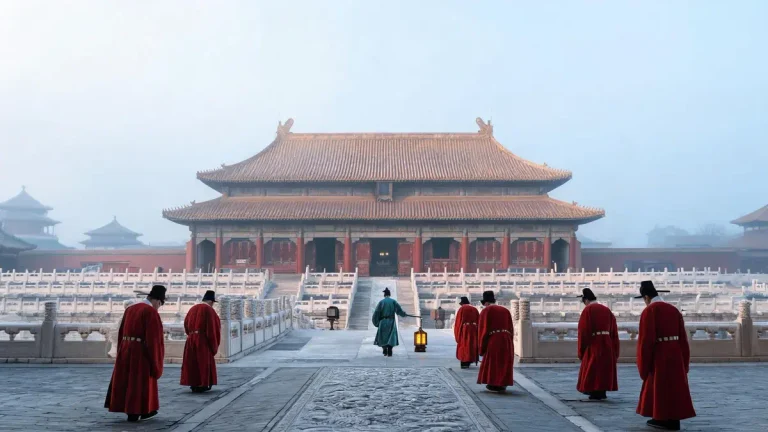
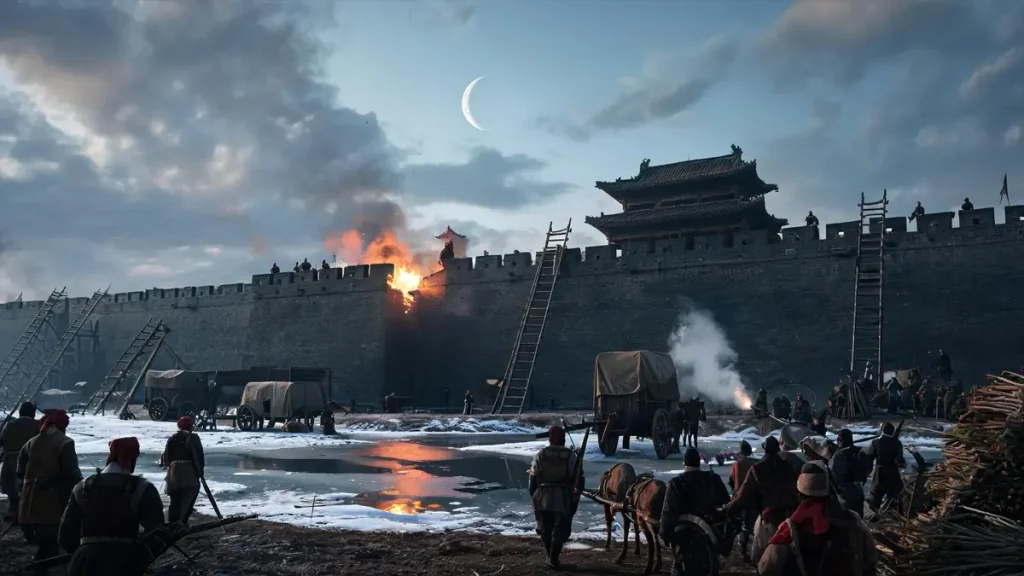
On the evening of April 24, 1644, the outer wall of Beijing fell. By dawn the inner wall was gone too, and the Chongzhen Emperor was dead on Wansui Hill, the low mound north of the palace that everyone now calls the Coal Hill.
The Chongzhen Emperor was thirty-three.
His robe carried a message in his own hand. He had shallow virtue, he wrote, and had offended Heaven, but it was his ministers who ruined him. He had no face for his ancestors, so he took off his crown and let his hair cover his face. The last line belonged to the army coming through the gates. Let the rebels divide my body, it said, but do not harm one of my people.
A shorter version circulates more widely, and it is harsher. In that one the Chongzhen Emperor is not the man who lost the realm; his ministers are. Those words are not in the Ming History. The annals quote the robe message in full, and the sentence is not there. The historians chose the first version, the one that admits to shallow virtue.
The Chongzhen Emperor was the last of the sixteen Ming emperors, but he does not fit the usual slot for a last ruler. Of the fifteen Ming emperors before him, one went more than twenty years without meeting his ministers, one invented a title for himself and rode off to war as a general, one gave up government for carpentry. The Chongzhen Emperor toured nothing, built nothing, drank nothing, and stopped the palace plays. In 1627 he came to the throne at sixteen. By the calendar of reign years he held it for seventeen; by counting months it was sixteen and a half.
The Ming History’s appraisal opens with approval. For seventeen years, it says, he kept away from music and women, worried, worked, and gave his heart to governing. Not many of the sixteen earned that sentence. The second half of the same appraisal says something else. He trusted eunuchs, put them in key posts, and took one wrong measure after another. Diligence and disorder sit in the same paragraph, and the historians did not try to reconcile them.
So the question is not why a bad man lost an empire. It is why a man who read memorials past midnight could not hold one together.
The August the Chongzhen Emperor inherited
In the eighth month of 1627 the Tianqi Emperor fell ill and called his younger brother to court. He died on the third day after that summons, and the throne passed to a boy of sixteen who would rule as the Chongzhen Emperor. The dead man was twenty-three and had no son. Their father had reigned for one month. In the seven years between, state business had sat in the hands of Wei Zhongxian, and officials across the empire had built shrines to him as far out as the frontier garrisons.
The Chongzhen Emperor moved fast. In his third month, Wei was sent to Fengyang and hanged himself on the road. Lady Ke, Wei Liangqing and Hou Guoxing were executed. In 1628 came an edict that no eunuch was to leave the palace gates without orders, a ban on rambling memorials, the destruction of the Compendium of the Three Reigns, and the abolition of supernumerary posts. Xu Xianchun, who had run the imperial prison, was executed. In the first month of 1629 the case against the eunuch faction was graded in six degrees. Wei was already dead, and his corpse was mutilated anyway.
Liaodong was a separate account. Fushun fell in 1618. In 1619 four columns marched out and three were destroyed, with 310 officers and 45,800 men lost. Liaoyang and Shenyang went in 1621, Guangning in 1622, and the line pulled back to Shanhai Pass. By the time the Chongzhen Emperor took over, the Ming held only a few points outside the pass. Everything on that line cost silver, and the silver came out of fields in Shaanxi and Henan.
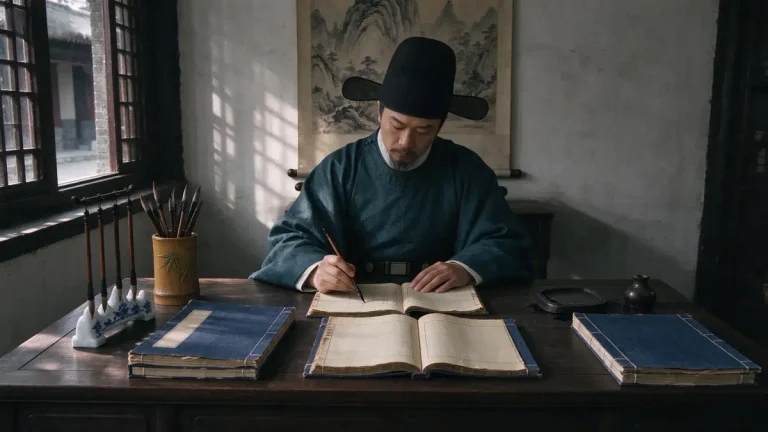
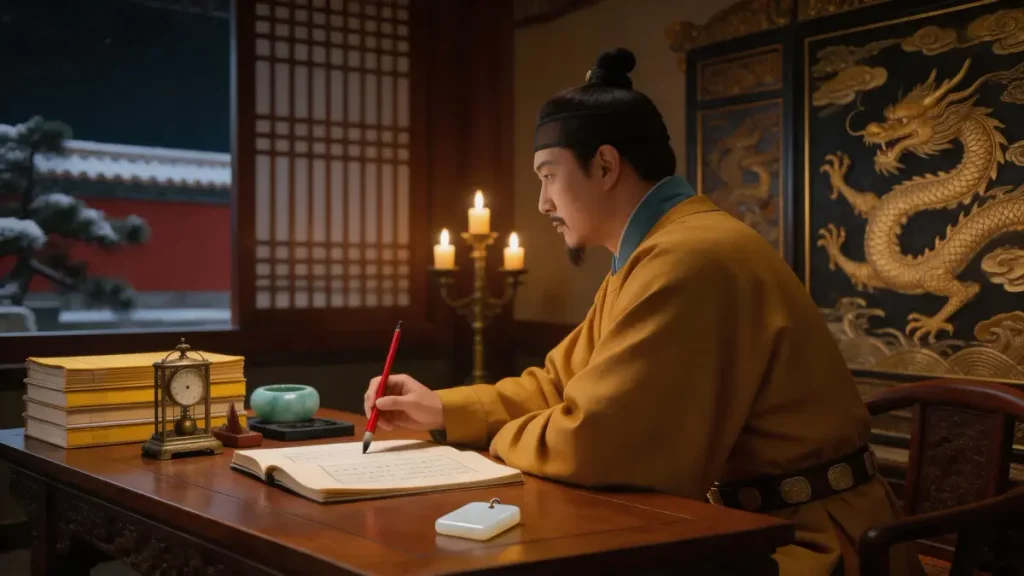
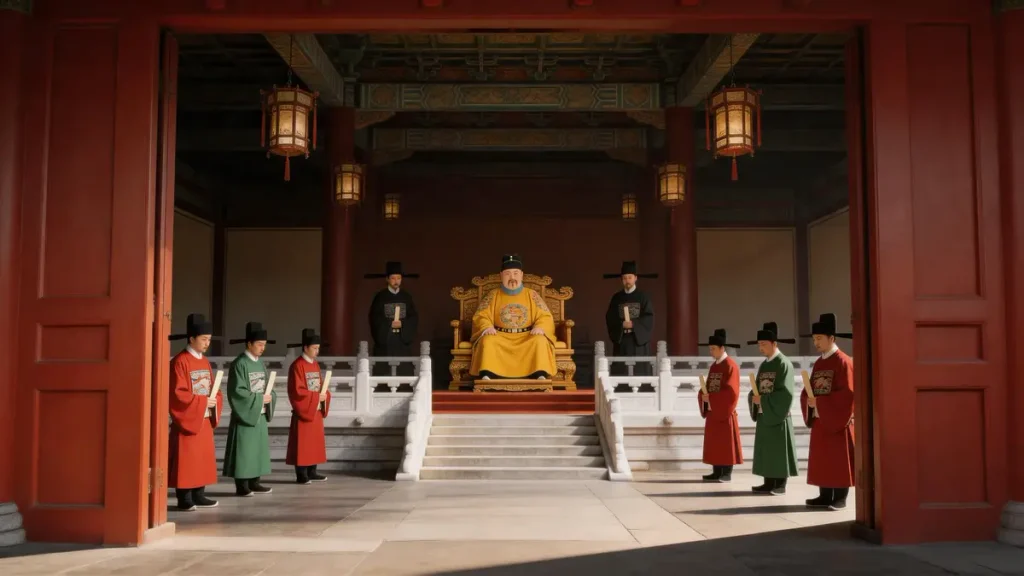
In the eighth month of 1628 the Chongzhen Emperor set himself a rule: except in extreme heat or cold, he would sit in the Wenhua Hall every day and discuss business with his grand secretaries. It went into an edict, not a diary. Two of the emperors before him had gone years without holding court. He put himself in the hall and stayed there.
That same twelfth month, the annals record a different line. Famine in Shaanxi, surcharges the peasants could not pay, and bandits rising in bands across Fuzhou and Yan’an. The purge was in Beijing. The hunger was in Shaanxi. Both happened in the same year.
The ledger the Chongzhen Emperor inherited was not good either. In the middle of the sixteenth century about two million taels a year reached the Grand Treasury, seven parts of it spent and three held back for war or bad harvests. By 1620 the nine frontier commands were costing 2.8 million. Once the war in Liaodong began, a surcharge was added, then raised, then made permanent at 5.2 million. The deficit was already fixed in place when he sat down, and the money went into a war with no end in sight.
Drought in the north, and a silver line cut at sea
The famine that met the Chongzhen Emperor in his first year was not a single bad year.
From 1637 to 1643 the north went through a run of drought that climate researchers rank as the worst in five hundred years. Gazetteers from a dozen Shandong counties repeat the same phrases about a summer without rain and no wheat, about famine and grain that could not be bought. In 1639 the Yidu county gazetteer records no rain from the first month to the sixth, then locusts in the seventh, then famine, then people eating each other, then refugees on the roads. The next year, forty-eight counties in Shandong recorded cannibalism. The annals compress all of it into one line for 1640: in the two metropolitan regions, Shandong, Henan, Shanxi and Shaanxi, drought and locusts, and people ate each other.
Relief did go out. In the intercalary first month of 1640 the annals record three separate shipments, to Zhending, to the poor of the capital, and to Shandong. A fourth followed in the third month. It was grain from the Grand Treasury and silver from the privy purse, passed down through the counties. The drought that year covered five provinces, and a few thousand bushels to a county is a few days of food.
The locusts started in eastern Shaanxi, southern Shanxi and around Kaifeng, then spread west to the Guanzhong plain and east to Xuzhou, and crossed the Huai to the south. Drought brought locusts, and locusts brought plague. In the seventh month of 1641 the annals put five characters in front of the word plague in the capital: the Linqing canal had run dry. Linqing was the throat of the grain route. With the canal dry, rice from the south could not come north. The capital ran out of grain before it ran out of nerve. In 1643 plague lasted in Beijing from the second month to the seventh. The annals record what the Chongzhen Emperor’s government did. It released prisoners held for minor offenses, opened the privy purse for medicine, and paid for the burial of unclaimed bodies inside and outside the five wards. It was everything available. It was not much.
Underneath the weather sat something further away.
After 1581 the single-whip reform had folded taxes and labor service into one payment in silver. It was simpler to administer, and it tied the empire’s revenue to how much silver arrived from abroad. Three routes brought it. Spanish America sent it across the Pacific on the Manila galleons, Japan sent it through Macao to Canton, and India sent it through Malacca to Macao. All three routes failed within a few years of each other. Before the European trade slump of the 1620s, as many as forty-one Chinese ships called at Manila in a year. By 1629 the number was six. Silver came back in the 1630s, then stopped harder. In 1634 Spain restricted shipments from Acapulco. In the winter of 1639 the Chinese community in Manila was massacred. In 1640 Japan cut off trade with Macao. In 1641 Malacca fell to the Dutch and the route from Goa closed.
The other end of that chain ran through Jiangnan, where the Chongzhen Emperor’s revenue came from. As the international silk trade shrank, silk districts like Huzhou in northern Zhejiang went into depression. Silk could not get out, and silver could not get in.
Then came the part that reads backwards. Silver got dear, and dear silver ruined the peasant. His tax was assessed in silver and his harvest was in grain, so he had to sell grain to get silver. With little silver in circulation, a shi of rice bought less of it, and the same tax took a shi and a half of rice to pay. The rate on the books never moved. The burden went up by half.
At the same time the Chongzhen Emperor’s court was raising the rate. By the time the training surcharge was added, censor Hao Jin put the arithmetic in a memorial. At the end of Wanli’s reign the nine frontiers cost 2.8 million taels. The Liaodong surcharge now stood at nine million, the bandit-suppression surcharge at 3.3 million, and the training surcharge above seven million. His question closed the memorial: since when has any dynasty taken twenty million a year to the capital, and another twenty million from the capital to the frontier?
The fiscal treatise adds six characters after that question. It could not be done.
The Chongzhen Emperor knew the base had gone. In the sixth month of 1643 he remitted the three surcharges and all ordinary taxes for two years in the ruined counties. By then most of those counties were inside the war zone. He was forgiving revenue that no longer existed.
After Songshan, the Chongzhen Emperor had one army left outside the pass
The Manchu threat had hung over the frontier for twenty-six years, counting from the fall of Fushun in 1618.
In the tenth month of 1629 Manchu cavalry came through the Da’ankou gap. Beijing was put under martial law in the eleventh month. Zhao Shuaijiao, the Shanhai Pass commander, rode to meet them and died outside Zunhua. Zunhua fell and its grand coordinator, Wang Yuanya, died. When the horsemen reached the Desheng Gate, the commanders Man Gui and Sun Zushou went out and both were killed.
It happened every few years after that. In 1634 they came through Shangfangbao to Xuanfu, in 1636 to Changping, in 1638 through the Qiangziling pass. The 1638 raid went two thousand li in, stayed five months, and took more than seventy cities in the metropolitan region and Shandong. Jinan fell in the first month of the following year, and the Prince of De was taken prisoner. Inside the pass, something else was burning. Li Zicheng came from Mizhi in northern Shaanxi. He had worked as a runner at the Yinchuan post station, and the Ming History calls him a fine archer and a hard man who broke the law more than once. He escaped a death sentence and became a butcher. In the fourth month of 1629 the court abolished the post stations. The saving was real: wages, horse feed, and the rations owed to officials traveling on state business added up to a large sum every year. The consequence is recorded in a single line: the wandering men of Shanxi and Shaanxi who had lived off post-station rations had nothing to eat, and they went over to the bandits, and the bandits grew.
That same season, a bureau director in the Ministry of War named Li Jizhen reported that the people of Yan’an were close to starving to death. He asked for a hundred thousand taels of silver. The annals give the Chongzhen Emperor’s answer in two characters: he refused.
The runner whose job was abolished took an army to Beijing fifteen years later.
Both fronts drew on one purse. In the second month of 1642 Songshan fell and Hong Chengchou surrendered. In the third month Zu Dashou surrendered Jinzhou. The troops that could still fight outside the pass were gone by then, except for Wu Sangui at Ningyuan. In the ninth month of the same year Li Zicheng broke the Yellow River dikes at Kaifeng and drowned the city, with tens of thousands dead in the water. In the tenth month of 1643 Sun Chuanting died at Tongguan with the last mobile army in Shaanxi. The annals give the reason that army came apart in five characters: the troops withdrew for lack of food.
By the second month of 1644 the Chongzhen Emperor was calling on every province to send troops. Only one commander came, Tang Tong, and he was posted to Juyong Pass with the eunuch Du Zhizhi beside him. Tang Tong surrendered at the pass. With Juyong open, the northern approach to Beijing had no wall left.
Guns were a third line, and a foreign one. Xu Guangqi and his circle had argued for years that Western artillery was the answer. In 1630 the court brought a Portuguese gun crew up from Macao, led by a captain named Goncalo Teixeira Correa. They helped hold Zhuozhou and the capital, then went to Dengzhou to train Chinese gunners under Sun Yuanhua. In the intercalary eleventh month of 1631 Kong Youde mutinied at Wuqiao. Dengzhou fell in the first month of 1632. Correa and twelve Portuguese died in the fighting, and Joao Rodrigues, then seventy-one, got over the wall alive. The court granted Correa the rank of assistant regional commander after his death, and executed Sun Yuanhua in the seventh month of the same year.
In those same years Johann Adam Schall von Bell was working on the calendar at the Directorate of Astronomy. The Chongzhen calendar treatise was finished in 1634, in 137 juan. It was not promulgated. Conservatives fought it for ten years, until the Chongzhen Emperor finally agreed that the Western method was more accurate and ordered it issued. The order came too late to be carried out. A calendar took the last ten years of a dynasty to get approved.
Five years on the platform
In the seventh month of 1628 the Chongzhen Emperor summoned Yuan Chonghuan to the Platform, a hall inside the palace where he liked to question officials in person. Yuan had just been made Minister of War and given command of the northern frontier. Asked for his plan, he said it was all in the memorial he had already sent. Then he added the sentence that decided his life: give him five years and the whole of Liaodong could be recovered.
The Chongzhen Emperor was pleased. Recover Liaodong, he said, and he would not begrudge a marquis’s title.
During a break, a supervising censor named Xu Yuqing went up to Yuan and asked what the five-year plan actually consisted of. Yuan’s answer was that the emperor was worn out with worry, and that he had said it to comfort him. Xu pointed out that the emperor was sharp and that a careless answer would be called in on schedule. The Ming History says Yuan looked stricken. He sent a follow-up at once. Within five years, he wrote, the Ministry of Revenue had to move the pay, the Ministry of Works had to supply the equipment, the Ministry of Personnel had to pick the men, and the Ministry of War had to move the troops. Only if every office did its part would it work. The emperor ordered all four ministries to comply on the spot.
A sentence spoken to calm a tired man became a contract with a ruler who checked deadlines.
In the sixth month of 1629 Yuan had Mao Wenlong killed on Shuang Island without trial. In the tenth month the Manchu army came through the passes. He marched back to defend the capital, and on the first day of the twelfth month he was summoned to the Platform a second time, seized on the spot, and put in the Embroidered Uniform Guard prison. In the eighth month of 1630 he was torn apart in the marketplace. His brothers, wife and children were sent three thousand li into exile and his property was confiscated. He had no son and no money left, and the Ming History says the whole country knew he had been wronged. The step in between was a planted rumour. The Manchu command let two captured eunuchs overhear a conversation about a secret deal with Yuan, then released them. They ran back to Beijing and reported it, and the Ming History says the Chongzhen Emperor believed it without doubt.
When the arrest happened, Zu Dashou was standing in the room. He shook, went out, and took his troops back toward the pass. He came back only when the Chongzhen Emperor sent him a letter written in Yuan’s own hand from prison. The Ming History’s verdict on the whole affair runs to two sentences. Yuan wrongly killed Mao Wenlong, and the Chongzhen Emperor wrongly killed Yuan. After Yuan died the frontier had no one, and the fall of the dynasty was settled.
The same machinery ran once more over peace talks. In 1642 Minister of War Chen Xinjia was negotiating with the Manchus on secret orders. Dozens of edicts went back and forth, and every one of them was marked with an instruction not to let it leak. Then a report came in from the front. Chen read it and left it on his desk. A servant mistook it for a routine dispatch and sent it out to be copied, and the censors erupted.
The Chongzhen Emperor sat on the protest for a few days, then issued a sharp reprimand. Chen refused to admit fault and instead listed his own achievements, which made it worse. He went to prison and was executed. Zhou Yanyu and Chen Yan argued for him, citing the rule that a minister of war is not executed unless the enemy is at the gates. The emperor’s answer was that seven imperial princes had been killed and insulted, which was worse than an enemy at the gates.
The Ming History states the reason plainly. In his last years, it says, the Chongzhen Emperor hated Chen for leaking state business and for making the emperor’s own fault visible, and so killed him without hesitation. What could not be made public was that the Chongzhen Emperor had wanted the peace.
Eighteen months later came the move south. In the second month of 1644 the Censor-in-Chief of the Left, Li Banghua, and the right vice supervisor Li Mingrui put two options on the table: the emperor withdraws to Nanjing, or the crown prince goes there to command the army. Both were refused. In the third month Grand Secretary Li Jiantai sent a memorial asking for the withdrawal. The Chongzhen Emperor called the court to the Platform and showed them the memorial. A ruler dies for his altars of state, he said. Where would he go?
Li Banghua asked again, this time only for the prince. He was refused again. That was the fourth day of the third month. The walls fell fifteen days later.
No eunuch leaves the palace gates without orders
In the eleventh month of 1631, questioning ministers at the Wenhua Hall about military and civil business, the Chongzhen Emperor came to the subject of eunuchs. If his ministers would do the work in earnest, he said, why would he need men like these.
He did not trust the eunuchs. He trusted the ministers less, and he said so himself.
After that sentence, the Chongzhen Emperor’s eunuchs multiplied. In the eleventh month of 1628 he had withdrawn the eunuch supervisors from the frontier garrisons. In the ninth month of 1631 he sent Wang Yingzhao and Deng Xizhao to watch the grain and pay of the Ji, Liao and Ningyuan commands. In 1632 Cao Huachun took charge of the capital garrison. In 1633 Chen Dajin and others were attached to the field armies, and Gao Qiqian was sent to watch the pay at Ningyuan and Jinzhou. In the eighth month of 1635 the supervisors were withdrawn again, except from the capital and the pass. In the third month of 1640 the provincial postings were abolished. In the second month of 1644, with Li Zicheng already in Shanxi, the Chongzhen Emperor sent ten men out at once to watch the frontier and the approaches to the capital. In the third month Wang Chengen took command of the city’s defense. Of the ten sent out in the second month, Du Xun surrendered as soon as he reached Xuanfu.
The Grand Secretariat turned over faster. Later counts put the number of grand secretaries who served under the Chongzhen Emperor at around fifty, with variants of one or two, but the order of magnitude is not in dispute. The number by itself says little. What says something is the verbs in the annals: over seventeen years, retired appears twenty-nine times, dismissed ten, imprisoned eleven, executed nine. The executions included Xiong Wencan, who accepted Zhang Xianzhong’s surrender and then lost him again, killed in the tenth month of 1640; Zheng Chongjian, killed in the third month of 1641; and Chen Xinjia, killed in the eighth month of 1642. In the eleventh month of 1643 Fan Zhiwan and Zhao Guangbian were executed on the same day, four months before the walls fell. Xue Guoguan and Zhou Yanyu were ordered to kill themselves, the latter in the twelfth month of 1643, three months before the end. Yang He, who had tried and failed to pacify the rebels by negotiation, was imprisoned and sent to the frontier.
Some of them deserved it. Xiong Wencan did mishandle the surrender, and Yang He’s negotiation did collapse. But when the men in a post are removed or killed in sequence, the next man in the post thinks first about not making a mistake, and second about getting anything done.
The other half of the court was faction. The case of 1629 graded the eunuch party into six degrees of guilt. Once the list existed, it became ammunition for fifteen years of denunciation. Wen Tiren built his career on attacking Qian Qianyi and lasted seven years in the Grand Secretariat. Zhou Yanyu was senior grand secretary twice, and the second time ended with an order to die. The Donglin and their opponents traded the upper hand several times, and neither side ever produced a working government.
In the first month of 1644 Grand Secretary Li Jiantai offered to raise troops outside the capital at his own expense. The Chongzhen Emperor went to the Zhengyang Gate tower to see him off. Six weeks later Li sent in the memorial asking the emperor to withdraw south. After that he surrendered to Li Zicheng at Baoding.
At the bottom of the system the arithmetic was simpler. Abolishing the post stations saved wages and horse feed. It also put men like Li Zicheng on the road. Three years later the rebel bands in Shaanxi were full of former post-station men. The savings had to be made up in military spending, the military spending came out of surcharges, and the surcharges came out of peasants who had already stopped paying. In 1633 the eunuch Zhang Yixian asked permission to collect 17 million taels in tax arrears. The Chongzhen Emperor approved it. That number was the answer to its own question.
A concubine’s grave at Changping
Nine days after the walls fell, Li Zicheng’s men carried the coffins of the Chongzhen Emperor and his empress out to Changping. Local people opened the tomb of Consort Tian and put them inside.
The Chongzhen Emperor had no tomb of his own. In seventeen years he never built one. The last ruler of a dynasty that lasted 276 years was buried in the grave of a concubine.
In the fifth month the Qing army entered Beijing. They reburied him with imperial rites, gave him the posthumous name Zhuanglie Min, and called the place Siling. Min means the one who was pitied. The dynasty that had just taken the city needed a decent ending for the one before it, and needed the world to understand that the Ming had fallen on its own.
That same year Martino Martini was in Hangzhou. He wrote down what he had seen, and in 1654 the book was published in Germany, the Low Countries, Italy and the Netherlands at once. Only then did European readers learn in detail what had happened in Beijing. It was ten years after the suicide, and the Shunzhi emperor was already secure.
Before that book, Europe read about China as Matteo Ricci had described it, a rich country run by philosophers. After it, Europe read about a country taken by cavalry.
Schall stayed in Beijing. He cut down the calendar the Ming had spent five years compiling, ten years arguing over, and no time at all using, and presented it to the new court. It became the Qing’s Shixian calendar, and he became the first foreign director of the Directorate of Astronomy. The same book was waste paper under one dynasty and a founding document under the next.
The Chongzhen Emperor had spent seventeen years choosing men, and the men who finally decided what his reign meant were a Portuguese gun captain, a German astronomer and an Italian priest.
The appraisal of the Chongzhen Emperor ends where it started. At court, it says, he sighed and wished for men of exceptional ability, and the men he used were the wrong ones, so the work only got worse. Then comes the last line: was this not the work of fate.
That is where the historians stopped. They had written down every event and could not join them into one chain, so they handed the end of the argument to a word nobody can check.
What can be checked is the shape of his diligence. The Chongzhen Emperor took everything into his own hands: reading memorials, appointing and removing officials, deciding who went to prison and who was executed. He did that work quickly and without hesitation. Finance, weather, grain transport and military organization were not that kind of work. They needed men to stay in one place for ten years without being replaced. They needed a system that kept running even when he was not paying attention.
The system he had was the one he kept taking apart. In seventeen years the Chongzhen Emperor removed more officials than he kept.
Later researchers reconstructed the drought of 1637 to 1643 as a curve. The bottom of that curve sits directly over the years when Li Zicheng entered Henan, Zhang Xianzhong entered Sichuan, Kaifeng drowned, and Tongguan fell. A curve cannot make a decision for anyone. It does show what was arriving on the desk in Beijing: reports of things that had already happened, and very little that could still be decided.
After the nineteenth day of the third month, from Grand Secretary Fan Jingwen down, several dozen men in Beijing died for him. It is not a large number. When a dynasty of 276 years ends, only a few dozen people are willing to go with it.
Sources and further reading
History of the Ming, juan 23, Basic Annals, first part: the purge of the eunuch faction, the daily court at the Wenhua Hall, the Shaanxi famine and banditry of 1628, the abolition of the post stations, and the eunuch supervisors sent out and recalled.
History of the Ming, juan 24, Basic Annals, second part: the message on the robe, the refusal to withdraw to Nanjing, the drought and plague entries, the drowning of Kaifeng, the last day on the hill, and the closing appraisal quoted at the end.
History of the Ming, juan 78, fiscal treatise: two million taels of ordinary revenue, the Liaodong surcharge fixed at 5.2 million, and Hao Jin’s figures for the three surcharges.
History of the Ming, juan 257, biography of Chen Xinjia: the secret negotiations, the servant who leaked the letter, the remark about seven princes, and the reason given for the execution.
History of the Ming, juan 259, biography of Yuan Chonghuan: the exchange on the Platform, the planted rumour, the execution and confiscation, and the verdict that the frontier had no one left.
History of the Ming, juan 309, biographies of the rebels: Li Zicheng’s years at the Yinchuan post station, the consequences of abolishing the post stations, and the refusal of the relief request for Yan’an.