Hongxi Emperor Zhu Gaochi: Ten Months That Turned the Ming
In the fourth month of 1425 the granaries of Shandong and the Huai valley were empty, and the local officials were still collecting the summer tax. The Hongxi Emperor called Yang Shiqi to the Western Corner Gate and had him draft an edict on the spot: cancel this year’s summer tax, and half of the autumn grain. Yang said the Ministry of Revenue and the Ministry of Works ought to be told first. The emperor answered that relieving the people’s poverty should be like saving them from fire or from drowning, with no time to hesitate, and that the ministries, worried about the treasury, would sit on the order. He called for paper and brush, had Yang write the edict on the gate tower itself, read it, sealed it and sent it out. Then he said, "Now you may tell the ministries."
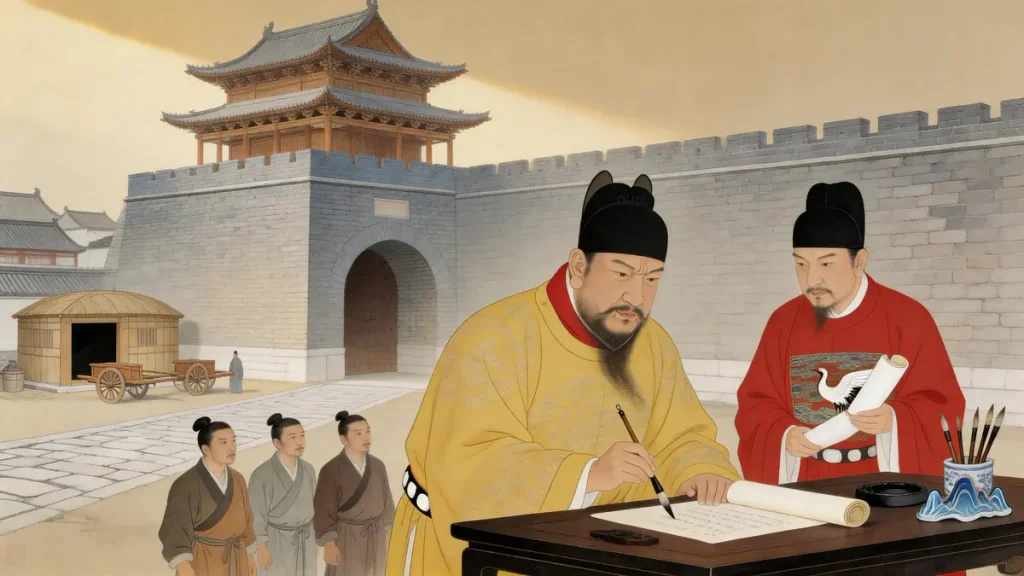
An edict cancelling two taxes had gone around the Ministry of Revenue.
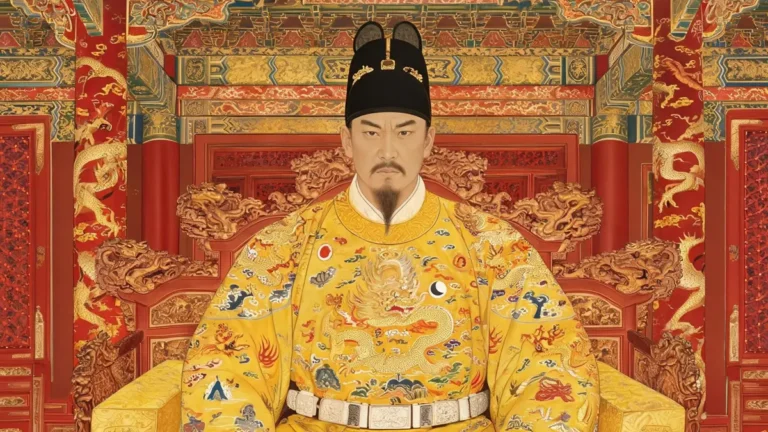
The man who issued it was Zhu Gaochi, temple name Renzong, who reigned as the Hongxi Emperor. He took the throne on September 7, 1424 and died in the Qinan Hall on May 29, 1425. That is 264 days, ten lunar months. The appraisal appended to his reign in the History of the Ming says he held the throne for one year, and gives his age at death as forty-eight by the old counting, which is forty-six.
Hong means vast. Xi means bright, harmonious, flourishing; xixi in the old texts is the look of peace and joy. They are ordinary words for a good reign. Hongxi had a first year and no second.
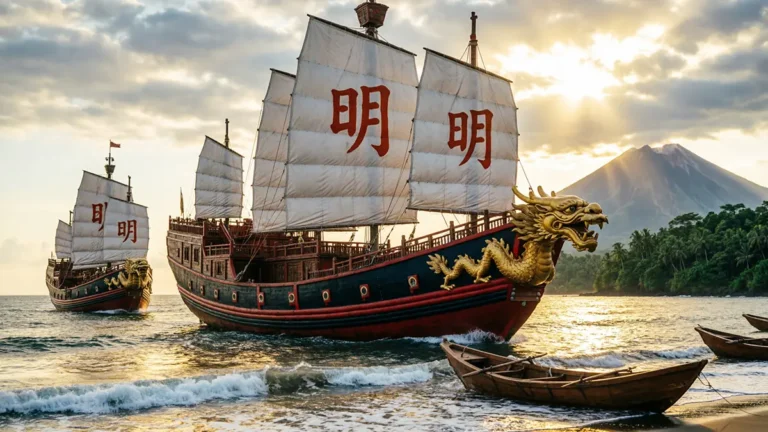
The Hongxi Emperor inherited a state with several large works running at once. Beijing was still being built. The Grand Canal was carrying grain north. The war in Jiaozhi, the Ming province in northern Vietnam, had gone on for nearly twenty years. The treasure fleet had come back from the Western Ocean two years before. His father’s tomb was not finished. And the palace where he took the throne was still missing its three great halls, burned in April 1421 and never rebuilt.
In ten months the Hongxi Emperor issued edicts that stopped the fleet, stopped the buying, cut the taxes and opened the prisons.
The Hongxi Emperor was the fourth Ming ruler, succeeding the Yongle Emperor and preceding Xuande. The Ming emperors list in reign order places his short reign between those two better-known periods.
A grandson tested at court
In 1395 Zhu Gaochi, then seventeen, was named heir to his father, the Prince of Yan. His grandfather, the Hongwu Emperor, did not set him essays. He gave the boys of the family tasks and watched what they did with them.
One task was to inspect the guards. The heirs of Qin, Jin and Zhou went with him to count the soldiers, and he came back last. Asked why, he said the morning was cold and he had waited until the men had eaten.
Another was to read memorials. The others handed up the whole stack. He reported only the ones that touched the soldiers and the people, and said nothing about the clerks’ mistakes. The Hongwu Emperor pointed at one and asked whether he had been careless. He said he had not: small faults were not worth troubling the throne with.
Then there was a question. The old man asked what the people had relied on when Yao and Tang ruled and floods and droughts still came. He answered: on the sage’s policies of relief. The Hongwu Emperor was pleased, and said his grandson had the mind of a ruler.
The History puts one line before these stories: as he grew older he practiced archery and never missed. The same history, in the biography of his younger brother, says the future Hongxi Emperor was fat and heavy with a lame foot, so that two eunuchs had to hold him up and he stumbled constantly. It is the same man in both places, a boy who could shoot and a crown prince who could not cross a courtyard alone.
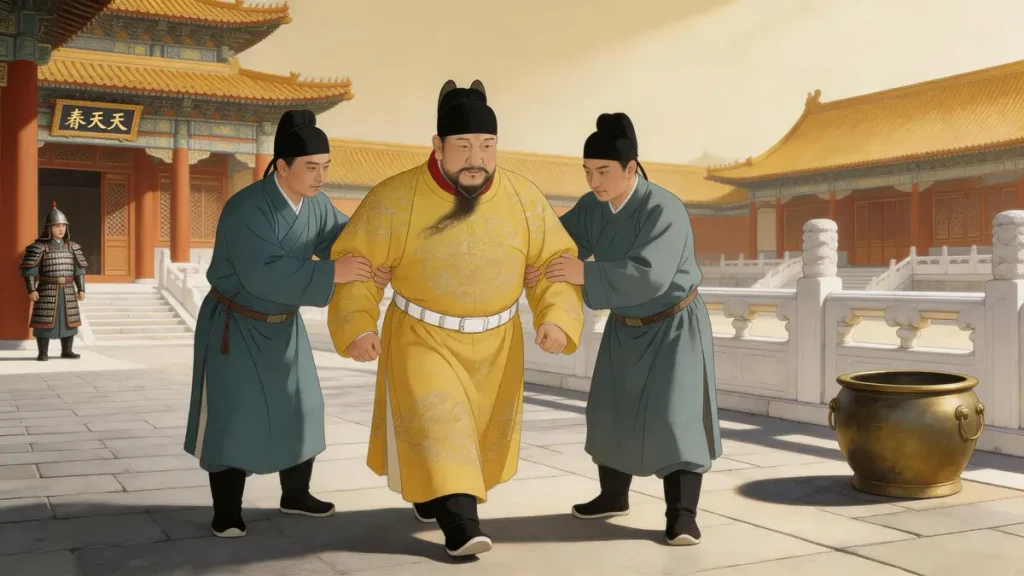
None of the three tests was about war.
The siege of Beiping
In 1399 the Prince of Yan raised troops against his nephew and left his heir in charge of Beiping. The History records that Li Jinglong came against the city with five hundred thousand men. The heir held it with ten thousand, and from then on the rebellion never lost its rear base. The figure is the one the History gives; there is no need to discount it or inflate it. What can be checked is the outcome.
The fighting belonged to his younger brother. Zhu Gaoxu rode with the army, saved their father at the Bai’gou River, and at Dongchang, where Zhang Yu was killed and their father escaped alone, brought his men up in time to drive the southern army back. "Whenever the prince came near disaster and turned defeat into victory," his biography says, "Gaoxu’s strength did most of it." Their father said this son resembled him.
So when the succession was argued, the Duke of Qi, Qiu Fu, and the emperor’s son-in-law Wang Ning spoke for Gaoxu, and came close to displacing the eldest. Two arguments settled it. The eldest was humane and competent, and the Hongwu Emperor had named him. In February 1404 Zhu Gaochi was made crown prince and Gaoxu was given the title Prince of Han, with a fief in Yunnan. He refused to go. "What crime have I committed," he said, "that I should be pushed out ten thousand li?"
One year their father ordered the two of them to the Xiaoling tomb together. The crown prince was heavy and lame, two eunuchs holding him on either side, and he kept stumbling. Gaoxu, behind him, said the man in front stumbles and the men behind learn to watch. The imperial grandson Zhu Zhanji, coming last, answered that there were men behind him to learn the same lesson. Gaoxu looked back and changed color.
Twenty years passed like that. The eunuch Huang Yan carried word to the emperor that the heir was in touch with the court in Nanjing. The heir sent the letter on unopened. When it arrived the emperor read it and said he had nearly killed his son. In 1412, because envoys had been late and a memorial badly worded, the whole staff of the Eastern Palace was jailed, Huang Huai among them. In 1418 Huang Yan accused the heir of pardoning criminals on his own authority, several of the staff were executed, and it took a secret report of seven points from Vice Minister Hu Ying to calm the emperor. Later Huang Yan plotted to put the Prince of Zhao on the throne, was found out and killed, and the Prince of Zhao survived because the heir pleaded for him.
The staff of the Eastern Palace were replaced more than once, and more than one of them went to prison. Yang Pu spent ten years in the Embroidered Uniform Guard’s cells, where the food his family sent often stopped coming, and read the histories and the philosophers through several times.
Someone asked the crown prince whether he knew who was slandering him. "I do not," he said. "I know only how to do a son’s duty."
The edicts of the Hongxi Emperor
The Yongle Emperor died at Yumuchuan in August 1424. Three days after the will reached Beijing, Xia Yuanji and others were let out of prison; ten days after that the Hongxi Emperor took the throne. Xia had been jailed for arguing against the northern campaigns.
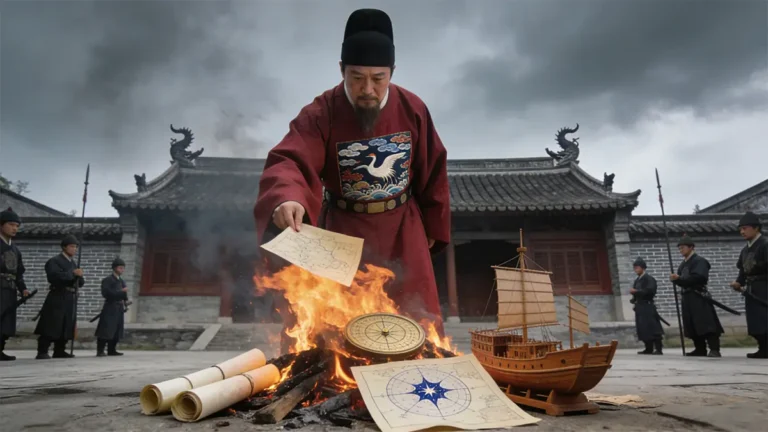
The Hongxi Emperor’s accession edict contained a short list: stop the treasure ships of the Western Ocean, the horse markets of the far west, and the procurement offices in Yunnan and Jiaozhi. Three things, in one sentence. The hand the Yongle court had reached out with was pulled back halfway.
The fleet did not sail again while he lived.
What followed was a series of small administrative acts. Redundant posts were cut. Officials whose sentences had enrolled them in the military registers were sent home. Civil officials were to retire at seventy. The Three Dukes and Three Solitaries were restored as honors for dukes, marquises, earls and ministers. In the ninth month the Hongxi Emperor gave silver seals to Jian Yi, Yang Shiqi, Yang Rong and Jin Youzi, inscribed with four characters, "correct faults and mend errors," and allowed them to send sealed memorials straight to him. In the tenth month he ordered the Three Judicial Offices to review prisoners together with the grand secretaries, the ministries, the Office of Transmission and the Six Offices of Scrutiny, at the Gate of Heavenly Succession, and made it a standing rule.
Joint review stopped being an emergency measure and became routine.
In the eleventh month an edict went to the Ministry of Rites. The families of the officials who had served the Jianwen Emperor were to be freed. They had been held in the Imperial Music Office, in the Embroidered Uniform Guard, in the Palace Laundry, or as slaves in the houses of meritorious officials. All of them were now commoners, and their land came back to them. Men exiled for speaking out were covered too. A month later he pardoned the relatives who had been sent to the frontier as whole families: one man to each family was to stay, and the rest could go home. Twenty-two years had passed since the fighting.
In the third month of 1425 the Hongxi Emperor issued an edict on punishment, phrased without ornament. Punishment exists to stop violence and turn people toward good, not to kill. Then the specifics. Every case was to be sentenced under the statute. If the emperor punished outside the law, the judicial offices were to object, and if five objections were refused, they were to object again with the Three Dukes and the senior ministers, and keep at it until he gave way. No office was to flog a prisoner’s back or impose castration. No collective punishment except for treason. The ban on slander was lifted, and informers were to be ignored.
The same year the Hongxi Emperor had Yang Shiqi and others fix the quotas for the examinations, sixteen shares to the south and fourteen to the north. It was the first time the examinations were allotted by region.
Two small episodes survive in Yang Shiqi’s biography. An edict cutting the annual household supply had been out for two days when the Fuel Office sent down an order for eight hundred thousand jin of dates, which contradicted it. Yang mentioned it, and the Hongxi Emperor halved the order at once. The other concerned mourning. The twenty-seven days of the mourning period had run out and the Minister of Rites, Lü Zhen, asked that ordinary dress be resumed. Yang Shiqi refused, and Lü shouted him down in front of the others; Jian Yi put both opinions before the throne. The next day the emperor held court in a plain cap and unhemmed hemp, and of the whole court only Yang Shiqi and the Duke of Ying, Zhang Fu, were dressed the same way. After the session he said to those around him that the coffin was still in the hall, and how could a subject bear to speak of changing his clothes.
None of it was large on its own. One edict, one seal, one argument about mourning dress. In ten months the Hongxi Emperor released men, cut taxes, limited punishments and opened the way for advice.
The year Beijing became a temporary capital
A month or so after the Hongxi Emperor took the throne, bad news came from Jiaozhi. The deputy regional commissioner Chen Zhong had been killed at Qinghua, and Le Loi’s men were still moving north. That month he recalled the minister Huang Fu from Jiaozhi. The war had run nearly twenty years, and Chen Zhong was not its only dead.
In the third month of 1425 the Hongxi Emperor ordered that Beijing’s offices be styled xingzai, where the court resides, and restored the branch ministry and the rear military commission. To call Beijing a place where the court happened to be was to say that the court meant to go back to Nanjing.
In the fourth month the Hongxi Emperor sent the crown prince, Zhu Zhanji, to the Xiaoling tomb and told him to stay on in Nanjing. The preparations were real: the palaces, the offices and the granaries in the south all had to be reconnected.
Then, in the fifth month, the Hongxi Emperor transferred the readers Li Shimian and Luo Rujing to the censorate for having spoken out, and had them jailed. Li’s case is recorded in another biography. He had sent up a memorial that angered the emperor, was brought to the informal hall, and refused to yield; the emperor ordered the guards to beat him with a golden mace, three ribs broke, and he was dragged out close to death. The next day he was made a censor for Jiaozhi and told to review one prisoner and submit one memorial a day. After three memorials he was sent to the Guard’s prison. A thousand-household commander he had once helped happened to be in charge there, called a doctor quietly, and treated him with dragon’s blood brought from overseas. He lived.
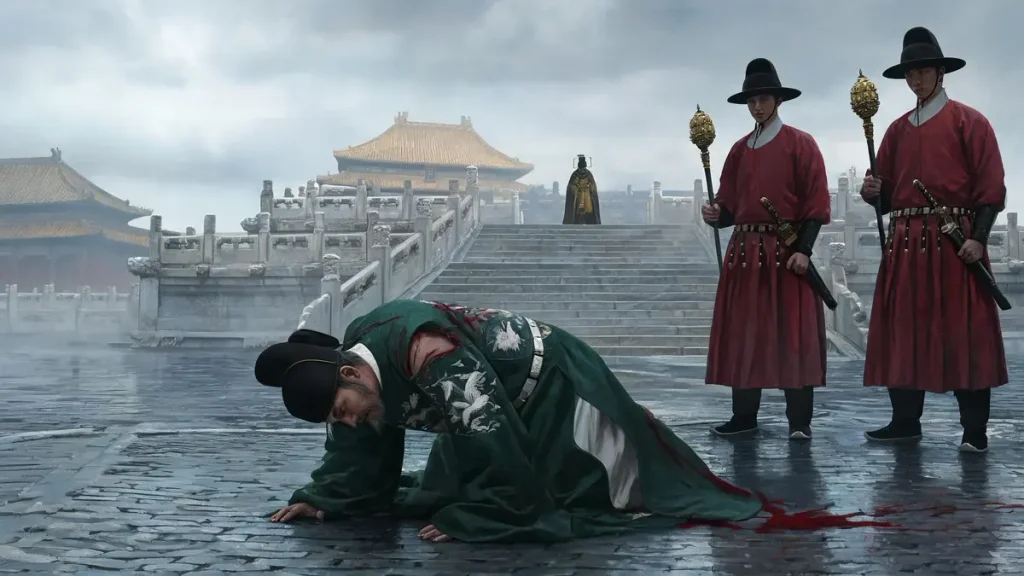
Li Shimian outlived the emperor by twenty-five years.
On the day after that the Hongxi Emperor fell ill and sent for the crown prince in Nanjing. On the next he was dying, and the will naming his heir was issued. To Xia Yuanji he said, "Li Shimian insulted me at court." The anger came up as he said it, and Xia talked him down. That evening the emperor died.
The appraisal records only that he fell ill, that he grew worse, and that he died that day. The biography of Li Shimian puts the sentence about the insult next to the report that the emperor died that evening. A reader will connect them. The History does not make the connection for him. What Li had written only came out after the Xuande Emperor took the throne, when he was asked and named two points. In the mourning period the emperor should not be close to his consorts, and the crown prince should not be kept far from his side. Both pointed at facts. One was the mourning, the other was the son sent south.
The crown prince was still on the road when his father died. Gaoxu tried to set an ambush for him on the way and did not get it done in time.
Hongxi porcelain and an era without marks
In the antique shops and the auction catalogues, six characters on the base of a dish, made in the Hongxi reign of the Great Ming, sell well. The reign lasted a year, so the imperial ware must be rare, and the claim travels widely.
Ye Peilan of the Palace Museum in Beijing put it plainly in a 2018 article on reign marks. Not every Ming emperor produced marked imperial porcelain. For Jianwen and Hongxi in the early period, for Zhengtong, Jingtai and Tianshun in the middle, and for Taichang at the end, no genuine piece with a reign mark has yet been found. What circulates with those marks is mostly later imitation and modern invention.
Reign marks were not yet standard under the Yongle Emperor and only became so under the Xuande Emperor. The Hongxi reign sat between them, and its ten months of kiln output mostly went unmarked, which makes it impossible to separate from late Yongle and early Xuande ware. Catalogues deal with the gap by writing early fifteenth century, or by filing the piece under Yongle to Xuande and leaving it there.
About the taste of the Hongxi Emperor’s court one thing has to be said first: there is no marked body of objects to point at. Calling Hongxi porcelain restrained and warm turns a gap in the catalogues into a style.
The objects do not carry the claim.
The raw material is one place to look. The saturated blue of Yongle and Xuande blue and white came from imported cobalt, and the supply ran through the voyages and the horse markets of the west. The Hongxi Emperor’s accession edict stopped both. By the Chenghua reign the palette had changed to another ore. Scholars have worked on every link in that chain, and none of them lets us lay the Chenghua change at the door of the Hongxi Emperor’s ten months.
The court’s taste is the other place, and it left documents. The Hongxi Emperor loved learning, the appraisal says, and talked with scholars without tiring. In the first month of 1425 he built the Hongwen Pavilion to the left of the Sishan Gate, put officials known for learning and conduct on duty there, and put Yang Pu in charge, handing him the seal himself. "I keep you at my side for more than scholarship," he said. "I want to know the condition of the people, and I want help in governing. When you have something to propose, seal it and send it in." In the third month Quan Jin, lately an assistant in the office that fed the court, was made a Grand Secretary of the Hall of Literary Glory for his filial conduct. That seat usually went to a man out of the Hanlin Academy.
The Xuande Emperor abolished the Hongwen Pavilion and called Yang Pu into the Grand Secretariat. The ascendancy of the Three Yangs dates from there, and the dozen years that followed, the Renxuan flourishing, rested on that group. The compilers of the History looked back and said that from Renzong and Xuande onward the Grand Secretariat grew heavy, and its grand secretaries did in practice what grand chancellors had once done.
In the eighth month of 1426, a year after the Hongxi Emperor’s death, Gaoxu rebelled. The Xuande Emperor went out against him in person, and at Le’an Gaoxu came out of the city and admitted the crime. He was reduced to commoner status and walled up inside the Xi’an Gate, where he and his sons died one after another. Six hundred and forty of his supporters were executed; fifteen hundred more were sentenced to death or to the frontier. Of the two men who had traded warnings on the road to the Xiaoling tomb, one was emperor and one died inside a wall.
Beijing’s status dragged on for another twenty years. In 1441, when the three great halls and the two rear palaces were finished, an edict finally fixed the capital there and the offices stopped calling themselves xingzai.
The appraisal of the Hongxi Emperor is generous, with one condition attached. In one year on the throne his appointments and his government were more than can be written down. Had heaven given him the years, and the empire the rest to be soaked in kindness, would his rule not have stood beside Wen and Jing?
The two era names that came after his lasted ten years and fourteen.