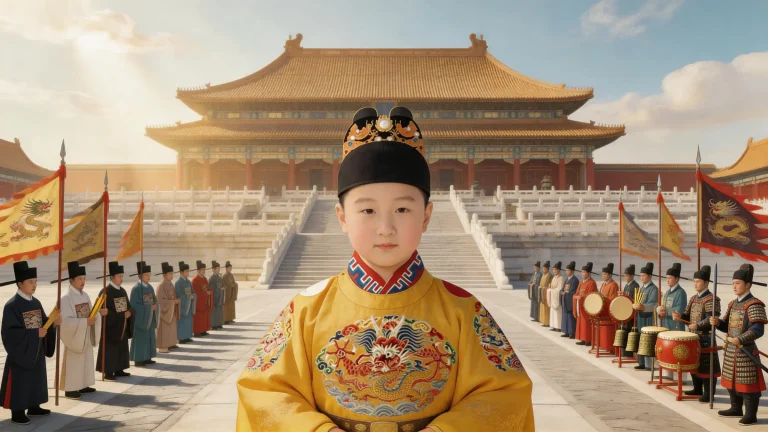
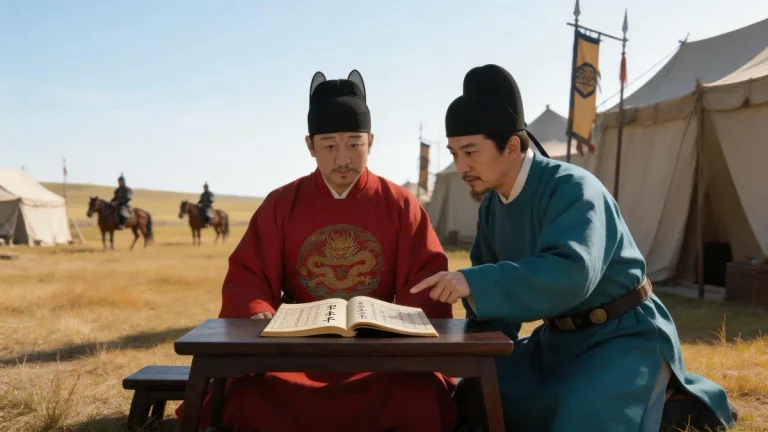
Jingtai (Ming Daizong / Zhu Qiyu): The Erased Emperor Who Saved China
Shi Heng held the key to the Chang’an Gate. In the small hours of February 11, 1457, while the Jingtai Emperor lay dying in the retreat outside the south wall, he had it opened a crack, let a column of soldiers through, and shut it again so that nobody outside could follow. The sky was overcast, and Xu Youzhen climbed onto a roof to read the stars, coming down to say the moment had come and must not be missed. The party moved toward the Southern Palace.
The gate there was sealed. They broke down the wall.
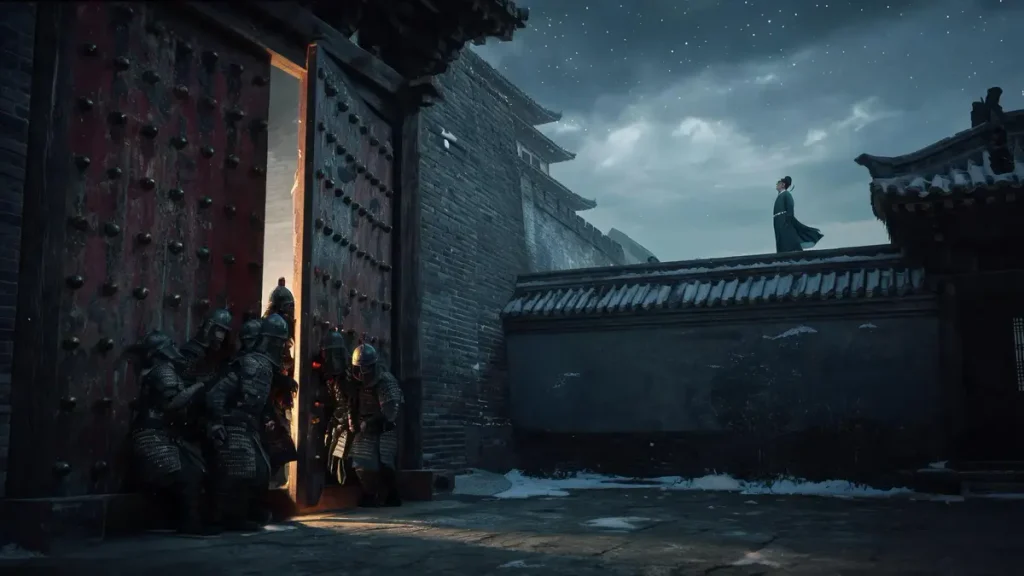
Through the gap they found the Retired Emperor sitting alone under a lamp. He asked what this was, and they knelt and asked him to take the throne. Someone called for a carrying chair, and the soldiers were shaking so badly they could not lift it. Xu Youzhen and several others put their hands on the poles and helped carry it themselves. At the East Glorious Gate the guards blocked the way. The Retired Emperor said, "I am the Retired Emperor." The gate stayed shut, so they turned back and went in through the Gate of Heavenly Reception.
Zhu Qiyu, known by his reign title Jingtai and posthumously as the Daizong Emperor, was the seventh ruler in the standard list of Ming emperors. For his place in the succession and the reign dates of the other rulers, see the full list of Ming dynasty emperors.
At dawn the officials came to court as usual. The word from the palace the day before was that the emperor had recovered and would hold audience that morning. They were waiting below the gate for the Jingtai Emperor. Instead there was shouting from inside the hall, then every gate opened, and Xu Youzhen came out and told them the Retired Emperor had been restored. They went in to congratulate him. He received the court at the gate that morning and took the throne in the main hall at midday. Five days later the era name changed from Jingtai to Tianshun. Before that night, the man in the Southern Palace had been confined for six and a half years. Seven and a half years earlier, the same city had panicked in a different way.
The Zuo Shun Gate, and a guard beaten to death in the hall
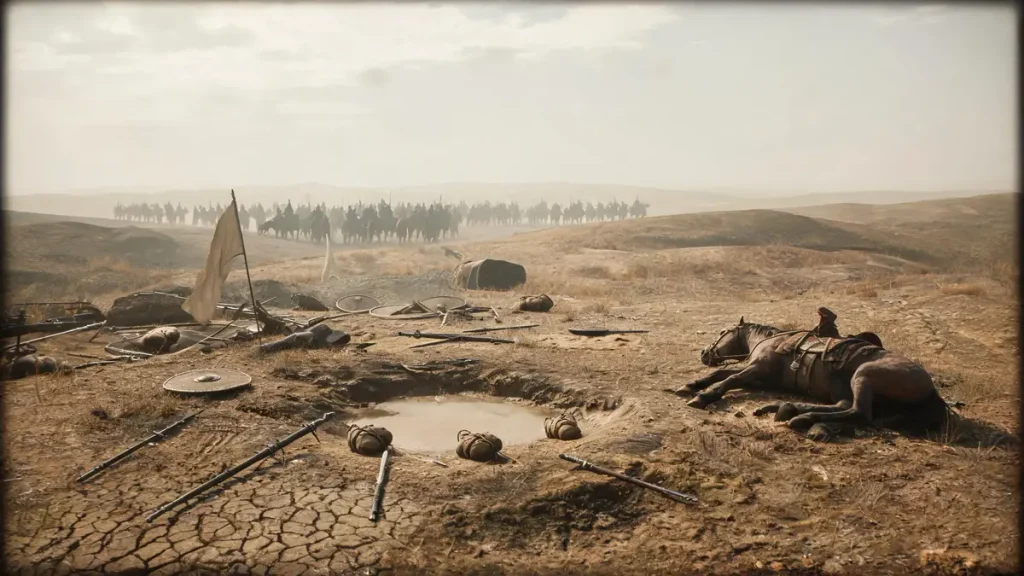
On September 1, 1449, there was no water at Tumu. The Ming army collapsed and the emperor, Zhu Qizhen, was carried off by the Oirat Mongols. The histories call him the Zhengtong Emperor for these years and Yingzong after his death. The report reached Beijing and the ministers wept in open court. Empress Dowager Sun named his half-brother Zhu Qiyu regent, and in the same run of edicts had the captive emperor’s infant son Zhu Jianshen made crown prince.
One day that month, the prince held a session at the Zuo Shun Gate. The officials demanded that the family of Wang Zhen, the eunuch who had talked the emperor into the campaign, be wiped out. Wang Zhen’s ally Ma Shun, a commander of the Embroidered Uniform Guard, was standing in the hall and cursed the censors to their faces.
Wang Hong, a supervising secretary, went at him with his fists. Everyone followed, and the court broke into a brawl while the guards outside began shouting. The prince was frightened and tried to leave. Yu Qian, still vice minister of war, pushed through the crowd, held him in place, and made him announce that Ma Shun and the others deserved death and the matter was closed. That stopped it, though Yu Qian’s sleeve was torn to pieces in the scuffle.
Ma Shun was beaten to death on the spot.
Outside the gate, Minister of Personnel Wang Zhi took Yu Qian’s hand and said the state depended on him now, and that a hundred Wang Zhis could do nothing today. Weeks earlier this court had been haggling over gifts owed to Oirat envoys. Three thousand of them had come, many using false names to collect a second share, and the Ministry of Rites had paid only for the real ones. Now there was a body on the floor of the palace, killed in session.
Twenty-two thousand men outside nine gates
After the news from Tumu, Yu Qian was promoted from vice minister to minister of war. Most of the ministers who had ridden out with the emperor were dead, and the office was empty. At the council, the expositor Xu Cheng said the stars had shifted, the mandate was gone, and only a move south could save the dynasty. The eunuch Jin Ying shouted him down. Yu Qian said that anyone who spoke of moving south should be executed, that the capital was the root of the realm, and that one step back would end everything, as it had for the Song. On September 22 the prince took the throne and sent his brother the title of Retired Emperor.
The immediate effect was that Esen’s hostage had lost its price. He wanted ransom and cities; the answer from Beijing was a second emperor. The Retired Emperor spent a year beyond the frontier and did not buy back a single town. In October, Esen brought him to Datong and turned on the Zijing Pass; the pass fell, and the Oirat army reached the walls of Beijing. Yu Qian put 220,000 men outside the nine gates and kept no reserve. He took the Desheng Gate with Shi Heng, facing Esen directly. There were two orders: a commander who fell back ahead of his troops was to be beheaded, and troops who fell back ahead of their commander were to be cut down by the ranks behind them.
Desheng was clean: Shi Heng set an ambush in empty houses and sent a few riders out as bait. More than ten thousand Oirat cavalry came after them. The deputy commander Fan Guang opened up with firearms and the ambush rose. Esen’s brother Boluo and a minister named Mao Naihai were killed by cannon fire. At the Zhangyi Gate things went wrong. The Ming troops had pushed back the Oirat vanguard when several hundred eunuchs from the palace rode out to grab the credit, broke the formation, and got the commander Wu Xing killed by a stray arrow. The Oirat chased them to the earthen wall, where people climbed onto their roofs and threw bricks and stones down, and the noise carried across the city. Reinforcements arrived and the Oirat pulled back.
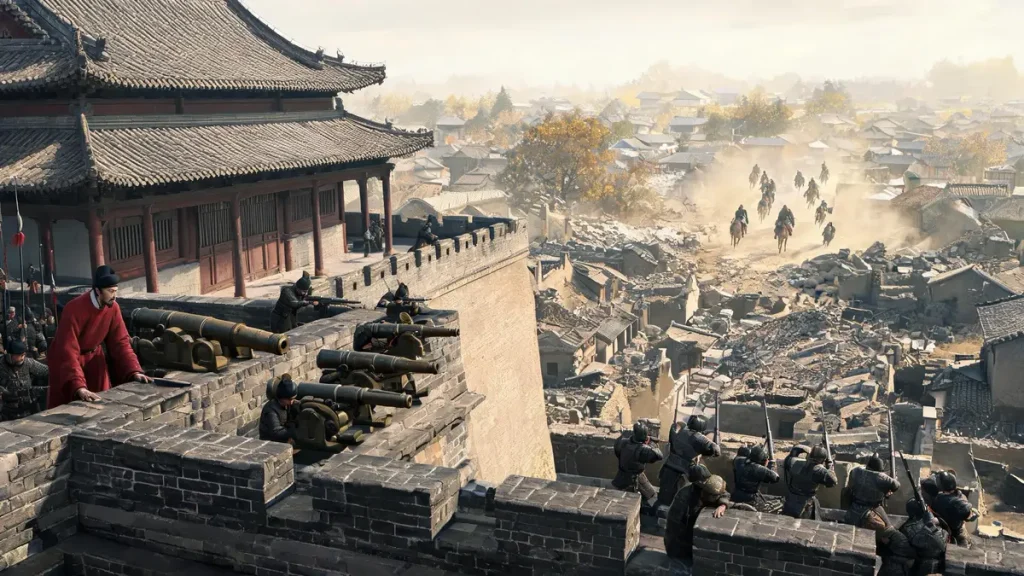
The standoff lasted five days, and when Esen asked for Yu Qian, Wang Zhi and Hu Ying to come out and negotiate he got no answer. The provincial armies were moving toward the capital, and he did not want his line of retreat cut. He took the Retired Emperor west through Liangxiang. Yu Qian was made a junior guardian and given overall command of the armies. He said that fortifications on all four sides were the shame of the ministers, and that he would not claim merit.
"The throne is settled. What else could there be?"
The Retired Emperor came back in September 1450. He entered through the Juyong Pass, was met at the East Glorious Gate with full ceremony, and was taken to the Southern Palace. The emperor led the officials there to pay their respects that same day.
Bringing him back had been argued over for a long time. The Jingtai Emperor did not want to send anyone, and said so plainly: he had never asked for the throne, and it was they who had pushed him onto it. Yu Qian answered that the throne was settled and nothing else could come of it, but propriety required them to bring his brother home quickly, and if the other side was playing a trick they would at least have the record on their side. The emperor gave way. "As you wish, as you wish."
Later writers put seven characters in Yu Qian’s mouth: the altars of state come first, the ruler counts for less. They are not in his biography in the Ming History. What the biography has is two other lines, one at the council, that anyone who spoke of moving south should be executed, and this one here, that the throne was settled. The first refused an enemy. The second invited a brother home. Both point at the same thing. Someone was already sitting on the throne, and bringing the elder brother back changed none of it.
After he came back, the Ministry of Rites tested the water twice. In November, Minister Hu Ying asked that the officials be allowed to congratulate the Retired Emperor on his birthday. Refused. In December he asked that they be allowed to pay respects at the Yannan Gate on New Year’s Day. Refused again.
The Southern Palace stood in the southeast of the imperial city. For the next six and a half years it was the one part of the palace the Jingtai Emperor left shut. Later accounts say the trees around it were cut down, the gate was locked and its keyway filled with lead, and food went in through a hole in the wall. The official record keeps only the two refusals, and four characters in the Ming History’s verdict on him: the inner palace was sealed deep.
In May 1452, the Jingtai Emperor replaced the heir
On a single day in May 1452 the Jingtai Emperor did three things. He demoted the crown prince, his nephew Jianshen, to prince of Yi. He made his own son Jianji crown prince. He deposed Empress Wang and raised the boy’s mother, Consort Hang, to empress. Jianshen was the son of the man in the Southern Palace, made heir at two and now four. Jianji was his own.
The logic is not hard to guess. The heir he had inherited was his brother’s son, and the moment he died the throne would go back to his brother’s line. He wanted to bend that line. The price was a break with the civil bureaucracy, because the Ming house rule held that the heir follows the principal wife and that a primary son and a secondary son cannot both be enfeoffed. There was no precedent for setting aside an elder for a younger.
To get it through, he bought the great ministers with titles. Shi Heng was given the honorary post of Grand Preceptor of the Crown Prince that year. In November of the following year, the crown prince died. After that the Jingtai Emperor had no son.
For three years the court kept raising it. In May 1454, Zhang Lun of the Ministry of Rites and the censor Zhong Tong petitioned to restore the prince of Yi and were sent to the Embroidered Uniform Guard prison. In August 1455, Liao Zhuang, a judicial official in Nanjing, raised it again and was flogged below the palace gate; Zhang Lun and Zhong Tong were dragged out of prison and flogged again, and Zhong Tong died under the rod. In February 1456, Empress Hang died, and that same month the emperor ordered work on his own tomb. In December he fell ill and canceled the New Year audience.
Fifteen thousand men in ten camps, and a river that ran clear
Most of what got done in those seven years was not done by the Jingtai Emperor himself. The capital garrison had been split among the Five Army, Firearms and Three Thousand Battalions, each with its own commander and none answering to another, so that any deployment required them to wait for each other. Yu Qian picked 150,000 of the best men, divided them into ten camps and trained them as one body. This was the integrated training corps, set up in December 1452, commanded by eunuch and military officers under the supervision of Yu Qian, Shi Heng, Liu Yongcheng and Cao Jixiang. It was the first time the Ming capital army had been put together as something that could be marched out and fought.
The Yellow River was harder. It had broken its banks at Shawang, and seven years of repairs had failed. The court nominated Xu Youzhen, the same Xu Cheng who had argued for moving south and had since changed his name. He went out as assistant censor-in-chief, surveyed the water, and came back with three proposals: build sluices, open a diversion channel, dredge the canal.
Wang Hong, now in charge of grain transport, wanted the breach plugged at once because the canal was too shallow for the barges. Xu refused. The shallows at Linqing were an old problem and had nothing to do with the breach. A plug put in that autumn would fail the next spring and the work would be wasted. He said he would not go after quick credit.
The court let him do it his way. He raised labor from the counties, ran a channel from Zhangqiu to meet the Yellow River and the Qin, held the scattered overflow behind nine weirs, built a great dike and set sluices in it. The work took 555 days. The channel was named Guangji, the sluice Tongyuan. When Shandong flooded in the autumn of 1456 and broke a good deal of the river wall, the stretch he had built held. He was promoted to vice censor-in-chief for it.
In the same years the northern problem solved itself. Esen declared himself khan in August 1454 and was killed by the Oirat councillor Alagh the following year. Earlier that same year, in the first month, the court annals record one line. The Yellow River ran clear from Longmen to Ruicheng. That was the year the floggings over the succession were at their worst. The historian wrote it down and offered no explanation.
February 11, before dawn
On February 6, the Jingtai Emperor was too weak to walk and had himself carried to the suburban retreat for the sacrifice to Heaven. He could not perform the rite, and summoned Shi Heng to the bedside to take his place. Shi Heng received the order there, saw how sick the man was, and went to find Zhang Yue and Cao Jixiang to talk about restoring the elder brother.
Shi Heng and Zhang Yue took the idea to Xu Bin, chief minister of the Court of Imperial Sacrifices. Xu said this was a merit that came once in an age, that he was too old to do anything about it, and that Xu Youzhen was the man for a desperate plan. Shi Heng went to Xu Youzhen’s house that same night. On the night of February 10 the group met there again. Xu went up on the roof to read the sky and came down saying the hour had come. There happened to be a frontier alarm, so he had Zhang Yue announce that extraordinary precautions were needed and move troops into the palace precincts. Shi Heng had the gate keys, and at the fourth watch he opened the Chang’an Gate, let them in, and shut it behind them.
Then they broke down the Southern Palace wall. The emperor was due to hold court the next morning. The officials were waiting below the gate when the shouting started.
Yu Qian and the Grand Secretary Wang Wen were arrested that day. The charge was treason: that they had colluded with a minor official named Huang Hong to change the heir, and had plotted to bring in a son of the prince of Xiang; the censor-in-chief Xiao Weizhen drew up the verdict. Wang Wen argued hard. Yu Qian laughed and said this was what Shi Heng wanted and arguing would do no good.
The memorial went up, and Yingzong hesitated, saying that Yu Qian had in fact done great service. Xu Youzhen said that if Yu Qian was not killed, the whole affair would have no name to stand on. Five days later the era name was changed to Tianshun, and the day after that Yu Qian and Wang Wen were executed. The confiscation found no surplus money in the house; the main room was locked tight, and inside were the robes and swords the emperor had given him. Chen Kui, a vice commissioner-in-chief, collected the body and buried it, and the next year it was taken back to Hangzhou.
The empress dowager did not know at first that Yu Qian was dead; when she heard, she grieved for days. Yingzong came to regret it too. The next year Chen Ruyan, who had taken over the Ministry of War, was ruined by a corruption case, and his takings ran to a fortune. Yingzong had the ministers brought in to look at it and said that Yu Qian, for all the favor he had enjoyed under Jingtai, had died with nothing, and asked how Chen had come by so much. Shi Heng could not answer. Later, when there was another alarm on the frontier and it showed on the emperor’s face, the Marquis of Gongshun, Wu Jin, said that if Yu Qian were alive the enemy would not have got this far. Yingzong said nothing.
About the man on the sickbed, the official record has one line. A notebook from the period adds that he heard the bells and drums, asked what it was, was told the Retired Emperor had been restored, and said, "Good."
The Ming History does not have that line.
A prince’s grave in the western hills
In the second month of 1457 the Jingtai Emperor was demoted to prince of Cheng and moved to the Western Inner Palace. Eighteen days later he died there, aged thirty by Chinese reckoning. The posthumous title given him was Li, one character meaning wayward or cruel. The tomb he had built for himself was destroyed. He was buried as a prince in the western hills, with two hundred soldiers’ households assigned to guard the grave.
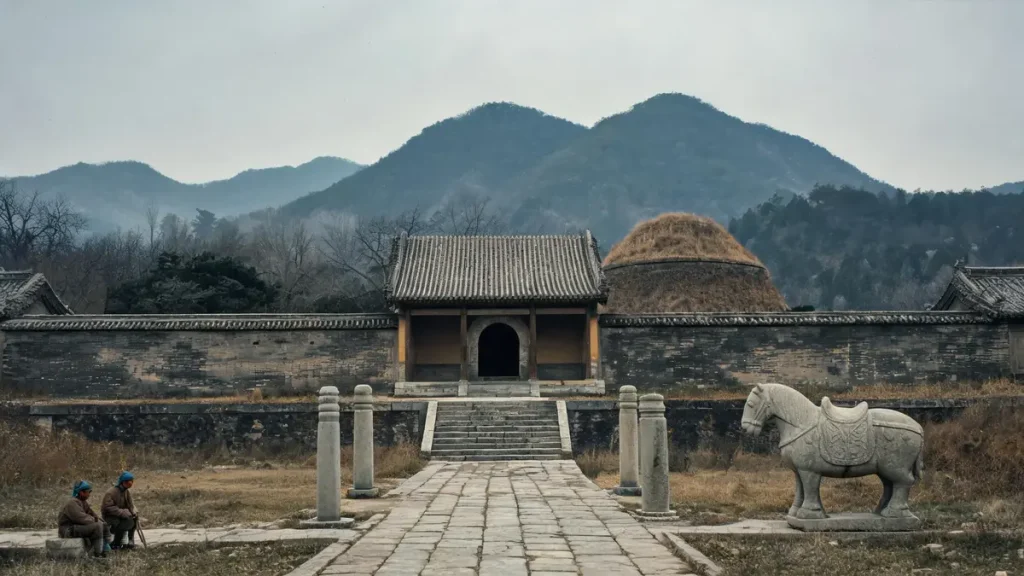
Since the Ming moved its capital to Beijing, its emperors had been buried together in the hills at Changping. Sixteen emperors, thirteen graves. The founder lay in Nanjing, the Jianwen Emperor had no tomb at all, and the last exception was Zhu Qiyu, alone at the foot of Yuquan Hill outside the Jinshankou pass. There was one small matter. In the second month of 1457, the director of the Imperial Observatory, Tang Xu, asked that the era name Jingtai be abolished as well. Refused.
In 1475, the Chenghua Emperor restored his uncle’s imperial title. The edict read that the prince of Cheng had taken the throne in a crisis, put down rebellion, preserved the state and steadied the ancestral altars for nearly eight years. At the end, it said, with the emperor dying, officials greedy for merit had stirred up slander and asked for the title to be cut away. The late emperor, it said, had soon learned this was unjust. The edict ordered the title restored, a posthumous name discussed, and the tomb repaired so that sacrifices would follow the same rules as the other imperial graves. The grave is still there. It is called the Jingtai Mausoleum.
None of the men who arranged the coup died in bed. Shi Heng was dismissed in 1459 and imprisoned in 1460 on a treason charge, his property confiscated; he died in prison a month later, and his nephew Shi Biao was executed that same year. Cao Jixiang rebelled in 1461, was defeated, and was cut to pieces in the marketplace with his clan wiped out. Xu Youzhen was made duke of Wugong for his part, fell out with Shi Heng and Cao within months, was imprisoned, and was sent in exile to the frontier in Yunnan. Released after Shi Heng’s fall, he lived out his life at home. He went on reading the sky, said the general’s star stood over Wu, carried an iron whip and danced with it when the mood took him. When he heard that Han Yong had won a campaign in the south, he threw the whip down and said, "So the boy answers to the stars too."
Yingzong lived seven years more, dying in early 1464 at thirty-seven. His will had one clause: the palace women were not to be buried with him.
A reign title left on a copper body
Cloisonné enamel came to China from outside. When it first arrived, the antiquarian Cao Zhao’s Essential Criteria of Antiquities called it Dashi ware, ghost-country ware, or Fulang inlay. By the late Ming and early Qing, writers referred to the enamel of the Jingtai imperial workshop. The Qing palace workshops set up an enamel division in 1680, and their archives called the technique copper-body cloisonné, which is still the technical name.
The earliest record of "Jingtai blue" that anyone has found comes from 1728, in the archives of the Qing imperial workshops. A ledger entry for the fifth day of the fifth month that year records a batch of objects sent up by Prince Yi, among them a cloisonné vase with flowers copied from Jingtai blue. The Yongzheng Emperor’s comment was: not good.
Three explanations are usually offered for the name, and none of them holds. The first says the craft began in the Jingtai years, but the earliest dated cloisonné carries a Xuande mark, more than twenty years before. The second says the finest work was done under Jingtai, yet the Jingtai Emperor’s reign ran less than seven years, the Miao rebellions in the south had not been put down, the north had just come through a war, and the treasury was paying out. A copper-body cloisonné piece had to be filled, fired, refilled and fired again three or four times, and one vessel cost as much as dozens of porcelains. Whether the workshops had the money and men to push the craft to a peak in those years is a question the surviving record cannot answer. The third says the pieces are blue-grounded, but from the late Ming on there are plenty with white and other grounds.
The marks are the real problem: only four Ming reign marks appear on surviving cloisonné, those of Xuande, Jingtai, Jiajing and Wanli. Jingtai marks are the most common and the hardest to date. The Palace Museum in Beijing holds more than a hundred pieces with Jingtai marks, and the British Museum, the Brooklyn Museum and the Hermitage all have groups of their own. The objects themselves run from the Yuan to the Republic. Most were made in the Kangxi reign, either by reworking older vessels, by scraping off an earlier mark and cutting Jingtai in its place, or by firing new pieces and marking them Jingtai from the start.
A researcher at the Palace Museum put it plainly: from the documents and the surviving objects, there is no cloisonné from the Jingtai period at all. So the position of those two characters on the copper was, in large part, given to them by workshops working more than two centuries later.
In Beijing today, the men who make the stuff still call it Jingtai blue.
Questions readers ask
Sources and further reading
The Ming History (Mingshi), annals of the Jingtai Emperor, juan 11: https://zh.wikisource.org/wiki/明史/卷11
The Ming History, annals of Yingzong after his restoration, juan 12: https://zh.wikisource.org/wiki/明史/卷12
The Ming History, biography of Yu Qian, juan 170: https://zh.wikisource.org/wiki/明史/卷170
The Palace Museum, on distinguishing cloisonné in its collection: https://www.dpm.org.cn/Uploads/wenhua/E32/E32d.htm
The Palace Museum, on the origin of the name Jingtai blue: https://www.dpm.org.cn/Uploads/pdf/1511/T00013_00.pdf
Wikipedia, "Jingtai Emperor": https://en.wikipedia.org/wiki/Jingtai_Emperor