The Battle of Lake Poyang: The Bloodbath That Birthed the Ming Dynasty
Picture this. It’s 1363. You’re standing on the shores of Lake Poyang in central China. In front of you, stretching across the water, is something that shouldn’t exist in the 14th century.
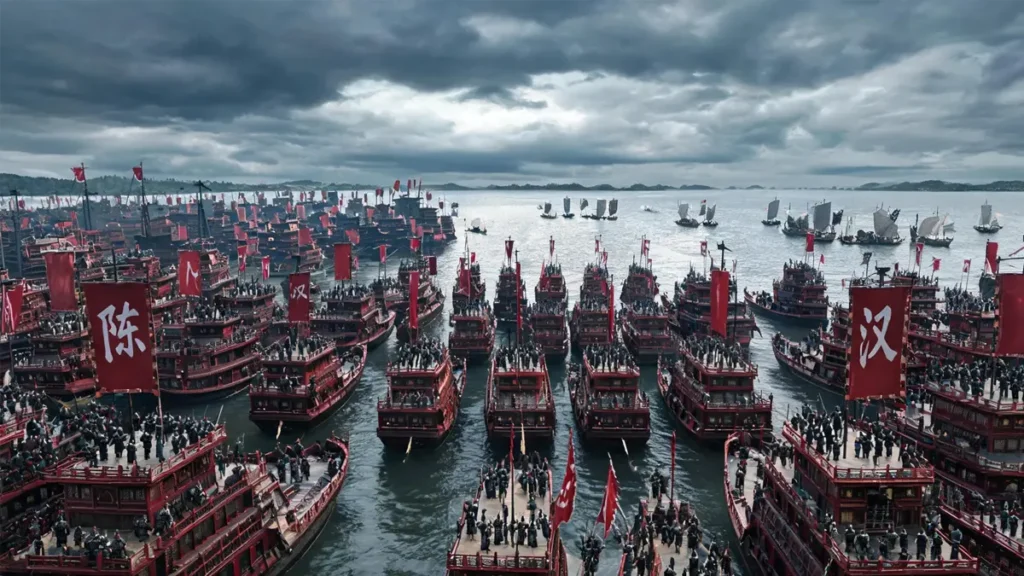
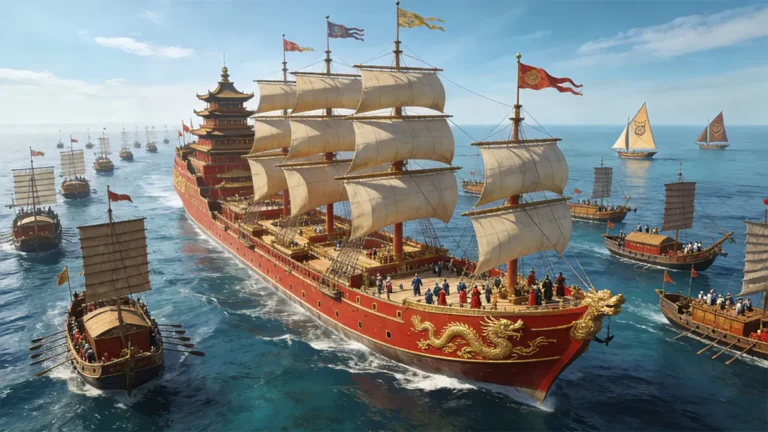
Chen Youliang’s fleet. Hundreds of tower ships, each three stories high, painted blood-red, so massive that horses can gallop across their decks. They’re locked together in a floating city of wood and steel, and they’re coming to erase you from history.
Now look down at your own fleet. Fishing boats. Transport barges. A handful of small war junks that wouldn’t reach the second deck of Chen’s monsters. You’re Zhu Yuanzhang, a peasant who clawed his way up from famine and begging, and you’re about to fight the largest naval battle the world would see until the 20th century.
This is the Battle of Lake Poyang. And against every rule of warfare, the peasant won.
Did 800,000 people really fight on this lake? Let’s talk numbers.
This is always the first question, and it’s a fair one. Chinese sources claim Chen Youliang brought 600,000 men to the lake, while Zhu Yuanzhang fielded 200,000. That’s 800,000 people. For context, the Spanish Armada in 1588 carried about 30,000 men. The Battle of Lepanto in 1571, the largest galley battle in European history, involved maybe 80,000 combatants on both sides.
Eight hundred thousand on a lake in 1363? I’m skeptical. Not because I doubt the Chinese chroniclers were trying to be honest, but because ancient and medieval sources everywhere—from Herodotus to the Norse sagas—inflate numbers as a matter of rhetorical tradition. It’s not lying. It’s genre.
Modern historians, including the scholars behind The Cambridge History of China, estimate the real number was closer to 300,000 to 400,000 total. That includes non-combatants—rowers, cooks, carpenters, the logistical tail that every premodern army dragged behind it.
But here’s the thing. Even at 300,000, this battle dwarfs anything happening in Europe at the same time. While England and France were slaughtering each other at Crécy with maybe 30,000 men total, a single battle on a Chinese lake involved ten times that number. The Black Death was ravaging Europe. The Mongol Empire was finally collapsing into fragments. And here, on this lake, two men were deciding who would rule the richest agricultural basin on earth.
The scale, even after we cut the numbers in half, was genuinely terrifying for the 14th century.
Why were rebels fighting each other instead of the Mongols?
If you’re a Western reader unfamiliar with this period, this question makes perfect sense. The Mongols still ruled China. The Yuan Dynasty, founded by Kublai Khan, was technically the legitimate government. Shouldn’t all the rebels be attacking them?
Reality was messier.
By the 1360s, the Mongol Yuan Dynasty was a rotting carcass. Decades of famine, floods, plague, and vicious factional infighting at court had hollowed it out. The Mongols had lost control of the south entirely. The real question wasn’t who would overthrow them—that was already inevitable. The real question was who would replace them.
Imagine the Western Roman Empire in its final decades. The barbarian warlords carving up Gaul and Hispania weren’t cooperating. They were killing each other, because the prize wasn’t the dying empire. The prize was who got to build the next one.
Zhu Yuanzhang and Chen Youliang were those warlords. The Yangtze River basin was the richest, most populous region in the known world. Whoever controlled it controlled the tax base, the granaries, and the manpower to unify China. The Mongol court in the north could wait. The real final boss fight was happening right here, between two southern rebels.
That’s what makes this battle so fascinating. It wasn’t a rebellion against foreign rule. It was a tournament between rivals, and the winner would get to write the next chapter of Chinese history from scratch.
The two men: a peasant survivor versus a ruthless tyrant
Let’s set up our protagonists properly, because their contrast is what gives this battle its narrative weight.
Zhu Yuanzhang was born into a family so poor they barely registered on any tax roll. When the famine and plague of the 1340s hit, his entire family—parents, brothers—died one after another. He was a teenage orphan with no money, no connections, and no future. He became a Buddhist monk purely to avoid starvation, then a beggar wandering through devastated villages. When rebel armies swept through his region, he joined them because the alternative was death.
And then something unexpected happened. This illiterate, traumatized peasant turned out to be a military genius. Not a romantic genius. A cold, calculating, paranoid genius. He understood terrain. He understood morale. He understood that soldiers fight harder when you treat them decently and don’t murder civilians for sport. By his early thirties, he had built a disciplined army and a functioning proto-state around Nanjing, the ancient southern capital.
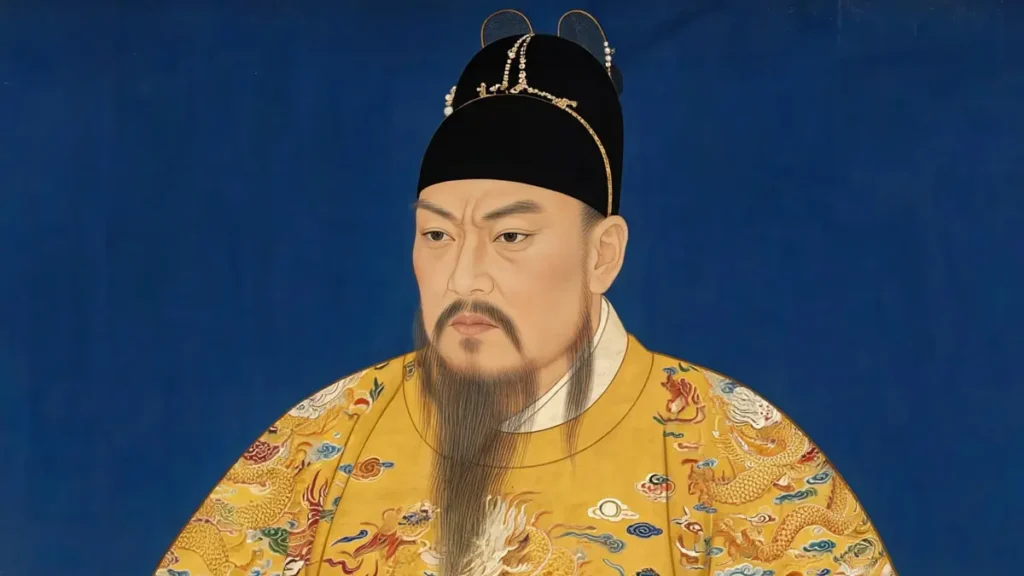
Now look at Chen Youliang. He was everything Zhu wasn’t. A former fishery clerk who murdered his way to power, Chen ran a brutal, top-down dictatorship built on raw force. His soldiers feared him. His officers feared him. He commanded the largest shipyards on the Yangtze and used them to build those monstrous tower ships, each one a floating fortress designed to crush enemies through sheer scale.
Chen represented the old logic of power: if it’s bigger, stronger, and scarier, it wins. Zhu represented something more unsettling: a man who understood that power without legitimacy, without loyalty, was just a pile of corpses waiting to happen.
In the summer of 1363, these two men met on Lake Poyang.
Giant ships versus a wolfpack: How do you fight a floating city?
The gap in hardware was absurd.
Chen’s tower ships were the supercarriers of their age. Three decks. Reinforced hulls. Ramming prows. Archers and catapults raining death from above. Some accounts say they carried up to 3,000 men each. Even accounting for exaggeration, these things were massive. Imagine a castle wall moving toward you across the water. Now imagine hundreds of them, chained together, presenting an unbreakable front.
Zhu’s fleet was mostly improvised. Fishing junks, river barges, small patrol craft. Light. Fast. Fragile. On paper, this wasn’t a battle. It was a slaughter waiting to happen.
Zhu knew this. So he never fought Chen’s battle.
Instead, he fought his own.
His tactic was simple in principle, brutal to execute: use small, fast ships like wolves, darting in and out, never letting the giants pin you down. Harass their flanks. Target their rudders and rigging. Make their size work against them. The analogy a military historian might reach for isn’t Salamis. It’s the wolfpack tactics that German U-boats would use against Allied convoys six centuries later.
But harrying tactics alone wouldn’t win this battle. For that, Zhu needed three things: weather, fire, and his opponent’s ego.
The moment the lake caught fire
The battle had been grinding for three days. Both sides were battered. Chen’s fleet was imposing but increasingly frustrated—those giant ships couldn’t maneuver in the lake’s shallow, shifting channels. Lake Poyang is notorious for its hydrology. In the dry season, water levels drop dramatically. Sandbars and mudflats appear without warning. Chen’s deep-draft tower ships were getting stuck.
Zhu had been waiting for this.
The real weapon arrived on day three in the form of a wind shift. Lake Poyang has a seasonal monsoon pattern that locals understood intuitively. When the wind turned, Zhu’s commanders knew exactly what to do.
They loaded seven small boats with straw, sulfur, and gunpowder. Disguised them as fishing vessels. Let them drift toward Chen’s fleet under cover of smoke and chaos. And then lit the fuses.
This is where Chen made the mistake that every armchair general screams about when they hear this story. He had chained his ships together.
The logic wasn’t entirely insane. A linked formation is more stable. It prevents gaps. It creates a continuous platform for archers. In the constrained waters of Lake Poyang, it probably felt like good defensive doctrine.
It wasn’t.
Once those fire ships hit the front rank, the flames jumped from deck to deck across the iron chains. The wind fanned them into an inferno. Men trapped on the upper decks burned alive. Men who jumped into the water drowned under the weight of their armor. Chinese records describe the lake turning red. Not metaphorically. Thousands of bodies, charred and broken, drifting in water choked with ash.
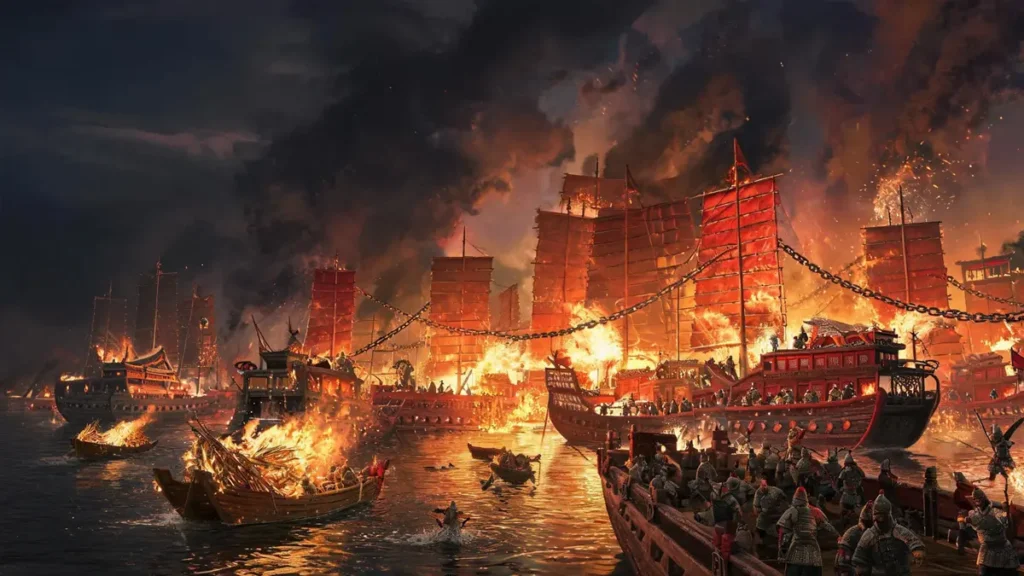
In one hour, Chen Youliang’s invincible fleet became a mass grave.
The gunpowder edge: how Poyang reshaped Chinese warfare
The fire ships were the headline, but there’s a quieter detail that matters enormously for military historians: Zhu’s ships were carrying early firearms.
Hand cannons. Bombards. Fire arrows tipped with gunpowder. These weren’t game-changing weapons on their own—14th-century Chinese firearms were slow, inaccurate, and dangerous to their own users. But against a densely packed formation of wooden ships, accuracy didn’t matter. You just had to point toward the crowd and hope the explosion did something useful.
What’s significant is what happened after the battle. Zhu Yuanzhang had just watched massed fire and gunpowder destroy an enemy he should never have been able to beat. He internalized the lesson completely.
When he founded the Ming Dynasty and became its first emperor, one of his earliest military reforms was creating the Divine Engine Division (Shenji Ying)—arguably the world’s first standing gunpowder army. By the early 15th century, Ming armies would field tens of thousands of arquebusiers and artillery pieces, a proportion of gunpowder troops that no European army would match for another hundred years.
The obsession started here, on this lake, when a peasant saw what fire could do to power.
| Comparison Axis | Chen Youliang’s Fleet | Zhu Yuanzhang’s Fleet |
|---|---|---|
| Ship Type | Tower ships (3 decks, horses on top) | Converted fishing boats, small junks |
| Core Doctrine | Massed assault, ramming, boarding | Swarm tactics, maneuver warfare, fire attack |
| Key Weapons | Crossbows, catapults, overwhelming numbers | Fire ships, early gunpowder weapons, hand cannons |
| Fatal Error | Chained formation, ignored wind and hydrology | Flagship nearly lost in a targeted assassination strike |
This table isn’t just a comparison. It’s an indictment. Chen Youliang bet everything on mass, density, and intimidation. Zhu Yuanzhang bet on mobility, terrain, and timing. The 14th century, it turns out, rewarded the man who could read the wind better than the man who could build the bigger boat.
One arrow, one empire
After the fire, Chen’s fleet was shattered but not entirely destroyed. He gathered his remaining ships and tried to break out toward the Yangtze River mouth, where deeper water would let him regroup.
Zhu had already blocked the exit.
In the chaotic fighting at the lake’s outlet, Chen Youliang poked his head out of a cabin window to survey the battle. A stray arrow—one projectile among tens of thousands flying that day—caught him through the eye and killed him instantly.
That’s how an empire falls. Not in a dramatic final duel. Not in a last stand with banners flying. A man leans out to see what’s happening, and a random arrow ends his story.
The effect was immediate and total. Chen’s army, held together by terror rather than loyalty, collapsed overnight. His commanders surrendered or fled. Zhu Yuanzhang absorbed his shipyards, his territory, his soldiers, and his resources. Within a year, the entire Yangtze valley was under Zhu’s control.
Five years after that, he declared himself emperor. The Ming Dynasty—one of the longest-lasting and most culturally significant empires in Chinese history—had been born.
Why Poyang mattered beyond China
It’s tempting to file this battle under “important Chinese event, no relevance to the rest of the world.” That would be a mistake.
When Zhu Yuanzhang unified China under the Ming, he did more than just replace the Mongols. He created a state that would, within decades, become the economic center of gravity for the entire globe. The Ming’s demand for silver would fuel Spanish mines in the Americas. Their porcelain would sit on European noble tables. Their naval expeditions under Zheng He would reach East Africa. The stability of the Ming state shaped trade routes from Japan to the Ottoman Empire.
And it all started on this lake, with a desperate peasant and a burning fleet.The victor of this epic battle would go on to become the Hongwu Emperor. For the complete story of his improbable rise and tumultuous reign, read our definitive article on Zhu Yuanzhang: The Beggar Who Founded the Ming Dynasty.
The Battle of Lake Poyang didn’t just decide who would rule China. It decided the kind of state that would rule China—and by extension, the kind of partner (and sometimes rival) that the emerging European powers would encounter when they began their own age of exploration.
Sources and Further Reading
- The Cambridge History of China, Volume 7: The Ming Dynasty, 1368–1644, Part 1, edited by Frederick W. Mote and Denis Twitchett. The standard English-language reference for this period, with rigorous analysis of the sources and troop estimates.
- Dreyer, Edward L. Zheng He: China and the Oceans in the Early Ming Dynasty, 1405–1433. Provides excellent context on the naval capabilities that emerged from Poyang.
- Lorge, Peter. The Asian Military Revolution: From Gunpowder to the Bomb. Explains the Ming gunpowder revolution that traced its origins to Zhu Yuanzhang’s experiences at Poyang.
- Primary sources: Ming shi (Official History of the Ming Dynasty), particularly the annals of Zhu Yuanzhang (Taizu) and the biography of Chen Youliang. Approach the numbers with caution. The tactical details, however, are corroborated by multiple independent accounts.