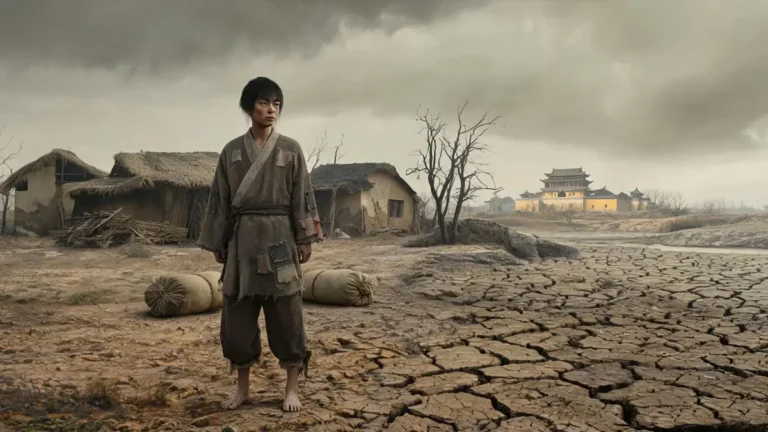
Zhu Qizhen: From Zhengtong Captive to Tianshun Restored Emperor
The Tumu Crisis, as the Ming court came to call it, began at a relay station with no water. On the fifteenth day of the eighth month of 1449 the army dug two fathoms into the ground and struck nothing. The river south of the walls, the only water within reach, was held by Oirat horsemen. Men and horses had gone three days without a drink, and the ranks were coming apart.
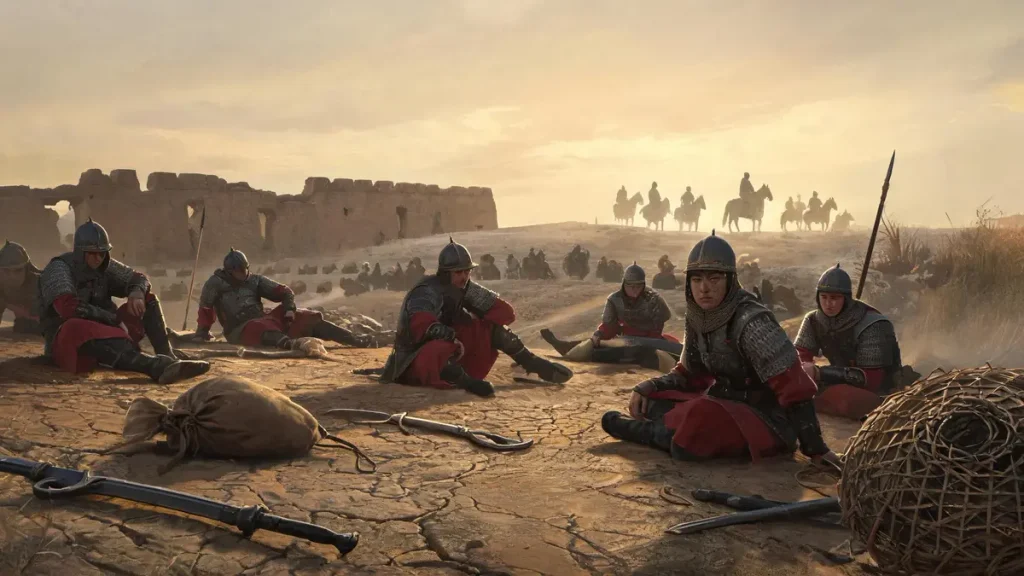
The next morning Esen pulled a few dozen riders back, as though he were leaving. Wang Zhen, the eunuch who had pushed for this campaign, saw the enemy move and ordered the camp struck, to march south and reach the river. The column had not finished forming when the Oirat horse came in from four sides. Zhang Fu, Duke of Ying, the ministers Kuang Ye and Wang Zuo, the grand secretary Cao Nai and more than fifty men of the court died in the rout. The emperor, Zhu Qizhen, was twenty-two, and he was taken alive.
Two days later the report reached Beijing, and the court wept in the audience hall. The year was the eighty-first of the dynasty. Behind it lay eleven years of repair under the Hongxi and Xuande emperors; ahead, fifteen years of contraction under the Jingtai and Tianshun reigns. The fourteen years in between carried the era name Zhengtong.Zhu Qizhen was the sixth of the Ming dynasty emperors, and the only one to rule under two era names: Zhengtong and Tianshun.
Zhengtong is more than a date range. As a word it means the legitimate line, the branch entitled to succeed. Eight years later the legitimate line changed the calendar. Before dawn on the fifteenth day of the first month of 1457, Shi Heng, Xu Youzhen and Cao Jixiang brought troops to the Southern Palace, took the imprisoned emperor out and seated him in the Hall of Reverent Heaven. Four days later the reign was renamed Tianshun. For a few days that year the calendar still read Jingtai 8; for the rest it read Tianshun 1. One year, two reign titles, two emperors.
A nine-year-old emperor and a grandmother who refused the curtain
In the first month of 1435 the Xuande Emperor died in the Palace of Heavenly Purity. He was thirty-eight. His son Zhu Qizhen was nine.
Word went round the palace that the Prince of Xiang would be brought in to rule. The Grand Empress Dowager Zhang called the ministers in, pointed at the boy and wept, and said that this was the new emperor. The rumor died. When the ministers asked her to govern from behind a curtain, she refused: the ancestors’ rules would not be broken on her account.
She did it another way. She stopped what could be stopped and left the government to the Grand Secretariat. The History of the Ming, in the chapter on empresses, says that she kept the boy at his studies and delegated to men she trusted, and then adds the line that matters. Wang Zhen might be the emperor’s favorite, it says, but while she lived he did not dare to run the government.
The accounts of the first years are tidy. Three thousand eight hundred musicians and workmen of the court entertainment office were dismissed. Seventeen thousand laborers on the imperial tomb were released. Four thousand seven hundred cooks and servants of the palace kitchen were let go. When the Ministry of Revenue reported that 2.77 million shi of tax had been remitted on abandoned land in Zhejiang and the Songjiang region, and asked to re-audit the figure, the nine-year-old refused. A re-audit, he said, would only raise the quota, and a higher quota would hurt the people. The numbers say nothing about the boy’s judgment. They say who was doing the work.
Yang Shiqi, Yang Rong and Yang Pu, the Three Yangs, had served four reigns between them, and the government was theirs. Memorials moved on the day they arrived, including Yu Qian’s from Henan and Shanxi, where he had been grand coordinator for nineteen years. In the ninth month of 1435, Wang Zhen took charge of the Directorate of Ceremonial.
In the tenth month of 1442 the Grand Empress Dowager fell ill. She had Yang Shiqi and Yang Pu brought to her bed and asked, through a eunuch, what great matter of state was still undone. Yang Shiqi named two. The Jianwen Emperor’s reign still had no veritable record. The ban on collecting the writings of Fang Xiaoru and his associates still stood. He did not reach the third. She died. By then Yang Rong had been dead two years. Yang Shiqi was shut away at home because his son had killed a man. Yang Pu was old and ill.
Wang Zhen’s seventeen years, and the day Liu Qiu was dismembered
Wang Zhen came from Yuzhou in the north. He had been chosen as a boy for the Inner College, the school the Xuande Emperor set up to teach young eunuchs to read, with grand secretaries as teachers. Zhu Yuanzhang had hung an iron tablet at the palace gate: eunuchs were not to touch state business, on pain of death. By Xuande’s reign the men inside the palace could read and write. Wang Zhen was assigned to the heir apparent with the rank of a bureau chief, and the emperor called him Master.
The Directorate of Ceremonial headed the twelve directorates of the inner court. It handled palace ceremonial, the bolts of silk issued as gifts and the tallies that controlled access to the throne. Above all it handled the paperwork that reached the emperor. With a child on the throne, memorials came in through the Office of Transmission, passed through the Directorate and then went up. The post commanded no troops and no revenue. It decided what the emperor saw.
The History of the Ming describes his method in seven characters: he taught the emperor to rule his officials with heavy punishments. The stated purpose was to stop ministers from deceiving him. The result was a steady flow of ministers into prison. In 1441 Yu Qian came to court without a present for the eunuch and was accused by the chief of the Office of Transmission of resenting his lack of promotion. He was sentenced to death, held three months and released as a vice minister of the Court of Judicial Review. In the sixth month of 1443 the Hanlin expositor Liu Qiu used a thunderbolt that struck the Hall of Reverent Heaven as an occasion for ten proposals, one of which touched Wang Zhen. He was in the Embroidered Uniform Guard’s prison the same day, where the commander Ma Shun had him dismembered. Xue Xuan, a vice minister of the Court of Judicial Review, nearly died in prison. The libationer of the Imperial College, Li Shimian, stood in a cangue at the college gate for three days. The censor Li Duo failed to kneel and was sent to the garrison at Tieling. The minister of revenue Liu Zhongfu and his vice minister Wu Xi were put in the cangue at the Chang’an Gate. The charges differed. The handling did not.
One case shows where the limit lay. Two palace eunuchs, Zhang Huan and Gu Zhong, and a Guard soldier named Wang Yong wrote an anonymous letter listing Wang Zhen’s crimes. They were executed in the marketplace, and the record adds three characters: no report was made to the throne. The killing did not require the emperor’s signature.
In 1443 he built himself a mansion east of the imperial city and a family temple at the mouth of the Lumicang lane, later given the name Zhihua. He exhausted timber and earthwork on it, the History says. The temple is still there, the best preserved stretch of Ming wooden architecture in Beijing.
The preface to the eunuch chapters of the History draws the line of Ming eunuch power in a single sentence. The line ran from Wang Zhen to Wei Zhongxian. His power had no institutional base. He held no office in the outer court and commanded no troops. Marquises and dukes called him foster father because he stood closest to the emperor. When his estate was confiscated after Tumu it held more than sixty vaults of gold and silver, a hundred jade dishes, and twenty stands of coral six or seven chi tall.
The History gives him seven years of unchecked power, from the death of the Grand Empress Dowager in 1442 to Tumu. In those seven years the army fought in three directions at once. Wang Ji led three campaigns into Luchuan in the southwest. Deng Maoqi rose in Fujian. Ye Zongliu gathered miners in the hills on the Fujian and Zhejiang border and killed the officials sent to stop him. Troops went south and east by the tens of thousands.
Three thousand envoys and a deal that was miscalculated
The Oirats were the western group of the Mongol tribes. Toghon had killed Aruqtai, set Toghto-bukha up as khan and taken the chancellorship for himself. When Toghon died his son Esen inherited the title of taishi, or grand preceptor, and the real power with it. The khan’s name went on the letters. The horses and the pastures were Esen’s. Tribute was trade. Every year the Oirats sent men with horses to Beijing, and the court paid by the head, in silk, paper money and grain. The old rule allowed fifty envoys. Through the 1440s the numbers climbed to two thousand and then to three.
The three thousand were not all envoys. Half were borrowed names, carried so that someone could collect an extra ration and an extra bolt of silk. The Ministry of Rites paid on the count it could verify and granted one item in five of what was asked. Esen was furious. The History says he felt deeply shamed and angry. The accounting was ceremonial: so many men, so much reward. The men were invented and the rewards were real. Both sides came away dissatisfied.
In the seventh month of 1449 Esen came south in four columns. Toghto-bukha attacked Liaodong. Alag, one of the Oirat lords, attacked Xuanfu and surrounded Chicheng. Another force rode on Ganzhou. Esen took the road to Datong. A deputy general, Wu Hao, was killed at Mao’erzhuang, and reports began arriving in Beijing several times a day.
Wang Zhen urged the emperor to go north himself. The minister of personnel, Wang Zhi, led the officials to kneel at the palace gate and argue against it. They were not heard. Ming emperors had a tradition of taking the field. Yongle had ridden out five times, and the Xuande Emperor had marched on Lean against the prince of Han. Zhu Qizhen was twenty-two and had never commanded anything. Wang Zhen wanted him to win a war, and wanted the army to pass through Yuzhou, so that his own county could see it. Five days passed between the order and the march.
The men who rode north with him made an impressive list. Zhang Fu, Duke of Ying, a commander of the Yongle wars, was in his seventies. The ministers of war and revenue, Kuang Ye and Wang Zuo, rode in the train, with Cao Nai and Zhang Yi, recently appointed grand secretaries, and a crowd of marquises, earls and provincial commanders. As a cabinet it was impressive. On a road, not one of them could tell the emperor to stop.
The Tumu Crisis: one well, fifteen days
The army left Beijing on the sixteenth of the seventh month. The next night, at Longhu Terrace, the camp panicked in the dark. Rain fell for days on the road to Xuanfu. Men kept coming forward to argue and Wang Zhen grew angrier with each of them. Zhu Yong, Duke of Cheng, and others of his rank crawled on their knees to report to him. When Kuang Ye and Wang Zuo said the wrong thing they were made to kneel in the grass. The army reached Datong on the first day of the eighth month. The eunuch commander there, Guo Jing, told Wang Zhen what the Oirats had in the field. For the first time Wang Zhen was afraid, and agreed to turn back. The retreat was meant to go through Zijing Pass, which would have taken the emperor past Yuzhou. Wang Zhen wanted him to see the family seat. After a few tens of li he changed his mind, because the columns would trample the crops round his own county, and turned the army toward Xuanfu instead. It marched in a loop and lost days.
On the thirteenth the Oirat cavalry caught the rear. Wu Kezhong, Marquis of Gongshun, and his brother Wu Keqin covered the retreat and were killed. Zhu Yong rode out with forty thousand men to recover them, fell into an ambush at Ya’er Ridge and lost the whole force. On the fourteenth the army reached Tumu, a fortified post in Huailai. The ground is high there and the post had no well. Water came from the river to the south, and Esen’s riders had cut the road to it. They dug two fathoms and found nothing.
On the fifteenth Esen sent men to discuss terms and pulled his troops back a little. Wang Zhen saw the enemy withdrawing and ordered the camp moved toward the water. The column had not finished forming when the Oirat horse came in from four sides.
The dead included Zhang Fu, Duke of Ying; Chen Ying, Marquis of Taining; Jing Yuan, a royal son-in-law; and the earls Chen Huai, Li Zhen, Chen Xun and Shen Rong. Below them were the commanders Liang Cheng and Wang Gui, the ministers Wang Zuo and Kuang Ye, the grand secretaries Cao Nai and Zhang Yi, the vice ministers Ding Xuan and Wang Yonghe and the vice censor-in-chief Deng Qi. More than fifty men of the court.
Wang Zhen died in the rout. The History says only that soldiers killed him in the disorder. A later account has a guards officer named Fan Zhong strike him down with a hammer. That story is not in the standard histories. The emperor was still inside the ring. He dismounted, sat down cross-legged on the ground, and was taken. When Esen heard that the emperor himself had been taken he did not believe it. Once he had seen him he treated him with great courtesy, lodged him in the camp of his brother Bayan-Temur, and had a captured guardsman, Yuan Bin, brought to wait on him.
The size of the army is a problem. The basic annals give one number and it is a result: several hundred thousand dead. Modern estimates run from two hundred thousand to five hundred thousand, and no single figure reconciles the sources. What is certain is what disappeared that day. The trained core of the capital army went, along with the firearms accumulated since Yongle and a whole generation of hereditary commanders. The histories call it the Tumu Crisis.
Beijing: two hundred and twenty thousand men and a closed gate
Xu Cheng, an expositor who would later rename himself Xu Youzhen, told the council that the stars had turned and the capital should move south. Yu Qian, vice minister of war, said that anyone who spoke of moving south should be executed. The capital was the root of the realm. One move and everything was lost, and the Song had crossed the river and never come back.
The Prince of Cheng took charge of the government. The officials demanded that Wang Zhen’s clan be wiped out. His client Ma Shun stood in the hall and cursed the censors. A supervising secretary, Wang Hong, struck him where he stood, the court followed, and the audience hall became a brawl. The prince, frightened, tried to leave. Yu Qian pushed through the crowd, held him where he was and got him to announce that Ma Shun and the others deserved death. The officials stopped. Yu Qian’s sleeves had been torn off in the scuffle.
Yu Qian was from Qiantang. Nineteen years as grand coordinator in Henan and Shanxi had taken him across his provinces on horseback, building embankments, planting trees, digging wells, appointing headmen to keep the works in repair. Under the Three Yangs his memorials moved quickly. Under Wang Zhen he had spent three months awaiting execution.
In the ninth month the Prince of Cheng took the throne as the Jingtai Emperor and gave his half-brother the title of Retired Emperor, which announced that he was no longer emperor. The hostage in Esen’s camp lost its value overnight.
In the tenth month Esen brought his prisoner to Datong and turned on Zijing Pass. The pass fell and the Oirat army arrived outside Beijing. Yu Qian put 220,000 men in line outside the nine gates. He took the Desheng Gate himself with Shi Heng, facing Esen.
The gates were closed behind them. There was no reserve.
He issued two orders. A commander who abandoned his men and fell back would be killed by his own officers. A unit that abandoned its commander would be cut down by the unit behind it.
Desheng Gate went well. Shi Heng hid men in empty houses and sent a few riders out to draw the enemy. Ten thousand Oirat horse came on, the deputy Fan Guang opened with firearms, and the ambush rose. Esen’s brother Boluo and a minister, Mao Naha, were killed by cannon fire.
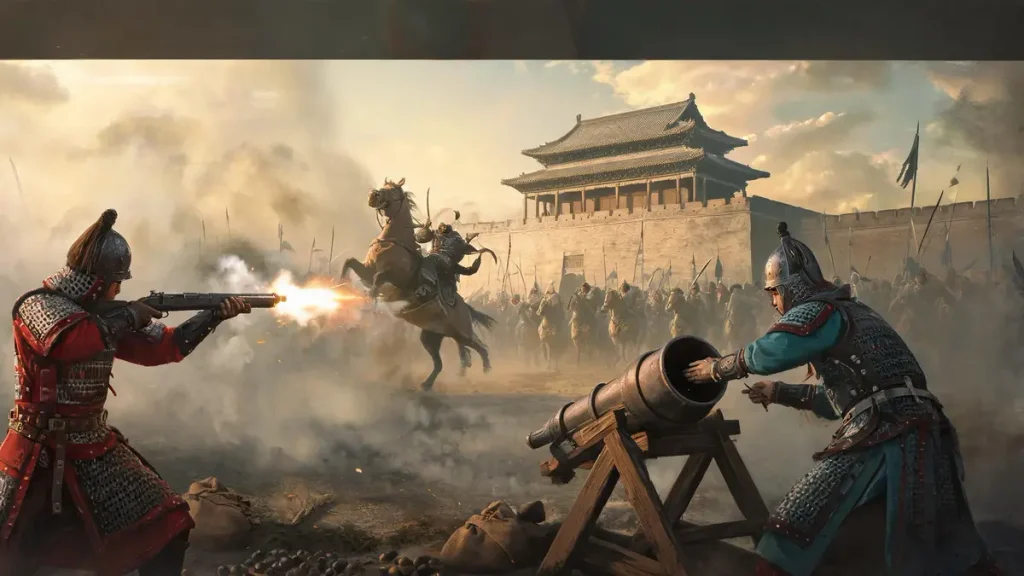
Zhangyi Gate went badly for a while. The Ming line pushed the Oirat vanguard back, and then several hundred eunuch cavalry rode forward to claim the credit, broke the formation, and Wu Xing was hit by a stray arrow and died. The Oirats chased into the earthen outer wall, where people climbed onto their roofs and threw bricks down, and the noise carried across the city. Wang Hong and Mao Fushou brought reinforcements, and the Oirats withdrew.
The standoff lasted five days. Esen asked for Yu Qian, Wang Zhi and Hu Ying to come out and negotiate and got no answer. The provincial armies were closing on his line of retreat. He went west through Liangxiang, taking the emperor with him.
Yu Qian was made junior preceptor and given overall command. The enemy is at the edge of the city, he said, and that is shame enough for the ministers. He would not claim a reward for it.
Esen went back to the steppe with a prisoner who could no longer buy him a city. In the eighth month of the following year he sent him home.
Seven years in the Southern Palace, and a coup before dawn
The Jingtai Emperor met his brother at the Dong’an Gate, observed every courtesy, and put him in the Southern Palace. In the eleventh month the minister of rites, Hu Ying, asked that the officials be allowed to congratulate the Retired Emperor on his birthday. He was refused. In the twelfth month Hu Ying asked that they be allowed to pay their respects at the Yan’an Gate on the first day of the new year. He was refused again.
When the emperor was taken, Empress Qian emptied the palace treasury to help pay for his return. She prayed at night until she fell asleep on the floor and damaged a leg. She cried until she lost the sight of one eye. In the Southern Palace, the History says, she found ways to keep his spirits up.
In the fifth month of 1452 the crown prince, Zhu Jianshen, was demoted to prince of Yi, and the Jingtai Emperor put his own son Zhu Jianji in his place. The boy died in the eleventh month of the next year. In the fifth month of 1454 Zhang Lun, a bureau director in the Ministry of Rites, and the censor Zhong Tong memorialized for the restoration of the prince of Yi. They went to the Guard’s prison. In the eighth month of 1455 Liao Zhuang, a vice minister of the Nanjing court of judicial review, raised it again and was flogged at the palace gate. Zhang Lun and Zhong Tong were dragged out of their cells and flogged again. Zhong Tong died under the rod.
In the first month of 1457 the emperor fell ill and stayed at the suburban shrine for the sacrifices. The officials asked him to name an heir. He would not. Before dawn on the fifteenth, Shi Heng, Zhang Ni, Zhang Yue, Yang Shan, Xu Youzhen and Cao Jixiang took troops to the Southern Palace, brought the Retired Emperor out and went straight to the Hall of Reverent Heaven. The officials were summoned when it was already light. The event is remembered as the Duomen Incident, the seizure of the gate.
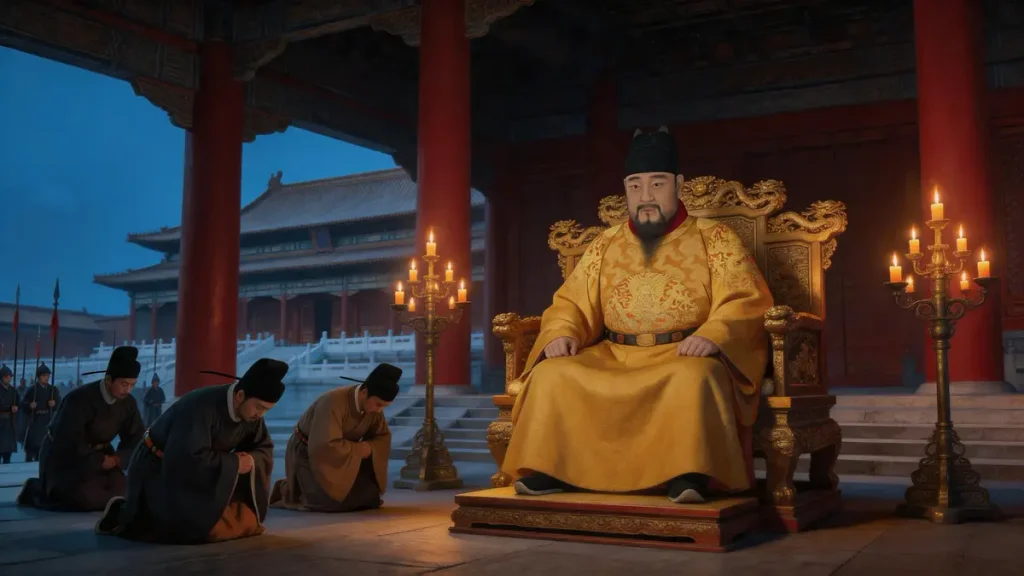
Yu Qian and the grand secretary Wang Wen were arrested the same day. The emperor hesitated. Yu Qian had done real service, he said. Xu Youzhen answered that if Yu Qian was not killed, the whole business would have no name. Five days later Yu Qian was executed in the marketplace. When the confiscators reached his house there was no spare money in it. One room was locked and barred. Inside were the robes and the sword the emperor had given him.
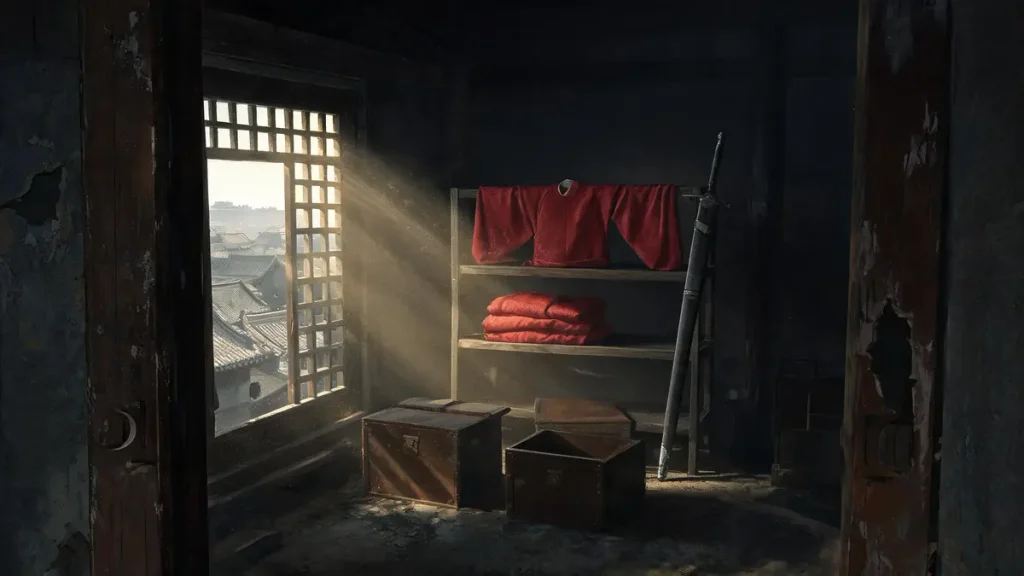
The Jingtai Emperor was reduced to prince of Cheng and moved to the western palace. A month later he died there, aged thirty. He was given the posthumous name Li, the tomb he had built for himself was demolished, and he was buried outside the western wall with the honors of a prince. Yu Qian’s body was collected by a regional commander, Chen Kui, and buried. A year later it went back to Hangzhou. In the tenth month of 1457 the emperor had Wang Zhen’s spirit summoned home for burial, gave him a sacrifice, and set up a shrine at Zhihua Temple with a plaque reading Jingzhong, loyalty honored.
In 1460 Shi Heng died in prison and his nephew Shi Biao was executed. In the seventh month of 1461 Cao Jixiang and his adopted son Cao Qin rose in revolt, were defeated, and Cao was torn apart in the marketplace with his clan destroyed after him. Xu Youzhen had already been sent to the garrison at Jinchi.
Kilns that left off the reign mark, mints that struck no coin
The twenty-nine years between Xuande and Chenghua are known in ceramics as the Interregnum. In the Zhengtong, Jingtai and Tianshun reigns, not one imperial piece with a proper reign mark has been found.
The kilns at Jingdezhen kept working through those years. In 1988 excavators opened a lane outside the west wall of the imperial factory, at Dongsiling, and found it packed with sherds between the Chenghua layer and the Xuande layer. More than twenty blue-and-white dragon vats were reconstructed from them. The largest stands 75.5 cm high with a belly 88.8 cm across. In 2014 a layer was found on the north slope of Zhushan, sealed under Chenghua debris and lying directly on Xuande. The pieces in it look back to Xuande at one end and forward to Chenghua at the other. The Palace Museum’s formulation is that the blank period is a blank in later knowledge, and that production did not stop.
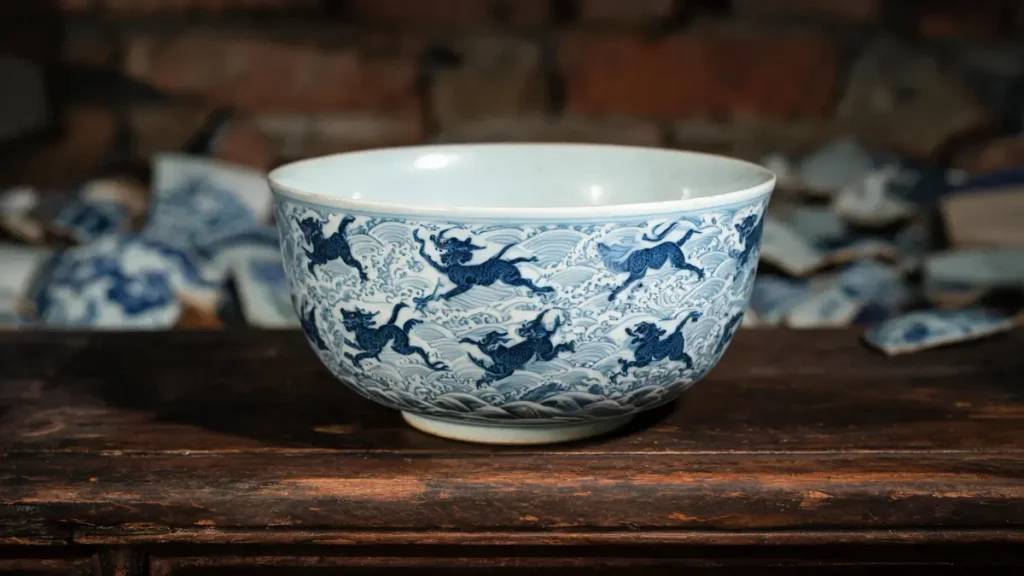
Why the mark disappeared is another question. Yongle had begun using a four-character seal mark, and under Xuande marking became normal without becoming law. One explanation points to the order at the start of the reign to suspend all non-essential works. Others point to the cost of the court and to the political turmoil. None of these is strong. What can be said is that the kilns fired and what came out did not carry a reign name.
The treatise on finance does confirm the firing. In 1441, when the three great halls were finished, the court ordered vessels for the nine-dragon and nine-phoenix dining tables and then large vats with blue dragons on a white ground. The vats dug out of Zhushan are the size that order describes.
Dating is the difficulty. For centuries the pieces went to Xuande or to Chenghua. European and American museums hold blue-and-white cataloged as circa 1450 because there was nothing better to write. A 2019 exhibition at the Shanghai Museum set the middle of the century out as a period of its own.
Popular wares are where the dates survive. Censers and water bowls given to temples carry the reign year and the donor’s name on the base, and a Tianshun-marked blue-and-white tripod censer with a Persian inscription in the Palace Museum belongs to that group. There are finer tests. Zhengtong popular wares used a domestic cobalt close to what Xuande had used and fire a strong, slightly dark blue. Jingtai and Tianshun pieces tend to a pale gray-blue. On a lotus scroll with the Eight Buddhist Emblems, Zhengtong painters drew a single fish where other reigns drew two. A detail like that is more reliable than a mark.
Coinage is a separate story. No reign coin was cast in Zhengtong. After Hongwu, Yongle and Xuande, the four reigns of Zhengtong, Jingtai, Tianshun and Chenghua struck none, and the mint did not resume until 1503. The small coins sold as Zhengtong Tongbao are treated by Chinese numismatists as later private castings or Vietnamese issues, not as Ming state coin.
What circulated was old coin, paper and silver. The treatise on finance says that at the start of the reign the tax system began converting grain into silver, the ban on silver was relaxed, and court and country used silver for everything of size and copper for small change. Paper survived only in official salaries, and it did not circulate. Under Xuande a shi of rice had cost fifty strings of paper money. By Chenghua one string would not buy a single coin. The mint stopped in the same decades that silver became the money people actually used.
At sea the pattern was different. The Chinese coin moving through Asian trade in the fifteenth century was mostly Yongle Tongbao, copied in quantity in Japan and Vietnam. The Ming had stopped casting. The old coin kept moving anyway.
The Zhengyang archery tower and 1,770 li of border wall
In the first years of Zhengtong the nine gates of the inner city were renamed. Lizheng became Zhengyang, Wenming became Chongwen, Shuncheng became Xuanwu, Qihua became Chaoyang, Pingze became Fucheng. In 1439 an archery tower was added south of the Zhengyang gatehouse: brick, on a platform twelve meters high, four stories, with ninety-four loopholes. It is the only one of the nine with a gate passage of its own, opened when the emperor went out to sacrifice at the Altar of Heaven or to plough the ritual field.
The gatehouse and tower standing today are not the Zhengtong fabric. They burned in 1900, were rebuilt in 1906, were remodeled in 1915, and the barbican came down. What survives is the position, the dimensions and the platform. In the fourth month of 1421 the three great halls of the Forbidden City, just completed, were struck by lightning and burned. For twenty years Beijing had no three great halls. In the eleventh month of 1441 they were rebuilt along with the palaces of Heavenly Purity and Earthly Peace, and in the same month the court declared Beijing the capital and stopped calling its offices a temporary seat. The word had been in use since 1425. It came off that month.
Zhihua Temple still holds the only Ming timber revolving sutra cabinet in Beijing. In 1961 the temple was listed in the first batch of national protected sites. The border wall was slower. In the eleventh month of 1450 the court ordered repairs to the passes, piecemeal work. The large program came in 1473. Yu Zijun, grand coordinator of Yansui, argued that the ground there was flat and open to cavalry and that the line should be walled and garrisoned. With the Mongols out of the Ordos that year, he began. The wall ran 1,770 li from Qingshuiying in the east to Huamachi in the west, with eleven forts, fifteen beacon towers, seventy-eight small towers and 819 lengths of short wall. The seat of the garrison moved from Suide to Yulin.
Brick facing and hollow bastions came a century later, under Qi Jiguang in the Jizhou command. So the sentence that the Tumu Crisis caused the Great Wall needs taking apart. The strategic turn was immediate. The building began twenty-four years later. The brick wall that visitors walk on today is a hundred years later again.
The emperor lived fifteen years after he was taken. He was nine when he came to the throne, twenty-two when he was captured, thirty when he took it back, thirty-eight when he died. In the first month of 1464, in his last edict, he ordered that palace women should no longer be killed to accompany a dead emperor. The practice ran from the founding of the dynasty, and the Jingtai Emperor had followed it seven years before.
The History’s verdict names Wang Zhen first: his seizure of power opened the breach and sent the imperial carriage into exile. The same paragraph goes on to say that ending the burial of palace women was a deed of great virtue, fit for later ages to follow.
In the twelfth month of 1475 the Chenghua Emperor restored the Jingtai Emperor’s title. The document reads: our uncle, the prince of Cheng, came to the throne in a time of crisis, put down the danger, held the state together, and gave it peace for nearly eight years.
Sources and further reading
History of the Ming (Mingshi), juan 10, basic annals of Yingzong, for the 1435 accession, the Wang Zhen years, the campaign of 1449 and the day-by-day record of the retreat. https://zh.wikisource.org/zh-hans/明史/卷10
History of the Ming, juan 11, basic annals of the Jingtai Emperor, for the defense of Beijing in the tenth month of 1449, the return of the Retired Emperor in 1450 and the change of heir in 1452. https://zh.wikisource.org/zh-hans/明史/卷11
History of the Ming, juan 12, basic annals of Yingzong after the restoration, for the Duomen coup, the execution of Yu Qian, the posthumous shrine to Wang Zhen and the edict against the burial of palace women. https://zh.wikisource.org/zh-hans/明史/卷12
History of the Ming, juan 170, biography of Yu Qian, for his nineteen years as grand coordinator, his imprisonment under Wang Zhen, the deployment of 220,000 men at the nine gates and the confiscation of his estate. https://zh.wikisource.org/zh-hans/明史/卷170
History of the Ming, juan 304, biographies of eunuchs, for Wang Zhen’s career, the dismemberment of Liu Qiu, the confiscation of his property and the preface on eunuch power. https://zh.wikisource.org/zh-hans/明史/卷304
History of the Ming, juan 328, account of the Oirats, for the tribute dispute, the four-column invasion of 1449, the death of Esen’s brother at Desheng Gate and Esen’s own fall. https://zh.wikisource.org/zh-hans/明史/卷328
History of the Ming, juan 81, treatise on finance, for the coinage gap and the shift to silver in the 1430s and 1440s. https://zh.wikisource.org/zh-hans/明史/卷81
History of the Ming, juan 113, biographies of empresses and consorts, for the Grand Empress Dowager Zhang, Empress Qian and the end of the practice of burying palace women with the dead. https://zh.wikisource.org/zh-hans/明史/卷113
The Palace Museum, "Ming imperial porcelain from the Zhengtong, Jingtai and Tianshun reigns", exhibition text on the 1988 and 2014 Jingdezhen excavations and the meaning of the blank period. https://ggzl.dpm.org.cn/app/api/app/exhibitionListPc/47?unitId=77
The Palace Museum, lecture text on the imperial kilns and the reign mark, for the transition from unmarked Yongle wares to the marked wares of Xuande. https://www.dpm.org.cn/classify_detail/258060.html
Beijing Municipal Government, entry on Zhihua Temple, for the 1443 foundation, the Tianshun shrine to Wang Zhen and the 1961 listing. https://www.beijing.gov.cn/renwen/rwzyd/qgzdwwbhdw/zhs/202210/t20221026_2845302.html
Tiananmen Area Management Committee, entry on Zhengyang Gate, for the 1419 gatehouse, the 1436 renaming and the 1439 archery tower. https://tamgw.beijing.gov.cn/diqufuwu/zjtam/201912/t20191224_1439923.html
China National Culture Park for the Great Wall, biography of Yu Zijun, for the 1473 Yansui wall: 1,770 li, eleven forts, fifteen beacon towers and 819 lengths of short wall. https://changcheng.ctnews.com.cn/2021-01/08/content_95718.html
Wikipedia, "Tumu Crisis". https://en.wikipedia.org/wiki/Tumu_Crisis
Wikipedia, "Esen Taishi". https://en.wikipedia.org/wiki/Esen_Taishi
Wikipedia, "Zhengtong Emperor". https://en.wikipedia.org/wiki/Zhengtong_Empero