From Peasant to Tyrant: The Dark Mind of Zhu Yuanzhang
In 1382 a man named Zheng Shili wrote a memorial to the throne. He held no office, and he had no part in the case he wanted to argue. His point was narrow. Every year, clerks from the provincial administrations traveled to the Ministry of Revenue to reconcile grain and military supply accounts. The road was long. To avoid having documents rejected and sent back for correction, they set out with blank sheets already stamped with the office seal. The practice had been standard for years, and nobody had treated it as a crime. Zhu Yuanzhang, the founding emperor of the Ming, learned of it in 1382. He decided it concealed fraud, and ordered the senior officials of every office put to death and their deputies flogged a hundred strokes and sent to the frontier. Zheng Shili wrote in their defense. He was flogged and sent to the frontier as well.
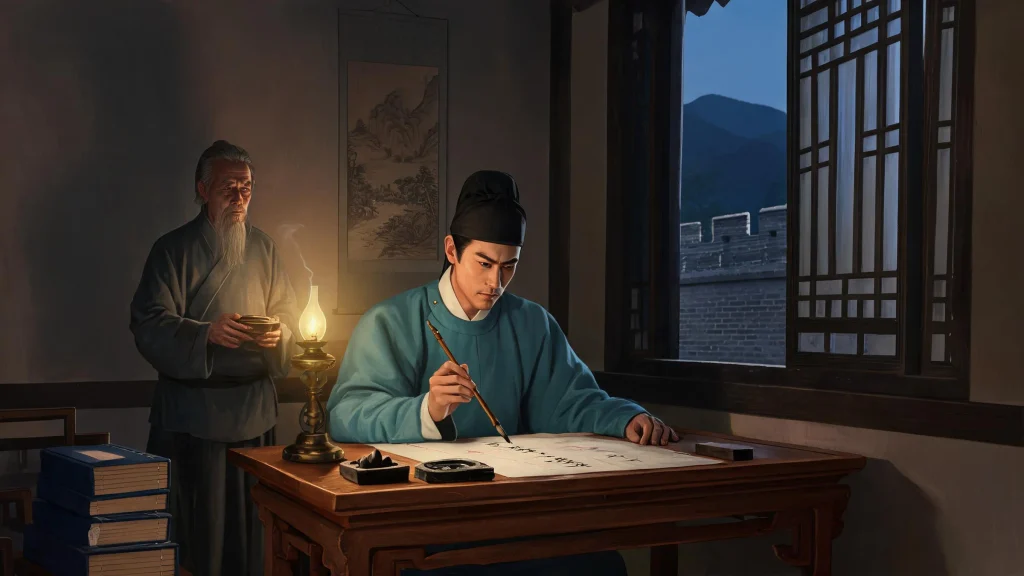
The History of the Ming never says what he expected to gain by it. What the record keeps is the emperor’s reaction: officials could change the numbers on paper, behind his back, until the numbers suited them. The cruelty and the paranoia in that reaction were not new in 1382.
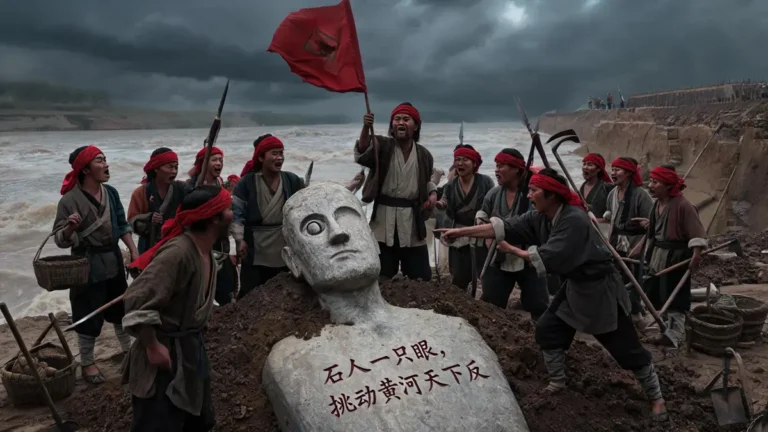
In 1344, drought, locusts, and epidemic struck the Huai River region. Zhu Yuanzhang was seventeen. His parents and an elder brother died within a short time of one another, and the family was too poor to bury them. He entered a Buddhist monastery as a novice and later spent three years begging his way through the prefectures of Guang, Gu, Ru, and Ying. For the full story of how this orphaned teenager rose from a starving beggar to the founder of the Ming Dynasty, see Zhu Yuanzhang’s rise from starving beggar to Ming founder.
1385: the Great Warnings carry Zhu Yuanzhang’s cruelty into every village
In March 1385 the vice minister of revenue, Guo Huan, was executed for stealing state grain. That October Zhu Yuanzhang issued the Great Warnings (Da Gao) to the empire, ordering that a copy reach every village. The preface told officials what to expect. Any office that put private profit ahead of public duty would be hunted to its source and punished.
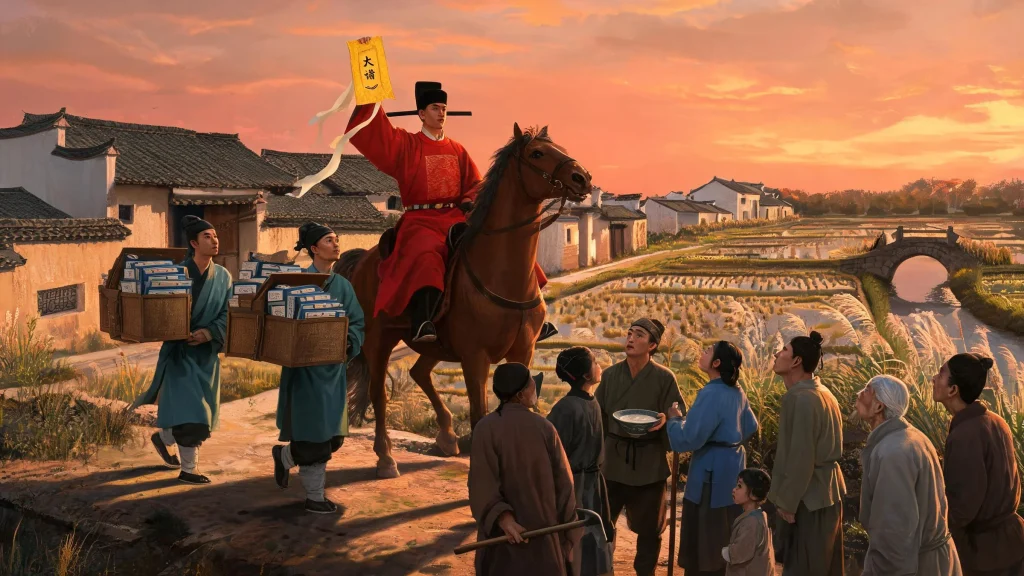
The History of the Ming disposes of all three editions of the Great Warnings in one sentence. People sentenced to slow slicing, to have their severed heads displayed, or to have their families wiped out numbered in the hundreds at the very least, and those sentenced to public execution or something lighter ran into the thousands. Even the mildest edition lists 364 palace graduates and imperial college students convicted once, twice, three times or four times. Most of them survived and returned to their posts, carrying on with the paperwork under a sentence of death.
The Guo Huan case reached further than the ministry that produced it. Everyone from the vice ministers of the Six Ministries, the empire’s central administrative departments, downward was put to death. Seven million in stolen grain was pursued through the books, and the depositions named officials in province after province. Several tens of thousands of people died in prison. The recovery of the money then spread into the countryside. To establish who was holding it, investigators named households all over the empire as depositories of stolen goods, and families of middling means went bankrupt in batches. The History of the Ming records that the sums were traced to borrowers across the empire, and that most of the middling households were broken by it.
The fear did not fall on officials alone.
Only three men ever served as grand chancellor
The verdict appended to Li Shanchang’s biography in the History of the Ming does the arithmetic for the reader. When the Ming was founded, Zhu Yuanzhang set up the Central Secretariat and appointed a left and a right grand chancellor. Those who filled the office with any effect were Li Shanchang, Wang Guangyang and Hu Weiyong, and no one else. After Hu Weiyong’s fall the post was abolished and never restored, so that for the whole of the dynasty only Li Shanchang and Wang Guangyang could be called grand chancellor. Three men, in a state that lasted 276 years.
Before any of that, Zhu Yuanzhang had changed where memorials entered the palace. In 1377 he ruled that petitions from commoners were to be sealed and delivered straight to him. That July he created the Office of Transmission to receive and forward documents from every office. In 1378 he ordered that routine reports need not be shown to the Central Secretariat first. By the first month of 1380, memorials had been reaching the throne without passing through the chancellorship for two and a half years.
That month Hu Weiyong, the left grand chancellor, was executed for treason, together with the censor-in-chief Chen Ning and the vice censor-in-chief Tu Jie. Five days later Zhu Yuanzhang abolished the Central Secretariat, scrapped the chancellorship, and set the Six Ministries directly under himself.
In 1384 a man from Taihe named Xiao Qi sent ten proposals to Zhu Yuanzhang. Punishments had gone too far, he wrote, and denunciation had become a trade. He asked the emperor to ban the sealed petition as a channel for false accusation. The channel he wanted closed was one the emperor had opened himself, seven years earlier.
Two noblemen and a minister died under the sticks at Zhu Yuanzhang’s order in these years. The Yongjia Marquis, Zhu Liangzu, and his son were flogged to death, and the minister of works, Xue Xiang, was beaten to death. The Treatise on Punishments in the History of the Ming lists beating at court, known as tingzhang, alongside the Embroidered Uniform Guard and the prison of its judicial office. All three, it says, were devices the Ming invented, killings of the utmost cruelty that lay outside the law. Then it adds a line of its own. Beating at court began under Taizu, the founding emperor.
In the first month of 1387 Zhu Yuanzhang ordered the instruments of torture in the Embroidered Uniform Guard burned, and the prisoners held there handed over to the Ministry of Justice.
1390: the charges keep growing until they reach Li Shanchang, aged seventy-seven
The History of the Ming notes that after Zhu Yuanzhang had Hu Weiyong killed, the treason had still not been fully exposed. Then the charges accumulated. In 1385 Li Cunyi was denounced. In 1386 the Lin Xian case closed, and collusion with Japan went on the record. In 1388 the capture of Feng Ji brought in collusion with the Mongols. By 1390 the conspiracy had grown much larger. That year Zhu Yuanzhang ordered Li Shanchang to die at the age of seventy-seven. The pretext was an ominous change in the heavens, read as a sign that the coming disaster should be moved onto a minister. His wife, his daughters, his brothers and nephews, more than seventy people in the household, were killed with him.
Accusations of this kind were easy to believe. From 1369 Japanese pirates came ashore in the coastal counties of Shandong, and after that there were alarms in Shandong, Zhejiang and Fujian almost every year, up to a raid on Ninghai in the second month of 1398. The enemy at sea was real, and the charge of colluding with a foreign power was believed the moment it was spoken.
February 1393: a guard commander accuses Lan Yu of treason
In the second month of 1393 the commander of the Embroidered Uniform Guard, Jiang Huan, accused Lan Yu, Duke of Liang, of plotting rebellion. The indictment said Lan Yu meant to strike while the emperor was out performing the spring ploughing. That same month the Record of Treasonous Officials was published throughout the empire, listing one duke, thirteen marquises and two counts. The day after it appeared, the emperor went out to plough. The death toll was published only in the ninth month: 15,000 people executed with their clans. The History of the Ming ends the passage with eight characters, that the founding generals were gone one after another.
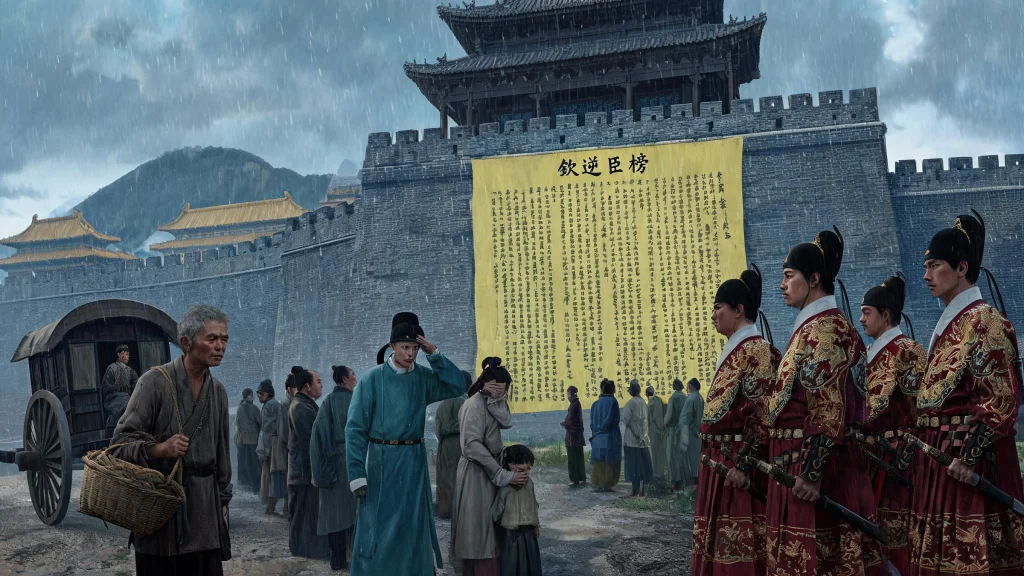
The purge and the transfer of military power were completed in the same spring. In the third month Feng Sheng and Fu Youde were sent to the northern frontier, and every garrison officer under them was placed under the command of the Prince of Jin and the Prince of Yan. Four days later an edict said the two princes need report only matters of importance.
Lan Yu was the uncle of the crown prince’s first wife, a daughter of the general Chang Yuchun. In the fourth month of 1392 the crown prince, Zhu Biao, died. Ten months later the Lan Yu case broke. The new heir, the imperial grandson Zhu Yunwen, who would reign as the Jianwen Emperor, was born to another consort and had no marriage tie to Lan Yu. I think the two events are connected, but not one document from the period proves it, and on that evidence the reasoning is not strong.
June 1395: at the Fengtian Gate, he says two things
In the sixth month of 1395 Zhu Yuanzhang told his ministers at the Fengtian Gate that in the forty-odd years since he took up arms he had sometimes punished outside the law, which was never meant to be the norm. His successors were to follow the code and the Great Warnings only, and were not to use branding, amputation, the cutting off of the nose or castration; an official who asked for such punishments was to be dealt with severely. The second thing he said was that he had abolished the chancellorship, that the ministries and the Censorate now ran the administration, and that no later ruler was to restore the office. Anyone who proposed restoring it was to be severely punished too.
The Imperial Ancestral Instructions put the same rule beyond argument. When a descendant sits on the throne he is not to appoint a grand chancellor. If a minister dares to propose one, the civil and military officials are to impeach him at once, and the offender is to be executed by slow slicing with his whole family.
In the second month of 1398 pirates raided Ninghai again. In the fifth month Zhu Yuanzhang fell ill. On the fifth day of that illness he placed the defense of Kaiping under the Prince of Yan. Zhu Yuanzhang died in the intercalary fifth month, in the western palace, at seventy-one. His last edict contains a line about himself, that his heart was heavy with worry and danger and that he never let up in his daily work.
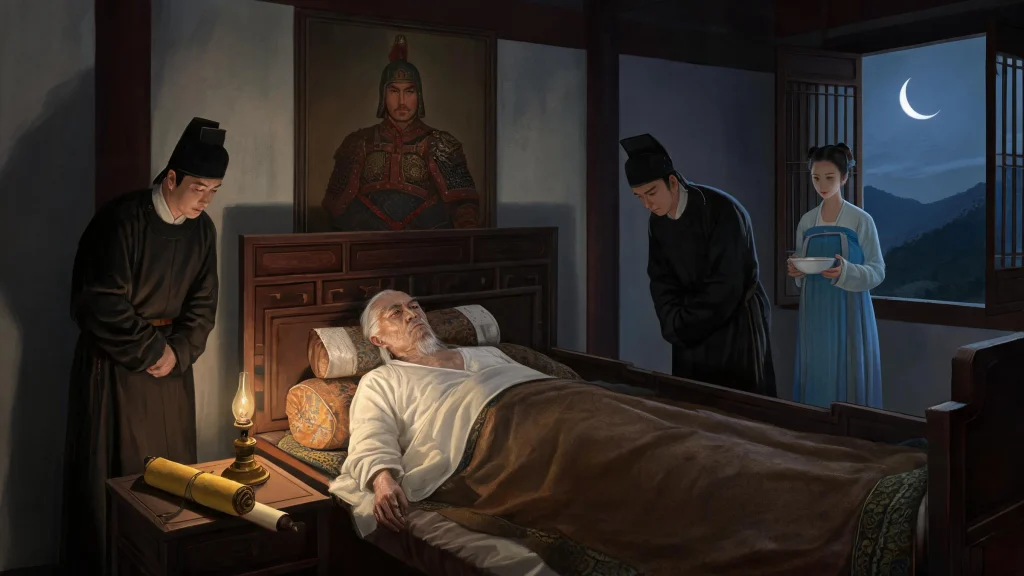
Back in 1376, Ye Boju had sent Zhu Yuanzhang a memorial naming three things that had gone too far: the enfeoffment of imperial princes, the volume of punishments, and the haste of the emperor’s drive for order. He died later in a Ministry of Justice prison. In the eighth month of 1399 Geng Bingwen, sixty-five years old, marched north as commander-in-chief with a nominal 300,000 men, of whom only 130,000 arrived. Attacked while moving his army across the river, his troops never formed ranks and fell back into the town of Zhengding, and the court replaced him with Li Jinglong. The History of the Ming records that by the end of the Hongwu reign almost every duke and marquis was dead, leaving only Geng Bingwen and the Wuding Marquis Guo Ying.
Sources and further reading
- The History of the Ming (Mingshi), Basic Annals of Taizu, juan 1 to 3: https://zh.wikisource.org/zh-hans/明史/卷1
- The History of the Ming, Treatise on Punishments, juan 94 and 95: https://zh.wikisource.org/zh-hans/明史/卷94
- The History of the Ming, biography of Li Shanchang, juan 127: https://zh.wikisource.org/zh-hans/明史/卷127
- The History of the Ming, biography of Geng Bingwen, juan 130: https://zh.wikisource.org/zh-hans/明史/卷130
- The History of the Ming, biography of Lan Yu, juan 132: https://zh.wikisource.org/zh-hans/明史/卷132
- The History of the Ming, biography of Ye Boju, juan 139: https://zh.wikisource.org/zh-hans/明史/卷139
- The History of the Ming, biography of Hu Weiyong, juan 308: https://zh.wikisource.org/zh-hans/明史/卷308
- Encyclopaedia Britannica, Hongwu: https://www.britannica.com/biography/Hongwu
- Wikipedia, Hongwu Emperor: https://en.wikipedia.org/wiki/Hongwu_Emperor
- Wikipedia, Hu Weiyong: https://en.wikipedia.org/wiki/Hu_Weiyong