Zhu Biao Death: Unpacking Its Impact on the Ming Dynasty
On May 17, 1392, the crown prince of the Ming dynasty died. Zhu Biao was thirty-six years old. The impact of the death reached into the next twenty-eight years of Ming history: the founding emperor killed the generals he had been keeping for his son, a grandson lost the throne to his own uncle, and the capital moved from Nanjing to Beijing.
Why those three things belong together is not obvious from the death alone. Zhu Yuanzhang, the founding emperor, had twenty-six sons. In 1392 his second, third and fourth sons, the princes of Qin, Jin and Yan, were grown men with soldiers behind them. He passed over every one of them and named Zhu Biao’s fourteen-year-old son as his heir.
Zhu Biao was the eldest son of Zhu Yuanzhang and was made crown prince in 1368, the first year of the Hongwu reign. For the next twenty-four years he sat beside his father learning the work.
Grooming an heir
In 1368 someone proposed following the Yuan practice and making the crown prince concurrent head of the Central Secretariat. Zhu Yuanzhang refused, saying the Yuan system was not worth copying. His own solution was to give the Eastern Palace no separate staff at all. Serving ministers and commanders took the posts instead: Li Shanchang, the left grand chancellor, as junior preceptor of the crown prince; Xu Da, the right grand chancellor, as junior tutor; Chang Yuchun, a senior administrator of the Central Secretariat, as junior guardian. The men who held the most power in the new empire were also the prince’s teachers.
In 1377 the emperor handed over the daily routine. From then on, government business was to go to the crown prince for decision and only afterwards be reported to him. The History of the Ming describes how Zhu Biao handled it in one line: he cut punishments wherever he could. Thirteen years later the same line was used about his son, Zhu Yunwen.
He mattered between his brothers as well. The princes of Qin and Zhou committed offences more than once, and it was Zhu Biao’s pleading that let them go back to their principalities. When someone accused the prince of Jin of plotting, Zhu Biao wept on his behalf and the emperor let the matter drop.
The confession of February 1393
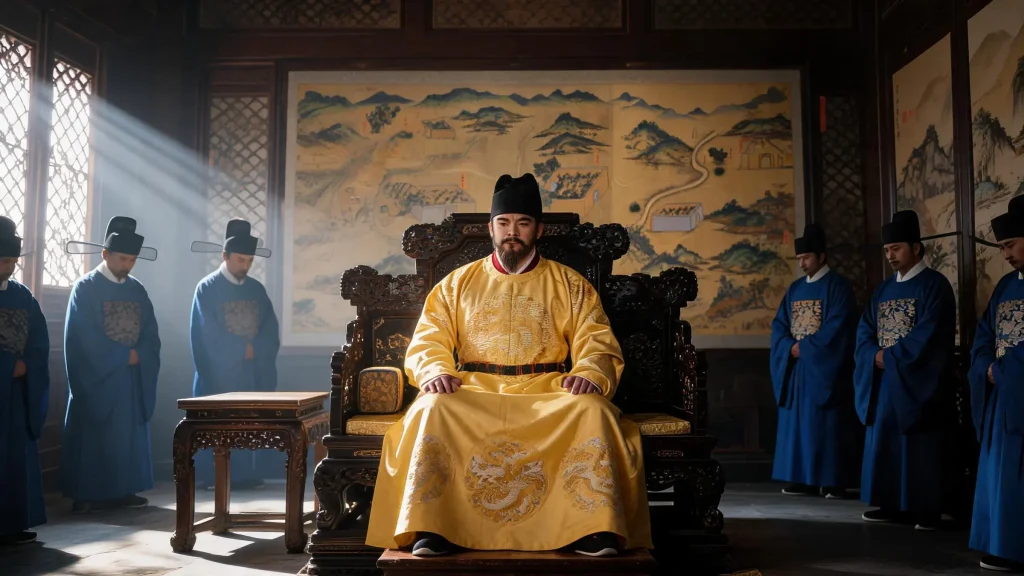
After Zhu Biao died, the emperor chose the next heir during the mourning period. The History of the Ming records the scene. Zhu Yuanzhang came out to the gate of the Eastern Pavilion, met his ministers there and wept. Liu Sanwu, a Hanlin academician, said that the imperial grandson, as heir of the principal line, should succeed him. The History adds one sentence: the appointment of the imperial grandson came from this. In the ninth month of 1392 Zhu Yunwen was made imperial grandson-heir.
The three grown princes had been passed over. The heaviest name in the army stood in a particular relation to the succession. Lan Yu was a native of Dingyuan and a younger brother-in-law of Chang Yuchun, the prince of Kaiping. Zhu Biao’s wife, the crown princess, was Chang Yuchun’s daughter, and Zhu Biao’s third son, Zhu Yuntong, was hers. Lan Yu was her uncle. Zhu Yunwen’s mother, Lady Lü, had no marriage tie to Lan Yu at all. The History of the Ming never explains why the emperor chose Yunwen over Yuntong.
In 1388 Lan Yu had taken 150,000 men deep to Buir Lake and received the surrender of the Yuan emperor’s following, and he was the finest field commander the dynasty still had. He was also arrogant. Given the post of grand tutor to the crown prince, he thought it beneath him and said, "Am I not fit to be grand preceptor?"
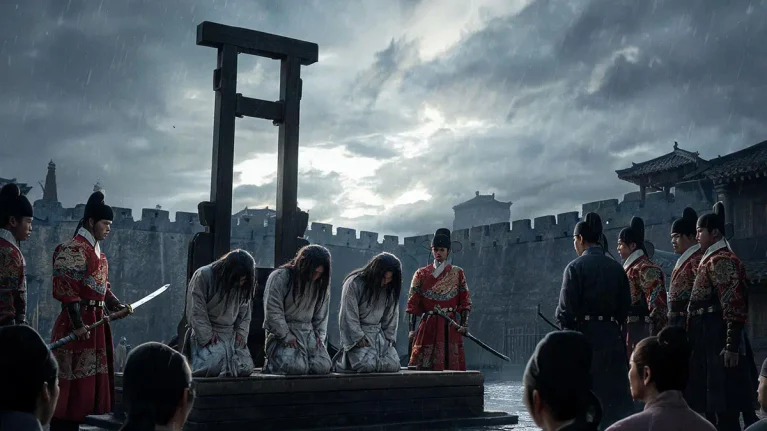
In the second month of 1393 the commander of the Embroidered Uniform Guard, Jiang Huan, accused Lan Yu of treason. The confession in the file said he meant to strike while the emperor was outside the city for the spring plowing ceremony. He was executed with his clan. In the ninth month the emperor published a total: "Lan Yu rebelled; the plot was discovered, and 15,000 were put to death with their clans." The names listed in the Record of Treasonous Officials came to one duke, thirteen marquises and two counts.
One year after Zhu Biao’s death the army changed hands. In the third month of 1393, Feng Sheng and Fu Youde were posted to the frontier in Shanxi and Beiping, and every garrison officer under them was ordered to take orders from the princes of Jin and Yan. By the last years of the reign, almost no dukes or marquises were left, and the one seasoned commander still trusted was Geng Bingwen, marquis of Changxing. In 1399 he was given the great general’s seal and marched north at the age of sixty-five.
The war between uncle and nephew
Zhu Yunwen was twenty-one when he took the throne. Zhu Di was thirty-eight. The stripping of the princes began at once. In the eighth month of 1398 the prince of Zhou was reduced to a commoner. In the fourth month of 1399 the prince of Xiang burned himself to death, and the princes of Qi and Dai were reduced. In the sixth month the prince of Min was stripped.
Five princes in ten months, every one of them his uncle.
When the court turned to the prince of Yan, it sent men to watch him. In the sixth month of 1399 an order questioned him and his household officers were arrested. Zhu Di claimed to be gravely ill and, with the monk Yao Guangxiao, had his commanders Zhang Yu and Zhu Neng bring eight hundred picked men inside the residence. In the seventh month he hid soldiers at the Duanli Gate, tricked Xie Gui and Zhang Bing in and killed them, and seized the nine gates of Beiping that day. He then memorialized the throne, naming Qi Tai and Huang Zicheng as treacherous ministers. As his authority he cited a line from the Imperial Ancestral Instructions: when there is no upright minister at court and evil men are within, the princes shall drill their troops and await orders.
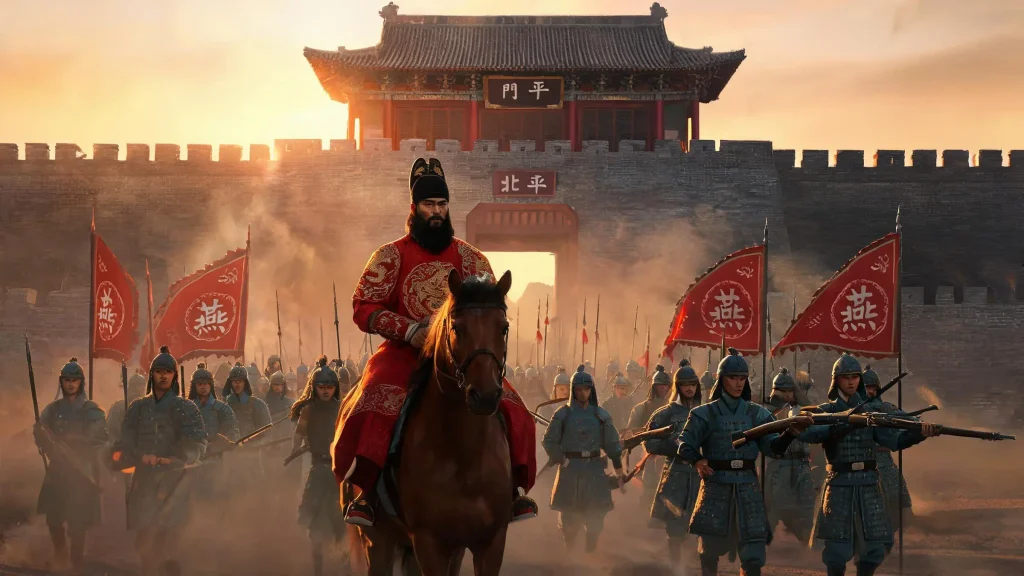
The Imperial Ancestral Instructions were the house law Zhu Yuanzhang left his descendants, written to guard against treacherous ministers at court. Four years later the clause became the ground on which a fourth son rose against his nephew. Zhu Di called his army the Jingnan campaign, the quelling of the crisis. In the sixth month of 1402 his troops reached the Jinchuan Gate at Nanjing. The prince of Gu and Li Jinglong, who were holding it, opened the gate and let them in. The capital fell, the palace burned, and the Jianwen emperor was never found.
Nine days after taking the throne, Zhu Di ordered Zhu Biao’s tablet removed from the imperial ancestral temple and his title cut back to crown prince Yiwen. In the seventh month he dated the year as the thirty-fifth year of Hongwu.
The Jianwen reign title was erased.
The capital and the Eastern Depot
In the first month of 1403, Zhu Di renamed Beiping Beijing. In the same year the annals add a line: eunuchs were from then on sent out to hold commands in the provinces and to supervise the capital garrison. In the ninth month the eunuch Ma Bin was sent on the first embassy to Java and other countries.
The new palace was prepared from 1406 and finished in 1420, fifteen years of work, with 230,000 craftsmen on the site.
In the eleventh month of 1420 the move to Beijing was proclaimed, and in the twelfth month the palace was complete. That same year, the annals note, the Eastern Depot was established and eunuchs were ordered to gather intelligence. The Treatise on Punishments is plainer: the Eastern Depot began under the Yongle emperor, was run by men close to him, had power equal to the Embroidered Uniform Guard, and came after the move of the capital.
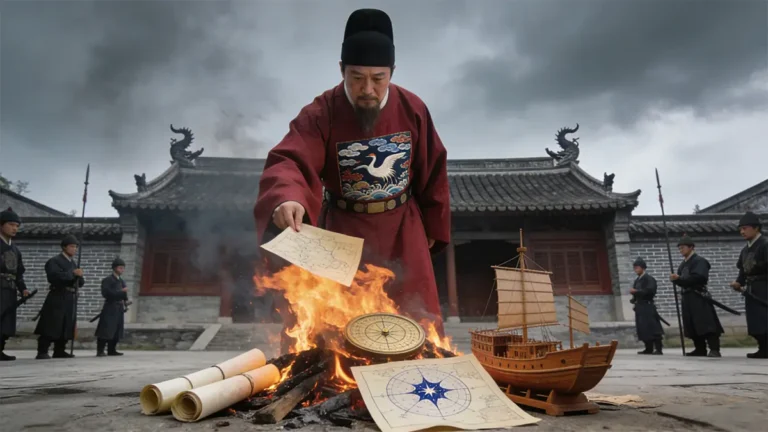
With the grand chancellor long abolished, the Six Ministries answered to the emperor directly, and Zhu Di spent much of his reign on campaign. He brought Xie Jin, Hu Guang and Yang Rong into the Wenyuan Chamber to take part in state affairs, and the Grand Secretariat dates from this. In 1405 Zheng He sailed for the Western Ocean. In 1408 the Yongle Encyclopedia was finished.
If Zhu Biao had not fallen ill in 1392
One way to measure the impact of Zhu Biao’s death on the Ming dynasty is to ask what did not happen. In the eighth month of 1391, Zhu Yuanzhang sent his son to Shaanxi to look at the land. The reason is in the History: a censor named Hu Ziqi had memorialized that Guanzhong, the region around Chang’an, was the best of the four possible capitals, and that no place in the empire compared with it. Zhu Biao came back in the eleventh month with a map of Shaanxi and then fell ill. In his illness he sent up a memorial on the planning of a capital. The History does not record what was in it.
Had he lived longer, the first capital of the Ming would very likely have moved west to Guanzhong. What happened instead, twenty-eight years later, was a move northeast to Beijing.
This one is a guess.
The evidence is better on punishment. Zhu Biao and his son did the same thing in the same post: they cut punishments. Had Zhu Biao come to the throne, the purge of the 1390s might never have happened. But the purge did not rest on the absence of one man. With the grand chancellor gone, the emperor ran the Six Ministries himself, and no one had to agree before a man was killed.
The princes are the weakest case of the three. In 1376, the ninth year of the Hongwu reign, Ye Boju, an instructor at Pingyao, memorialized that the enfeoffment of the imperial princes was too lavish and the punishments too frequent. Zhu Yuanzhang said he would shoot him with his own hands. Ye Boju died in prison and did not live to see the Jingnan campaign twenty-three years later.
Zhu Biao’s three sons were reduced to commoners and shut up in Fengyang, or housed at his tomb park. Zhu Yunwen’s second son, Zhu Wengui, was two years old when he was shut into the Guang’an Palace at the Central Capital. The court called him the Jian commoner. He was released in 1457, the first year of the Tianshun reign, at the age of fifty-seven.
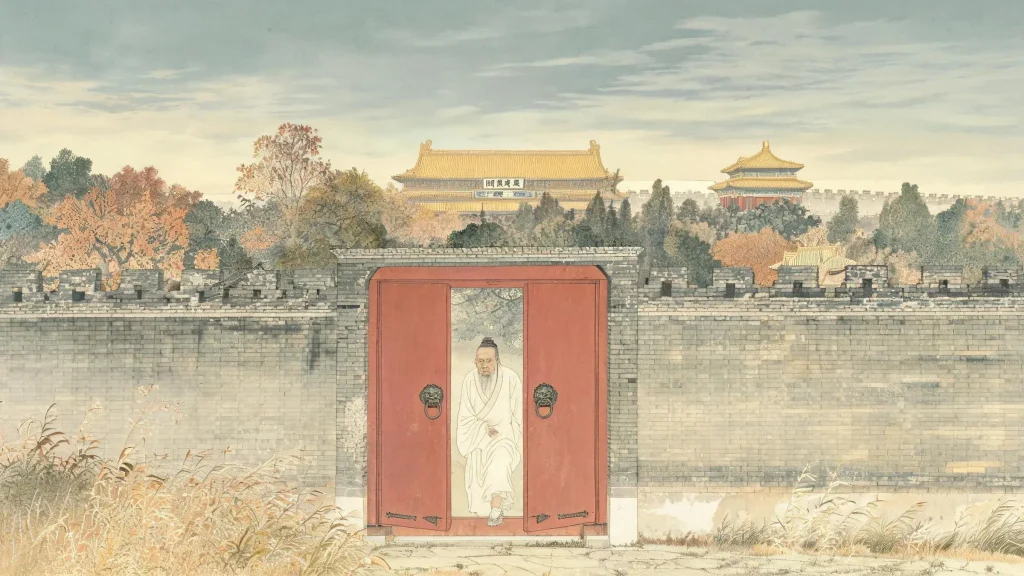
Sixty-five years separate Zhu Biao’s death from the day his grandson walked out of that gate.