The Imjin War: How Ming China Fought Japan in Korea, 1592–1598
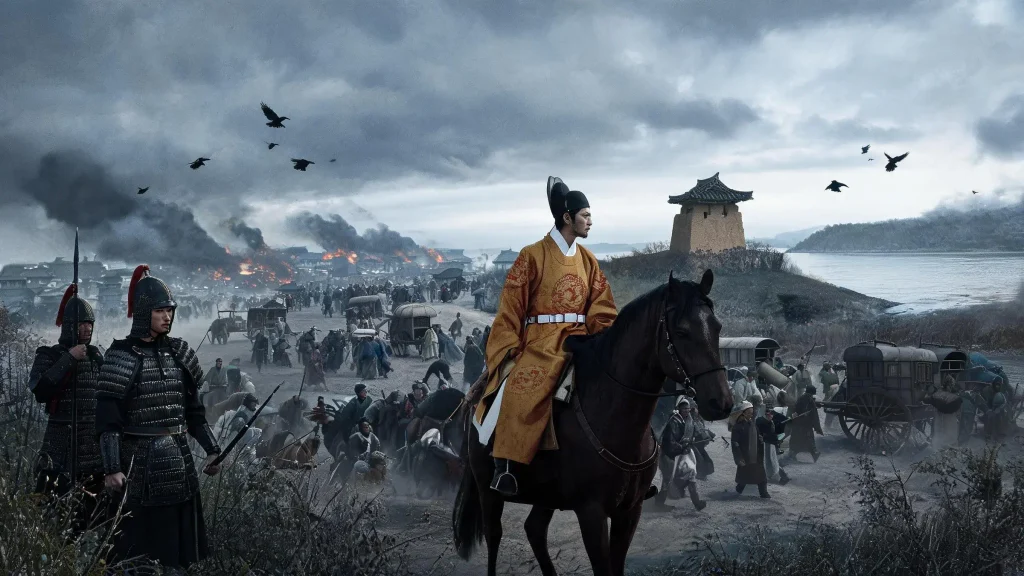
By May 1592, one month into the Imjin War, King Yi Yeon of Korea had already withdrawn to Uiju on the Yalu River. His capital was gone, two of his princes were in Japanese hands, and seven of his eight provinces had been overrun. The History of the Ming records what he asked Beijing for in his memorial: annexation. He offered to fold Korea into the territory of the Ming.
That same month the Ministry of War in Beijing was handling two things at once. In the northwest, a retired deputy general named Bobai had killed his province’s grand coordinator in the third month and raised a revolt at Ningxia, and in the fourth month the court sent Li Rusong to put it down. Meanwhile Korea’s appeals and envoys kept arriving on the road from Liaodong to the capital. Li Rusong was not released from the Ningxia front until the tenth month, when he was reappointed commander-in-chief against the Japanese and crossed the Yalu.
The answer the Ming gave Korea was not annexation. The court debate left behind one line: Korea must be held, for it is the fence of the realm. An envoy named Xue Pan was sent to Uiju, where he told the Korean court that a hundred thousand imperial troops were on their way. At that point the claim was empty.
The Imjin War ran from the Japanese landing at Busan in 1592 to the battle of Noryang in December 1598, seven years. Ming China sent about 166,700 men to Korea over that time, in rotations, and never had more than 80,000 in the peninsula at once. When it ended, the Japanese army was back home and the house that sent it was gone within five years. Korea kept its dynasty and its name, at the price of its people, its farmland and its government archives. The Ming held the border of a tributary state by pulling garrison troops out of Liaodong, Xuanfu, Datong and Shanxi, batch after batch, across the Yalu. Twenty years later Nurhaci rose at Fushun, and the Ming had no second army in Liaodong.
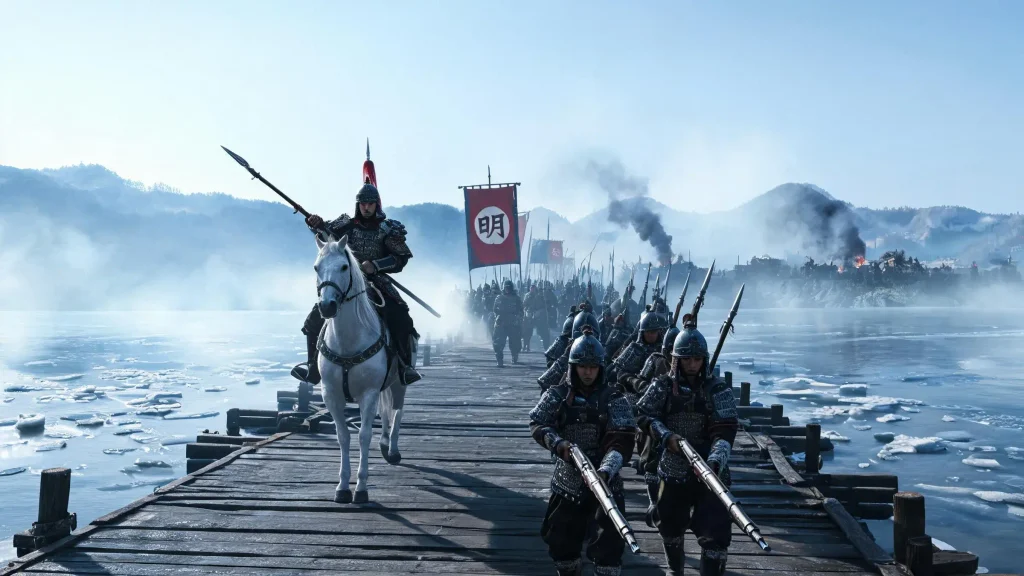
What Was the Imjin War?
The Imjin War was the seven-year fight for Korea, from 1592 to 1598, between the armies of a newly unified Japan and an expeditionary force sent by Ming China, with Korean troops, militias and a navy on the Chinese side.
The war has a different name in each country, because each country counted its years differently. English-language accounts usually call the whole conflict the Japanese invasions of Korea. Korea used the sixty-year cycle of stems and branches, in which 1592 was an imjin year, so the first invasion became the Imjin waeran, the Japanese disturbance of Imjin. The second invasion came in a jeongyu year, so Koreans call it the Jeongyu jaeran. Japan named its two campaigns after its own era names, Bunroku and Keicho. Ming documents called the whole affair the eastern campaign, and later historians grouped it with the Ningxia and Bozhou campaigns as the three great campaigns of the Wanli reign.
A recent study of the Imjin War’s legacies calls it the largest armed conflict anywhere in the world in the later sixteenth century, and the numbers support that. Japan sent 158,800 men in the first invasion, roughly a third of them fighting troops and the rest laborers and sailors, and 141,900 in the second. Korea’s standing army at the outbreak was 84,500 men, joined by about 22,000 irregular volunteers and by a navy that turned out to matter more than either. Ming China sent about 166,700 men over the course of the Imjin War.
To see why the Ming could not stay out of Korea, it helps to know what a tributary state was. Korea was not a province of the Ming. It had no Ming officials, paid no grain tax to Beijing, and kept its own kings, armies and laws. Its king received his title from the emperor, its documents used the Ming calendar, and in a crisis it asked Beijing for instructions. The History of the Ming sums up the arrangement in one line: Korea was called a tributary state, but in practice it was treated as territory within the realm. Embassies came several times a year and gifts went back with them, too many to record, so the compilers wrote down only what bore on the fate of the dynasty.
Korea had also not fought a war for more than two hundred years. The History of the Ming is blunt about the result: the country had been at peace so long that its soldiers had no practice in war, and King Yi Yeon was sunk in drink and had let his defenses lapse. When the islanders landed, the lines broke at the sight of them.
Why Did Japan Invade Korea?
Toyotomi Hideyoshi, the regent who had made himself master of Japan, took the Kanto plain from the Hojo in 1590 and brought the far north to heel in 1591, ending more than a century of civil war. The whole of Japan now answered to one man. The lords and fighting men who had spent their lives in that war did not get land out of the settlement. The Taiko land survey pulled large numbers of samurai off the land and into castle towns, where they went on drawing stipends and had no war left to fight.
Three years before the Imjin War, in 1589, Hideyoshi had the So clan of Tsushima ask Korea to send an embassy to Japan. Korea sent Hwang Yun-gil and Kim Song-il in 1590, and they came home with opposite readings of what they had seen. Hwang said Japan would invade. Kim said there was nothing to fear. The Korean court believed Kim.
Japan’s demand was put in writing and delivered in person by the men from Tsushima: let Japanese armies pass through Korea to attack the Ming, and let Korea guide them. Korea refused.
The History of the Ming preserves a second thread. Hideyoshi sent for the surviving followers of Wang Zhi, the Chinese smuggler who had run the coast a generation earlier, and heard that Chinese feared Japanese the way people fear tigers. It made him more confident still. He also worried that Ryukyu would leak his plans, and told the kingdom to stop sending tribute. A merchant from Tong’an named Chen Jia, trading in Ryukyu, worked out what was coming. He and the Ryukyuan official Zheng Jiong used a tribute mission to send word to the Fujian grand coordinator Zhao Cenlu. Zhao reported it, the Ministry of War forwarded the documents to the king of Korea, and the king spent his answer denying that he had agreed to guide anyone. He did not grasp that Japan was coming for him.
In the eleventh month of 1591 Korea itself reported that the Japanese regent had announced an invasion for the third month of the coming year. The Ming ordered the Ministry of War to strengthen the coastal defenses. The intelligence arrived a year ahead of the army, and nobody treated it as an operations plan.
The Imjin War was still a year away.
Hideyoshi’s own intentions survive as a physical document: twenty-five articles he sent to his nephew and regent, Toyotomi Hidetsugu, on May 18, 1592. The Japanese emperor was to move to Beijing and receive ten provinces around the capital. Hidetsugu would become regent of China with a hundred provinces. Japan would get a new regent. Korea would go to Hashiba Hidekatsu or Ukita Hideie. Hideyoshi himself would land at Ningbo and go on to India. When the Maeda house catalogued its papers in the Edo period, the lord of Kaga labeled the document, with some sarcasm, the retired regent’s three-country plan, drawn up far too early.
How much weight that plan deserves is disputed. A researcher at the University of British Columbia argues that there is no evidence the conquest of the Ming was ever the aim of the Imjin War. At most it was a brief idea in the opening weeks. What Hideyoshi wanted was to bring Korea to heel, and his real problem was ending the expedition without shaking his own power at home. He spent six years failing to do it.
The record also preserves how the Japanese lords took the order. The History of the Ming notes that the commanders resented Hideyoshi’s brutality and said among themselves that this campaign was not aimed at China at all, it was aimed at them. Each had his own plans, and Hideyoshi did not dare cross to Korea himself.
On the discipline of his army the same source adds one line: once it was on the march it only went forward, and anyone who fell back was executed even if he was the commander’s son-in-law. That was why it won wherever it went.
Why Did Ming China Intervene?
Ming China went to war in Korea to keep the fighting on the far side of the Yalu. The river was the frontier, and a Japanese army camped south of it put Liaodong and the Shandong coast within reach.
In the third month of 1592 the retired deputy general Bobai, a Mongol who had taken Ming service, killed the grand coordinator Dang Xin and the vice commissioner Shi Jifang and raised a revolt at Ningxia. He also opened talks with Mongol tribes across the Ordos. In the fourth month the court made Li Rusong commander of the punitive campaign, drawing in troops from Gansu, Liaodong, Xuanfu, Datong and Shanxi. Ningxia held out until the ninth month. In the twelfth month the court announced to the empire that the rebellion was over.
Korea’s crisis sat in the middle of all this. In the fifth month Japanese forces took the Korean capital; King Yi Yeon fled to Uiju and asked for help. In the seventh month the deputy general Zu Chengxun led a relief force across the Yalu and was beaten at Pyongyang. The officer Shi Ru was killed in the fighting, and Zu came back with his life and little else. It was the Imjin War’s first Ming land defeat.
The court in Beijing was shaken. In the eighth month Vice Minister of War Song Yingchang was appointed supreme commander against the Japanese. In the tenth month Li Rusong was given command of the garrisons of Ji, Liao, Baoding and Shandong, made commander-in-chief against the Japanese, and sent to Korea.
The reasoning inside the Ministry of War rested on one word. Korea was the fence of the realm, and if the fence went, Liaodong was next. The History of the Ming also recorded the Japanese plan as the Ming understood it: one army would march on Beijing with Korean guides, and another would work down the coast of Zhejiang and Fujian with guides who knew those waters. The garrisons at Dengzhou, Laizhou and Tianjin went onto the agenda that year.
Shi Xing, the Minister of War, had nothing else to hand. He sent men toward the Japanese camp to learn what could be learned, and a man from Jiaxing named Shen Weijing volunteered. The History of the Ming gives him five characters: a ruffian from the marketplace. Shi Xing hung a brevet colonel’s commission on him and sent him to Li Rusong’s headquarters.
Shen rode alone into Pyongyang and met Konishi Yukinaga, the commander of the Japanese First Division. Konishi gave him a story. Let the imperial army stay where it is, he said, and we will withdraw before long, leaving Korea everything west of the Taedong River. Shen carried the offer up the chain. The court decided the Japanese could not be trusted and pressed Song Yingchang to attack, but Shi Xing found Shen’s report persuasive. The supervising secretary Zhang Fuzhi and the Liaodong censor Zhao Yao both argued that a settlement was not something to be accepted lightly.
In the twelfth month of 1592 Li Rusong reached the army. Shen Weijing had just come back from the Japanese camp with the same offer, and Li cursed him and wanted him beheaded. His adviser Li Yingshi stopped him. Use Shen to keep the Japanese expecting an investiture, he said, and attack while their guard is down. Li Rusong took the advice. He kept Shen in camp and led the army across the river.
The Imjin War’s first Ming offensive began in the first month of the next year.
1592: The First Invasion and the Fall of Seoul
Busan fell on May 24, 1592, in the first weeks of the Imjin War. Its commander, Jeong Bal, refused to surrender, scuttled every ship in the harbor, and died on the wall. The garrison was destroyed almost to a man; some 8,000 Koreans were killed or wounded, and most of the 200 prisoners were executed soon afterward. The Japanese army barely paused. Dongnae came next.
Two wooden signs survive from Dongnae. The Japanese set one up outside the walls: fight, and we fight; do not fight, and lend us the road. The magistrate Song Sang-hyeon set the other up inside: dying in battle is easy, lending the road is hard. The city fell and Song was killed.
Korean armies broke in the field one after another. Yi Il’s force was beaten at Sangju. At Tangeumdae near Chungju, Sin Rip’s command was destroyed and he drowned himself. Watching the Japanese ranks, Yi Il left behind a line that Korean histories kept: the enemy looks like gods. At Hanseong, the general in command sank the city’s weapons in the Han River and abandoned it.
The History of the Ming compresses the collapse into a single sentence. The Japanese entered the capital, dug up the royal tombs, seized princes and ministers, looted the treasuries, and overran seven of the eight provinces. They were expected to cross the Yalu at any moment, and the appeals for help came up the road without stopping. Yi Yeon moved from Hanseong to Pyongyang, and from Pyongyang to Uiju. Kato Kiyomasa’s Second Division pushed up into Hamgyong province in the northeast, took two Korean princes at Hoeryong, and then crossed the Tumen River to attack a Jurchen fort, until a Jurchen counterattack drove it back.
The Korean court had few resources left. Militias raised by local gentry and commoners, known as righteous armies, harassed the Japanese behind the lines, and Buddhist monks under Hyujeong and Yeonggyu brought their own fighters. In the tenth month of 1592 the Japanese pulled back from Jinju. The garrison that held the city numbered a little over three thousand, and its commander was Kim Si-min. It was the first Korean town held on land since the Imjin War began.
The Battle of Pyongyang and the Relief of Korea
On the eighth day of the first lunar month of 1593, February 8 on the Western calendar, the Ming army attacked Pyongyang. Li Rusong had brought just under 40,000 men across the Yalu, with several thousand Koreans alongside.
Days before the assault the Ming had tried to take off the Japanese command. On the fourth day of the month Li Rusong’s troops reached Suknyeonggwan, and Konishi, still expecting an investiture embassy, sent twenty officers out to welcome it. Li had them seized. Three were taken and the rest escaped. Konishi was alarmed and sent a trusted aide to see Li, who sent him back with polite words.
On the sixth the army reached Pyongyang, and Konishi still believed an embassy had arrived. He waited in a pavilion while his men in their best clothes lined the road. When the Ming began forming up for battle, the arrangement became obvious, and the Japanese manned the walls.
The battle of Pyongyang is recorded in Li Rusong’s biography. He ordered his troops not to stop for heads and prize money, left the east side of the city open, and put Zu Chengxun’s men into Korean uniforms in the southwest, because the Japanese held Korean troops cheap. Another force under Wu Weizhong attacked the northern hill. Li took the main body against the southeast wall. Japanese shot and arrows came down like rain and the line gave ground, so Li had the men who fell back executed and sent volunteers up the ladders. As the Japanese moved to meet the attack from the south, Zu’s men threw off their disguises and showed Ming armor. The Japanese split their forces in alarm, and by then Yang Yuan’s troops were over the small west gate and Li Rubai was inside the great west gate. The firearms went off together and the smoke covered the sky. Wu Weizhong took a ball in the chest and kept shouting orders. Li Rusong’s horse was killed under him; he mounted another, fell into a ditch, climbed out and pressed the attack. The city fell, and the Ming counted more than 1,200 enemy heads.
It was the one Ming siege in the Imjin War that went according to plan.
Konishi slipped across the Taedong River after midnight and fell back on Yongsan. Li Ning and Zha Dashou had hidden 3,000 picked troops on a side road along the river and cut down another 360 men. On the nineteenth Li Rubai retook Kaesong, and the lost provinces of Hwanghae, Pyongan, Gyeonggi and Gangwon came back with it.
On the twenty-seventh of the same month, February 27, 1593, the Imjin War’s first Ming offensive came apart. Koreans reported that the Japanese had given up Hanseong. Li Rusong believed them and rode forward with his cavalry. Thirty li short of the capital he ran into an ambush and was surrounded. A Japanese officer in gilded armor came at him, and the commander Li Yousheng died fighting him off. Li Rubai and Li Ning charged in from both sides, Li Rumei shot the armored man out of the saddle, and Yang Yuan’s troops arrived and cut a way through. The Ming lost heavily. Rain had been falling for days and the cavalry could not work in the flooded rice fields. The Japanese had their backs to a hill, the Han River in front of them, and a chain of camps inside the city. The Ming pulled back to Kaesong.
After the defeat Li Rusong’s confidence went. He found another way to hurt the Japanese. Told that a commander the Ming records call Ping Xiujia held the granary at Yongsan with hundreds of thousands of bushels inside, he sent Zha Dashou with picked men by a side road to burn it. The Japanese ran short of food.
On the eighteenth day of the fourth month the Japanese abandoned Hanseong. Song Yingchang and Li Rusong entered the city and sent troops across the Han in pursuit. The Japanese marched in step and rested in relays, and the Ming did not dare close with them. They fell back on Busan and settled in to stay.
Four provinces had been recovered, and the Imjin War’s bill came with them. The Ministry of War said the garrison troops had been abroad too long and should be brought home by turns. The debate over what came next turned into an argument about who paid. The Sichuan troops left behind needed 50,000 taels a month, first from the Ministry of Revenue and the Ministry of War, then from Korea itself. In the same discussion a minister wrote a plain sentence: after the fighting and the famine, Korea suffered not only from the Japanese but from our own troops.
The Stalemate and the Failed Negotiations (1593-1597)
After the Imjin War’s first year ended with Hanseong recovered, Song Yingchang wanted a result, and the Japanese were short of food and wanted to go home, so the question of an investiture came up. Song sent the colonel Zhou Hongmo and Shen Weijing to the Japanese camp with terms: hand over the capital, return the princes, and the army would be allowed to leave. In the fourth month the Japanese did leave.
Opposition never stopped. In the ninth month of 1593 the secretary Zeng Weifang, of the Ministry of War, sent up the strongest memorial of the whole debate. The main Japanese army had already gone home, he wrote, and Konishi was waiting with his command; he would not attack while the Ming army was in the country. To go back and tell Hideyoshi that he needed another try, he would need a favorable wind, and the winter was against him. So whether or not there was a settlement, he would leave, and whether or not there was a settlement, he would come back. Shen Weijing’s bargaining at the Japanese camp had been followed by the fall of Haman and Jinju. Anyone who wanted a settlement so that next year would be quiet was only hurrying next year’s attack. Let Korea hold its own ground, Zeng wrote: mourn the dead, raise soldiers, store grain, and look to itself. The emperor agreed with him.
The next year He Qiaoyuan, a bureau director in the Ministry of Rites, reported that the Korean envoy Kim Sui had wept in front of him and said that 60,000 people in Korea had been killed without resistance. He added that Shen Weijing, in his dealings with the Japanese, never spoke of peace but only of the enemy begging to surrender.
What followed went the other way. Shi Xing was set on a settlement. The emperor rebuked the ministers who obstructed it and stripped the censor Guo Shi and others of their posts. The court fixed three conditions for Japan: withdraw every soldier to Japan; accept the title but no tribute; swear not to attack Korea again. The Japanese envoy Konishi Joan, whom Ming records call Xiaoxi Fei, accepted all three. In the first month of 1595 Li Zongcheng and Yang Fangheng were appointed to invest Hideyoshi as King of Japan.
The embassy took more than two years to arrive. Shen Weijing crossed first and privately gave Hideyoshi brocade robes, a jade belt, a court cap, maps, military texts and good horses. Li Zongcheng extorted what he could along the way until the Japanese officials on Tsushima drove him out of camp, and he ran for Hanseong by night, leaving the imperial letters behind. That was in the fourth month of 1596.
In the ninth month of 1596 Yang Fangheng reached Japan. Hideyoshi refused the investiture, on the ground that Korea had not kept the terms. He put the question to the Ming envoy directly. Do you not consider that the two princes, the three ministers, the three capitals and the eight provinces were all returned according to the agreement with your court? And now you send a minor official with a few trinkets to congratulate me. Is that an insult to my country, or to yours? He left his troops at Busan and did not withdraw them.
Only then did the Ming see that the two sides had been discussing different things. According to the records Japan and Korea left behind, the Japanese terms included the cession of four Korean provinces, a Korean prince as a hostage, the reopening of the tally trade, and a Ming princess for the Japanese emperor. The Ming had settled on a title without tribute. The two lists could not be made to meet, and the middlemen had each reported to their own court a version that would pass. The memorial of thanks that reached Beijing was later found to be carelessly drawn. Its cover carried the Toyotomi seal, and it did not use the Ming calendar.
Wang Dewan, a vice minister of revenue, summed the affair up: a title means tribute and tribute means trade, so Shen Weijing misled the supreme commander, the supreme commander misled the governor-general, the governor-general misled the ministry, and the ministry misled the court. The investiture did, in the end, fail.
The emperor’s answer was to arrest Shi Xing and Shen Weijing. In the ninth month of 1597 Shi Xing was imprisoned and sentenced to death, and he died in prison in 1599. Shen Weijing was beheaded in the marketplace the same year.
Four years of the Imjin War had bought a peace that did not exist. In the first month of 1597 Korean envoys came to ask for help again. In the second month the court took up the war once more.
1597: The Second Invasion
Japan sent 141,900 men into the Imjin War’s second invasion. The Ming changed its command. Vice Minister of War Xing Jie was made Minister of War and governor-general of Ji, Liao and Baoding, in charge of the campaign. Ma Gui, a former deputy commander, was appointed commander-in-chief against the Japanese. Yang Hao became supreme commander in Korea, based at Tianjin.
The Japanese moved more slowly this time, but they moved on the vital points. In the eighth month of 1597 they took Hansan Island and pushed on Namwon; the deputy general Yang Yuan abandoned the city and ran, and the Japanese were again closing on Hanseong. On why Hansan Island mattered, the History of the Ming offers its own analysis. It lay in Korea’s western approaches, screening Namwon on its right and covering the whole of Jeolla province. Once it fell, the coast was open and Japanese fleets could sail as far as Tianjin, Dengzhou and Laizhou. Namwon was sacked after it fell.
The Imjin War’s second invasion had taken two of the south’s main cities in one month. Chen Yuzhong at Jeonju, a hundred li away, had not dared to relieve Namwon while it was under attack; when he heard it had fallen, he abandoned his own city.
For a time the defense of Hanseong was to be given up. Ma Gui asked Xing Jie for permission to withdraw to the Yalu. Xiao Yinggong, the coastal defense commissioner, thought otherwise and rode from Pyongyang to Hanseong without stopping to prevent it, and Korea sent Yi Won-ik out through the Uryeong pass into Chungcheong. Xing Jie came to Hanseong himself, and the panic subsided.
What the Grand Secretariat had decided, Xing Jie then told his staff officer Li Yingshi. He called Li in for advice, and Li asked what the court’s plan was. Fight openly and make peace secretly, Xing Jie answered, suppress openly and conciliate secretly; the government has settled on those eight characters and no one is to breathe a word. Li took the cue. The Japanese had attacked, he said, because they had given up hope of any settlement, and the fact that they had not killed Yang Yuan after he abandoned Namwon showed they still hoped for one. Tell them Shen Weijing is alive and they will withdraw. Xing Jie did it, sending Zhang Zhenming with a letter in Shen Weijing’s own hand to scold the Japanese for moving. In the ninth month the Japanese fell back to Jeongeup.
Ma Gui reported a great victory at Cheongsan and Chiksan. Xiao Yinggong contradicted him in a report of his own. The Japanese withdrew because of Shen Weijing’s letter, he wrote, and no fighting ever took place at Cheongsan or Chiksan; where does the credit come from? Xing Jie and Yang Hao were furious and impeached Xiao for cowardice and for failing to deliver Shen Weijing in person, and had him arrested. Both versions are in the History of the Ming.
In the twelfth month the Ming assembled its reinforcements and attacked Ulsan in three columns, aiming at Kato Kiyomasa. Ma Gui sent money to Kato under cover of a truce and then brought the main army down on his camp. The colonel Bai Sai drew the Japanese into an ambush with light cavalry; 400 heads were taken and two palisades overrun, and the Japanese fell back on Mount Dodo and threw up three more camps. Mount Dodo was higher than Ulsan and its stone walls were strong, and the Ming took heavy losses attacking uphill. The generals agreed to sit it out: the Japanese had a hard time by water and could not be resupplied, so Kato could be taken without a battle. They invested the place for ten days and nights, the Japanese starved, and then played for time with talk of surrender. Konishi’s relief force arrived in strength and began to work around the Ming flank. Yang Hao never got an order out. He rode west, the army collapsed, and the survivors fell back on Hanseong. Two thousand men were lost.
The annals of the reign reduce it to one line: the imperial army attacked the Japanese at Ulsan and failed, and Yang Hao and Ma Gui fled to Hanseong. In the sixth month Yang Hao was dismissed and Wan Shide took over as supreme commander.
In the autumn of 1598, with the Imjin War in its seventh year, Xing Jie raised more naval troops. Chen Lin arrived with soldiers from Guangdong, and Liu Ting with soldiers from Sichuan. Deng Zilong brought troops from Zhejiang. The army was then divided into four commands, by land and sea: Dong Yiyuan in the center, Ma Gui in the east, Liu Ting in the west, and Chen Lin at sea. None of the three land attacks went well. Liu Ting tried to lure Konishi to a meeting and waited for him alone on the road, until a soldier gave the plan away and Konishi escaped; Liu took the wall and 92 heads. Ma Gui had some success at Ulsan, then let the Japanese draw him into an empty camp and was beaten by the troops hidden there. Dong Yiyuan took the outer camp at Sacheon and closed on the new fortress, which had a river on three sides, a sea inlet for a moat, and a thousand boats at anchor below it. In the tenth month he attacked from all sides and blew in the gate with firearms, and his men were through the palisade when the powder inside went up and the smoke covered the sky. The Japanese came out after it, the garrison at Goseong arrived, and the Ming army broke and fell back on Jinju.
That April, on the other side of the Yalu, the Liaodong commander Li Rusong rode out of the frontier and was killed in an ambush.
He was the Ming commander who had taken Pyongyang five years earlier in the Imjin War.
Yi Sun-sin and the War at Sea
In the Imjin War, fighting at sea was a different matter from fighting on land. Japan’s supply line ran across the strait from the home islands to Busan, and as long as Korea had a fleet holding the southern anchorages, the Japanese western flank stayed open. The Ministry of War later admitted the point: at first the imperial forces had no ships and the Japanese moved on the water as they pleased, and only once Chen Lin’s fleet was built did they stop moving freely.
Yi Sun-sin was the man who took that idea as far as it would go. Born in 1545, he passed the military examinations in 1576 and was twice removed from command on charges brought by rivals. In 1591 he was appointed naval commander of the western half of Jeolla province. There he trained his crews, stocked equipment, and rebuilt a warship the Koreans called the turtle ship. It had a dragon’s head at the bow that could fire guns and make smoke, and a deck studded with iron spikes. By later estimates it was about twenty meters long. He fought twenty-three actions at sea during the Imjin War. The two most famous were Hansan Island and Myeongnyang.
In the first year of the Imjin War the Korean navy sank Japanese ships at Okpo and followed up at Dangpo and Danghangpo. In the eighth month it met the Japanese at Hansan Island and destroyed or took fifty-nine ships, forty-seven sunk and twelve captured, and recovered some Koreans who had been held prisoner. After that the Japanese never got into Jeolla by sea. Korea’s rice basket, and the supply routes south of the Han River, stayed in Korean hands.
The sharpest turn of the Imjin War came from the Korean court itself in 1597. The Japanese worked a deception, the court ordered Yi Sun-sin to attack Busan, and when he refused he was arrested and imprisoned. Won Gyun took command of the fleet. In the seventh month Won Gyun was destroyed at Chilchonryang and the Korean navy was almost wiped out, and Hansan Island went with it. When Yi Sun-sin was released he had twelve ships and two hundred sailors. With his flagship that made thirteen.
He put those thirteen ships into the Myeongnyang strait on October 26, 1597. The strait is narrow, the tide runs hard, and the hills on either side throw shadows. The Japanese brought about 133 warships and at least 200 transports. With that many hulls in that little water they could only come in groups, and what met them inside were Korean guns and bows at long range, while the Japanese way of fighting was to close and board. They fell back. The Korean navy had kept the western sea route, and Hanseong was not abandoned after all.
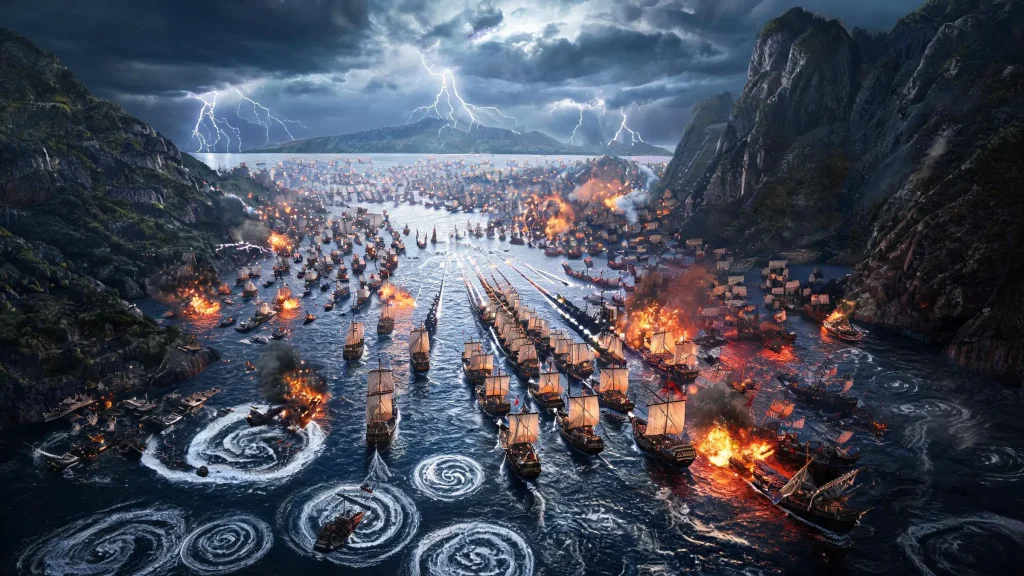
In the eighth month of 1598 Hideyoshi died, and the Japanese began to withdraw. In the twelfth month Chen Lin’s fleet and Yi Sun-sin’s squadron intercepted the withdrawal at Noryang, and the three countries recorded that battle differently. Chen Lin’s biography in the History of the Ming gives one version. Chen sent Deng Zilong and the Korean admiral Yi Sun-sin to block the Japanese. Deng Zilong was killed. The Shimazu squadron came west to relieve Konishi, and Chen caught it in mid-passage, killed its commander and destroyed three hundred of his men. The credit for the last sea fight of the Imjin War went to Chen first, Liu Ting second and Ma Gui third. The same history does not record the death of Yi Sun-sin. The Japanese records have the Shimazu squadron reaching home. The Korean record says Yi Sun-sin was hit in that battle and that his last order was that no one should announce his death. He was born in 1545 and died on December 16, 1598, off Noryang.
How the Imjin War Broke the Ming Dynasty
Around the end of the Imjin War the Ministry of Revenue’s accounts recorded the price. In a memorial, the vice minister of revenue Wang Dewan wrote that the Ningxia campaign had cost more than 1.8 million taels, the Imjin War 7.8 million, and the Bozhou campaign more than 2 million, for a total above 11.6 million taels.
The same memorial carries another set of numbers. The annual frontier budget had been 430,000 taels in the Hongzhi and Zhengde reigns, 2.7 million under Jiajing, and 3.8 million by the middle of Wanli’s. Those were the fixed payments. In the years when Wang was writing, the investitures and weddings of the emperor’s eldest son and the other princes cost 9.34 million taels, and ceremonial robes another 2.7 million. His own words: with waste like this, how is the state to hold up?
Where the money came from is recorded year by year. In the intercalary fourth month of 1599, with the Imjin War over, the court announced the repeal of the apportioned land tax that had been levied for the eastern campaign. That line shows a levy had been imposed during the fighting and was now lifted. When Bozhou was fought, Sichuan and Huguang were assessed again. In the ninth month of 1618 came another apportionment, for Liaodong, then another in the twelfth month of 1619 and a third in the third month of 1620. The next entry of the kind, in 1628, records that the starving people of Shaanxi were oppressed by the apportionments and that bandits rose in numbers.
There was a second line of money. In the seventh month of 1596 the court began sending eunuchs into the metropolitan region to open mines, and in the tenth month it sent eunuchs to levy taxes at Tongzhou, and before long tax commissioners were sitting in every province. The History of the Ming notes the justification offered at the start, that the money would help with the great construction works, and that the receipts went instead into the inner treasury and were never spent on building. The year was 1596, the Imjin War’s fifth. The report that Hideyoshi had refused the title and invaded again is dated to the ninth month of the same year.
Where the tax commissioners ended up is recorded in two episodes. In the fourth month of 1599 the emperor received the prisoners from Korea at the Meridian Gate. In that same month the people of Linqing burned the office of the tax commissioner Ma Tang and killed thirty-four of his attendants.
The Imjin War had ended in the twelfth month of 1598. In the twelfth month, riots at Wuchang and Hanyang left the tax commissioner Chen Feng injured.
The change in Liaodong came more slowly and drew less attention. In 1606 Li Chengliang, then in his seventies, decided the six Kuandian forts were too exposed to hold and abandoned them after consulting his superiors, moving the whole population back inside. The settlers did not want to leave their homes, so he drove them out with the army; the dead lay in heaps, and he then claimed credit for bringing fugitives back to the land. The supervising secretary Song Yihan argued that giving up the ground was a mistake, and the censor Xiong Tingbi’s inspection reached the same conclusion. The emperor, who had always favored Li Chengliang, left the memorials in the palace unanswered.
Around the same years, both the Ming and Korea were watching what Nurhaci was doing. In 1592 and again in 1597 he offered the Ministry of War troops to fight in Korea. Both offers were refused. The reason Korean officials gave is preserved in the records of the Border Defense Council: if Nurhaci once entered Korea, that would be the end of the state. The Ming reason was simpler. The Jianzhou Jurchens were becoming something to guard against. Li Rusong was Li Chengliang’s eldest son, and Li Chengliang’s business in Liaodong had been holding the Jianzhou down. With the Liaodong garrisons drawn off to Korea, Nurhaci defeated a nine-tribe alliance led by the Yehe at Gure Mountain in 1593, and after that no Jurchen power could match him.
How much room the Imjin War actually gave him is a question historians do not answer the same way. One line of argument holds that during the fighting he expanded by diplomacy rather than by arms, and that the wholesale absorption of the Haixi tribes came after 1601. What is on the ledger is the removal of the Liaodong troops. In the fourth month of 1618 the Later Jin took Fushun. In the second month of the following year Yang Hao took the oath at Liaoyang and sent Li Rubai, Du Song, Liu Ting and Ma Lin out in four columns. In the third month Du Song was killed, Ma Lin’s army was destroyed, and Liu Ting died at Abudali Ridge. Only Li Rubai’s column came back, and he killed himself later under impeachment. Liu Ting was the veteran of two Korean campaigns. Li Rubai had been at Pyongyang and Byeokjegwan.
The appraisal of the Wanli emperor at the end of the History of the Ming closes with one verdict: those who judge the dynasty say the Ming was already lost under Shenzong, the Wanli emperor.
The apportionment of the ninth month of 1618 was for Liaodong. The one levied twenty years earlier, for the Imjin War, had been repealed long before.
Aftermath: Death Toll, Cost, and Legacy
The Imjin War left no reliable count of its dead in any of the three countries. For the Ming, the History of the Ming has one sentence to offer. The Japanese ravaged Korea for seven years. Tens of thousands of troops were lost and millions of measures of grain consumed. Neither the court nor its tributary ever had the upper hand, and the trouble ended only with the regent’s death. Whether those tens of thousands cover the Ming alone or all three countries, the text does not say. Modern accounts usually cite more than 30,000 Ming dead.
Japan’s losses in the Imjin War, from fighting, disease, capture and disappearance, are estimated above 100,000. Most of what was spent came out of the Toyotomi house and the outside lords who fought for it.
Korea lost the most, because the war was fought on its ground. The figure usually given is more than a million soldiers and civilians dead. A study of postwar forests and garrison farms puts the loss differently. About a fifth of the population died or was carried off, and cultivated land fell to 66 percent of what it had been. All three royal palaces burned, and three of the four archives of the dynastic annals were destroyed. Korean officials told a Ming envoy two years into the Imjin War that 60,000 people had been killed without resistance, a figure that counts the killed and not the starved and the sick.
Between 50,000 and 60,000 Koreans were taken to Japan. Among them were potters, scholars, doctors and printers. The potter Yi Sam-pyeong found the clay that gave Japan its first porcelain, at Arita, and the Shim family of Satsuma kept making pottery into the modern period. The scholar Kang Hang lectured in Japan on Zhu Xi’s learning, and among those who listened was Fujiwara Seika. Arita porcelain, Satsuma ware, and the Neo-Confucian line that runs from Fujiwara Seika all begin with the people taken out of Korea.
The three countries went in different directions afterward. In Japan, Hideyoshi died in the eighth month of 1598 and the army came home. Sekigahara followed two years later, and Osaka castle fell fifteen years after that; the Toyotomi house was finished. The History of the Ming disposes of it in seven characters: Hideyoshi passed through two successions and was gone. The Tokugawa handed relations with Korea to Tsushima, and in 1607 a Korean embassy crossed the sea again.
In Korea, King Yi Yeon came back to Hanseong to find his palaces in ruins, and lodged at first in the house of a relative. Over the following decades the court rebuilt the land and tax registers, reprinted the annals, and repaired the walls. Gratitude for the Ming intervention hardened into an institution. In 1704 King Sukjong built a sacrificial altar in the rear garden of Changdeok Palace and made offerings there to the Ming emperors. The altar is known as Taebodan, the Altar of Great Recompense, and the rites continued into the nineteenth century.
What the Ming kept was a popular sentiment. The last line of the Japanese chapter in the History of the Ming reads as follows. To the end of the dynasty the ban on contact with Japan was strictly enforced. Common people in the lanes and alleys would curse each other by calling one another Japanese, and hush their children with the word.
The Korean chapter ends thirty-nine years later. The Qing emperor went to war with Korea in person, the Korean king submitted, and not long after that Pi Island fell and Korea’s connection with the Ming was severed. A few years later the Ming was gone.