Xuande Zhu Zhanji: The Cricket Emperor Who Built Ming
In the old imperial kitchens of Topkapi Palace in Istanbul, more than ten thousand Chinese porcelains stand under the domes. One group is early Ming blue and white, dishes up to sixty-two centimeters across, each with six characters in regular script on the base: Da Ming Xuande Nian Zhi. Made in the Xuande reign of the Great Ming.
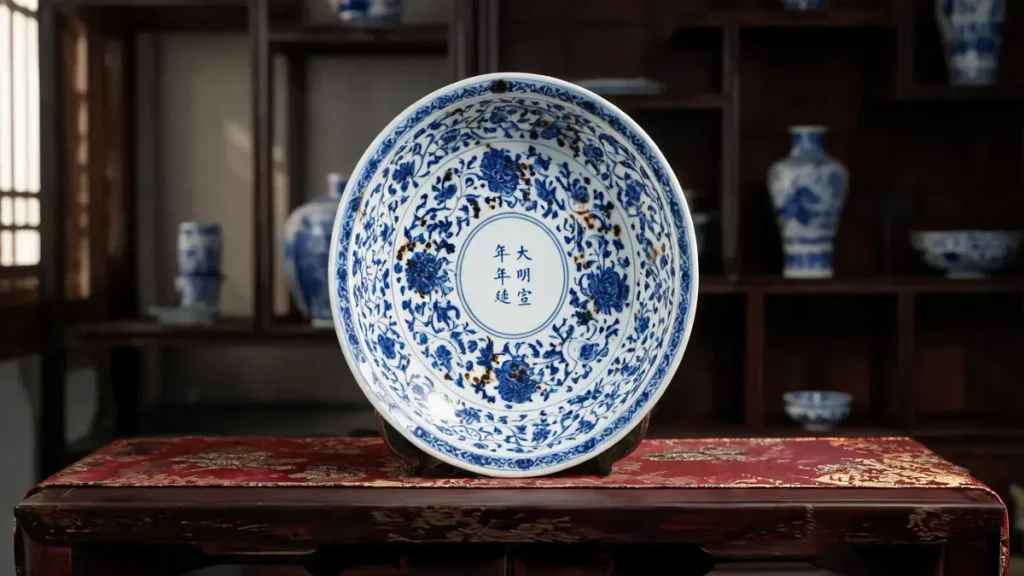
Those dishes were not bought in a shop. Some came as gifts from envoys. Some were acquisitions of successive sultans. Some arrived as war booty, carried off with everything else.
The reign those six characters name belonged to the Xuande Emperor, Zhu Zhanji. He was born in the second month of 1398, took the throne in the sixth month of 1425, and died in the Qianqing Palace on the third day of the first month of 1435. The History of the Ming gives his age at death as thirty-eight by Chinese reckoning, which is thirty-six. His era name ran ten years. He actually ruled nine years and seven months.Zhu Zhanji was the fifth of the sixteen Ming dynasty emperors, ruling from 1425 to 1435.
The Xuande Emperor inherited a state with several large bills open at once. The war in Jiaozhi, the Ming province in northern Vietnam, had run almost twenty years. The new capital was barely finished, and its three great halls were still the burnt shell left by the fire of April 1421. The treasure fleet had been stopped in 1425. The cost of five campaigns into the steppe had not yet been made good.
He was the grandson of Zhu Di, the Yongle Emperor.
The grandson who studied the classics in camp
In the eleventh month of 1411 Zhu Zhanji was named Imperial Grandson-heir. He was fourteen by Chinese reckoning and was capped in the same ceremony. From then on his grandfather took him on every progress and every campaign.
Two years earlier he had gone north to Beijing with the court. The Yongle Emperor sent him to look at farm tools and at how peasants lived and ate, then wrote a short tract, On the Root of the Matter, and gave it to him. In 1410, when the emperor took the army into the steppe, the boy was left to hold Beijing.
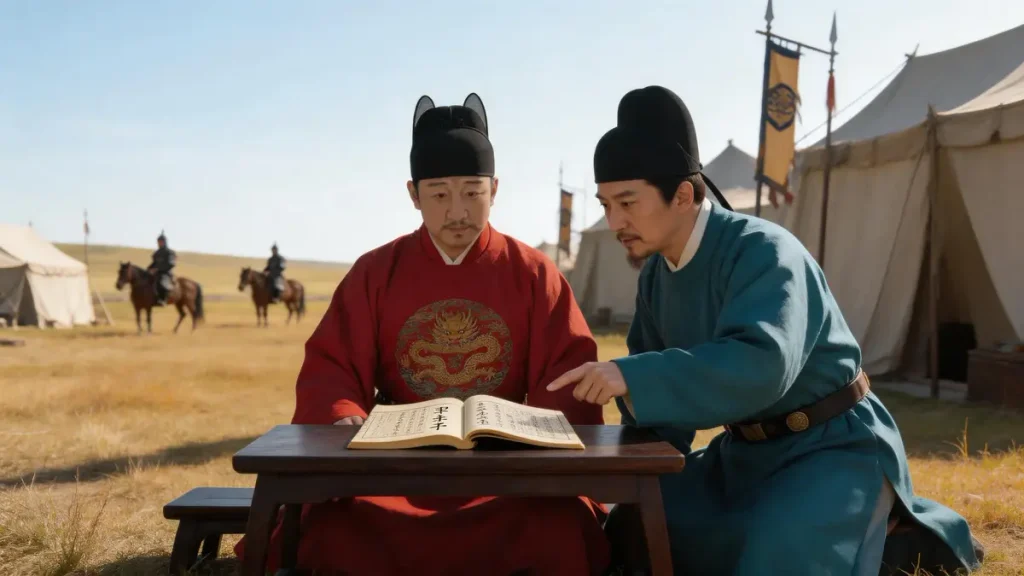
His lessons did not stop for the campaign. The emperor had Hu Guang and other Hanlin scholars lecture the heir on the classics in camp, between marches. "This is the Son of Heaven for a peaceful age," the emperor said to the boy’s father, more than once.
The line was quoted for the rest of the dynasty, and it carried more weight than a grandfather’s fondness. In 1404, with the succession still open, the Duke of Qi, Qiu Fu, argued that the prince of Han had earned the throne by his fighting. The Yongle Emperor asked Xie Jin, a Hanlin scholar, privately, and Xie said the eldest son was kind, filial, and held by the empire. The emperor said nothing. Xie bowed his head again and said, "A good imperial grandson." He meant Zhu Zhanji. The emperor nodded, and the succession was settled.
The appraisal in the History puts it plainly. His father, as heir, had lost the Yongle Emperor’s favor, and "he was in danger and came safe again, and the grandson had much to do with it."
From 1413 he rode with his grandfather’s campaigns. He saw how an army of a hundred thousand or more left the passes, where its grain came from, and how it came back.
His grandfather died at Yumuchuan, north of the frontier, in the eighth month of 1424. Ten months later his father died in the Qinan Hall.
From Le’an to Wuding: twenty days
In the fifth month of 1425 the heir was in Nanjing. His father was dying and sent for him. The prince of Han, Zhu Gaoxu, was waiting at Le’an for exactly this. He put men on the road to ambush the heir, and the ambush came to nothing for want of time.
In the eighth month of 1426 Gaoxu rose. His calculation was not hard to follow. His nephew was in his twenties, less than a year on the throne, and Gaoxu was repeating his own father’s performance of 1399: rise from a single prefecture, call it a war of rescue, and march south.
The court moved fast. Within days the Xuande Emperor had pardoned soldiers under sentence of death and restored their ranks, which steadied the army. He then took the field in person, and ten days after leaving the capital he was outside Le’an.
Before he left, riding at Yangcun, he worked through Gaoxu’s options aloud. Some of the staff thought Gaoxu would take Jinan first, others that he would march south. The emperor said he would do neither. Jinan was too strong to storm, and the guards’ families were all in Le’an, so the men would not go far from home. Gaoxu talked large and was timid underneath, and could not decide under pressure. He had risen because he thought a young and newly enthroned emperor would not dare come in person. "When he hears I am on the road his nerve will go. Will he come out and fight? I will have him the moment I arrive."
Gaoxu behaved as predicted. When he heard that Xue Lu was coming with troops he rolled up his sleeves and was delighted, thinking it would be easy. When he heard the emperor was coming himself, he began to be afraid. On the last night he burned his weapons and his correspondence with the conspirators. In the morning he came out by a side road, knelt, and said, "My crimes deserve death ten thousand times. I wait on Your Majesty’s command." The settlement ran in two directions. One was killing. Wang Bin and the others were executed. The garrison commanders in Tianjin, Qingzhou, Cangzhou and Shanxi who had promised to rise with him were found out and killed, six hundred and forty of them, with fifteen hundred more sentenced to death or to the frontier. The other direction was accommodation. When men accused the prince of Zhao, Gaoxu’s younger brother, of complicity, and the censors asked that his guards be stripped and that he be brought to the capital, the Xuande Emperor refused. He sealed the memorials, sent them to Zhao, and let the prince answer for himself. The prince of Zhao said, "I am saved," and handed over his guards.
The end of Gaoxu is one line in the History: "Gaoxu and his sons died one after another." How they died, the History does not say. Gu Yingtai, writing two centuries later, does. Gaoxu was chained in the Xiaoyao Compound inside the Xi’an Gate. The emperor went to look at him, and Gaoxu, catching him off balance, hooked a foot round the emperor’s leg and brought him down. The emperor ordered attendants to bring a bronze vat weighing three hundred jin and turn it over him. Gaoxu was strong enough to lift it on his shoulders. They piled charcoal on the vat and lit it. The bronze softened and ran, and he died inside it, and his sons died after him.
That story is not in the dynastic history.
Gu Yingtai was a Qing official whose book came out in 1658, and the vat survives because the scene is too exact to forget. All the record establishes is that Gaoxu died in the Xuande reign, with no date attached.
The Three Yangs at the desk, and a school for eunuchs
In the second month of 1430 the court issued a nine-point order of relief. Inspect storm and flood damage. Relax the horse levy. Cancel arrears of hay and fodder. Call back wandering households and exempt them for a year. Stop the purchasing offices. Cut the tax on official fields by three parts in ten. Relieve artisans. Forbid granary officers to take a cut. Require the judicial offices to be careful with prisons.
Two years later, in the third month of 1432, the Xuande Emperor wrote to the Ministry of Rites in terms that were not polite. "I cut the tax on official fields by three parts in ten. And I hear that when remissions were issued in the past, the Ministry of Revenue simply did not carry them out, and worse, warned local officials not to cite the edict. That is to block an order and keep its benefit from reaching the ground. From now on an order is to be carried out, without obstruction."
The Xuande Emperor knew his edicts were not arriving.
The daily work rested on a handful of men. Yang Shiqi and Yang Rong had been in the secretariat for years. Yang Pu came on duty in the Wenyuan Chamber in the intercalary seventh month of 1425, and Chen Shan followed in 1427, which completed the group later called the Three Yangs. Historians gave the eleven years of Renzong and Xuande a name, the Ren-Xuan rule. Nobody used it at the time. The compilers of the History said that under Renzong and Xuande the Grand Secretariat grew heavy, and its grand secretaries did in practice what grand chancellors had once done.
Twice in 1429 the Xuande Emperor walked over to the Wenyuan Chamber to talk to them. Ming emperors did not often do that.
That spring he set aside Empress Hu and made Consort Sun empress. Hu had no son and was often ill. "She was put aside without fault," the History says, "and the empire heard of it and pitied her." The great ministers, Zhang Fu, Jian Yi, Xia Yuanji, Yang Shiqi and Yang Rong, could not stop it. However heavy the secretariat had grown, this was still a decision the Xuande Emperor took alone.
Appointments outside the capital changed too. In the eighth month of 1425 Hu Gai, chief minister of the Court of Judicial Review, and Ye Chun, a provincial administrator, were sent out to inspect the Nanjing region and Zhejiang. The History dates the office of grand coordinator from that mission. In the fifth month of 1430 nine officials, among them Kuang Zhong, a bureau director, and He Wenyuan, a censor, were made prefects and sent out with sealed instructions. In the ninth month six more, Yu Qian and Zhou Chen among them, were made vice ministers and sent as grand coordinators to the two capitals and six provinces. These men came out of the ministries and the censorate and answered to the emperor directly.
Kuang Zhong spent his first three days at Suzhou pretending to understand nothing. The clerks stood round him with documents. He asked them what to do and did whatever they said. They were delighted and decided the new prefect was a fool. On the fourth day he called them in and went down the list. This case should have gone forward and you stopped me. That one should have been stopped and you pushed it through. You have been twisting the paperwork for years and the penalty is death. He had several beaten to death on the spot, dismissed the rest of the staff who were greedy, cruel or useless, and the prefecture came to attention.
In the palace the same years produced a school. In 1429 the court set up the Inner Writing Hall and put Chen Shan in charge of teaching the young eunuchs to read. The compilers of the History add the line that says what it ended: "and so the Taizu prohibition on teaching eunuchs letters was abandoned." The founding emperor had set an iron tablet at the palace gate saying that eunuchs were not to take part in government, on pain of death, and had kept them illiterate. In 1429 the rule came off.
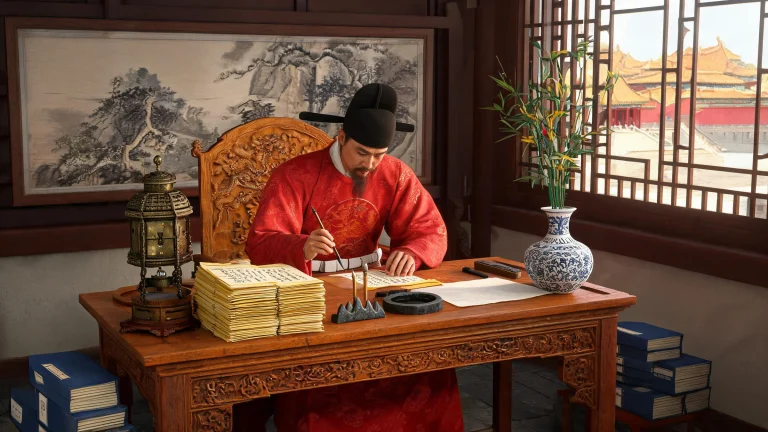
Literacy was for use. The eunuchs of the brush in the Directorate of Ceremonial handled memorials and wrote the vermilion endorsements on the drafts that came back from the Grand Secretariat. A eunuch who could not read could not do that. The Inner Writing Hall existed to staff that desk.
At the same time he kept a hand on them. In the seventh month of 1426 he told the Six Offices of Scrutiny that any order passed on by a eunuch had to come back to him before it was executed. In 1429 he stopped the eunuch shipyard on the Sungari. In 1432 he stopped the eunuch horse trade in the west. At the end of 1431 Yuan Qi and ten other eunuchs were executed in the market, and their crimes were posted through the empire.
Eighty-six thousand came back from Jiaozhi
The first bad news from Jiaozhi reached the court in the third month of 1426. Chen Zhi and Fang Zheng had been beaten at Chalong, and the prefect of Nghe An was dead. In the fourth month Wang Tong was made commander and sent south. In the eleventh month he was beaten again at Yingping, and the minister Chen Qia was killed. In the fourth month of 1427 Le Loi took Changjiang, and the garrison commander, two commandants, a prefect and a eunuch all died in the city. In the ninth month Liu Sheng’s army walked into an ambush at Daoma Slope. Liu Sheng was killed, two senior commanders died of illness in camp, and the army broke. In the tenth month Wang Tong abandoned Jiaozhi and made terms with Le Loi.
Giving it up was not a decision of that month. The chapter on Jiaozhi opens with it. When he came to the throne, the Xuande Emperor spoke with Yang Shiqi and Yang Rong about Jiaozhi and wanted to let it go at once. Now he put Le Loi’s memorial in front of the court and told them he meant to stop the fighting and rest the people. Yang Shiqi and Yang Rong backed him. Only Jian Yi and Xia Yuanji objected. The decision was already his, and nobody pressed it further.
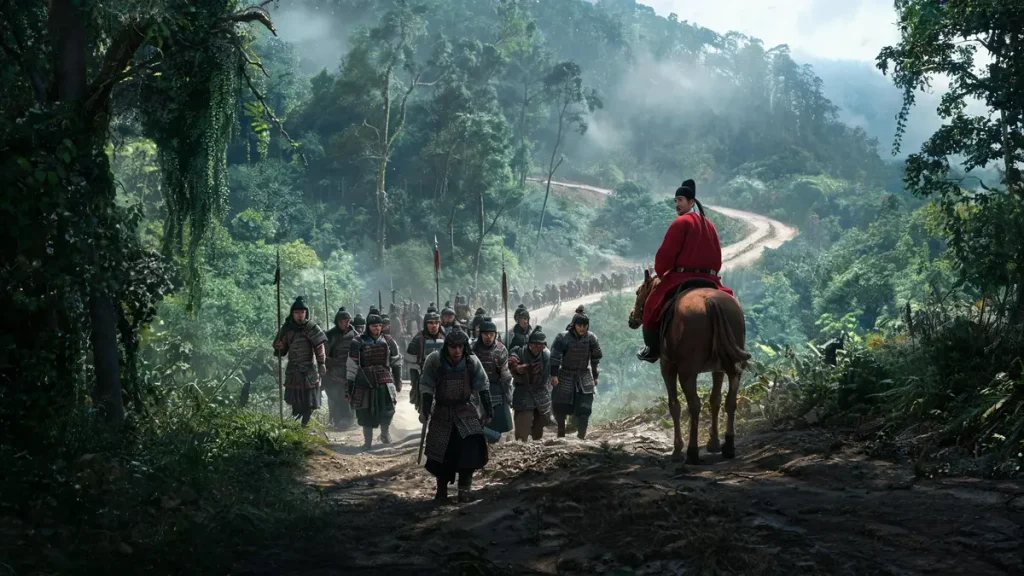
On the first day of the eleventh month the edict went out. Pardon Le Loi. Make Tran Cao king of Annam. Bring every official and soldier home. The number that came back is in the chapter: eighty-six thousand. The killed and the detained were, in its words, beyond counting. The same passage adds that the empire blamed Wang Tong for abandoning the territory and ruining its people, and that the emperor was not angry. In the intercalary fourth month of the following year the court apportioned blame. Wang Tong, the provincial commissioner Yi Qian, the eunuchs Shan Shou and Ma Qi were imprisoned and sentenced to death, their property confiscated. Gu Xingzu was imprisoned as well. The decision had been the emperor’s. The death sentences fell on the men in the field. The History does not explain that, and does not apologize for it.
The northern account was kept the same way. In the eighth month of 1428 he abolished the Beijing branch ministries and the rear commission of the Five Chief Military Commissions, and rode out to inspect the frontier himself. In the ninth month the Uriyangkhad crossed into Huizhou. He took three thousand picked troops out through Xifeng Pass and fought them at Kuanhe. The annals are precise. The emperor shot the men in front himself and killed three. Both wings came in and the enemy broke. When they saw the yellow dragon banner they dismounted, bowed and asked to surrender, and were taken alive.
What he did with the northern line was larger than the battle. In the fourth month of 1430 Xue Lu built five forts at Chicheng, Diaoe, Yunzhou, Dushikou and Tuanshan. That same year the Kaiping garrison moved its headquarters south from Kaiping, the old Yuan summer capital taken in 1369, to Dushikou. Yongle’s five campaigns had passed through Kaiping four times. By the Xuande years both covering garrisons, Daning and Xinghe, were gone, and Kaiping sat alone beyond the passes with no way to feed itself. The frontier came back by a hundred miles or more.
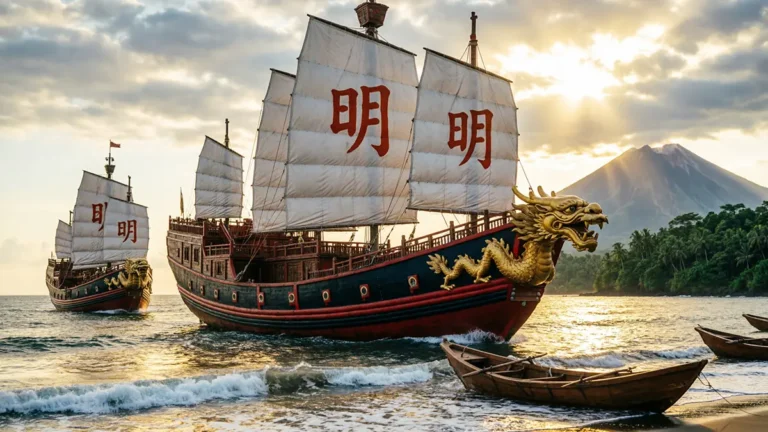
The sea was another account. That summer the Xuande Emperor said he had been long enough on the throne and that the distant kingdoms still had not sent tribute, and ordered Zheng He and Wang Jinghong out again, through Hormuz and seventeen kingdoms. The fleet came back in 1433. No Ming fleet sailed again.
Why it stopped is thinly documented. The accession edict of 1425 had put the abolition of the treasure ships first in its list. The order went out again in 1430, and there was no next time. A voyage cost ships, grain and gifts, and the bill could be counted. The garrisons in the north and the famine relief in the south came due every year.
The mice, the rabbits and three sheep
One of his paintings carries a line of small characters: "Painted for amusement by the imperial brush in the wushen year of Xuande, and given to Chen Xuan, Count of Pingjiang." The date is 1428. The subject is Zhuge Liang before he came out of his thatched hut, chest bare, head on a book box, lying in the grass under bamboo. Chen Xuan was in his sixties and ran the grain transport. The gift was a nudge to imitate the man in the picture.
The painting, Marquis Wu at Rest, is in the Palace Museum in Beijing. Ink on paper, 27.7 by 40.5 centimeters. The folds of the robe are drawn with a stroke that starts with a pause, like a nail head, and tapers to a hair.
The Xuande Emperor painted small animals more often. A mouse on a bitter-melon vine is in Beijing. Three Rams Bring the Spring, a ram with two lambs; a family of three apes at a stream; and two cats under flowers are in Taipei. A pine, the Ten Thousand Years Pine, is in the Liaoning Provincial Museum.
In the eleventh month of 1427 his eldest son was born. The next year a second son followed. In folk usage the mouse is a god of children and the melon is full of seeds, and later writers have read the mouse picture as a wish for a son. Nothing on the painting says so.
He wrote in the manner of the Shen brothers of Huating, and the Palace Museum’s cataloguer says the characters come out firm inside a rounded hand. His collected works ran to forty-four juan. The pieces the annals mention survive at least in name. There was the Lament for the Orchid, given to the court in the tenth month of 1429; a poem on locusts in 1430; the Book of Officials, thirty-five sections, in 1432; a poem on drought in 1433, when the prayers for rain failed.
The poems were not ornaments. The locust poem came out of an order he had sent to the countryside around the capital, and he told the Ministry of Revenue: "In past years the officers sent to destroy locusts have done the people as much harm as the locusts. See that you avoid that fault."
The Palace Museum’s note says he kept the painting academy at work through the reign. A dozen or so of his pictures survive, in Beijing, Taipei and Shenyang. He gave them away, with the year and the recipient’s name written on the silk.
One thousand crickets
The prefect of Suzhou received an order in the seventh month of 1434. "Of late the eunuchs An’er and Jixiang have been collecting crickets. The number they sent is small, and many are too little to be used. I have told them to bring a thousand in the last shipment. When this reaches you, work with them and do not fail."
The text survives in Wang Shizhen’s collection of historical materials. Shen Defu, writing in the 1590s, is shorter. "Our Xuande Emperor was the most accomplished man of his day at this sport, and once sent a secret order to Kuang Zhong, prefect of Suzhou, for a thousand crickets. The saying went round: the crickets chirp, and the Xuande Emperor wants them."
The Palace Museum, in an article on the imperial cricket jars, explains the choice of Suzhou. The soil around Beijing was too poor to raise good fighters, so the buyers went to the richest soil in the south. A thousand were divided among seven counties, the counties among the wards, the wards among households. People pulled down walls and dug up fields to find them. Those who could not went and bought, and the price rose tenfold, with a good one fetching a dozen taels of gold.
Huangfu Lu, in a notebook, tells of a grain-tax captain at Fengqiao who saw a fine cricket for sale and traded his horse for it to meet his quota. At home his wife and concubines could not believe an insect was worth a horse and wanted a look. The lid came off and the cricket jumped. The women hanged themselves, and the captain followed them.
That is a notebook, not a dynastic record. The objects are another matter. In the spring of 1993 a pit of blue and white shards was dug up at the imperial kiln site on Zhushan in Jingdezhen. Reconstructed, they were all cricket jars: drum-shaped, holed lids, the six characters Da Ming Xuande Nian Zhi inside the lid and on the base. The decoration runs through cloud dragons, phoenixes, sea monsters, mandarin ducks, peony scrolls, pine, bamboo and plum, melons and bitter melons, a dozen motifs or more. The dragon jars carry five-clawed dragons, which by regulation only the emperor could use.
The Qing palace kept 1,174 pieces of Xuande imperial ware, most of them now in Taipei. There is not one cricket jar among them. The gap has an explanation. After the Xuande Emperor died, the Empress Dowager Zhang ordered that everything in the palace that was a plaything, and every task that was not urgent, be abolished. The Palace Museum adds that the fashion ran downward, and that cricket fighting became a nationwide pastime in these years.
In the same seventh month of 1434 another order went out, to the censors, the supervising secretaries and the Embroidered Uniform Guard, to drive the locusts out of the two capitals and four provinces. One edict went north after insects. One went south for a thousand of them.
Sumali cobalt and the look of Xuande blue and white porcelain
Xuande blue and white has a blue that few other reigns have. The Palace Museum’s catalogue is technical about it. The cobalt, called Sumali, is high in iron and low in manganese, and in the right kiln atmosphere it fires to a sapphire blue. Because of the iron, the color carries irregular black crystalline speckles. Ming writers described the same ore. Wang Shimao, in the 1590s: "The imperial kilns of Yongle and Xuande are still the most prized. In that time sweet white with its pinholes was the staple, Sumali cobalt the ornament, and fresh red the treasure." Chen Jiru said that in Xuande ware the choice of clay, the forming, the painting and the inscription were all without fault, and that the blue was suboni cobalt. Gao Lian said the same in different words. One ore, two names, three writers.
The speckles have a name in connoisseurship: iron spots. The Taipei catalogue describes them as brownish-green patches, or brown and iron-black crystalline spots, sometimes sunk below the glaze. On genuine pieces the spots usually lie under the glaze and pit the body, so a raking light shows a dip. On later copies they tend to sit on top. Bleeding behaves the same way. The edge of a painted line blurs, like ink on unsized paper. The Palace Museum’s note on a square vase with morning-glory scroll says that the potter mixed imported and domestic cobalt, that the blue bleeds naturally, and that the iron crystals have sunk. Xuande potters did not use one ore for everything. Imported cobalt went into the washes. Domestic cobalt went into the fine outlines.
Many Xuande shapes are visibly copied from West Asian metalwork. The same vase has elephant-head handles, cut corners, and a splayed foot ring finished with a step inside, which the Palace Museum calls a Xuande characteristic. There are pen boxes, pilgrim flasks with ribbon handles, and basin-shaped dishes whose ancestors are metal and glass vessels from the Islamic world.
The kiln site at Zhushan has produced, from its Xuande stratum, blue and white, red glaze, snowflake blue, peacock green, Ge-type, Ru-type and Longquan-type celadon. Most of what the Ming and Qing imperial kilns would later make already existed in this one reign. That list comes from excavation, not from a text.
Where the pieces went is another trail. The Yongle and Xuande blue and white in Topkapi reached the Ottoman court as gifts, purchases and booty. The Ardebil shrine in Iran holds fewer than twelve hundred pieces, given by Shah Abbas in 1611. Among them is a Xuande imperial dish with a lotus scroll. Within a century and a half of the reign, these dishes were standing in Persia and Anatolia.
The ore itself is usually said to have come from Persia. Whether the voyages had anything to do with the supply is a fair question and not a settled one. The route looks plausible, since the fleet called at Hormuz, which was a clearing house for cobalt. But no document records a shipment of Sumali cobalt, or a weight, or a price, or a date. The link is inference. What is certain is that the ore ran short after Xuande, and that by the Chenghua reign the blue came from a different source and fires paler and evener.
Six characters under the foot: the Xuande mark and period
Xuande marks are the hardest in Ming imperial ware to pin down. Sun Yingzhou, who catalogued the Palace Museum’s ceramics, turned the problem into a mnemonic. The mnemonic says the marks run all over the piece: in regular script, carved, stamped, in seal script or in relief; horizontal or vertical; set in a flower, in four frames, in a double ring, a single ring, or no ring at all. The finest are in the small regular script of the Jin and Tang. The first claim is about position. Besides the base, the mark turns up inside the foot, inside the wall, under the lid, on the lip, the neck, the shoulder, the waist, and the spout of a ewer. The second is about technique. Written in cobalt or in overglaze color, incised, or impressed. The six-character mark is always regular script. The four-character mark comes in regular and in seal.
A reign that scattered its mark this widely left a problem for everyone after it. The common form is a six-character mark in two columns inside a double circle on the base. But a piece marked on the shoulder, or inside the lid, is not thereby false. And a piece with the right mark in the right place in the right hand is not thereby of the reign. The copies are everywhere. From the middle of the Ming to the three Qing reigns of Kangxi, Yongzheng and Qianlong, the six characters were written continuously. A group of Kangxi imperial pieces carries the Xuande mark as a compliment rather than a forgery. In the trade the line between the two blurred long ago.
Bronze is worse. In 1428 Siam sent a tribute of copper, the fine sort known as wind-polished, and the court cast a set of ritual vessels for the suburban altars, the imperial ancestral temple and the palaces. The tradition says three thousand or more, refined twelve times, with the mark under the foot. The type took the reign’s name and became the Xuande censer.
The Xuande censer is the least settled object in Ming decorative art. The register that describes the casting, the Illustrated Register of Xuande Ritual Bronzes, was called into question by Paul Pelliot in 1936, and defended by Chinese scholars as recently as 2020. Researchers at the Palace Museum, working from scientific testing, argue that genuine pieces exist. What the field agrees on is narrower. There is no single vessel accepted by everyone as the standard of the 1428 casting.
Xuande red is deeper than Yongle red, with a purple cast, and is called ruby red. The lip shows a narrow white line where the glaze thins, the rush-light rim. Snowflake blue was first fired in this reign: blue glaze blown through a bamboo tube onto a white body, so that the white shows through in flecks, like snow.
Four pieces of snowflake blue are known. The Capital Museum has a bowl-shaped one, 11.5 centimeters high and 25.3 across the mouth, marked in a double circle inside. In the 1970s an old woman brought it into the state antique shop in Beijing and asked what it was worth. She had kept salt in it, and later fed chickens out of it. The shop took it for a Qianlong piece and paid her eighty yuan. When it was cleaned, the six characters came out from under the dirt. Geng Baochang and Fu Dayou looked at it, and it was graded a first-class national treasure.
She took her eighty yuan and left. The shop later tried to find her and pay her more. They never did.
The third day of the first month, Xuande 10
The Xuande Emperor fell ill in the twelfth month of 1434. On the first day of the new year he did not hold court, and had the officials greet the heir in the Hall of Literary Glory. On the second day he was failing, and cancelled the purchasing and construction commissions. On the third day he died in the Qianqing Palace, aged thirty-eight by Chinese reckoning. The testamentary edict was one sentence. Weighty matters of state to the Empress Dowager.
He was thirty-six. His son Zhu Qizhen was nine. The Empress Dowager Zhang abolished the playthings and the non-urgent business, and stopped the sending of eunuchs on outside assignments. The cricket jars, and the purchasing offices, stopped in that month.
The men he left behind went on working: all three of the Yangs were in the secretariat. Yang Rong lasted until 1440. He was seventy, on his way home from a visit to his family graves, and died at the post station at Wulin, outside Hangzhou. Yang Shiqi died in 1444 at eighty. Yang Pu died in 1446 at seventy-five.
The History closes Yang Pu’s biography with a cold sentence. After Yang Rong and Yang Shiqi died, the men who came into the secretariat, Ma Yu, Gao Gu and Cao Nai, were juniors without weight. Yang Pu stood alone, and Wang Zhen grew stronger. "Three years later Wang Zhen led the Yingzong Emperor north, and the army was destroyed at Tumu, and the state nearly fell."
Tumu was 1449. Among the dead was Zhang Fu, Duke of Ying, son of the Jingnan commander Zhang Yu and made duke in 1406. In 1426 he had been one of the ministers who could not stop the setting aside of Empress Hu, and in 1449 he rode out with the army at seventy-five and was killed in the rout.
Western scholarship cuts the period differently. In 2014 the British Museum mounted an exhibition called Ming: 50 Years That Changed China, with 280 objects, curated by Jessica Harrison-Hall of the British Museum and Craig Clunas of Oxford. Their fifty years run from 1400 to 1450, from the Jingnan campaign to Tumu, with the Xuande reign in the middle. The argument was that the move of the capital, the Forbidden City, the voyages, and the shift from military to civil government set the shape of the next five centuries.
Clunas put it to a reporter in a sentence. When the Qianlong Emperor wanted the best porcelain in the eighteenth century, he went back to Xuande. Xuande-period porcelain is still the most expensive thing sold at auction.
The appraisal in the History is the highest register the tradition has. "The officials were equal to their posts, the government was even, the rules were clear, the granaries were full, the lanes and villages were content, and the years brought no disaster. Sixty years had passed since the Ming rose; the people’s spirit was easing, and there was the look of order and peace." The second half turns to the other side. A powerful prince rose suddenly and was put down at once, the frontier was swept, the enemy was overawed, and in his bearing and his grasp of strategy he came close to matching his ancestor. Gu Yingtai set the two reigns beside Zhou’s Cheng and Kang and Han’s Wen and Jing, and in the same breath listed three failures. "He gave up Jiaozhi beyond the frontier, set aside Empress Hu in a long gate, and chained Chen Zuo in prison." Chen Zuo became a censor in 1427. He sent up a memorial asking the emperor to have scholars lecture on the Great Learning in his spare time, without interruption. The emperor read it and lost his temper. "Does this petty Confucian think I have never read the Great Learning? To slight me like this is beyond forgiving." Chen Xun, a grand secretary, smoothed it over by saying that the man was a provincial who did not know the throne had read everything. The emperor calmed down. Chen Zuo went to prison anyway, with a dozen of his household, kept apart from one another for five years. His father died there.
He is buried at Jingling, below Tianshou Mountain in Changping, with Empress Sun. The empress he set aside is buried at Jinshan, with the rites of a consort. The Empress Dowager Zhang died in 1442. Hu wept and was dead within a year. In the seventh month of 1463 she was finally given a posthumous title and a tomb. The tomb was built.
Her tablet never went into the ancestral temple.
Questions readers ask
Who was the Xuande Emperor?
The Xuande Emperor was Zhu Zhanji (1398-1435), fifth ruler of the Ming dynasty and grandson of the Yongle Emperor. He reigned from 1425 to 1435 under the era name Xuande, which means "proclaimed virtue." He was the son of the Hongxi Emperor, whose reign lasted ten months, and the father of the Yingzong Emperor, who was captured by the Oirats at Tumu in 1449. His grandfather groomed him for the job. Zhu Zhanji was named Imperial Grandson-heir in 1411 and taken on campaign, and the Yongle Emperor is said to have fixed the succession on him as much as on his father. As ruler he kept the Grand Secretariat close, moved senior officials out to the provinces as grand coordinators and prefects, and personally led one campaign, against his uncle at Le’an in 1426.
Was the Xuande Emperor a good ruler?
The verdict on the Xuande Emperor is yes, with reservations. The appraisal in the History of the Ming praises full granaries, even government and contented villages. The 1430s were the second half of what historians call the Ren-Xuan rule. He cut taxes, reviewed prisoners again and again, and sent senior officials out of the capital as grand coordinators.
The reservations are specific and were named early. Gu Yingtai, writing in the 1650s, listed three: the abandonment of Jiaozhi, the setting aside of Empress Hu, and the imprisonment of the censor Chen Zuo for suggesting that the emperor read more. Modern accounts add the founding of the Inner Writing Hall, which taught eunuchs to read and staff the desk that wrote the vermilion endorsements. Wang Zhen, the eunuch who took the Ming army to disaster in 1449, was a product of that system.
Why is Xuande porcelain so valuable?
Two reasons, one material and one documentary. The material is the cobalt. Xuande blue and white used an imported Persian ore called Sumali, high in iron and low in manganese, which fires to a deep sapphire with black crystalline speckles that sink into the glaze. Nobody after the fifteenth century could reproduce the effect exactly, because the ore supply ran out. The documentary reason is the mark. Da Ming Xuande Nian Zhi is the best-known reign mark in Chinese ceramics, and the marks of this reign are unusually varied: on the base, inside the foot, under the lid, on the shoulder, in seal script or regular, carved or written. That variety makes the mark hard to read and easy to fake, which is why "Xuande mark and period" is a phrase collectors treat with care. A mark of the period is not the same as a piece of the period.
Was the Xuande Emperor really the cricket emperor?
The name is earned. In the seventh month of 1434 he sent an order to the prefect of Suzhou demanding a thousand crickets, complaining that the ones already sent were too small, and telling the prefect to work with the eunuchs collecting them. A contemporary jingle ran: the crickets chirp, and the Xuande Emperor wants them. A notebook tells of a grain-tax captain who traded his horse for a cricket and lost his family over it.
The physical evidence arrived in 1993, when excavations at the imperial kiln site in Jingdezhen produced a pit of shattered cricket jars, all marked with the reign name, some painted with five-clawed dragons. The Qing palace, which kept 1,174 pieces of Xuande imperial ware, has none of them, probably because the empress dowager had the palace playthings cleared out after his death.
Why did the Ming give up Jiaozhi and the treasure voyages?
Both were running costs that had stopped paying. Jiaozhi, the Ming province in northern Vietnam, had been at war since 1406; by 1427 the Ming field army had been destroyed at Daoma Slope and the garrison was cut off. The Xuande Emperor had wanted to abandon the province from the day he took the throne. He brought eighty-six thousand people home, then had the commanders who lost the war imprisoned and sentenced to death.
The voyages ended differently. A fleet was sent out once more in 1430, under Zheng He, and came back in 1433. No official fleet followed. The cost of ships, grain and gifts could be counted, while the frontier garrisons and famine relief came due every year, and the court that had paid for the voyages was gone.
Sources and further reading
- History of the Ming (Mingshi), chapter 9, annals of the Xuande Emperor. The naming as Imperial Grandson-heir, the Le’an campaign and the move to Wuding, the nine-point relief order, the 1432 letter to the Ministry of Rites, the Wenyuan Chamber visits, the abolition of the Beijing branch ministries, the Kuanhe battle, the Dushikou forts, the 1430 voyage order, the death on the third day of the first month: https://zh.wikisource.org/zh-hans/明史/卷9
- History of the Ming, chapter 118, princes, biography of Zhu Gaoxu, Prince of Han. The ambush on the road, the Yangcun staff conference, the surrender at Le’an, the executions, the prince of Zhao’s guards: https://zh.wikisource.org/zh-hans/明史/卷118
- History of the Ming, chapter 113, biographies of the empresses. The setting aside of Empress Hu, the ministers who could not stop it, her burial at Jinshan and the 1463 restoration of her title: https://zh.wikisource.org/zh-hans/明史/卷113
- History of the Ming, chapter 148, biographies of Yang Shiqi, Yang Rong and Yang Pu. The completion of the Three Yangs, the death of Yang Rong at Wulin, and the closing sentence on Tumu: https://zh.wikisource.org/zh-hans/明史/卷148
- History of the Ming, chapter 161, biography of Kuang Zhong. The three days of feigned ignorance at Suzhou and the purge of the clerks: https://zh.wikisource.org/zh-hans/明史/卷161
- History of the Ming, chapter 162, biography of Chen Zuo. The memorial on the Great Learning, the emperor’s outburst, and the five years in prison: https://zh.wikisource.org/zh-hans/明史/卷162
- History of the Ming, chapter 304, eunuchs, biography of Zheng He. The 1430 order and the return from Hormuz and seventeen kingdoms: https://zh.wikisource.org/zh-hans/明史/卷304
- History of the Ming, chapter 321, foreign countries, Jiaozhi. The decision to withdraw, the eighty-six thousand who came back, and the sentencing of Wang Tong: https://zh.wikisource.org/zh-hans/明史/卷321
- History of the Ming, chapter 74, officialdom, the eunuch offices. The Inner Writing Hall of 1429, the eunuchs of the brush and the vermilion endorsements: https://zh.wikisource.org/zh-hans/明史/卷74
- History of the Ming, chapter 72, officialdom, the Grand Secretariat. The grand secretaries’ duty to draft and endorse memorials: https://zh.wikisource.org/zh-hans/明史/卷72
- History of the Ming, chapter 154, biography of Zhang Fu. His death at Tumu at seventy-five: https://zh.wikisource.org/zh-hans/明史/卷154
- Gu Yingtai, Mingshi Jishi Benmo, chapter 27, the rebellion of the prince of Han. The bronze vat: https://zh.wikisource.org/zh-hans/明史紀事本末/卷27
- Gu Yingtai, Mingshi Jishi Benmo, chapter 28, the Ren-Xuan government. The comparison with Cheng and Kang, Wen and Jing, and the three failures of the Xuande Emperor: https://zh.wikisource.org/zh-hans/明史紀事本末/卷28
- Wang Shizhen, Yanzhou Shiliao Houji, chapter 31. The text of the 1434 order to Kuang Zhong on crickets.
- Shen Defu, Wanli Yehuo Bian, chapter 24. The secret order for a thousand crickets and the jingle that followed.
- Huangfu Lu, Huang Ming Ji Lue. The grain-tax captain at Fengqiao who traded his horse for a cricket.
- Palace Museum, Beijing, Marquis Wu at Rest, with the 1428 inscription to Chen Xuan: https://www.dpm.org.cn/collection/paint/231097.html
- Palace Museum, Beijing, blue and white jar with kui-dragon scroll, and its note on Sumali cobalt: https://www.dpm.org.cn/collection/ceramic/226863.html
- Palace Museum, Beijing, square vase with morning-glory scroll, and its note on mixed cobalt: https://www.dpm.org.cn/collection/ceramic/227385.html
- Palace Museum, Beijing, "A brief account of the Ming imperial kiln site at Jingdezhen," on the 1993 cricket jars and the range of Xuande wares.
- Palace Museum, Beijing, "The cricket emperor: luxury and play at the Xuande court," on the Suzhou procurement and the price of a good cricket: https://www.dpm.org.cn/court/culture/166685.html
- Palace Museum, Beijing, blue and white cricket jar with peony scroll, excavated at Zhushan in 1993: https://gugongzhanlan.dpm.org.cn/artShare/749
- National Palace Museum, Taipei, catalogue note on a blue and white dish with cloud dragons, for the description of Sumali cobalt, iron spots and the six-character mark.
- Sun Yingzhou’s mnemonic for Xuande reign marks, as transmitted in Palace Museum publications and the Palace Museum Journal.
- Capital Museum, Beijing, the Xuande snowflake-blue bowl, 11.5 by 25.3 centimeters; the 1970s purchase at eighty yuan is reported in CCTV’s Art Investment programme, May 2007.
- British Museum, Ming: 50 Years That Changed China, 18 September 2014 to 5 January 2015, 280 objects, curated by Craig Clunas and Jessica Harrison-Hall.
- People’s Daily Online, 19 September 2014, interview with Craig Clunas on the Qianlong Emperor’s imitation of Xuande porcelain.