Zhu Houcong (Emperor Shizong): The Dark Jiajing Reign
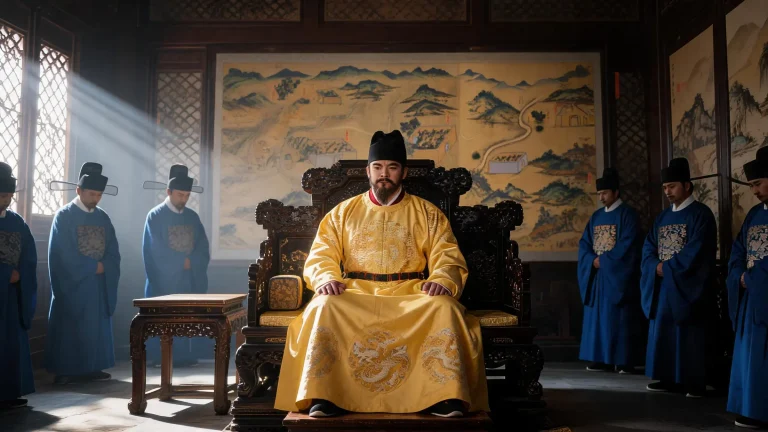
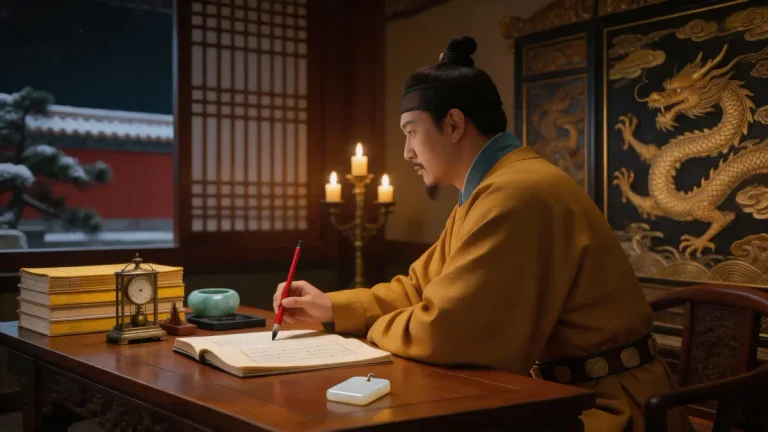
In the fourth month of 1521 a party from Anlu, in Huguang, reached the edge of Beijing with a boy of fifteen. He would rule for forty-five years as the Jiajing Emperor. His father had died two years earlier, and from the age of thirteen he had been running the princely household himself. Zhu Houcong became the eleventh of the Ming dynasty emperors, ruling from 1521 to 1567.
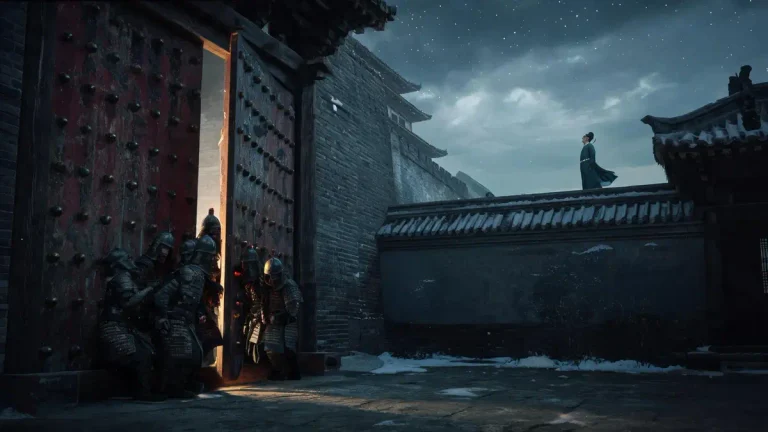
The Ministry of Rites already had the ceremony written out. The new ruler would come in through the Dong’an Gate, stay in the Hall of Literary Brilliance, and be installed with the rites for a crown prince. He refused to enter. Yuan Zonggao, the administrator of his household, heard him give the reason: the testament summons me to the throne as emperor, not as a son.
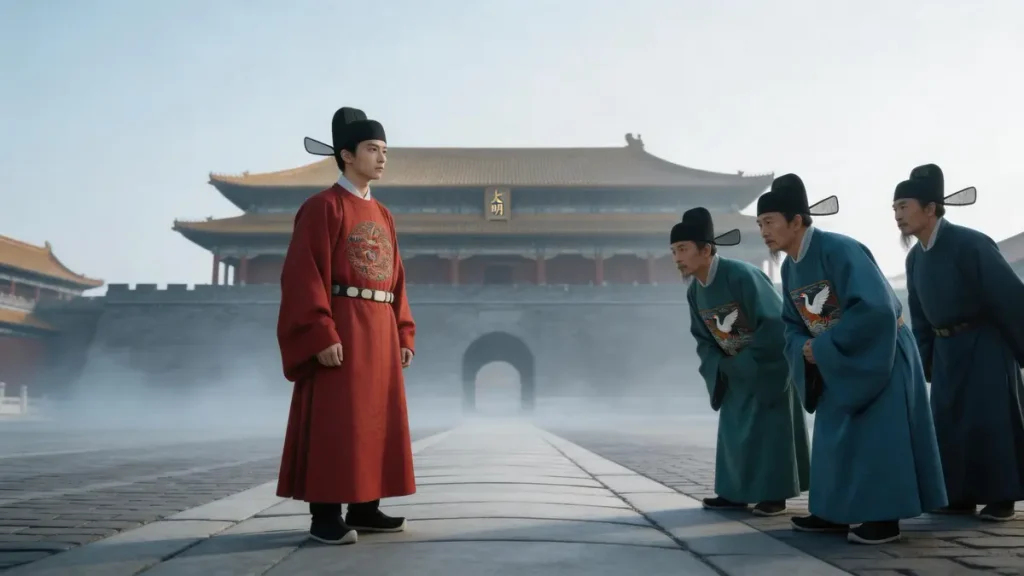
Yang Tinghe had his own logic. The Zhengde Emperor had left no son and no surviving brother, so the succession had to climb back up to the line of the Chenghua Emperor and come down again. The prince of Xing’s branch was the nearest. But by the rules of ritual, a man who inherits a throne first becomes the son of the man he succeeds. To make the chain close inside the ancestral temple, this boy had to take the Hongzhi Emperor as his father and demote his own father to imperial uncle.
The two sides held their ground outside the walls for several days. In the end the empress dowager pressed the officials to petition him to accept, he received the petition in the suburbs, and that same midday he walked in through the Great Ming Gate and took his seat in the Hall of Reverent Heaven.
Six days into the reign he ordered the Ministry of Rites to open a discussion on what title his father should carry. His father had been dead two years. The coffin was still in Anlu.
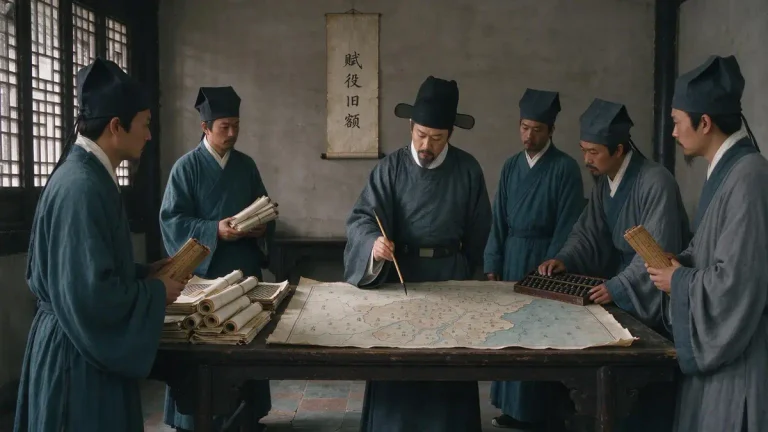
In those first months he did what the Zhengde court had not. He released the animals from the palace menagerie and banned further tribute of that kind. He struck three thousand men from the padded rolls of the Embroidered Uniform Guard, cancelled appointments made by direct palace order, and cut 148,000 people who had bought or talked their way into sinecures as guards, soldiers and artisans. He remitted arrears of tax going back to 1520 and gave the empire half of the next year’s land tax. Yang Tinghe drafted those edicts. The emperor signed them.
Then the Ministry of Rites brought in its finding. Xiaozong was to be his father. His own father was to be called imperial uncle, his mother imperial aunt, and the emperor himself nephew. A son of the prince of Yi would be adopted into the Xing line to keep his father’s sacrifices burning. Yang Tinghe handed the precedents, the prince of Dingtao under the Han and the prince of Pu under the Song, to the minister of Rites, Mao Cheng, with one instruction attached. Anyone who argued otherwise was a traitor and should be executed.
The testament made him emperor, he said, not a son
In the seventh month a jinshi named Zhang Cong sent up a memorial.
He had passed the metropolitan examination at forty-seven, after failing it seven times, and was at that point serving his probation in a ministry. Some of what he wrote was hard for Yang Tinghe to answer. The Zhengde Emperor had no heir. The grand secretaries had followed the dynastic instructions and chosen by seniority of descent. The testament named "the eldest son of the prince of Xing" and never said "heir to Xiaozong". The Han and Song cases involved boys raised in the palace and designated in advance. This was a summons, not an adoption.
The emperor read it and said one thing: with this argument out, father and son are both safe.
In the second year of the reign the dispute moved off paper. The prince’s widow, Lady Jiang, traveled up from Anlu and stopped at Tongzhou when she heard how the court was arguing. She would not come into the city. Told that his mother was being held outside the gate, the emperor wept and said he would give up the throne and go home to his princedom. That threat loosened the court. In the first month of 1522 an edict allowed Xiaozong the title of father and the emperor’s own parents the title of birth father and birth mother, without the imperial prefix.
His mother entered the palace. His father’s title was still half a title. In the first month of 1524 Gui E, a secretary in the Nanjing Ministry of Justice, submitted a memorial asking that Xiaozong be renamed imperial uncle and the prince of Xing be named father outright. The emperor called Zhang Cong and Gui E to Beijing. They arrived in the fifth month, and the court seethed. Men said openly that they would beat the pair to death in the street, and Gui E stayed indoors for days. The emperor gave each of them a Hanlin post.
Zhang Cong went from new jinshi to grand secretary in six years, which almost nobody in the Hanlin system had ever managed. Once he had his Hanlin seat he had twenty-two of the academy’s lecturers and readers reassigned, pushed out or dismissed, and sent every bachelor of the academy off to serve in ministries and counties. The History of the Ming gives the result in four characters: the forest of brushes stood empty.
For a hundred and fifty years the state has fed its scholars
In the seventh month of 1524 the emperor moved on the word "birth". Stripping it away made his own father his only father and left Xiaozong with no claim on him at all.
On the day of the new edict the officials would not leave after the audience. He Mengchun, a vice minister of Personnel, reminded the crowd of a precedent from the Chenghua reign, when the whole court had wept at the Wenhua Gate over the burial of an empress dowager and the emperor had given way. Yang Shen, a compiler of the Hanlin Academy and the son of Yang Tinghe, said the line that later generations kept quoting: for a hundred and fifty years the state has fed its scholars, and today is the day to pay for it.
So they knelt outside the Gate of Left Obedience. Twenty-three ministers of the nine courts, twenty-two Hanlin officials, twenty-one supervising secretaries, thirty censors, and the secretaries and bureau staff of the Six Ministries came to 229 men. The emperor sent eunuchs from the Directorate of Ceremonial to order them away. Nobody moved. From the hour of the dragon to the hour of the horse the order came twice, and they stayed on their knees.
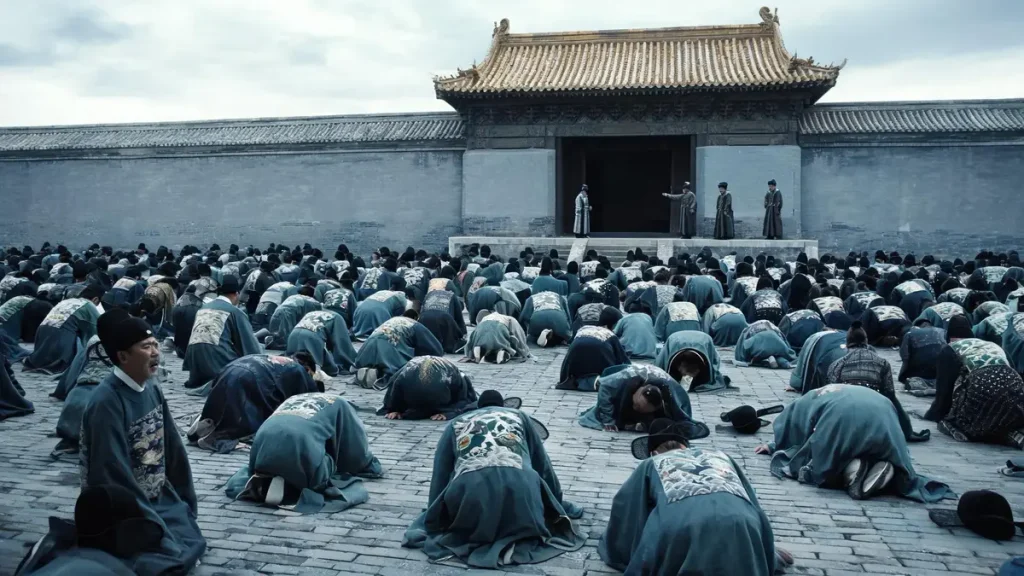
What followed is recorded in the basic annals with great economy. Ma Li, a bureau secretary, and 133 others were sent to the Embroidered Uniform Guard prison. On a later day Ma Li and the rest were flogged at court and sixteen died. Then Yang Shen and others were flogged, Zhang Yuan died of it, and Yang Shen was exiled to garrison duty in Yunnan.
The same History, in juan 191, gives another number for that day: eighteen compilers and editors flogged to death. Sixteen or eighteen, the two chapters do not agree. What is not in doubt is that a dozen and a half officials died under the rods in one afternoon, and that a much larger number were exiled, fined or struck off. Yang Shen never came back.
Mao Ji, the last grand secretary left in the Grand Secretariat, petitioned for the prisoners and was accused of forming a faction. Before he went home he put one sentence in his memorial: the flogging of officials at court, hundreds at a time, is something no earlier reign has known, and every order for it came out of the palace without the Grand Secretariat seeing it.
Once the rods were put away the ritual settled. The collected papers of the debate were published in 1525, and the great compilation on the rites in 1528. In the ninth month of 1538 the emperor changed the temple name of the Yongle Emperor from Taizong to Chengzu, gave his own father the temple name Ruizong, and had his tablet carried into the Imperial Ancestral Temple, ranked above the Zhengde Emperor’s. Two hundred years later the compilers of the History were still objecting in the annal’s closing comment: to raise him into the temple above Wuzong, was that not too much. A probationary jinshi and a secretary in Nanjing had sent in one memorial that pleased the emperor, and within six years one was chief grand secretary and the other was in the Grand Secretariat. On the other side, from the chief grand secretary down to the Hanlin compilers, men were dismissed, flogged and exiled in batches. After that the emperor could raise a man by direct order, condemn him by edict, and use the rods and the guard prison as ordinary instruments. Several of the procedures that had once slowed a Ming emperor down broke in those three years and were not repaired.
Zhang Cong ended as chief grand secretary, was driven out more than once for settling scores and was recalled each time, and died at home in Wenzhou. Yang Tinghe was struck from the register and died at Xindu in Sichuan in 1529. The empress dowager Zhang, widow of the Hongzhi Emperor and mother of the Zhengde Emperor, had supplied the second half of the legal basis for the summons in 1521: without her order the paperwork did not close. Throughout the rites dispute she stood as the moral authority behind Yang Tinghe’s position. Her brother Zhang Yanling, the marquis of Jianchang, was accused of treason. Zhang Fujing, as Zhang Cong was later renamed, argued for him on the grounds that the man was a miser and had no capacity for rebellion. The emperor did not listen, and did not kill him either. Zhang Yanling stayed in prison until his sister died in the eighth month of 1541, and he was executed five years after that.
Consort Cao was torn apart in the marketplace
With the rites settled, the emperor turned to the other thing on his mind, which was living forever.
Back in 1526, while the argument was still running, the Daoist Shao Yuanjie was brought to court and installed in a temple. He conducted prayers there and was given the title of Perfected Man, with authority over three temples and over the Daoist clergy as a whole. On the imperial progress south in 1539 Shao Yuanjie fell ill and recommended a man from Huanggang named Tao Zhongwen. At Weihui a whirlwind circled the imperial carriage, and the emperor asked what it meant. Fire, Tao Zhongwen said. That night the temporary palace burned and a number of palace women died. Tao Zhongwen was made a holy man, then a Perfected Man, and in 1550 a count.
Around the same time the emperor tried once to hand off the daily work. In the eighth month of 1540 he proposed that the crown prince govern while he devoted himself to quiet cultivation. Yang Zui, chief minister of the Court of the Imperial Stud, memorialized against it and was flogged to death. The court stopped raising the subject.
The next year the trouble came from inside the palace.
On the twenty-first day of the tenth month of 1542 the palace women mutinied. The basic annals give the whole affair one line: the palace women plotted treason and were executed, and Consort Cao, titled Duanfei, and Consort Wang, titled Ningpin, were torn apart in the marketplace.
Later accounts are fuller. Yang Jinying, a palace maid, led a dozen others into the chamber where the emperor was sleeping, in Consort Cao’s apartments, and put a silken cord around his neck. They pulled from both sides. The knot had been tied wrong and would not close, so the cord never did its work. He lost consciousness and did not die. One of the women lost her nerve and ran to tell Empress Fang, who came and cut the cord, and he was brought round. He spat blood for a while and could not speak for days.
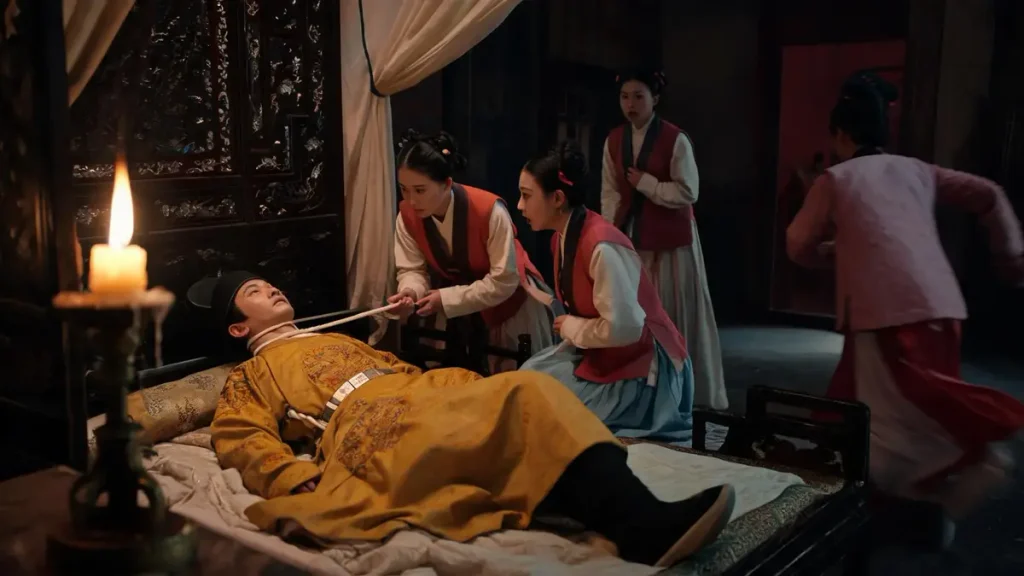
More than a dozen palace women were executed afterwards. Consort Cao and Consort Wang were dismembered in the market. Whether Consort Cao knew what was being planned in her own rooms is a question the record never puts.
For the cause, the notes written after the reign give two. One is the emperor’s Daoist practice, which had palace women out before dawn collecting dew from leaves and punishing those who came back with too little. The other is the elixir the alchemists were making, which called for the blood of young girls, so that more and more of them were taken into the palace. Neither explanation appears in the official annals or the Veritable Records, which record only scattered orders to buy materials and select girls. Where exactly the knot went wrong, the accounts differ. What is certain is the outcome: he lived, and he never slept in the Forbidden City again.
After 1542 the emperor moved into the Western Garden and lived in the Palace of Longevity. The biography of Yan Song says he moved there in 1541, after the plot; the annals date the plot to 1542. The two entries sit a year apart and neither can be dismissed. For the next twenty-four years the annals record no expedition of his outside the city, no visit to the tombs.
The Western Garden lay west of the palace, inside the city wall, and several halls had been built there since the early years of the reign, among them the Hall of No Idleness and the Binfeng Pavilion. Once the emperor settled in, altars for the fasts, furnaces for the elixirs and plank huts for the grand secretaries went up one after another.
In the eleventh month of 1547 a fire broke out in the Forbidden City, and he ordered the release of Yang Jue, a censor who had been in prison for years. That same month Empress Fang died.
The last time the Jiajing Emperor went south of the city
The biography of Yan Song contains one sentence that fixes the shape of the reign: after burying the Empress Dowager Zhangsheng in 1539, the emperor stopped holding court. She was his mother. She died in the twelfth month of 1538 and was buried in the seventh month of 1539 at Xianling, in Chengtian prefecture in Huguang.
From that year to his death is twenty-seven years.
The simplest way to see those years is to count the sacrifices in the annals.
In the second month of 1522 he plowed the imperial field himself. He did it again in the second month of 1530. After that the annals record no emperor plowing that field.
From 1522 to 1530, every first month carries the same line: the great sacrifice to Heaven and Earth at the southern altar. Nine years, nine times, not one missed. In 1530 he separated the sacrifices and built four altars for Heaven, Earth, the sun and the moon. In 1531 the prayer for grain was held in the Great Sacrifice Hall, and in 1532 at the Circular Mound. That year the annals add three words for the first time: he ordered the marquis of Wuding, Guo Xun, to deputize. The emperor stopped going in person and sent a nobleman instead.
In the eleventh month of 1538 he sacrificed at the southern altar. In the first month of 1539 the prayer for grain was moved indoors, to a hall inside the palace. In the eleventh month of that same year he went south of the city once more. He never went again.
After that, in the second volume of the annals, covering 1543 to 1566, the words "southern altar" appear zero times. The prayer for grain, zero. The ancestral temple, zero. Twenty-four years of a day-by-day court chronicle, and not one of the three.
The sacrifices went on without him. The nobleman deputized, the Ministry of Rites sent up congratulations, and the paperwork moved as before.
The Daoist theatre grew with the years. In the seventh month of 1546 a spring of sweet water broke out in one of the palace halls, the officials sent up congratulations, and the emperor suspended the processing of memorials for twenty days. From then on, during fasts and festivals, no memorial was to come in at all: the reports from the provinces and the ministries sat outside the gate for the length of the rite.
In the fourth month of 1557 the three great halls of the outer court burned, and his response was five days of fasting, a suspension of memorials and a halt to executions. In the tenth month of 1558 the Ministry of Rites presented 1,860 specimens of auspicious fungus; he found them small and ordered a search for caps a foot across. In the third month of 1562 a white rabbit gave birth, and the ministry asked permission to announce it in the ancestral temple. In the fifth month of 1564 a peach was found in the imperial tent, and the officials congratulated him.
His family had shrunk as well. In the second month of 1539 he had named his son Zhu Zairui crown prince. The boy died in the third month of 1549. No new crown prince was named. The surviving sons, the prince of Yu and the prince of Jing, were moved out to their own residences, and the brothers rarely met. Hai Rui later listed this among the emperor’s failures: the two princes never see each other, and men take it for a thin father.
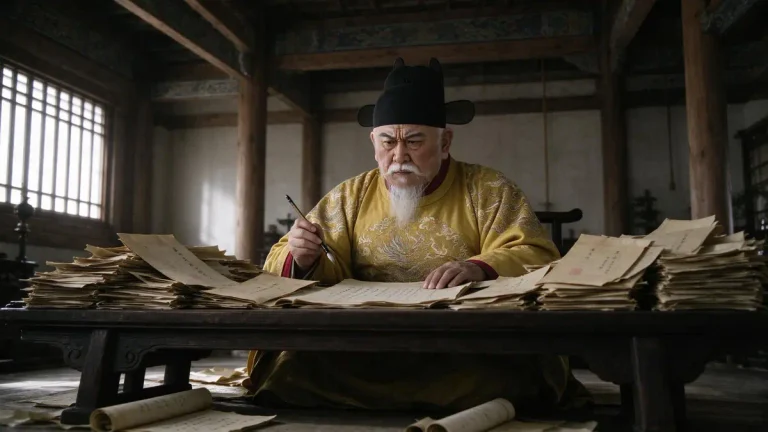
Memorials came in through the Office of Transmission, went by way of the Directorate of Ceremonial to the Grand Secretariat for drafting, and came back to the emperor for the vermilion endorsement. Since the emperor lived in the Western Garden, the line moved there with him. The grand secretaries kept a duty room in the garden and slept there in rotation while eunuchs carried documents back and forth. On a busy day several autograph notes went out. On a slow one the paper sat in the duty room.
The congratulation on a spring of sweet water and the report of a raid on the frontier arrived by the same route. Both ended in the Western Garden.
Twenty years in a plank hut in the Western Garden
Most of what passed through the Western Garden passed through Yan Song.
He came from Fenyi in Jiangxi, had taken his jinshi in 1505, and had spent ten years reading on Mount Qian in his thirties, where he wrote poetry and prose and earned a reputation for integrity. What changed his career was a trip in 1528 to announce an imperial decision at the Xianling mausoleum. He came back with a report of auspicious signs all along the road: the sky cleared as the tablets were installed, a stone appeared in Zaoyang, storks circled, the river rose as the stele went into the water. The emperor was delighted and ordered the Grand Secretariat to compose an inscription.
There was also a hat. The emperor, who practiced Daoism, had five crowns carved from agarwood and gave them to Xia Yan and others. Xia Yan would not wear his. Yan Song wore his to an audience with a layer of gauze over it. The emperor saw it and from then on treated him as one of his own. When Xia Yan was in power Yan Song invited him to drink, and Xia Yan refused to see him. Yan Song set the table outside the gate, unfolded the invitation and read it aloud on his knees. Xia Yan concluded that the man knew his place.
In the eighth month of 1542 Yan Song entered the Grand Secretariat as minister of Rites and grand secretary, past sixty. He slept in the plank hut in the Western Garden, a narrow room that was stifling in summer and cold in winter, and according to the History he went a long time without going home to wash. The emperor gave him a silver seal cut with four characters: loyal, diligent, quick, penetrating.
Two months later the palace women tried to strangle the emperor. He withdrew further into the garden, saw ministers rarely, and took advice from Yan Song alone. Autograph notes went out several times a day and nobody else in the Grand Secretariat saw them. The History puts it plainly: this is how Yan Song got his way.
With Xia Yan gone, nobody wrote the blue-paper prayers better than Yan Song. They were written on blue paper and burned, and the form was fixed, the diction formal, and the wording had to answer whatever the emperor was asking for at the time. Other men could write them. Few could make him feel that the prayer was in his own voice.
The emperor was generous with him. When Yan Song’s duty room proved too narrow, the emperor pulled down a small hall and used its timber to enlarge it, planted flowers and trees around it, and sent him meals and wine from his own kitchen morning and evening. At eighty, Yan Song was allowed to ride a sedan chair into the palace grounds.
Xia Yan came back and still outranked him, and in the end died over the Ordos. In the first month of 1548 Zeng Xian, the commander of the three northern border provinces, was arrested for proposing to recover the Ordos loop, and in the third month Zeng Xian was executed and Xia Yan arrested. In the tenth month Xia Yan was executed in the marketplace. He had been chief grand secretary.
Qiu Luan shows how the machine worked. He had been impeached by Zeng Xian, and he used Yan Song to bring Zeng Xian down; the two men called each other father and son. In 1550 he brought troops to the relief of Beijing, caught the emperor’s eye, and began to put distance between himself and Yan Song. Yan Song sent in a secret memorial against him and the emperor ignored it. Qiu Luan sent in a report on Yan Song and his son, and the emperor took some of it. For a stretch Yan Song was not summoned to duty. He followed Xu Jie and Li Ben toward the inner gate, was stopped by the guards for having no order, went home, and wept with his son.
Yan Song ran the government for twenty years, and much of it went through his son. The emperor’s notes were often cryptic and hard to read. Yan Shifan read them at a glance and answered them correctly. He was short-necked and fat, blind in one eye, and knew the revenues of every province and the going price of every office. The court called him Donglou, East Tower. In his old age Yan Song, asked for a decision by a ministry, would say: take it to East Tower.
His fall began in the eleventh month of 1561. The Palace of Longevity burned down and the emperor moved into a cramped hall. He asked Yan Song what to do. Yan Song suggested moving back into the Forbidden City, or into the old palace in the south of the city, where the Yingzong Emperor had been held after his capture. The emperor did not like either answer. He asked Xu Jie, who proposed building with timber left over from the reconstruction of the three great halls, finishing in a hundred days. It was done in a hundred days, the emperor moved in, and named it the Palace of Longevity.
What finally moved the emperor was a Daoist. Lan Daoxing worked the planchette, and when the emperor put questions to the spirit, the writing that came back mentioned faults in the Yan household. Censor Zou Yinglong happened to be sheltering from rain in a eunuch’s house and heard about it.
In the fifth month of 1562 Zou Yinglong memorialized against father and son. Yan Song was retired, Yan Shifan imprisoned. In the third month of 1565 Yan Shifan was executed in the marketplace and the family property confiscated: thirty thousand ounces of gold, two million of silver, and treasures worth several million more.
The verdict as first drafted cited the wrongful deaths of Yang Jisheng and Shen Lian. Xu Jie read it and asked the judges whether they wanted the man alive. They said they wanted him dead. Then this is how to keep him alive, Xu Jie said. Both cases had been decided by the emperor himself. Putting them in the indictment made the emperor the guilty party. To kill the son, they needed another charge. He rewrote the document himself. It rested on Yan Shifan’s dealings with the remnants of Wang Zhi’s pirate fleet, on a plan to send him to Japan, on a house built on ground with imperial geomantic quality, and on the use of regal specifications in its construction. It went up, and Yan Shifan was beheaded.
Yan Song was reduced to commoner status, and two years later, old and ill, he was living on charity in a graveyard shed, where he died.
Mongol cavalry reached the walls of Beijing
What Altan Khan wanted was trade. In the intercalary fifth month of 1542 he sent envoys to the Datong frontier to discuss terms, and the grand coordinator Long Dayou had them lured inside and killed. In the sixth month Altan raided Shuozhou, came through the Yanmen Pass and raided Taiyuan; in the seventh month he plundered Lucheng and killed the assistant commander Zhang Shizhong. After that the frontier deteriorated year by year.
In the eighth month of 1550 Altan’s Tumed Mongols broke the wall at Gubeikou, scattered the Jizhen garrison, plundered Tongzhou, camped at the Bai River and sent columns across the metropolitan counties. Beijing was put under martial law.
On the day the enemy reached the walls, the emperor appeared in the Hall of Reverent Heaven and admonished his officials. The annal uses one word for it: for the first time, he held court there.
The relief forces came from Datong, Henan and Shandong, under the Datong commander Qiu Luan, who was made grand general and given authority over all the columns. Altan had taken what he wanted and withdrew the next day. Someone had to answer for it. The minister of War, Ding Rukui, and the grand coordinator Yang Shouqian were executed for failing to defend the city. Ding Rukui learned on the scaffold what Yan Song had meant when he told him: I am here, you have nothing to worry about.
When the fighting stopped the solution was a market. In the third month of 1551 horse fairs opened at Xuanfu and Datong, and in the ninth month of 1552 the border markets were closed again. Qiu Luan died of illness in 1552 and was dug up, mutilated and his head sent round the frontier garrisons.
The southeast was burning at the same time. In the intercalary third month of 1553 Wang Zhi, a Huizhou trader turned pirate leader, brought a fleet against the coastal prefectures and did not withdraw until the sixth month. In the fifth month of 1555 the supreme commander Zhang Jing and the deputy commander Yu Dayou broke the pirates at Wangjiangjing. Two weeks later Zhang Jing was arrested. In the tenth month Zhang Jing, the grand coordinator of Zhejiang Li Tianchong and the bureau secretary Yang Jisheng were executed together. Yang Jisheng had sent up a memorial two years earlier listing ten crimes of Yan Song.
Elsewhere in those years the ground moved. In the twelfth month of 1555 an earthquake in Shanxi, Shaanxi and Henan shook the Wei and Yellow rivers out of their beds, and the annal records more than 830,000 dead. In the fifth month of 1557 officials were sent to Sichuan and Huguang for timber. In the second month of 1560 the Nanjing garrison mutinied and killed the vice minister in charge of grain. The three halls, burned in 1557, were not rebuilt until the ninth month of 1562. Then the Hall of Reverent Heaven took the name Hall of Imperial Supremacy, the Hall of Floral Canopy the name Hall of Central Supremacy, and the Hall of Circumspection the name Hall of Established Supremacy.
The reports all went to the Western Garden. Whether they were read, and when, was another matter.
He brought a coffin to the court
In the second month of 1566 Hai Rui, a bureau secretary in the Ministry of Revenue, sent up a memorial.
He was from Qiongshan in Hainan, had come up through the provincial examination rather than the palace examination, and had served as magistrate of Chun’an, where he wore cotton and ate coarse rice and had an old servant grow the household’s vegetables. Hu Zongxian, the governor-general, once remarked to someone that he had heard the magistrate bought two catties of pork for his mother’s birthday. When the censor-in-chief Yan Maoqing toured the province, Hai Rui fed him sparingly and told him the county was too small for so many carriages. Yan Maoqing took his revenge through a subordinate and had him demoted. He ended up in the Ministry of Revenue, in charge of the granaries.
The memorial does not soften anything. The emperor had begun with energy, Hai Rui wrote, and then let a delusion carry him off. He had given himself to cultivating the Dao and squeezed the people dry. Buildings went up without limit, and more than twenty years passed without a court audience, until the law went slack. He went on: Your Majesty took Tao Zhongwen as a teacher and called him master. Tao Zhongwen is dead. He did not live forever. Why does Your Majesty alone seek it? He came to the peaches and the pills as well. A peach has to be picked before it can be had, a pill has to be made before it can be taken. If these two things arrive without cause, do they come on feet?
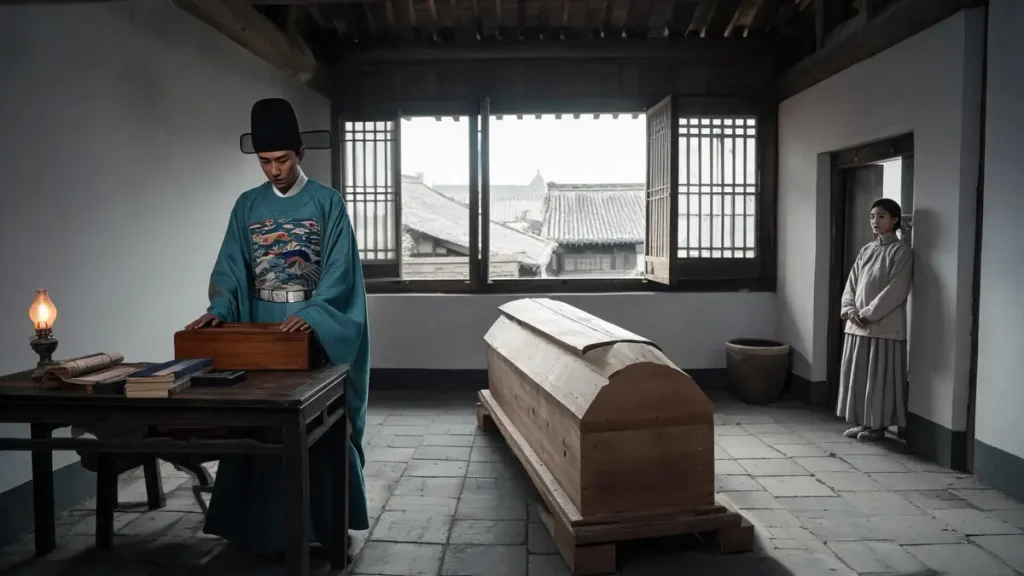
Before sending it he bought a coffin, dismissed his servants, took leave of his wife, and waited in the audience hall. The emperor read it, threw it on the floor, and told the men around him to go and seize the man before he got away. The eunuch Huang Jin, standing nearby, said that Hai Rui had a name for foolishness. He had known what the memorial would cost him, had bought his coffin, and had no servants left to run. The emperor said nothing for a while, picked the memorial up again, read it several times over the course of a day, and kept it for months. He said the man could be compared to Bi Gan, only he himself was not the tyrant Zhou.
When the emperor fell ill and grew restless and unhappy, he summoned Xu Jie to discuss abdicating. Everything Hai Rui says is right, he said. I have been ill a long time. How could I attend to business? He added that he had not taken care of himself, that the illness had come to this, and that if he could still appear in the audience hall he would not be taking this abuse.
He had Hai Rui put in the guard prison all the same and sentenced to death. The file went up and stayed on his desk. He Yishang, a secretary in the Ministry of Revenue, guessed that the emperor did not mean to kill him and petitioned for his release. He was flogged a hundred times, put in the same prison, and interrogated day and night.
In the eleventh month of 1566 the emperor fell gravely ill. In the twelfth month he was carried from the Western Garden back to the Palace of Heavenly Purity and died the same day, aged sixty.
The news had not spread. The warden of the prison, assuming Hai Rui would soon be released and promoted, brought him wine and food. Hai Rui thought he was going to the execution ground and ate and drank without restraint. The warden leaned in and told him the emperor had died that day and that he would shortly be going out. Hai Rui asked whether it was true, then broke down, vomited everything he had eaten, collapsed, and wept all night.
Xu Jie drafted the testament. All fasts and Daoist offerings, all building works, all purchases of pearls and precious goods, all weaving workshops were to stop. Everyone jailed over the Great Rites and everyone punished for speaking out was to be restored. When it was published the court and the country wept, and men compared it to the accession edict Yang Tinghe had drafted in 1521. Hai Rui and He Yishang walked out under it.
One case surfaced as soon as he was dead. The judges charged the alchemist Wang Jin and others under the statute on a son who kills his father, on the theory that the elixirs had killed the emperor. Gao Qiang objected. The late emperor had reigned forty-five years and died at over sixty, he wrote, after a long illness that ran through a whole year. He had a long life and a natural end, with nothing sudden about it. To say now that Wang Jin killed him was to accuse the late emperor of not dying properly. The sentence was reduced to garrison exile.
The History of the Ming closes the annal with its verdict. In the first years of the reign he rooted out every abuse and the empire called it good government. What follows in the same passage is the Great Rites and the uproar it caused. Armies were worn down on the frontier and bandits rose inside. The worship of Daoism, sacrifices outside the canon, and building on a scale that emptied the treasury wore down a hundred years of prosperity and good order. The last sentence is this: though he cut out powerful villains and kept the levers of power in his own hands, he was, after all, a ruler of middling capacity.
In the first month of 1567 he was given his posthumous name, the temple name Shizong, and buried at Yongling.
Sources and further reading
History of the Ming (Mingshi), juan 17, basic annals of Shizong, first part, for the accession of 1521, the Great Rites, the Left Obedience Gate protest and the flogging, the last southern sacrifice of 1539 and the palace plot of 1542. https://zh.wikisource.org/zh-hans/明史/卷17
History of the Ming, juan 18, basic annals of Shizong, second part, for the Altan Khan raid of 1550, the Japanese pirate raids, the earthquakes of 1555, the burning of the three halls, the memorial of Hai Rui, the death of the emperor and the closing verdict of the annal. https://zh.wikisource.org/zh-hans/明史/卷18
History of the Ming, juan 190, biographies of Yang Tinghe, Jiang Mian and Mao Ji, for the drafting of the 1521 testament, the instruction to Mao Cheng that dissenters should be executed, and Mao Ji’s protest about flogging. https://zh.wikisource.org/zh-hans/明史/卷190
History of the Ming, juan 191, biographies of Mao Cheng, He Mengchun and others, for the roll of the 229 men at the Gate of Left Obedience and the figure of eighteen flogged to death. https://zh.wikisource.org/zh-hans/明史/卷191
History of the Ming, juan 196, biographies of Zhang Cong, Gui E and Xia Yan, for Zhang Cong’s memorial of 1521, the standoff at Tongzhou, the purge of the Hanlin Academy and the death of Xia Yan. https://zh.wikisource.org/zh-hans/明史/卷196
History of the Ming, juan 226, biography of Hai Rui, for the full text of the 1566 memorial, the coffin, the emperor’s remarks and the scene in the prison. https://zh.wikisource.org/zh-hans/明史/卷226
History of the Ming, juan 307, biographies of favorites, for Shao Yuanjie and Tao Zhongwen, the whirlwind at Weihui and the proposal of 1540 to let the crown prince govern. https://zh.wikisource.org/zh-hans/明史/卷307
History of the Ming, juan 308, biographies of traitorous ministers, for the whole career of Yan Song, the agarwood crowns, the duty hut in the Western Garden, the fall of the family and the rewriting of the verdict by Xu Jie. https://zh.wikisource.org/zh-hans/明史/卷308
History of the Ming, juan 213, biography of Xu Jie, for the rebuilding of the Palace of Longevity, the drafting of the 1567 testament and the case against the alchemists. https://zh.wikisource.org/zh-hans/明史/卷213
Wikipedia, "Jiajing Emperor". https://en.wikipedia.org/wiki/Jiajing_Emperor
Wikipedia, "Great Rites Controversy". https://en.wikipedia.org/wiki/Great_Rites_Controversy
Wikipedia, "Renyin palace plot". https://en.wikipedia.org/wiki/Renyin_palace_plot