Longqing Emperor Muzong: The Life and Reforms of Zhu Zaiji
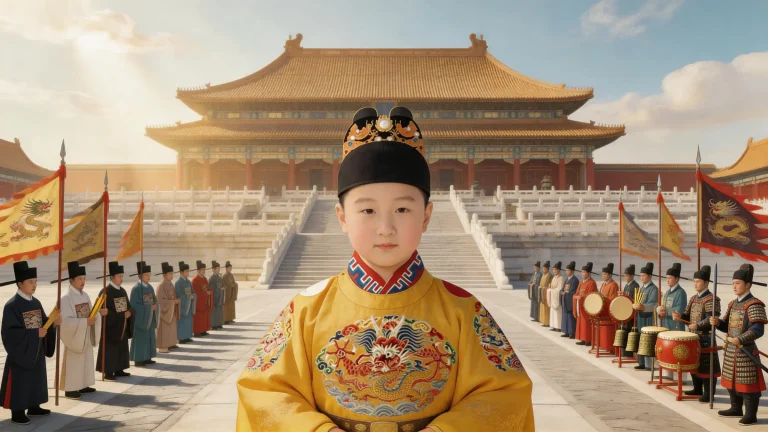
In the twelfth month of 1566 the Jiajing Emperor died in the Palace of Heavenly Purity, one day after moving back there from the Western Garden. Twelve days later his third son took the throne as the Longqing Emperor. He was thirty. He had been prince of Yu for twenty-seven years and his father had never named him heir. Longqing was the 12th of the 16 Ming dynasty emperors, ruling from 1567 to 1572.
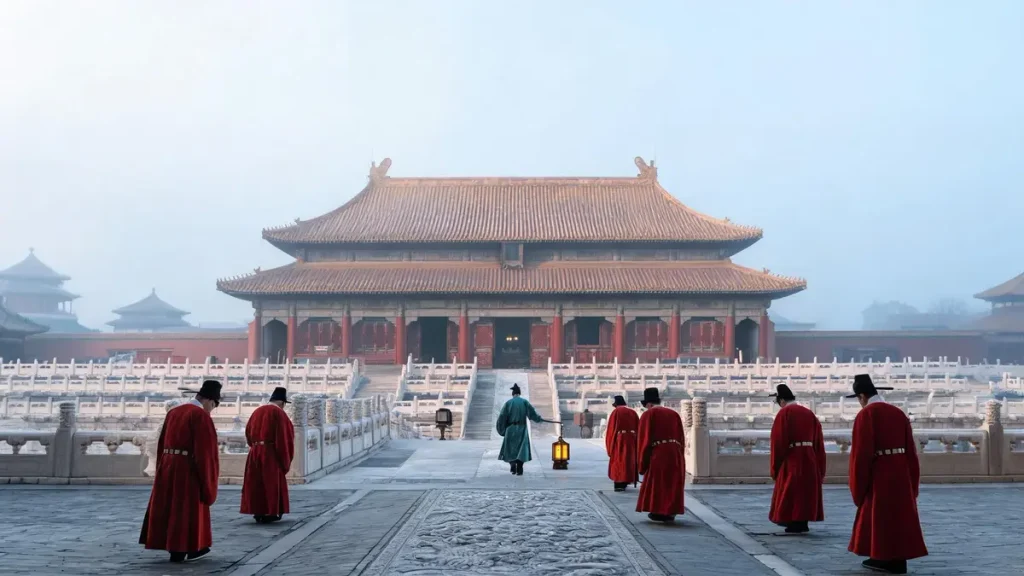
The testament was already written. Xu Jie, the chief grand secretary, drafted it with Zhang Juzheng and told nobody else. Gao Gong and Guo Pu, the two grand secretaries who had entered the Grand Secretariat alongside him, found out afterwards. Guo Pu said what he thought of it: Xu slanders the late emperor, and for that he should be beheaded.
The clauses went at the Jiajing settlement one by one. Daoist fasts and offerings, building works, pearls and precious goods, the weaving workshops: stopped. Officials jailed over the Great Rites Controversy and officials punished for speaking out: recalled if alive, pensioned and honored if dead. The alchemists: handed to the judges. Half the land tax for the coming year and all arrears back to 1564: remitted. A secretary in the Ministry of Revenue named Hai Rui, under sentence of death: released.
When the edict was published the court and the country wept. Men compared it to the accession edict Yang Tinghe had drafted in 1521.
In the twelfth month of 1566, the edict left Gao Gong out
The Longqing reign opened with a general amnesty and a new era name. The History of the Ming covers those months in a single line: inconvenient policies of the previous reign were all changed by the testament.
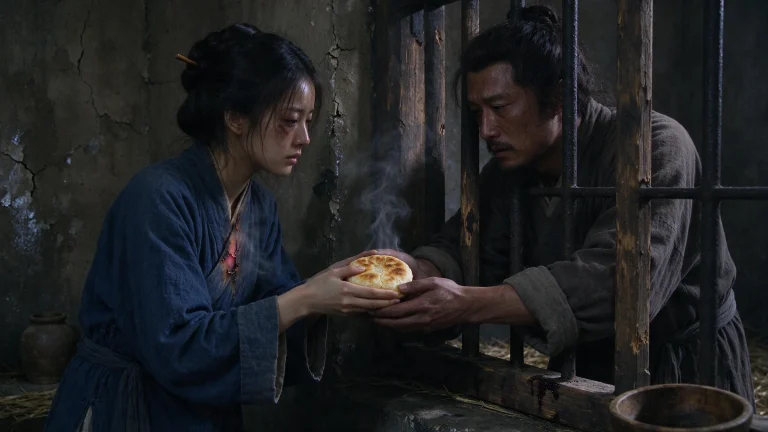
In the autumn of 1566 Hai Rui had bought a coffin, dismissed his servants, and sent up a memorial accusing the emperor of wrecking the country. The Jiajing Emperor had him put in the guard prison, sentenced him to death, and left the file on his desk. Under the testament he walked out, together with He Yishang, a ministry clerk who had been flogged a hundred times for asking for his release. Both were restored.
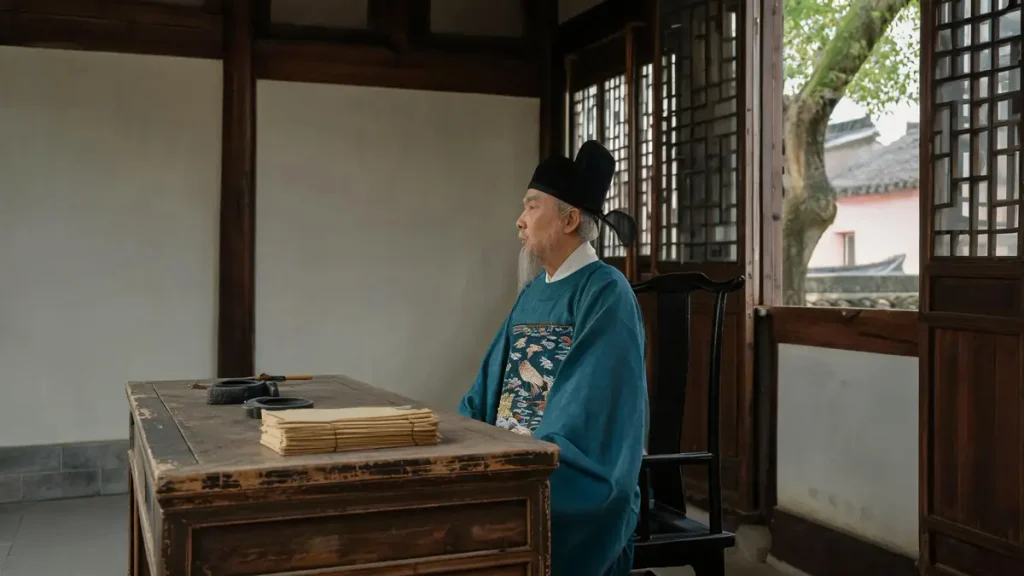
In the summer of 1569 the Longqing Emperor made Hai Rui right assistant censor-in-chief and grand coordinator of Yingtian, with ten prefectures under him. Subordinates who had been stealing resigned rather than face him. Families with vermilion gates had them painted black overnight. He lasted half a year. He measured the land the rich had swallowed and did not exempt the Xu family, whose head had been chief grand secretary. The gentry turned on him. He was moved to grain transport in Nanjing, and when Gao Gong took over the Ministry of Personnel he folded the post into the Nanjing ministry. Hai Rui went home and pleaded illness.
The alchemists’ case came out heavier than anyone expected. The judges charged Wang Jin and the others under the statute on a son who kills his father, which meant the elixirs had killed the emperor. Gao Gong objected. A ruler who dies by other than natural means does not get a good name, he wrote, and the late emperor had reigned forty-five years and died past sixty after a long illness. To say now that Wang Jin murdered him was to tell later generations that the Jiajing Emperor had not died in his bed. The charge was reduced to garrison exile.
That memorial saved his father’s name, and it set the tone. The Longqing Emperor did not intend to put the Jiajing reign on trial. What could be stopped was stopped, what could be changed was changed, and nobody was pursued for what he had done under the old man.
In the first month of 1567 the Longqing Emperor cancelled the pairing of Ruizong with Heaven at the Bright Hall. Ruizong was the Jiajing Emperor’s own father, the prince of Xing, promoted after death to emperor. The Great Rites Controversy had run from 1522 to 1538, and the pairing was what it had been for. The other thing the dispute produced, the change of Taizong’s temple name to Chengzu in 1538, was left alone. Chengzu stayed Chengzu.
In the second month Chen Yiqin and Zhang Juzheng entered the Grand Secretariat, both of them former lecturers in the prince of Yu’s household. Zhang Juzheng came in as left vice minister of Personnel with the title of grand secretary of the Eastern Hall. A year earlier he had been a fifth-rank academician. In the fourth month the court banned the tribute of rare birds and animals.
Later historians did the sums on the Longqing reign. Six years on the throne, no great projects, frugality in person, and a palace kitchen that saved ten thousand taels a year.
In the fifth month of 1567 the Yellow River works at the breach were finished. In the sixth month continuous rain sent him out of the audience hall in plain clothes to work from the Gate of Supreme Authority. The river broke at Pei County in 1569 and at Pizhou in 1570, and in 1572 a dike went up for 370 li between Xuzhou and Suqian. The autumn grain was remitted somewhere most years, in Xiangyang, Yunyang, the Nanjing region, Jiangxi, Shaanxi, Sichuan, the northern metropolitan region and Huguang, and juan 19 lists them one by one. In the twelfth month of 1568 the Longqing court capped the estates of noble families. In the seventh month of 1570 memorials were ordered shorter and grand coordinators were told to stop local officials using torture.
Zhang Juzheng brought Gao Gong back
Gao Gong had spent nine years teaching the prince of Yu. The prince wrote out four characters for him: cherishes the worthy, loyal to the end. That was not a thing Ming princes did often.
Late in the Jiajing reign Yan Song and then Xu Jie ran the government, and both recommended Gao Gong to the emperor as a man who would one day carry weight. In 1566 he entered the Grand Secretariat, with Guo Pu, on Xu Jie’s word. That same year the emperor died, and Xu Jie drafted the testament with Zhang Juzheng alone.
Gao Gong did not take it. He was the emperor’s old tutor and he said so, several times, to Xu Jie’s face. Guo Pu put it more plainly: Xu slanders the late emperor, and should be beheaded. In 1567 the supervising secretary Hu Yingjia impeached Gao Gong, the censor Qi Kang impeached Xu Jie in return, and then the nine courts and everyone below them sent up memorial after memorial attacking Gao Gong and praising Xu Jie. In the fifth month Gao Gong asked to retire and went home to Xinzheng to be ill, keeping the titles of junior preceptor, grand guardian of the heir apparent, minister and grand secretary.
Xu Jie could not hold either. In the seventh month of 1568 the supervising secretary Zhang Qi impeached him out of a private grudge and he asked to go. The emperor let him, with post horses and an officer to lead his escort.
Li Chunfang became chief grand secretary. Zhao Zhenji entered the Grand Secretariat and treated Zhang Juzheng as a junior. Zhang Juzheng went to Li Fang, a eunuch he was on good terms with, and had Gao Gong recalled to run the Ministry of Personnel, partly to block Zhao Zhenji and partly to take the government away from Li Chunfang. In the twelfth month of 1569 Gao Gong came back into the Grand Secretariat with the ministry in his hand.
The first thing he did was reverse Xu Jie’s three years. Every official restored or pensioned under the testament was struck off again. He wrote a memorial to justify it. The Collected Statutes on the Great Rites had been published and accepted for decades, he argued, and the men now running the government were using an imperial edict as cover to honor everyone who had once been punished for opposing the rites. What was the late emperor’s father, seated in the temple, supposed to make of that? What was the late emperor himself supposed to make of it? The emperor agreed with him.
The rehabilitation lasted three years. The men struck off did not come back for another decade and more.
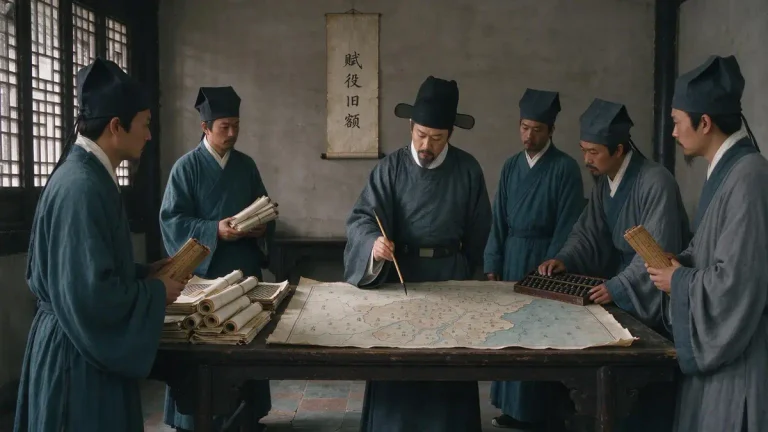
Gao Gong could run an office. In Personnel he had each bureau keep a register of its officials, with their abilities, their home districts and their names, updated monthly and totaled annually, so that a sudden vacancy did not mean a blind pick. He asked for extra vice ministers of War to be held in reserve for supreme command, so that a man could go from vice minister to supreme commander to minister of War and the frontier would stop running out of people who knew it.
For the Zhuang rising at Gutian in Guangxi he used Yin Zhengmao, of whom everyone said that he stole. Gao Gong’s answer was that a million taels given to Yin Zhengmao would still get the job done if half of it disappeared. When the Liaodong grand coordinatorship fell vacant he asked Wei Xuezeng who should have it. Wei thought for a long time and said Zhang Xueyan. Gao Gong was delighted. Zhang is a man of parts, he said, and nobody has noticed, because nobody has put him on a hard knot yet.
Those were also the years the Grand Secretariat came apart. Zhao Zhenji was driven out. Yin Shidan was maneuvered out. Liu Fenyong, chief minister of the Seal Office, attacked Gao Gong in a memorial without naming him, and the supervising secretary Cao Daye impeached him on ten counts of disloyalty; both were sent to posts outside the capital. Gao Gong was blunt and proud and his colleagues could not stand him. Zhang Juzheng deferred to him and Gao Gong did not notice.
The Longqing opening at Yuegang: two oceans only
Private voyages had been a crime since the Hongwu reign. Under the Jiajing Emperor the ban was enforced hardest and the coast was in its worst disorder. Wang Zhi kept his base in the Japanese islands of Hirado and the Goto group. Xu Hai worked the Zhejiang coast with him. The fighting ran for decades, and so did the practice of killing civilians and reporting them as pirates.
The coastal crisis was not, at bottom, about the Japanese. The founding ban had left one opening, the tribute mission, and once the tally trade broke down the business went private. In 1523 two Japanese missions fought each other in the streets of Ningbo over precedence, and the maritime trade office was abolished, revived, and abolished again. In 1547 Zhu Wan became grand coordinator of Zhejiang, arrested and executed the merchants who ran the smuggling, was denounced by the gentry of Fujian and Zhejiang, and killed himself two years later. In 1555 Zhang Jing won a battle at Wangjiangjing and took 1,980 heads, had the credit stolen by Zhao Wenhua, and was arrested and executed in Beijing.
In 1565 Zhangzhou set up a new county, Haicheng, seated at Yuegang, on a tangle of creeks where the Jiulong River reaches the sea.
The next year the Jiajing Emperor died. Tu Zemin, grand coordinator of Fujian, asked for the maritime office to be opened and for private traders to be turned into licensed ones: two oceans only, Japan excluded, saltpeter, sulfur, copper and iron barred from any cargo. The court allowed it.
The exact year is not settled. Zhang Xie’s study of the trade, the Dongxiyang kao, dates the county to 1565 and says that in the following year, with the new reign, Tu Zemin asked for the ban to be lifted. Xu Fuyuan, grand coordinator of Fujian in the 1590s, wrote that it happened in the first years of Longqing. Gu Yanwu wrote the same. The edict itself has not survived. Convention says 1567, and all that can be said with confidence is the early years of the reign.
Nor did the ships leave from Yuegang at first. The Zhangzhou trade had sailed from Meiling in Zhao’an, and Meiling was so often in pirate hands that the departure point moved to Haicheng.
What is now called the Longqing opening was not an opening of the sea. Every ship needed a permit naming its destination, its cargo and its crew. A customs office at Yuegang collected a duty on the width of the hull, a duty on the value of the cargo, and a surcharge on ships bound for Luzon. Japan stayed on the banned list, and a captain who went there was still a traitor. On the whole coast of the empire there was one legal exit.
Zhou Qiyuan, writing a preface to the Dongxiyang kao, described what followed. Merchants from everywhere gathered on the water, cut timbers for great ships, and divided between the eastern and western routes. The money they turned over came to several hundred thousand taels a year, and the treasury and the merchants both lived off it. The place was, he wrote, the emperor’s southern treasury.
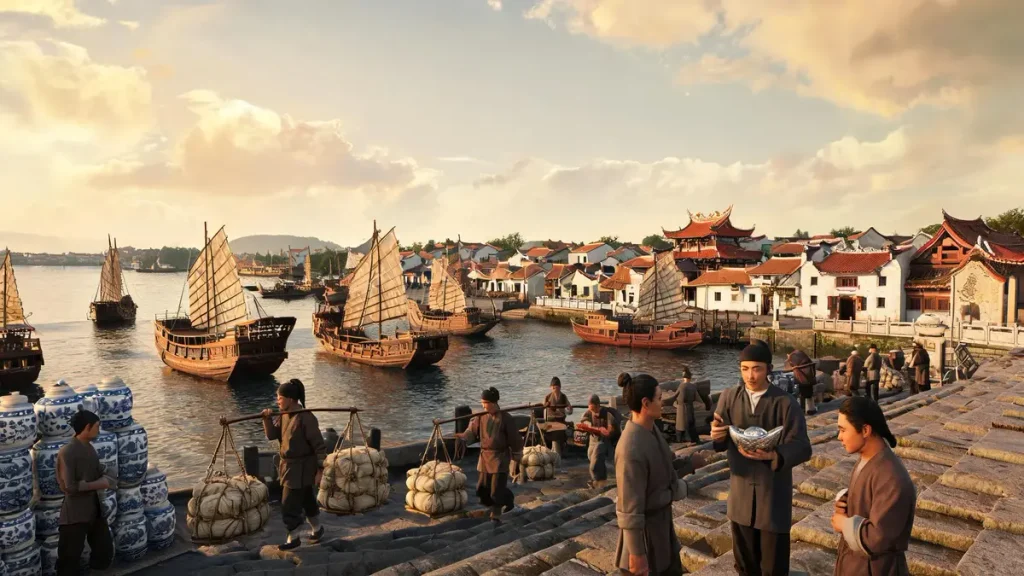
While Yuegang was opening, the far end of the Pacific was being connected. In 1571 the Spanish made Manila their capital. Two years later the first galleon sailed from Manila to Acapulco. Chinese ships carried raw silk, satin and porcelain to Luzon and came back mostly with silver. The silver came out of Potosi and Zacatecas, went overland to Acapulco, crossed the Pacific, came ashore at Manila, and was loaded onto Zhangzhou junks.
How much of it ended up in China is a question with no agreed answer. Quan Hansheng estimated that four hundred million pesos reached Manila between 1571 and 1821 and that between a quarter and a half of it went on to China. Andre Gunder Frank put the total far higher, at sixty thousand tons, about half of world production. Conservative estimates run from a quarter to a third. The arithmetic is beyond recovery; the direction is not. China was where the line ended.
Silver changed what the accounts were kept in. The Single Whip reform had been tried and dropped several times under the Jiajing Emperor and was made universal in 1581. A county totaled its land tax and its labor service, assessed both on land and on adult males, and commuted the whole of it to silver by the mu. Without a steady inflow of silver that arithmetic could not be worked at county level.
In the winter of 1574 a man from Chaozhou pulled the three parties on that route into the same room. Lin Feng, a Chinese sea lord, attacked Manila with a fleet, was driven off, and withdrew to the harbor at Pangasinan. In the spring of 1575 Fujian sent a garrison commander named Wang Wanggao to Manila to propose a joint operation against him. The Spanish governor agreed at once and sent the Augustinian friar Martin de Rada back on Wang’s ship. In July Rada came ashore at Xiamen, went up through Quanzhou to Fuzhou, and asked for trade and for permission to preach. The grand coordinator referred him to the throne, gave him presents, and sent him back to Manila.
Eight years after the port opened, a pirate had done the introductions. Smuggling did not stop because an edict was issued. It acquired a legal channel running alongside the illegal ones.
Baghanaji walked into Datong
In the eighth month of 1550 Altan Khan’s cavalry reached the walls of Beijing. He plundered the suburbs for eight days and asked for tribute trade. The court refused, and afterwards executed the minister of War, Ding Rukui, and the grand coordinator Yang Shouqian. The next year it opened horse markets, then closed them. When Altan Khan came again, the court posthumously tried Qiu Luan, the minister who had argued for the markets. His corpse was disinterred and mutilated, and it became a capital offense to propose a horse market again.
That prohibition held for twenty years. Behind it the frontier had changed. In the 1540s and 1550s Zhao Quan led tens of thousands of Chinese into the Fengzhou plain, where they built houses, broke ground, and founded a settlement the Chinese called Bansheng. They proclaimed Altan Khan emperor, built him walls and a palace, and built Zhao Quan a house to princely specifications with a plaque over the gate reading Kaihua Prefecture. These men taught Altan Khan how to fight. His riders went east into Jizhou and Changping and west into Xinzhou and Daizhou, with patrols reaching Pingyang and Lingshi. From 1541 the raiding ran thirty years, and frontier officials who failed were punished in a long line.
In the first month of 1570 Wang Chonggu took the frontier as supreme commander of Xuanhua, Datong and Shanxi. He stopped soldiers slipping out of the passes and turned the men who had always traded with the Mongols into scouts. He offered terms to Chinese and Mongol soldiers who had gone over, and in one year more than two thousand came in from the tribes beyond.
In the tenth month of that year Altan Khan’s grandson Baghanaji rode into Datong with his wife and a dozen retainers. The cause was domestic. Baghanaji had lost his father as a child and was raised by Altan Khan’s senior wife, Yike Hatum. His marriage to Dacheng Biji had gone badly. He had arranged a second match for himself with a girl known as Sanniangzi, who was Altan Khan’s granddaughter by a daughter. Altan Khan saw her, wanted her, and took her. Baghanaji, humiliated, heard that Wang Chonggu was taking in defectors, and came.
Fang Fengshi, the Datong grand coordinator, sent word to Wang Chonggu. Wang kept the man in Datong, treated him well, and then memorialized with Fang, laying out three ways to handle it. The best was to keep Baghanaji comfortable, wait for Altan Khan to ask for him, and trade him for Zhao Quan and the people Zhao had taken. The next was, if Altan Khan came with an army, to say plainly that the grandson would be killed and force him to talk. Failing both, they could keep Baghanaji for years with a rank and a stipend. After Altan Khan died they could send him back to gather his father’s people, so that he and Altan Khan’s son Xin’ai would face each other and both would need Beijing.
The memorial reached the capital and the court split. The censors Rao Renkan, Wu Shangxian and Ye Mengxiong all said the Mongols could not be trusted. Ye cited the Song dynasty, which had taken in Guo Yaoshi and Zhang Jue and regretted it. Guo Qian, the minister of War, could not decide. The grand secretaries Gao Gong and Zhang Juzheng backed Wang Chonggu, and the emperor gave Baghanaji the rank of guard commander and a crimson robe, and sent Ye Mengxiong out of the capital.
Altan Khan came back from the west and moved Xin’ai’s troops in by separate roads to demand his grandson. Xin’ai made a show of marching and then stayed where he was. Yike Hatum wept for the boy every day and Altan Khan ran out of ideas. Fang Fengshi sent an officer named Bao Chongde into his camp. Altan Khan received him with contempt: since I began fighting, he said, your generals keep dying. Bao answered with a question. How do your generals compare with your grandson?
Altan Khan had assumed the boy was dead. Told that he was alive and comfortable, he sent men to look. Wang Chonggu had Baghanaji come out in crimson and gold to meet them. Altan Khan was delighted. He cleared the tent and told Bao that he had never wanted war and that the war belonged to Zhao Quan and his kind. His grandson’s defection, he said, was heaven’s arrangement. If the Son of Heaven made him a prince, he would keep the north quiet for good. When he died his grandson would inherit the title and could not afford to betray the court.
In the twelfth month Altan Khan bound Zhao Quan and eight others and sent them to Datong. The court sacrificed to Heaven and the ancestral temple, had Zhao Quan and the rest torn apart in the market, and sent Baghanaji home.
The settlement went through a court conference first. Twenty-two men, headed by the duke of Dingguo, Xu Wenbi, and the vice minister Zhang Siwei, said yes. Seventeen, headed by the duke of Yingguo, Zhang Rong, and the minister Zhang Shouzhi, said no. Five, headed by the minister Zhu Heng, wanted the tribute and refused the markets. Only Li Tang, an assistant censor-in-chief, argued flatly that it should be done. Twenty-two to seventeen. The decision was taken at a lecture session, where the grand secretaries asked the Longqing Emperor face to face to hold the Mongols loosely while repairing the defenses, and he nodded. Then the edict went out. In the third month of 1571 the Longqing Emperor created Altan Khan Prince Shunyi and renamed the city he lived in Guihua. Kunduli, Xin’ai and the rest received ranks. Baghanaji was made a general and kept his command. Jineng, who held the Ordos, was given a rank as well. In the ninth month the markets opened at the three frontier commands.
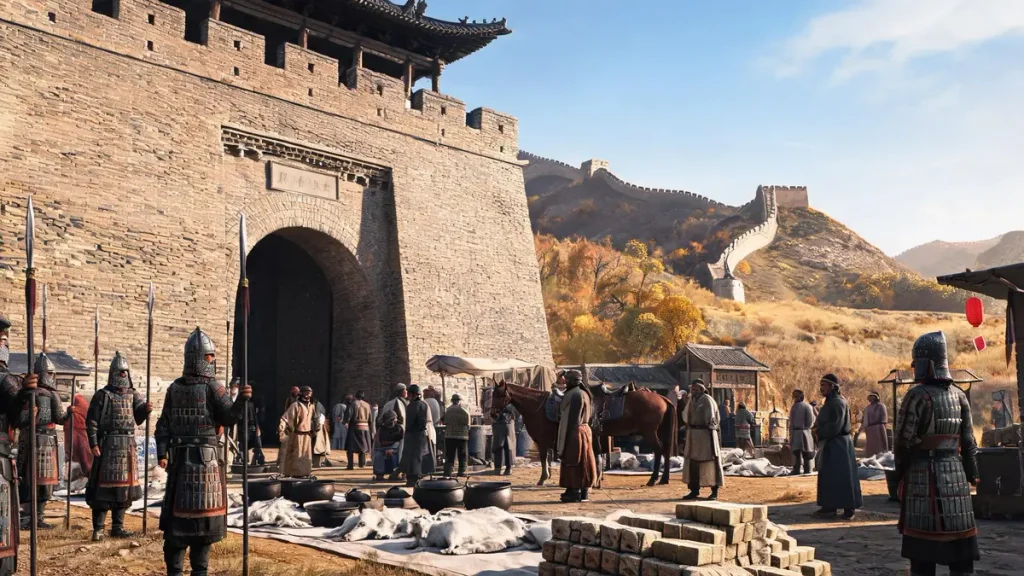
Fang Fengshi later did the accounts. The three commands spent 270,000 taels a year on market capital and gifts. The old cost had been more than 700,000 from the Ministry of Revenue for campaign supplies, plus over 100,000 from the imperial stud for horses. The new figure was two or three tenths of the old one. He also put the argument in a form that could be remembered: war is a disaster, a marriage alliance is a disgrace, and payment is a shame. What we have is called tribute, which is not a marriage alliance. We have markets, which is not payment. With tribute and markets there is no war. The History of the Ming records the result in one line. From the eastern end of the line to Jiayu Pass in the west, seven commands and several thousand li of soldiers and civilians worked without weapons, and the cost fell by seven tenths. Cloth, grain, beans and leather came down from Jianghuai and Huguang to the frontier, and the court taxed the trade to pay for the gifts.
The frontier did not rest on the treaty alone. In the same years Tan Lun commanded Jizhou, Liaodong and Baoding and Qi Jiguang trained the troops, and 3,000 watchtowers went up between Juyong Pass and Shanhai Pass. The Longqing Emperor took Zhang Juzheng’s advice, gave Tan Lun the whole military brief, and ordered the grand coordinator Liu Yingjie not to interfere. That autumn there was no alarm in Jizhou or Changping. In earlier years troops had been pulled from Shaanxi, Hejian and Zhengding for the autumn defense. That year the movement stopped.
The Ming History on the Longqing Emperor: generous, not firm
The verdict at the end of juan 19 begins with praise. Six years on the throne, he sat still and wanted little, practiced frugality in person, and the palace kitchen saved ten thousand a year. He allowed Altan Khan’s tribute and markets, cut taxes, rested the people, and the frontier was quiet. A ruler who kept what he inherited without wrecking it, the annal says, may be called a good one. Then it turns. His great ministers pulled against each other and the factions began to open, and he could not seize the reins or break the old habits. He was, the sentence runs, more generous than firm and more forgiving than clear-sighted.
Generous is the word it uses. Juan 19 also carries a list of names. In the first month of 1568 the supervising secretary Shi Xing sent up six proposals, was flogged at the palace gate, and was reduced to commoner status. In the fifth month of 1569 the censor Zhan Yangbi asked for an end to wasteful spending and was dismissed. In the twelfth month of that year Zheng Lüchun, an assistant minister of the Seal Office, was flogged and jailed for speaking. In the fifth month of 1570 the supervising secretary Li Ji was flogged and jailed for objecting to a purchase of gold and jewels.
They had all offended the same men. Teng Xiang, Meng Chong and Chen Hong, eunuchs of the Directorate of Ceremonial, were in favor in those years. They competed in novelties to please him, built him a lantern mountain for the festival, and kept him drinking into the night. Li Fang, a senior eunuch of the inner court, told him to his face that this was wrong and was suspended. In the eleventh month of 1568 he was flogged eighty times and put in the Ministry of Justice prison to await sentence. Mao Kai, the minister of Justice, said the charges had never been stated and he did not know what to convict the man of. The emperor answered in one line: Li Fang was disrespectful to me, keep him locked up.
Li Fang stayed in prison until the fourth month of 1570, came out branded, and was sent to do menial duty in Nanjing. In six years, no official who attacked those three eunuchs stayed at court.
The Longqing Emperor did leave the palace. In the ninth month of 1569 he reviewed the capital army in person. In the third month of 1568 he went out to the South Lake. The capital army was reorganized twice, into three training camps with six commanders in the second month of 1570 and back to a single command under a minister in the ninth.
The inner palace is thinly recorded. Empress Chen had been his second wife while he was still a prince. She was childless, often ill, and lived in a separate palace. Consort Li had come to him in the princely household and gave birth to Zhu Yijun.
In the intercalary third month of 1572 the Longqing Emperor appeared at the gate of the Hall of Supreme Authority, was taken ill in front of the court, and went back inside. He did not come out again for two months. In the fifth month he was dying and called Gao Gong, Zhang Juzheng and Gao Yi to hear his charge. He died the next day in the Palace of Heavenly Purity, aged thirty-six.
From the attack to the end was less than two months. What was wrong with him is recorded in two characters: taken ill. The notebooks written after 1572 say a great deal, about women, about elixirs, about girls brought into the palace, and the official history takes none of it up. That he died at thirty-six in the Palace of Heavenly Purity is what can be said.
On the day the Longqing Emperor died Gao Gong wept in the Grand Secretariat and said that a boy of ten could not govern the empire. In the sixth month Feng Bao repeated the remark to the empresses with the wording changed: Gao Gong had called the heir a ten-year-old child and asked how such a person could be ruler. Feng Bao had already inserted himself into the regency by way of a testament and now held the Directorate of Ceremonial and the Eastern Depot. Gao Gong tried to remove him and Feng Bao sat on the memorial. On the sixteenth day of the sixth month an edict from the two palaces and the child emperor was read out, listing Gao Gong’s crimes. He collapsed and could not get up. Zhang Juzheng helped him out, hired a mule cart, and sent him through the Xuanwu Gate. In the seventh month the dead emperor was given his posthumous name, the temple name Muzong, and buried at Zhaoling.
Zhang Juzheng took the government. What was done in the first years of Wanli rested on what six years of Longqing had left. The performance reviews, the land survey, the Single Whip made universal, Qi Jiguang at Jizhou, Li Chengliang in Liaodong: none of it started from nothing. Permits at Yuegang were in their sixth year of issue, the markets at Datong had never once closed, and the watchtowers stood along the Jizhou wall. The History of the Ming, closing its account of the settlement, says that Xuanhua and Datong kept the peace until the dynasty fell.
The Ming History runs to twenty-four juan of basic annals. Shizong has two. Shenzong has two. Muzong has one, and the whole of it is under two thousand characters.
The last sentence in that juan, on this thirty-six-year-old emperor, reads: more generous than firm, more forgiving than clear-sighted.
Sources and further reading
History of the Ming (Mingshi), juan 19, basic annals of Muzong, for the testament of 1566, the rehabilitation, the river works, the tax remissions, the dates of the floggings, the audience of 1572, the death and the closing verdict. https://zh.wikisource.org/zh-hans/明史/卷19
History of the Ming, juan 213, biographies of Xu Jie, Gao Gong, Guo Pu and Zhang Juzheng, for the drafting of the testament, the quarrel of 1567, Gao Gong’s recall and reversal, his use of Yin Zhengmao and Zhang Xueyan, and the fall of 1572. https://zh.wikisource.org/zh-hans/明史/卷213
History of the Ming, juan 222, biographies of Tan Lun, Wang Chonggu, Fang Fengshi and Wu Dui, for the 1550 raid, the Bansheng settlement, the defection of Baghanaji, Wang Chonggu’s three options, the court conference, Fang Fengshi’s arithmetic and the watchtowers at Jizhou. https://zh.wikisource.org/zh-hans/明史/卷222
History of the Ming, juan 226, biography of Hai Rui, for the memorial of 1566, his release, the tenure at Yingtian and his removal. https://zh.wikisource.org/zh-hans/明史/卷226
History of the Ming, juan 305, biographies of eunuchs, for Li Fang, Teng Xiang, Meng Chong and Chen Hong, and for Feng Bao’s manipulation of the testament and the fall of Gao Gong. https://zh.wikisource.org/zh-hans/明史/卷305
History of the Ming, juan 114, biographies of empresses, for Empress Chen and Consort Li. https://zh.wikisource.org/zh-hans/明史/卷114
Zhang Xie, Dongxiyang kao (A Study of the Eastern and Western Oceans), juan 7, on the tax rules at Yuegang, the permits, and the duties on hulls, cargo and voyages to Luzon.
Xu Fuyuan, Memorial on Relaxing the Maritime Ban, in the Ming jingshi wenbian, for the wording of Tu Zemin’s request and the two-ocean limit.
Quan Hansheng, "The Import of American Silver into China during the Ming and Qing," Journal of the Chinese Institute of Chinese Studies, vol. 2, no. 1, 1969, for the four hundred million peso estimate.
Andre Gunder Frank, ReOrient: Global Economy in the Asian Age, 1998, for the sixty thousand ton estimate.
Fujian Provincial Department of Transportation, "The Rise and Fall of Yuegang and Ming Maritime Policy," for the customs office, the permit system and the shift from Meiling to Haicheng. https://jtyst.fujian.gov.cn/zwgk/jtyw/mtsy/202601/t20260113_7074297.htm