Zhu Changluo (Taichang & Guangzong): The 30-Day Mystery
Before dawn on September 26, 1620, the Taichang Emperor had been on the throne twenty-nine days and was dying in the Palace of Heavenly Purity.
The evening before, Li Kezhuo, an assistant minister of the Court of State Ceremonial, had carried a second red pill into the heated chamber. The ministers waiting outside asked how the emperor did. The word came back that he was quiet and unchanged. Fang Congzhe, the chief grand secretary, stood at the gate until dark and heard the same thing.
By the hour of the rabbit, between five and seven, he was dead. He was thirty-nine by Chinese reckoning and thirty-eight by the Western one.
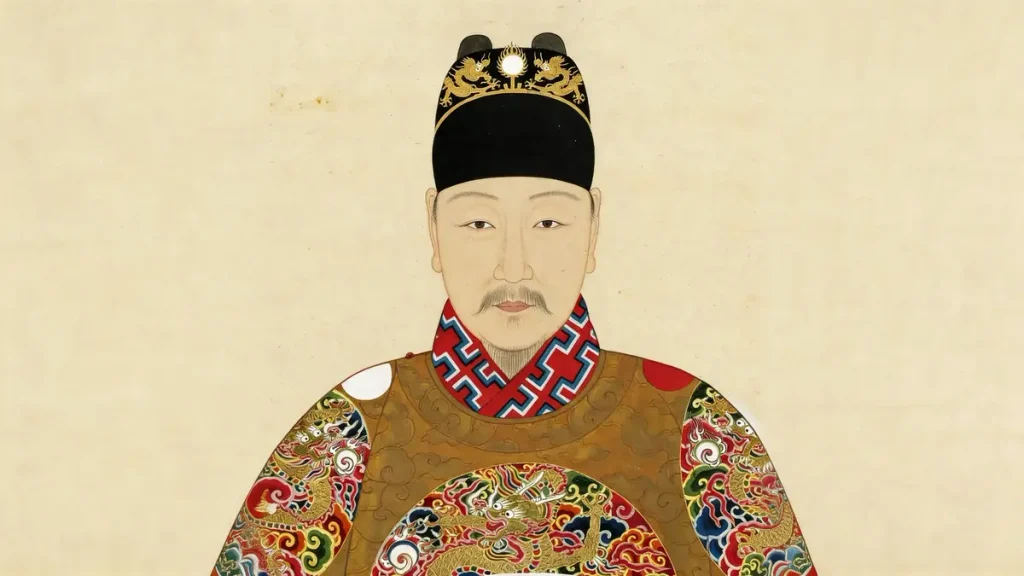
The Ming History, the official account compiled under the dynasty that replaced his, gives the moment a single sentence. On the first day of the ninth month he died in the Palace of Heavenly Purity, having reigned one month, aged thirty-nine. It then records his son’s accession, the argument over the era name, the posthumous titles, the tomb, and stops.
He never used his own era name. When he took the throne on August 28, the amnesty promised that the next year would be the first of Taichang. He died before it began. The court then fell to arguing about what to call the year it had just lived through. Some wanted the Taichang name struck from the record altogether. Others wanted all of 1620 to be Taichang. A third group wanted 1620 erased and the following year made Taichang, with Tianqi after it. Zuo Guangdou, a censor, talked them all down and got the compromise that held: 1620 stayed Wanli up to the end of the eighth month, and the rest of it became Taichang. A man remembered as the Taichang Emperor spent his only month of rule dating documents to the forty-eighth year of his father.
Thirty-eight years separated his birth in the eighth month of 1582 from his accession in the eighth month of 1620.
In the eighth month of 1582, a maid in the Cining Palace
His mother was a woman named Wang, a maid at the Palace of Compassionate Tranquility, where the empress dowager lived. In 1581 his father came to that palace and took her to bed. Palace rule required a reward afterwards, and a clerk of the document office wrote down the date and the gift so that a claim could be checked years later. The emperor declined to acknowledge anything, and no one near him dared raise it.
Months on, it could not be hidden. At a meal with his mother he was taxed with it and said nothing. The empress dowager sent for the palace diary and laid it in front of him. I am old, she said, and I still have no grandson. If it is a boy, that is a blessing for the dynasty. A mother is honored for her son. Why should there be degrees?
In the fourth month of 1582 Lady Wang was made Consort Gong. In the eighth month she bore the eldest son.
In 1586 Consort Zheng bore the third son, Zhu Changxun, and was made imperial noble consort. Consort Gong’s rank did not move. The eldest boy was five. The succession was still empty. In the second month the chief grand secretary, Shen Shixing, led the court in asking for an heir, and the emperor said the boy was young. Jiang Yinglin, a secretary in the Ministry of Personnel, tried a side door: make Consort Gong imperial noble consort first, and settle the succession after. He was sent down to a minor post in Guangchang.
The argument ran fifteen years. His eventual accession placed him fourteenth in the Ming succession; the Ming emperors in order page shows where his reign falls between Wanli and Tianqi.
Once the emperor tried to end it by giving the three eldest princes their titles at the same time, in the first month of 1593, so that none of them would be heir. The court threw it back at him, memorial after memorial: the dynastic law does not wait on a principal wife’s son, and the eldest son is not enfeoffed alongside the others. In the tenth month of 1601 the eldest son was made heir apparent. He was twenty.
How many censors were demoted, flogged at court, or struck off in those fifteen years nobody counted into a single ledger. The empress dowager intervened once. The emperor came to pay his respects and she asked about the succession, and he said the thing that was on his mind: he is the son of a maid. She turned on him. You are the son of a maid. The palace called its women duren, and she had come up from that rank herself. He got down on the floor and stayed there.
Once he was heir, his mother’s position did not change. In 1611 she fell fatally ill and he asked leave to visit her. The gate of her palace was locked. He had it forced. She was blind by then, and she caught hold of his robe and wept. My son has grown so tall, she said. What is there left to regret. She died that day. Ye Xianggao, a grand secretary, said that the funeral of the heir’s mother ought to be generous. Nothing came back. He asked again, and it was granted.
In 1603 a handbill appeared in the capital accusing the emperor of wanting to change heirs and naming Consort Zheng. That was the seditious pamphlet case. The investigation ran for months and pulled in a crowd, and it ended with a man named Jiao Shengguang torn apart in the market. In the sixth month of 1613 an informer denounced a group of diviners for working sorcery against the heir, and the trail led to Consort Zheng and the prince of Fu again. Ye Xianggao told the emperor to sit still and get the prince out to his fief, and the thing died down. The prince left for Luoyang in the third month of 1614.
What the officials were defending was a rule: primogeniture by the empress’s eldest son, or failing that by the eldest son at all. The rule fixed who inherited. It had nothing to say about which child a father liked. An emperor who could disinherit the eldest because he preferred the third could break any other rule he found inconvenient, and the men who took a flogging at court for saying so were defending the rule.
He sat in the heir’s palace for nineteen years. He never governed in his father’s absence and never issued an order of his own.
A jujube staff at the gate of the heir’s palace
On the fourth day of the fifth month of 1615 a man carrying a staff of jujube wood came in through the Donghua Gate into the Ciqing Palace, where Zhu Changluo lived. He struck down the gatekeeper, Li Jian, and got as far as the eaves of the front hall before the eunuchs held him.
Liu Tingyuan, the censor responsible for the city, questioned him first. The man gave his name as Zhang Cha, a peasant from Jing’eryu in Jizhou, and talked nonsense. Liu’s finding was carefully phrased: by his tracks he looked like a madman, by his face like a knave. Two bureau directors in the Ministry of Justice, Hu Shixiang and Yue Junsheng, charged him under the statute on shooting arrows or throwing tiles inside a palace and left the rest to madness. The case could have ended there. Wang Zhicai, the secretary in charge of the ministry’s prison, did not think it should.
Wang went round the cells with the rice. Zhang Cha came last. He was young and strong and did not look mad. Wang set the bowl down in front of him: confess and eat, hold your tongue and starve. Zhang Cha looked at the floor and said he did not dare speak. Wang sent the clerks out and kept two guards to hold him up, and the story came out. His name at home was Zhang Wuer. His father was dead. An uncle called Ma and a father-in-law called Li had told him to follow a eunuch he had never seen, and the eunuch had said: when it is done you get a few mu of land. The eunuch rode and he walked. They slept at Yanjiao on the third and came into the capital on the fourth. There was a big house off a street whose name he never learned. A eunuch fed him and said, go in and swing at whoever you meet, kill one and we will get you out, and gave him the staff. Asked again, he produced two names: Pang Bao and Liu Cheng. Both were eunuchs in Consort Zheng’s palace. The Ming History adds that Pang Bao had once been Zheng Jin and Liu Cheng had once been Liu Dengyun.
A madman at a gate had become a plot against the heir. The talk in the capital went straight to Zheng Guotai, the consort’s brother.
On the twenty-eighth of the month the emperor met his officials. He had not done that in twenty-five years. The meeting was at the mourning hall of the empress dowager in the Cining Palace, with the heir standing at his right. He took his son’s hand. This boy is very filial, he said, and I am very fond of him. He had raised a six-foot orphan into a grown man; if he had meant anything else, why not change the succession then. The prince of Fu was in his fief thousands of li away. Unless he were summoned, could he fly back? He had the three grandsons brought up to the steps so that the officials could look at them.
Zhu Changluo said his piece too. The man is a madman. Settle it and let it stop there.
The next day Zhang Cha was torn apart in the market. The day after, the Directorate of Ceremonial sat with the three judicial offices at the Wenhua Gate to examine Pang Bao and Liu Cheng, and neither would confess. Ten days later the ministry sentenced three men named Ma Sandao, Li Shoucai and Kong Dao to exile, and Pang Bao and Liu Cheng died inside the palace. That was the end of it.
Who sent Zhang Cha was never established. One account, written decades later by Xia Yunyi, has him ruined in a quarrel over firewood with the eunuchs who ran the brick kilns, coming to the palace to petition and walking through the wrong gate. The other reading has nothing to say about motive and everything about doors: the heir’s household kept few guards, and a stranger with a staff reached the front hall.
Wang Zhicai was struck off within two years for his trouble. Under the next reign he was thrown into the imperial prison and died there.
Six grand secretaries and a purge
The Wanli Emperor died on the twenty-first day of the seventh month of 1620. The day after, the heir released a million taels of silver from the privy purse for the frontier, abolished the mining and commercial taxes, and recalled the officials who had been punished for speaking out. The day after that, another million.
On August 28 the Taichang Emperor took the throne, declared an amnesty and remitted taxes in the provinces that had suffered disaster.
The abolition of the mining taxes was credited to the Taichang Emperor afterwards. The edict had been his father’s, issued on his deathbed, and the heir only carried it out. Nobody at the time made the distinction. The tax eunuchs came back from the provinces, the officials came back from exile and dismissal, and posts that had stood empty for years were filled. Within the month he appointed six grand secretaries: Shi Jixie, Shen Que, He Zongyan, Liu Yijing, Han Kuang and Zhu Guozuo. In the last years of Wanli the Grand Secretariat had held one man. Fang Congzhe had run it alone for seven years.
Fang stayed on as chief minister.
In that same month the Ming History records two other things. Liaodong had a drought. On the fifteenth day the Yellow River at Lanzhou ran clear for three days. The Taichang Emperor was by then going to the latrine thirty or forty times a day and night.
Consort Zheng had been living in the Palace of Heavenly Purity while the old emperor was ill and had not moved out when he died. Zhou Jiamo, the minister of Personnel, went to her nephew Zheng Yangxing, and she moved to the Cining Palace.
Then her gifts arrived. Fang Congzhe’s biography has pearls, jade and eight palace women. Cui Wensheng’s biography, in the same book, has four. Two numbers for one delivery.
On the tenth of the eighth month the Taichang Emperor fell ill. On the twelfth he came out to hold court anyway and did one thing: he ordered Fang to make Consort Zheng empress dowager. Fang sent the order straight to the Ministry of Rites. Sun Ruyou, a vice minister there, refused to move on it, and it stopped. A few days later Zheng Yangxing asked for the order to be withdrawn, and it was.
On the fourteenth Cui Wensheng gave him a purgative. Rhubarb, and a strong dose of it. He was up thirty or forty times in a day and a night; the Ming History has him prostrate among the bedclothes. On the sixteenth he stopped holding court. The edict that came out said he had not slept for several nights, ate less than a bowl of gruel a day, and had a swimming head, slack limbs and no strength to walk. Cui’s career mattered more than his prescription. He had been a eunuch in Consort Zheng’s household, was promoted on the accession to the Directorate of Ceremonial, and was put in charge of the imperial pharmacy. Yang Lian, a supervising secretary, wrote the indictment that everyone quoted afterwards. The physicians’ rule, he said, is to drain what is full and to tonify what is empty. The emperor, worn out by mourning and by ten thousand decisions a day, needed tonics, and Cui gave him the reverse. Was the mistake intended, or was it not? If it was intended, powdering his bones would not pay for it. If it was not, one mistake should not be allowed to lead to a second.
The question was well put and there was no one to answer it. No case notes survive. Which physician wrote what, in what quantity, against what pulse, exists only in other men’s retellings.
There is a discrepancy in the record worth flagging. The basic annals date the illness to the twenty-first. The biographies and the chronicle of the reign date it to the tenth. On the annals’ dating, the purge on the fourteenth happens before the illness it was meant to treat.
The herald with an elixir
On the twenty-sixth the Taichang Emperor held an audience in the east heated chamber of the Palace of Heavenly Purity. He was propped against a couch with a low table at his elbow, and the heir stood beside him. He said he was glad to see them. The medicine, he said, had not gone down for more than ten days.
On the twenty-ninth he held another. This one sounded like a farewell. He told them to make his son a second Yao or Shun. He spoke of a tomb, and they took him to mean his father’s, and he pointed at himself: this is my tomb. The officials wept.
Then he asked where the man from the Court of State Ceremonial was, the one with the medicine.
Fang Congzhe answered: Li Kezhuo, an assistant minister there, says he has an elixir. We did not venture to believe him.
The Taichang Emperor had him brought in. Li examined the patient and gave a fluent account of the disease and its cure. The emperor was pleased and told him to mix it at once. He choked on soup, the Ming History says, but he kept the pill down. He called Li a loyal minister twice.
The officials withdrew to the gate. After a while a eunuch came out and said the emperor was resting quietly. Toward dusk Li came out and said he had given another pill. Fang asked how it had gone. Quiet, as before.
At dawn the emperor was dead.
What was in the pill is not known. The Ming History writes two characters, red pill, and gives no formula. Alchemy had run through the palace since the Jiajing reign a lifetime earlier. Its staple was red lead, refined from the menses of young women and compounded with ginseng and deer antler as a tonic for the body’s original qi. Whether Li’s pill belonged to that school, nobody recorded. Nor is there any note of who gave him the recipe, or whether a second man ever looked at it. Modern readers come at the Taichang Emperor’s death from the other side. Rhubarb is a violent purgative. Ten days of it will strip a man’s water and electrolytes down to dangerous levels, drop his blood volume, and leave his heart and kidneys without the margin to work. On top of that, an unknown pill with stimulant properties could plausibly tip a weakened heart into failure. That is a guess. There was no autopsy, and the dose was never written down.
The case could not be solved for a blunter reason as well: the evidence ends inside the Taichang Emperor’s body. What came out of the chamber was that he felt warm and soothed and wanted food. What Yang Lian called it was malpractice. Neither party knew any medicine. The one man who did was sent into exile, the other to the frontier, and neither was ever questioned about what the drug did.
In 1622 Sun Shenxing, the minister of Rites, reopened the Taichang Emperor’s case and called Fang a regicide. The argument ran for months. Zhang Wenda, with the nine ministers behind him, put it in plain terms. Li was not a physician and knew neither the pulse nor the art. He tried a drug on the emperor and the emperor was gone. Fang, as chief minister, could not stop him and rewarded him instead. The outcome was Li to garrison exile, Cui to Nanjing, and no charge against Fang.
Fang kept his titles and went home.
Three years later Wei Zhongxian cancelled Li’s exile and sent Cui to run the grain transport on the Grand Canal.
On the first of the ninth month, the gates stayed shut
On the day the Taichang Emperor died, Consort Li was still in the Palace of Heavenly Purity. The officials came to wail over the body and the eunuchs shut the gates on them. Liu Yijing and Yang Lian pushed them open. The heir, Zhu Youxiao, was sixteen, and Consort Li had him in the heated chamber.
Yang Lian’s biography has him shouting through the door: who dares hide the new Son of Heaven. Wang An’s biography has it differently: the eunuch who had been the boy’s companion at his lessons went in and talked her round. Liu Yijing took the opening, called out long life, lifted the boy onto a litter and had him carried to the Wenhua Hall.
What she wanted was a title. While the Taichang Emperor lay dying she had pushed the boy out in front of the ministers to say that she wanted to be empress. He refused. He ordered her made imperial noble consort instead, and the ceremony never happened.
From the first of the month to the fifth, memorials came in daily. Zuo Guangdou put it hardest. The Palace of Heavenly Purity is to the inner court what the great audience hall is to the outer: only the Son of Heaven lives there, and the empress with him. She is neither the principal wife nor the mother. The new ruler has been pushed into the Ciqing Palace and cannot keep the vigil or perform the rites. He is sixteen; does he still need to be nursed? Leave this, and she will govern in the name of raising him, and we shall have the Empress Wu over again.
She was furious and sent for him several times. He answered that he was the Son of Heaven’s judge, that he went when the Son of Heaven called and not before.
On the fifth, the day before the accession, Liu Yijing and Han Kuang stood at her gate with Fang until she moved. Fang’s biography puts her in the Huiluan Palace. The biographies of the empresses put her in the Renshou Hall. Two addresses for one eviction.
The next day Zhu Youxiao took the throne. He later issued an edict that went through the whole of it. She blocked me in the heated chamber, and the eunuchs of the Directorate had to insist before I was let out. Then she changed her mind and sent Li Jinzhong and others to call me back three times. At the steps of the palace Li Jinzhong held on to my robe and would not let go. He added an older grievance. She had bullied my mother, who sickened over it and died.
That Li Jinzhong is Wei Zhongxian.
Within days Jia Jichun, a censor, memorialized that the new emperor had treated his father’s consort shabbily. He was struck off for it. Five years later Wei reversed the case, brought him back, and put Yang Lian and Zuo Guangdou in prison.
A book that named three culprits
Wei Zhongxian came from Suning, had been a local tough, and gambled. He won a little money off the wrong men, they turned on him, and in a rage he castrated himself. He changed his name to Li Jinzhong and only later took his own surname back, with the emperor giving him the name Zhongxian. Under Tianqi he ran the Directorate of Ceremonial, commanded the Eastern Depot, and had Madam Ke, the emperor’s wet nurse, inside the palace with him.
In 1625 the court was ordered to compile the Compendium of the Three Reigns, which went back over the staff, the red pill and the eviction and settled what each of them had been. It named one culprit for each: Wang Zhicai for the staff, Sun Shenxing for the pill, Yang Lian for the eviction.
Three men: one who got a confession out of a prisoner, one who demanded an inquiry into a prescription, one who pulled a sixteen-year-old out of a doorway. The book made them the criminals of the reign they had tried to save.
Yang Lian had sent up his memorial of twenty-four crimes against Wei in the sixth month of 1624. The next year he and five others died in the imperial prison: Zuo Guangdou, Wei Dazhong, Zhou Chaorui, Yuan Huazhong and Gu Dazhang.
Liaodong did not wait for any of this. In 1618 the Later Jin took Fushun. In 1619 four Ming armies were destroyed at Sarhu, with 310 officers and 45,800 men killed by the Ming History’s count. Both dispatches reached Beijing while Zhu Changluo was still heir. In 1621 Shenyang and Liaoyang fell. In 1629 the court cut the post stations to save money, and a groom at Mizhi named Li Zicheng lost his job.
For twenty years the court argued about the three cases.
Whether the pill was poison was argued to the end of the dynasty, and on into the southern court at Nanjing. Every change of government flipped the verdict. Under Wei, giving the pill was innocent and attacking it was a crime. When the Chongzhen Emperor broke the eunuch faction, it flipped back. What Li Kezhuo had actually put in the pill was never examined by anyone.
The men who compiled the Ming History, writing a generation later, gave the Taichang Emperor four lines at the end of an annal that belongs mostly to his father. One month on the throne. Heaven did not grant him the years. His measures were never unfolded. The three cases became a quarrel, and the factional war grew hotter for it. A pity, that is all.
After the annal
Qingling lies in a hollow just under a mile northwest of Changling, the tomb of the Yongle Emperor. The hollow has a name of its own. It is called Jingtai Wa, the Jingtai pit.
In 1456 the Jingtai Emperor’s empress died. He had a tomb surveyed for himself in the Tianshou Hills, eight hundred yards east of the Xianling, and by the end of the sixth month the underground palace and the soul tower were finished and she was laid in it. In the first month of the next year his elder brother came back out of confinement, took the throne again, and demoted him to prince of Cheng. He died a month later west of the city and was buried as a prince at Jinshan. The soul tower and the underground palace were pulled down on the new emperor’s orders, and the empress was moved elsewhere. What remained was a pit.
A hundred and sixty-five years later the Taichang Emperor died with no tomb of his own and no money to spare for choosing one. In the third month of 1621 the site at Jingtai Wa was fixed and work began. On the twenty-ninth of the seventh month the gate of the underground palace was sealed. It had taken four months. In the ninth month he was buried, with three empresses who had all been honored after their deaths.
The tomb sits between the Xianling and the Yuling, whose occupants died in 1425 and 1464, more than a century before him. In the left-right order that governs the tombs he does not belong where he is. Nobody chose this place for him. It was the only one going.
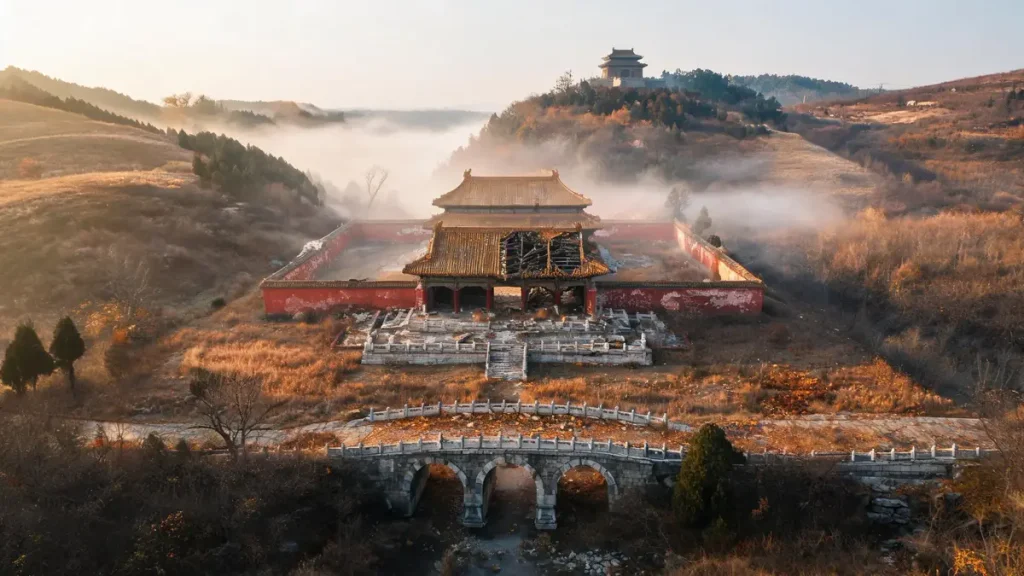
The stele in front of the tomb carries no inscription. The Qianlong Emperor’s repairs took its roof for bricks and rebuilt the hall and its gate on a smaller scale. Qingling is still closed to visitors. Through the railing outside the first courtyard you can see the gate and the hall as broken walls.
The burial mound and the courtyard in front of it are separated by a low hill, so that the two halves of the tomb never meet. Only one other tomb at the Ming graves is laid out that way. It belongs to the Hongxi Emperor.
Sources and further reading
The Ming History (Mingshi), juan 21, basic annals of Shenzong and Guangzong, for the accession on August 28, the illness, the audiences of the twenty-sixth and twenty-ninth, the red pill, the death on the first of the ninth month, the era-name compromise, and the closing verdict: https://zh.wikisource.org/wiki/明史/卷21
The Ming History, juan 218, biography of Fang Congzhe, for the eight palace women, the order making Consort Zheng empress dowager, the emperor’s own words at the last audiences, the second pill, the reward to Li Kezhuo, the eviction and the Huiluan Palace, and the 1622 inquiry: https://zh.wikisource.org/wiki/明史/卷218
The Ming History, juan 305, biographies of the eunuchs, for Cui Wensheng’s post and his rhubarb, Wang An and the removal of the heir, and Wei Zhongxian’s self-castration and change of name: https://zh.wikisource.org/wiki/明史/卷305
The Ming History, juan 114, biographies of the empresses, for the palace maid Wang, the palace diary, the empress dowager’s retort, Consort Gong’s death, the funeral, and Consort Li’s attempt to be made empress: https://zh.wikisource.org/wiki/明史/卷114
The Ming History, juan 244, biographies of Yang Lian and Zuo Guangdou, for the eviction, the sixteen-year-old heir, Zuo Guangdou’s memorial on the palace, and the deaths in prison: https://zh.wikisource.org/wiki/明史/卷244
The Ming History Chronicle (Mingshi Jishi Benmo), juan 68, on the three cases, for the interrogation of Zhang Cha, the emperor’s appearance at the Cining Palace, and the sequence of the purge: https://zh.wikisource.org/wiki/明史紀事本末/卷68
Beijing Municipal Cultural Heritage Bureau, "Qingling, a tomb with a story," for the Jingtai Wa site, the 1456 tomb, its demolition, the four-month construction in 1621, the uninscribed stele and the tomb’s present condition: https://wwj.beijing.gov.cn/bjww/resource/cms/article/bjww_362761/515846/2022051018054714152.pdf
Beijing Daily, "Why the Guangzong Emperor’s tomb was built at Jingtai Wa," for the empresses buried at Qingling and the 1456 survey: https://xinwen.bjd.com.cn/content/s649156bfe4b090861a25c9e4.html
Xia Yunyi, Surviving Records (Xingcun Lu), quoted in the Mingshi Jishi Benmo, for the account of Zhang Cha’s quarrel over firewood.