Ming Dynasty Timeline (1368–1644): Key Events & Emperors
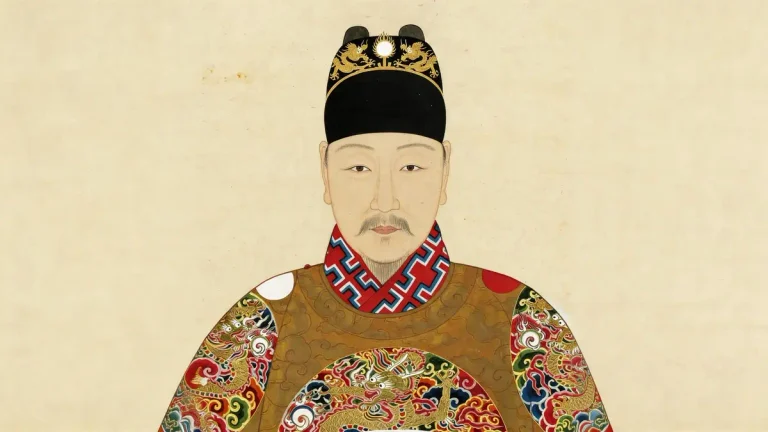
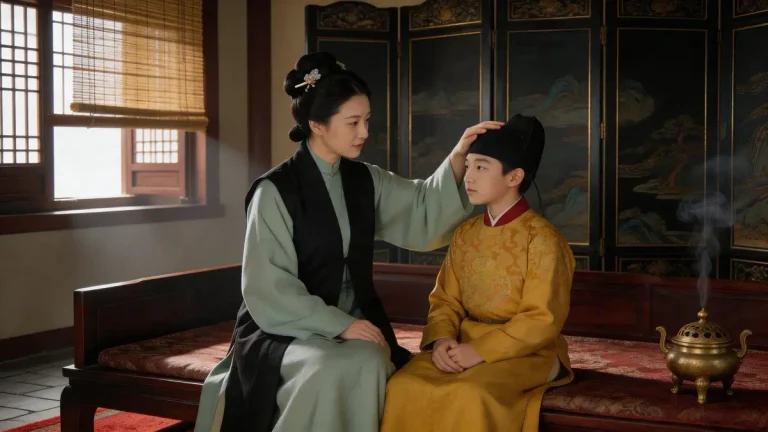
In 1395, twenty-eight years into the Ming dynasty, Zhu Yuanzhang had a book of family rules printed and distributed. He called it the Imperial Ancestral Instructions. One clause was written for the emperors who would come after him:
“No descendant of mine who sits on the throne shall appoint a grand chancellor. Should any subject dare to memorialize for the office to be restored, the civil and military officials shall impeach him at once. The offender shall be put to death by slicing, and his whole family with him.”
He was sixty-eight that year. Fifteen years earlier, in the first month of 1380, he had executed his left grand chancellor, Hu Weiyong, on a charge of treason. Five days later he abolished the Central Secretariat and the office of grand chancellor, and divided the work that office had supervised among the Six Ministries of Personnel, Revenue, Rites, War, Justice and Works. Each ministry now answered to him directly.
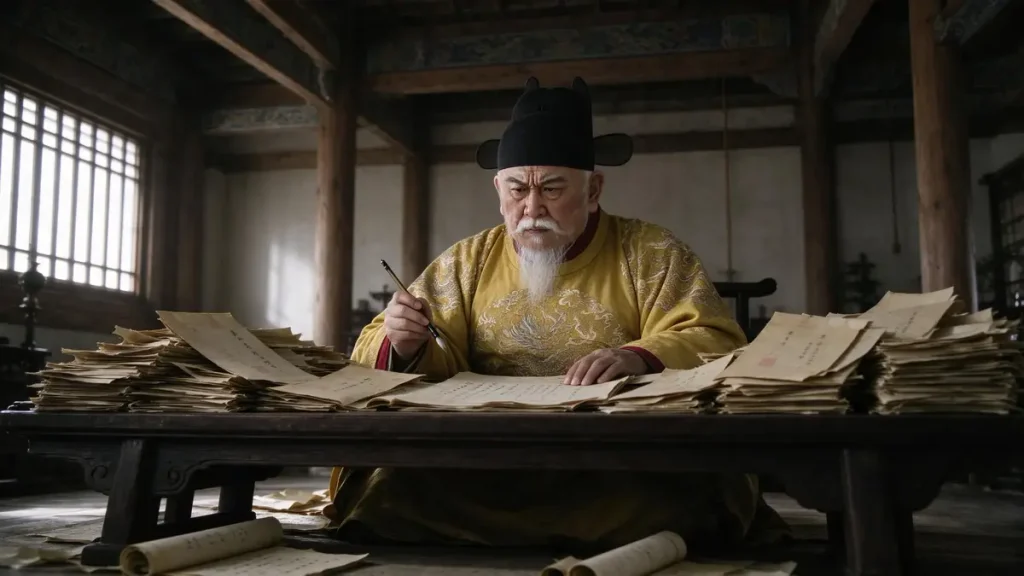
By the time he wrote the Instructions he had been reading the empire’s memorials alone for fifteen years. The editors of the History of the Ming thought the office came back anyway, under a different name. The Yongle Emperor brought Hanlin officials into the Wenyuan Chamber to help with state papers. By the reigns of Hongxi and Xuande, the editors wrote, “the weight of the Grand Secretariat grew daily, and in practice it did the work of a grand chancellor.”
Ming dynasty history runs 276 years, from the fourth day of the first month of 1368 to the nineteenth day of the third month of 1644. Sixteen men held the throne. The capital stood at Nanjing first and at Beijing afterward. Their names, reign titles and temple names are in the table at the end of this article, and anyone building a Ming dynasty timeline will want the reign dates that go with them. What follows takes the Ming dynasty in order: how it began, where it turned, how it ended. The figures most often asked for are collected here first; where each one comes from is explained in the sections that follow.
| Item | Detail |
|---|---|
| Before and after | Yuan (Mongol) → Ming → Qing (Manchu) |
| Dates | January 23, 1368 to April 25, 1644, or 276 years |
| Capital | Nanjing (1368–1421), then Beijing (1421–1644) |
| First emperor | Zhu Yuanzhang, reign title Hongwu |
| Last emperor | Zhu Youjian, reign title Chongzhen |
| Number of emperors | Sixteen. The Southern Ming rulers are not counted |
| Population | 60 million on the registers; scholars estimate 150 million in fact |
| What survives | The Forbidden City, the Ming Great Wall, the Xiaoling tomb at Nanjing, the Ming tombs, volumes of the Yongle Encyclopedia, the Compendium of Materia Medica, Journey to the West |
A drought at Zhongli, 1344
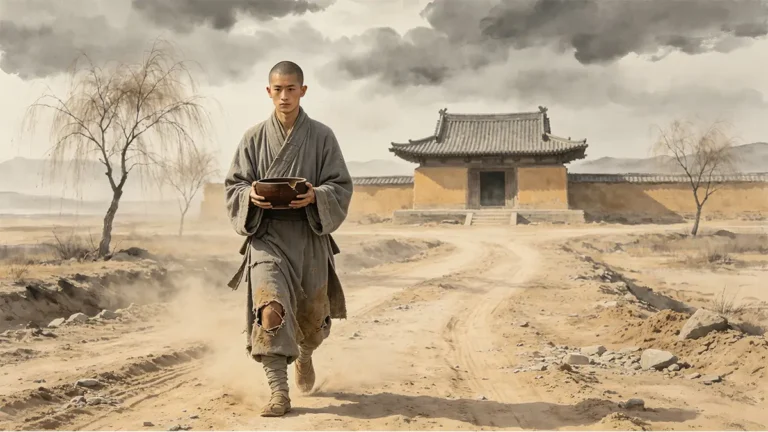
The History of the Ming gives the year 1344 a few lines. Drought, locusts, famine, epidemic. The boy who would become the Hongwu Emperor was seventeen. His father, mother and elder brother died one after another within a few weeks, and the family was too poor to bury them. A neighbor named Liu Jizu gave them a piece of land, and the graves later became the imperial tombs at Fengyang. He entered the Huangjue Temple as a novice. Within a month the temple had nothing to feed him either, and he left to beg, heading toward Hefei, falling ill on the road. For the next three years he walked through Guangzhou, Gushi, Runing and Yingzhou before going back to the temple.
The Yuan had troubles beyond drought. The Yellow River broke its bank at Baimao in the fifth month of that year and flooded for years afterward, disrupting the grain tribute and the salt works. In the fourth month of 1351 the court put Jia Lu in charge of the river and conscripted 150,000 laborers and 20,000 soldiers. In the fifth month of the same year Han Shantong and Liu Futong rose at Yingzhou with red cloth wrapped around their heads. The river workers and the deserting soldiers became the first recruits of that army.
In the intercalary third month of 1352, aged twenty-five, Zhu Yuanzhang joined Guo Zixing at Hao Prefecture. Guo kept him as a bodyguard and married his adopted daughter, a girl of the Ma family, to him. Over the next fifteen years he gathered Xu Da and Tang He, crossed the Yangtze, took Jiqing and renamed it Yingtian. In 1363 Chen Youliang brought 600,000 men and besieged Hongdu; Zhu met him on Lake Poyang, burned his ships, and Chen died of a stray arrow. In 1367 Pingjiang fell and Zhang Shicheng hanged himself after his capture. Of the rival powers in the south, one was left.
On the fourth day of the first month of 1368 he took the throne at Nanjing. The dynasty took the name Ming, with the reign title Hongwu. In the intercalary seventh month Xu Da’s army reached the walls of Dadu, and the Yuan emperor Toghon Temur left through the Jiande Gate in the night. In the eighth month the Ming army entered the city. The northern expedition’s proclamation carried eight characters that were quoted for centuries afterward: drive out the Hu barbarians, restore China. The Yuan had held the empire ninety-seven years, counting from 1271, and eighty-nine from the conquest of the Southern Song. Toghon Temur went north to Shangdu, and the court survived on the steppe for decades under the name Northern Yuan. In 1388 Lan Yu destroyed Toghus Temur at Lake Buir and took 77,000 men and women and 150,000 horses, camels, cattle and sheep. Nobody claimed the Yuan imperial title after that.
Five days in the first month of 1380
On the wuxu day of the first month of 1380, the left grand chancellor Hu Weiyong, the censor-in-chief Chen Ning and the vice censor-in-chief Tu Jie were executed for treason. On the guimao day, five days later, an edict abolished the Central Secretariat, scrapped the offices of grand chancellor, re-ranked the Six Ministries and split the Chief Military Commission into five, for the center, left, right, front and rear.
Three men had held the chancellorship in the whole of Ming dynasty history: Li Shanchang, Wang Guangyang and Hu Weiyong. Wang Guangyang was ordered to kill himself at the end of 1379. Li Shanchang followed ten years later, at seventy-seven, condemned as a Hu associate. For the rest of Ming dynasty history no one held the office.
Zhu had already acted three times before he abolished it. In 1376 the provincial secretariats were converted into provincial administration commissions, taking revenue and civil government out of the Central Secretariat’s hands. In the sixth month of 1377 an edict let subjects send sealed memorials straight to the throne. In the seventh month of the same year the Office of Transmission was created to receive and forward them. In the third month of 1378 officials were told that memorials need not be reported to the Central Secretariat first. By the first month of 1380 the intake had been routed around the chancellor for two and a half years.
Once the secretariat was gone, the ministers of the Six Ministries were raised to the senior second rank and each answered to the emperor. The Censorate was set up two years later, sharing impeachment, trial and review with the Ministry of Justice and the Court of Judicial Review. That arrangement held for more than two hundred years of Ming dynasty history without change. The cost showed up quickly. In the ninth month of 1384 the supervising secretary Zhang Wenfu did the arithmetic: in eight days the offices of the capital and the provinces had sent in 1,660 documents dealing with 3,391 separate matters. Zhu admitted the problem in an edict of his own. “One man handling this much business,” he wrote, “how could I get through it all?”
The Embroidered Uniform Guard was created in 1382, at the third rank, to provide guards, make arrests and run prisons; its Zhenfu office also held the imperial jail. In 1387 Zhu had the instruments of torture burned, sent the prisoners to the Ministry of Justice and gave all prisons to the three judicial offices. The Guard’s jail closed, then reopened under the Yongle Emperor, and it stayed open until 1644.
Beyond the Guard, the heavy punishments fell mainly on officials. Every year local officials came to the Ministry of Revenue to reconcile their grain accounts, and for a long time they had carried blank sealed documents so that a rejected figure could be corrected on the spot. In the seal case of 1382 Zhu judged the practice fraudulent. The responsible officials were sentenced to death, their deputies flogged a hundred strokes and sent to the frontier. In the Guo Huan case of 1385 a vice minister of revenue was found to have embezzled state grain. Everyone in the Six Ministries below the rank of vice minister was executed. Seven million shi of grain were recovered. The families caught in the case, the History says, ran to tens of thousands, and most of the middling households were ruined.
Land settlement went on at the same time as the concentration of power. Vagrants were sent home to their counties, military colonies were opened, and reservoirs and dikes repaired. The closing commentary in the History says that in one year he dug canals and built tens of thousands of weirs and ponds for irrigation. In 1381 the yellow registers were compiled, listing every household by member and every adult by labor obligation, to be remade every ten years. In 1387 came the fish-scale maps, which drew each field with its shape, area and owner so that the pages overlapped like scales. Set the two against each other and land matched people, and the tax could not be dodged. In 1393 the registers recorded 10.65 million households and 60.54 million people.
Enfeoffment was a separate matter. In 1370 he made nine of his sons princes in a single act: Qin, Jin, Yan, Wu, Chu, Qi, Tan, Zhao and Jingjiang, each posted to a strategic city. The princes on the northern frontier, at Yan, Jin and Ning, had troops and led expeditions beyond the wall every year. In 1392 the heir apparent Zhu Biao died, and instead of choosing another son Zhu named Zhu Biao’s son Zhu Yunwen as his heir. The emperor died in the intercalary fifth month of 1398, aged seventy-one.
Two lines of the will were aimed at his sons. For funeral and sacrificial vessels, no gold and no jade. The princes in their principalities were not to come to the capital.
A garrison army in Beiping, summer 1399
Zhu Yunwen was twenty-one when he took the throne, with the reign title Jianwen. He and Qi Tai and Huang Zicheng agreed to cut the princes down, starting with the weakest. The Prince of Zhou, Zhu Su, was reduced to commoner status and exiled to Yunnan; the Prince of Xiang, Zhu Bo, burned himself and his household to death; the princes of Qi, Dai and Min were deposed in turn. The Prince of Yan, Zhu Di, held Beiping and pleaded illness. In the seventh month of 1399 the guard of his princely palace rose in revolt. Before it rose, the provincial administration commissioner of Beiping, Zhang Bing, and the regional commander Xie Gui had surrounded the palace with troops. Zhu Di gave a banquet, had soldiers kill the two of them inside the gate, and took the nine gates of the city that night. His memorial to the court said that Qi Tai and Huang Zicheng were traitors and that he was clearing the ruler’s side. He abolished the Jianwen reign title and dated the year Hongwu the thirty-second.
The war lasted three years and is called the Jingnan campaign. The court had the numbers; the Prince of Yan had the better troops. At Zhending the grand general Geng Bingwen, sixty-five years old, claimed 300,000 men and received 130,000. Struck while moving his camp across the river, he was driven back into the city. Li Jinglong replaced him, besieged Beiping with 500,000, and was caught between the garrison and a relieving force and routed at the Baigou River. At Dongchang Sheng Yong broke the Yan army with firearms and poisoned crossbows, killing its best general, Zhang Yu. Three times in three years the Prince of Yan came close to collapse, and three times he came back.
In the sixth month of 1402 the Yan army bypassed the fortified cities and went straight for Nanjing. The Prince of Gu, Zhu Hui, and Li Jinglong opened the Jinchuan Gate and let them in. Fire broke out in the palace. The History writes that the emperor’s end is unknown, and adds that some said he left through a tunnel. In 1440 a monk came from Yunnan to Guangxi claiming to be the Jianwen emperor. The prefect of Sien reported it. The investigation found a man from Junzhou named Yang Xingxiang, over ninety. He died in prison four months later, and the twelve monks who had joined him were sent to Liaodong. Where the real one went the official record does not say, and six hundred years have not settled it.
Fang Xiaoru was brought to the hall the day the city fell. Zhu Di told him to draft the accession edict, said that this was a family matter, and handed him brush and paper. Fang threw the brush on the floor, wept and cursed. “Death is death,” he said. “The edict will not be written.” He was executed by slicing in the marketplace, leaving a last poem that ends: “To die for my lord, what more could I ask.” Qi Tai and Huang Zicheng were killed, and their clans did not escape.
The Ming dynasty capital moves north, in two stages
Zhu Di took the throne and changed the reign title to Yongle. For the first few years he settled accounts with the Jianwen court. After Fang Xiaoru came Jing Qing, who entered the palace with a blade hidden in his robe. It was found, and he was sliced to death. His clan and then his neighbors were drawn into the case one after another, in what the History calls the melon-vine confiscation, until the villages stood empty.
The Grand Secretariat took shape in the eighth month of 1402. On entering the capital the Yongle Emperor had seven men posted to the Wenyuan Chamber to take part in state affairs: Xie Jin, Huang Huai, Yang Shiqi, Hu Guang, Jin Youzi, Yang Rong and Hu Yan. The History says the Grand Secretariat’s part in state affairs began there. The seven held ranks of about the fifth grade, had no subordinate staff and could not issue orders to the Six Ministries. Their work was to read memorials for the emperor and draft the answers. The reduction of the princes continued. The Prince of Ning’s command at Daning was moved inland and the prince himself resettled at Nanchang; the princes of Qi and Gu were reduced to commoners. After the Yongle reign the princes had no troops, their guards were stripped, and leaving their cities required permission.
In the seventh month of 1403 he ordered Xie Jin and others to compile a reference work that would copy out the classics, the histories, the philosophers and the belles-lettres by rhyme category. It was finished the next year and named the Complete Writings, and he judged it incomplete and ordered it redone. The final text was ready in the winter of 1408 and renamed the Yongle Encyclopedia: 22,877 chapters of text and 60 of tables and rules of use, bound as 11,095 volumes, about 370 million characters, drawn from seven or eight thousand works. Only one copy was made, kept in the Wenyuan Chamber at Nanjing, and a duplicate was copied in the last years of Jiajing. The original disappeared. The duplicate scattered in the Qing. About four hundred volumes survive, held by libraries in eight countries, 224 of them in the National Library of China.
He led five campaigns beyond the northern frontier. The first, in 1410, went as far as the Onon River and defeated Bunyashiri; in 1414 he beat the Oirat chief Mahmud at Hulan Hushiwun; the last three, from 1422 to 1424, met almost no opposition. He died in the seventh month of 1424 at Yumuchuan on the way back from the fifth campaign, aged sixty-five. The eunuch Ma Yun and the grand secretaries Yang Rong and Jin Youzi agreed to keep the death quiet while the army was in the field.
The capital project began in 1406. In the fifth month of that year he ordered palaces built at Beijing. Work started in earnest in 1416, the palaces were finished in the twelfth month of 1420, and on the first day of the first month of 1421 he received the court in the Fengtian Hall. The Forbidden City covers 720,000 square meters. Timber came from the mountains of Huguang and Sichuan, bricks from Suzhou, stone from Fangshan. Moving the Ming dynasty capital north meant feeding it from the south: in 1411 the minister of works Song Li reopened the Huitong River, and a channel that had silted for years ran again.
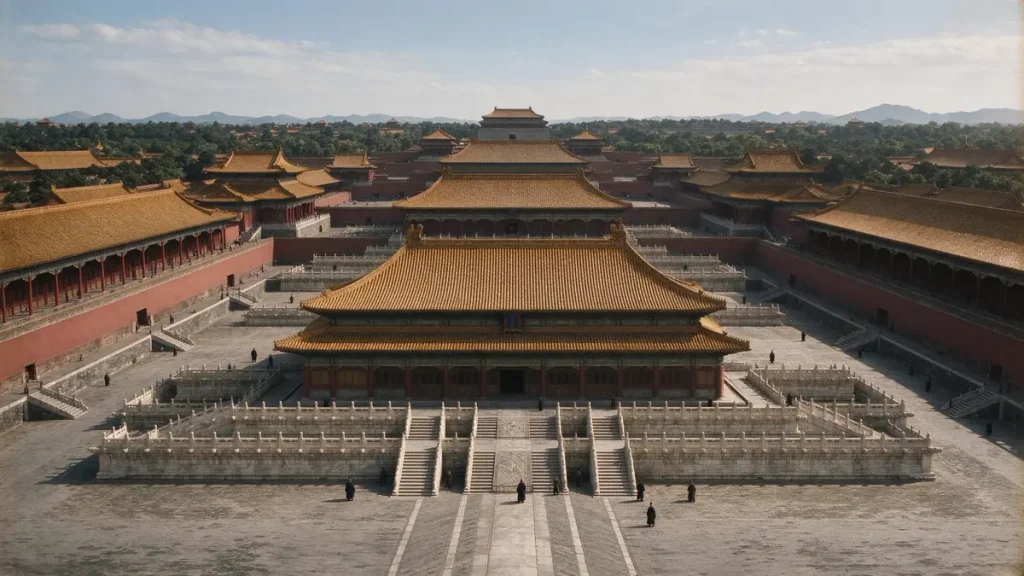
Three months later lightning set the three great halls on fire, and the Fengtian, Huagai and Jinshen halls burned through the night. The palaces at Beijing were never properly rebuilt after that. Hongxi, on taking the throne, ordered the capital back to Nanjing and had every Beijing office prefixed with the words travelling court. Only in the eleventh month of 1441, when the Qianqing and Kunning palaces and the three halls had been rebuilt, did the court fix the capital at Beijing and drop the prefix. Twenty years separate the two dates. So “the Yongle emperor moved the capital” is a later summary. The emperor moved in 1421; the bureaucracy admitted it in 1441.
Three hundred and seventeen ships at Liujiagang
In the sixth month of 1405 Zheng He sailed from Liujiahe, near Suzhou. The fleet had 317 ships and 27,800 officers and men, including 62 great ships 44 zhang long and 18 wide. Forty-four zhang comes to about 140 meters in Ming feet. Columbus’s flagship was under 25. The History gives the voyage two purposes: the Yongle Emperor suspected that the Jianwen emperor had fled overseas and wanted him traced, and he also wanted to display arms in foreign lands and show China’s wealth. A missing man and a demonstration, handled in the same errand.
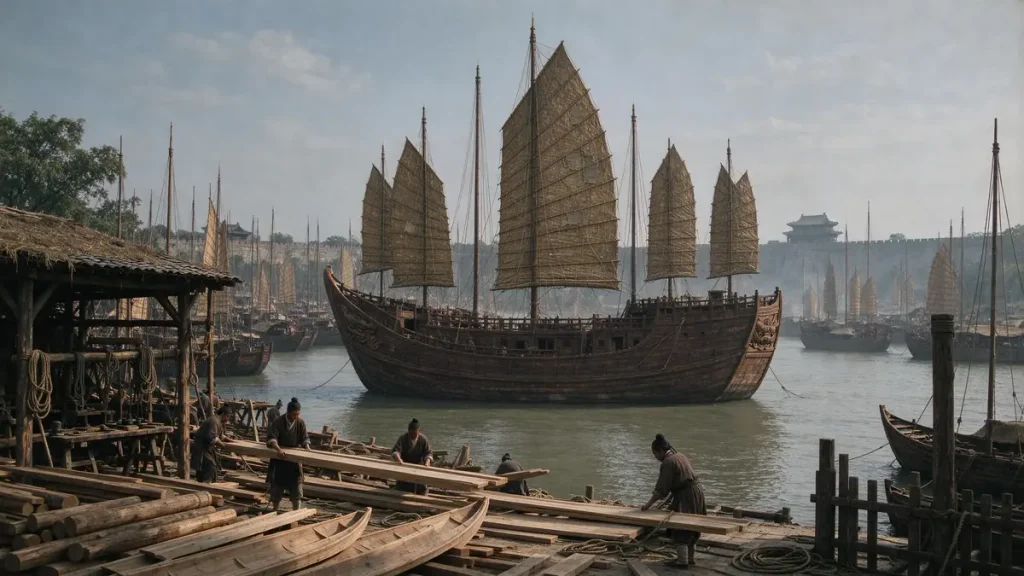
The seven voyages followed much the same route. They left from the Wuhumen anchorage in Fujian and went past Champa, Java, Palembang and Malacca, through the strait to Sumatra, Ceylon and Calicut. Then west to Hormuz and Aden, and at the farthest to Mogadishu and Brava on the East African coast. Malacca had belonged to Siam and paid forty taels of gold a year; in 1409 Zheng He conferred a seal and set up a stele there, and the port had a name of its own. The fleet built a depot at Malacca behind a palisade, with warehouses, and every ship coming back from the west gathered there to wait for the south wind in the middle of the fifth month. What the fleet carried out was edicts, seals, silk and porcelain. What it brought back was envoys and local produce. It left no governor and no garrison anywhere along the route.
Force was used too. On the return voyage of 1407 the fleet destroyed Chen Zuyi’s following at Palembang. In 1411 the ruler of Ceylon, Vira Alakeshwara, attacked the fleet. Zheng He took his capital and brought him to Nanjing, and the emperor sent him home again. In 1421 the voyages were suspended for a time. In 1424 the Yongle Emperor died, and the accession edict of Hongxi abolished the treasure fleets outright. In 1430 Zheng He sailed for the last time, and in 1433, on the return, he died at Calicut. Wang Jinghong brought the fleet home. No more treasure ships were built, and the docks at the Nanjing shipyard silted up.
Zheng He reached Calicut for the first time in 1407. Ninety years later, in May 1498, Vasco da Gama’s squadron anchored in the same harbor: four ships, about 170 men.
The edict that ended the voyages, 1424
In the eighth month of 1424 the Hongxi Emperor took the throne. His accession edict carried one sentence that stopped three things at once: abandon the treasure ships to the Western Ocean, the horse trade to the west, and the procurement in Yunnan and Jiaozhi. He was on the throne ten months and died at the Qin’an Hall in the fifth month of 1425, aged forty-eight. He had already ordered the capital moved back to Nanjing, and with his death the move lapsed.
The Xuande Emperor ruled for the ten years after him. Within a year of taking the throne his uncle, the Prince of Han Zhu Gaoxu, rose at Le’an, and the emperor campaigned in person and finished it in twenty days. After that he put his attention on the Grand Secretariat and on appointments. The Secretariat came into its own in those ten years. Yang Shiqi, Yang Rong and Yang Pu stayed in it for a long stretch and were known as the Three Yang. They drafted rescripts, deliberated policy and recommended men, and the documents of the Six Ministries went past them before reaching the throne. Yang Shiqi served from his appointment until his death in 1444, over forty years. Yang Rong knew the frontier and rode with several campaigns. Yang Pu had spent ten years in the imperial prison under Yongle and came out as minister of rites. The sentence quoted at the start of this article, about the weight of the Secretariat growing daily until it did the work of a grand chancellor, describes those ten years.
Abroad, the policy was retrenchment. Jiaozhi had been taken in 1407 by Zhang Fu and organized as a province with officials, garrisons and grain levies, and it rebelled for twenty years. In the tenth month of 1427 the commander Wang Tong abandoned the province, made a pact with Le Loi and withdrew; back at court he and his officers were imprisoned and sentenced to death. The Ming never posted officials in Vietnam again.
Later historians called the decade the Ren-Xuan interlude. The History says of the Hongxi Emperor that he was on the throne one year, and of the Xuande Emperor that officials fit their posts and the government kept its level. The blue-and-white of the Xuande reign used imported cobalt and came out dark; the bronze censers of the same reign used copper traded from Siam. What antique dealers mean by “Xuande” today is those objects, not the man.
Tumu, eighth month of 1449
In the seventh month of 1449 Esen of the Oirat came in by four routes, and Datong, Xuanfu, Liaodong and Ganzhou all sent alarms at once. On the eleventh day the Zhengtong Emperor ordered a personal campaign. Wang Zhi, the minister of personnel, led the officials in protest and was not heard. The army left through the Juyong Pass that month with the eunuch Wang Zhen in train and the vice minister of war, Yu Qian, left behind in charge of the capital. Wang Zhen came from Yuzhou and had served the emperor in the Eastern Palace when he was heir; after the accession he ran the Directorate of Ceremonial. The emperor called him master. The dukes and marquises called him father-in-law.
In the early eighth month the vanguard was destroyed at Yanghe and then at Yaorling. Zhu Yong, the Duke of Chengguo, and Xue Shou, the Count of Yongshun, went to relieve Yanghe, ran into an ambush at Yaorling, and were wiped out. On the thirteenth the army fell back on Tumu; the next day it broke. The History records that the dead numbered several hundred thousand. Zhang Fu, the Duke of Yingguo, who was seventy-five and had served four reigns, Chen Ying, the Marquis of Taining, and dozens of senior commanders were killed. The emperor was taken.
Word reached Beijing and the officials wept in open court. The expositor Xu Cheng proposed moving the capital south; Yu Qian, the vice minister of war, said no. The empress dowager put the Prince of Cheng in charge of the government, and in the ninth month he took the throne as the Jingtai Emperor, with the captive named retired emperor. In the tenth month Esen broke through the Zijing Pass and came up to Beijing. Yu Qian mustered 220,000 men and arrayed them outside the nine gates, taking the Desheng Gate himself with Shi Heng. His order was blunt: a commander who pulled back without his troops would lose his head, and troops who pulled back without their commander would lose theirs. When Esen attacked the Desheng Gate, Yu Qian set an ambush in the empty houses, sent cavalry out to draw the attack, and when ten thousand horsemen were inside the trap opened fire. Esen’s brother Bolod and the commander Mao Naihai were killed by cannon.
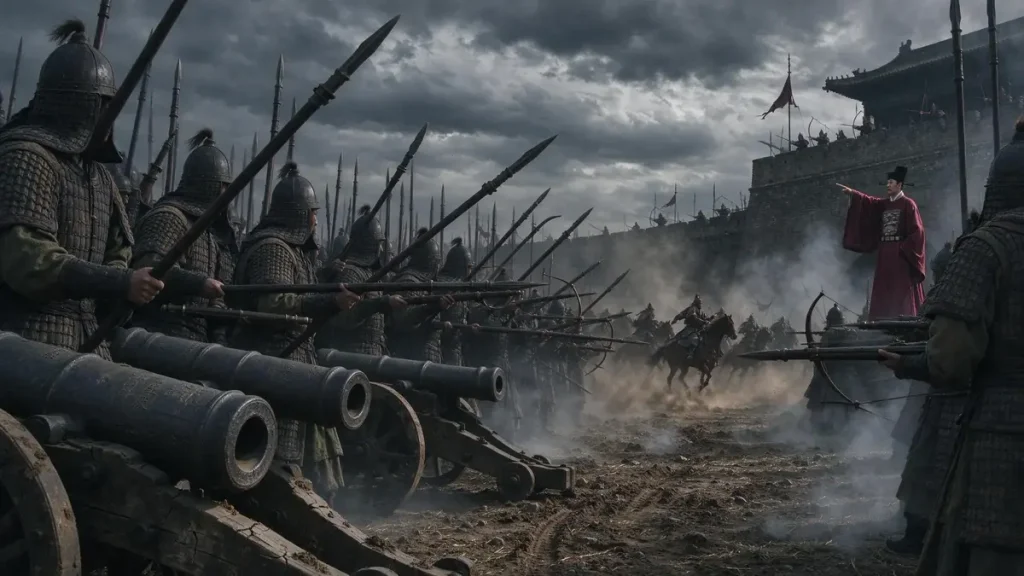
Five days later Esen withdrew. He went home, quarreled with his own khan, killed him, took the title, and was killed two years later in the upheaval that followed. On the Ming side the best of the capital army was spent in that fight, and strategy toward the steppe turned defensive from then on, with the border walls and the Nine Garrisons carrying more weight every year.
The Zhengtong Emperor spent a year in the north. In the eighth month of 1450 Esen sent him back, and he was lodged in the Southern Palace. In the first month of 1457 Shi Heng, Xu Youzhen and Cao Jixiang broke the gate of the Southern Palace open and put him back on the throne. A few days later Yu Qian was executed outside the Chongwen Gate. The History records that on the day he died the sky closed over and the empire knew an injustice had been done. The confiscation of his property found no savings; one room was locked and barred, and inside were only the python robes and the swords the emperor had given him.
The Jingtai Emperor was reduced to his old title of Prince of Cheng and given the posthumous name Li, meaning perverse, and buried in the western hills with his tomb demolished. The Zhengtong Emperor, restored, reigned twenty-four years in all and died in the first month of 1464, aged thirty-eight. His will carried one line worth keeping: the burial of palace women with the dead emperor was abolished. The practice had run from the first emperor to that year.
From Shanhaiguan to Jiayuguan: 8,851 kilometers
The brick facing, the crenellations and the hollow watchtowers that visitors photograph at Badaling and Mutianyu were almost all built in the middle and late stretch of Ming dynasty history. In 2009 the State Administration of Cultural Heritage and the State Bureau of Surveying and Mapping published the total length of the Ming wall: 8,851.8 kilometers, from Hushan in Liaoning in the east to Jiayuguan in Gansu in the west. The order in which it was built followed the order of the fighting. The Nine Garrisons were Liaodong, Jizhou, Xuanfu, Datong, Shanxi, Yansui, Ningxia, Guyuan and Gansu, each responsible for a stretch of wall running from the Yalu River to the Hexi Corridor. Under Hongwu the passes came first: Xu Da built Shanhaiguan in 1381 and Jiayuguan in 1372. Under Chenghua, Yu Zijun built the Yansui wall and linked the beacon towers around Yulin into a line. Under Jiajing and Wanli the important stretches were faced in brick, and Qi Jiguang built 1,200 hollow watchtowers in the Jizhou sector, each with men, grain and guns inside.
The Qin wall and the Ming wall are not the same line. The Qin wall ran through the Yin Mountains, was rammed out of earth, and today is mostly a ridge in the grass. The Ming wall pulled back several hundred li to the south and put the line along the ridges of the Yan and Taihang mountains. Between the two lie stretches built under the Han, the Northern Wei, the Northern Qi, the Sui and the Jin. What the wall stopped was large bodies of cavalry. In 1550 Altan broke through at Gubeikou, came up to the walls of Beijing, and withdrew after eight days. In April 1644 the gate at Shanhaiguan was opened from the inside.
An emperor without a son, 1521
In the third month of 1521 the Zhengde Emperor died at the Leopard House, aged thirty-one, without a son. Everything that happened, he said at the end, was his own fault, and none of them could have prevented it. He had reigned sixteen years and liked war. In the ninth month of 1517, at Yanghe, he styled himself “supreme commander of military affairs, fierce great general and commander-in-chief”, and took the name Zhu Shou. His later edicts went out under that title, with the dukedom of Zhenguo and 5,000 shi of grain a year attached to it.
The throne passed to Zhu Houcong, son of the Prince of Xing, from Anlu in Huguang. He was fifteen and a cousin of the dead emperor. The Ministry of Rites proposed to bring him into the palace with the ceremonies for an heir apparent, and he refused, saying that he had come to be emperor and not to be heir. In the end he entered by the Great Ming Gate and took the throne in the Fengtian Hall. The quarrel then moved to names. He wanted his dead father, the Prince of Xing, raised to emperor and called imperial father, and the Hongzhi Emperor demoted to imperial uncle. Yang Tinghe’s Grand Secretariat and most of the court opposed it; Zhang Cong and Gui E supported him. In the seventh month of 1524 more than two hundred officials knelt outside the Zuo Shun Gate and wept, shaking the gate and filling the courtyard with the noise. The emperor sent the Embroidered Uniform Guard. A hundred and thirty-four were imprisoned, officials below the fifth rank were flogged outside the Wu Gate, and sixteen died under the rods.
That fixed the tone of the reign: emperor and civil officials did not trust each other. In the tenth month of 1542 a group of palace women tried to strangle him with a cord while he slept. The knot was tied wrong, he did not die, and one of them ran to tell the empress. The women were executed, and Consort Duan of the Cao family and Consort Ning of the Wang family were sliced to death in the marketplace. He moved out of the Qianqing Palace into the Western Park and for more than twenty years seldom came back.
The government fell to Yan Song. He entered the Grand Secretariat in 1542 and was dismissed in 1562, holding the office twenty years. His son Yan Shifan collected money outside the palace, and father and son read every draft rescript and every appointment between them. In 1562 the censor Zou Yinglong impeached the son; Yan Song was dismissed, the son imprisoned and executed three years later.
The fighting outside went on at the same time. In the north, Altan came up to Beijing in 1550 in what is called the Gengxu incident. In the southeast the wokou landed year after year from 1552, and in the worst year Jiangsu and Zhejiang were both alarmed at once. Qi Jiguang recruited in Yiwu and formed the Qi family army, won nine engagements at Taizhou in 1561, and went into Fujian the next year and broke the pirate nest at Hengyu.
A different set of foreigners came by sea. In 1557 the Portuguese built sheds at Macao on the pretext of drying goods, and afterward paid 500 taels a year in rent to Xiangshan county. Macao became the first long-term European foothold in East Asia.
In the second month of 1566 Hai Rui, a secretary in the Ministry of Revenue, sent up a memorial saying that the empire had long since judged the emperor unworthy. He bought a coffin, handed his family to a friend and submitted it. The emperor put him in the Guard’s prison and did not kill him. In the twelfth month the emperor fell ill, came back from the Western Park to the Qianqing Palace and died the same day, aged sixty. Hai Rui was released only after the Longqing Emperor took the throne.
The year Yuegang opened
In 1567 the grand coordinator of Fujian, Tu Zemin, asked for the maritime ban to be lifted and trade to the Eastern and Western Oceans permitted. The court agreed, but opened one port only: Yuegang in Zhangzhou, with a tax office to collect the duties. A ship needed a pass listing the ship’s owner, the owner of the cargo, the size of the crew and the destination, and the pass was checked on return, with a tonnage duty and a duty on the value of the goods. A ban that had run for nearly two centuries was loosened by one gap.
The ban had begun in 1371. For two hundred years the coastal trade never stopped; it only moved from official ships to private ones. The wokou bands of the Jiajing years included Japanese ronin and also Chinese merchants and fishermen. The court finally conceded that it could not close the coast, and Yuegang was the result.
The timing was good. In 1572 the Spanish built Manila on Luzon, and galleons began running between Manila and Acapulco. Silver from Potosi in the Americas and from Iwami in Japan came into China by two routes, one through Manila in exchange for silk and porcelain and one through Nagasaki in exchange for raw silk. Scholars estimate that tens of millions of pesos came in by those two routes between the end of the sixteenth century and the middle of the seventeenth.
Silver became the currency of account, and China mined very little of it. Once land tax, labor service and commercial duty were all commuted into silver, a squeeze in the money supply hit grain prices, tax burdens and soldiers’ pay at the same time. That bill came due under Chongzhen.
The accounts Zhang Juzheng inherited, 1572
The Longqing Emperor died in the fifth month of 1572, aged thirty-six. In the sixth month the nine-year-old Zhu Yijun took the throne, and six days later the senior grand secretary Gao Gong was dismissed. Zhang Juzheng took his place. With the eunuch Feng Bao of the Directorate of Ceremonial holding the inside of the palace and Zhang holding the outside, the two of them ran the government for ten years. The first thing he did was set deadlines. In 1573 he introduced the examination of achievements: every task was entered in a register with a time limit, in three copies, one kept by the office concerned, one sent to the Six Offices of Scrutiny and one to the Grand Secretariat. Anything unfinished at the deadline was treated as dereliction. From then on, the History says, nothing dared be glossed over.
In 1577 his father died at Jiangling and custom required him to go home for twenty-seven months of mourning. He refused to go, and the court called the arrangement seizing back for service. The Hanlin officials Wu Zhongxing and Zhao Yongxian, the vice director Ai Mu and the secretary Shen Sixiao protested and were dragged outside the Wu Gate and flogged. The jinshi Zou Yuanbiao protested next and was sent to the frontier.
The second measure was the land survey, pressed nationwide from about 1580. The third was the Single Whip. The History’s treatise on finance gives the method. The tax and labor service of a county were consolidated, land measured and adults counted, grain and service alike paid to the state. Everything was assessed per mu and collected in silver, handled by the officials, which is why it was called the Single Whip. The method had been tried in a few southern provinces under Jiajing, on and off, and only now went national. Taken together, the three measures reconciled people, land and assessment, and converted goods and labor into silver.
The effect showed in the accounts. The reserves at the Taicang treasury went from deficit to surplus, and the granaries at the capital held several years of grain. Zhang Juzheng died in the sixth month of 1582, when the treasury was fuller than at any other point in the second half of Ming dynasty history. The year after his death the confiscation came: 10,000 taels of gold, over 100,000 of silver. His eldest son Zhang Jingxiu, a secretary in the Ministry of Rites, could not stand the interrogation, confessed falsely to having lodged 300,000 taels with other families, and hanged himself.
What he had put aside went into three wars. Between 1592 and 1600 the Ming fought at Ningxia against Bohai, in Korea against Japan, and at Bozhou against the native chieftain Yang Yinglong; the three are known as the three great campaigns. The Ministry of Revenue’s accounts: 1.8 million taels for Ningxia, 7.8 million for Korea, 2 million for Bozhou. The Korean war lasted seven years. Toyotomi Hideyoshi’s army landed at Busan in 1592 and withdrew in 1598, and the Ming sent two expeditions. Bozhou was left until 1599 and settled in 1600.
After 1586, little news came out of the palace
In 1586 the eldest son, Zhu Changluo, was five. His mother was a palace woman named Wang. That same year Consort Zheng gave birth to Zhu Changxun. The officials asked for the eldest to be made heir, and the emperor said nothing. The argument ran fifteen years and is called the succession dispute. In 1593 the emperor tried a way out: enfeoff all three sons as princes, name no heir, and wait to see whether the empress produced a son. The court objected and the plan was withdrawn. In the tenth month of 1601 Zhu Changluo was finally made heir apparent, aged twenty.
Around the same time memorials began to be left in the palace. In the twelfth month of 1589 Luo Yuren, a judge of the Court of Judicial Review, sent up four admonitions on wine, women, wealth and temper, in language that spared nothing, and the emperor kept the document and did not answer it. Keeping became normal after that, and vacancies in the Six Ministries, the Censorate and the provincial governorships went unfilled for years. In 1603 the Ministry of Personnel reported that prefectures had no prefects and got no answer. In 1604 the grand secretaries asked for the posts to be filled and censors sent out, and got no answer either.
From 1596 the mining and tax eunuchs spread through the provinces. The cause was money: the three campaigns and the fire in the three halls had emptied the Ministry of Revenue, and the emperor sent eunuchs out as mining supervisors and tax commissioners to collect directly from the localities. Extortion, levies and denunciations followed them, and riots broke out at Linqing, Wuchang, Suzhou and in Yunnan. At Suzhou the weavers, led by Ge Cheng, surrounded the tax office.
A good many books were printed in these same decades. Li Shizhen began the Compendium of Materia Medica in 1552 and worked on it for twenty-seven years, listing 1,892 drugs, and it was printed at Nanjing in 1596. Journey to the West, in a hundred chapters, came out from the Shidetang press at Nanjing in 1592. The texts of Romance of the Three Kingdoms and Water Margin read today descend from editions cut in the Jiajing and Wanli years.
In the fifth month of 1615 a man named Zhang Cha got into the Ciqing Palace with a jujube-wood staff, injured the eunuch at the gate and was caught. The interrogation led to two eunuchs in Consort Zheng’s palace, and the case closed on a finding of madness: Zhang Cha was sliced to death and the two eunuchs were quietly killed inside the palace. This is the staff case.
The northeast changed in the same period. In 1616 Nurhaci proclaimed himself khan at Hetu Ala under the name Jin, which historians call the Later Jin; the name Qing came in 1636. In 1618 he issued seven grievances and took Fushun. In the second month of 1619 the Ming sent four columns to converge on Sarhu, and three were destroyed. The History counts the dead: over 310 civil and military officers, and over 45,800 soldiers. In the seventh month of 1620 the emperor died, aged fifty-eight, after forty-eight years on the throne, the longest reign in Ming dynasty history. A censor had written late in the reign that the emperor lived in seclusion for more than twenty years without once receiving a minister. Later writers turned the figure into thirty.
The sound of saws in the Qianqing Palace, 1627
In the eighth month of 1620 Zhu Changluo took the throne with the reign title Taichang. A month later he died in the Qianqing Palace, aged thirty-nine. Before the end an official of the Court of State Ceremonial, Li Kezhuo, offered him red pills, and he took two in succession. This is the red pill case. He was followed by Zhu Youxiao, sixteen years old, reign title Tianqi. The boy’s wet nurse, Madam Ke, and the eunuch Wei Zhongxian made common cause; the inner court was theirs, and the outer court belonged first to the Donglin and then to the eunuch faction. The Donglin Academy had been restored at Wuxi in 1604 by Gu Xiancheng and others, and its lectures turned into commentary on the government, which is where the name Donglin party comes from. In the sixth month of 1624 Yang Lian impeached Wei on twenty-four counts and was dismissed. In 1625 Yang Lian, Zuo Guangdou, Wei Dazhong, Yuan Huazhong, Zhou Chaorui and Gu Dazhang died in prison.
Liaodong collapsed in those years. In the third month of 1621 the Later Jin took Shenyang and Liaoyang and the regional commander Yuan Yingtai died. In 1622 Guangning was lost and Wang Huazhen and Xiong Tingbi were imprisoned. Sun Chengzong took command at Shanhaiguan and built the Ningyuan and Jinzhou line. In the first month of 1626 the Later Jin besieged Ningyuan, Yuan Chonghuan held it, and the siege was lifted: the first time a Ming army had held a city against them. In the eighth month of that year Nurhaci died.
The emperor liked carpentry. The History’s chapter on eunuchs says he was clever with his hands and loved saws, planes and lacquer work, and never tired of it. Whenever he was stretching a line or marking a cut, Wei Zhongxian and the others would bring him state papers. Annoyed, the emperor would say: I have seen it all, you people handle it. That is how Wei came to run everything. In the eighth month of 1627 the Tianqi Emperor died, aged twenty-three, without a son, and his brother, the Prince of Xin, Zhu Youjian, took the throne.
March 19, 1644
Zhu Youjian was seventeen when he took the throne and the reign title Chongzhen. The last seventeen years of Ming dynasty history were his. Two months into the reign Wei Zhongxian was sent to Fengyang and hanged himself at Fucheng on the way. In the first month of 1629 the case against him was settled in six grades of guilt. What the court ran into first was money. At the end of Wanli the Nine Garrisons cost 2.8 million taels a year. Under Chongzhen the Liaodong surcharge was raised to 9 million, the suppression surcharge stood at 3.3 million and the training surcharge at over 7.3 million. The censor Hao Jin did the arithmetic in a memorial and said that no dynasty had ever squeezed 20 million taels out of a country in one year. The three levies were later called the three surtaxes. The other side of the ledger was silver. In the 1630s Japan closed its ports and Spain restricted the export of American silver, and the flow into China fell sharply. Silver grew dear and copper cash cheap, and a farmer who sold grain for cash to pay a tax assessed in silver needed more grain for the same assessment.
The weather did not help. In the early seventeenth century the northern hemisphere cooled in what is called the Little Ice Age, and northern China went into a long drought. From 1637 to 1643 the north China plain and the northwest had drought every year, with locusts and plague behind it. In the county gazetteers of Shaanxi, Henan and Shandong the same three characters keep appearing: people ate each other.
Liaodong turned over completely in this period. In the tenth month of 1629 Hong Taiji went around Mongolia, came in through the Xifengkou sector and appeared before Beijing. Yuan Chonghuan brought troops to relieve the city and was executed by slicing the next year. After that the Ming held only Ningyuan and Jinzhou outside the pass.
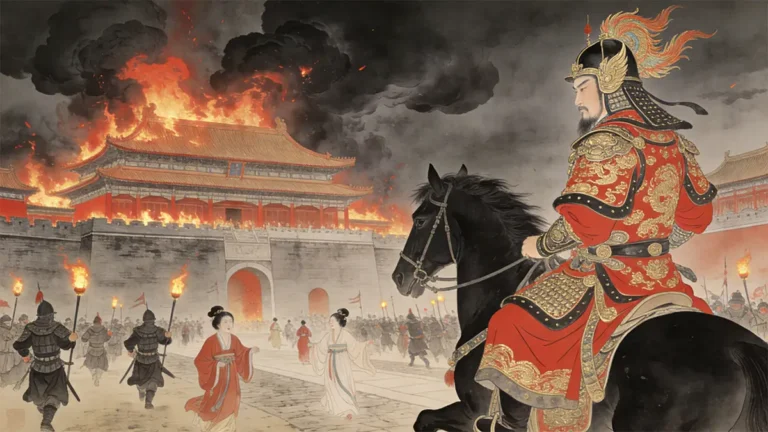
The starving in Shaanxi rose first. The risings began in 1628, and Li Zicheng, a post-station groom, was among them; in 1636 he was made Dashing King. His advisers wrote a slogan and had children sing it: welcome the Dashing King, no grain tax. In the first month of 1644 Li took the royal title at Xi’an under the name Dashun. In the second month he crossed the Yellow River into Shanxi. He took Changping on the sixteenth day of the third month, stood before Beijing on the seventeenth, broke the outer city on the eighteenth, and took the inner city at dawn on the nineteenth.
Before dawn that day Chongzhen hanged himself from a tree on Meishan, the hill north of the palace, and the eunuch Wang Chengen died with him. On the lapel of his robe he had written: “My virtue is slight and my person unworthy, and I have provoked the anger of Heaven, but it was my ministers who ruined me. In death I have no face to meet my ancestors, so I take off the crown and let my hair cover my face. Let the rebels divide my body as they like, but spare the common people.” The empress, of the Zhou family, had hanged herself first. Princess Changping had an arm cut off.
Wu Sangui was holding Shanhaiguan with the Guanning troops. He accepted Li’s offer of terms, set out for the capital, turned back on the way, reportedly after hearing that his father had been tortured for money and his household insulted, and asked Dorgon for help. On April 22 the Qing cavalry came onto the field at Yipianshi and Li’s army broke. On May 2 Dorgon entered Beijing and posted a notice to the empire in the name of avenging the sovereign.
After the fall of the Ming dynasty: Nanjing, Fuzhou, Zhaoqing
Word of the fall reached Nanjing, and in the fifth month the Prince of Fu, Zhu Yousong, took charge of the government and then the throne, with the reign title Hongguang. The first business at Nanjing was faction. Ma Shiying held the Ministry of War, Ruan Dacheng came back, and cases decades old were reopened to settle scores with the Donglin and the Restoration Society. Shi Kefa was pushed out to command at Yangzhou with very few troops. In the fourth month of 1645 the Qing besieged Yangzhou, the city fell and Shi Kefa died. In the fifth month Nanjing surrendered, Zhu Yousong fled to Wuhu, was taken, and was killed at Beijing the next year.
Three regimes followed. Longwu held Fuzhou, with the Prince of Tang, Zhu Yujian, from 1645 to 1646, and the troops belonged to Zheng Zhilong, who went over to the Qing; Longwu died at Tingzhou. Shaowu held Guangzhou for a few months. Yongli held Zhaoqing, with the Prince of Gui, Zhu Youlang, from 1646 to 1662, moving about the southwest for sixteen years before retreating into Burma. In April 1662 Wu Sangui had him strangled with a bowstring at Kunming.
One force remained on the coast. Zheng Chenggong, known in English as Koxinga, operated from Kinmen and Xiamen, went up the Yangtze in 1659 to besiege Nanjing and failed, and in the fourth month of 1661 crossed with 25,000 men, landed at Luermen and besieged Fort Zeelandia for nine months. On February 1, 1662, the Dutch East India Company garrison surrendered and left Taiwan. Zheng died in the fifth month of the same year, aged thirty-nine. His grandson Zheng Keshuang surrendered to the Qing in 1683, and Taiwan was incorporated into the Qing empire. The last regime still dating its documents by the Yongli calendar ended there.
The sixteen Ming dynasty emperors, in order
The editors of the History of the Ming wrote sixteen annals, one for each of the sixteen Ming dynasty emperors. The closing commentary on the last of them opens with a verdict: the Ming held the empire and passed it down through sixteen generations, and beyond Taizu and Chengzu, those worth calling good were Renzong, Xuanzong and Xiaozong. That is where the number sixteen comes from.
The reign title changed with each man, with one exception: Yingzong had two, Zhengtong and Tianshun, with the eight years of Jingtai between them. Two temple names were conferred by the Southern Ming, Jianwen’s Huizong and Jingtai’s Daizong; the History, following the dynasty’s own usage, calls them Gongmin and Jing. Chongzhen’s temple name was changed more than once by the Southern Ming, and the Qing gave him the posthumous title Zhuanglie Min; the History calls him Zhuanglie. Zhu Di was Taizong at his death and became Chengzu in 1538. The personal names have traps of their own. The Longqing Emperor’s name is written Zaiji in the History, and later writers often wrote it with a different character of similar shape, close enough to confuse the two.
| No. | Reign | Reign title | Temple name | Personal name | What he is known for |
|---|---|---|---|---|---|
| 1 | 1368–1398 | Hongwu | Taizu | Zhu Yuanzhang | Rose from a tenant household, drove out the Yuan, abolished the chancellorship, ruled the bureaucracy with severe law |
| 2 | 1398–1402 | Jianwen | Huizong (Southern Ming) | Zhu Yunwen | Cut the princes down and lost the civil war; disappeared when Nanjing fell |
| 3 | 1402–1424 | Yongle | Chengzu | Zhu Di | Took the throne by rebellion, moved the capital to Beijing, commissioned the Yongle Encyclopedia and the voyages to the Western Ocean |
| 4 | 1424–1425 | Hongxi | Renzong | Zhu Gaochi | Ten months on the throne, stopped the treasure fleets, failed to move the capital back |
| 5 | 1425–1435 | Xuande | Xuanzong | Zhu Zhanji | The Grand Secretariat gained weight, Jiaozhi was abandoned, the porcelain and bronze censers collectors still pay for |
| 6 | 1435–1449, 1457–1464 | Zhengtong, Tianshun | Yingzong | Zhu Qizhen | Captured at Tumu, restored in 1457, had Yu Qian killed |
| 7 | 1449–1457 | Jingtai | Daizong (Southern Ming) | Zhu Qiyu | Held Beijing, changed the heir, stripped of the title after death |
| 8 | 1464–1487 | Chenghua | Xianzong | Zhu Jianshen | Set up the Western Depot, doted on Consort Wan, doucai porcelain |
| 9 | 1487–1505 | Hongzhi | Xiaozong | Zhu Youtang | Diligent, and took only one empress |
| 10 | 1505–1521 | Zhengde | Wuzong | Zhu Houzhao | Made himself a general, died at the Leopard House without an heir |
| 11 | 1521–1567 | Jiajing | Shizong | Zhu Houcong | The Great Rites Controversy, withdrew to the Western Park, the wokou and the Gengxu raid |
| 12 | 1567–1572 | Longqing | Muzong | Zhu Zaiji | Opened a port, settled with Altan Khan |
| 13 | 1572–1620 | Wanli | Shenzong | Zhu Yijun | Zhang Juzheng’s reforms, three great campaigns, then years without receiving a minister |
| 14 | 1620 | Taichang | Guangzong | Zhu Changluo | Twenty-nine days, the red pill |
| 15 | 1620–1627 | Tianqi | Xizong | Zhu Youxiao | Carpentry, Wei Zhongxian |
| 16 | 1627–1644 | Chongzhen | Sizong (Southern Ming) | Zhu Youjian | Hardworking and suspicious, hanged himself on Meishan |
Yingzong holds one row for two reigns, so the sixteen rows are the sixteen Ming dynasty emperors. Only three of them reigned more than thirty years: Taizu thirty-one, Shizong forty-five, Shenzong forty-eight. Of the rest, the shortest ran twenty-nine days and the longest twenty-three years.
On the twenty-first of the third month Li’s soldiers moved the coffins of the emperor and empress to Changping. The people of Changping opened the tomb of Consort Tian and put the two coffins inside. After entering the pass the Qing reburied them with the proper rites and called the place Siling; Shunzhi and Qianlong both had it repaired, and it stayed the smallest of the thirteen tombs. The largest is Zhu Di’s Changling. The eleven between them, from Renzong to Tianqi, are all there. Three are missing: Zhu Yuanzhang lies at Nanjing, Jianwen has no tomb, and Jingtai lies at Jinshan in the western hills.
The underground palace at Siling was built for a concubine.
Sources and further reading
The History of the Ming (明史), the Qing compilation of 1739, is the narrative spine. The annals run from chapter 1 to 24; the chapters used here for institutions and biographies are 76 (offices and the Embroidered Uniform Guard), 78 (finance, the Single Whip, the three surtaxes), 141 (Fang Xiaoru), 147 (the rise of the Grand Secretariat), 170 (Yu Qian), 213 (Zhang Juzheng), 304 (Zheng He), 305 (Wei Zhongxian) and 309 (Li Zicheng). Full text at Wikisource: https://zh.wikisource.org/wiki/明史
The Imperial Ancestral Instructions (皇明祖训), 1395, for the clause abolishing the chancellorship.
The Veritable Records of Taizu (明太祖实录), chapter 165, for Zhang Wenfu’s count of 1,660 documents in eight days.
The Forbidden City’s own site, on the construction of the palace and the shift of the capital: https://www.dpm.org.cn
UNESCO’s listing of the Ming and Qing imperial tombs, for the thirteen tombs and the Xiaoling: https://whc.unesco.org/en/list/1004
Encyclopaedia Britannica, for the institutional outline of the Grand Secretariat and the Six Ministries: https://www.britannica.com/topic/Ming-dynasty
For the voyages, the account of Ma Huan, Yingya Shenglan (瀛涯胜览), and the navigation chart in chapter 240 of the Wubei Zhi.