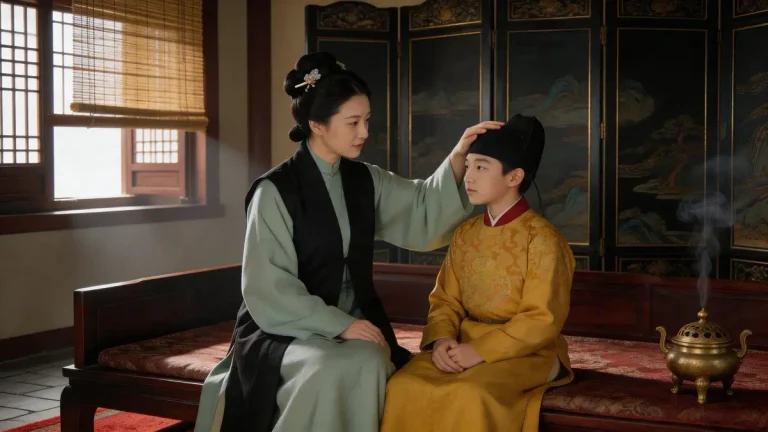
Ming Dynasty Grand Secretariat: How Clerks Ruled an Empire
In 1578 Zhang Juzheng left Beijing for Jiangling to bury his father. Before he had gone far, a note in the emperor’s own hand reached the Ming Grand Secretariat. Great matters were not to be settled by the second grand secretary. The papers were to go to Jiangling by post horse and wait on Mr. Zhang.
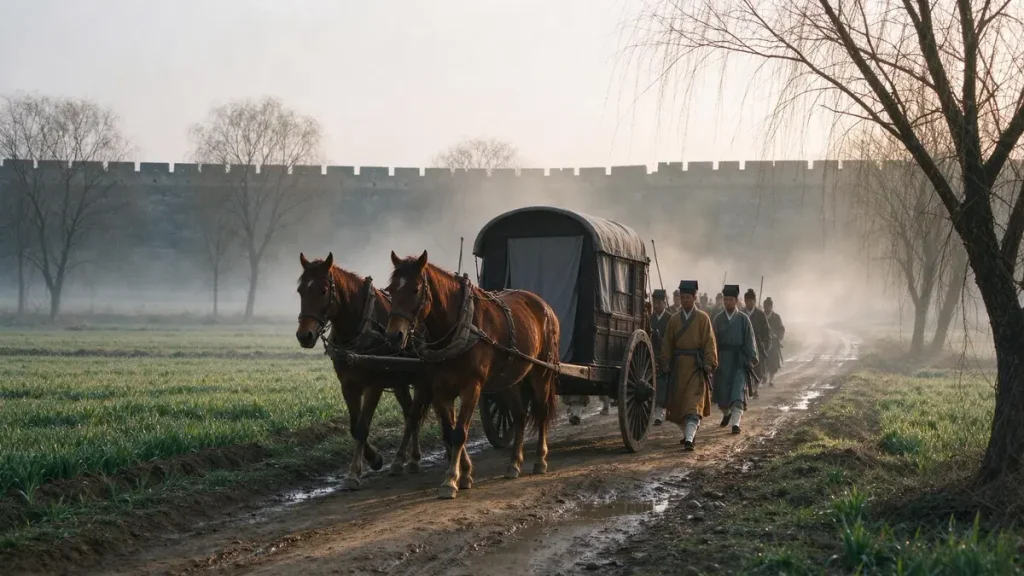
A man already on the road was still deciding for the empire. The letters called him Senior Grand Secretary, Junior Preceptor Zhang, and never by the title of his office.
The Grand Secretariat was fixed at six grand secretaries, and their rank was the fifth. A minister of the Six Ministries held the second rank in those same years. No other office in the dynasty was built this way.
Ran is too strong a word on its own. The Grand Secretariat had no subordinate offices, and by its own rules it commanded no ministry. It did one thing, which was to read memorials and draft the answers. Even the name was chosen to sound smaller than the work. The treatise on officials in the History of the Ming explains why the office was not called grand chancellor. The grand secretaries ate inside the palace and spent their days under the emperor’s halls and pavilions. So they avoided the name of chancellor, and the office was called the inner cabinet. The name was avoided. The work was not. By the Jiajing reign the same treatise says the office had become the real chancellorship in all but name, pressing down on the Six Ministers.
The first month of 1380
In the ninth month of 1379 a tribute mission from Champa reached Nanjing. The Central Secretariat did not report it. A eunuch who had been sent out of the palace saw the envoys and mentioned them on his return, and that is how Zhu Yuanzhang learned the mission had come.
He called in the left and right grand chancellors. Hu Weiyong and Wang Guangyang knelt and apologized, then pushed the fault onto the Ministry of Rites, which pushed it back to the Central Secretariat. Zhu Yuanzhang sent the officials involved to prison together. In the twelfth month Wang Guangyang was demoted and started south for Guangnan. At Taiping his boat was stopped and he was ordered to kill himself.
There had been an earlier matter. Hu Weiyong’s son was riding in the streets, fell from his carriage and died, and Hu had the driver killed. Zhu Yuanzhang told him a life was owed. Hu offered gold and silk to the family instead and was refused. The History of the Ming dates the conspiracy from this point. He began to talk with the censor-in-chief Chen Ning and the vice censor-in-chief Tu Jie. He sent men to the coast to bring in Japanese pirates, and letters to what was left of the Yuan forces asking for troops in support. In the first month of 1380 Tu Jie laid information against him. Zhu Yuanzhang had the court try the case, and the confession pulled in Chen Ning and Tu Jie himself. The court officials said something cold. Tu Jie had been part of the plan and turned informer only when he saw it would fail, so he could not be spared. The three were killed together. Five days later, on the guimao day, the Central Secretariat was abolished, and the office of grand chancellor with it.
The History of the Ming wrote a single eulogy for the three chancellors, in the biographies of Li Shanchang and Wang Guangyang, and it takes the measure of the change. At the founding the dynasty set up the Central Secretariat with left and right grand chancellors, and the men who sat there and did a chancellor’s work were three: Li Shanchang, Wang Guangyang, Hu Weiyong. After Hu Weiyong fell, the office of grand chancellor was abolished and never filled again. Three men held the title in the whole dynasty. Not one of them died at home.
Zhu Yuanzhang had been moving on the office for years before he abolished it. In the sixth month of 1377 he ordered that anyone with business for the throne could seal the document and send it straight to him. In the seventh month he created the Office of Transmission to take in memorials from inside and outside the capital. In the third month of 1378 he ordered that memorials need not pass through the Central Secretariat at all. By the first month of 1380 the entry point for paperwork had run around the chancellor for two and a half years.
In 1395 he wrote the arrangement into law. The edict to his officials began with the abolition and ended with a threat. None of his descendants was to discuss appointing a chancellor, and any official who petitioned for one was to be punished with death. The Imperial Ancestral Instructions of the same year were more exact. A man who asked for a chancellorship was to be cut to pieces, and his family killed. The Instructions were promulgated in the ninth month with a line added at the end: whoever said the ancestral institutions should be changed was to be treated as a traitor.
1,660 memorials in eight days
Four months after the abolition, with no Grand Secretariat yet in existence, a supervising secretary named Zhang Wenfu did the arithmetic. In eight days, by his count, 1,660 memorials from offices inside and outside the capital reached the throne, and they carried 3,391 separate items of business. Zhu Yuanzhang admitted the cost in an edict of his own. "I am one man, handling this much business. How could I get through all of it?"
In the ninth month of 1380 he tried a stopgap: four auxiliary administrators, filled by scholars such as Wang Ben, seated below the dukes, marquises and commanders, working in three ten-day rotations a month. The arrangement did not last.
In the eleventh month of 1382 he created grand secretaries of the halls and pavilions and gave the posts to Shao Zhi, Wu Bozong, Song Ne and Wu Chen. This is the office that became the Ming Grand Secretariat. The rank was set at the fifth. The job was described plainly in the same passage: "The grand secretaries merely attend at the emperor’s side and are available for consultation, and that is all." The passage goes on to say who actually read the papers: officials of the Hanlin Academy and of the heir apparent’s Spring Court read the memorials for the emperor, and the grand secretaries stood by to be asked.
Turning them into working officials was Zhu Di’s doing. After he took the throne in 1402 he picked Jie Jin, Hu Guang, Yang Rong and four others to serve in the Wenyuan Chamber and take part in policy. Yang Rong was the youngest of the seven. The treatise says the participation of grand secretaries in state business began here. The next line limits it. The men appointed were compilers, correctors and lecturers. The Grand Secretariat had no staff, could not direct any department, and departments submitting business did not report to it.
Rank came up a step at a time. On his accession the Renzong emperor promoted his old household men. Yang Shiqi became vice minister of rites with the Huagai Hall title, and Yang Rong chief of the Court of Imperial Sacrifices with the Jinshen Hall title. The treatise says the Grand Secretariat grew more honored from this point. The same paragraph also says that though a man sat in the Grand Secretariat, precedence went to whoever held a ministry. Under the Jingtai emperor Wang Wen came in from the Censorate by way of the Ministry of Personnel, and the order between the two began to reverse. After Jiajing, at court audiences, the Grand Secretariat stood ahead of the Six Ministries.
One career shows how fast the gap could close. Zhang Juzheng entered the Grand Secretariat as left vice minister of personnel with the title of grand secretary of the East Hall. The next year he was minister of rites and grand secretary of the Hall of Martial Valor. The History of the Ming notes the interval: barely a year had passed since he left the fifth-rank post of grand secretary.
A slip of paper and a line of red ink
A memorial moved by a fixed route. The Office of Transmission took it and sent it into the palace. The emperor read it and sent it back to the Grand Secretariat. The grand secretaries talked it over and wrote their recommendation on a separate slip, which was pasted to the face of the memorial. The emperor approved in red ink, or changed the wording, or let it lie. Approved papers went to the Six Offices of Scrutiny, were copied out, and passed to the Six Ministries.
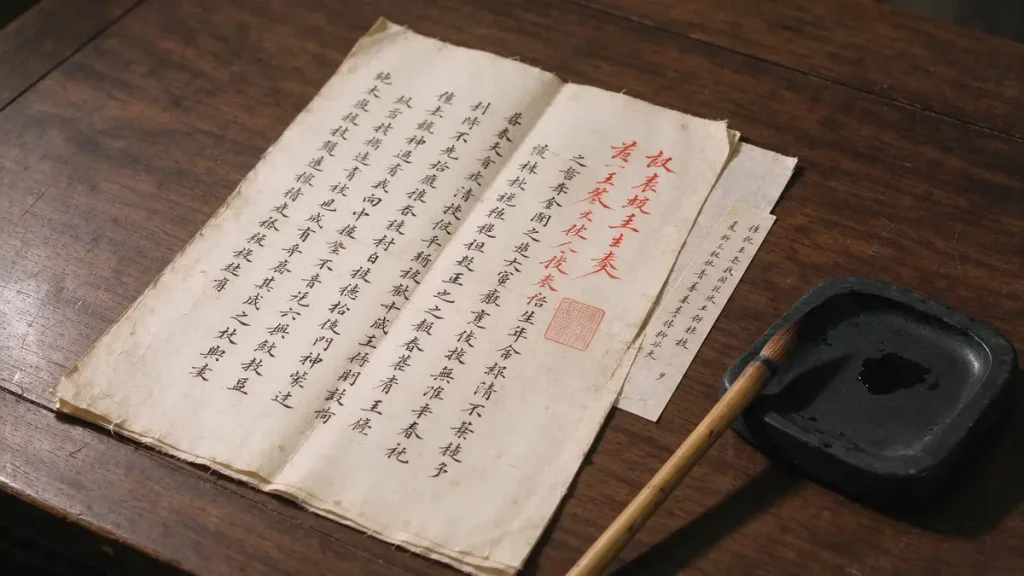
The draft was black and was called piaoni. The approval was red and was called pihong. Everything the office could do passed through those two steps. The treatise lists the duties of a grand secretary in a string of clauses, and the operative one comes last: to review the memorials and to draft the rescripts. The clauses before it are court ceremony. Only the last of them carries power.
Between the draft and the order sat the Six Offices of Scrutiny. A chief supervising secretary held the seventh rank and could return a document. When an edict was to be issued, great matters were reported back to the throne and small ones signed and sent out, and if something was wrong the paper was sealed and returned with an objection. If the Six Offices thought the emperor had approved a mistake, they could send the original back. A second rule covered oral orders. When a eunuch passed on an imperial order, the order had to be reported back, and only a second order allowed it to be carried out.
Three checks in a row. Read as a diagram, nobody in the chain could decide alone. It did not run that way. Influence moved with how closely the emperor watched. The preface to the table of grand secretaries says where the weight ended up. After the Renzong reign, grand secretaries collected the titles of minister, guardian and mentor and sat closer and closer to the throne. Edicts and verdicts all came out of the draft rescripts, and the weight of the office was the weight of a Han or Tang chancellor, except that it never carried the name.
When the emperor read the drafts, they were advice. When he stopped reading them, they were the decision.
After the burial of the empress dowager Zhangsheng in 1539, the Jiajing emperor stopped holding court. After the palace women tried to strangle him in 1542 he moved to the Wanshou Palace in the Western Park and did not come back to the inner palace. The biography of Yan Song records what that did to access. Ministers rarely saw the emperor. Only Yan Song was consulted, and sometimes several notes in the imperial hand came down in a single day, and even the men who shared the Grand Secretariat with him did not see them.
The Wanli reign ran the other way. In the twelfth month of 1589 Luo Yuren sent up four admonitions on wine, women, wealth and temper. From then on, the History says, memorials began to be held in the palace. Held meant neither approved nor returned. By 1612 the censors of the Nanjing circuits wrote that the offices stood empty and business was rotting, and that the emperor had sat in seclusion for more than twenty years without receiving a minister. The memorial went up and drew no answer.
The red brush in the Directorate of Ceremonial
The red end of the process belonged to the Directorate of Ceremonial. Its establishment, as the treatise gives it, was one eunuch director of the seal, with eunuchs of the brush and eunuchs of the hall in no fixed number. The director of the seal handled memorials from within and outside the palace and the tallies laid before the throne. The eunuchs of the brush handled the documents, and copied the drafts of the Grand Secretariat in vermilion.
The words say copy. The brush eunuchs also changed wording, and they also sat on papers. The preface to the same treatise puts the arrangement in one sentence: the draft rescripts could not be settled without the red approval of the inner eunuchs, and so the weight of the chancellorship passed to palace servants. Discipline at court, and the careers of honest officials, turned over in their hands.
In 1572 the two sides worked together. Feng Bao held the Directorate of Ceremonial and supervised the Eastern Depot, and was bound closely to Zhang Juzheng, who led the Grand Secretariat. The History says Zhang had ability, but that the reason he was trusted with the government was that Feng Bao stood at his side. Feng Bao’s own manner is on record. At the Wanli emperor’s accession he went up and stood beside the throne without stepping down, and the whole court was startled. Later, when the emperor rewarded or punished anyone, nothing was carried out unless it came from Feng Bao’s mouth.
The inner court had limits as well. In 1572 Feng Bao tried to use the Wang Dachen case to pull in Gao Gong and coached the prisoner to say that Gao Gong had sent him to kill the emperor. At the joint interrogation Wang Dachen shouted that he had been promised wealth and rank and was now being tortured, and asked how he would even know Grand Secretary Gao. The Embroidered Uniform Guard, the imperial secret police, did not dare go on. Yang Bo, Ge Shouli and other senior officials spoke for Gao Gong, Zhang Juzheng put in a word with Feng Bao, and the case was dropped.
The Tianqi reign went the other direction. Wei Zhongxian was illiterate and by rule should never have entered the Directorate of Ceremonial. The History gives the reason in four characters: because of Madam Ke. Once he was inside, Gu Bingqian and Wei Guangwei in the Grand Secretariat acted as his men, and the outer court had its lists of five tigers, five leopards, ten dogs, ten children and forty grandchildren. In 1624 Yang Lian impeached him on twenty-four counts. Wei went to the emperor and wept, Madam Ke argued for him at his side, and the emperor was too muddled to tell one from the other. The next day the memorial came back with a sharp rebuke.
Emperors were not always kept in the dark. Jiajing, the History says, treated Yan Song with great courtesy and never quite believed him. Now and then he decided alone, or deliberately let the two sides differ, to keep them from joining forces.
Among the grand secretaries, the senior man counted most
Senior grand secretary was not an office. The Ming Grand Secretariat usually held several men, and the one who ranked first was called the senior grand secretary. There was no appointment procedure. Order of entry and the emperor’s confidence decided it. The preface to the table of grand secretaries says one line about the result: among the grand secretaries, the senior man counted most.
The first to make the chair steady was Yang Shiqi. He served in the Wenyuan Chamber from the Yongle reign. On the accession of Renzong he was made vice minister of rites with the Huagai Hall title. With Yang Rong and Jin Youzi he received a silver seal inscribed with the words "correct errors and mend faults", which let the three men send sealed memorials.
Renzong’s protection of him is on record in detail. Yang Shiqi reported that the Fuel Office had been ordered to collect 800,000 jin of dates, against a reduction issued a few days earlier. Renzong cut the order in half at once. Yang asked several times to end the practice of handing surplus army horses to civil offices to pasture, and heard nothing back. Some time later Renzong called him to the Sishan Gate and explained. He had not forgotten. He had heard that Lü Zhen and Li Qing disliked Yang, and he did not want him standing alone and taking the damage, so he would not abolish the practice on Yang’s word alone. Now he had grounds of his own. He brought out a memorial from the Shaanxi surveillance commissioner Chen Zhi arguing that the pasture scheme did not work, and told Yang to draft the edict.
Under Xuanzong the seven grand secretaries were down to three, Yang Shiqi, Yang Rong and Yang Pu. The Yingzong emperor was nine years old when he took the throne. Military and state business was reported to the grand empress dowager, who trusted the three men, and when something came up she sent palace messengers to the Grand Secretariat for an opinion and then decided. This is where the Grand Secretariat became the place decisions were made. The order of business, papers to the Grand Secretariat for a view and then to the dowager and the child emperor for a ruling, dates from these years.
The first years of the Zhengtong reign were well governed, and the three Yangs were the reason. Then the eunuch Wang Zhen began to put his hand into the outer court. After the grand empress dowager died, the History says, Wang Zhen’s power grew and he handed out favors and punishments as he pleased, and Yang Shiqi could not restrain him either.
Yang Shiqi’s last years were not good ones. His son Yang Ji killed men in the family’s home district. The censors memorialized together, and the court sealed the indictment and sent it to Yang to read. He pleaded age and illness and stayed home. The emperor sent an edict of comfort. He wept over it and could not rise from worry. He died in the third month of 1444, at eighty.
Twenty years in a plank hut at the Western Park
In the eighth month of 1542 Yan Song was appointed grand secretary of the Hall of Martial Valor, went on duty in the Wenyuan Chamber, and kept the Ministry of Rites. He was past sixty. The History records his routine: from morning to night he stayed in the plank hut at the Western Park, and never once went home to wash. The emperor concluded that he was diligent.
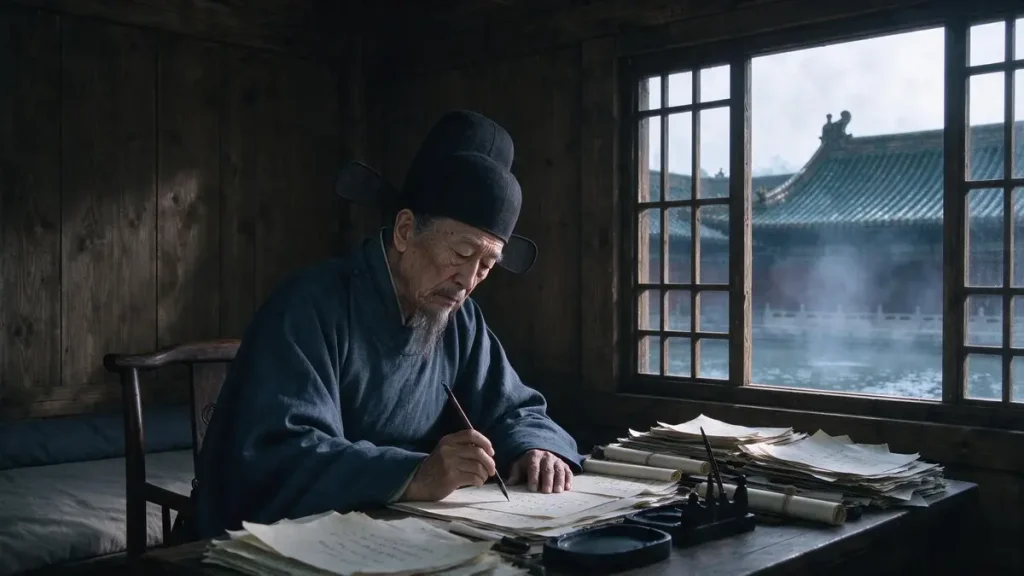
He had one man to get past first. When Xia Yan entered the Grand Secretariat, Yan Song held the Ministry of Rites, had passed the examinations in an earlier year, and sat lower. At the start he was extremely deferential. He set out wine and invited Xia Yan, went to the gate himself to welcome him, and when Xia declined to see him he spread a mat on the ground and read his own petition aloud on his knees. Xia Yan took him for genuinely submissive and did not guard against him.
The turn came over a hat. The emperor, who practiced Daoist cultivation, had five hats carved from aloeswood and gave them to Xia Yan and others. Xia Yan would not wear his. Yan Song wore his to an audience with a layer of gauze over it. The emperor saw it and drew closer to him. Later Yan Song used the argument over the Ordos to frame Xia Yan and the governor Zeng Xian, and both were executed in the market.
The judgment in his biography is short. Yan Song had no talent or strategy. He gave himself entirely to flattering the throne, stealing authority and trading influence. He did not kill in his own name. When Yang Jisheng impeached him, Yan attached Yang’s name to the end of the Zhang Jing case and had him killed with the rest. Officials he disliked were pushed out through transfers and performance reviews, and the History notes that none of it left a trace.
The offices were sold by his son. Court business, the record says, was all handed to Yan Shiyan, and the nine chief ministers could not get in to see him for ten days at a stretch. Yan Shiyan knew which posts were rich and which poor, which were hard and which dangerous, and how much each could bear in bribes, to the last hair.
In the fifth month of 1562 the censor Zou Yinglong memorialized at length against the father and son. Yan Song retired, went home by post horse, and was given a hundred shi of rice a year by the local office. The History sums him up in one line: "Yan Song usurped the government for twenty years."
Yan Shiyan did not get off so easily. The Nanjing censor Lin Run accused him of trading with Japanese pirates and of building a mansion on a prince’s scale. He was imprisoned, sentenced to beheading, and his property was seized: more than 30,000 ounces of gold and over two million ounces of silver. The verdict that killed him was rewritten by Xu Jie in his own hand. The judicial officers wanted to cite the Yang Jisheng and Shen Lian cases. Xu Jie asked whether they wanted the man to live. They said they wanted him dead. Xu Jie told them that written that way they would be saving him. In both of those cases Yan Song had got the emperor’s consent by careful stages, and to bring them up now would put the emperor’s own conduct on the record. The judges would be the ones in danger, and young Mr. Yan would ride out of the city gate. The charges were changed to piracy and the aura of kingship. Yan Song himself lived two years longer, eating at a tomb keeper’s lodge, and died there.
The emperor’s letters called him Mr. Zhang
Zhang Juzheng entered the Grand Secretariat in 1572. The Longqing emperor was gravely ill that year, and Zhang, working with the eunuch Feng Bao, drove Gao Gong out of the capital. On the day the edict was read out against Gao Gong, the History says, he lay on the ground and could not get up, and Zhang Juzheng lifted him and walked him out.
In the first years of Wanli, Zhang pushed through a system for auditing performance. Business that a ministry had passed down to a provincial governor or an inspecting censor was apt to sit unanswered. Zhang set deadlines by size and urgency and made a missed date punishable. From that point, the History says, no one dared gloss over a file, and the conduct of government tightened. On the fiscal side came the single whip. In each county the land tax and the labor service were combined, assessed on the acreage held and collected in silver, and in 1581 it was extended to the whole empire. The History describes his administration in one line: though the business were ten thousand li away, the order went down in the morning and was carried out by evening.
In those years the grain in the metropolitan granary could have fed the capital for ten years, and the Court of the Imperial Stud held more than four million ounces of silver. That was the ceiling of what a senior grand secretary could do.

Beyond the figures there was the rest of it. In 1577 his father died. By rule he should have withdrawn from office for mourning. He stayed, and the Hanlin officials and censors who objected were flogged at court and demoted one after another. The History records the mood: feeling ran high, fingers pointed at Zhang Juzheng, and libels were posted on the main streets.
In 1578 he went home for the burial. Local officials knelt along the road, and governors and censors crossed their jurisdictions to meet him and clear the way. Passing Xiangyang, the prince of Xiang came out of the city to wait for him and asked him to a banquet. By precedent a duke or marquis meeting a prince performed a subject’s rites. Zhang treated him as host and guest and left. The emperor gave him a silver seal reading "the emperor’s gift to a loyal and good man", and let him send sealed memorials. He also told the second grand secretary, Lü Diaoyang, that great matters were not to be settled without him: send them to Jiangling and let Mr. Zhang dispose of them.
When he fell ill the emperor had Zhang Siwei and the others handle routine business in the Grand Secretariat, and great matters were settled at Zhang’s house. When he could no longer read documents he still would not let Zhang Siwei into them.
He died in the sixth month of 1582, and was given the title pillar of state and the posthumous name Wenzhong. Half a year later Feng Bao was demoted and sent to Nanjing, and the seizure of his property produced more than a million ounces of gold and silver. After that the censors came back to Zhang Juzheng. The emperor sent the eunuch director Zhang Cheng and a vice minister, Qiu Shun, to Jingzhou to confiscate the family’s property. The local officials registered the household in advance and sealed the gates. When the gates were opened, a dozen people had starved. The seizure produced 10,000 ounces of gold and more than 100,000 ounces of silver. The eldest son, Zhang Jingxiu, could not bear the torture, confessed falsely to 300,000 ounces deposited elsewhere, and hanged himself. The edict stripped every title, took back the seals and the patents of four generations, published the charges, and said that by right the coffin should be opened and the body mutilated, but that this would be forgiven. His brothers and sons were sent to the malarial south as garrison soldiers. The eulogy in the History says that he held the levers of power almost to the point of overawing the throne, and that the disaster came after his death.
In the Tianqi years the court began to speak for him. His offices were restored and he was given a funeral and sacrifices. In 1640, at the request of his great-grandson Zhang Tongchang, Zhang Jingxiu’s rank was restored too.
The Central Secretariat, the Grand Secretariat and the Six Ministries
The table sets the Ming Grand Secretariat beside the two offices it is most often confused with, the Central Secretariat it replaced and the Six Ministries it never commanded.
| Central Secretariat, before 1380 | Grand Secretariat, after 1402 | Six Ministries | |
|---|---|---|---|
| Chief officer | left and right grand chancellors | no single head; six grand secretaries, the senior one leading | one minister in each |
| Rank | first rank | fifth rank | second rank |
| Source of authority | a statutory office charged with the whole of government | the emperor’s commission, and control of the drafting channel | statutory offices, each with its own portfolio |
| Core function | command the Six Ministries and direct policy | review memorials, draft rescripts, draft edicts | carry out orders and run their own offices |
| Power to command officials directly | yes; the Six Ministries answered to it | no staff, no command, and departments did not report to it | yes, within its own service |
The last row asks whether the office could order officials around. For the Grand Secretariat the answer was no, and it did not change between 1402 and 1644. What moved business was the brush that wrote for the emperor, and whether the emperor chose to use it.
One more office sits outside the table. The Six Offices of Scrutiny, whose chief secretaries held the seventh rank, controlled the return of documents. An edict leaving the palace passed through them, and a bad one could be sealed and sent back. That power was classed as surveillance rather than administration, and its holders ranked below the grand secretaries.
No statute ever described the power of the Grand Secretariat. It had no seal of its own and no staff, and what it could do on a given day depended on whose desk the memorials reached. The same establishment pressed down on the Six Ministries under Jiajing and took orders from the Directorate of Ceremonial under Tianqi. The difference was whether the emperor read the papers, and whether he saw people.
The Qing inherited the arrangement. In the Shunzhi reign the Three Inner Courts were renamed the Grand Secretariat and staffed much as under the Ming. Under the Yongzheng emperor, with war in the northwest, the Grand Council was created. Important military and state business went through the council, and the Grand Secretariat handled routine documents. The council had no fixed staff and no separate rank. Its men were picked by the emperor from among grand secretaries, ministers and vice ministers, and went back to their own posts when they left it.
In the fourth month of 1911 the Qing court created a responsible cabinet and abolished the Grand Council.
The treatise on officials states the rank of the Ming Grand Secretariat in four characters: all six titles carried the fifth rank. By 1644, not one word of that had been revised.
Sources and further reading
Primary sources
History of the Ming, juan 72, treatise on officials I: the six hall titles and the words all of them the fifth rank; the sentence on eating inside the palace and avoiding the name of chancellor; the 1402 appointment of Jie Jin and the others with its limit on command; the growth of rank under Renzong and the note that precedence went to a minister; the verdict that by Jiajing the office was the real chancellorship.
History of the Ming, juan 74, treatise on officials III: the establishment of the Directorate of Ceremonial, the phrase about copying the Grand Secretariat’s drafts in vermilion, and the rules of the Six Offices of Scrutiny on returning documents and on repeating a eunuch’s order.
History of the Ming, juan 109, table of grand secretaries, preface: the statement that edicts and verdicts all came from the draft rescripts, that the office carried the weight of a Han or Tang chancellor without the name, and that the senior man counted most.
History of the Ming, juan 2, annals of Taizu, part two: the order of 1377 that sealed memorials go straight to the throne, the creation of the Office of Transmission, the order of 1378 that memorials need not pass the Central Secretariat, and the executions and abolition five days apart in 1380.
History of the Ming, juan 3, annals of Taizu, part three: the creation of the grand secretaries of the halls and pavilions in 1382 and the edict and ancestral instruction of 1395 against any future chancellorship.
History of the Ming, juan 127, biographies of Li Shanchang and Wang Guangyang: the eulogy counting the three men who did a chancellor’s work in the whole dynasty, and Wang Guangyang’s death at Taiping.
History of the Ming, juan 148, biography of Yang Shiqi: the silver seal, the exchange at the Sishan Gate over the date levy and the horse pasture, the nine-year-old emperor and the grand empress dowager, Wang Zhen’s rise, and Yang’s son and his death in 1444.
History of the Ming, juan 213, biography of Zhang Juzheng: the year between the fifth rank and the ministry, the audit of performance, the line about orders carried out the same evening, the mourning dispute, the burial journey through Xiangyang, the emperor’s note to Lü Diaoyang, and the confiscation and its dead.
History of the Ming, juan 305, biographies of eunuchs: Feng Bao standing beside the throne, his partnership with Zhang Juzheng, the Wang Dachen interrogation, and Wei Zhongxian’s entry into the Directorate of Ceremonial and the audience of 1624.
History of the Ming, juan 308, biographies of Hu Weiyong and Yan Song: the Champa mission, the death of Hu’s son and the killing of the driver, the 1380 trial, Yan Song’s years in the plank hut, the aloeswood hats, the sale of offices through his son, the confiscation, and Xu Jie rewriting the verdict.
Veritable Records of Taizu (Ming Taizu Shilu), juan 165: the accounting by the supervising secretary Zhang Wenfu of 1,660 memorials and 3,391 items of business in eight days, and the emperor’s admission that he was one man handling that much business. Cited from the text; no open link is stable.
Imperial Ancestral Instructions (Huang Ming Zuxun): the clause sentencing to death by slicing any official who petitions for a chancellorship, and the closing warning against altering the ancestral institutions.
Official and reference works
Palace Museum, Beijing: the Office of Transmission: the function of the office created in 1377, which took in memorials from inside and outside the capital and moved the entry point for paperwork away from the chancellor.
Encyclopaedia Britannica, Ming dynasty: the abolition of the chancellorship in 1380, the Six Ministries reporting directly to the emperor, and the evolution of the Grand Secretariat out of the Hanlin Academy.
Wikipedia, Grand Secretariat: a summary account used only for cross-checking the sequence of offices, not as evidence for any quotation in this article.