The Tumu Crisis: An Emperor Captured 90 Miles from Beijing
On September 1, 1449, the Ming army at Tumu broke camp and started for the river. The Tumu Crisis had one morning left.
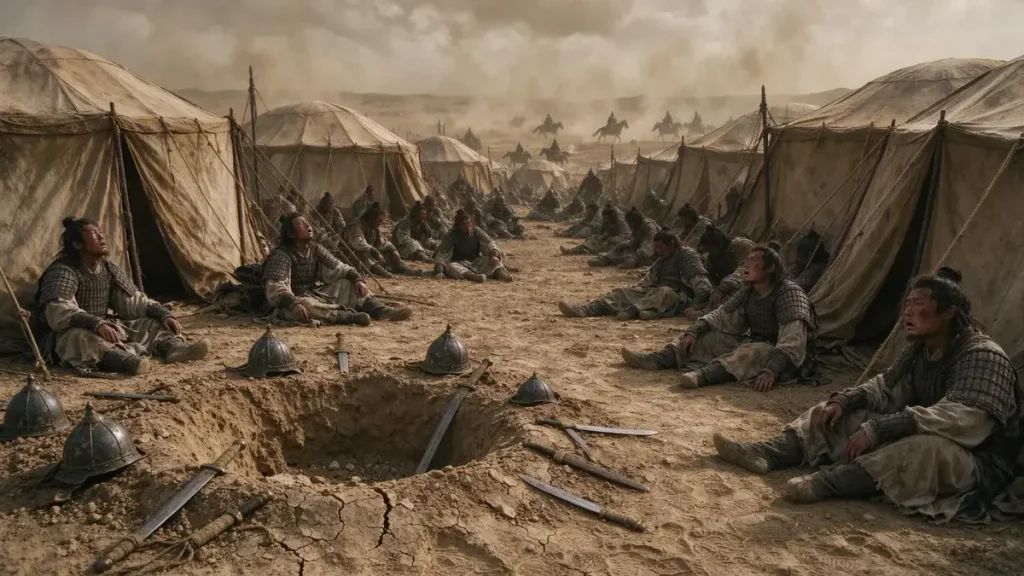
The ground there is high and dry, and the only water within reach lay south of the fort, on a road the Oirat horsemen had already closed. Men and horses had gone two days without a drink. The order to move came from Wang Zhen, the eunuch who had talked the emperor into this war.
The column came apart as soon as it started. The History of the Ming covers the next hour in a few dozen characters: the army had barely moved when Esen threw his cavalry at it from four sides, the ranks broke, and the enemy rode through the gaps.
Zhu Qizhen could not cut his way out. He was carried north with a eunuch named Xi Ning and a guards officer, Yuan Bin, who spent the next year with him on the steppe.
Tumu is about 90 miles from Beijing.
When the news reached the Oirat camp Esen refused to believe it; he had spent years raiding for grain, livestock and people and had never expected to pick up an emperor. The last Chinese emperor carried off by a steppe army had been taken in 1127, when the Jin marched Huizong and Qinzong north and ended the Northern Song. In Europe the last king taken on a battlefield was John II of France, captured at Poitiers in 1356 and shipped to London, where he died before his ransom was paid.
The Ming had almost nothing left to answer with. The capital’s armored cavalry had gone into the ground at Tumu, and fewer than 100,000 exhausted men remained. The trained core of the garrison, a stock of firearms and a whole generation of hereditary commanders had disappeared in one day.
A nine-year-old emperor and the eunuch who taught him to read
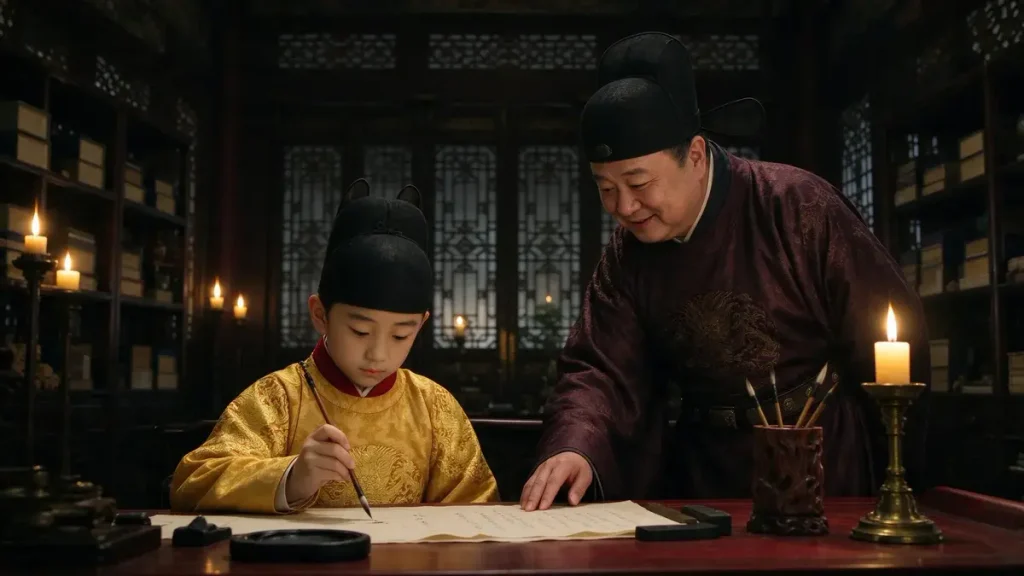
Xuande died in the first month of 1435 and his son Zhu Qizhen took the throne at nine. In the ninth month of the same year Wang Zhen was put in charge of the Directorate of Ceremonial. Wang came from Yuzhou, in the hills west of Beijing. He had been chosen as a boy for the Inner College, the palace school Xuande set up to teach young eunuchs to read, and was later assigned to the heir apparent’s household as a junior steward. It was a small post that happened to sit next to the future emperor.
The dynasty’s founder had tried to shut this door. He had a plaque fixed to a palace gate: eunuchs are not to take part in government, and those who do will be executed. The plaque did not stop the paperwork. Memorials entered through the Office of Transmission, passed to the Directorate of Ceremonial, and reached the throne from there, and an emperor facing that volume of paper every day needed someone to go through it first. Xuande had the boys taught by a Grand Secretary, Chen Shan, so they could read, write and handle documents. The chapter on eunuchs states the result without softening it: most of them came away able to read, knowing something of the past, and used the advantage to work on the man above them.
Once a eunuch could read a memorial aloud the emperor’s closest company changed. A general sat in a frontier garrison and saw him once a year; a Grand Secretary knelt outside the hall for a few words at the morning audience; the eunuch was there when the prince woke up. Zhu Qizhen called Wang Zhen Master. Dukes and marquises called him Father Weng.
For seven years Wang could not do as he liked. The Grand Empress Dowager Zhang was alive, and the Grand Secretariat held Yang Shiqi, Yang Rong and Yang Pu, with Zhang Fu, Duke of Ying, behind them. The History notes that although the emperor favored Wang Zhen, he never dared take over the government while she lived. She died in 1442. Yang Rong had been dead two years, Yang Shiqi had withdrawn after his son was jailed for murder, and Yang Pu was old and ill. The two new Grand Secretaries, Ma Yu and Cao Nai, carried no weight. The verdict on that year is five characters: he became overbearing, and could not be controlled.
What followed is set down in order. A mansion east of the palace. The Zhihua Temple, built at ruinous expense. A campaign in Luchuan that unsettled the southwest. Then the case of Liu Qiu, an expositor who used an earthquake as an occasion to submit criticism that stung Wang, and was thrown into prison, where the guard commander Ma Shun was told to tear him apart. Xue Xuan, a vice minister of justice, nearly died. Li Shimian, the head of the Imperial College, was put in a cangue at the college gate.
Two eunuchs and a guard soldier wrote an anonymous letter listing Wang’s crimes, were caught, and were cut to pieces in the marketplace. The History adds three characters: no report was made. He could kill without telling the emperor.
Three thousand envoys, one fifth of the price
The Oirats were a Mongol people living west of the Tatars. In 1439 Toghon died and his son Esen took his place, styling himself Grand Preceptor and Prince of Huai, and most of the northern tribes answered to him, while the nominal khan, Toghto-bukha, held a title and little else.
Ming and Oirat kept up a standing exchange that the Ming called tribute. Oirat missions brought horses and furs to Beijing; the court paid a reward for each man and a price for each horse, and sent back silk and paper money. By custom a mission ran to fifty men at most, but the rewards were generous enough that the missions grew to two thousand and then more, and edicts telling them to stop had no effect.
In 1448 a mission of three thousand arrived, with names invented to collect extra rations. The Ministry of Rites paid on the real count and granted about a fifth of what had been asked. The History records Esen’s reaction in three characters: he was shamed and furious. The chapter on Wang Zhen puts the bill on him instead, saying that when Esen sent horses as tribute Wang cut the price and the envoys went home angry.
Esen had been clearing his flanks for years. He took Hami and carried off its prince and the prince’s mother, then let them go. He married into the Shazhou and Chijin Mongol houses, broke the Uriyangkhad, and pressed on Korea. Frontier commanders saw a large war coming and sent up warnings, and the court answered with edicts to strengthen the defenses.
In the seventh month of 1449 he came in four columns. Toghto-bukha moved on Liaodong, a second column struck Xuanfu and put Chicheng under siege, a third raided Ganzhou, and Esen took the road to Datong, where the deputy commander Wu Hao was killed at Mao’er Zhuang. Song Ying, Marquis of Xining, and Zhu Mian, Earl of Wujin, met him at Yanghe with the Datong garrison; the eunuch Guo Jing was their overseer, the generals could not move without him, and the army was destroyed. Song and Zhu died. Guo Jing lay down in the grass and lived. Shi Heng, the commander, rode back.
Two hundred thousand men march out through Juyong Pass
Word of the Datong defeat reached the capital and Zhu Qizhen ordered a campaign in person. Wang Zhi, the minister of personnel, led the officials in protest and was not heard. Five days after the order the army left, with the emperor’s half-brother Zhu Qiyu left behind in charge.
The numbers never settled. The figure given out afterward was 500,000; people doubted it at the time, and modern estimates run near 200,000. Either way the supply arrangements were improvised, and the troops were short of grain before they reached Datong.
Wang Zhen drove the thing. Zhu Qizhen was twenty-two and had never been to war; his great-grandfather, the Yongle emperor, had led five campaigns into the steppe himself, and his father had taken the field too. Wang wanted a military record, the Luchuan campaign of 1441 having been his idea, and the History says he took the emperor with him on campaign, which settles who was in charge.
The march is recorded in fragments: at Longhutai the camp panicked in the night, the army passed Juyong Pass, and at Xuanfu the officials begged the emperor to stop there and were refused.
It rained at Xuanfu. Zhu Yong, Duke of Chengguo, and others who came to report crawled forward on their knees, and the ministers Kuang Ye and Wang Zuo, having said something Wang Zhen disliked, were made to kneel in the wet grass until dark. Peng Deqing, director of the Imperial Observatory, argued from the sky, and Wang cursed him: “What do you know of it? If it comes to that, it is the will of heaven.” Cao Nai said the officials’ lives meant nothing but that the emperor carried the realm on him. He was not heard.
At Datong the rain went on and the camp panicked again in the night, and Guo Jing, the eunuch in command there, told Wang the truth about the enemy, which frightened him enough to agree to turn back. The route then changed twice. The short way east ran through Zijing Pass, and Guo Deng, holding Datong, told Cao Nai and Zhang Yi that the pass lay only forty li off and the emperor should go that way. Wang refused. He wanted to take the emperor through Yuzhou and put him up at his own house for a night. Halfway there he worried that the army would trample the crops of his own district, and swung back to the Xuanfu road. The column lost days doubling about.
The cost came quickly. The rearguard under Wu Kezhong and Wu Keqin was destroyed; Zhu Yong and Xue Shou went after the enemy with 40,000 men, walked into an ambush at Yao’er Ridge, and lost the whole force. On the fourteenth of the month the army reached Tumu. Huailai was not far off, and the officials wanted to push on and hold the town. Wang refused, waiting for the baggage train. Esen caught up.
At Tumu, twenty feet down and no water
The ground at Tumu is high and has no spring. The History describes it in one line: they dug wells twenty feet deep and found no water, the enemy had cut them off from the river, the men were thirsty, and more horsemen kept arriving. For a day Esen did not attack, waiting for the army to come apart on its own. On the second morning he sent envoys to talk peace and drew his horsemen back a little. Zhu Qizhen had Cao Nai draft a reply, the envoys left, and Wang Zhen ordered the camp struck and the army moved toward the river. The History uses one word for the pullback: a feint. Moving 200,000 men is the hardest thing an army does, and once the ranks open, orders stop traveling. The front of the column was on the road while the rear was still taking down tents. A few li out, the horsemen came from every side.
More than fifty officers of rank were killed: Zhang Fu, Duke of Ying; the ministers Wang Zuo and Kuang Ye; the Grand Secretaries Cao Nai and Zhang Yi; the imperial son-in-law Jing Yuan; several marquises and earls; and a string of commanders. The day is known as the Tumu Crisis.
Zhang Fu was seventy-five. Between 1406 and 1416 he went to Annam four times and broke three rebellions there, and the Ming province of Jiaozhi was his work; the History says his name was feared abroad and that the Annamese feared no one else. He had served four reigns, and in the years when dukes and ministers bowed to the ground before Wang Zhen, Zhang Fu was the one who would not bow, and on this campaign Wang let him come and kept him away from the planning. The History spends eight characters on him: Fu was old, and said nothing.
Kuang Ye was sixty-five. Before the army left he had sent up a memorial arguing that one frontier general could handle Esen and that the emperor, as heir to the dynastic temple, should not risk himself. Nothing came of it. On the road he asked several times for the army to turn back, and Wang told him that a rotten scholar knew nothing of war and that the next man to speak would die. Kuang answered that he spoke for the realm and its people and had nothing to fear. Wang had him led out, and he and Wang Zuo wept at each other in the tent. He had fallen from his horse on the march and nearly died, and when people urged him to stay at Huailai for a doctor, he said the emperor was on the road and he could not plead illness and please himself.
Wang Zhen died in the rout. The chapter on eunuchs gives five characters: killed by the soldiers. Another account has a guards general named Fan Zhong stave in his head with a mace and shout that he was killing the man for the realm. That story is not in the History and comes from later narratives and notebooks. When Wang’s estate was seized it held sixty storehouses of gold and silver, a hundred jade dishes, and twenty-odd coral trees six or seven feet tall.
Zhu Qizhen could not break out. When Esen heard the emperor had arrived he did not believe it, and in person he was deferential, lodging him in the camp of his younger brother Bayan-Temur and sending in Yuan Bin, a guards officer taken earlier, to look after him. The History adds that Esen once considered doing him harm and that a thunderstorm killed the horse under him and strange lights showed over the emperor’s tent, so he let the idea go. That is a historian writing about a Son of Heaven, and the reader may take it or leave it. What is certain is that Esen worked out quickly that the man was worth more alive than dead.
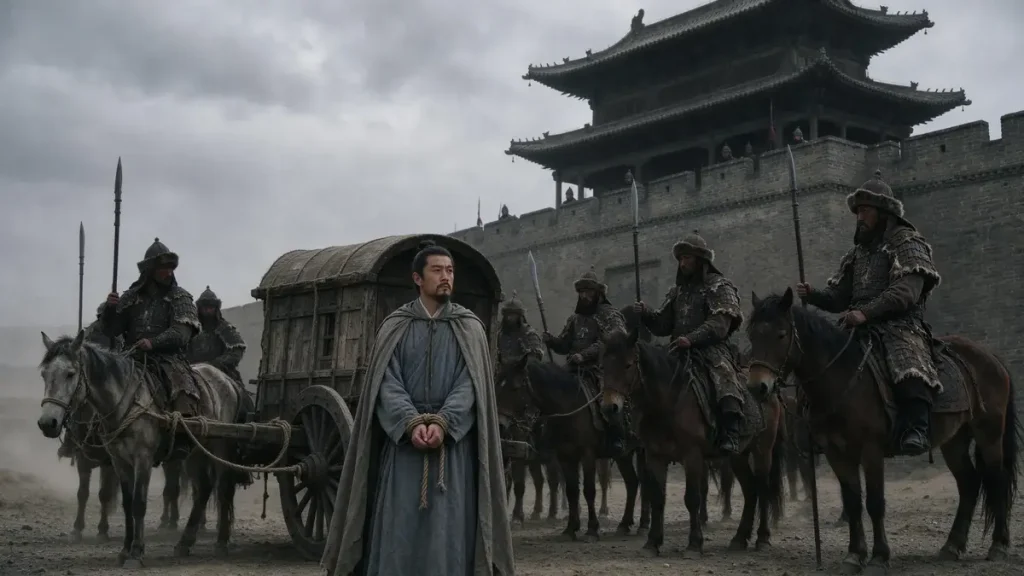
His method of cashing in was direct. He brought the emperor to the walls of Datong and asked for silver, and Guo Deng sent 30,000 taels. Guo also tried to pull the emperor back inside the city, and Zhu Qizhen himself refused. The History says only that the emperor blocked it. It does not say why.