Zhu Di (Yongle Emperor): The Reign That Shaped the Ming Dynasty
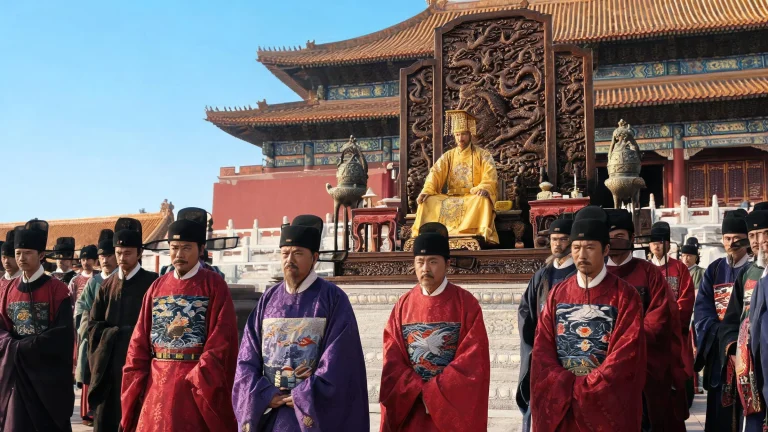
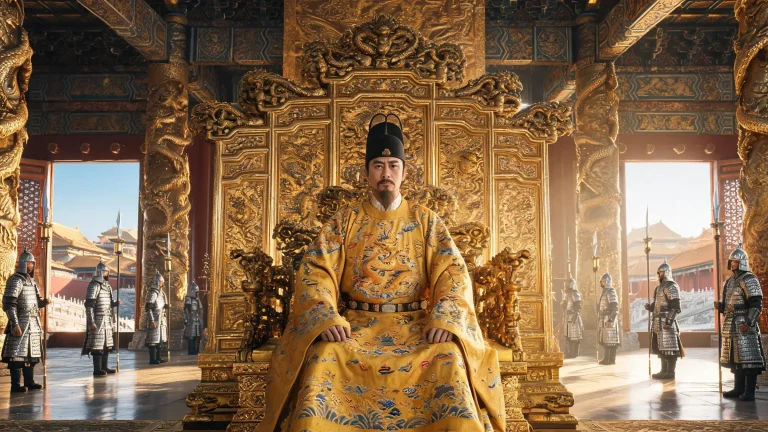
On the first day of the first month of 1421, the Yongle Emperor held his first full court in the Hall of Receiving Heaven in the new palace at Beijing. Officials stood in ranks below the terrace. Princes and foreign envoys had their places. The hall rang with the ritual cry of ten thousand years. It was the first New Year audience in the new capital, and fifteen years had passed since the emperor sent men into the mountains to cut timber for it.
Four months later, lightning struck the three great halls. The timber burned through the night, and by morning the center of the palace was ash.
The hall that visitors queue for in the Forbidden City today is a different building. The Hall of Supreme Harmony on the same terrace was rebuilt in 1695, eleven bays wide and thirty-five meters tall. What Yongle left is the stone platform, the carved processional ramp, and the axis that runs from the Yongding Gate through the palace and north to the drum tower.
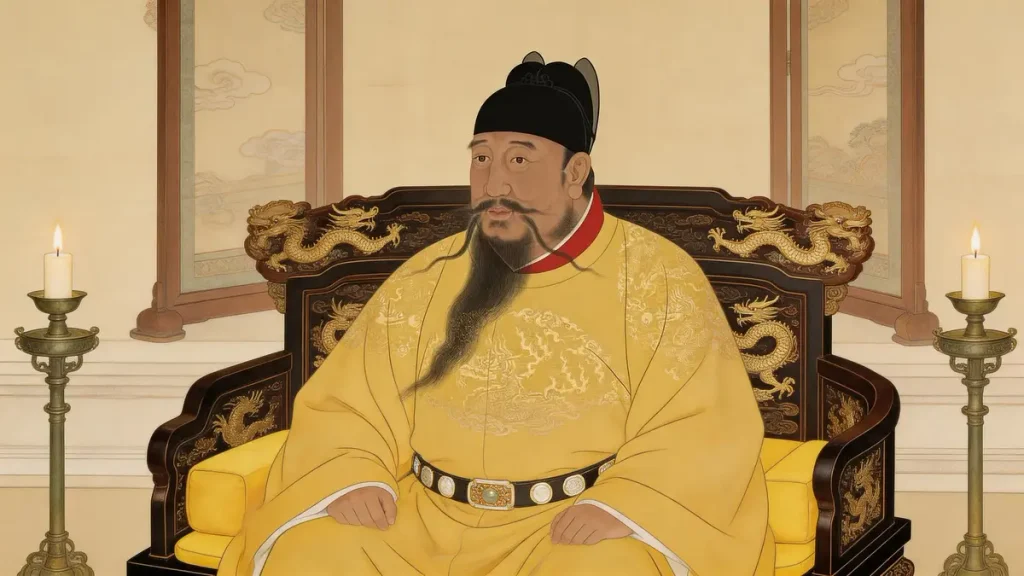
The Yongle Emperor chose a reign name that meant lasting joy: Yongle, which English writers usually render as Perpetual Happiness. The name was used for twenty-two years. The Hongwu emperor had left a framework of government. The fixed parts went in during these two decades: the Grand Secretariat, the Eastern Depot, Beijing as the capital, the ocean fleets. For the next two centuries the Ming ran on them.
All of it began with a coup in the seventh month of 1399.
The Jingnan campaign, 1399 to 1402
In 1370 the Hongwu emperor made his fourth son, Zhu Di, Prince of Yan. In 1380 the prince moved to his fief at Beiping, the old Yuan capital, where the walls still stood and the Yuan palace had become his residence. He was twenty. In 1390 he campaigned against Naghachu alongside his brother the Prince of Jin. The Prince of Jin held back; Zhu Di marched hard for the Yidu Hills and brought back the whole enemy following. After that he led armies north several times, and his father gave him control of the frontier troops.
Hongwu had twenty-six sons. He had placed the grown ones along the northern frontier from Liaodong to Gansu, each with soldiers of his own. The arrangement worked while he lived. Once he was dead it became a problem. He died in the intercalary fifth month of 1398, and his will ordered the princes to stay in their fiefs and not come to the capital. Zhu Di, the future Yongle Emperor, had already left Beiping to attend the funeral. He stopped on the road when the order reached him.
The heir was his nephew, the Jianwen emperor. Two men had his confidence: Qi Tai, minister of war, and Huang Zicheng, minister of rites. The reduction of the princes began with Zhu Su, Prince of Zhou, a full brother of Zhu Di. Huang Zicheng put the logic plainly: “Cut off Zhou and you cut off Yan’s hands and feet.” In the eighth month of 1398 the Prince of Zhou was reduced to commoner and sent to Yunnan. In the fourth month of 1399 the Prince of Xiang, Zhu Bo, burned himself to death, and the princes of Qi and Dai were reduced. In the sixth month the Prince of Min was sent to Zhangzhou. Five princes had fallen in ten months. The strongest one had not been touched.
The future Yongle Emperor took to his bed and claimed illness. At the same time he quietly brought eight hundred fighting men into his residence. The man advising him was a Buddhist monk, Daoyan, whose family name was Yao and who came from Suzhou. Hongwu had assigned monks to attend his sons, and Daoyan had been sent to the Prince of Yan. The two men took to each other at once. Daoyan became abbot of the Qingshou Monastery and came and went from the prince’s residence, often clearing the room to talk alone. Zhu Di asked him what to do when the people were on the other side. Daoyan answered: “I know the will of Heaven. Why talk about the hearts of the people?”
The weapons were made in the back garden. Workers dug out rooms underground, walled them thick, and forged day and night while geese and ducks were kept above to cover the noise of the hammers. Before the rising a storm blew down a roof tile, and Zhu Di turned pale. Daoyan told him it was a good sign: “A dragon in flight is attended by wind and rain. The tile falls because yellow is about to replace it.” Yellow was the imperial color.
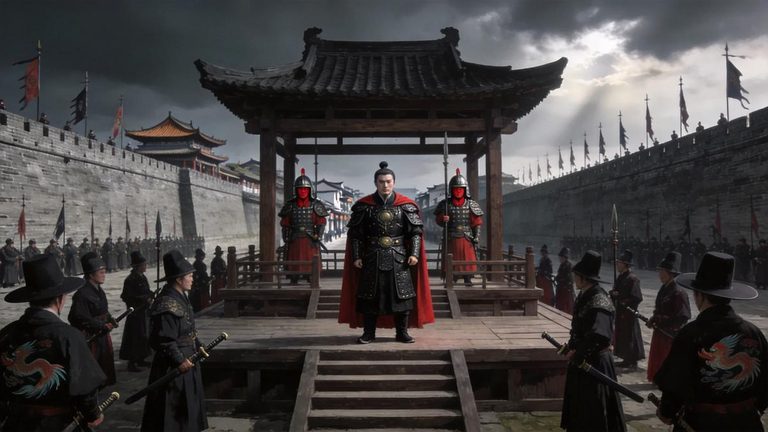
On the day recorded as guiyou in the seventh month, Xie Gui and Zhang Bing had troops guarding the gates of the prince’s residence. Zhu Di hid his men inside the Duanli Gate, lured the two officials in, and had them killed. By evening he held the nine gates of the city. He sent a memorial to the throne naming Qi Tai and Huang Zicheng as traitors, and quoted the Imperial Ancestral Instructions: when the court has no upright minister and evil men are within, a prince may drill troops and await orders. He called his army the Jingnan force, the army that pacified trouble. The war lasted four years, and later generations called it the Jingnan campaign.
The court had more soldiers every year. In the eighth month Geng Bingwen marched to Zhending. One of his officers, Zhang Bao, surrendered to the prince and reported that the government army numbered three hundred thousand, of whom a hundred and thirty thousand had arrived, half camped north of the Hutuo River and half south. Zhu Di sent Zhang Bao back with orders to spread word that the prince’s army was coming. The government troops crossed the river to meet him, and Zhu Di caught them in the middle of the crossing.
Thirty thousand were killed.
In the ninth month Li Jinglong massed five hundred thousand men at Hejian. Zhu Di refused the direct fight. He marched east to relieve Yongping, then north to Daning, and came back with the Prince of Ning’s troops and the Mongol cavalry of the three Uriankhai guards. In the eleventh month he broke seven of Li Jinglong’s camps at Zhengcunba. The Bai River froze over as he prayed, and his cavalry crossed on the ice. When the government troops tried to follow, the ice broke and many drowned.
The battle at the White Gou River in the fourth month of 1400 was the closest he came to losing. Li Jinglong drew up a line dozens of li long and broke the rear of the prince’s army. Zhu Di led his cavalry across and killed Qu Neng and his son. He ran out of arrows, changed horses three times, broke his sword, and rode up onto the embankment, where he raised his whip as if calling up reserves. Li Jinglong suspected an ambush and held back. Then a whirlwind snapped his standard. The prince’s men set fires and came on through the smoke, killing tens of thousands.
There were also days when nothing worked. At Dongchang in the twelfth month of 1400 Sheng Yong used firearms and heavy crossbows, and the prince’s army broke. Zhu Di cut his way out. His best general, Zhang Yu, was killed. At Jiahe in the third month of 1401 he spent the night with a dozen riders near Sheng Yong’s camp, and at dawn found himself inside the encirclement. He rode out at a walk, sounded his horn, and passed through the camp. The officers on the other side looked at one another and did not shoot. The History of the Ming gives their reason: the emperor had ordered that no one was to carry the guilt of killing his uncle.
After three years the prince held only three prefectures, Beiping, Baoding and Yongping. Towns he took reverted as soon as his army left. The turn came from a eunuch who had been dismissed from the court and fled to him with the news that the capital was empty. The future Yongle Emperor said that years of fighting had to end somewhere, and that he would cross the river and finish it, never looking back. Yao Guangxiao had been telling him the same thing: stop taking cities and go straight for the capital. In the sixth month of 1402 his army reached the Jinchuan Gate. The Prince of Gu and Li Jinglong opened it.
The capital fell.
A fire started inside the palace. The History of the Ming says in one sentence that the emperor’s whereabouts are unknown. In the next it says the Prince of Yan sent eunuchs to pull the emperor’s and empress’s bodies out of the fire, and buried them eight days later. Two statements sit in the same passage, and later readers have taken whichever one they preferred.
On the day recorded as jisi, Zhu Di visited the imperial tomb and took the throne in the Hall of Receiving Heaven as the Yongle Emperor. Eight days later Qi Tai, Huang Zicheng and Fang Xiaoru were executed, and their families with them.
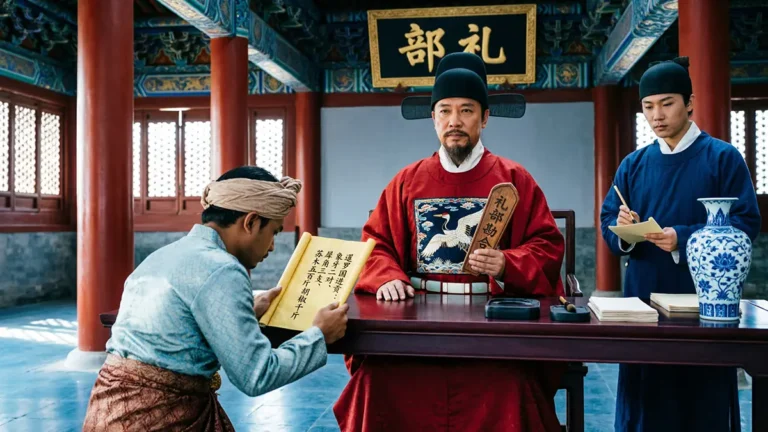
Yao Guangxiao had asked for Fang Xiaoru’s life in advance. When the army left Beiping he told the prince: “When the city falls he will not surrender. Spare him. Kill Fang Xiaoru and you cut off the seed of scholarship in this world.” Zhu Di agreed. In Nanjing he ordered Fang Xiaoru to draft the accession proclamation. Fang came into the hall and wept so loudly that the sound carried beyond the steps. Zhu Di came down from his seat and tried to comfort him: “Do not distress yourself, sir. I mean to follow the Duke of Zhou, who supported the young king.” Fang asked where the young king was. Zhu Di said he had burned to death. Fang asked why the son was not put on the throne. Zhu Di said the state needed an adult. Fang asked why the younger brother was not put on the throne. Zhu Di said, “This is my family’s business,” and ordered writing materials brought to him. Fang threw the brush on the floor, wept, cursed, and said he would die but would not write. He was torn apart in the marketplace.
He was forty-six.
Later accounts say he died with ten branches of his family, eight hundred and seventy-three people in all. That number is not in the History of the Ming, which says that several hundred of his kinsmen, friends and students were executed. The ten branches belong to notes written in the middle and late Ming, when students and old associates were counted as a branch of the family. The two accounts are far apart. There is no need to reconcile them.
The first thing the Yongle Emperor did with the calendar was erase his nephew’s reign. The years 1399 to 1402 became the thirty-second to thirty-fifth years of Hongwu, and the next year became the first of Yongle. The Veritable Records compiled under Jianwen were burned. Two new editions were made in the Yongle reign, and the text used today was completed in 1418. He also insisted, on every public occasion, that he was a son of Empress Ma and therefore a legitimate son. The official histories say so. A late Ming register of sacrifices at the Nanjing imperial tomb lists Consort Gong as his mother, seated alone on the west side. Fu Sinian and Wu Han accepted that reading. Zhu Xizu rejected it. The Palace Museum’s own account says none of the claims can be proven.
In 1412 the Yongle Emperor began the Great Bao’en Monastery outside Nanjing. It took nineteen years. Its centerpiece was a nine-story octagonal tower faced in white porcelain, seventy-eight meters tall, with five-colored glazed arches and eaves. The official purpose was to repay his parents. A popular story said the main hall stayed shut and held an image of Consort Gong. The tower was destroyed in the fighting of 1856.
Only foundations and fragments remain.
A prince who took a throne by civil war needed the mandate of Heaven more than a legitimate heir did. Six months after his accession, the Yongle Emperor renamed Beiping Beijing.
The move to Beijing and the Forbidden City
In the first month of 1403, on his order, Beiping became Beijing. In the second month the Yongle Emperor set up a branch military commission, a branch administration and a national academy there, and renamed the prefecture Shuntian. In the eighth month he moved wealthy households from ten prefectures of Suzhou and nine provinces of Zhejiang to the new capital. In each of the next two years he moved ten thousand households from Shanxi. A new capital is not drawn on paper.
People have to live in it.
The Yongle Emperor’s edict gave strategic reasons. Beijing sits against the Yan Mountains, looks south over the north China plain, and stands one march from the passes. Grain and money could come up the Grand Canal. What the edict did not say was that the Yongle Emperor had spent nineteen years there, from 1380 to 1399, and that his old officers, his garrisons and his Mongol cavalry were all in that region. Nanjing, by contrast, was the Jianwen court. The ministries were full of men who had been writing denunciations of him four years earlier.
In 1410 the Yongle Emperor led his first campaign into the steppe. He left Beijing in the second month, caught Bunyashiri on the Onon River in the fifth month, and drove him off with seven riders. On the way back he broke Arughtai’s army. In 1414 the Yongle Emperor marched west against the Oirats and defeated Mahmud. In 1422, 1423 and 1424 he went out again. On the last campaign his scouts rode three hundred li up the Dalan Namur valley and found nobody. The supply train ran out and the army turned back. In the seventh month he fell ill at Yumuchuan and died in camp at sixty-five.
“The emperor guards the gate of the realm” is a phrase later writers made up for him. What the Yongle Emperor actually did was move the throne from the Yangtze to a city less than a hundred kilometers from the Great Wall, and then ride out through the passes himself, year after year.
The Yongle Emperor ordered the palace in the intercalary seventh month of 1406, with work to begin in the fifth month of the following year. Ministers were sent to Sichuan, Huguang, Jiangxi, Zhejiang and Shanxi to cut timber. In the eleventh month of 1416 the court was ordered to deliberate on the construction. In the second month of 1417 the Marquis of Taining, Chen Gui, took charge. The palace and its altars were finished in the twelfth month of 1420, and the Hall of Receiving Heaven received the court in the first month of 1421.
For the Yongle Emperor’s palace, materials came from half of China. Nanmu grew in the mountains of the southwest. Once cut, the logs went down streams and rivers, and the trip from Sichuan to Beijing often took three to five years. The floor bricks came from Suzhou and Songjiang, the wall bricks from Linqing in Shandong, the white marble from Fangshan. The great dragon slab behind the Hall of Preserving Harmony was dragged from Fangshan on rollers over a road watered and frozen every winter, and the haul took more than twenty days.
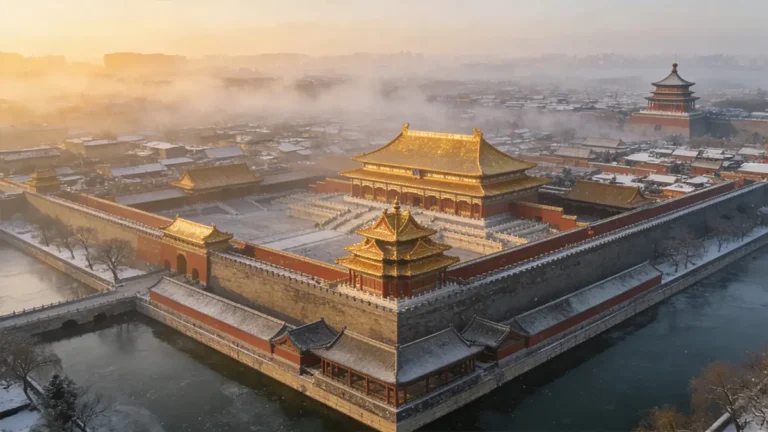
The Yongle Emperor’s plan is a single axis. It runs from the Meridian Gate in the south to the Gate of Divine Prowess in the north. Three great halls stand in front, three palace halls behind. The ancestral temple is on the left, the altars of soil and grain on the right, and the ministries are ranged on either side. South of the palace are the Temple of Heaven and the Altar of Agriculture. The Temple of Heaven was built in 1420 as the Hall of Heaven and Earth, where both were worshipped together. Only under the Jiajing emperor, a century later, was worship split into a round altar in the south and a square altar in the north, which is where the old formula of a round heaven and a square earth took physical form.
The walled palace, the Forbidden City, covers 720,000 square meters. Its buildings come to about 150,000 square meters, with more than seventy halls and some nine thousand rooms. Twenty-four emperors of the Ming and Qing lived in it.
The Yongle Emperor’s bill came due three months later. The three halls burned, and he called for frank criticism. Officials wrote in, and many said the move to Beijing had been a mistake. He was furious. He had Xiao Yi, a ministry secretary, killed, and said the move had been discussed with his ministers for a long time and was not a rash act. The censors then turned on the ministers. He made the two sides kneel outside the Meridian Gate and argue, and the senior ministers cursed the censors to their faces. Xia Yuanji, the minister of revenue, submitted a memorial on his own: “They answered a call for criticism and are guilty of nothing. We are the ministers. We failed to help plan this, and the fault is ours.” The Yongle Emperor’s anger cooled and he pardoned both sides. Someone accused Xia of abandoning his earlier position. He said that men who had served as long as they had could afford to be wrong, because the emperor would spare them, but that if the censors were punished for speaking, the damage would not be small.
How Xiao Yi died is not settled. One account has him killed in prison. Another has him dying of illness there in 1423, at forty.
The Yongle Emperor’s move was not formally completed either. In 1421 the court simply relocated. In the third month of 1425 the Hongxi emperor ordered a return to Nanjing and had every Beijing office marked again as a provisional posting. Only in the eleventh month of 1441, after the three halls had been rebuilt, was Beijing confirmed as the capital and the provisional label dropped. For twenty years the city had carried the status of a temporary seat.
The three halls burned again in 1557, again in 1597, and again in 1644 when Li Zicheng withdrew from the city. The form of the hall standing today was set in the rebuilding of 1695.
Zheng He and the treasure ships
In the sixth month of 1405 the Yongle Emperor sent the eunuch Zheng He to the Western Ocean. The fleet left from Liujiabang in Suzhou, took on final supplies at the Wuhumen anchorage in Fujian, and made Champa its first port. The History of the Ming gives the numbers: 27,800 soldiers and sailors, and sixty-two great ships of 44.4 zhang by 18 zhang, or roughly 140 by 57 meters, to judge by the official figures.
Zheng He was from Kunyang in Yunnan, a Hui Muslim whose family name was Ma. His grandfather and father had both made the pilgrimage to Mecca, which earned them the title hajji. In 1381, when Ming armies took Yunnan, he was captured and castrated, and he ended up in the household of the Prince of Yan. He served in the Jingnan campaign, and the prince gave him the surname Zheng. His background gave him something most civil officials in the capital lacked: a working knowledge of the ports, the monsoon calendar and the languages of the Indian Ocean.
The History of the Ming gives two motives. The Yongle Emperor suspected that the Jianwen emperor had fled overseas and wanted him traced, and he also wanted to display soldiers in foreign lands and show off China’s wealth. One motive was a search, the other a demonstration. There is no reason to choose between them.
The Yongle Emperor’s fleet sailed seven times, from 1405 to 1431, across twenty-eight years. Six voyages belonged to the Yongle reign. The last was sent by the Xuande emperor. It reached more than thirty countries and principalities, and went as far as Mogadishu, Brava and Juba on the East African coast. The route out through the South China Sea, past Malacca and across the Indian Ocean is what is now called the maritime Silk Road.
The Yongle Emperor’s fleet did not only carry gifts. On the return in 1405 Zheng He brought back Chen Zuyi, the chief of Palembang, the old capital of Srivijaya. Chen had been raiding merchant shipping. Zheng summoned him, and Chen pretended to surrender while planning an attack. He was defeated, taken, and executed in Nanjing. In 1408 the fleet went to Ceylon, where King Alakeshvara lured Zheng inland, demanded gold, and sent soldiers against his ships. Zheng saw that the army had left and the city was empty, took two thousand men, stormed the capital and captured the king with his wives and officials. He presented the prisoner in 1411. The Yongle Emperor spared him and sent him home. In the winter of 1412 the fleet sailed again and seized Sekandar, a pretender to the throne of Samudra, bringing him back in 1413.
Malacca shows how the Yongle Emperor’s system worked on the ground. The place had been subject to Siam and paid forty ounces of gold a year. In 1409 Zheng He invested the local chief with a silver seal, robes and a stone tablet, and Malacca became a kingdom under Ming protection. When the fleet arrived, it built a stockade with a wall, four gates, drum towers and a night watch, and inside it a second enclosure with warehouses. Ships going to different ports left their goods there and came back to assemble. When the southwest monsoon turned in the middle of the fifth month, the whole fleet left together.
At Calicut a stone inscription survived: “Ten thousand li and more from China, where the people and their goods are at peace and share one custom. Cut in stone here, to be shown forever.” Calicut is Kozhikode, on the Malabar coast. Business there had its own form. The broker named a date for the sale, the two sides clapped palms once in front of witnesses, and the price stood.
Once fixed, neither side could reopen it.
Under the Yongle Emperor, the system ran on tribute. Foreign courts brought local goods. The Ming gave back silk, porcelain and copper cash, usually more than it received. That practice had a name: give much, receive little. What the court wanted was recognition and order, not annexation, garrisons or governors. Its fleet used force when sea lanes were blocked or a king attacked its ships.
The cost is in the History of the Ming: “The nameless treasures it brought back cannot be counted, and China’s waste was beyond reckoning.” In the first month of 1424 Zheng He was still being sent to Palembang with a seal. By the time he returned, the Yongle Emperor was dead. In the second month of 1425 he was posted to command the garrison at Nanjing, the first man to hold that post. In 1431 the Xuande emperor, noting that distant states had stopped coming, sent him out one last time. He died at Calicut in 1433 on the way home. Wang Jinghong brought the fleet back. Zheng He was buried on the southern slope of Ox Head Hill outside Nanjing.
Ninety years later Vasco da Gama reached the same port of Calicut. He had four ships and about 170 men. On his first visit Zheng He had brought sixty-two great ships and 27,800 men.
The Yongle Encyclopedia
In the seventh month of 1403 the Yongle Emperor ordered Xie Jin, a reader in the Hanlin Academy, to compile a book that would gather material from the classics, histories, philosophical works and belles-lettres by category, so that it could be consulted easily. One hundred and forty-seven scholars worked on it. They delivered in the twelfth month of the following year under the title Wenxian Dacheng, the Great Compendium of Documents.
The Yongle Emperor was not satisfied. It was not complete enough. He added Yao Guangxiao and Liu Jichi to the editorial board and raised the number of editors, copyists and proofreaders to more than three thousand. In the winter of 1408 the work was finished and given the title Yongle Dadian, the Great Canon of the Yongle Reign.
The main text runs to 22,877 juan, with sixty juan of rules and index, bound in 11,095 volumes, about 370 million characters, all copied by hand. Each folio is fifty centimeters tall and thirty wide. The covers are built up from layers of hard-backed paper and wrapped in yellow silk, in the wrapped-back binding used for imperial books. The text is in formal court kaiti. Titles of quoted works are written in red, and the marks for punctuation were stamped with small red circles.
The Yongle Emperor’s compilers arranged the book by the rhyme categories of the Hongwu Zhengyun dictionary. Characters come first, then everything written about them. Under a single character the compilers put its pronunciation, its meanings, its forms in seal, clerical, cursive and regular script, and then extracts from every book that touched on it, sorted by topic. Astronomy goes under heaven. Geography goes under earth. Nothing was rewritten. A sentence, a passage, a chapter, sometimes a whole book, was copied out as it stood.
The compilers drew on seven or eight thousand works, from the pre-Qin period to the early Ming, covering astronomy, geography, medicine, agriculture, poetry and history. When the Qing court compiled its Complete Library of the Four Treasuries in the eighteenth century, editors pulled hundreds of lost books out of the Yongle Encyclopedia. The Old History of the Five Dynasties, the Old Book of Tang, the Song Administrative Documents and the Long Draft of the Continued Comprehensive Mirror all came back that way. Without it, the Old History of the Five Dynasties might survive today as a title and nothing more.
The Yongle Emperor’s encyclopedia is often compared with the Encyclopaedia Britannica, whose first edition appeared in 1768, more than 360 years later. They are not the same kind of thing. Britannica is arranged alphabetically and revised edition after edition, and its entries are written for people who need to look something up. The Yongle Encyclopedia is arranged by rhyme, was copied once, and sat in a storeroom. Nothing was ever added to it. It produced no new knowledge. It moved old books, whole and unaltered, onto one shelf, and in doing so preserved many that would otherwise have disappeared.
Only one copy of the Yongle Emperor’s encyclopedia was made. In 1557 fire broke out in the palace and burned the three great halls. The Wenlou library was in danger, and the Jiajing emperor issued repeated orders through the night to save the books. They survived. In 1562 he ordered a second copy made in the same format. It was finished in 1567. From then on there were two: the original and the copy. The original was never recorded again. The copy went to the imperial archive and was moved to the Hanlin Academy in the early Qing.
The losses began inside the academy. Officials borrowed volumes and did not return them, or stole them and sold them. By the Guangxu reign a count found only about eight hundred volumes left. In 1900, when the academy caught fire during the fighting in Beijing, the rest were burned or looted. About four hundred volumes, some eight hundred juan, survive today, less than four percent of the whole, scattered across more than thirty institutions in eight countries.
The National Library of China holds more than 220 volumes, the largest share. The British Library holds twenty-four. One of them still has a clipping from The Times of January 6, 1914, pasted inside the cover, describing how the books traveled from Beijing to London. The Library of Congress holds forty-one, the largest group outside Asia, all digitized in 2023.
One volume has a stranger history. In the summer of 1900, during the siege of the legation quarter, an American in Beijing took a volume of the Yongle Encyclopedia from the Hanlin Academy next door and used it, along with other books, to block a window against bullets. After the siege he carried it home to Ohio. Around 1927 it was shown at the library of Oberlin College. His daughter later gave it to the Huntington Library.
Yongle blue and white porcelain
The Yongle Emperor’s blue and white is reckoned the finest porcelain of the Ming, and color is the most direct reason.
The color came from an imported cobalt. The sources call it sumali blue, sometimes sunibo blue. The official name was Huihui blue, the blue of the western Muslims. Analysis shows the ore is high in iron, low in manganese and carries arsenic, the opposite of Chinese cobalt. Its origin is usually traced to the Kashan region of Persia, where the local product was called Sulaimani. It was a processed blue pigment, glassy, and rich in fluxes.
A flux-rich pigment melts into the glaze. That is why Yongle blue and white often shows bleeding, where the edge of a line dissolves and spreads like ink on paper. The iron content produces dark crystalline spots as the piece cools, the speckles collectors call rust spots, sunk slightly into the glaze. With the fine orange-peel texture of the glaze, those three features are the most common tests for a Yongle piece.
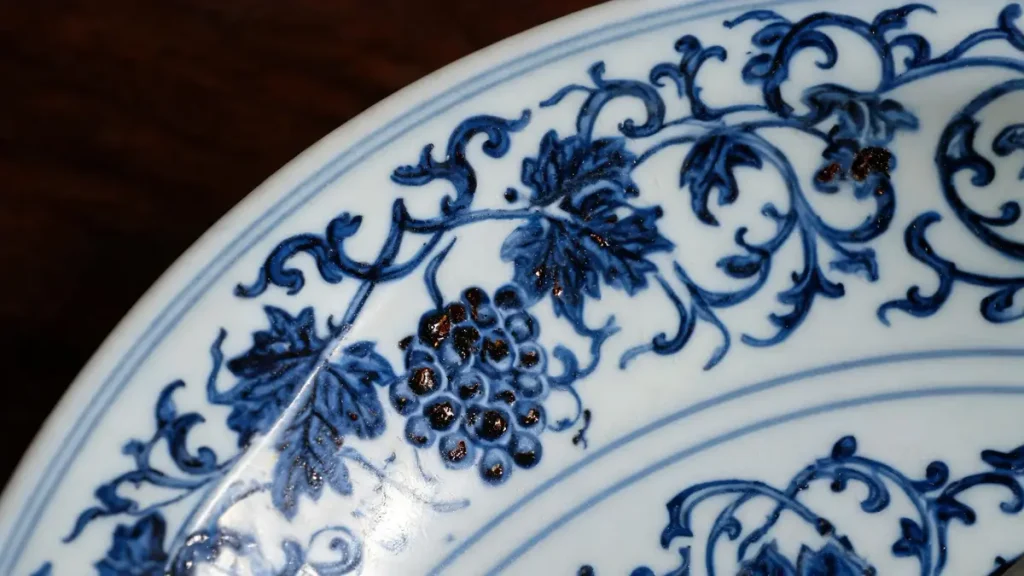
The shapes are foreign too. The globe vase, the flattened flask with ribbon handles, the pilgrim flask, the flower sprinkler, the flared basin, the long-necked ewer: none of them come out of the older Chinese repertoire. Their models are West Asian metalwork and glass. Many were made to be given to foreign courts.
The place to see this material today is the Topkapi Palace in Istanbul, which holds more than 10,700 pieces of Chinese porcelain, from Song to Qing, with a strong group of early Ming blue and white. The old collection of the Ardabil Shrine in Iran is the other. Both point to the same sea lanes.
Almost no Yongle blue and white carries a reign mark. A piece is dated by its body, its glaze, its shape and the look of its cobalt, not by anything written on the base. Reign marks became standard only after the Xuande reign.
Sweet white porcelain, gilt bronzes and carved lacquer
Most of the porcelain fired in the Yongle reign was white.
The Chinese name for it, tianbai, means sweet white. The sweetness is about touch. The glaze is opaque and smooth, thick enough to look like set fat. Many pieces are thin enough to be nearly bodiless, so that a hand held behind them shows through. The walls often carry lotus scrolls or flower sprays incised under the glaze, invisible when seen straight on and visible only when the light rakes across them. When archaeologists excavated the imperial kiln site at Zhushan in Jingdezhen, more than ninety-eight percent of the shards in the early Yongle layers were sweet white. This was not an occasional curiosity. It was what the palace used every day.
No source explains why the Yongle Emperor preferred white. A few facts can be set side by side. He had spent nineteen years at Beiping, where the Mongol taste for white still lingered. White porcelain was used in sacrifices and in Buddhist ritual. The tower he began at the Great Bao’en Monastery in 1412 was faced in white porcelain. Three facts point at white. Which one was the cause cannot be said.
The Palace Museum has a sweet white monk’s-cap ewer, with a mouth that rises at the back and dips at the front, shaped like the hat of a Tibetan monk. The form began as a Tibetan water vessel and tea pot and had reached China under the Yuan. The Yongle Emperor’s court made it in white porcelain and sent it back to Tibet.
Bronze images went with the envoys. The gilt bronzes that survive from the Yongle Emperor’s reign often carry six characters incised on the base: bestowed in the Yongle reign of the Great Ming. The word is bestowed, not made. They were gifts, not furnishings. The recipients were Tibetan lords and senior clerics. The bronzes are cast in high-grade copper by the lost-wax method, gilded all over, with faces, robes and lotus seats that combine Tibetan proportion with Chinese modeling.
The court’s interest in Tibet was diplomatic before it was devotional. In 1403 the Yongle Emperor sent the eunuch Hou Xian with letters and gifts to invite Halima, known in Tibetan sources as Deshin Shekpa, the fifth Karmapa of the Karma Kagyu school. Hou traveled tens of thousands of li and brought him to Nanjing in the twelfth month of 1406. The Yongle Emperor received him in the Hall of Receiving Heaven and loaded him with gifts, with escorts, saddles and utensils largely of gold and silver. In the second month of 1407 a great offering was held at Linggu Monastery for the benefit of Hongwu and Empress Ma, and the court was told of clouds, flowers, sweet dew, blue birds and white elephants. In the third month Halima was titled the Great Treasure Prince of Dharma, with authority over Buddhism in the realm and a seal graded like those of princes.
The Yongle Emperor’s lacquer took another route. After the move to Beijing in 1421, the imperial household workshops set up the Orchard Factory inside the palace city and brought in Zhang Degang, son of the Yuan master Zhang Cheng. He was interviewed, found satisfactory, and given a post in the Directorate of Construction with charge of lacquer production. Carved red lacquer is built up layer by layer, eighty or ninety coats at the low end, more than a hundred at the high end. While the lacquer is still soft the design is drawn on and cut. The Palace Museum’s oval dish with grapes has fruit rising about fifteen millimeters above the surface, close to full sculpture.
The Orchard Factory is not settled history. Su Yuming, Harry Garner and Cai Meifen have all questioned its connection to Yongle lacquer and argued that official carved lacquer in the early fifteenth century was made in workshops in Jiangsu and Zhejiang.
The site is gone.
Much of the Yongle Emperor’s lacquer went to Japan. He sent three missions there, carrying 203 pieces of carved lacquer among the gifts, along with a few incised gold pieces. They entered the Ashikaga storehouses and became part of the shogunate’s collection of Chinese objects. Late Ming connoisseurs judged Yongle lacquer “a cut below the Song, but still fine.”
In the seventh month of 1424, on the way back from his fifth campaign, the Yongle Emperor fell ill at Yumuchuan. He left an edict naming the crown prince as his successor and ordering a funeral on the Hongwu model. He died on the day recorded as xinmao, at sixty-five.
The Yongle Emperor’s army was still in the steppe. The eunuch Ma Yun, the grand secretary Yang Rong and Jin Youzi decided to keep the death secret, for fear of what the news would do to the troops. They melted tin into an inner coffin, laid the body in it, and set it on the imperial carriage, with meals served morning and evening as usual wherever the column stopped. In the eighth month Yang Rong rode back to Beijing with the news, and the crown prince sent his son to meet the coffin at Kaiping.
The Yongle Emperor was buried at Changling, on the Tianshou range at Changping. The tomb was begun in 1409, the Ling’en Hall was finished in the third month of 1416, and the whole complex was complete in 1427. The Ling’en Hall is the only Ming imperial hall of its kind still standing. It is nine bays wide and five deep, and sixty whole nanmu columns carry the roof. The four in the center bay are the thickest, 1.12 meters across at the base, more than a man can reach around. The Hall of Supreme Harmony in Beijing is more than two centuries later and larger, but its timber is not the original.
The Yongle Emperor’s temple name was Taizong. In the ninth month of 1538 it was changed to Chengzu.
The verdict in the History of the Ming sets two things side by side. The first says his territory “far surpassed that of the Han and Tang” and that some thirty states sent envoys under his command. The second says that “in the matter of the proscription he acted against the grain,” and that the shame of it cannot be covered. One sentence covers territory and tribute. The other covers the means by which he took the throne. The editors placed both in the same paragraph and did not let either cancel the other.
What can be seen of Yongle today is scattered. There is the axis and the stone platform in the Forbidden City, the nanmu hall at Changling, the foundations of the Great Bao’en Monastery in Nanjing, a few hundred volumes in London and Washington, and a room of blue and white in Istanbul.
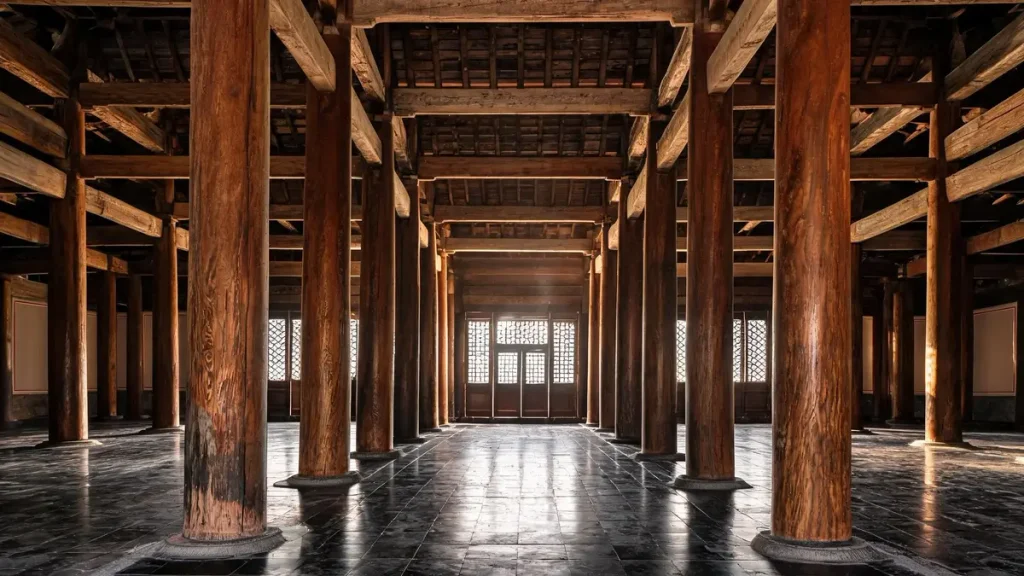
The Ling’en Hall is still the timber frame finished in 1416, and its sixty nanmu columns were raised then. The timber of the Hall of Supreme Harmony is not.
Sources and further reading
Primary sources
- History of the Ming, juan 5 to 7: annals of the Yongle Emperor. The Jingnan campaign, the move to Beijing, the northern campaigns and the death at Yumuchuan.
- History of the Ming, juan 4: annals of the Jianwen Emperor. The reduction of the princes, the fall of Nanjing, the fire in the palace.
- History of the Ming, juan 304: biographies of the eunuchs, including Zheng He and Hou Xian. The seven voyages, Malacca, Calicut and the missions to Tibet.
- History of the Ming, juan 141: biographies of Qi Tai, Huang Zicheng and Fang Xiaoru. The Duanli Gate, the accession and the execution.
- History of the Ming, juan 145: biography of Yao Guangxiao. The advice to march on the capital, the weapons workshop and the line about the will of Heaven.
- History of the Ming, juan 147: biography of Xie Jin. The first compilation and the Hanlin appointment.
- History of the Ming, juan 149: biographies of Jian Yi and Xia Yuanji, with the Xiao Yi affair appended. The fire of 1421 and the criticism of the move.
Palace Museum, Beijing
- Yongle blue and white: the Sumali cobalt, the bleeding of the color and the iron spots.
- Sunibo blue: the imported pigment and the rust marks.
- The Orchard Factory: the lacquer workshop and Zhang Degang.
- Carved red lacquer dish with grapes: the height of the relief and the Yongle mark.
- The Hall of Supreme Harmony: the 1420 construction, the 1695 rebuilding and the dimensions.
- Changling: the tomb, the Ling’en Hall and its sixty nanmu columns.
- The Bao’en Monastery tower: the 1412 start, the 1431 completion, the white tile facing and the destruction.
- Empress Xiaoci Gao: the official maternity and the unproven alternatives.
- The three great halls of the Forbidden City: the 720,000 square meters, the 150,000 square meters of building and the nine thousand rooms.
The Yongle Encyclopedia
- National Library of China Publishing House: the 22,877 juan, the 11,095 volumes, the surviving 400-odd volumes and the 1900 fire.
- Fujian Overseas Chinese Affairs Office: the 370 million characters, the 3,000-plus compilers and the National Library’s 224 volumes.
- Library of Congress: the 41 volumes held and digitized, the largest group outside Asia.
- British Library: 24 volumes from the second copy made between 1562 and 1567, with the 1914 Times clipping.
Art history
- The Metropolitan Museum of Art: Defining Yongle, the 2005 exhibition that treated the court arts of the reign as a coherent group.
- National Palace Museum, Taipei: the absence of reign marks on most Yongle blue and white and the West Asian shapes.