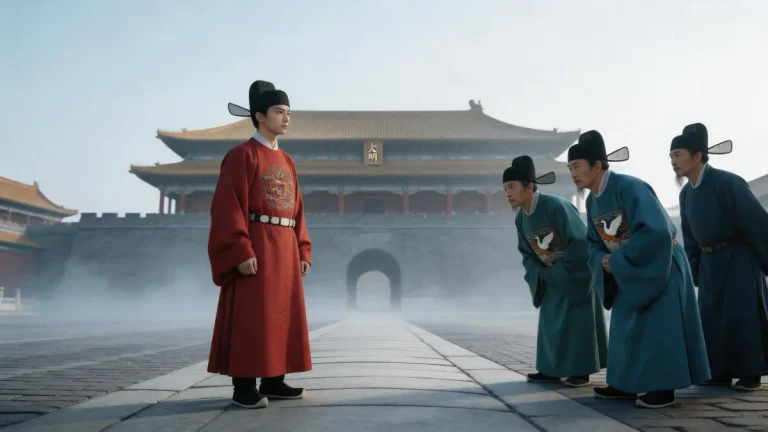
Tianqi Emperor Zhu Youxiao (Xizong): The Untold History
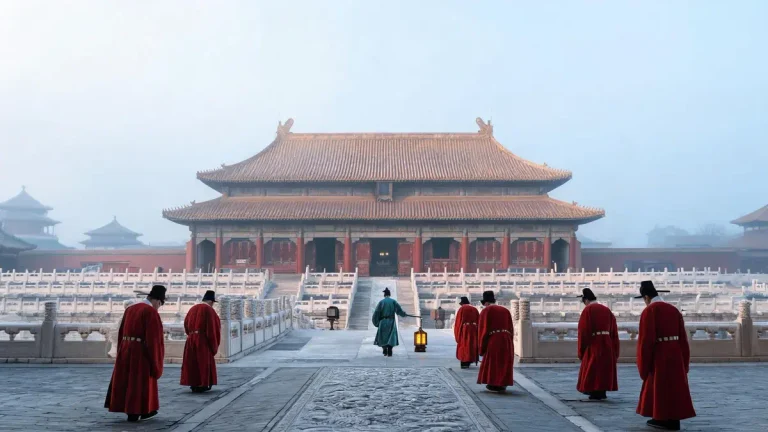
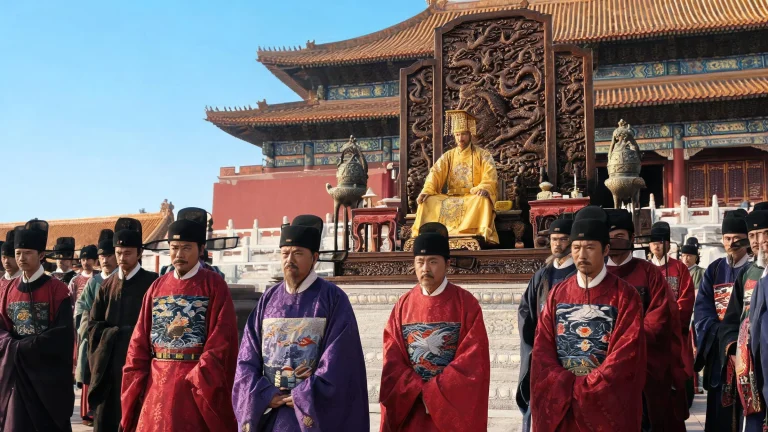
On the twenty-fifth day of the ninth month of 1626 the Hall of Imperial Supremacy was finished, and the Tianqi Emperor sat in it to receive his officials. Halfway through the ceremony a noise came out of the building. The Veritable Records describe it as a heavy sea arriving all at once. Ministers looked at one another. Nobody could say where the sound had started. The audience ended there.
That hall had been a burnt platform for twenty-eight years. In the sixth month of 1597 fire took the three great halls of the Forbidden City together, and the ceremonial front of the palace stood empty afterwards. Work began again on the twenty-third day of the second month of 1625. The Hall of Imperial Supremacy came up first. The other two, the Hall of Central Supremacy and the Hall of Established Supremacy, had their beams raised and their name tablets hung on the second day of the eighth month of 1627.
On the twenty-second day of that month he died in the Palace of Heavenly Purity. Twenty days separated the finished halls from the death.
The Ministry of Works closed the accounts at 5,957,519 taels. The figure came in while he was ill in bed. On the sixth day of the eighth month the Ministry of Rites asked him to pick a day for taking possession of the new halls. He wrote back that he was resting and would set a date later.
He never left the Palace of Heavenly Purity again.
To place Tianqi in the full succession, see the complete list of Ming dynasty emperors, from Hongwu to Chongzhen.
He was never once crown prince
Zhu Youxiao was born in the Forbidden City on December 23, 1605. His father, Zhu Changluo, was the emperor’s eldest son and had been crown prince for four years. His mother, Consort Wang, was a palace woman of the eastern palace, moved up one rank after the birth. The father’s position had cost fifteen years of argument. From 1586 the court fought over whether the eldest son or Consort Zheng’s boy would be named heir, and the question was not closed until 1601. By the time Zhu Youxiao arrived the fight was over and the palace was not calmer for it. His own standing was never fixed. The proof sits in his grandfather’s will, which ordered that the eldest grandson be invested in good time and then noted that it had not been done. Until the Wanli Emperor died in the seventh month of 1620, the boy had never been through the ceremony that would have made him heir to an heir. His father followed six weeks later. Within two months the boy had gone from no title at all to the throne.
She did not live to see any of it. Consort Wang died in the third month of 1619, when he was fourteen, and the palace record of it is a sentence. Ke Shi came from Dingxing, was the wife of a man named Hou Er, and entered the palace at eighteen to nurse him. In the month he took the throne he made her Lady of Sage Favor and gave her son an office. The officials moved at once. In the second month of 1621 a censor, Wang Xinyi, asked that her incense lands and household be cancelled; the memorial went unanswered. In the tenth month another censor, Zhou Zongjian, asked that she be sent out of the palace. The emperor refused, two supervising secretaries said the same thing, and both were posted to the provinces.
In his first year he had spent two officials to keep his nurse in the building.
The September he took the throne
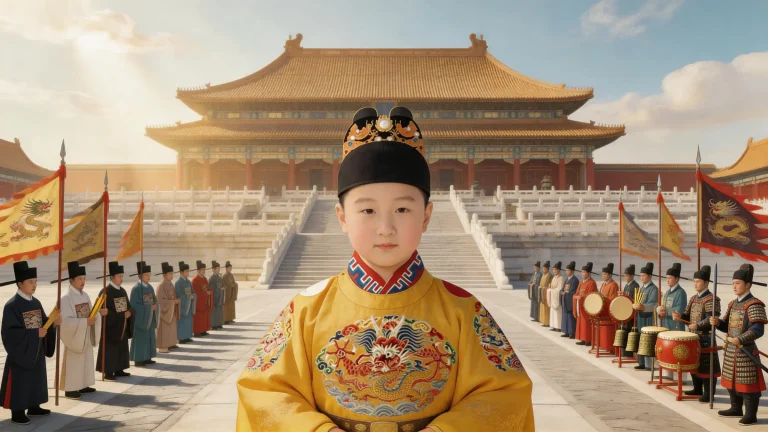
His father died on September 26, 1620, after twenty-nine days as emperor. On the fifth day of the ninth month Consort Li moved out of the Palace of Heavenly Purity into the Palace of Benevolent Longevity, and on the sixth day Zhu Youxiao was enthroned.
The eviction took four days and he played no part in it. The ministers came to mourn and found the palace gate shut. Liu Yijing and Yang Lian pushed it open. The sixteen-year-old heir was being held in the warm chamber, and Yang Lian shouted through the door to ask who dared hide the new Son of Heaven. Wang An, who had been the boy’s companion in the eastern palace, talked the consort round. Liu Yijing took the moment, called him emperor, and had him carried to the Hall of Literary Brilliance.
That same September, two edicts went out. One gave Wei Jinzhong’s elder brother a chiliarchy in the Embroidered Uniform Guard. The other made the nurse Lady of Sage Favor. Wei Jinzhong was Wei Zhongxian, born in Suning, a local tough in his youth who lost at dice, cut himself, and entered the palace as a eunuch under the name Li Jinzhong. He took his own surname back later and was granted the name Zhongxian. The History of the Ming leaves one line about him that explains the next seven years. Wei Zhongxian could not read, and by regulation a man who could not read had no business in the Directorate of Ceremonial. He got there through Ke Shi.
The court the Tianqi Emperor entered had been rebuilt after the last reign. Ye Xianggao, Liu Yijing and Han Kuang took the Grand Secretariat, Zhao Nanxing held the Ministry of Personnel, and Gao Panlong, Yang Lian and Zuo Guangdou controlled the channels of criticism. Later writers called it the court of full worthies. In 1623 Zhao Nanxing ran the triennial evaluation of officials and dismissed a great many of them, and a good number of the dismissed found their way to Wei Zhongxian’s door. In the twelfth month of 1623 Wei Zhongxian took charge of the Eastern Depot, the eunuch-run secret police. He was already the second most powerful man in the palace. After that he was the first.
A palace three or four feet high
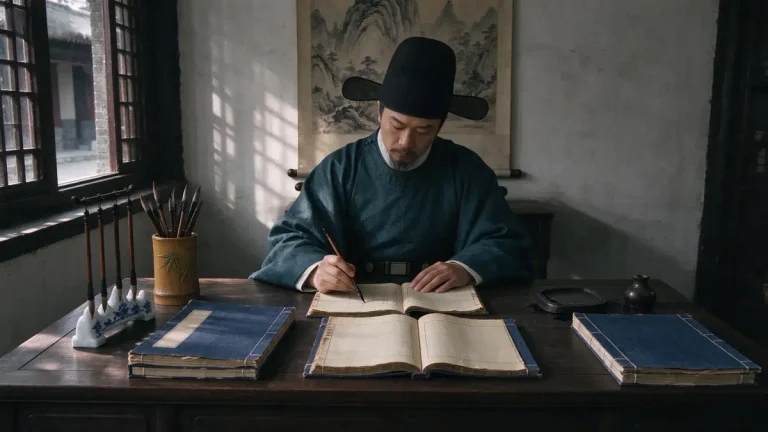
The most concrete sentence the History of the Ming has about the Tianqi Emperor is not in the annals of his reign. It is in the biography of Wei Zhongxian: "He was ingenious by nature, and liked to take up axe, saw and lacquer himself. He never tired of it over the years. When he was stretching a line or shaving a mark, Wei Zhongxian and the others would come to him with business. He found it tedious and would say, ‘I have it all. You people attend to it.’ And so Wei Zhongxian did as he liked with the powers of the throne."
The sentence exists for the five words that come out of the emperor’s mouth. The annals close on a different note: weak and irresolute, with the women and the eunuchs stealing the handles of government, handing out rewards and punishments without limit. That verdict does not mention carpentry once. The carpentry is in another set of sources. Liu Ruoyu was a eunuch of the inner court who was imprisoned in the first years of the next reign and wrote the Treatise on the Inner Palace from his cell. He describes a young man who rode hard, watched fighting plays, and above all built water works. He took great wooden tubs and copper vats, bored holes, fitted valves, and let the water in and out until it either sprayed like beads or poured like a waterfall. Underneath he rigged a mechanism so the current would spin a walnut-sized wooden ball, up and around and down, never falling. Wei Zhongxian and Ke Shi stood by and praised him for a cleverness Heaven had given and no man could match.
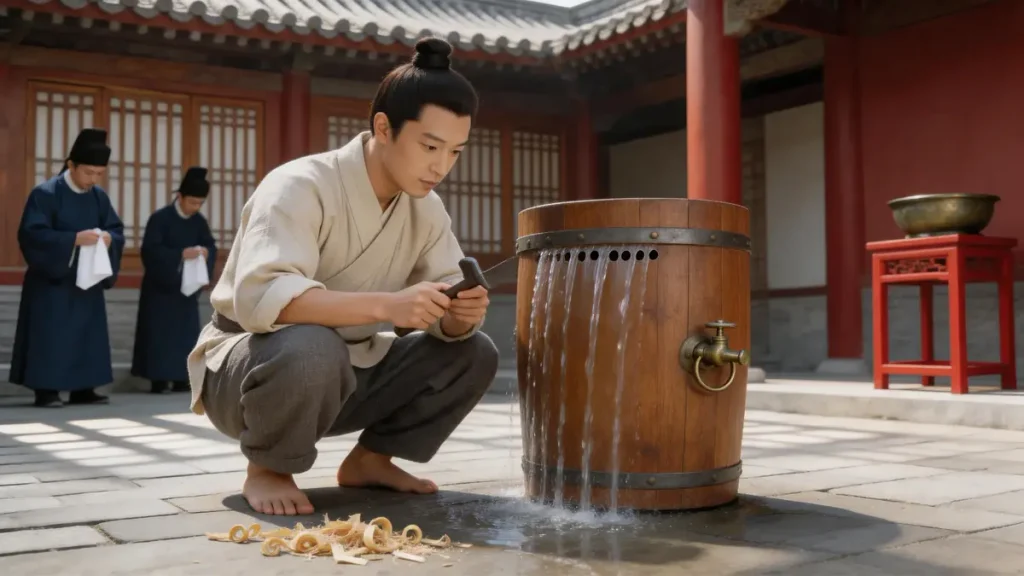
The same book has him building rooms. "His nature also ran to putting up houses. He handled the axe and chisel himself, and a good craftsman could not match him." He worked morning and night, was delighted when a thing was finished, tired of it soon after, threw it away, and made another. He did not mind destroying his own work. What he wanted was the hour of satisfaction. Other notebooks add stories. Wu Baoya, writing in the next century, says he built a model palace in a courtyard after the plan of the Palace of Heavenly Purity, three or four feet high, with beams, columns, lintels and sills all in place. There were ten small screens for lamps, carved with sparrows quarreling on plum branches. A eunuch took them to market and sold them for ten thousand cash, and the emperor was pleased. Someone else says he rebuilt the imperial bed, which in that period was so heavy that a dozen men were needed to shift it. His folded at the middle, and he carved the frame.
None of this is in the official history. The men who compiled it kept three characters, ingenious by nature, and left the rest to the eunuchs and the diarists. The stories are of mixed reliability. On one point the sources do not disagree. The man was good with his hands.
The Tianqi Emperor also had charge of a very large building project. In the sixth month of 1626, after the explosion at the arsenal, he issued an edict that spent half its length on materials for the halls. The Hall of Imperial Supremacy used one part in ten of the timber asked for, accepted stone that was not flawless, and kept its offcuts, which then went into the next two halls. He knew which wood would do, which stone could be made to serve, how the remainder of one hall carried into the next.
The three halls took two and a half years. In the same period the annual surcharge for the war in Liaodong came to 5,200,000 taels. In the tenth month of 1626 an edict went out on the completion of the hall, and one clause recorded that 965 artisans and men of miscellaneous callings had been granted office. A single building project put nearly a thousand craftsmen on the payroll of the state.
The Nine Thousand Years and the shrines across the empire
Under the Tianqi Emperor, Wei Zhongxian’s power did not arrive all at once. He had the Eastern Depot from 1623. Inside the palace he had Ke Shi. Outside it he had Cui Chengxiu, a censor who became his strategist and later his minister of war.
In the twelfth month of 1625 the court published the names of the Donglin faction and posted them through the empire. The list had a formal title, the Donglin Roll Call, and it was drawn up by the minister of personnel, Wang Shaohui, who matched one hundred and eight Donglin figures to the one hundred and eight outlaws of the novel Water Margin. The empire was informed that its senior officials were a bandit gang.
In the intercalary sixth month of 1626 Pan Ruzhen, grand coordinator of Zhejiang, asked for permission to build a living shrine to Wei Zhongxian on West Lake. The emperor gave it. The History of the Ming adds six characters: shrines followed, nearly everywhere under heaven. There was a price for holding back. Censor Liu Zhidai was one day late circulating the memorial and lost his rank. Hu Shirong of Jizhou and Geng Ruqi of Zunhua were sentenced to death, one for failing to prepare the paperwork for a shrine, the other for walking into one without bowing. In the fifth month of 1627 a student of the National Academy, Lu Wanling, asked that Wei Zhongxian be sacrificed to alongside Confucius, with his father beside the Sage’s father. Each of these requests went to the Tianqi Emperor, and each was granted.
The official history is very exact about how Wei Zhongxian traveled. A canopied carriage with feathered banners, four horses at a gallop, guards of the Embroidered Uniform Guard with jade belts and drawn sabers riding at each side, and behind him cooks, players, acrobats and bearers by the ten thousand. Memorials from the ministries had to be sent after him by fast rider.
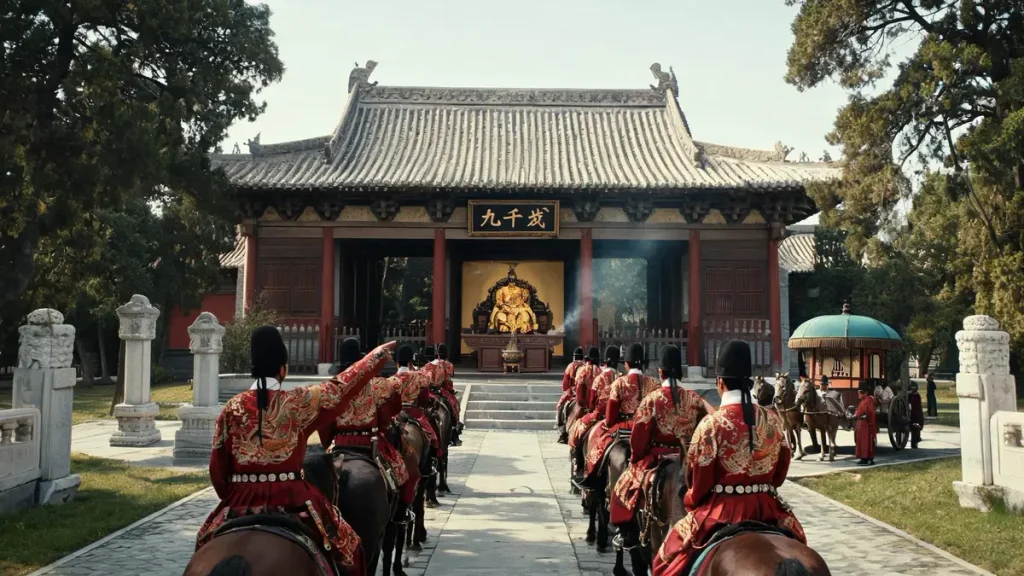
Where he passed, the History says, officials prostrated themselves beside the road and called him Nine Thousand Years, one step below the emperor’s Ten Thousand. He never once looked round.
Memorials stopped using his name. He was the Deputy of the Depot. Grand Secretaries Huang Liji, Shi Fenglai and Zhang Ruitu drafted rescripts in the form "We and the Deputy." When Shandong reported that a qilin had been born in the province, the grand coordinator sent a painting. The rescript came back: the Deputy cultivates virtue, and so the benevolent beast appears. His family rose with him. A grand-nephew in swaddling, Wei Pengyi, was made a count, and a nephew, Wei Liangdong, a marquis. The History notes that neither child could walk. Wei Liangqing, another nephew, performed the imperial sacrifices to Heaven and Earth and to the ancestors in the emperor’s place. By the time the record reaches that point, its sentence is that the empire began to suspect Wei Zhongxian of wanting the throne itself.
Every appointment, every title, every shrine happened while the emperor was alive. The idea that he was kept in the dark does not hold up. The idea that these seven years were simply Wei Zhongxian’s is also too simple. The six men arrested in 1625 were taken on a rescript that bypassed the Grand Secretariat, and in form that rescript was the emperor’s. The succession was settled by the emperor in person. Wei Zhongxian never crossed that line. What he had was the day-to-day conduct of government. The names and the succession stayed where they were.
The imperial prison, July 1625
In the sixth month of 1624, in the fourth year of the Tianqi Emperor, Yang Lian, vice censor-in-chief, sent up a memorial listing twenty-four crimes of Wei Zhongxian. The emperor handed it to Wang Tiqian to read aloud.
Wang Tiqian read it with the substance left out. Yang Lian was punished.
What Yang Lian and his friends wanted came down to a short list. They wanted the succession question settled, the three cases of 1615 to 1620 reopened, the mining and commercial taxes abolished, eunuchs kept out of government, and the evaluations that decided promotions cleaned up. In the tenth month Yang Lian, Zuo Guangdou and Chen Yanting were struck from the register.
In the third month of the following year an old case was reopened, the case of Wang Wenyan, a secretary of the Grand Secretariat. Six men were taken to the imperial prison: Yang Lian, Zuo Guangdou, Wei Dazhong, Yuan Huazhong, Zhou Chaorui and Gu Dazhang. The charge changed on the way in. The first plan was to convict them over the palace eviction, and Xu Dahua put the objection to Wei Zhongxian plainly. On the eviction there was no money to point to. If they were convicted of taking bribes from Yang Hao and Xiong Tingbi, the loss of a frontier was involved, and killing them would have a better name.
So the charge became bribery by defeated generals. Yang Lian and Zuo Guangdou were each assessed at twenty thousand taels, Wei Dazhong at three thousand, Yuan Huazhong at six thousand, Zhou Chaorui at ten, Gu Dazhang at forty.
In prison Wang Wenyan was put through every instrument they had and told to name Yang Lian as a receiver of bribes. He shouted that there had never been a venal Yang Dahong, which was Yang Lian’s courtesy name. Xu Xianchun wrote the confession himself. Wang Wenyan opened his eyes and told him not to invent things, because one day they would have to face each other over it. He was beaten to death that day. The six men then confessed. The calculation was simple. A man who refused would be tortured to death. A man who confessed might be sent down to the regular courts and live long enough to see daylight. Wei Zhongxian closed that route with a rescript ordering Xu Xianchun to keep collecting the fines every five days and never send them to the courts.
On the twenty-sixth day of the seventh month Yang Lian and Zuo Guangdou died in the same night, at the hands of the warders. Zuo Guangdou was fifty-one. A month later Yuan Huazhong and Zhou Chaorui were dead. Gu Dazhang was moved to the regular courts, then ordered back to the imperial prison. He called for wine, took leave of his younger brother, and hanged himself.
When they came for Zuo Guangdou the elders and boys of his district clung to his horse’s head and wept, and the sound carried across the fields. The arresting officers wept with them. Sun Qifeng of Rongcheng and Lu Zheng of Dingxing raised several thousand taels to pay off his fine. The money had not arrived when he died.
In the eighth month of 1625 Xiong Tingbi was executed in the marketplace and his head sent round the nine frontier garrisons. That same month an edict abolished the Donglin academies throughout the empire. The two things were done inside four weeks.
In the second month of 1626 Gao Panlong drowned himself in Wuxi. Zhou Shunchang, Miao Changqi, Li Yingsheng, Zhou Zongjian and Huang Zunsu died in the imperial prison one after another. In the sixth month the Compendium of the Three Cases was finished and published. It reset the verdicts on the staff assault, the red pill and the eviction, and gave each case a single author of the crime: Wang Zhicai for the staff, Sun Shenxing for the pill, Yang Lian for the eviction.
The Western guns at the wall at Ningyuan
The war the Tianqi Emperor inherited had begun under his grandfather. In the third month of 1621 Shenyang and Liaoyang fell, and the military commissioner of Liaodong killed himself. East of the Liao River the Ming had almost nowhere left to stand. In the first month of the next year the army at Guangning broke, and Wang Huazhen and Xiong Tingbi came back through the passes.
Yuan Chonghuan had passed the imperial examinations in 1619 and served as magistrate of Shaowu in Fujian. When Guangning broke he rode out through the passes alone to look at the ground, came back, and told the court that with men, horses, money and grain he could hold the pass by himself.
Sun Chengzong went out in the eighth month of 1622 as supreme commander, based at Shanhaiguan. He put Yuan Chonghuan in charge of Ningyuan. The wall Yuan laid out was thirty-four feet high, with a parapet of six feet, a base of thirty-two feet and a top of twenty-five, finished in 1624. Ningyuan became the anchor of the frontier.
In the summer of 1625 Sun and Yuan pushed garrisons forward to Jinzhou, Songshan, Xingshan, Youtun and the Greater and Lesser Ling rivers. The History calls it two hundred li of recovered ground. Later writers named the line after its three nodal points: Ningyuan, Jinzhou and the Shanhai Pass. In the ninth month a Ming force was destroyed at Liuhe, and in the tenth month Sun Chengzong was dismissed. Gao Di replaced him, decided the ground outside the pass could not be held, and ordered the stores at Jinzhou and Youtun brought inside. More than a hundred thousand shi of grain were abandoned. The History records the march back: the dead along the road, the wailing, the soldiers worse than before.
Yuan Chonghuan refused to go. He held the post of defense commissioner for Ningyuan and Qian, he said, and a man who holds a post dies at it. He would not leave.
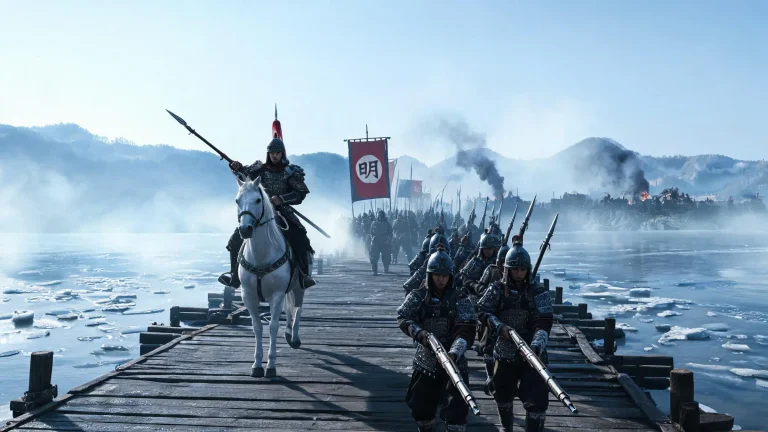
On the twenty-third day of the first month of 1626 Nurhaci’s army reached Ningyuan. Yuan wrote his orders in his own blood and bowed to his officers, and they asked to die where they stood. He burned the houses outside the wall, brought the stores inside, cleared the countryside, and sent word to the garrisons at Qiantun and Shanhai that any soldier who ran to them would be executed. The Jin attacked with shields over their heads and picks at the base of the wall, and arrows could not stop them. Yuan ordered Luo Li, a gunner from Fujian, to open with the Western guns, and the fire fell on the troops outside the wall. They attacked again the next day, were driven back again, and the siege lifted.
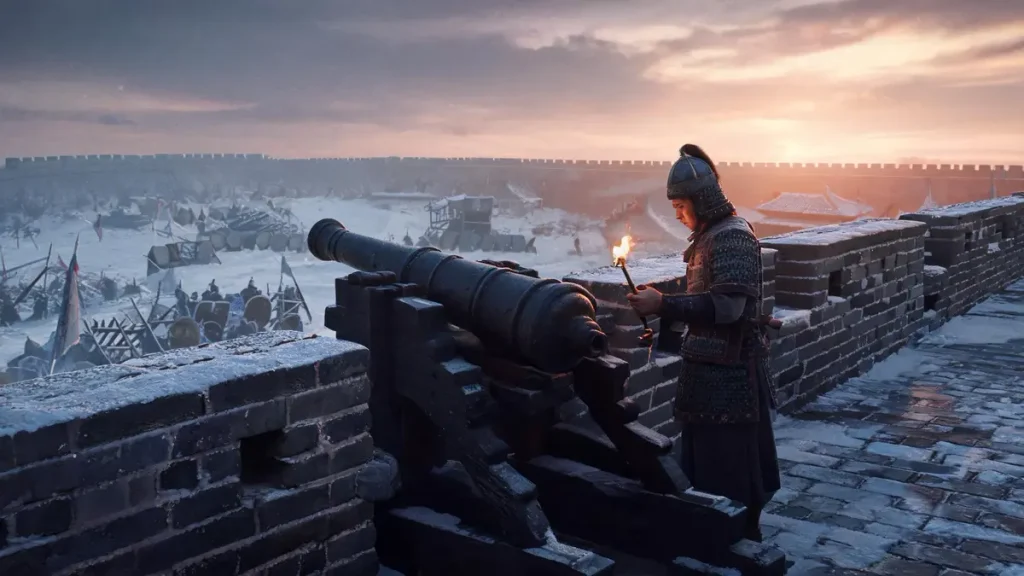
The battle is remembered as the great victory at Ningyuan. A grain official died on the wall. Jin Qigong was directing the guns when one went off and killed him, which is all the History says about it. He had come up from a clerk’s post, and Sun Chengzong had made him assistant prefect over the garrison’s grain, its walls and its lawsuits.
After the siege lifted the Jin turned on Juehua Island, where the Ming kept its grain, and killed the garrison commander and several thousand soldiers and civilians. The History gives Yuan’s position in one line: the wall was just finished, and he had nothing left to send.
The report reached Beijing and the court was delighted. Yuan became a vice censor-in-chief. Wei Zhongxian at once sent two of his people, Liu Yingkun and Ji Yong, out to Liaodong as garrison supervisors. Yuan objected in a memorial and was overruled. Nurhaci died in the eighth month of 1626 and Hong Taiji succeeded him. In the fifth month of the following year the Jin surrounded Jinzhou and on the twenty-eighth detached a force against Ningyuan. Yuan, the eunuch supervisor Liu Yingkun and the circuit intendant Bi Zisu held the wall while Man Gui, You Shilu and Zu Dashou fought outside it. Man Gui took several arrows. The Jin battered at the place until the fifth day of the sixth month, could not carry it in the heat, and withdrew, destroying the two Ling river forts as they went. This one is called the great victory of Ningyuan and Jinzhou. When the rewards were handed out, several hundred officers and officials were promoted and given hereditary rank. Wei Pengyi, still a child, was made a count. Yuan Chonghuan was raised one grade.
Wei Zhongxian then had his people argue that Yuan had failed to relieve Jinzhou and was finished as a commander. Yuan asked to be relieved. At that point the History writes a sentence that is painful to read: while the whole court was competing to praise Wei Zhongxian, Yuan reluctantly asked to build him a shrine, and even that did not please him. In the seventh month the emperor let him go home. He had won the battle, built the shrine, and still was not forgiven.
The bill for Liaodong fell on the Ministry of Revenue. From 1618 a surcharge was added to the land tax, nine li per mu by the end of the reign, about one hundredth of a tael. It was fixed at 5,200,000 taels a year and became a permanent part of the revenue. In the edict of the sixth month of 1626 the emperor himself wrote that the annual frontier funds came in full, that he had sent out twenty million taels from the treasury, that it had gone like water, and that nothing had come of it. In the third month of 1627 the peasants of Chengcheng in Shaanxi killed their magistrate, Zhang Douyao. The History puts it in the annals of the reign and says nothing more.
The sixth day of the fifth month, at the hour of the snake
At some point between nine and eleven in the morning on May 30, 1626, in the sixth year of the Tianqi reign, the Wanggongchang arsenal in the southwest of Beijing went up.
The History gives it one sentence: in the fifth month, on the day wushen, the factory was destroyed and the dead were very many.
Wanggongchang belonged to the Ministry of Works. It made gunpowder, stored it, and housed the workshops that filled the shells. Li Canran, the censor for the Western District, reported the damage that same day: 10,930 rooms collapsed, 537 men and women crushed. The Tianqi Emperor’s instruction was to grade the losses and pay promptly.
The minister of revenue, Li Qiyuan, asked for 6,000 taels from the inner treasury. The emperor thought that was stingy and released 10,000 from his own household. The paperwork records how it was divided. Eight mace three candareens went to each ruined house, one tael six mace six to each death, and the ten thousand came out exact. The other figure comes from the gazette. The account known as the Report of the Celestial Change says houses by the tens of thousands and people by the ten thousand, and later retellings raised the dead and injured to twenty thousand and more. The two numbers count different things. The censor counted the houses with owners and the bodies with names in one district on the day. The gazette counted the city. The original is lost and survives in copies.
What the gazette records best is the part that does not add up. Bodies were incomplete. Men and women were found stripped, and the living had their clothes torn off them. From Shuncheng Gate Street in the east to the Ministry of Justice street in the north, three or four li long and thirteen li around, everything was powder. Trees were pulled out by the roots. There were pits several fathoms deep. One account says that at the center not an inch of wood was scorched, and that there was no sign of burning at all. The court’s first move was to look for saboteurs. Yang Suoxiu, supervising secretary of the Ministry of Personnel, and Wang Yehao, a supervising censor, sent a joint memorial suggesting that an agent had fired the powder store and asking for tighter checks.
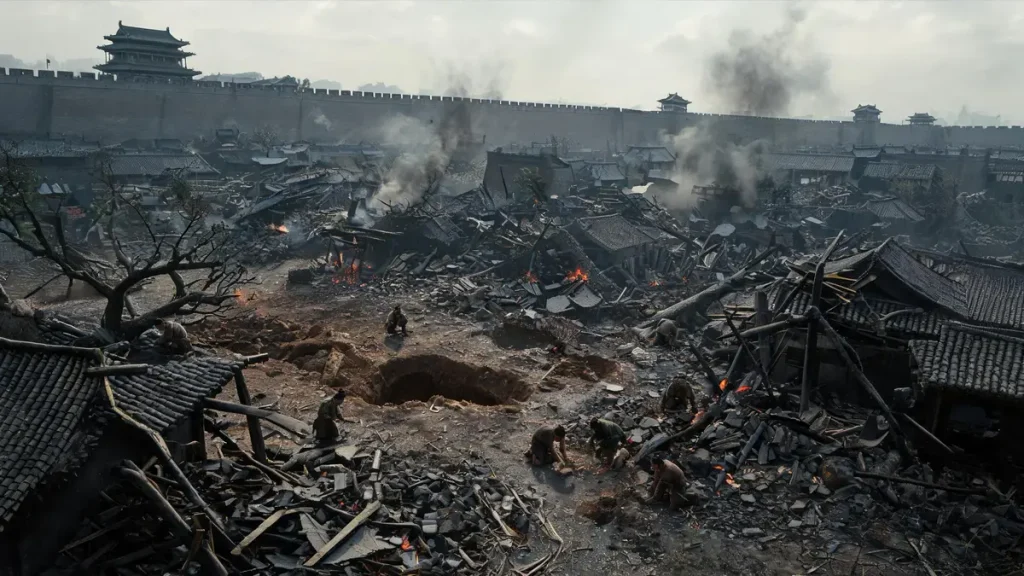
On the eleventh day of the sixth month the emperor issued an edict. It opens with the observation that Heaven in its benevolence had given three warnings in a single month. The three were Wanggongchang on the sixth, the Taoist palace of Chaotian on the twenty-first, and an earthquake in the capital at the start of the sixth month. Then the edict does something unexpected. Most of it is an audit. The Hall of Imperial Supremacy had cost 1,500,000 taels, no levy had been imposed on the people, no extravagance had been allowed. The frontier funds came in full and twenty million taels had gone out and vanished. He had already stopped the extra collections, the sweeps and the apportionments.
An edict answering a sign from Heaven reads as an accountant’s defense of a building project.
That day, according to the gazette, the emperor ran out of the palace barefoot, and his third son was thrown to the ground. The boy had been born in the tenth month of 1625. In the intercalary sixth month he was given the posthumous title Heir Apparent Xianhuai, and on the twenty-first day of that month his coffin was carried out.
As for what made the sound, three centuries have not settled it. The plainest explanation is a powder explosion. The factory held the stuff, men worked in it day and night, and one fire could take the lot. Beijing’s magazines blew up more than once: 1593, 1605, 1629, 1630 and 1634 all have entries. The second is an earthquake. The capital was shaking that month, and the Chaotian palace fire and the June tremor are both in the annals, so the store may have come down first and caught afterwards. The third is something from the sky, a meteor or an airburst like the one over Siberia three hundred years later.
None of the three covers the record. A powder accident cannot explain a center with no scorching or a street full of naked people. A meteor cannot explain why most of the dead were crushed under fallen houses, or what happened to the powder. In three hundred years nobody has produced a document that folds the three into one.
The boat at the Western Garden
In the fifth month of 1627 the Tianqi Emperor was boating at the Western Garden. The wind came up, the boat turned over, and he went into the water. He was pulled out and seemed unhurt. He never really recovered.
Huo Weihua, a minister, brought him a formula he called spirit dew, distilled from grain, sweet to the taste. The emperor drank it every day. After some months his body began to swell, from the feet up to the face, and he took to his bed. A modern reading is that spirit dew, if that is what it was, came down to sugar and water. Anyone living on it is short of protein, and protein shortage makes edema worse. That is a guess. No medical record survives, and nobody knows who prescribed it or how much he took.
On the eleventh day of the eighth month he called in his younger brother, the Prince of Xin. The line that gets quoted is: come, brother, you must be a Yao or a Shun, meaning the sage kings of old. The prince was frightened and said nothing for a long time, and then said that he deserved death for hearing such a thing.
On the twelfth the Tianqi Emperor met the grand secretaries and the supervising officials and told them that Wei Zhongxian and Wang Tiqian were loyal and could be trusted with great matters. On the twenty-second he died in the Palace of Heavenly Purity. He was twenty-three by Chinese reckoning and twenty-one by the Western count.
His will is a strange document. He begins with seven years of inheriting the ancestral enterprise and never daring to relax, then lists what he thinks he has done: the three halls are complete, the frontier has beaten back the enemy several times and is quieter. He meant to govern well and let the people rest. His constitution had been poor since before he took the throne. The strain of looking east and west at once had worn him down, and the old illness had come back, with blood from the nose, and he was writing at his desk and could not rise. The halls and the quiet frontier are the two achievements the Tianqi Emperor chose for himself.
He had no living son. All three boys had died young, the last of them shortly after the explosion at the arsenal, and that one was buried as Heir Apparent Xianhuai. The throne went to the fifth brother, who took it on the twenty-fourth day of the eighth month and changed the era name to Chongzhen the following year.
In the tenth month of 1627 the court settled his temple name, Xizong, and buried him at Deling. The tomb sits under Tanyu Ridge on the Tianshou range, the last imperial tomb the Ming built for itself. There was no money. It is smaller than the ones in front of it.
In the eleventh month Wei Zhongxian was sent to Fengyang and got as far as Fucheng, where he heard that he was to be arrested, and hanged himself in an inn with Li Chaoqin. His body was dismembered and his head hung up at Hejian. Ke Shi was beaten to death in the laundry court. When her house was searched the officers found eight palace women in it. In 1629 the new reign settled the case of the eunuch faction and graded its members into six classes of guilt.
In the third month of 1644 Li Zicheng’s army entered Beijing and the Chongzhen Emperor hanged himself on Coal Hill. The Hall of Imperial Supremacy was still standing that month. It kept its name until 1645, when the Qing renamed it the Hall of Supreme Harmony, which is what the tourists walk into today.
Sources and further reading
The History of the Ming (Mingshi), juan 22, basic annals of Xizong, for the birth in 1605, the accession, the two edicts of the accession month, the Eastern Depot appointment, the arrest of the six men, the Wanggongchang disaster, the living shrines, the completion of the halls, the 965 artisans, the death and the closing verdict: https://zh.wikisource.org/wiki/明史/卷22
The History of the Ming, juan 305, biographies of the eunuchs, for Wei Zhongxian’s origins, his illiteracy, the passage on the axe and saw, the Nine Thousand Years, the phrase "We and the Deputy", the qilin rescript, the children made nobles, and his death at Fucheng: https://zh.wikisource.org/wiki/明史/卷305
The History of the Ming, juan 259, biography of Yuan Chonghuan, for the single ride through the passes, the wall at Ningyuan, the withdrawal from Jinzhou, the cannon at Ningyuan, the death of Jin Qigong, Juehua Island, the rewards after Ningyuan and Jinzhou, and the shrine he was made to request: https://zh.wikisource.org/wiki/明史/卷259
The History of the Ming, juan 244, biographies of Yang Lian, Zuo Guangdou and Wei Dazhong, for the twenty-four crimes, the substitution of the bribery charge, the fines, the deaths of the twenty-sixth of the seventh month, and the money raised by Sun Qifeng and Lu Zheng: https://zh.wikisource.org/wiki/明史/卷244
The History of the Ming, juan 250, biography of Sun Chengzong, for the appointment in 1622, the forward garrisons of 1625 and the two hundred li of recovered ground: https://zh.wikisource.org/wiki/明史/卷250
The Veritable Records of Xizong, juan 72, for the edict of the eleventh day of the sixth month 1626, its opening on three warnings in one month, and its audit of the hall’s cost: https://zh.wikisource.org/wiki/罪己詔_(明熹宗)
The Palace Museum Journal, on the reconstruction of the three great halls, for the start of work on the twenty-third day of the second month 1625, the completion of the Hall of Imperial Supremacy in 1626, the raising of the beams on the second day of the eighth month 1627, the total of 5,957,519 taels, and the emperor’s reply that he was resting: https://www.dpm.org.cn/Uploads/pdf/5063/T00021_00.pdf
The Palace Museum, on public disaster response after the Wanggongchang explosion, for the censor Li Canran’s figure of 10,930 rooms and 537 dead, the 10,000 taels from the imperial household, and the compensation rates of 0.833 tael per room and 1.666 tael per death: https://www.dpm.org.cn/Uploads/File/2022/03/09/u6228227256005.pdf
The Tianfu Guangji, juan 5, for the fire of 1597, the twenty-eight years the three halls stood empty, and the same total cost of 5,957,519 taels: https://zh.wikisource.org/wiki/天府廣記/05