Yu Qian: Saving Beijing in 1449 & His Tragic Fall
On the seventeenth day of the eighth month, 1449, word from Tumu reached the capital.
The History of the Ming covers the moment in six characters: the officials wept in the hall. A room full of men stood and cried, and when they were done they did not know what the next sentence was.
The expositor Xu Cheng spoke first. He had read the stars, he said, and the stars had changed, and the capital should move south. Yu Qian, left vice minister of War, cut him off. Whoever speaks of moving south should be beheaded. The capital is the root of the realm. Move it once and everything is finished. Had they not seen what became of the Song when the court crossed the river?
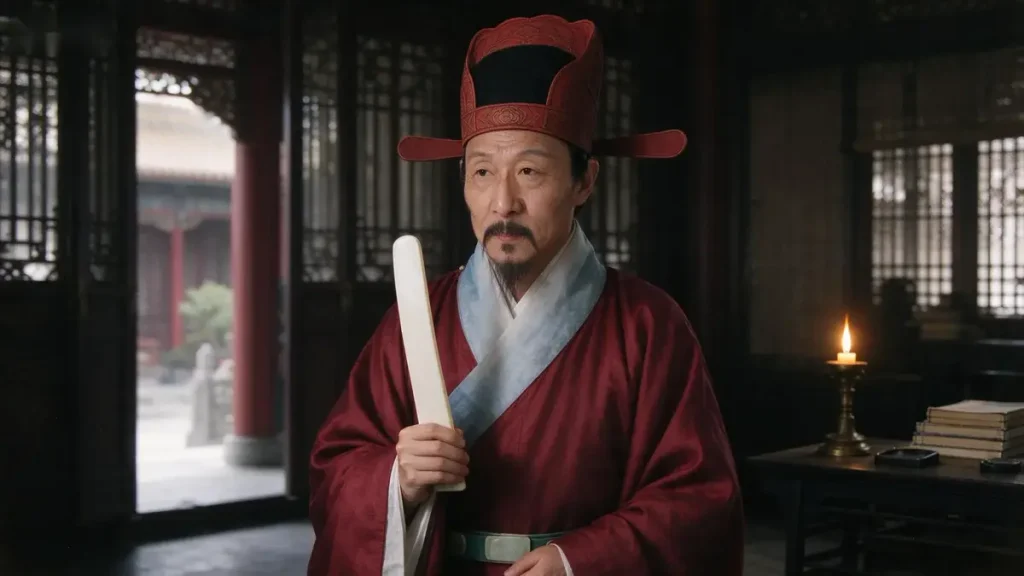
Zhu Qiyu, prince of Cheng, nodded, and the question of whether to hold the city was settled.
Two days earlier the Ming army at Tumu had been surrounded and had come apart in a single day. The History counts the dead in the hundreds of thousands. Among them were Zhang Fu, Duke of Ying, the minister of War Kuang Ye, the minister of Revenue Wang Zuo, and the Grand Secretary Cao Nai. The emperor, Zhu Qizhen, was carried off by the Oirat. In eighty-one years the dynasty had not seen anything like it.
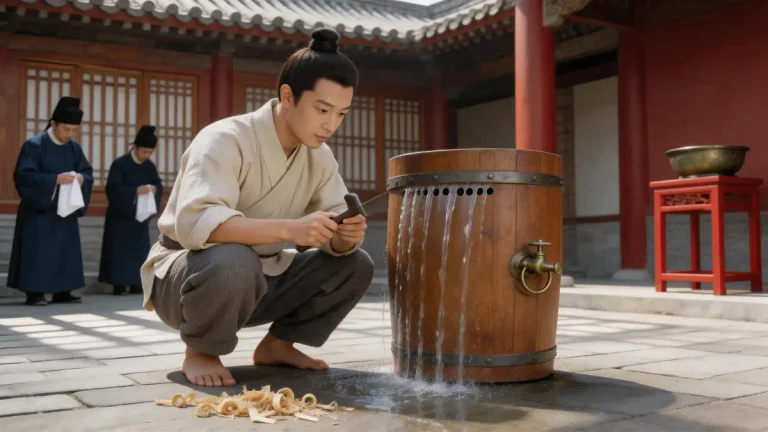
Yu Qian was born in 1398 in Qiantang, which is now part of Hangzhou, and took the jinshi degree in 1421. His office that autumn was left vice minister of War, and he had been back in the capital less than a year. For the nineteen before that he had been grand coordinator of Henan and Shanxi, and the work was granaries, dikes and wells. In 1441 he sent up a memorial on the granaries. Every March the prefectures and counties were to report the households short of food and issue grain against the autumn harvest, forgiving the old and the sick who could not repay. The dikes along the Yellow River were to be built thick, with a pavilion every li and a headman in each to keep them repaired. Elms and willows were to be planted along the roads beside new-dug wells, so that travelers would not go thirsty.
Under the Ming system the minister of War handled military registers, the appointment and ranking of officers, weapons and the post stations. He was a civil official of the second rank. Moving troops belonged to the five Chief Military Commissions and to the regional commanders in the field, and those men were soldiers. A civil official standing outside Desheng gate giving orders to fire was not provided for anywhere in the regulations.
Wang Zhen Takes the Emperor Out Through Juyong Pass
It began with the price of horses. In 1449 Esen, taishi of the Oirat, sent men in with tribute horses. Wang Zhen, who ran the Directorate of Ceremonial, cut the price. The envoys went away angry. In the seventh month Esen came against Datong in force.
Wang Zhen was from Yuzhou. He had been chosen as a boy for the Inner College, the palace school for young eunuchs, and then assigned to the heir apparent’s household, so he had been beside Zhu Qizhen since the prince was a child. The History says the emperor leaned toward him completely and called him Master. Dukes and marquises called him Father Weng. In 1442 the Grand Empress Dowager died. Yang Rong was already dead, Yang Shiqi had withdrawn after his son was jailed, Yang Pu was old and ill, and the two new Grand Secretaries, Ma Yu and Cao Nai, carried no weight. From that year Wang Zhen could not be controlled.
He talked the emperor into going north himself. The minister of Personnel Wang Zhi brought the officials to remonstrate and was not listened to. Kuang Ye, the minister of War, and Yu Qian also remonstrated, and were not listened to either. Kuang Ye went along to manage the troops, and Yu Qian stayed behind to run the ministry. That arrangement decided who would be holding the ministry in Beijing.
On the sixteenth day of the seventh month the army left the capital. The next day, at Longhutai, the camp panicked in the night on its own. At Xuanfu there was wind and heavy rain, more men remonstrated, and Wang Zhen grew furious. Zhu Yong, Duke of Chengguo, came in to report and crawled forward on his knees. The ministers Kuang Ye and Wang Zuo crossed him and were made to kneel in the grass.
On the first day of the eighth month they reached Datong. The eunuch Guo Jing, who was stationed there, told him what the enemy looked like, and only then did Wang Zhen become afraid. He ordered the army back. The route changed twice. He wanted to go by Zijing Pass and swing through Yuzhou so that the emperor could visit his house. Then he was afraid the army would trample the crops of his own district, and turned back onto the Xuanfu road. The men marched in circles. They reached Tumu on the fourteenth day of the eighth month and were surrounded that day. The next day the army broke. The emperor was taken. Wang Zhen was killed by soldiers in the rout.
Word of the defeat reached Beijing two days later. The empress dowager ordered the prince of Cheng to supervise the government and made Zhu Qizhen’s son Jianshen, not yet two, crown prince. Esen held an emperor. The Ming held a child not yet two. Between them lay the dead, counted by the History in the hundreds of thousands, and a city with almost no soldiers left in it.
Xi Ning, a eunuch who had gone over to Esen, was doing his thinking for him. The plan was to ask for gold and silk by the ten-thousand measure, and to ask that ministers come out of the city to welcome the emperor back and talk terms.
September 1449: Beijing Gets a New Emperor
Two days after the news arrived, the grain at Tongzhou began moving into the city. Two days after that, on the twenty-first day of the eighth month, Yu Qian went from left vice minister to minister of War. The defense of Beijing was now his to run.
Before the new emperor there was a killing in the audience hall. The officials wanted Wang Zhen’s whole clan destroyed. Ma Shun, one of Wang’s men, turned on the censors and cursed them. Wang Hong, a supervising secretary, hit him, the hall piled on, and the guards started shouting. The prince of Cheng was frightened and began to rise. Yu Qian forced his way through the crowd, held him where he was, and got the words out of him that Ma Shun and the others deserved to die and no one was to pursue it further. He came away with his sleeve torn off. At the gate the minister of Personnel Wang Zhi took his hand and said the realm was resting on him, and that a hundred Wang Zhis could do nothing today.
Putting up a new emperor was a decision the officials and the empress dowager made together. Yu Qian did not make it alone. With no one on the throne, a crown prince too small to hold it, and an enemy army coming, the ministers asked the empress dowager to raise the prince of Cheng. He refused twice. Yu Qian spoke out: it is the realm we are anxious about, not ourselves. The prince accepted. On the sixth day of the ninth month he took the throne and named his half-brother Retired Emperor.
That step did its work on Esen’s side. The emperor in his hands stopped being an emperor.
In the ninth month Yu Qian sent up a memorial that laid out the defense item by item. Order the frontier commanders to work together. The capital’s weapons are nearly gone, so raise militia by district and put the Ministry of Works on armor. Send the commanders Sun Tang, Wei Ying, Zhang Yue, Zhang Yi and Lei Tong to hold the nine gates with camps outside the wall. Attach the censor Yang Shan and the supervising secretary Wang Hong to them. Move the people of the suburbs inside. Keep the Tongzhou grain by letting troops draw it themselves, with what they cannot eat sold to them at a price, rather than leave it for the enemy. Use a civil official like Xuan Ni as grand coordinator, and soldiers like Shi Heng, Yang Hong and Liu Pu as commanders. The last line was: as for the fighting, I will carry it myself, and if it fails, punish me. The emperor approved all of it.
What he had inherited was this. The capital’s armored cavalry was gone, fewer than 100,000 exhausted men remained, and no one above or below had any confidence left. He asked for writs calling in the reserve units of the two capitals and Henan, the anti-pirate garrisons on the Shandong and Nanjing coast, and the grain-convoy troops of Jiangbei and the Beijing prefectures. They came in batches. By the tenth month, when the army formed up outside the nine gates, the History gives the number as 220,000.
In the tenth month he was given command of all the camps. The writ put the soldiers of the capital garrison into the hands of a minister of War.
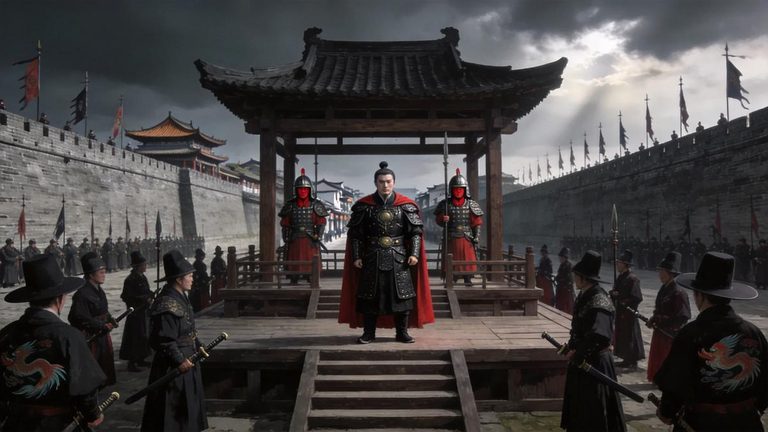
The roster survives in the History, gate by gate. Tao Jin at Anding. Liu An, Earl of Guangning, at Dongzhi. Zhu Ying, Earl of Wujin, at Chaoyang. Liu Ju at Xizhi. Gu Xingzu, Marquis of Zhenyuan, at Fucheng. Li Duan at Zhengyang. Liu Dexin at Chongwen. Tang Jie at Xuanwu. Yu Qian himself, with Shi Heng and the deputy commanders Fan Guang and Wu Xing, stood outside Desheng, facing the road Esen would come by. Ministry business went to the vice minister Wu Ning. All nine gates were shut, and he commanded from outside the wall.
The orders were two. A general who falls back without his men will be killed by his own officers. Soldiers who fall back without their general will be cut down by the ranks behind. The History says the men understood that they were going to die, and obeyed.
Shi Heng proposed something else. Pull the troops inside, sit behind the wall, and let the enemy wear himself out. Yu Qian refused, and asked him what good it did to show weakness and let the enemy think less of them.
The Empty Houses Outside Desheng Gate
In the tenth month Esen came through Zijing Pass with the Retired Emperor and entered the capital’s hinterland.
Xi Ning advised him to demand gold and silk, and to demand that Yu Qian, Wang Zhi and Hu Ying come out of the city to talk. The Jingtai emperor refused. With no minister leaving the wall, the hostage had nothing to buy.
Esen had come expecting the city to fall in a day or two. When he saw the army drawn up outside the gates waiting for him, the History says his confidence drained.
On the gengshen day of the tenth month the enemy probed Desheng gate. Yu Qian had Shi Heng put troops into the empty houses and send a few riders out as bait. More than 10,000 horsemen came on, Fan Guang opened with firearms, and the ambush rose. Esen’s brother Bolod and a senior official, Mao Naihai, were killed by cannon.
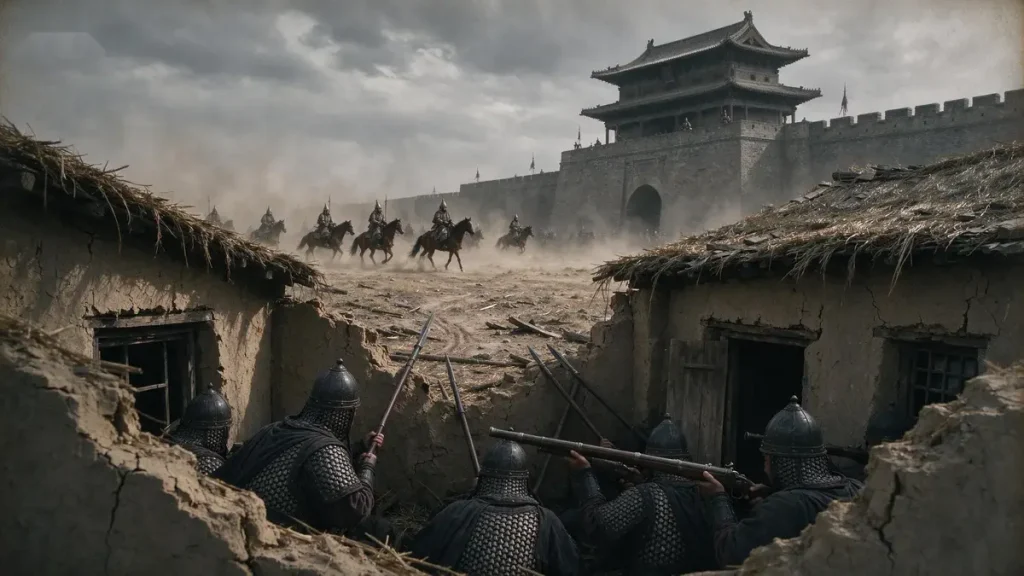
The enemy turned to Xizhi gate. Sun Tang held, Shi Heng detached troops to him, and they fell back.
Zhangyi gate went badly. Wu Xing and the commander Wang Jing broke the enemy’s van, and the enemy was about to withdraw when a few hundred riders came out of the palace wanting the credit, charged, and broke their own formation. Wu Xing took a stray arrow and died. The pursuit reached the earth wall, where people climbed onto their roofs and threw bricks down, shouting loud enough to carry a long way, until Wang Hong and Mao Fushou came up with reinforcements and the enemy fell back.
The standoff lasted five days. Esen got nothing. No one came out to him, his attacks failed, and the relief armies were closing. Afraid of being cut off behind, he went west from Liangxiang with the Retired Emperor. Yu Qian sent troops after him, and they turned back at the pass.
For the defense he was made junior guardian and given overall command. He refused. Enemies on four sides are the shame of the officials, he said, and he would not ask for a reward. He was not allowed to refuse.
In the third month of 1450 Xu Gui, a deputy general at Datong, sent up a memorial. Three men had come down from the north saying that the court should send an envoy to make peace. Yu Qian turned it down. The last time an envoy went, Ji Duo and Yue Qian, Esen came raiding right behind them. The time after, Wang Fu and Zhao Rong went and never got to see the Retired Emperor’s face. Peace cannot be relied on, he wrote, that much is clear, and besides, we and they cannot live under the same sky, so there can be no peace by any reckoning. He sent a sharp reprimand around the frontier. After that the border commanders argued for war and for holding, and no one raised peace again.
Over the next few years most of his work was not on a battlefield. The capital garrison had been split among the Five Army, Firearms and Three Thousand Battalions, each with its own commander and none under another. In 1452 he asked for 150,000 picked men out of them, formed into ten camps and trained together; the integrated training corps dates from that year. When the Oirat came in with tribute they brought people they had taken, and he had every one of them redeemed with a payment, several hundred in all. When the Retired Emperor came home he said the shame was still unpaid, and asked to raise a large force and go north himself. The Jingtai emperor refused.
The Oirat side came apart in the same years. Esen fell out with Toghto-bukha, the khan in name, and in 1454 was killed by Alag, one of his own commanders.
Before Daylight on the Seventeenth Day of the First Month
In the first month of 1457 the Jingtai emperor was ill, and had himself carried out to the Fasting Palace in the southern suburbs. The officials asked him to name a crown prince. He would not. The succession sat empty.
Before daylight on the seventeenth a party of soldiers went to the Southern Palace. It was led by Shi Heng, Marquis of Wuqing, with the commanders Zhang Ni and Zhang Yue, the censor-in-chief Yang Shan, the vice censor-in-chief Xu Youzhen and the eunuch Cao Jixiang. They brought the Retired Emperor out and took him to the Fengtian gate to face the officials. At noon he sat on the throne in the Fengtian hall. The event is known as the Duomen incident, seizing the gate. Four days later the era name changed to Tianshun. On the fifth day Yu Qian was killed.
The men who killed him each had a bill. At Desheng Shi Heng had done less than Yu Qian and came away a hereditary marquis, and he knew it. He sent up a memorial recommending Yu Qian’s son Mian. Yu Qian pushed it back. The state is in trouble, he wrote, and a subject may not look after private debts. Shi Heng is a great general and has not recommended one man in hiding or one man out of the ranks who would help the army and the state, and he recommends my son instead. On military merit I block every shortcut, and I will not let my son take a reward he did not earn. Shi Heng hated him from then on.
Xu Youzhen was the Xu Cheng who had read the stars and wanted to move south. Yu Qian had cut him down in front of the court, and he changed his name afterward and kept the account. Zhang Yue had lost men on the Miao campaign and been impeached by Yu Qian. Cao Jixiang was a eunuch who had hated him for years.
The attacks did not come only from soldiers. Luo Tong, a censor-in-chief, said his list of merits was inflated. A censor named Gu said he was too independent, and asked that major business of the Six Ministries be submitted jointly with the Grand Secretariat. The History describes the temper: hard by nature, and when something went against him he would strike his chest and say, where is all this hot blood of mine to be spilled. He thought little of the pliant ministers and the old noble houses, and the men who resented him grew in number.
In 1452 the emperor changed the succession, moving the title from Zhu Jianshen to his own son Zhu Jianji. On that the History leaves Yu Qian exactly one line. When the Eastern Palace changed, those who held concurrent posts in the heir’s household were given a double salary; the other officials all declined, and Yu Qian alone declined twice. What he declined was a second salary. Other accounts say he sent up a memorial against the change, but the text is not in what survives.
Four years later the first charge against him was that same change of heir, a piece of state business the court had carried out in the open. The second was a plot to bring in a son of the prince of Xiang. The censor-in-chief Xiao Weizhen fixed the verdict: treason, capital punishment.
In prison, the Grand Secretary Wang Wen argued and argued. Yu Qian laughed at him. It is what they want, he said, and what is the use of arguing.
The memorial went up and the emperor still hesitated. Yu Qian did good service, he said. Xu Youzhen answered: if Yu Qian is not killed, this has no name.
That sentence is the whole hinge of it. Yu Qian had held Beijing, and the emperor knew that he had. A restoration needs a crime, and the crime has to land on a man heavy enough to carry it. The reason he died had nothing to do with anything he did after Tumu.
On the twenty-second day of the first month Yu Qian was executed in the marketplace. The History uses the two characters for a public execution. Later accounts put the ground outside the Chongwen gate.
On the first day of the second month the Jingtai emperor was reduced to prince of Cheng and moved to the western palace. On the nineteenth he died there, thirty years old. He was given the posthumous name Li, harsh. The tomb he had been building was pulled down, and he was buried in the Western Hills with the rites of a prince.
No Money in the House, and One Room Locked Tight
When they searched the house there was no surplus money in it. One main room was locked and bolted. Inside were the court robes and the swords the throne had given him over the years.
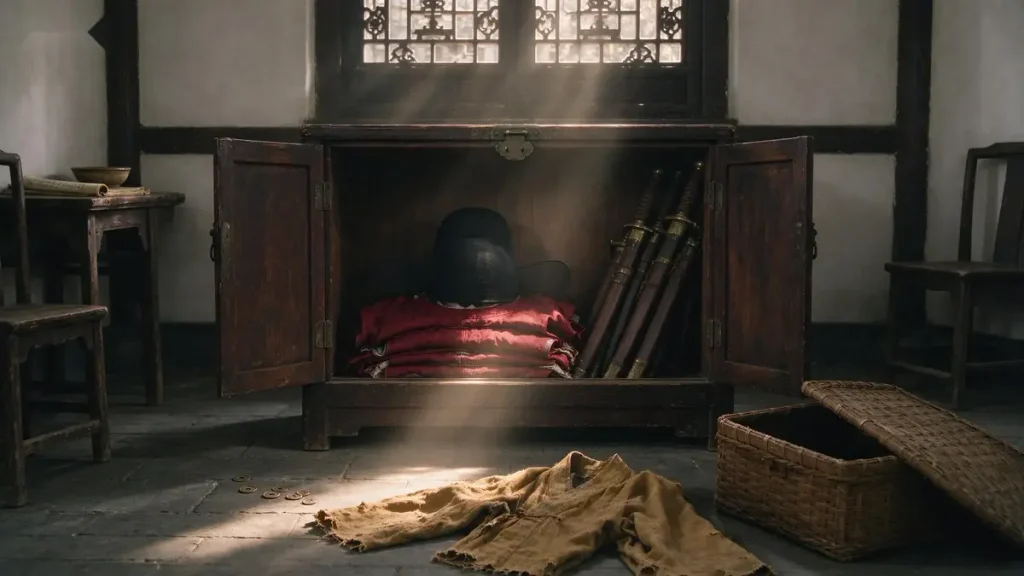
He had lived where the wind and rain came through. The Jingtai emperor offered him a mansion at Xihua gate. He refused it: the state is in trouble, and a subject has no business being comfortable. When he could not refuse, he sealed and labeled everything he had been given, the edicts, the robes, the silver, and looked at it once a year. He often slept at the ministry duty room instead of going home. He had a phlegm disease, and when it flared the emperor sent Xing An and Shu Liang to look in on him in turn. Hearing that his bedding and utensils were too thin, he had the imperial workshops make them and send them over, down to the pickles, and went himself to Longevity Hill to cut bamboo and draw the sap for him. Someone said this was too much favor for one official. Xing An answered: he carries the realm’s worries day and night and never asks what his own estate is worth, and if he goes, where is the court going to find another one.
Earlier, in the provinces, he came to the capital for consultations with his pockets empty. The History has it that he entered with an empty bag, and the powerful men had nothing to hope from him. His collected works hold a poem called Entering the Capital whose last two lines run: with two sleeves of clear wind I go up to court, so that the people in the lanes have nothing to say against me. The four characters for two sleeves of clear wind became a set phrase in Chinese from there.
On the day he died the sky closed over, and it was agreed everywhere that he had been wronged. A commander named Duo’er, who had served under Cao Jixiang, brought wine to the place of execution, poured it out and wept aloud. Cao Jixiang had him beaten. The next day he came back and did it again. Chen Kui, a deputy commissioner, collected the body and coffined it, and a year later it went home to Hangzhou. The empress dowager had not known he was dead; when she heard, she sighed over it for days. The emperor regretted it too.
In the tenth month of 1457 the emperor ordered sacrifices and a burial for Wang Zhen, called his spirit back, and set up a shrine for him at the Zhihua Temple.
In the first month of 1458 Chen Ruyan, who had taken his seat at the Ministry of War, was caught. The property seized came to a fortune. The emperor had the ministers brought in to look at it and said, with his face changed: Yu Qian served the Jingtai court and died with nothing left, and how is it that Chen Ruyan has this much. Shi Heng stood with his head down and had no answer. Later, when the frontier sent up an alarm and the emperor’s worry showed, Wu Jin, Marquis of Gongshun, who was in attendance, said that if Yu Qian were here he would not let the enemy get this far. The emperor said nothing.
In the first years of Chenghua, Yu Mian was pardoned and came home, sent up a memorial demanding justice, and got the office and the sacrifices restored. The patent has a line: when the state was in its difficulties he kept the altars whole and safe; he alone held to what was fair, and the powerful hated him for it together. My predecessor knew that he had been wronged, and I grieve for his loyalty. In 1489, on the word of the supervising secretary Sun Xu, he was given the office of grand tutor, the rank of pillar of state and the posthumous name Su Min. A shrine went up at the grave, called Jinggong, where the local authorities sacrifice every year at the proper seasons. Under the Wanli emperor the name was changed to Zhong Su, loyal and reverent. In Hangzhou, Henan and Shanxi the offerings have not stopped.
Shi Heng was jailed in 1460 and died there. Cao Jixiang rebelled in 1461, was executed, and his clan was wiped out. Xu Youzhen was brought down by Shi Heng and sent to Jinsi in Yunnan. The verdict at the end of Yu Qian’s biography in the History puts their ends side by side. They all caught up with them without a step’s delay, it says, and his loyalty and honor shine against the sun and moon.
He is buried at the east foot of Santai Hill, on West Lake in Hangzhou. Half a lake to the north, under Qixia Ridge, is Yue Fei’s grave. To the south, under Nanping Hill, is Zhang Huangyan’s. Later generations call the three the Three Heroes of West Lake. Yuan Mei, writing in the Qing, has a line about how, with the two junior guardians Yue and Yu lying here, the world began to take West Lake seriously. Yue Fei and Yu Qian both held the office of junior guardian. Their deaths are 315 years apart, and their graves stand at two ends of one lake.
Wen Tianxiang is buried in Ji’an, in Jiangxi, nowhere near the water. Men of letters from the Ming and Qing on usually added a line about the hero of Yu Qian’s boyhood. The story comes from collections edited by later hands and from the Hangzhou gazetteers, which have him keeping a portrait of Wen in his study and writing a eulogy for it. Wen Tianxiang was killed in the market at Dadu in 1283. Yu Qian was killed outside the Chongwen gate in 1457, a hundred and seventy-four years later.
The Other Yu Qian, Born in 1969
Search the name in Chinese and the man who comes up is often not the Ming one.
The other is a xiangsheng performer, the two-man comedy form built on rapid dialogue, born on January 24, 1969, a member of Deyunshe and the fixed partner of Guo Degang. The two first played together in 2000 in a routine called Shuan Wawa, and he joined the troupe in 2004. In 2019 he starred in and co-produced a film about a high school teacher, which brought him the best actor award at the 11th Macau International Movie Festival. He also writes, and has published a collection of essays called Wanr, roughly “mucking about”.
The two Yu Qians were born 571 years apart. The first has a biography in juan 170 of the History of the Ming and a grave on West Lake. The second is on Deyunshe’s playbills. Put Ming or Deyunshe into a search and they stay apart.
Questions readers ask
Who was Yu Qian in the Ming dynasty?
Yu Qian was a civil official of the middle Ming, a jinshi of 1421 who rose to minister of War. He spent nineteen years as grand coordinator of Henan and Shanxi, then took over the Ministry of War after the Tumu crisis of 1449 and organized the defense of Beijing against the Oirat army of Esen. When the Zhengtong emperor took the throne back in 1457, Yu Qian was executed for treason. He was cleared in the 1460s, given the posthumous name Su Min in 1489, and renamed Zhong Su under Wanli.
How did Yu Qian hold Beijing in 1449?
He rebuilt an army out of what was left. The capital’s armored cavalry had gone at Tumu and fewer than 100,000 exhausted men remained; by calling in reserve units, coastal garrisons and grain-convoy troops he had 220,000 men outside the nine gates by the tenth month. He put them outside the wall instead of inside, against advice, and had the gates shut behind them. He also refused to let any minister leave the city to negotiate, which left Esen’s hostage worth nothing. At Desheng gate an ambush in empty houses and a volley of firearms killed Esen’s brother and broke the attack. After five days Esen withdrew.
Why was Yu Qian executed after winning the Battle of Beijing?
Because the charge was not about the battle. The men who restored the Zhengtong emperor in 1457 needed the previous reign’s leading minister to be a traitor, and Yu Qian was the heaviest man available. The emperor hesitated and said Yu Qian had in fact done good service; Xu Youzhen answered that without killing him the whole enterprise had no name. The two charges, changing the heir and plotting to install a prince of Xiang, could not be proved. He was executed on the twenty-second day of the first month of 1457.
What is the difference between the Ming official Yu Qian and the comedian Yu Qian?
The dates and the trade. The Ming Yu Qian lived from 1398 to 1457, was born in Qiantang, passed the jinshi examination in 1421, became minister of War and is buried at Santai Hill on West Lake in Hangzhou. The other Yu Qian was born on January 24, 1969, performs xiangsheng with Guo Degang at Deyunshe and has also acted in films. Adding Ming, Beijing or Deyunshe to a search keeps the two apart.
Sources and further reading
Mingshi (History of the Ming), juan 10, the annals of Yingzong before 1449, for the march north, the collapse at Tumu and the roster of the dead. Chinese text: https://zh.wikisource.org/wiki/明史/卷10
Mingshi, juan 11, the annals of the Jingtai emperor, for the accession, the nine gates, the fighting in the tenth month and the Duomen coup. https://zh.wikisource.org/wiki/明史/卷11
Mingshi, juan 12, the annals of Yingzong after the restoration, for the executions of 1457 and the shrine to Wang Zhen. https://zh.wikisource.org/wiki/明史/卷12
Mingshi, juan 170, the biography of Yu Qian, the main source for this article, including the nine-gate roster, the two orders, the search of his house and the verdict at the end. https://zh.wikisource.org/wiki/明史/卷170
Mingshi, juan 304, the chapter on eunuchs, for Wang Zhen, his household, the price of horses and the shrine at the Zhihua Temple. https://zh.wikisource.org/wiki/明史/卷304
Yuzhongsu gong ji (Collected Works of Yu Qian), for the poem “Entering the Capital”. Standard modern edition: Yu Qian ji, Zhejiang guji chubanshe.
Wikipedia, “Yu Qian”: https://en.wikipedia.org/wiki/Yu_Qian
Wikipedia, “Tumu Crisis”: https://en.wikipedia.org/wiki/Tumu_Crisis
Wikipedia, “Jingtai Emperor”: https://en.wikipedia.org/wiki/Jingtai_Emperor
Wikipedia, “Esen Taishi”: https://en.wikipedia.org/wiki/Esen_Taishi