why did the ming dynasty fall
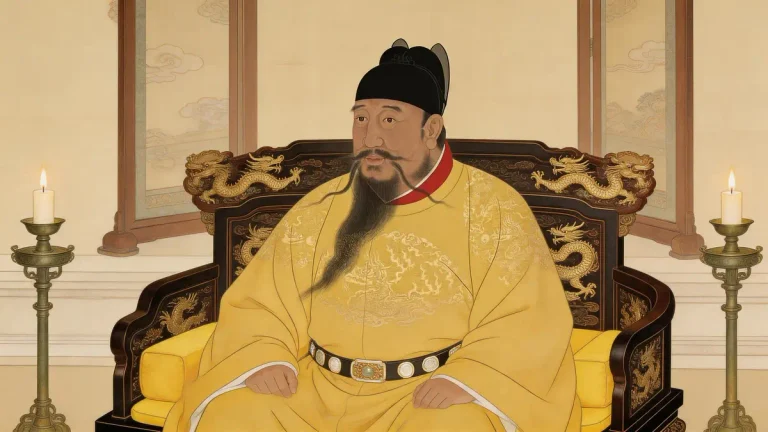
On the evening of April 24, 1644, the outer wall of Beijing gave way and the men on the parapets came down and ran. That night Empress Zhou killed herself inside the palace.

Before dawn on the 25th the inner city fell as well. The History of the Ming disposes of the whole event in a single sentence: at first light the inner wall was lost, the emperor died on Coal Hill, and the eunuch Wang Chengen died with him. Coal Hill is the rise immediately north of the Forbidden City, now called Jingshan.
On the lining of his robe he left a few lines: "My virtue is thin and I have provoked the anger of Heaven, but it was my ministers who ruined me. In death I have no face to meet my ancestors, so take off my crown and let my hair cover my face. Let the rebels divide my body, but spare the common people." The note asks for nothing else.
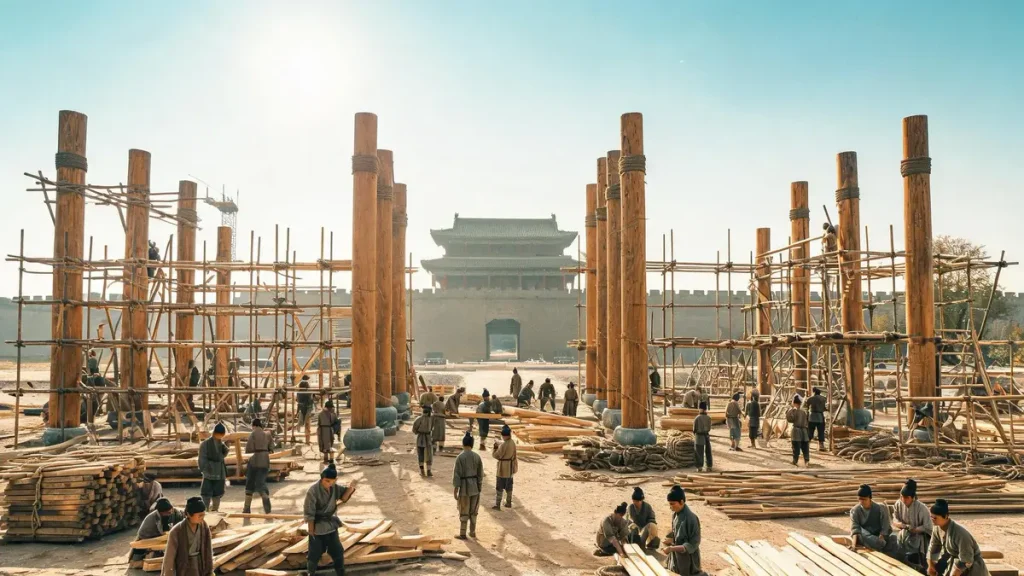
The Ming dynasty had lasted 276 years. Much of what it built is still standing. The palace on Beijing’s central axis took fourteen years to raise and is now the Forbidden City. The wall that tourists climb at Badaling is mostly Ming masonry. The blue-and-white porcelain fired at Jingdezhen was seized at sea by Dutch ships in the seventeenth century and sold in lots, which started a collecting habit in European courts. In 1405 Zheng He sailed west with sixty-two great ships, eighty-seven years before Columbus crossed the Atlantic. The tax registers listed sixty million people, and modern estimates put the real population above a hundred million.
So the question worth asking is not why one man died on a hill. It is why the fall of the Ming dynasty came so fast, in an empire that had held together for 276 years.
Four things arrived in the same generation. Global temperatures fell and north China went seven years without rain. The silver that the tax system ran on stopped coming from two directions at once. The court stopped working, and the men who should have run it spent their time fighting each other. And two wars opened at once, one in Liaodong and one in the interior, so that the best troops in the empire were pinned at Shanhai Pass. Together they made a perfect storm.
Seven years without rain in north China
In 1972 the meteorologist Zhu Kezhen published a temperature curve covering five thousand years of Chinese history. On it the seventeenth century is the coldest stretch of the past millennium. At the end of the Ming, average temperatures ran one to two degrees Celsius below today’s. Applied to farming, one or two degrees means a shorter growing season, fewer frost-free days, and less grain from the same field.
The cold was not a Chinese problem. Ice cores from Greenland and harvest records from Europe point to the same window of years, and the Thirty Years’ War was fought inside it.
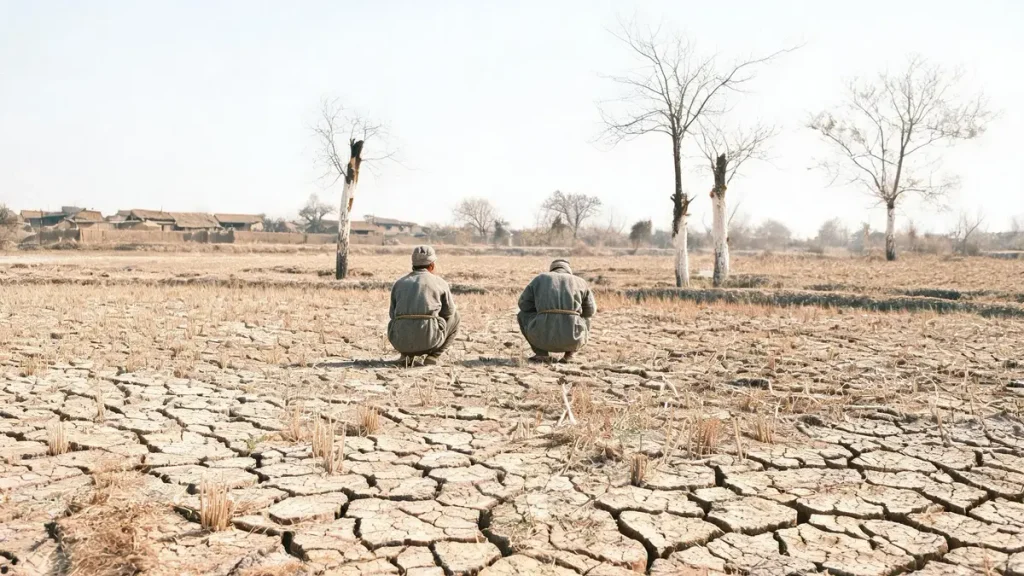
The Chinese record is far more specific. From 1637 the north went seven years with almost no rain, and 1640 was the worst of them. Zhu Kezhen, working from local gazetteers, put rainfall across the central plains between May and September of that year at about 210 millimeters, roughly what the Gobi gets in a year. The Fen River in Shanxi stopped flowing. Gazetteers in Henan, Shandong and Hebei keep returning to one phrase for the ground: bare earth.
For 1640 the History of the Ming has a single line: drought and locusts in the two metropolitan provinces, Shandong, Henan, Shanxi and Shaanxi, and people eating one another. The two metropolitan provinces were the districts around Beijing and Nanjing.
Locusts came with the drought. The record notes swarms in Henan in 1635, in Shandong and Henan in 1637, and again in 1638, 1640 and 1641. Drought, locusts and famine came in that order, and what came after the famine was disease.
Plague reached the capital in 1643. The entry for that year records a great epidemic in Beijing from the second month into the seventh. It then lists what the court did: released prisoners held on minor charges, opened the treasury to pay for medicine, and paid for the burial of bodies left in the streets. The entry is dated July, eight months before the city fell.
Modern studies of the outbreak, working from gazetteers across north China, put the dead in the millions. The estimates vary a great deal by method. What the sources agree on is that the capital had been through a mass death before the rebels reached it.
The military consequence was direct. In March 1644, with Li Zicheng’s army outside the wall, the garrison registers still listed soldiers, and there were not enough men fit to stand on the battlements. The History of the Ming records the collapse of the capital garrison in four characters and adds no detail. Two days later the inner city was gone.
A tax system that would only take silver
The fiscal treatise of the History of the Ming describes the Single Whip reform in plain terms. It consolidated the labor service and the land tax of each county into one assessment, calculated on land and persons, and commuted the whole into silver, paid by the taxpayer and handled by the magistrate. The compilers add that the method was simple and convenient.
That simplicity was the point, and also the trap. A county that had once collected grain, cloth, silk and labor under dozens of headings now collected one sum of money. From that point on, every peasant in China owed a tax in something he did not produce. He grew grain and paid in silver, and whether he could get silver depended on whether anyone wanted to buy his grain.
China mined almost no silver of its own.
In the early seventeenth century the metal reached China by three routes: from the Americas across the Pacific to Manila, from Japan through Nagasaki and Macao to Guangzhou, and from India through the Strait of Malacca. Potosí, in Bolivia, opened in 1545 and supplied most of the American metal. Manila was founded in 1571, and from 1573 a galleon ran the Pacific crossing once a year.
All three routes narrowed in the 1630s. In the busiest years of the 1620s, forty or more Chinese ships called at Manila each year. By 1629 the number was six. In 1634 Spain restricted silver exports from Acapulco. In the winter of 1639 the Chinese community in Manila was massacred. In 1640 Portugal recovered its independence and the Macao trade with Manila stopped. Japan closed its ports in a series of edicts from 1633, and its silver exports fell away.
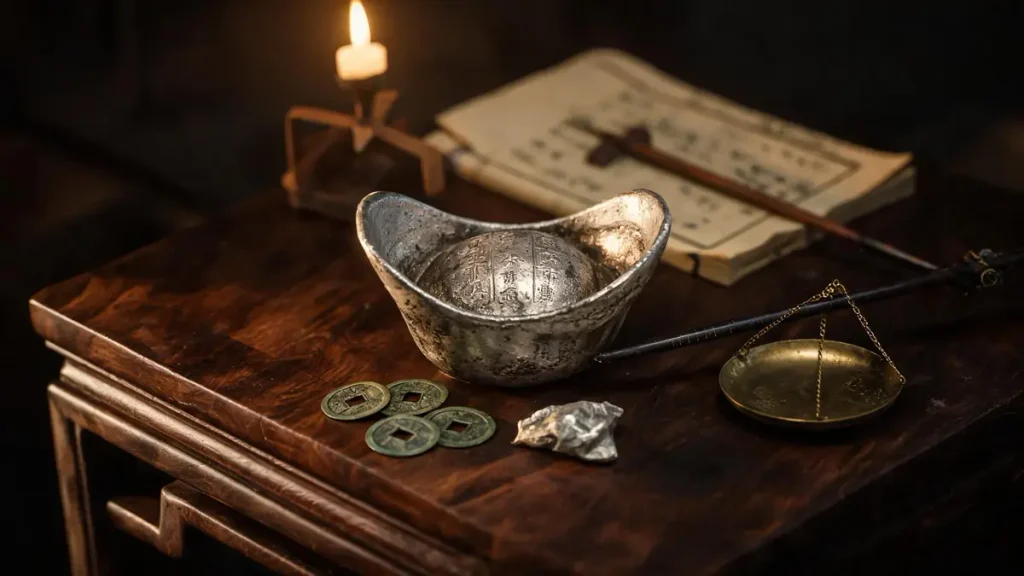
Less silver in circulation made each tael worth more. A fixed quantity of rice now fetched fewer taels than it had a decade earlier, while the tax assessed in taels stayed where it was. To raise the same sum a farmer had to sell more grain.
The court kept adding to the bill at the same time. In the last years of the reign the censor Hao Jin did the arithmetic for the throne. The nine frontier commands had cost 2.8 million taels a year at the end of the Wanli reign. The Liaodong levy had since risen to nine million, the suppression levy to 3.3 million, and the training levy to more than 7.3 million. He asked whether any state in history had gathered twenty million taels from the countryside in one year and another twenty million to send to the frontier. Every tael was assessed on land and paid in silver. Sitting under that bill was a fixed cost the court could not touch. In 1562 the censor Lin Run laid it out. The grain shipped to the capital each year came to four million shi, while the stipends owed to the imperial princes and their descendants came to 8.53 million. In Shanxi and Henan the grain retained locally, handed over entire, would cover less than half of what the princes of those two provinces were owed, and official salaries and army pay came out of the same granary. The clan was also growing. At the founding, fifty-eight imperial kinsmen were on the register. By 1605 the imperial genealogy listed 157,000.
Xu Guangqi, doing his own count, thought fewer than 80,000 were still alive. The two figures differ by half and measure different things, but the direction is the same.
None of these people could sit the examinations, trade, or leave their fiefs. They could only draw their stipends.
Fixed income met a growing population, and the state’s answer was to fall into arrears.
Memorials that went in and never came out
Finance was one thread. Administration was the other. In April 1612 the censors of the Nanjing circuit sent up a joint memorial: the censorate and the ministries stood empty, business was being neglected, and the emperor had not received a minister in more than twenty years. The History of the Ming records the answer in two characters: no response.
No response became the standard entry for the later Wanli years. In the winter of 1589 a junior official named Luo Yuren submitted a document criticizing the emperor’s drinking, his women, his greed and his temper. The emperor wanted him punished and the senior grand secretary, Shen Shixing, talked him out of it. The same passage ends with a line that matters more than the incident: from this point memorials began to be held back. Held back meant neither approved nor returned. A frontier report, a request for famine relief, a list of officials waiting to be appointed went into the palace and stopped there. Vacancies were entered in the annals as they accumulated. In March 1603 the Ministry of Personnel reported that prefectures had no prefects, and got no answer. In February 1604 the grand secretaries asked for appointments to provincial posts and for censors to be sent out, and got no answer. Fang Congzhe’s biography preserves the emperor’s own explanation. He believed the realm was at peace, that offices need not all be filled, and that he was deliberately keeping the establishment small.
What followed Wanli was a different kind of emptiness. The eunuch biography explains how Wei Zhongxian entered the Directorate of Ceremonial in one sentence: he was illiterate and by rule should never have been admitted, but the emperor’s wet nurse, Madam Ke, had arranged it. A man who by the rule should never have held the office ended up running the Eastern Depot.
The Eastern Depot and the Embroidered Uniform Guard could arrest people without going through the three judicial offices. Six officials who were taken in, Yang Lian among them, died in custody one after another. The same biography records the mood on the street, where a chance remark could get a man flayed.
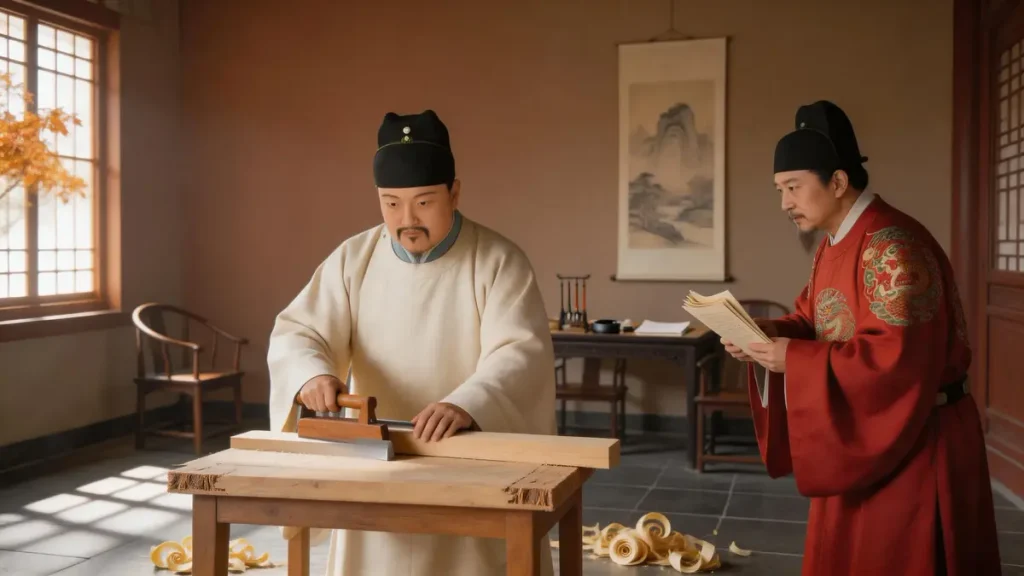
It also records a scene. The Tianqi emperor liked cabinetwork. He was quick with his hands and spent whole days at the saw and the plane, and while he was measuring and cutting, Wei Zhongxian would bring him papers. The emperor, annoyed, said he had seen enough and they should handle it themselves.
The officials had their own war. In 1604 Gu Xiancheng rebuilt the Donglin Academy in Wuxi, where scholars lectured and commented on policy, and their opponents named them the Donglin faction. The name began as an insult. For thirty years the bureaucracy split into camps that fought over the succession, over three disputed palace cases, and over the audits that decided who got promoted. By the Chongzhen reign the eunuch faction was gone and the fighting went on. In 1629 the new emperor published a list of eunuch-party crimes in six grades, and after that Wen Tiren and Zhou Yanyu went on fighting each other until Zhou was ordered to kill himself.
The cost of this was concrete. In 1638 the Minister of War, Yang Sichang, argued for settling the interior first and dealing with the Manchus afterwards. The Supreme Commander of Xuanfu and Datong, Lu Xiangsheng, argued for meeting the Qing raiders head on. The quarrel went to the throne. Lu Xiangsheng rode out with fewer than twenty thousand men, no pay and no reinforcements, and died in December at Haoshuiqiao in Julu.
Yuan Chonghuan and the price of suspicion
Chongzhen reigned for seventeen years and died on that hill. In that time he went through about fifty grand secretaries. The counts differ by one or two depending on who is included, and the order of magnitude is not in dispute. The verbs in his annals say more than the number does. The word for retirement on grounds of age appears twenty-nine times, the word for dismissal ten.
Yuan Chonghuan was the most expensive misjudgment of the seventeen years. In the summer of 1628 the emperor received him on the platform outside the palace and asked how long it would take to settle Liaodong. Five years, Yuan said. The emperor was delighted and gave him a sword of authority. In December of the following year, with Qing cavalry in the suburbs of Beijing, Yuan brought his troops in to relieve the city, was received on the platform a second time, and was taken straight to the Embroidered Uniform Guard’s prison. In the autumn of 1630 he was executed.
The verdict at the end of the annals is unusually specific. It says that in seventeen years the emperor never touched music or women, rose early, worried constantly, and exhausted himself on government. Two sentences later it says he trusted eunuchs, placed them in key posts, took the wrong measures, and arranged affairs badly. In the same passage the historians note that the court was split by faction and that the frontier generals were arrogant and their soldiers slack.
He was not lazy. He read memorials late into the night and wore patched clothes. He also replaced fifty grand secretaries, executed two ministers of war and one field commander, and used able men as consumables. In 1642 he had Chen Xinjia killed because Chen’s negotiations with the Qing had leaked out. In the last weeks of 1643 he ordered Zhou Yanyu to die for reporting a victory that never happened.
Li Zicheng to the south, the Eight Banners to the north
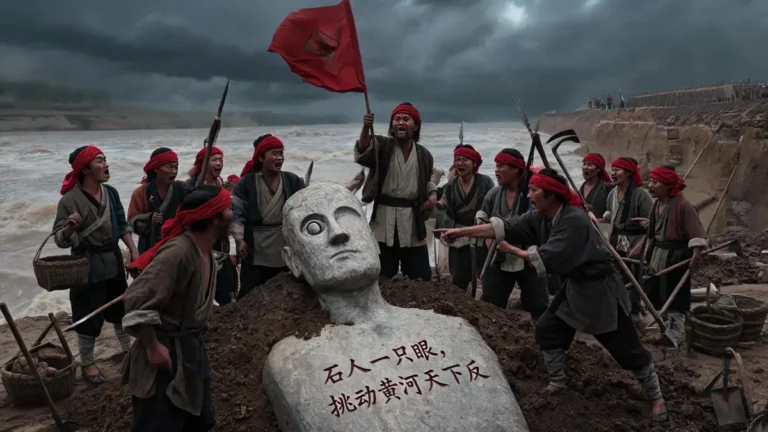
The southern war began at a post station. In 1629 the court took a subordinate official’s advice and cut the courier system to save money. A groom at a station in Mizhi, Shaanxi, named Li Zicheng lost his job and joined a rebel band the following year.
The bandit biography says Li’s following grew on a slogan. His men handed out what they had taken to the hungry, who did not always know who had fed them and called out for Master Li, who had kept them alive. Then a rhyme was written for children to sing: "Welcome the Dashing King, no grain tax."
The popularity of that rhyme is itself an argument. A state that assessed its taxes in silver and levied its surcharges on land, facing a north where seven harvests had failed, was taking every tael out of the hands of people who had nothing to eat. In 1641 Li took Luoyang and killed Zhu Changxun, Prince of Fu. In 1643 he took Tongguan and killed Sun Chuanting, and Shaanxi was lost. In the first month of 1644 he proclaimed himself king in Xi’an under the dynastic name Dashun, and in the third month his army reached Beijing.
The northern war began with Nurhaci. In 1583 he raised his standard with thirteen sets of armor. In 1615 he organized the Eight Banners. In 1616 he declared the Later Jin. In 1619, at Sarhu, four Ming columns of about a hundred thousand men advanced on separate roads and were destroyed one at a time by sixty thousand. After that the Ming went from attacking to defending, and the line settled at Ningyuan and Jinzhou. Hong Taiji, who succeeded him, did three things. He renamed the Jurchens Manchu, he renamed the state Qing, and he organized Mongol and Chinese banners alongside the Manchu ones. By 1642 Songshan and Jinzhou had fallen, Hong Chengchao had surrendered, and the only field army left outside the pass was at Ningyuan under Wu Sangui. That is what a two-front war means. Troops sent to hunt rebels left the frontier short. Troops kept on the frontier left the pass thin. In March 1644 the emperor made Wu Sangui Earl of Pingxi and ordered him to abandon Ningyuan and march to the capital. He was halfway there when Beijing fell.
The History of the Ming gives his reason for turning back in one sentence: at Luanzhou he heard that his concubine Chen Yuan had been carried off by Liu Zongmin, and in a fury he rode back to the pass and broke the rebel garrison. Chen Yuan is the woman later known as Chen Yuanyuan. Wu Weiye turned the episode into a long poem, the Song of Yuanyuan, and its line about a man’s fury over a beautiful face has been quoted for three hundred years. Gu Cheng, in his history of the Southern Ming, argued that Wu’s defection was forced by the military situation and that a woman explains nothing. The History of the Ming records the woman all the same.
On May 27 the two armies met. Li Zicheng had about two hundred thousand men drawn up inside the pass, from the northern hills down to the sea. The Qing cavalry waited outside it, and Wu Sangui’s men held the right end of the line. The History of the Ming records the weather: a great wind, sand and stones flying, hail striking the rebels. Around midday the Qing cavalry came out from behind Wu’s right and hit the center. Li’s army broke, and the pursuit ran forty li over ground the sources describe as covered with corpses and red with ditch water.
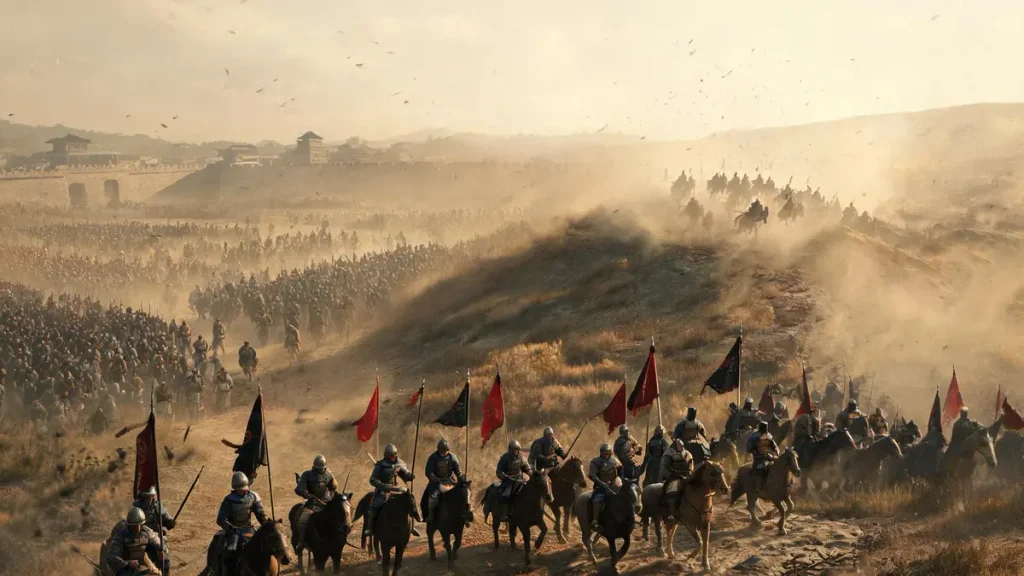
He fell back on Beijing, killed Wu Sangui’s father, had himself proclaimed emperor in Wuying Hall on June 3, and left the next day.
The Qing entered Beijing on June 6. The entry for that day contains three characters that give away who wrote it: our Great Qing. The men writing them were Qing subjects.
Both wars mattered. Neither one on its own explains the fall of the Ming dynasty.
Put the four threads side by side and the sequence in each is plain:
| Thread | Root cause | Immediate result |
|---|---|---|
| Climate | Global cooling, seven years of drought, locusts, then plague | Harvests failed, the roads filled with people leaving their land, and the capital had already buried its dead |
| Silver | Taxes commuted to silver while the American and Japanese routes closed | Silver grew dear, grain fetched less, the surcharges could not be collected |
| Politics | Memorials held back, eunuchs running the police organs, officials split into factions | The court lost the capacity to move money, troops or grain |
| War | A frontier war and an interior war at the same time | No reserve left to defend the capital, and the pass decided everything |
No single one of these would have brought the dynasty down. The cold years were not China’s alone, since Europe, Japan and Korea went hungry in the same decades. The Ming dynasty had been through silver shortages before. Faction fighting ran from Wanli’s reign into Chongzhen’s. The two-front problem was already there in the 1610s. What made it fatal was timing. All four reached their worst point in the same generation, and the court had nothing left in reserve.
I would not put the fall of the Ming dynasty down to one emperor or one battle. Chongzhen was not a foolish man, and he was not idle. He was also suspicious to the point of self-harm, and he treated the men who could still do the work as expendable. A system that depends on the stamina of one man in ordinary years has nothing else to fall back on in a bad one.
The last two characters of the Chongzhen annals read: the Ming perished. That was not the dynasty’s last day. In May a cousin of the dead emperor was installed as regent in Nanjing, and the following year took the reign title Hongguang. Longwu, Shaowu and Yongli followed, one after another. In the fourth month of 1662 the Yongli emperor was strangled in Kunming, and the order was given by the man who had opened Shanhai Pass eighteen years before.
Sources and further reading
Primary source
History of the Ming, juan 24, annals of the Chongzhen emperor: the breach of the walls on April 24 and 25, the note on the robe, the 1643 plague entry and the court’s response to it, the four characters on the collapse of the capital garrison, and the closing words of the annals.
History of the Ming, juan 23, annals of the Chongzhen emperor, first part: the Shaanxi famine and the first rebel bands in 1628, and Yuan Chonghuan’s arrest in December 1629 and execution in 1630.
History of the Ming, juan 78, treatise on finance: the text of the Single Whip reform, the sequence of surcharges from 1618 onward, and Hao Jin’s figures for the three levies.
History of the Ming, juan 305, biographies of eunuchs: Wei Zhongxian’s entry into the Directorate of Ceremonial through Madam Ke, the deaths of Yang Lian and his colleagues in custody, the carpentry scene, and the mood in the streets.
History of the Ming, juan 309, biographies of rebels: Li Zicheng’s rise, the rhyme about the grain tax, Wu Sangui’s turn at Luanzhou, the battle inside the pass on May 27, and the Qing entry into Beijing on June 6.
History of the Ming, juan 218, biography of Fang Congzhe: the emperor’s own explanation for leaving offices unfilled.
History of the Ming, juan 259, biography of Yuan Chonghuan: the audience on the platform and the five-year promise for Liaodong.
State papers of the Ming collected in the Jing Shi Wen Bian, including Lin Run’s memorial of 1562 on the stipends owed to the imperial clan, the four million shi of grain shipped to the capital, and the 8.53 million owed to the princes.
Official, archival and press accounts
Palace Museum, Beijing: the construction of the palace complex between 1406 and 1420, and the topography of Coal Hill immediately to its north.
UNESCO World Heritage List, Imperial Palaces of the Ming and Qing Dynasties: the extent of the palace complex on Beijing’s central axis.
Scholarly and contemporary works
Zhu Kezhen, "A Preliminary Study of Climatic Change in China over the Past 5,000 Years," Acta Archaeologica Sinica 1 (1972): the temperature curve for the last five millennia and the figure of about 210 millimeters of rainfall in north China between May and September 1640.
Gu Cheng, A History of the Southern Ming: the argument that Wu Sangui’s decision at Shanhai Pass is not explained by Chen Yuanyuan and should be read against the military position in 1644.