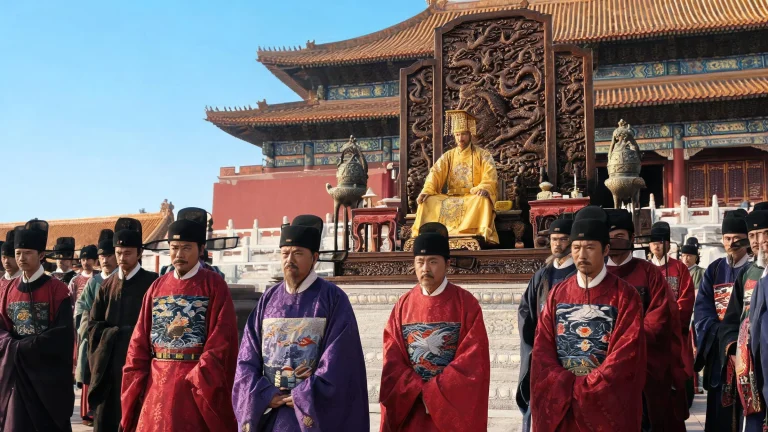
why are there 13 ming tombs but 16 emperors
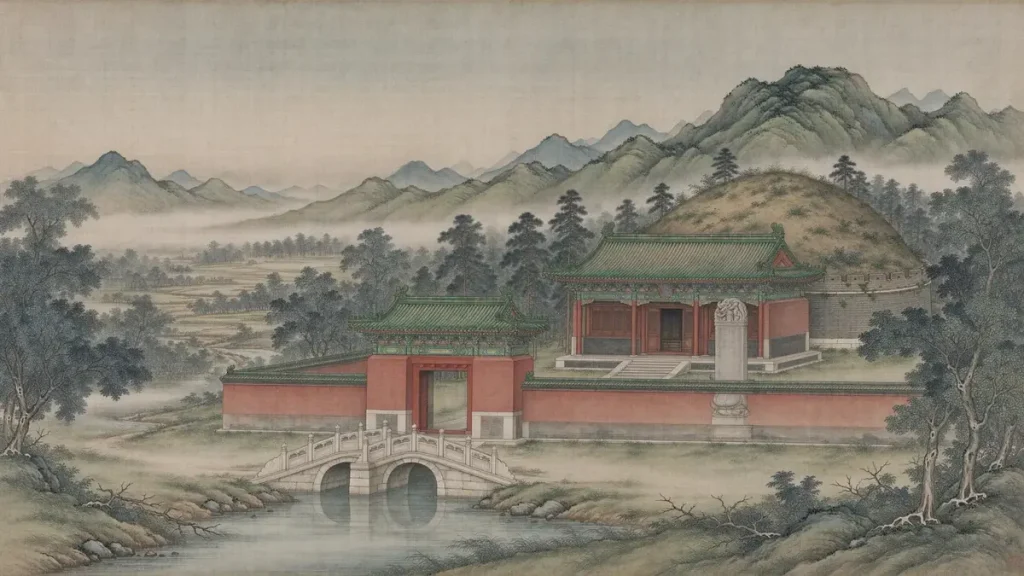
The site map at the foot of Tianshou Mountain in Changping shows thirteen circles. Changling, Xianling, Jingling, Yuling, Maoling, Tailing, Kangling, Yongling, Zhaoling, Dingling, Qingling, Deling, Siling. Thirteen names in a line along the slope, running from the Yongle emperor to the last of his line.
The dynasty had sixteen emperors.
Three of the sixteen are not there. Zhu Yuanzhang, who founded the dynasty, lies under the Purple Mountain in Nanjing, in a tomb called Xiaoling. The Jianwen emperor, Zhu Yunwen, went missing in a fire the year Nanjing fell, and there is no grave to visit. The Jingtai emperor, Zhu Qiyu, was thrown off the throne by his elder brother and buried at Jinshan, in the western hills of Beijing.
Each was kept out for a different reason. One had his capital in Nanjing. One had his reign struck from the record. One was demoted to prince by his own brother. Each case opens onto something bigger: a move of the capital, a war between uncle and nephew, a coup between brothers.
The four rows below sum it up. Three are the men who never got in. The fourth is the one who had no business being there and is.
| Emperor | Reign | Buried at | Why not at Tianshou Mountain |
|---|---|---|---|
| Hongwu, Zhu Yuanzhang | 1368-1398 | Xiaoling, Nanjing | The capital was still in Nanjing when he died |
| Jianwen, Zhu Yunwen | 1398-1402 | No grave can be identified | Vanished after the Jingnan campaign; his uncle erased the reign |
| Jingtai, Zhu Qiyu | 1449-1457 | Jingtai Tomb, western hills of Beijing | Deposed as prince of Cheng and buried with princely rites |
| Chongzhen, Zhu Youjian | 1627-1644 | Siling, inside the Ming tombs | Built no tomb of his own; buried in a concubine’s grave |
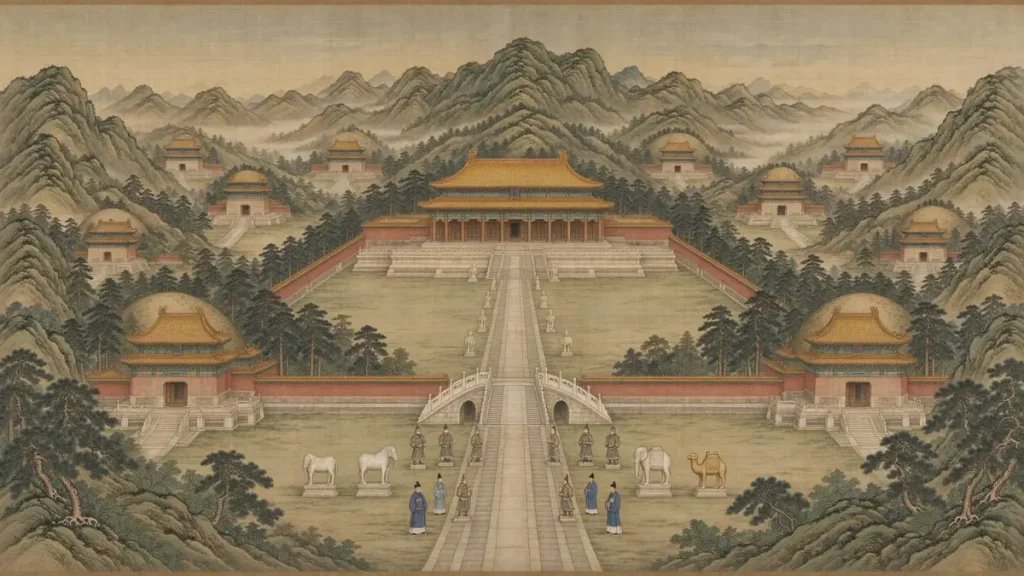
Thirteen of the sixteen lie in the Ming tombs at Tianshou Mountain. The last of the thirteen was built after the dynasty had already fallen.
The tomb Zhu Yuanzhang built for himself in Nanjing
Zhu Yuanzhang took the throne at Yingtian in the first month of 1368. That autumn his court settled the names of two capitals. Yingtian became Nanjing, and Kaifeng became Beijing. The name Beijing appears for the first time in a Ming edict that gives it to Kaifeng, not to the city that bears it now. Thirty-five years would pass before it was handed to Beiping.
The palace stood inside the walls of Nanjing. The tomb went east, to the south slope of the Purple Mountain. Work began in 1381. Empress Ma died in the eighth month of the following year and was buried that autumn with the tomb still unfinished. Her posthumous name was Xiaoci, and the place took its name from those two characters.
Xiaoling broke with the plan of earlier imperial graves. The mound was round rather than square. A walled court with a tower on top stood in front of it. The compound was laid out like a palace, hall first, burial mound behind. The twelve Ming tombs that followed copied the arrangement, and so did the Qing cemeteries east and west of Beijing. Building went on until 1413, when the stele pavilion was finished, more than thirty years in all. In 2003 Xiaoling joined the World Heritage list as an extension of the imperial tombs of the Ming and Qing.
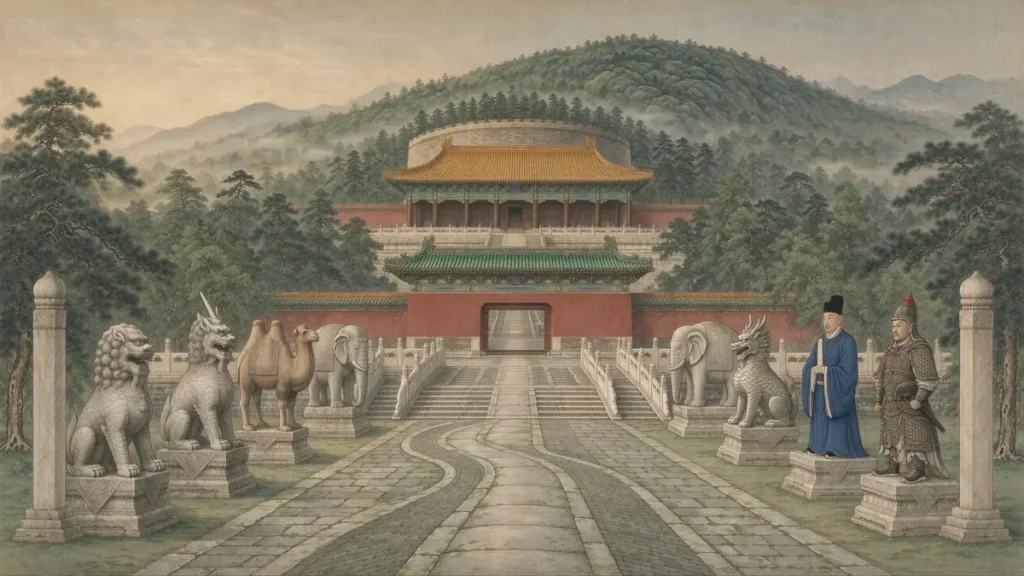
In the intercalary fifth month of 1398 Zhu Yuanzhang died in the western palace, seventy-one years old. Two lines of his will touch the tomb. The hills and streams of Xiaoling were to be left as they were, with no new earth turned. And the princes were to stay in their principalities rather than come to the capital for the funeral. Six days later he was buried there, sixteen years after his wife.
Zhu Di, prince of Yan, was in Beiping. He started south for the funeral and turned back when the order reached him.
It was this son, shut out of his father’s burial, who moved the capital. Zhu Di had been made prince of Yan in 1370 and had lived in Beiping since 1380, twenty years in the city, and the troops of the Jingnan campaign came out of it. In twenty-two years on the throne he led five campaigns against the Mongols, all of them to the north. In the first month of 1403 Beiping was renamed Beijing.
Empress Xu died in 1405. The next year Zhu Di sent the minister of Rites, Zhao Hong, and a geomancer from Jiangxi named Liao Junqing to find a site near Beijing. They were at it for more than a year before settling on a hill in Changping called Huangtu. In the fifth month of 1409 the court began the tomb and gave the mountain a new name, Tianshou. A tract of eighty li around it was closed off as tomb land.
The hill has a main peak at its back, ridges curling in from east and west, flat ground between them and open plain to the south. Changling, the first of the Ming tombs, went up under the peak. Empress Xu was laid there in the second month of 1413. Zhu Di died on campaign in 1424, at Yumuchuan on the way home, and was buried beside her. Changling is the largest of the Ming tombs, and the sixty columns of its main hall are still single trunks of nanmu.
In the eleventh month of 1420 an edict announced the move of the capital. In the first month of the next year Zhu Di held court in Beijing, and three months later fire took the three great halls. The new capital had barely opened for business. Nor did the title arrive with the court. In 1425 the Hongxi emperor ordered a return to Nanjing and had every office in Beijing styled a provisional branch. Only in the eleventh month of 1441 did the Zhengtong emperor make Beijing the capital in name as well. For twenty years the paperwork had called it a temporary seat.
The other twelve tombs stand to left and right of Changling. They are not arranged by the old rule of alternating generations. Distance from the main ridge decides.
In the summer of 1402, a gate opened from the inside
The heir apparent, Zhu Biao, died in the fourth month of 1392. That autumn Zhu Yuanzhang named Zhu Biao’s son Yunwen as his heir. Six years later the young man took the throne and called his reign Jianwen.
What he inherited was a set of uncles with armies. In the first months of the reign the prince of Zhou lost his fief. In the fourth month of the next year the prince of Xiang burned his palace and died in it, and the princes of Qi and Dai were reduced to commoners; by the sixth month the prince of Min had gone the same way. Zhu Di feigned illness in Beiping until the seventh month of 1399. He then killed the provincial administrator and the garrison commander sent to watch him, took the gates of the city and raised troops, calling the war Jingnan, the quelling of a crisis.
The fighting ran three years. The court had more men; Zhu Di had better ones. At Baigou River in the fourth month of 1400 his army broke, and he covered the retreat with three horsemen. He lost his way in the dark, dismounted, and put his face to the ground to read the run of the water before he could tell east from west. In the twelfth month, at Dongchang, Sheng Yong broke him with firearms and crossbows. Zhu Di cut his way out. His best general, Zhang Yu, did not. By the third year the rebels held three prefectures, Beiping, Baoding and Yongping, and every other town they took fell back to the court the moment they marched away.
That year Zhu Di said the war could not go on like this. One charge at the river, he said, and no looking back.
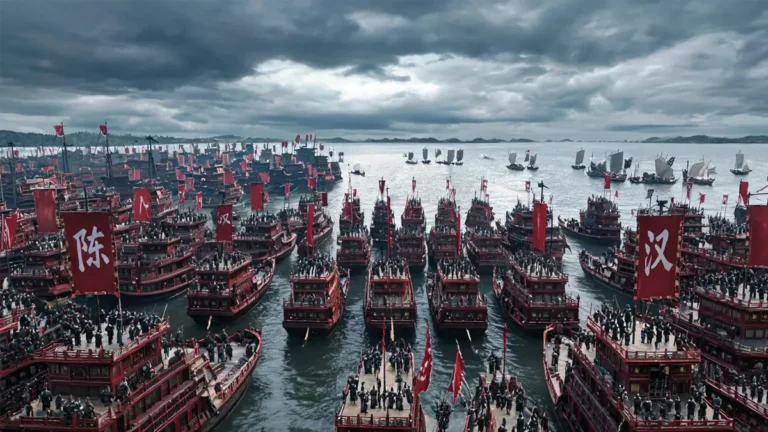
The opening came from inside Nanjing. Eunuchs dismissed from the palace fled north and told him the capital was empty. In the first month of 1402 he marched south and stopped bothering with towns. In the fourth month, at Lingbi, thirty-seven court commanders were taken, Ping An and Chen Hui among them. In the sixth month the river fleet came over, and his army crossed at Guazhou and came down through Zhenjiang to Longtan.
Then the gate called Jinchuan opened, from the inside. The prince of Gu opened it, and Li Jinglong with him. The capital fell, and the palace caught fire.
The History gives two accounts. By one, fire broke out in the palace and the emperor’s whereabouts were never known. By the other, the prince of Yan sent a eunuch to pull the bodies of the emperor and empress out of the fire, and they were buried eight days later. The annals of the Yongle reign put it in a single line: the Jianwen emperor was buried.
Whether he died has never been settled. The History itself adds that some said he got out through a tunnel. For two centuries afterwards, Yunnan, Guizhou and Sichuan kept a tradition of a monk who had once been emperor passing through. In 1440 a monk of over ninety came from Yunnan to Guangxi claiming the throne. The prefect looked into him and found a man from Junzhou named Yang Xingxiang. He died in prison four months later, and the twelve monks behind him were sent to the frontier.
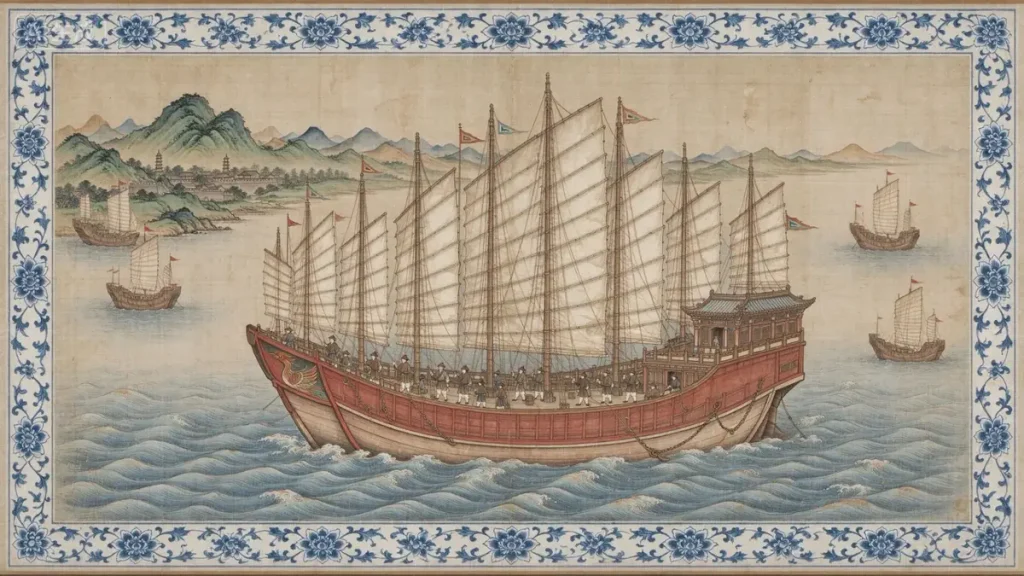
Then there is Zheng He. The seven voyages that began in 1405 hang on this in the eunuch chapter of the History. The Yongle emperor suspected the Jianwen emperor had fled overseas and wanted to trace him, it says, and he wanted to show his armies abroad as well. Hunting one man and displaying force sit in the same sentence with nothing to rank them. The fleets that sailed seven times carried more than twenty thousand men and dozens of great ships, and wherever they went they issued seals, raised stones and fought. That is a great deal more than it takes to find one man.
What came after the disappearance was erasure. Nine days into the reign Zhu Di had Zhu Biao’s tablet moved out of the ancestral temple and demoted him to heir apparent again, taking an imperial title off a dead man. In the seventh month he decreed that the year would be counted as the thirty-fifth of Hongwu and the next as the first of Yongle. Four years of Jianwen ceased to exist in official time. Fang Xiaoru, Qi Tai and Huang Zicheng were killed. Fifty more were posted as traitors, and the purge spread.
The History records a burial. It gives no tomb name and no place. Nanjing has no tomb for him, and neither do the Ming tombs.
In the tenth month of 1457 the restored Zhengtong emperor released Zhu Wengui, the Jianwen emperor’s young son, with his household, and settled them at Fengyang. Fifty-five years had passed since the fall of Nanjing. The History records the order and nothing about the man’s age when it came.
The imperial title itself was restored only in 1736, by the Qing. It is the reason the History has a chapter for him at all.
A brother written down as a prince
In the seventh month of 1449 Esen, taishi of the Oirat, attacked Datong. Wang Zhen, who ran the Directorate of Ceremonial, urged the emperor to go out and meet him. Wang Zhi, minister of Personnel, led the officials in protest and was ignored. In the eighth month the army was surrounded at Tumu and came apart in a day. Tens of thousands died, the History says. Zhang Fu, duke of Ying, Kuang Ye the minister of War, Wang Zuo the minister of Revenue and the grand secretary Cao Nai were among them. The emperor was carried off by the Oirat.
Word reached Beijing two days later. The officials wept in the hall. Xu Cheng, an expositor, said the stars had shifted and the capital should move south. Yu Qian, vice minister of War, cut him off. Anyone who spoke of moving south, he said, should be executed.
In the ninth month the prince of Cheng, Zhu Qiyu, took the throne and named his brother retired emperor. In the tenth month Esen came through the Zijing pass with his hostage and reached the walls of Beijing. Yu Qian put 220,000 men outside the nine gates and held for five days. Esen withdrew.
The next year the retired emperor was sent home. The Jingtai emperor put him in the Southern Palace, where he stayed six and a half years.
In the fifth month of 1452 the Jingtai emperor set aside his brother’s son, Zhu Jianshen, and made his own son heir. The boy died in the eleventh month of the next year. The succession stayed empty until 1457.
Objection never stopped. In the fifth month of 1454 Zhang Lun, a director in the Ministry of Rites, and the censor Zhong Tong sent up a memorial asking for the old heir to be restored, and both went to the Embroidered Uniform Guard prison. In the eighth month of the next year Liao Zhuang, a judicial official in Nanjing, raised it again. He was beaten at the palace gate, and Zhang Lun and Zhong Tong were beaten in their cells. Zhong Tong died there.
In the second month of 1456 Empress Hang died. The emperor ordered a tomb built for himself in the Ming tombs at Changping and buried her in it that summer.
In the first month of 1457 the Jingtai emperor was ill and staying at the suburban fasting palace. One morning that month Shi Heng, Xu Youzhen, Cao Jiqing, Zhang Yue, Zhang Ni and Yang Shan brought troops to the Southern Palace. They took the retired emperor into the palace and had him on the throne by daybreak, with the officials in attendance. The coup has a name: seizing the gate.
That month Yu Qian and Wang Wen were executed and their property confiscated.
In the second month the restored emperor reduced his brother to prince of Cheng and moved him to the western palace. He died there two weeks later, thirty years old. The two sets of annals disagree by five days about when.
His posthumous name was a single word, Li, harsh. The tomb he had built for himself was pulled down, and he was buried in the western hills with the rites of a prince.
In the twelfth month of 1475 the Chenghua emperor restored his uncle’s title. The edict said that the prince of Cheng had taken the throne in a crisis, put down a revolt and kept the altars of the state whole for nearly eight years. Treacherous officials greedy for credit, it went on, had asked for the title to be cut. It added that the throne had later seen the injustice and died before correcting it. The order that followed told the authorities to repair the tomb and to sacrifice there as at the other imperial tombs.
The tomb did not move. It stands at Jinshankou, on the north slope of the Jade Spring Hill, its scale somewhere between an emperor’s and a prince’s. The repairs of 1475 added a hall and service buildings; the tiles stayed green. Not until 1536, when the Jiajing emperor visited the tombs at Tianshou Mountain and stopped at this one on the way back, were they changed to imperial yellow and a stele pavilion built inside the gate. Through the whole dynasty the tomb had no name of its own. Jingtai Tomb is what later generations call it.